
Maurizio Vretenar for the NIMMSSEEIIST Collaboration Thessaloniki video
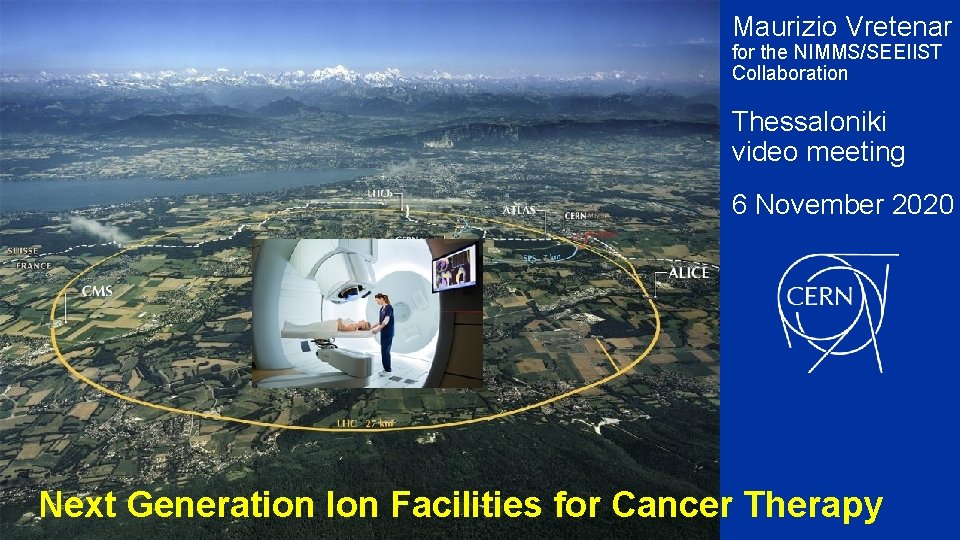
Maurizio Vretenar for the NIMMS/SEEIIST Collaboration Thessaloniki video meeting 6 November 2020 Next Generation Ion Facilities for Cancer Therapy
CERN: International Organisation founded in 1954: 12 European States “Science for Peace” Today: 23 Member States Employees: ~2 700 staff, 800 fellows Associates: ~12 400 users, 1 300 others Budget (2019) ~ 1 200 MCHF Greece was one of the 12 founding Member States: Austria, Belgium, Bulgaria, Czech Republic, Denmark, Finland, France, Germany, Greece, Hungary, Israel, Italy, Netherlands, Norway, Poland, Portugal, Romania, Serbia, Slovak Republic, Spain, Sweden, Switzerland United Kingdom Associate Members: Cyprus, Slovenia, Croatia, India, Lithuania, Pakistan, Turkey, Ukraine Applications for Associate Membership: Brazil, Estonia Observers to Council: Japan, Russia, USA, EU, UNESCO 2
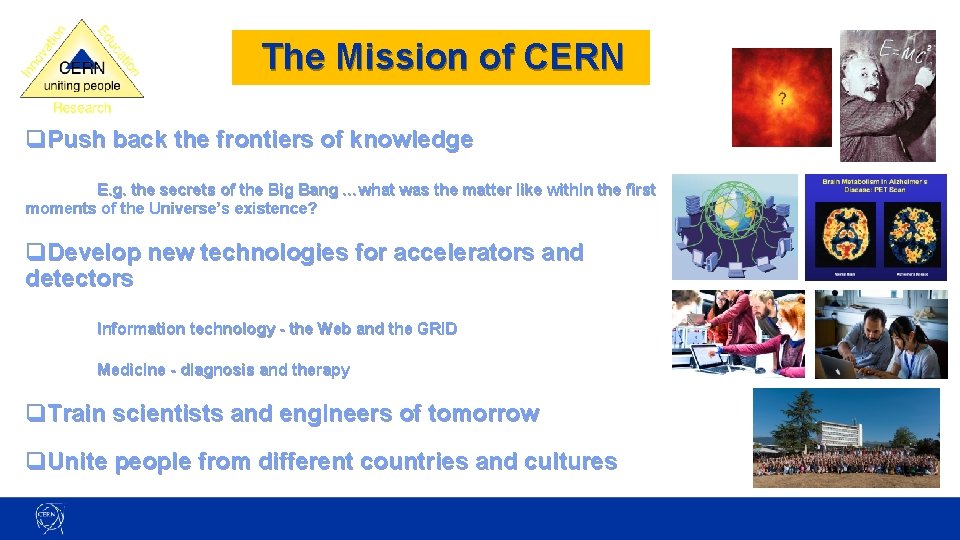
The Mission of CERN q. Push back the frontiers of knowledge E. g. the secrets of the Big Bang …what was the matter like within the first moments of the Universe’s existence? q. Develop new technologies for accelerators and detectors Information technology - the Web and the GRID Medicine - diagnosis and therapy q. Train scientists and engineers of tomorrow q. Unite people from different countries and cultures
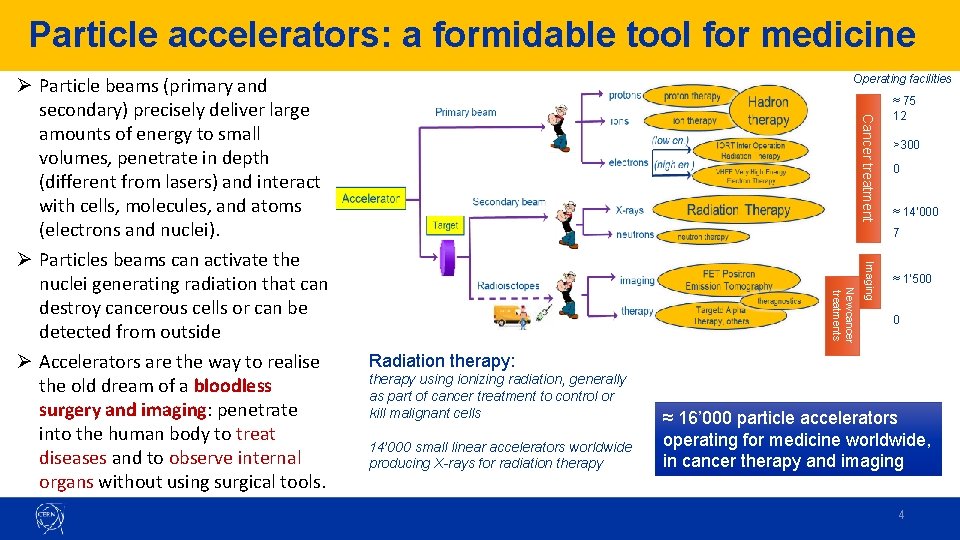
Particle accelerators: a formidable tool for medicine Operating facilities Cancer treatment ≈ 75 12 >300 0 ≈ 14’ 000 7 Imaging New cancer treatments Ø Particle beams (primary and secondary) precisely deliver large amounts of energy to small volumes, penetrate in depth (different from lasers) and interact with cells, molecules, and atoms (electrons and nuclei). Ø Particles beams can activate the nuclei generating radiation that can destroy cancerous cells or can be detected from outside Ø Accelerators are the way to realise the old dream of a bloodless surgery and imaging: penetrate into the human body to treat diseases and to observe internal organs without using surgical tools. ≈ 1’ 500 0 Radiation therapy: therapy using ionizing radiation, generally as part of cancer treatment to control or kill malignant cells 14’ 000 small linear accelerators worldwide producing X-rays for radiation therapy M. Vretenar | NIMMS ≈ 16’ 000 particle accelerators operating for medicine worldwide, in cancer therapy and imaging 4
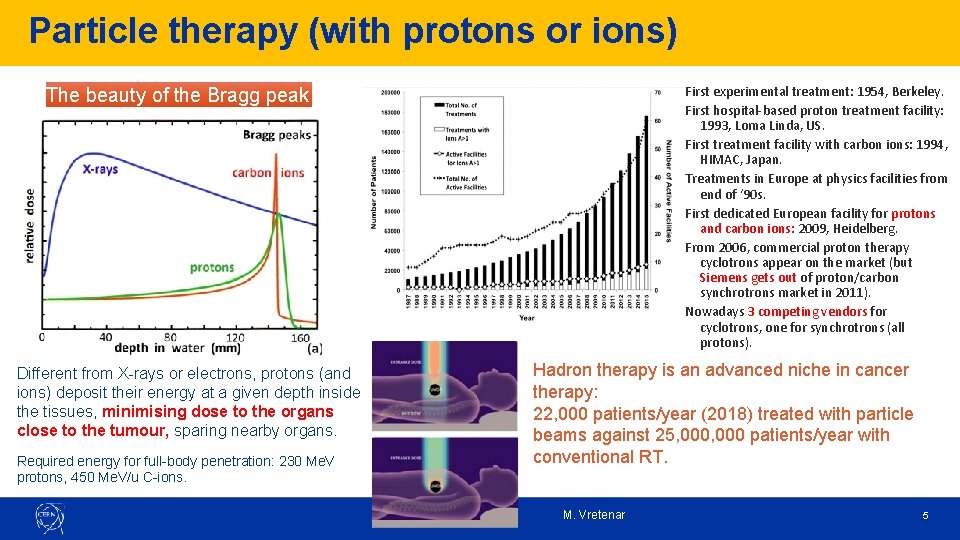
Particle therapy (with protons or ions) First experimental treatment: 1954, Berkeley. First hospital-based proton treatment facility: 1993, Loma Linda, US. First treatment facility with carbon ions: 1994, HIMAC, Japan. Treatments in Europe at physics facilities from end of ‘ 90 s. First dedicated European facility for protons and carbon ions: 2009, Heidelberg. From 2006, commercial proton therapy cyclotrons appear on the market (but Siemens gets out of proton/carbon synchrotrons market in 2011). Nowadays 3 competing vendors for cyclotrons, one for synchrotrons (all protons). The beauty of the Bragg peak Different from X-rays or electrons, protons (and ions) deposit their energy at a given depth inside the tissues, minimising dose to the organs close to the tumour, sparing nearby organs. Required energy for full-body penetration: 230 Me. V protons, 450 Me. V/u C-ions. Hadron therapy is an advanced niche in cancer therapy: 22, 000 patients/year (2018) treated with particle beams against 25, 000 patients/year with conventional RT. M. Vretenar 5
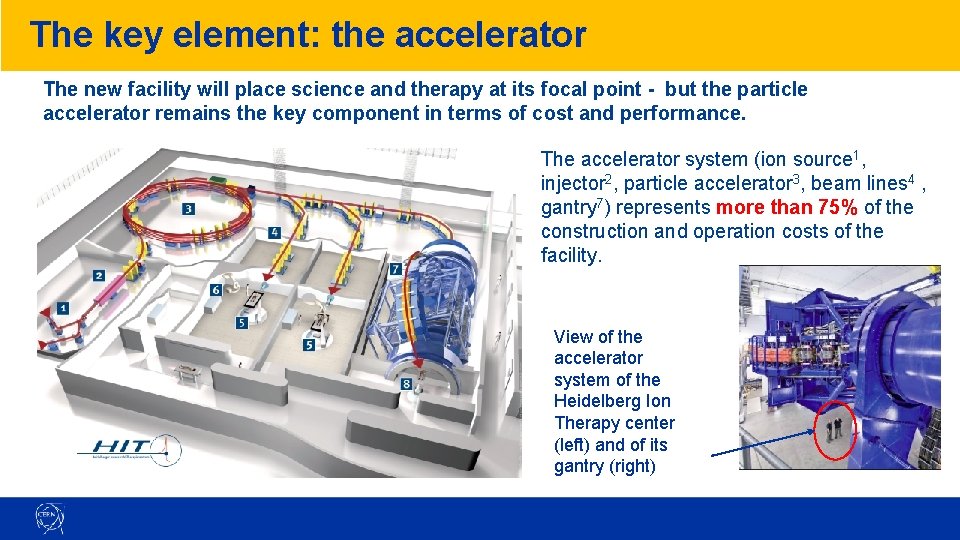
The key element: the accelerator The new facility will place science and therapy at its focal point - but the particle accelerator remains the key component in terms of cost and performance. The accelerator system (ion source 1, injector 2, particle accelerator 3, beam lines 4 , gantry 7) represents more than 75% of the construction and operation costs of the facility. View of the accelerator system of the Heidelberg Ion Therapy center (left) and of its gantry (right)
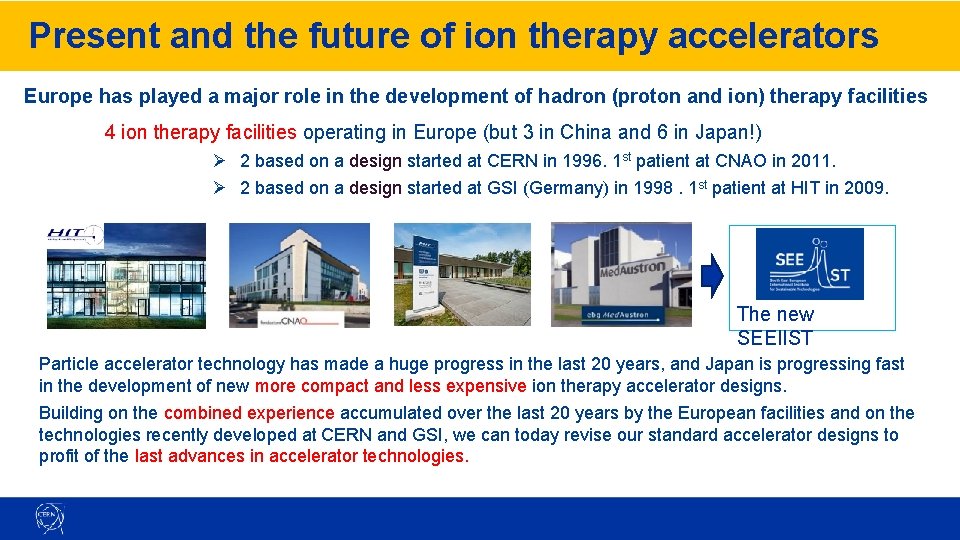
Present and the future of ion therapy accelerators Europe has played a major role in the development of hadron (proton and ion) therapy facilities 4 ion therapy facilities operating in Europe (but 3 in China and 6 in Japan!) Ø 2 based on a design started at CERN in 1996. 1 st patient at CNAO in 2011. Ø 2 based on a design started at GSI (Germany) in 1998. 1 st patient at HIT in 2009. The new SEEIIST Particle accelerator technology has made a huge progress in the last 20 years, and Japan is progressing fast in the development of new more compact and less expensive ion therapy accelerator designs. Building on the combined experience accumulated over the last 20 years by the European facilities and on the technologies recently developed at CERN and GSI, we can today revise our standard accelerator designs to profit of the last advances in accelerator technologies.
Requirements for a new accelerator design Requirement s of the ion therapy community, expressed at the Archamps Workshop, June 2018 1. Concentrate on heavy ions (Carbon but also Helium, Oxygen, etc. ) because proton therapy is now commercial (4 companies offer turn-key facilities) while ions have higher potential for treatment but lower diffusion. 2. A next generation research and therapy accelerator must have: q Lower cost, compared to present; q Reduced footprint; q Lower running costs; q Faster dose delivery with higher beam intensity or pulse rate; q A rotating ion gantry; q Operation with multiple ions (for therapy and research). A new innovative design: - Can attract a wide support from the scientific community; - Can increase the exchange SEE-WE and inside SEE thanks to stronger collaboration on scientific and technical issues; - Can bring modern high technology to the region, with new opportunities for local industry and scientific institutions. + Specific requirements for SEEIIST: q q q Easy Industrialization Reliability Simple operation Reduced risk Acceptable time to development
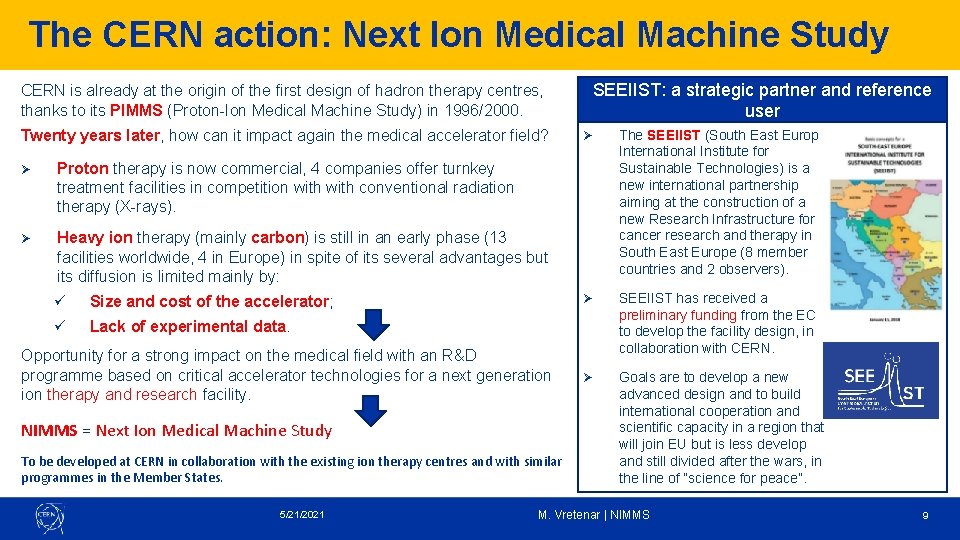
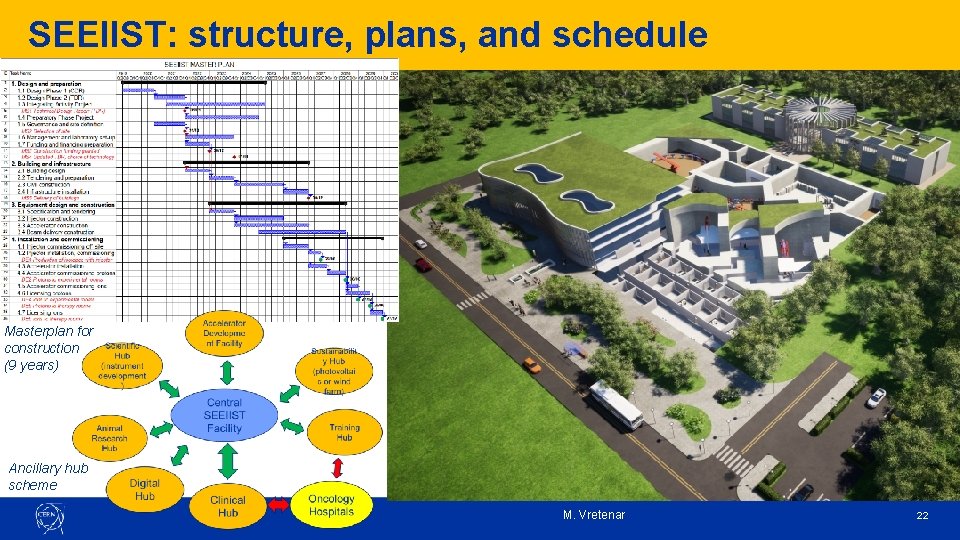
The CERN action: Next Ion Medical Machine Study SEEIIST: a strategic partner and reference user CERN is already at the origin of the first design of hadron therapy centres, thanks to its PIMMS (Proton-Ion Medical Machine Study) in 1996/2000. Twenty years later, how can it impact again the medical accelerator field? Ø Proton therapy is now commercial, 4 companies offer turnkey treatment facilities in competition with conventional radiation therapy (X-rays). Ø Heavy ion therapy (mainly carbon) is still in an early phase (13 facilities worldwide, 4 in Europe) in spite of its several advantages but its diffusion is limited mainly by: ü Size and cost of the accelerator; ü Lack of experimental data. Opportunity for a strong impact on the medical field with an R&D programme based on critical accelerator technologies for a next generation therapy and research facility. NIMMS = Next Ion Medical Machine Study To be developed at CERN in collaboration with the existing ion therapy centres and with similar programmes in the Member States. 5/21/2021 Ø The SEEIIST (South East Europe International Institute for Sustainable Technologies) is a new international partnership aiming at the construction of a new Research Infrastructure for cancer research and therapy in South East Europe (8 member countries and 2 observers). Ø SEEIIST has received a preliminary funding from the EC to develop the facility design, in collaboration with CERN. Ø Goals are to develop a new advanced design and to build international cooperation and scientific capacity in a region that will join EU but is less develop and still divided after the wars, in the line of “science for peace”. M. Vretenar | NIMMS 9
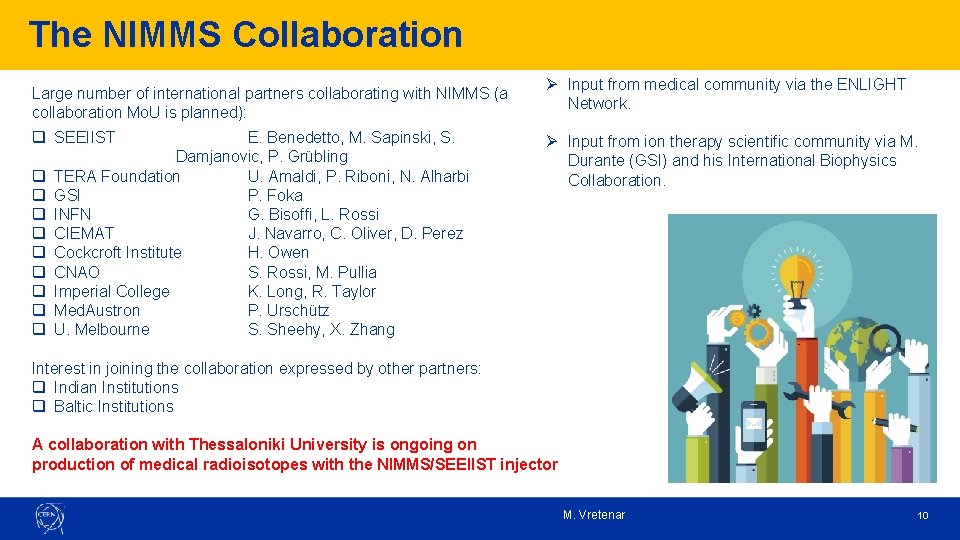
The NIMMS Collaboration Large number of international partners collaborating with NIMMS (a collaboration Mo. U is planned): q SEEIIST q q q q q E. Benedetto, M. Sapinski, S. Damjanovic, P. Grübling TERA Foundation U. Amaldi, P. Riboni, N. Alharbi GSI P. Foka INFN G. Bisoffi, L. Rossi CIEMAT J. Navarro, C. Oliver, D. Perez Cockcroft Institute H. Owen CNAO S. Rossi, M. Pullia Imperial College K. Long, R. Taylor Med. Austron P. Urschütz U. Melbourne S. Sheehy, X. Zhang Ø Input from medical community via the ENLIGHT Network. Ø Input from ion therapy scientific community via M. Durante (GSI) and his International Biophysics Collaboration. Interest in joining the collaboration expressed by other partners: q Indian Institutions q Baltic Institutions A collaboration with Thessaloniki University is ongoing on production of medical radioisotopes with the NIMMS/SEEIIST injector M. Vretenar 10
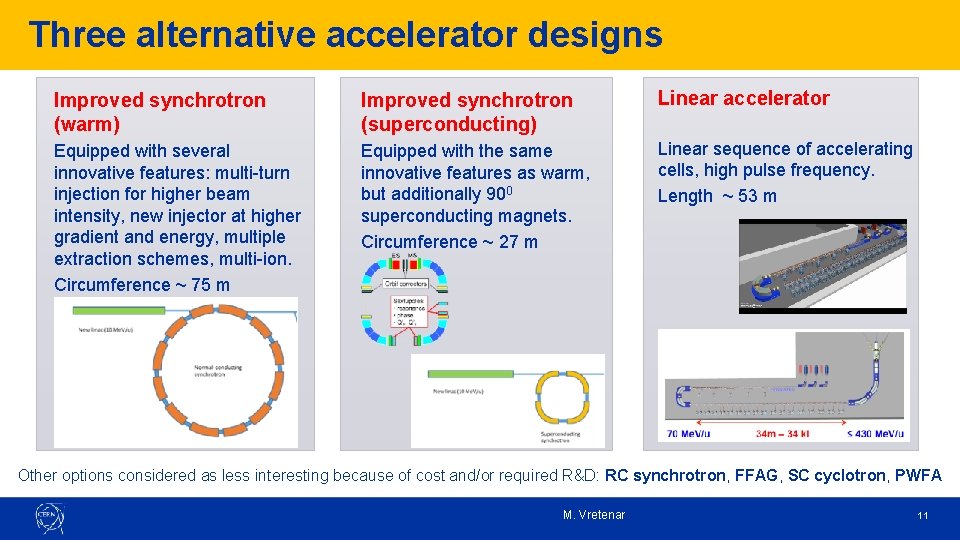
Three alternative accelerator designs Improved synchrotron (warm) Improved synchrotron (superconducting) Linear accelerator Equipped with several innovative features: multi-turn injection for higher beam intensity, new injector at higher gradient and energy, multiple extraction schemes, multi-ion. Circumference ~ 75 m Equipped with the same innovative features as warm, but additionally 900 superconducting magnets. Circumference ~ 27 m Linear sequence of accelerating cells, high pulse frequency. Length ~ 53 m Other options considered as less interesting because of cost and/or required R&D: RC synchrotron, FFAG, SC cyclotron, PWFA M. Vretenar 11
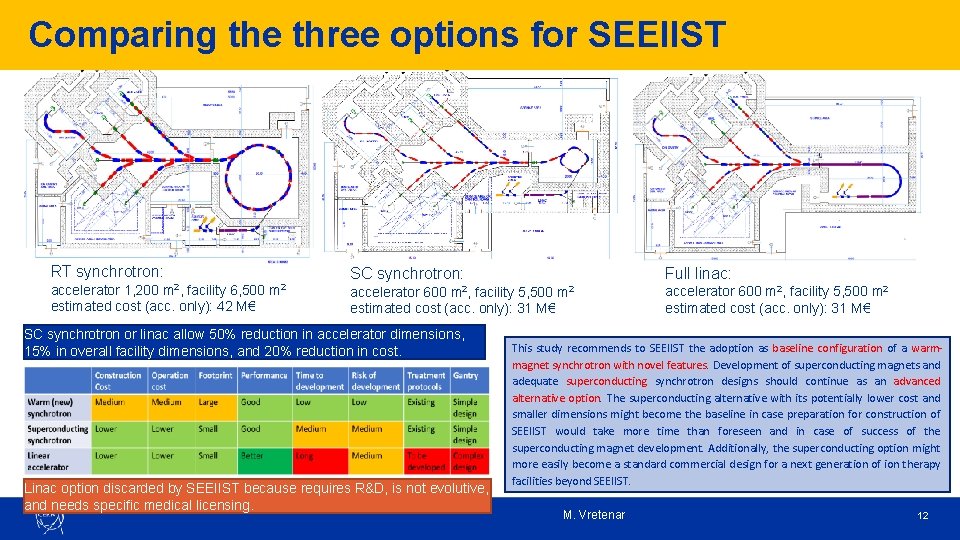
Comparing the three options for SEEIIST RT synchrotron: m 2, accelerator 1, 200 facility 6, 500 estimated cost (acc. only): 42 M€ m 2 SC synchrotron: Full linac: accelerator 600 m 2, facility 5, 500 m 2 estimated cost (acc. only): 31 M€ SC synchrotron or linac allow 50% reduction in accelerator dimensions, 15% in overall facility dimensions, and 20% reduction in cost. Linac option discarded by SEEIIST because requires R&D, is not evolutive, and needs specific medical licensing. This study recommends to SEEIIST the adoption as baseline configuration of a warmmagnet synchrotron with novel features. Development of superconducting magnets and adequate superconducting synchrotron designs should continue as an advanced alternative option. The superconducting alternative with its potentially lower cost and smaller dimensions might become the baseline in case preparation for construction of SEEIIST would take more time than foreseen and in case of success of the superconducting magnet development. Additionally, the superconducting option might more easily become a standard commercial design for a next generation of ion therapy facilities beyond SEEIIST. M. Vretenar 12
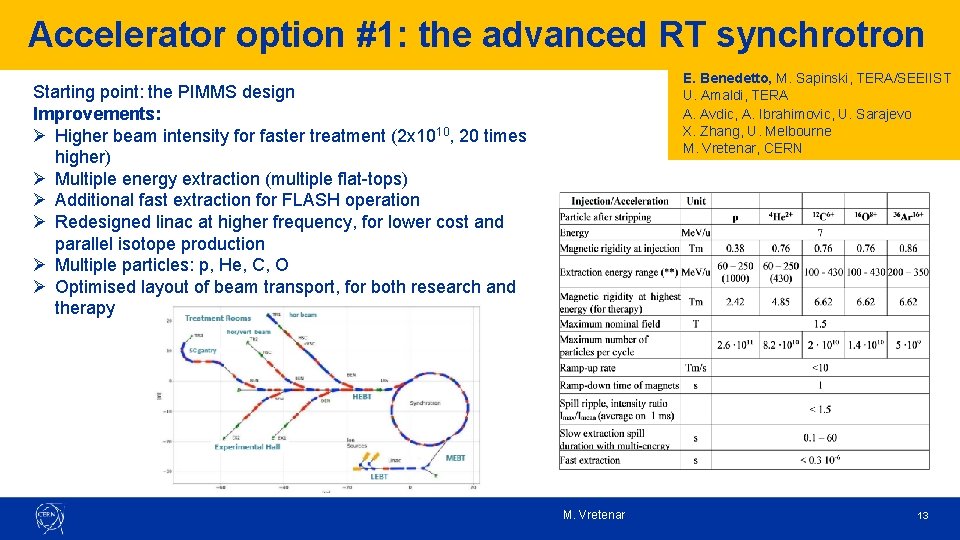
Accelerator option #1: the advanced RT synchrotron E. Benedetto, M. Sapinski, TERA/SEEIIST U. Amaldi, TERA A. Avdic, A. Ibrahimovic, U. Sarajevo X. Zhang, U. Melbourne M. Vretenar, CERN Starting point: the PIMMS design Improvements: Ø Higher beam intensity for faster treatment (2 x 10¹⁰, 20 times higher) Ø Multiple energy extraction (multiple flat-tops) Ø Additional fast extraction for FLASH operation Ø Redesigned linac at higher frequency, for lower cost and parallel isotope production Ø Multiple particles: p, He, C, O Ø Optimised layout of beam transport, for both research and therapy M. Vretenar 13
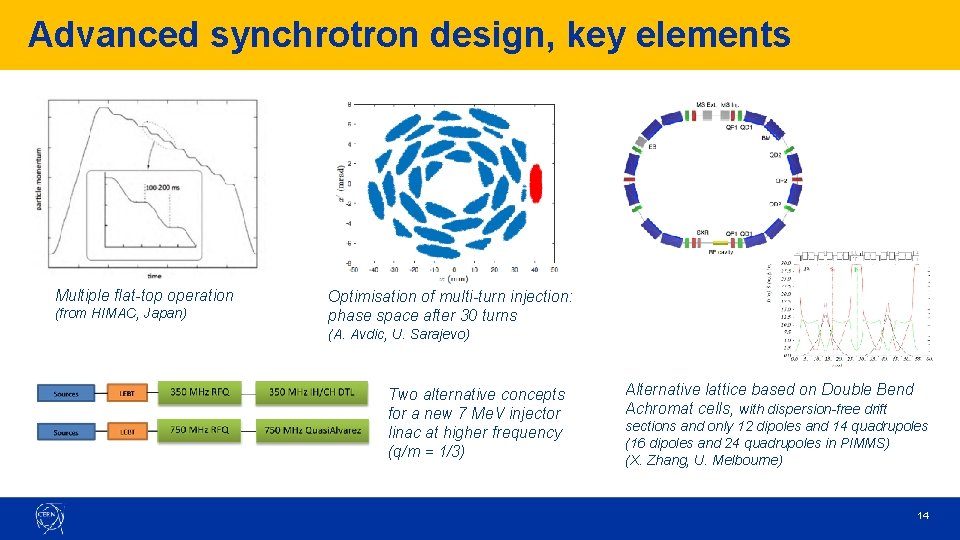
Advanced synchrotron design, key elements Multiple flat-top operation (from HIMAC, Japan) Optimisation of multi-turn injection: phase space after 30 turns (A. Avdic, U. Sarajevo) Two alternative concepts for a new 7 Me. V injector linac at higher frequency (q/m = 1/3) Alternative lattice based on Double Bend Achromat cells, with dispersion-free drift sections and only 12 dipoles and 14 quadrupoles (16 dipoles and 24 quadrupoles in PIMMS) (X. Zhang, U. Melbourne) 14
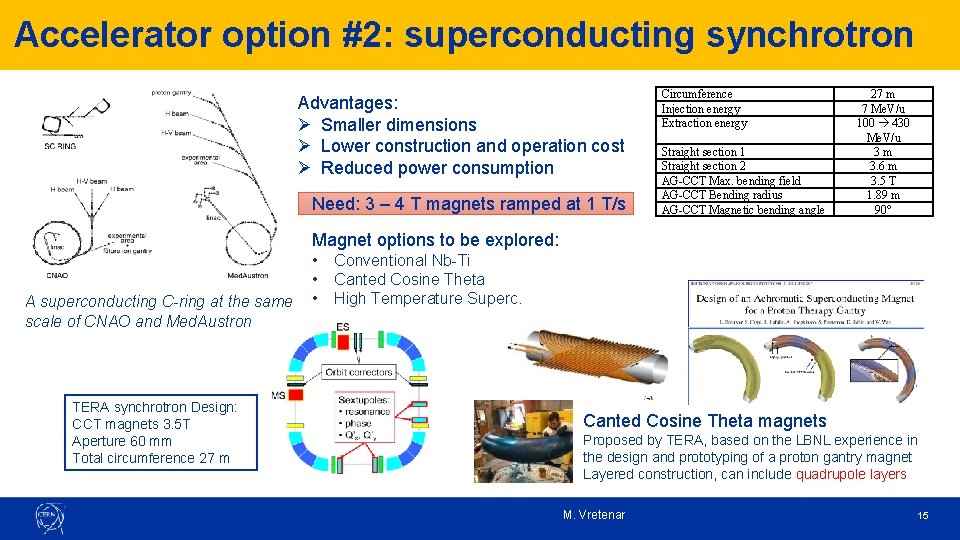
Accelerator option #2: superconducting synchrotron Advantages: Ø Smaller dimensions Ø Lower construction and operation cost Ø Reduced power consumption Need: 3 – 4 T magnets ramped at 1 T/s Circumference Injection energy Extraction energy Straight section 1 Straight section 2 AG-CCT Max. bending field AG-CCT Bending radius AG-CCT Magnetic bending angle 27 m 7 Me. V/u 100 430 Me. V/u 3 m 3. 6 m 3. 5 T 1. 89 m 90° Magnet options to be explored: A superconducting C-ring at the same scale of CNAO and Med. Austron TERA synchrotron Design: CCT magnets 3. 5 T Aperture 60 mm Total circumference 27 m • • • Conventional Nb-Ti Canted Cosine Theta High Temperature Superc. Canted Cosine Theta magnets Proposed by TERA, based on the LBNL experience in the design and prototyping of a proton gantry magnet Layered construction, can include quadrupole layers M. Vretenar 15
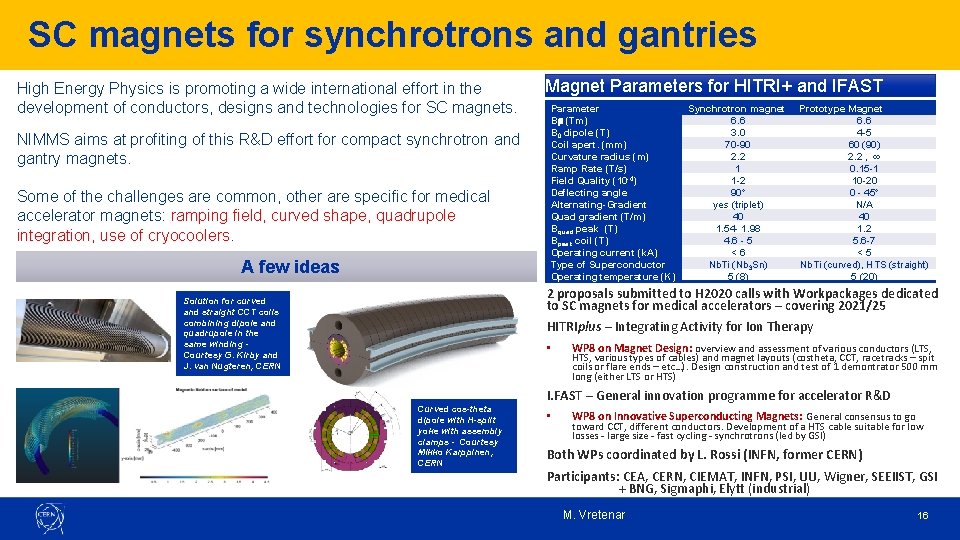
SC magnets for synchrotrons and gantries High Energy Physics is promoting a wide international effort in the development of conductors, designs and technologies for SC magnets. NIMMS aims at profiting of this R&D effort for compact synchrotron and gantry magnets. Some of the challenges are common, other are specific for medical accelerator magnets: ramping field, curved shape, quadrupole integration, use of cryocoolers. A few ideas Magnet Parameters for HITRI+ and IFAST Parameter B (Tm) B 0 dipole (T) Coil apert. (mm) Curvature radius (m) Ramp Rate (T/s) Field Quality (10 -4) Deflecting angle Alternating-Gradient Quad gradient (T/m) Bquad peak (T) Bpeak coil (T) Operating current (k. A) Type of Superconductor Operating temperature (K) Synchrotron magnet 6. 6 3. 0 70 -90 2. 2 1 1 -2 90 yes (triplet) 40 1. 54 - 1. 98 4. 6 - 5 <6 Nb. Ti (Nb 3 Sn) 5 (8) Prototype Magnet 6. 6 4 -5 60 (90) 2. 2 , 0. 15 -1 10 -20 0 - 45 N/A 40 1. 2 5. 6 -7 <5 Nb. Ti (curved), HTS (straight) 5 (20) 2 proposals submitted to H 2020 calls with Workpackages dedicated to SC magnets for medical accelerators – covering 2021/25 Solution for curved and straight CCT coils combining dipole and quadrupole in the same winding Courtesy G. Kirby and J. van Nugteren, CERN HITRIplus – Integrating Activity for Ion Therapy • WP 8 on Magnet Design: overview and assessment of various conductors (LTS, HTS, various types of cables) and magnet layouts (costheta, CCT, racetracks – spit coils or flare ends – etc…). Design construction and test of 1 demontrator 500 mm long (either LTS or HTS) I. FAST – General innovation programme for accelerator R&D Curved cos-theta dipole with H-split yoke with assembly clamps - Courtesy Mikko Karppinen, CERN • WP 8 on Innovative Superconducting Magnets: General consensus to go toward CCT, different conductors. Development of a HTS cable suitable for low losses - large size - fast cycling - synchrotrons (led by GSI) Both WPs coordinated by L. Rossi (INFN, former CERN) Participants: CEA, CERN, CIEMAT, INFN, PSI, UU, Wigner, SEEIIST, GSI + BNG, Sigmaphi, Elytt (industrial) M. Vretenar 16
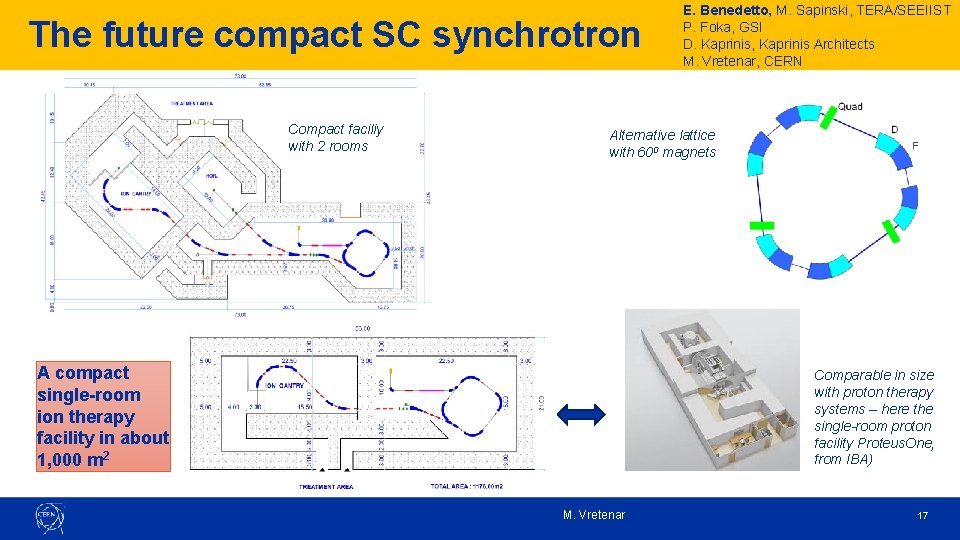
The future compact SC synchrotron Compact faciliy with 2 rooms E. Benedetto, M. Sapinski, TERA/SEEIIST P. Foka, GSI D. Kaprinis, Kaprinis Architects M. Vretenar, CERN Alternative lattice with 600 magnets A compact single-room ion therapy facility in about 1, 000 m 2 Comparable in size with proton therapy systems – here the single-room proton facility Proteus. One, from IBA) M. Vretenar 17
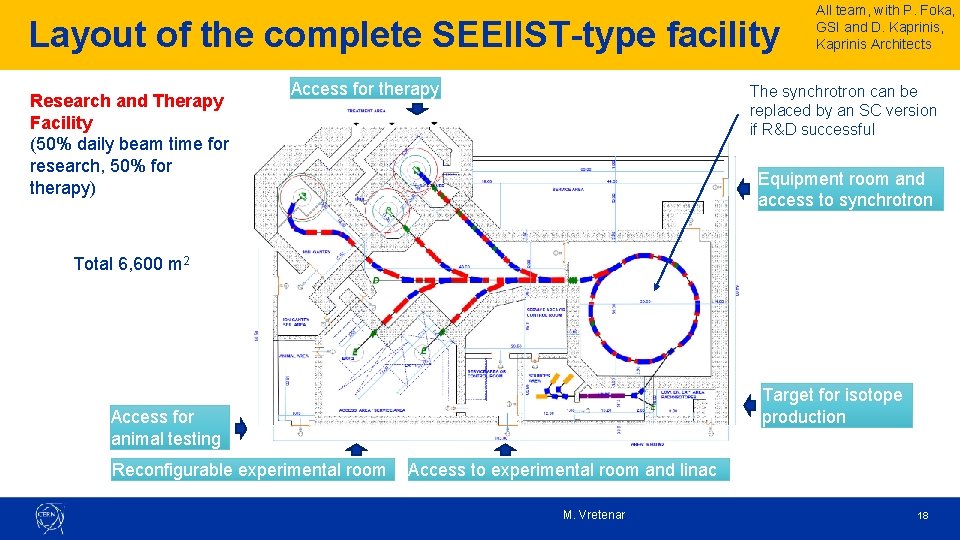
Layout of the complete SEEIIST-type facility Research and Therapy Facility (50% daily beam time for research, 50% for therapy) Access for therapy All team, with P. Foka, GSI and D. Kaprinis, Kaprinis Architects The synchrotron can be replaced by an SC version if R&D successful Equipment room and access to synchrotron Total 6, 600 m 2 Target for isotope production Access for animal testing Reconfigurable experimental room Access to experimental room and linac M. Vretenar 18
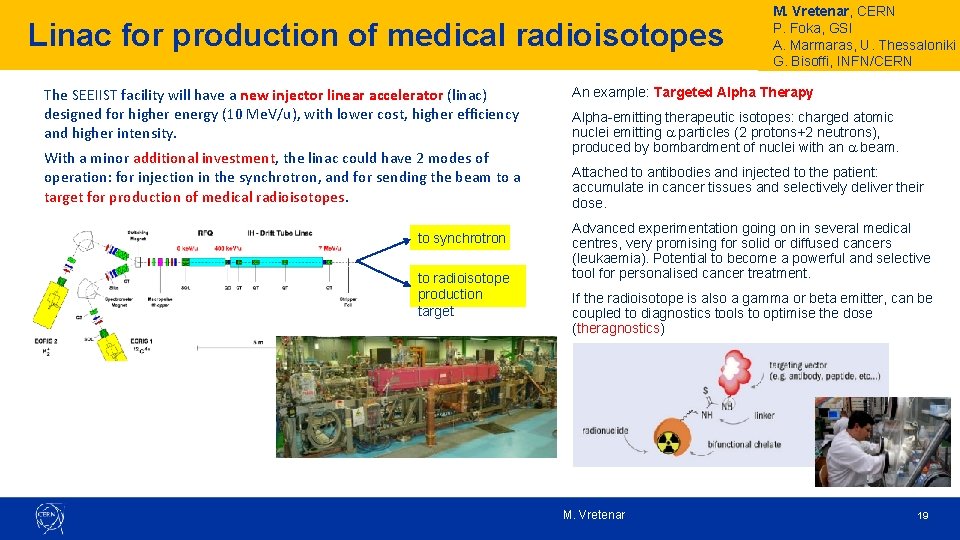
Linac for production of medical radioisotopes The SEEIIST facility will have a new injector linear accelerator (linac) designed for higher energy (10 Me. V/u), with lower cost, higher efficiency and higher intensity. With a minor additional investment, the linac could have 2 modes of operation: for injection in the synchrotron, and for sending the beam to a target for production of medical radioisotopes. to synchrotron to radioisotope production target M. Vretenar, CERN P. Foka, GSI A. Marmaras, U. Thessaloniki G. Bisoffi, INFN/CERN An example: Targeted Alpha Therapy Alpha-emitting therapeutic isotopes: charged atomic nuclei emitting a particles (2 protons+2 neutrons), produced by bombardment of nuclei with an a beam. Attached to antibodies and injected to the patient: accumulate in cancer tissues and selectively deliver their dose. Advanced experimentation going on in several medical centres, very promising for solid or diffused cancers (leukaemia). Potential to become a powerful and selective tool for personalised cancer treatment. If the radioisotope is also a gamma or beta emitter, can be coupled to diagnostics tools to optimise the dose (theragnostics) M. Vretenar 19
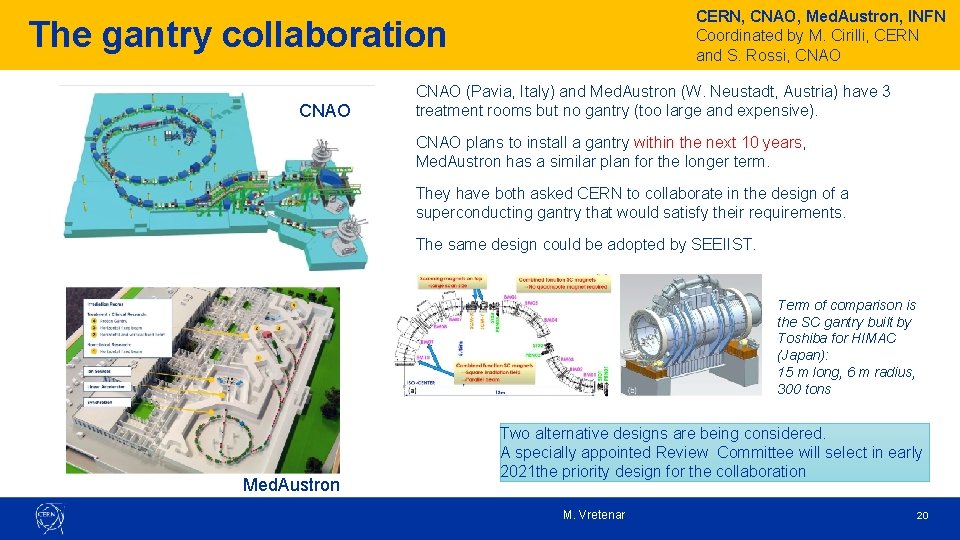
CERN, CNAO, Med. Austron, INFN Coordinated by M. Cirilli, CERN and S. Rossi, CNAO The gantry collaboration CNAO (Pavia, Italy) and Med. Austron (W. Neustadt, Austria) have 3 treatment rooms but no gantry (too large and expensive). CNAO plans to install a gantry within the next 10 years, Med. Austron has a similar plan for the longer term. They have both asked CERN to collaborate in the design of a superconducting gantry that would satisfy their requirements. The same design could be adopted by SEEIIST. Term of comparison is the SC gantry built by Toshiba for HIMAC (Japan): 15 m long, 6 m radius, 300 tons Med. Austron Two alternative designs are being considered. A specially appointed Review Committee will select in early 2021 the priority design for the collaboration M. Vretenar 20
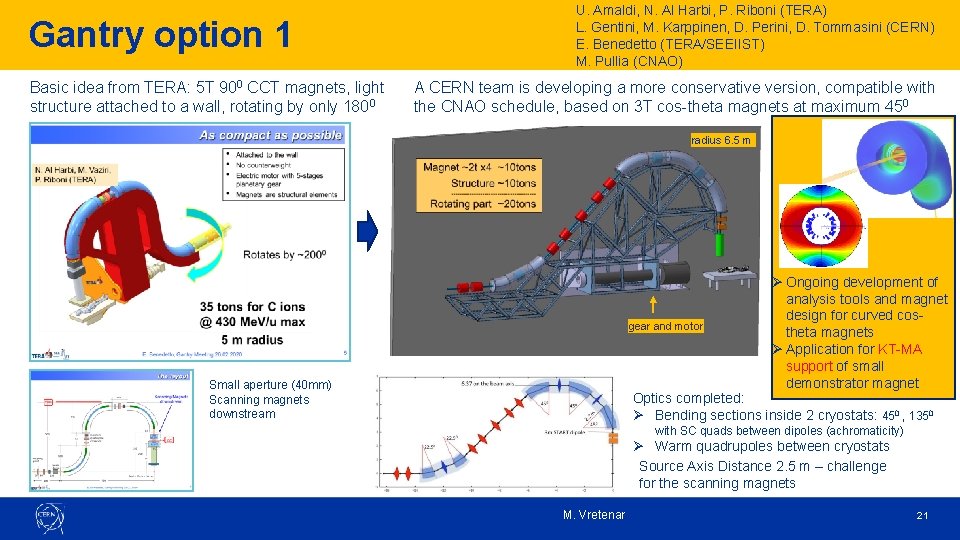
Gantry option 1 Basic idea from TERA: 5 T 900 CCT magnets, light structure attached to a wall, rotating by only 1800 U. Amaldi, N. Al Harbi, P. Riboni (TERA) L. Gentini, M. Karppinen, D. Perini, D. Tommasini (CERN) E. Benedetto (TERA/SEEIIST) M. Pullia (CNAO) A CERN team is developing a more conservative version, compatible with the CNAO schedule, based on 3 T cos-theta magnets at maximum 450 radius 6. 5 m gear and motor Small aperture (40 mm) Scanning magnets downstream Ø Ongoing development of analysis tools and magnet design for curved costheta magnets Ø Application for KT-MA support of small demonstrator magnet Optics completed: Ø Bending sections inside 2 cryostats: 450 , 1350 with SC quads between dipoles (achromaticity) Ø Warm quadrupoles between cryostats Source Axis Distance 2. 5 m – challenge for the scanning magnets M. Vretenar 21
SEEIIST: structure, plans, and schedule Masterplan for construction (9 years) Ancillary hub scheme M. Vretenar 22
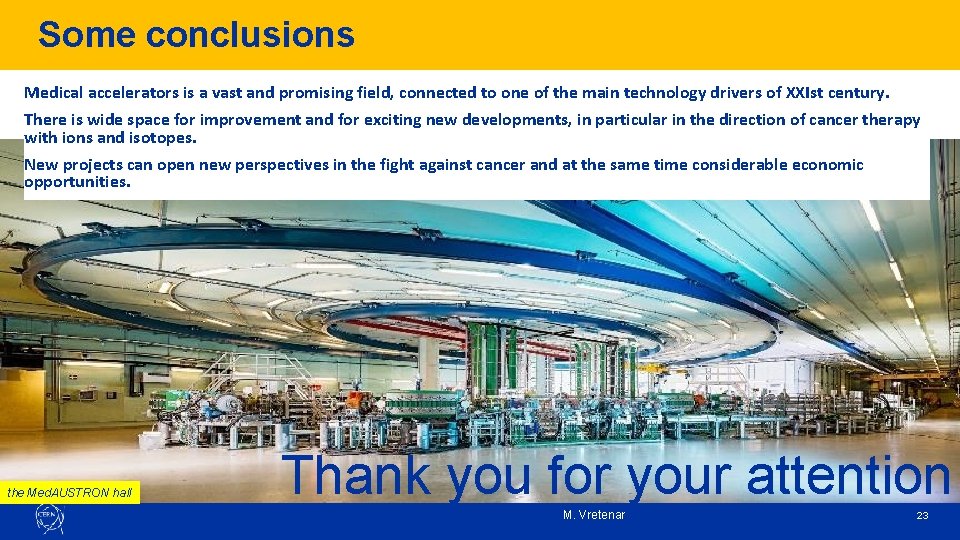
Some conclusions Medical accelerators is a vast and promising field, connected to one of the main technology drivers of XXIst century. There is wide space for improvement and for exciting new developments, in particular in the direction of cancer therapy with ions and isotopes. New projects can open new perspectives in the fight against cancer and at the same time considerable economic opportunities. the Med. AUSTRON hall Thank you for your attention M. Vretenar 23
home. cern
- Slides: 24