
Matthias Kawski Technology and doing mathematics ASU FYM
- Slides: 26
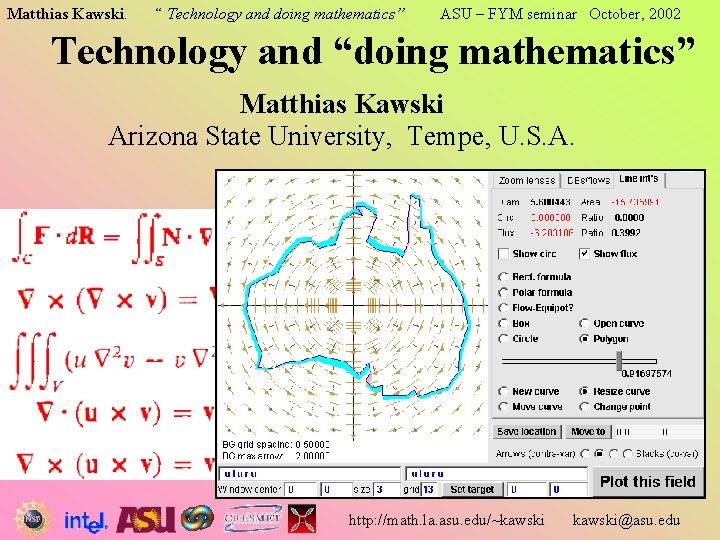
Matthias Kawski. “ Technology and doing mathematics” ASU – FYM seminar October, 2002 Technology and “doing mathematics” Matthias Kawski Arizona State University, Tempe, U. S. A. http: //math. la. asu. edu/~kawski@asu. edu
Matthias Kawski. “ Technology and doing mathematics” ASU – FYM seminar October, 2002 Outline • Brief intro – Visual, iconified language – Doing math …. experimentation • Demo: Divergence & Gauss’ theorem • Questions and discusion http: //math. la. asu. edu/~kawski@asu. edu
Matthias Kawski. “ Technology and doing mathematics” Vision ASU – FYM seminar October, 2002 (M. K. , Odense 2000) We are at the beginning of a new era in which an interactive visual language not only complements, but often supersedes the traditional, almost exclusively algebraic-symbolic language which for generations has often been confused with mathematics itself, (and which may be largely responsible for the isolation, poor public perception, and extremely difficult re-entry into mathematics due to the imposed vertical structure). http: //math. la. asu. edu/~kawski@asu. edu
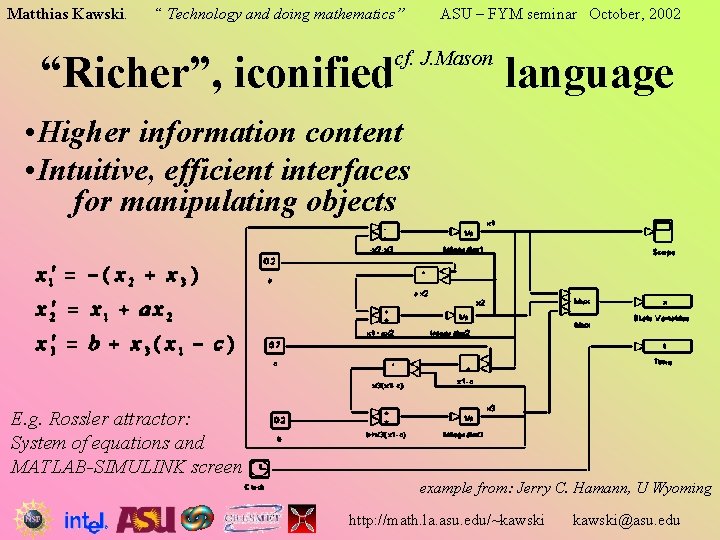
Matthias Kawski. “ Technology and doing mathematics” “Richer”, iconified ASU – FYM seminar October, 2002 cf. J. Mason language • Higher information content • Intuitive, efficient interfaces for manipulating objects E. g. Rossler attractor: System of equations and MATLAB-SIMULINK screen example from: Jerry C. Hamann, U Wyoming http: //math. la. asu. edu/~kawski@asu. edu
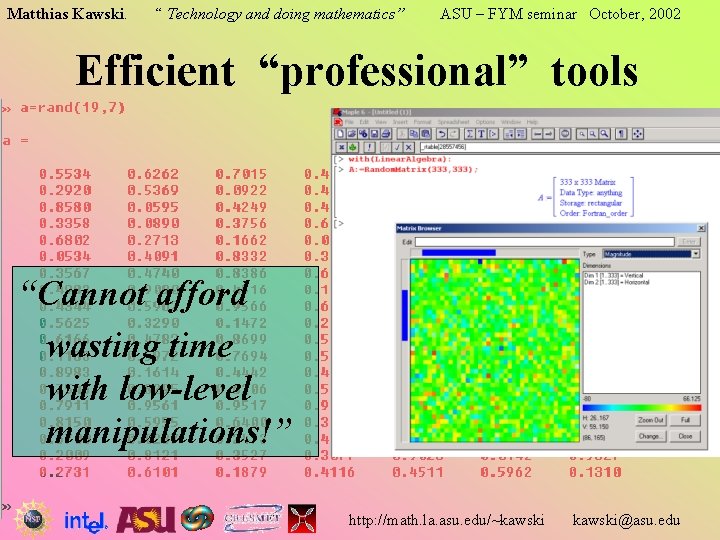
Matthias Kawski. “ Technology and doing mathematics” ASU – FYM seminar October, 2002 Efficient “professional” tools “Cannot afford wasting time with low-level manipulations!” http: //math. la. asu. edu/~kawski@asu. edu
Matthias Kawski. “ Technology and doing mathematics” ASU – FYM seminar October, 2002 Doing mathematics ? ? ? Axiom Definition Theorem Lemma Proof Example Exercise http: //math. la. asu. edu/~kawski@asu. edu
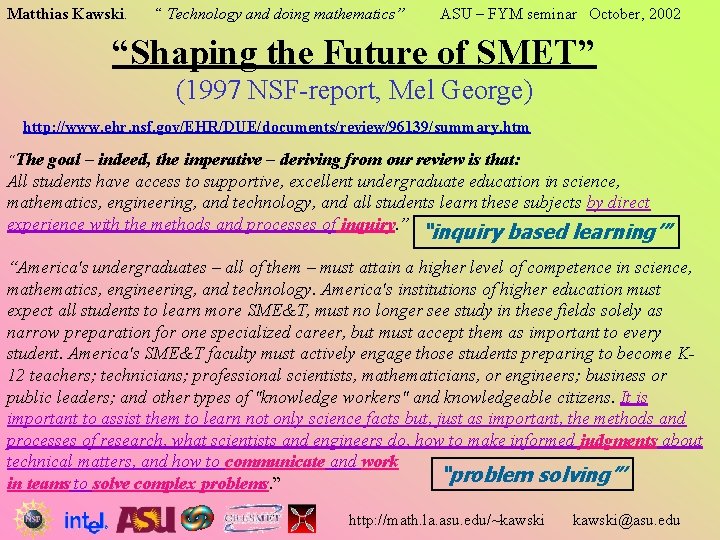
Matthias Kawski. “ Technology and doing mathematics” ASU – FYM seminar October, 2002 “Shaping the Future of SMET” (1997 NSF-report, Mel George) http: //www. ehr. nsf. gov/EHR/DUE/documents/review/96139/summary. htm “The goal – indeed, the imperative – deriving from our review is that: All students have access to supportive, excellent undergraduate education in science, mathematics, engineering, and technology, and all students learn these subjects by direct experience with the methods and processes of inquiry. ” “inquiry based learning’” “America's undergraduates – all of them – must attain a higher level of competence in science, mathematics, engineering, and technology. America's institutions of higher education must expect all students to learn more SME&T, must no longer see study in these fields solely as narrow preparation for one specialized career, but must accept them as important to every student. America's SME&T faculty must actively engage those students preparing to become K 12 teachers; technicians; professional scientists, mathematicians, or engineers; business or public leaders; and other types of "knowledge workers" and knowledgeable citizens. It is important to assist them to learn not only science facts but, just as important, the methods and processes of research, what scientists and engineers do, how to make informed judgments about technical matters, and how to communicate and work “problem solving”’ in teams to solve complex problems. ” http: //math. la. asu. edu/~kawski@asu. edu
Matthias Kawski. “ Technology and doing mathematics” ASU – FYM seminar October, 2002 Doing mathematics ? ? ? Axiom Definition Theorem Lemma Proof Example Exercise http: //math. la. asu. edu/~kawski@asu. edu
Matthias Kawski. “ Technology and doing mathematics” ASU – FYM seminar October, 2002 Doing mathematics !!! Question/problem (context!, application …) http: //math. la. asu. edu/~kawski@asu. edu
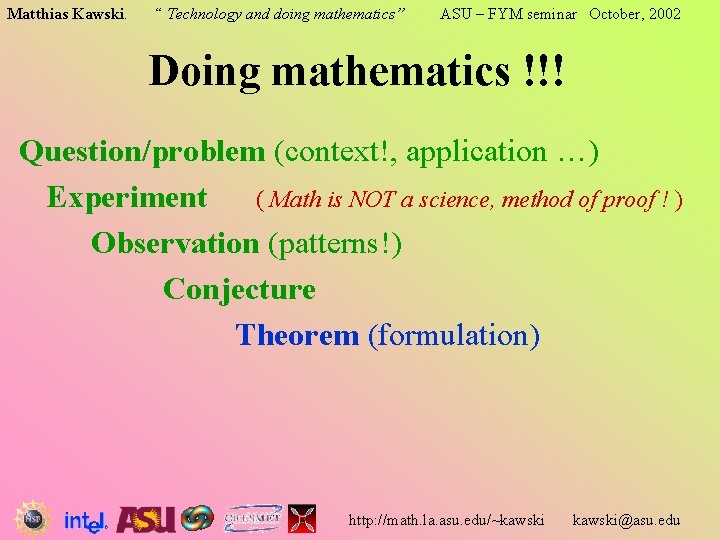
Matthias Kawski. “ Technology and doing mathematics” ASU – FYM seminar October, 2002 Doing mathematics !!! Question/problem (context!, application …) Experiment ( Math is NOT a science, method of proof ! ) http: //math. la. asu. edu/~kawski@asu. edu
Matthias Kawski. “ Technology and doing mathematics” ASU – FYM seminar October, 2002 Doing mathematics !!! Question/problem (context!, application …) Experiment ( Math is NOT a science, method of proof ! ) Observation (patterns!) http: //math. la. asu. edu/~kawski@asu. edu
Matthias Kawski. “ Technology and doing mathematics” ASU – FYM seminar October, 2002 Doing mathematics !!! Question/problem (context!, application …) Experiment ( Math is NOT a science, method of proof ! ) Observation (patterns!) Conjecture http: //math. la. asu. edu/~kawski@asu. edu
Matthias Kawski. “ Technology and doing mathematics” ASU – FYM seminar October, 2002 Doing mathematics !!! Question/problem (context!, application …) Experiment ( Math is NOT a science, method of proof ! ) Observation (patterns!) Conjecture Theorem (formulation) http: //math. la. asu. edu/~kawski@asu. edu
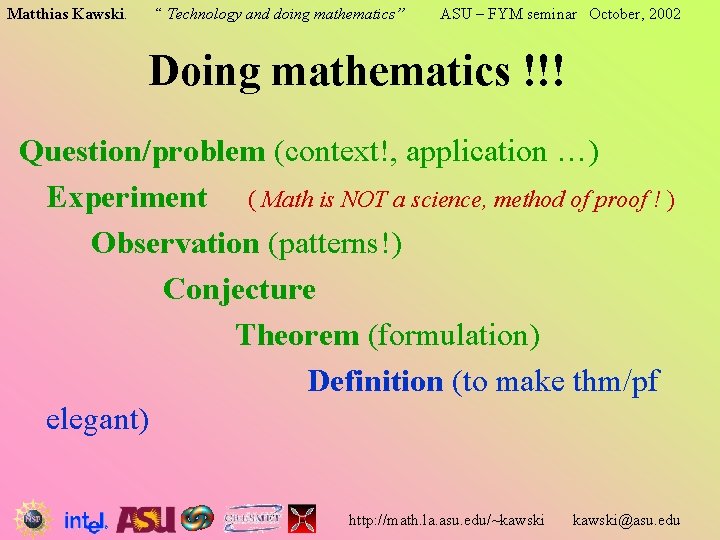
Matthias Kawski. “ Technology and doing mathematics” ASU – FYM seminar October, 2002 Doing mathematics !!! Question/problem (context!, application …) Experiment ( Math is NOT a science, method of proof ! ) Observation (patterns!) Conjecture Theorem (formulation) Definition (to make thm/pf elegant) http: //math. la. asu. edu/~kawski@asu. edu
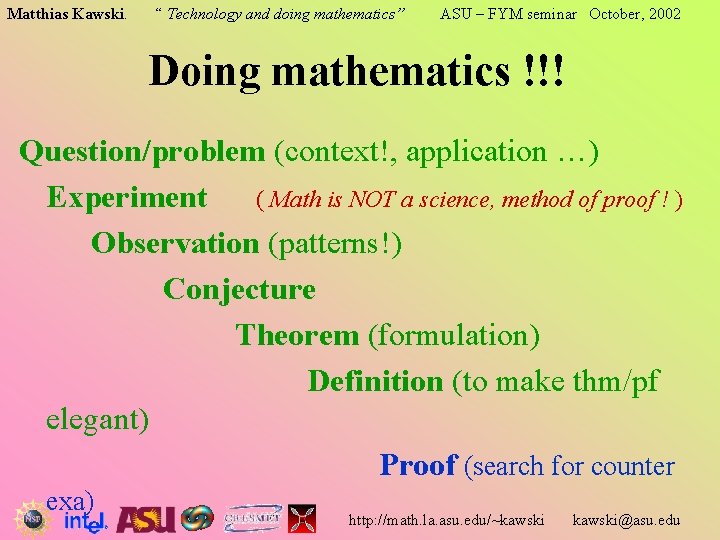
Matthias Kawski. “ Technology and doing mathematics” ASU – FYM seminar October, 2002 Doing mathematics !!! Question/problem (context!, application …) Experiment ( Math is NOT a science, method of proof ! ) Observation (patterns!) Conjecture Theorem (formulation) Definition (to make thm/pf elegant) Proof (search for counter exa) http: //math. la. asu. edu/~kawski@asu. edu
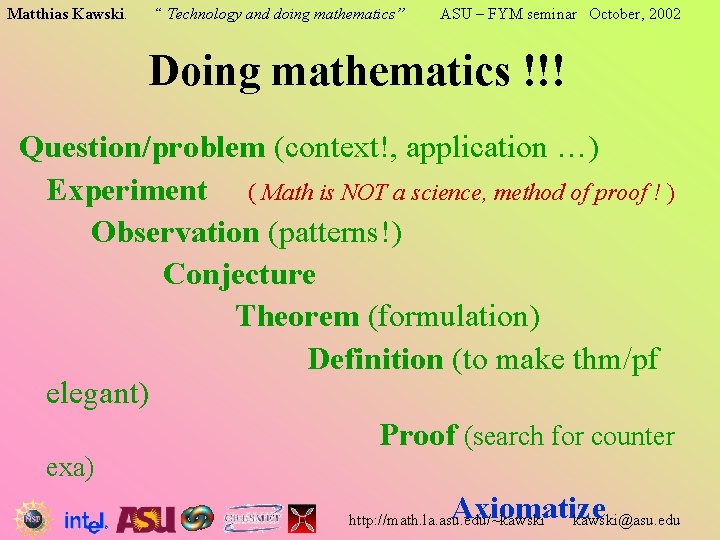
Matthias Kawski. “ Technology and doing mathematics” ASU – FYM seminar October, 2002 Doing mathematics !!! Question/problem (context!, application …) Experiment ( Math is NOT a science, method of proof ! ) Observation (patterns!) Conjecture Theorem (formulation) Definition (to make thm/pf elegant) Proof (search for counter exa) Axiomatize kawski@asu. edu http: //math. la. asu. edu/~kawski
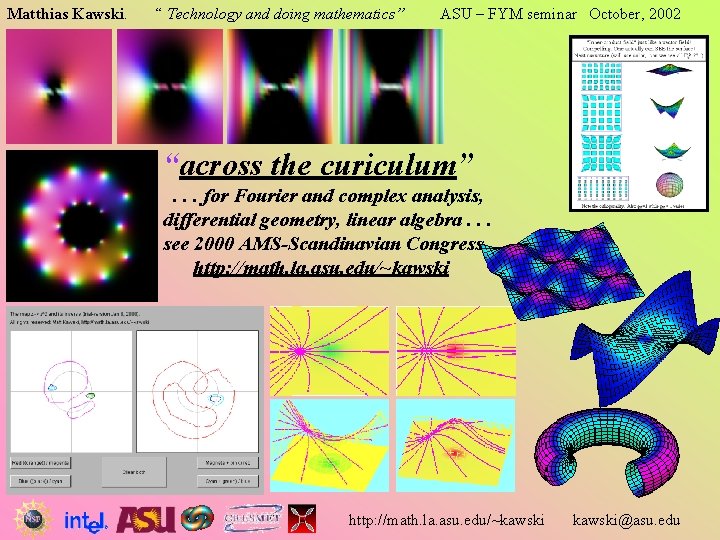
Matthias Kawski. “ Technology and doing mathematics” ASU – FYM seminar October, 2002 “across the curiculum”. . . for Fourier and complex analysis, differential geometry, linear algebra. . . see 2000 AMS-Scandinavian Congress http: //math. la. asu. edu/~kawski@asu. edu
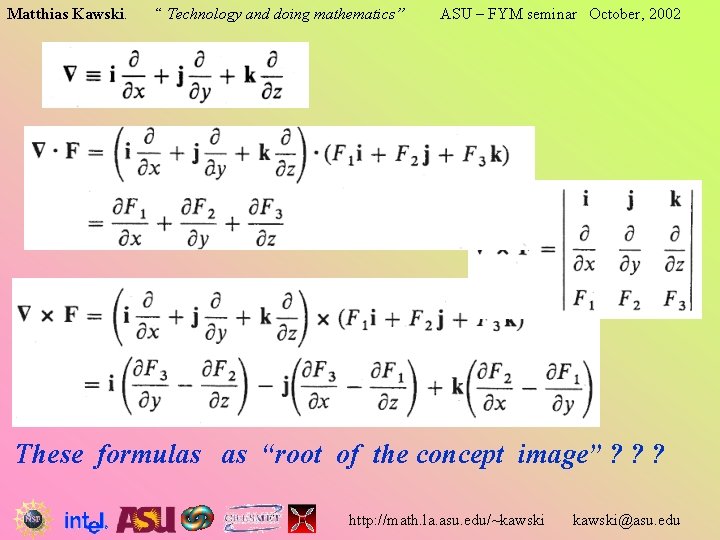
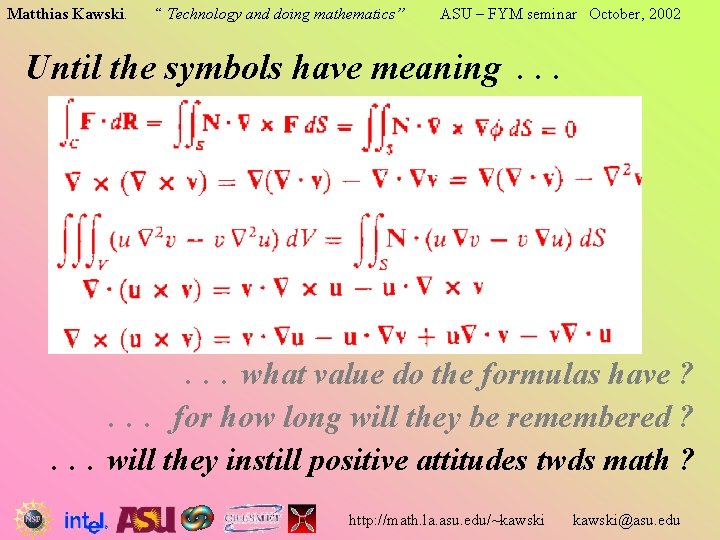
Matthias Kawski. “ Technology and doing mathematics” ASU – FYM seminar October, 2002 These formulas as “root of the concept image” ? ? ? http: //math. la. asu. edu/~kawski@asu. edu
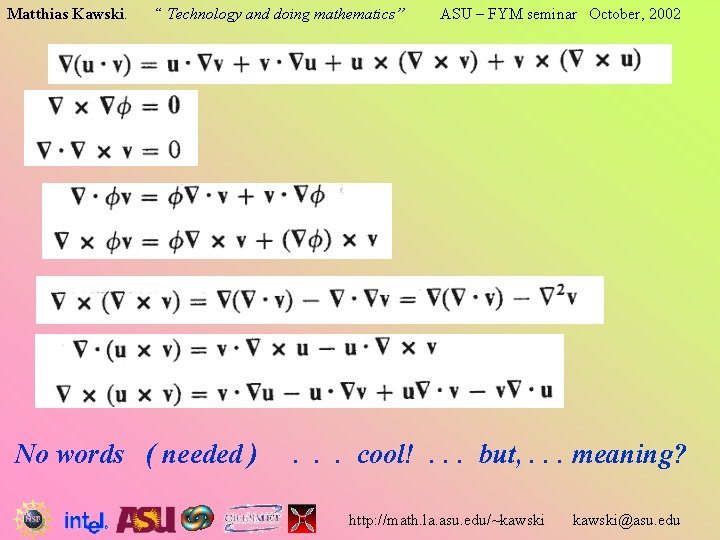
Matthias Kawski. “ Technology and doing mathematics” No words ( needed ) ASU – FYM seminar October, 2002 . . . cool!. . . but, . . . meaning? http: //math. la. asu. edu/~kawski@asu. edu
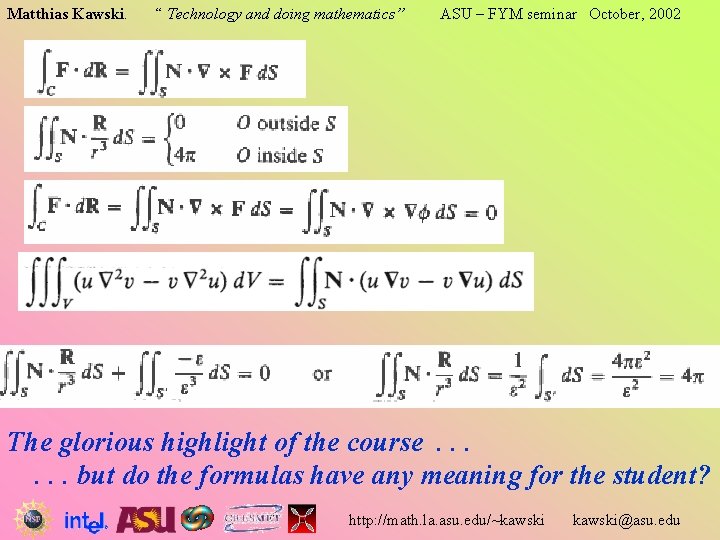
Matthias Kawski. “ Technology and doing mathematics” ASU – FYM seminar October, 2002 The glorious highlight of the course. . . but do the formulas have any meaning for the student? http: //math. la. asu. edu/~kawski@asu. edu
Matthias Kawski. “ Technology and doing mathematics” ASU – FYM seminar October, 2002 Until the symbols have meaning. . . what value do the formulas have ? . . . for how long will they be remembered ? . . . will they instill positive attitudes twds math ? http: //math. la. asu. edu/~kawski@asu. edu
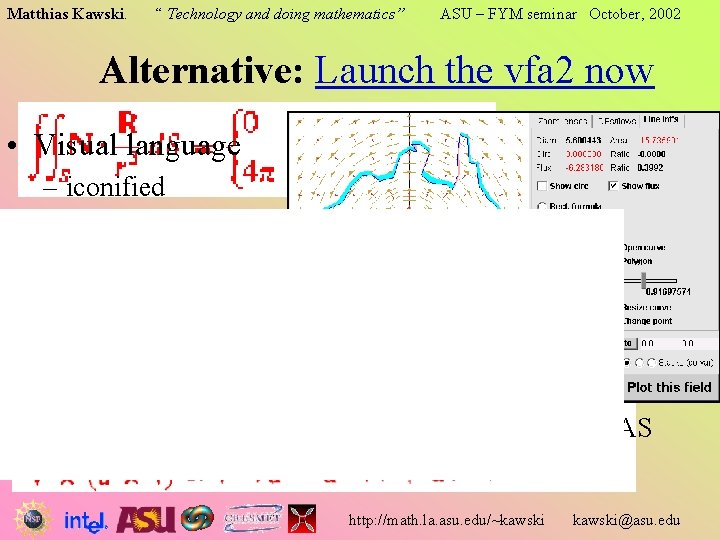
Matthias Kawski. “ Technology and doing mathematics” ASU – FYM seminar October, 2002 Alternative: Launch the vfa 2 now • Visual language – iconified – mouse input – rapid experiments • Algebraic symbols – at end, if at all. Just as needed to interface with CAS http: //math. la. asu. edu/~kawski@asu. edu
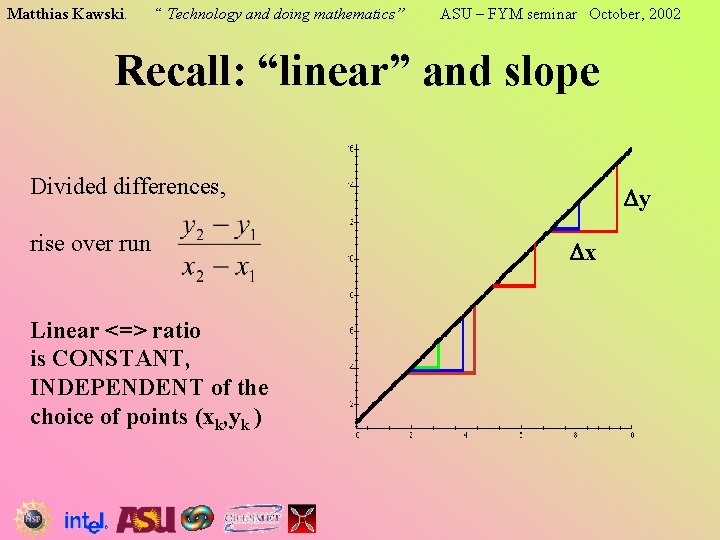
Matthias Kawski. “ Technology and doing mathematics” ASU – FYM seminar October, 2002 Recall: “linear” and slope Divided differences, rise over run Linear <=> ratio is CONSTANT, INDEPENDENT of the choice of points (xk, yk ) Dy Dx
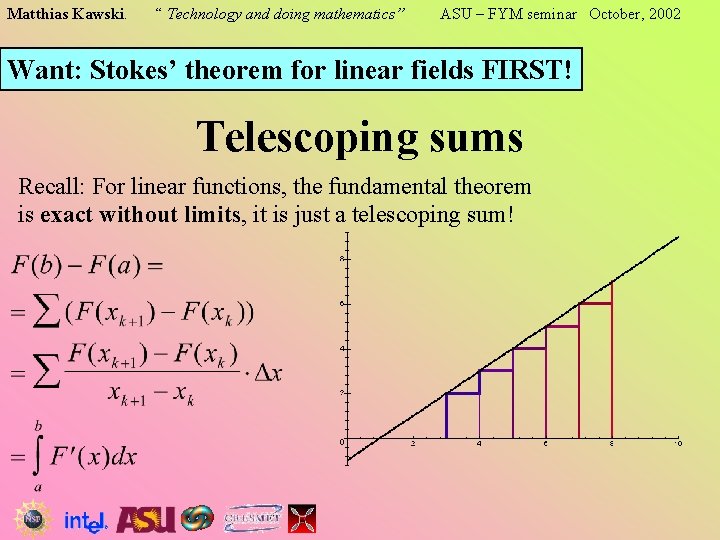
Matthias Kawski. “ Technology and doing mathematics” ASU – FYM seminar October, 2002 Want: Stokes’ theorem for linear fields FIRST! Telescoping sums Recall: For linear functions, the fundamental theorem is exact without limits, it is just a telescoping sum!
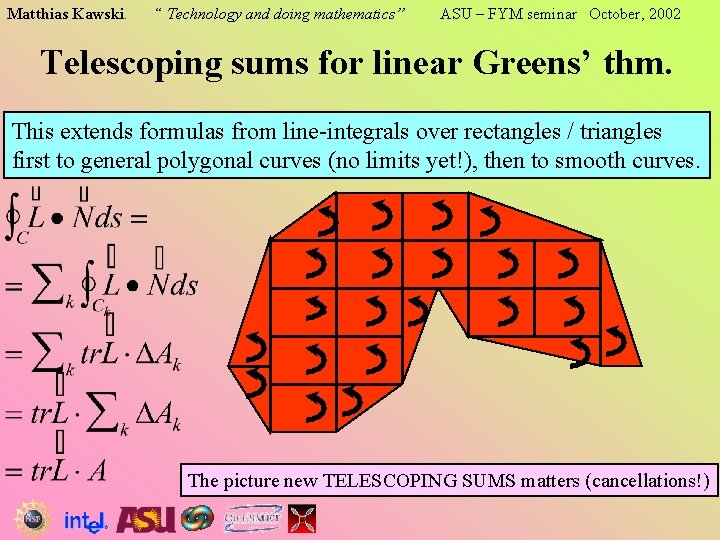
Matthias Kawski. “ Technology and doing mathematics” ASU – FYM seminar October, 2002 Telescoping sums for linear Greens’ thm. This extends formulas from line-integrals over rectangles / triangles first to general polygonal curves (no limits yet!), then to smooth curves. The picture new TELESCOPING SUMS matters (cancellations!)
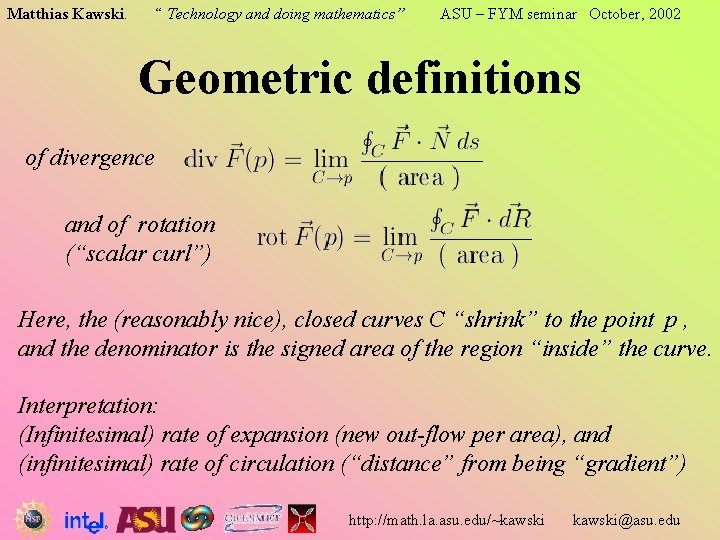
Matthias Kawski. “ Technology and doing mathematics” ASU – FYM seminar October, 2002 Geometric definitions of divergence and of rotation (“scalar curl”) Here, the (reasonably nice), closed curves C “shrink” to the point p , and the denominator is the signed area of the region “inside” the curve. Interpretation: (Infinitesimal) rate of expansion (new out-flow per area), and (infinitesimal) rate of circulation (“distance” from being “gradient”) http: //math. la. asu. edu/~kawski@asu. edu