
Matter www middleschoolscience com 2008 Matter Anything that


- Slides: 17
Matter www. middleschoolscience. com 2008
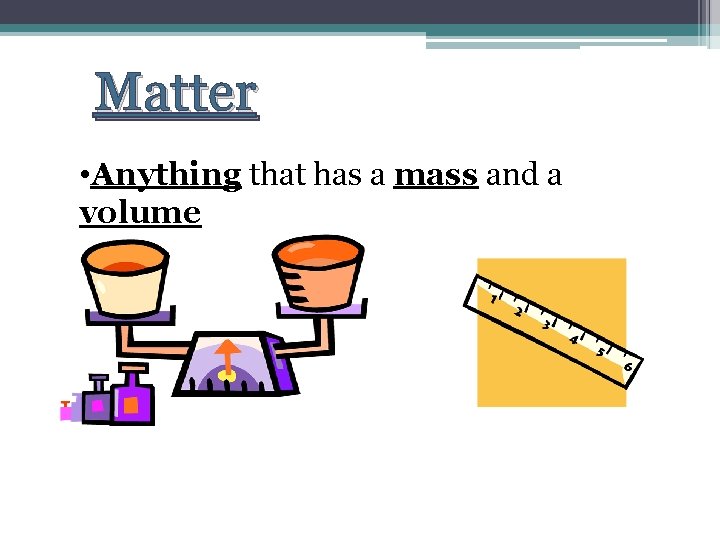
Matter • Anything that has a mass and a volume
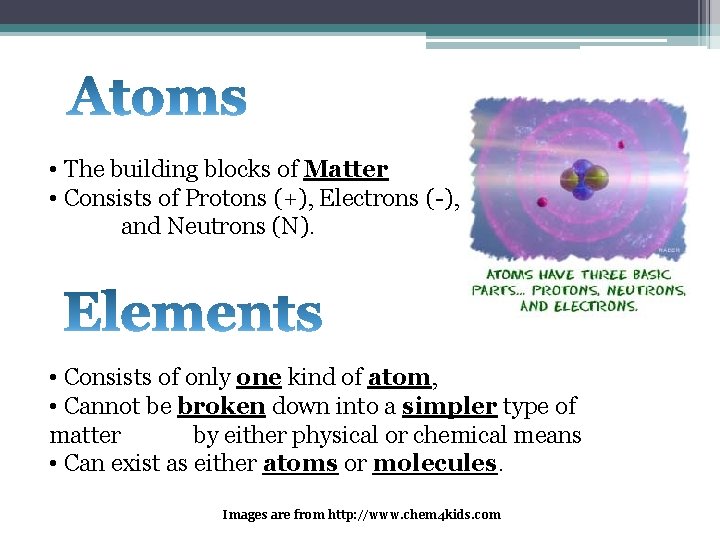
• The building blocks of Matter • Consists of Protons (+), Electrons (-), and Neutrons (N). • Consists of only one kind of atom, • Cannot be broken down into a simpler type of matter by either physical or chemical means • Can exist as either atoms or molecules. Images are from http: //www. chem 4 kids. com
• A molecule consists of two or more atoms of the same element, It is a Pure Substance…. • In the animation above, two nitrogen atoms (N + N = N 2) make one Nitrogen molecule.
• Atoms of two or more different elements bound together. • Can be separated into elements chemically, but not physically. In the animation above, water (H 20) is a compound made of Hydrogen and Oxygen. Animated images and notes from http: //www. chem. purdue. edu/gchelp/atoms/elements. html
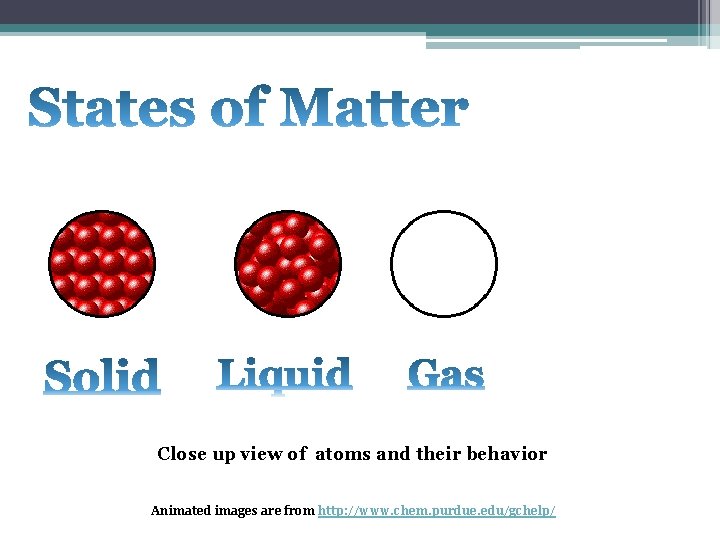
Close up view of atoms and their behavior Animated images are from http: //www. chem. purdue. edu/gchelp/
• http: //preparatorychemistry. com/KMT_flash. ht m • How could this change with shape, volume, viscosity in response to temperature change?
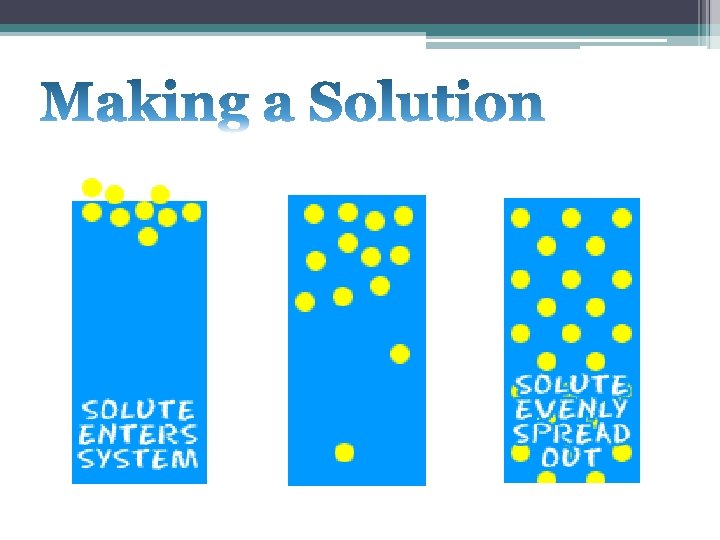
• Solutions are groups of molecules that are mixed up in a completely even distribution. Images are from http: //www. chem 4 kids. com
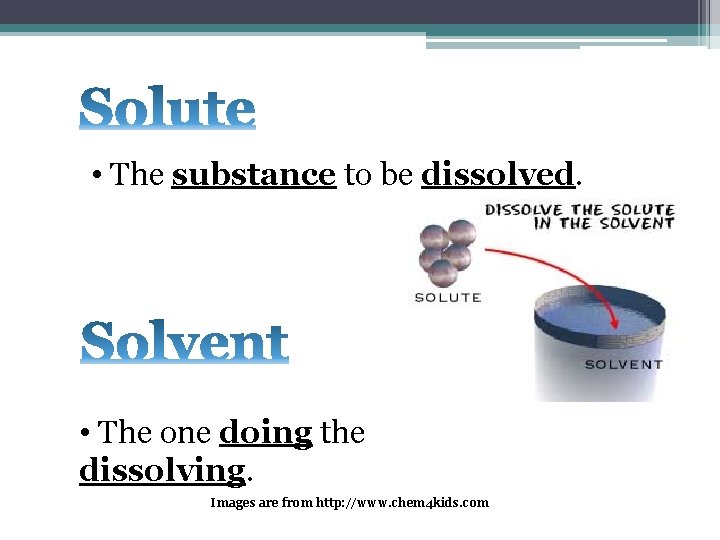
• The substance to be dissolved. • The one doing the dissolving. Images are from http: //www. chem 4 kids. com
• They are substances held together by physical forces, not chemical. • Can be separated physically. • Solutions are also mixtures. Images are from http: //www. chem 4 kids. com
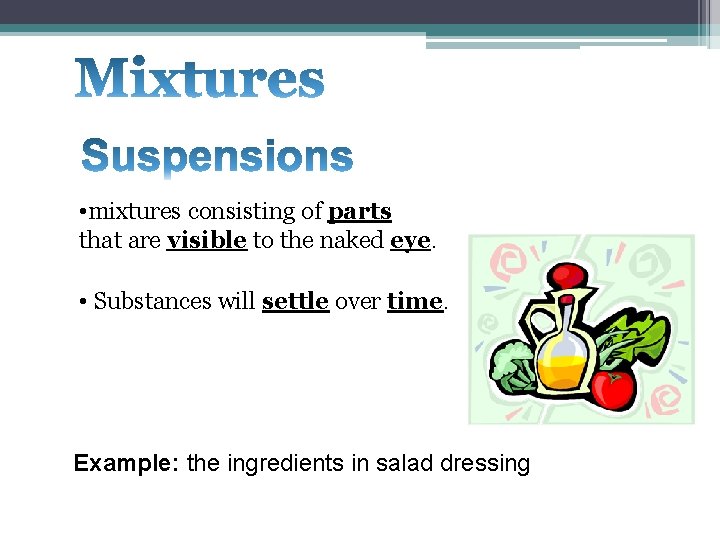
• mixtures consisting of parts that are visible to the naked eye. • Substances will settle over time. Example: the ingredients in salad dressing
Mr. Lee’s Rap • http: //www. youtube. com/watch? v=B 0 dfzj 9 o. MQ&feature=related
Discussion • Describe the movement of particles in a solid and the forces between them. ▫ Solid particles vibrate in place and they have strong attractive forces between the particles. • How do particles move and interact in a gas? ▫ Gas particles move freely, spread out, and they have little attraction for other gas particles.
Challenge • How is temperature related to particle motion? ▫ Temperature is directly related to particle motion. The higher the temperature, the more kinetic energy the particles have. The more kinetic energy particles have, the faster they move.
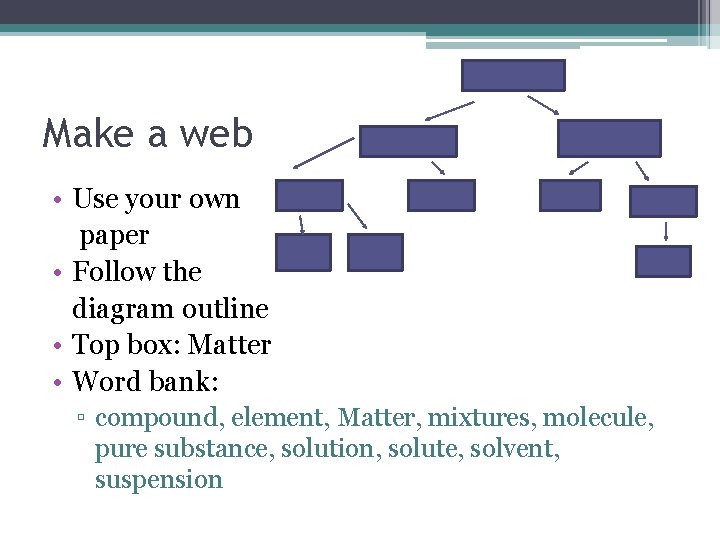
Make a web • Use your own paper • Follow the diagram outline • Top box: Matter • Word bank: ▫ compound, element, Matter, mixtures, molecule, pure substance, solution, solute, solvent, suspension
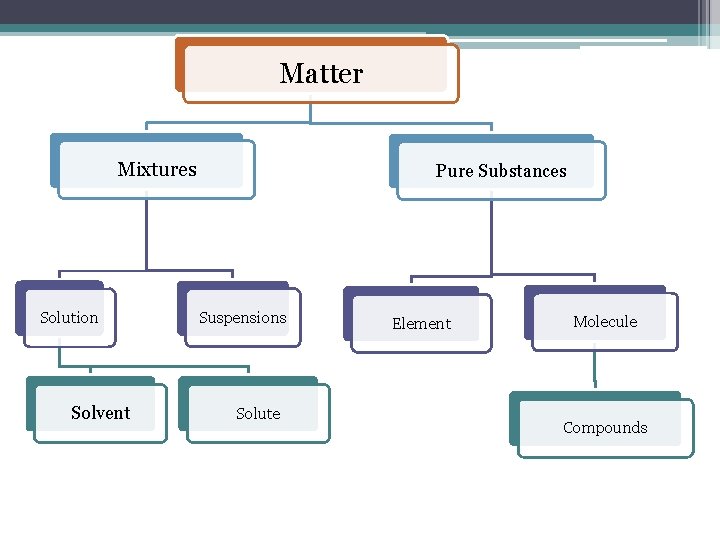
Matter Mixtures Solution Solvent Pure Substances Suspensions Solute Element Molecule Compounds