
MATTER SOLUTIONS and ACIDS AND BASES MATTER SPS
MATTER, SOLUTIONS, and ACIDS AND BASES
MATTER SPS 5. Obtain, evaluate, and communicate information to compare and contrast the phases of matter as they relate to atomic and molecular motion. A. Ask questions to compare and contrast models depicting the particle arrangement and motion in solids, liquids, gases, and plasmas. B. Plan and carry out investigations to identify the relationships among temperature, pressure, volume, and density of gases in closed systems. (Clarification statement: Using specific Gas laws to perform calculations is beyond the scope of this standard; emphasis should focus on the conceptual understanding of the behavior of gases rather than calculations. ) SPS 7. Obtain, evaluate, and communicate information to explain transformations and flow of energy within a system. d. Analyze and interpret data to explain the flow of energy during phase changes using heating/cooling curves. 2
DENSITY • Density is a measure of the amount of mass in a certain volume. • The heavier an object, the more dense it is. • This physical property is often used to identify and classify substances. • It is usually measured in g/cm 3. SAMPLE PROBLEM: What is the density of a billiard ball that has a volume of 100 cm 3 and a mass of 250 g? 3
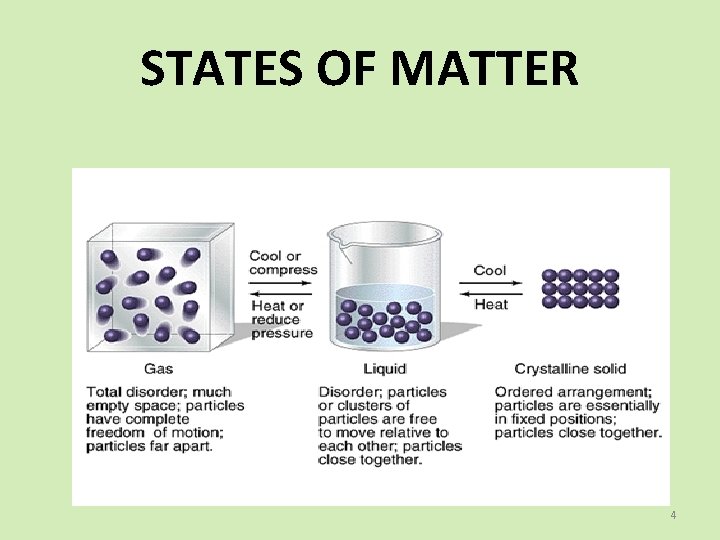
STATES OF MATTER 4
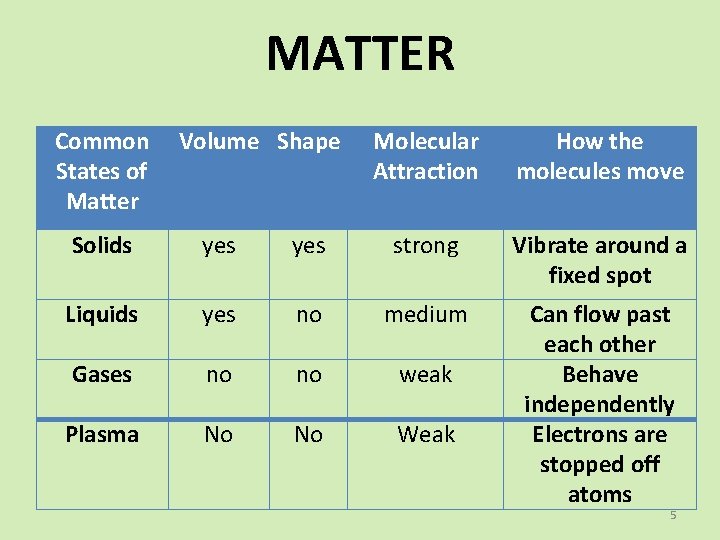
MATTER Common States of Matter Volume Shape Molecular Attraction How the molecules move Solids yes strong Vibrate around a fixed spot Liquids yes no medium Gases no no weak Plasma No No Weak Can flow past each other Behave independently Electrons are stopped off atoms 5
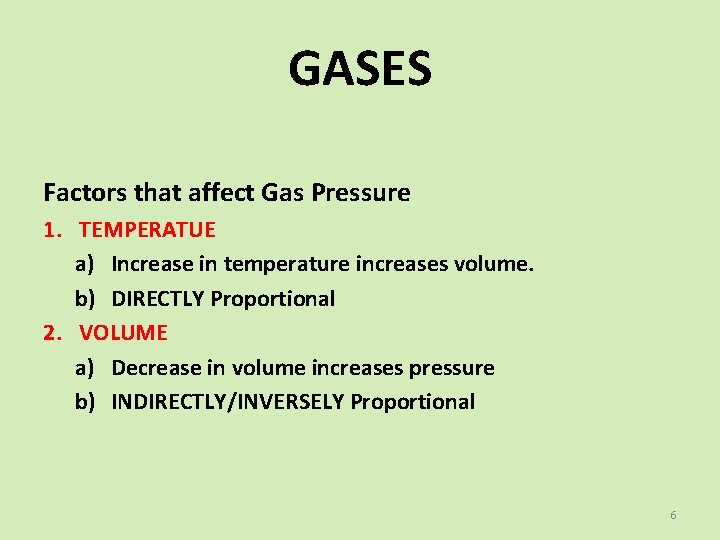
GASES Factors that affect Gas Pressure 1. TEMPERATUE a) Increase in temperature increases volume. b) DIRECTLY Proportional 2. VOLUME a) Decrease in volume increases pressure b) INDIRECTLY/INVERSELY Proportional 6
7
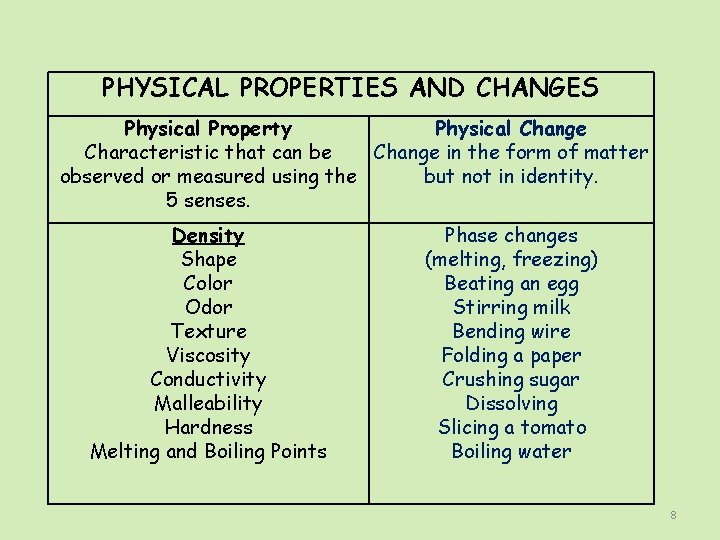
PHYSICAL PROPERTIES AND CHANGES Physical Property Physical Change Characteristic that can be Change in the form of matter observed or measured using the but not in identity. 5 senses. Density Shape Color Odor Texture Viscosity Conductivity Malleability Hardness Melting and Boiling Points Phase changes (melting, freezing) Beating an egg Stirring milk Bending wire Folding a paper Crushing sugar Dissolving Slicing a tomato Boiling water 8
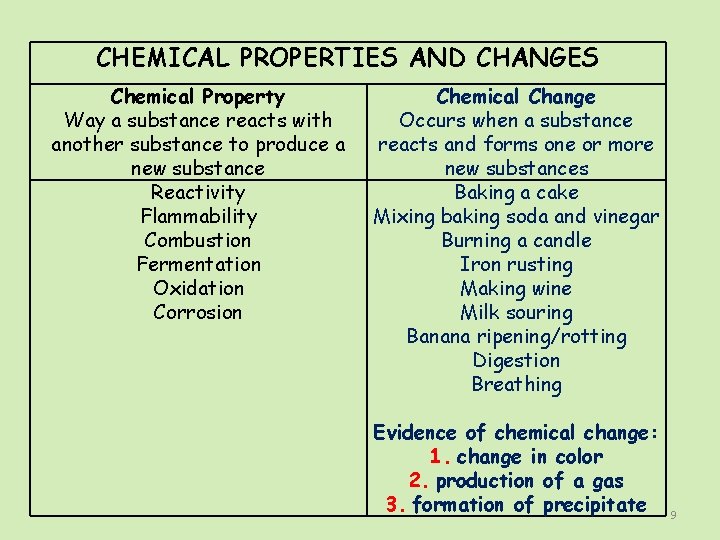
CHEMICAL PROPERTIES AND CHANGES Chemical Property Way a substance reacts with another substance to produce a new substance Reactivity Flammability Combustion Fermentation Oxidation Corrosion Chemical Change Occurs when a substance reacts and forms one or more new substances Baking a cake Mixing baking soda and vinegar Burning a candle Iron rusting Making wine Milk souring Banana ripening/rotting Digestion Breathing Evidence of chemical change: 1. change in color 2. production of a gas 3. formation of precipitate 9
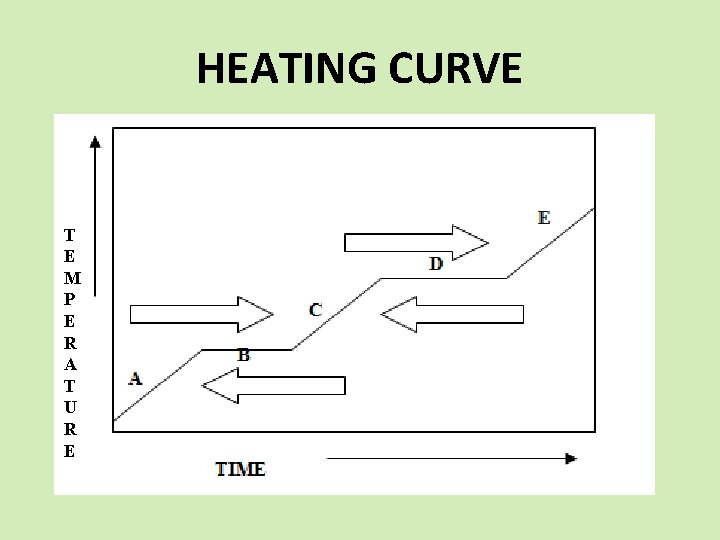
HEATING CURVE T E M P E R A T U R E
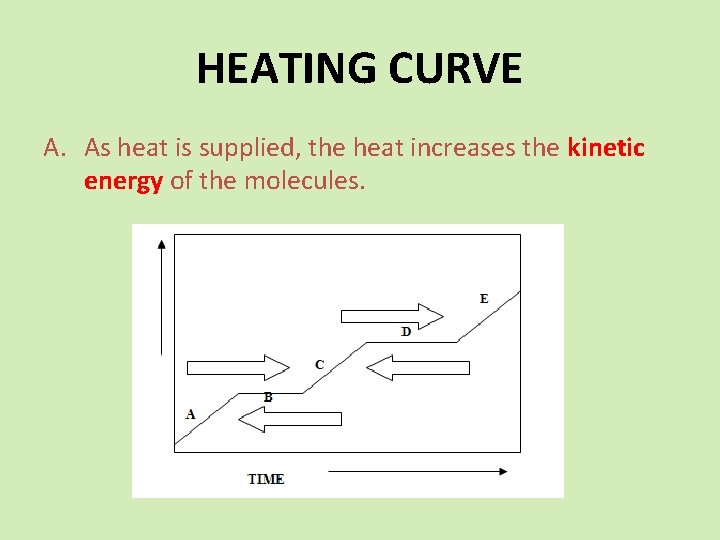
HEATING CURVE A. As heat is supplied, the heat increases the kinetic energy of the molecules.
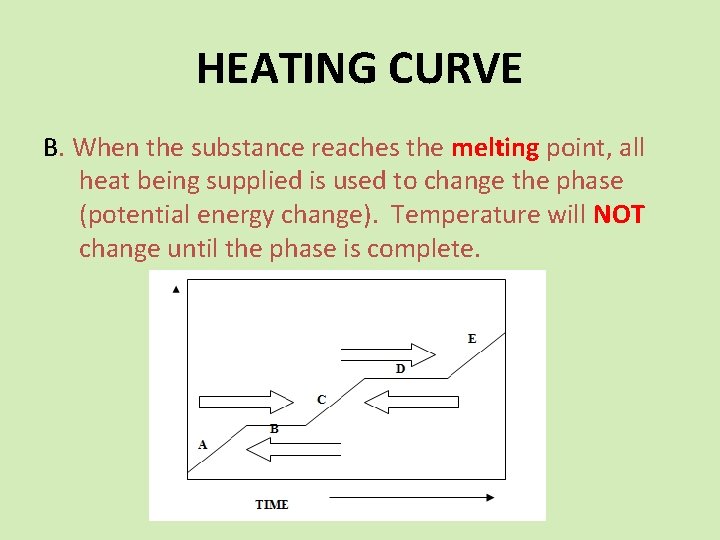
HEATING CURVE B. When the substance reaches the melting point, all heat being supplied is used to change the phase (potential energy change). Temperature will NOT change until the phase is complete.
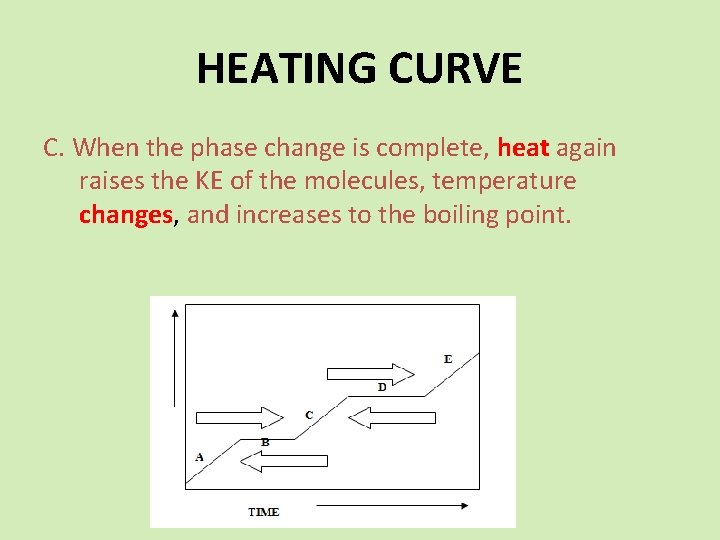
HEATING CURVE C. When the phase change is complete, heat again raises the KE of the molecules, temperature changes, and increases to the boiling point.
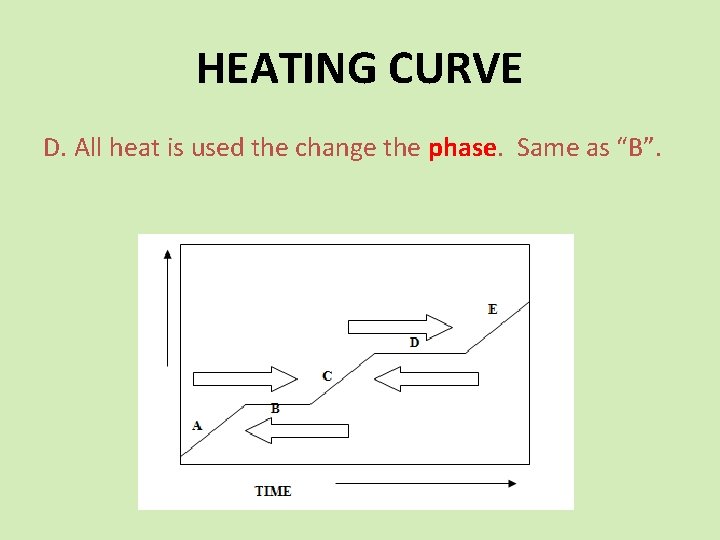
HEATING CURVE D. All heat is used the change the phase. Same as “B”.
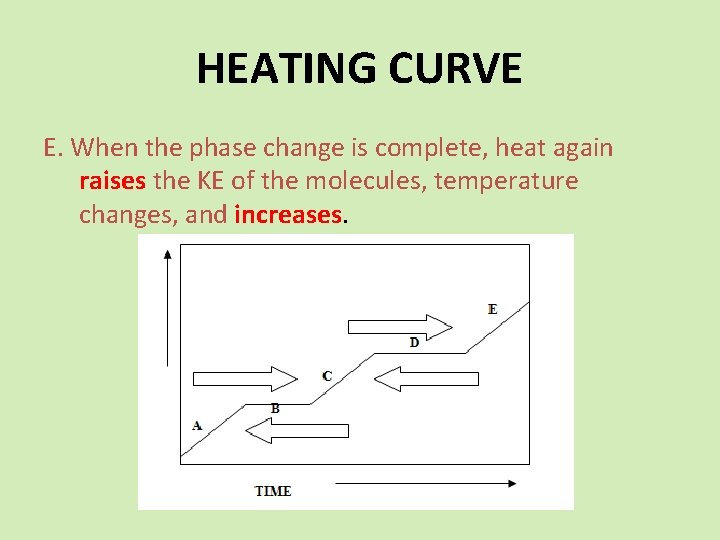
HEATING CURVE E. When the phase change is complete, heat again raises the KE of the molecules, temperature changes, and increases.
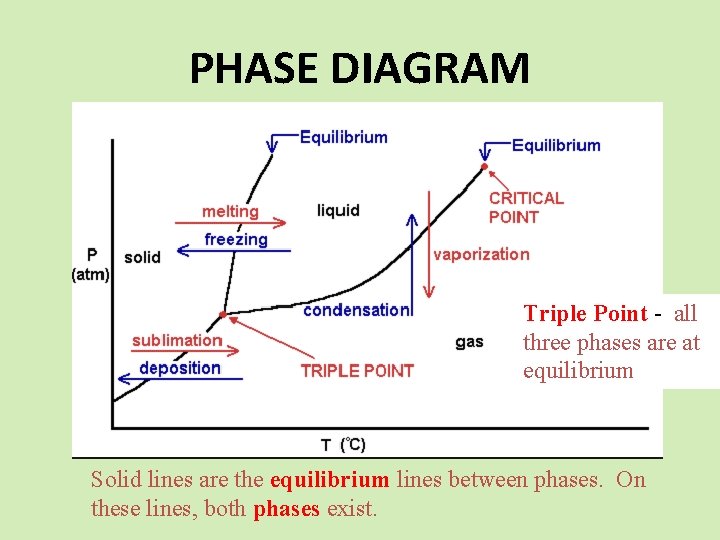
PHASE DIAGRAM Triple Point - all three phases are at equilibrium Solid lines are the equilibrium lines between phases. On these lines, both phases exist.
PHASE DIAGRAM REMEMBER • Energy is conserved – it can be converted from one form to another, but it cannot be destroyed. • The energy stored in a substance because of its composition is CHEMICAL POTENTIAL ENERGY. Chemical potential energy plays an important role in chemical reactions.
PHASE DIAGRAM • In a chemical reaction, the potential energy can be released as heat. • Heat is the energy that flows from a warmer object to a colder object. Heat is measured using the SI unit Joule, J.
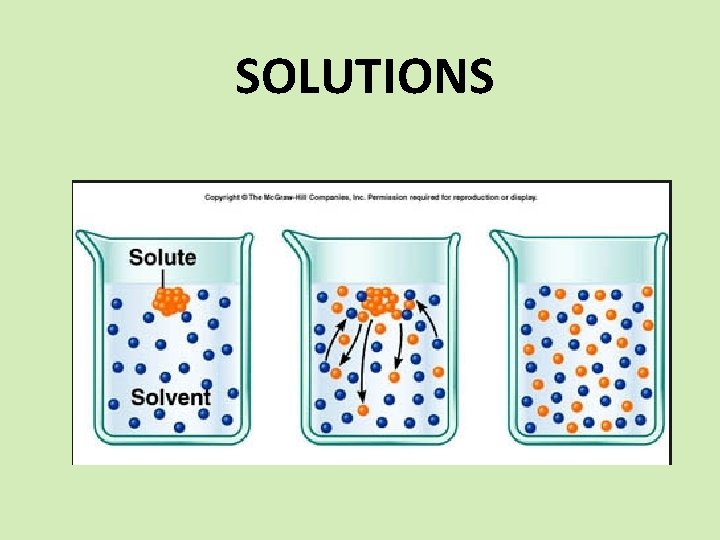
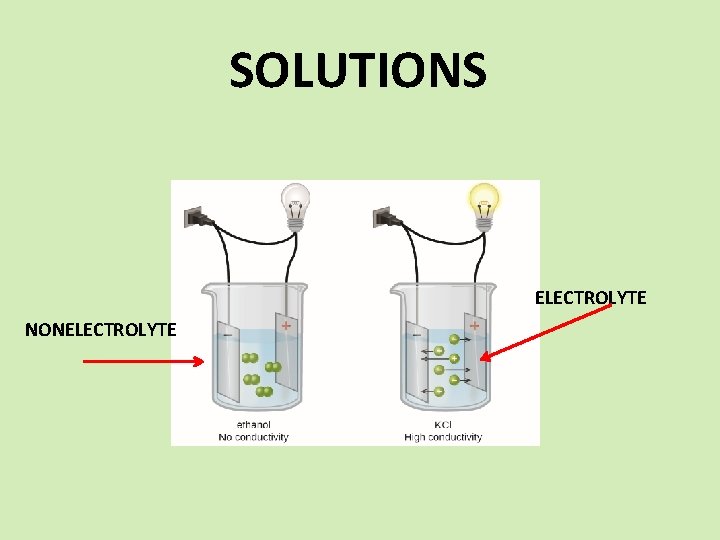
SOLUTIONS SPS 6. Obtain, evaluate, and communicate information to explain the properties of solutions. a. Develop and use models to explain the properties (solute/solvent, conductivity, and concentration) of solutions. b. Plan and carry out investigations to determine how temperature, surface area, and agitation affect the rate solutes dissolve in a specific solvent. c. Analyze and interpret data from a solubility curve to determine the effect of temperature on solubility.
SOLUTIONS
SOLUTIONS
SOLUTIONS ELECTROLYTE NONELECTROLYTE
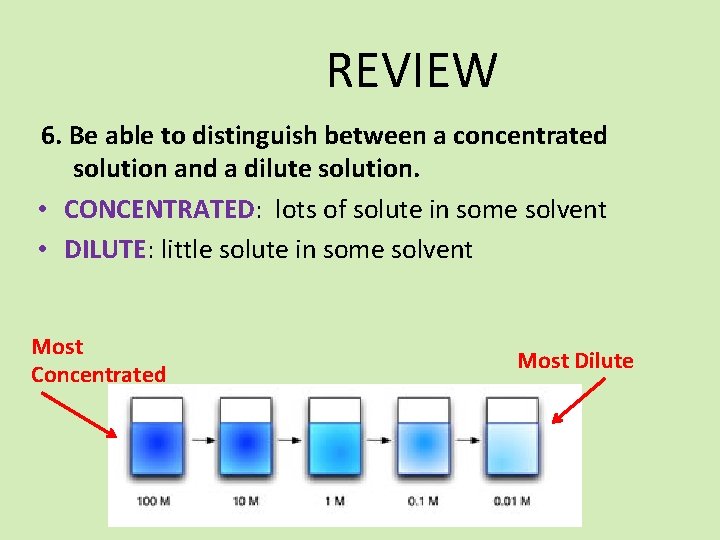
REVIEW 6. Be able to distinguish between a concentrated solution and a dilute solution. • CONCENTRATED: lots of solute in some solvent • DILUTE: little solute in some solvent Most Concentrated Most Dilute
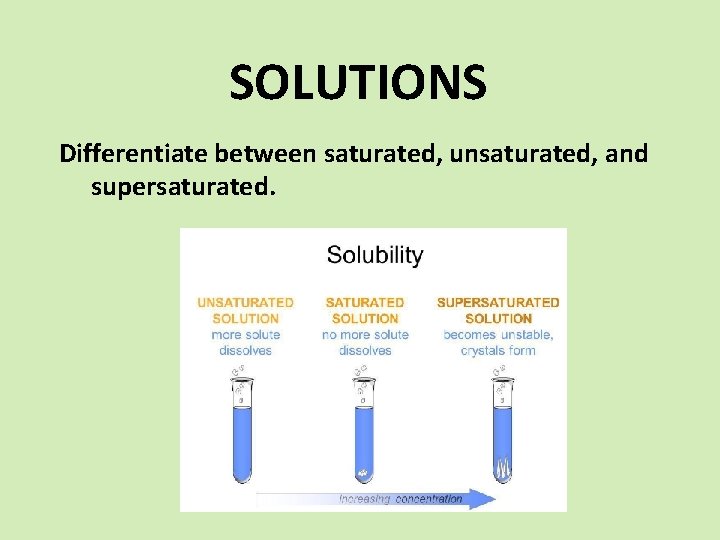
SOLUTIONS Differentiate between saturated, unsaturated, and supersaturated.
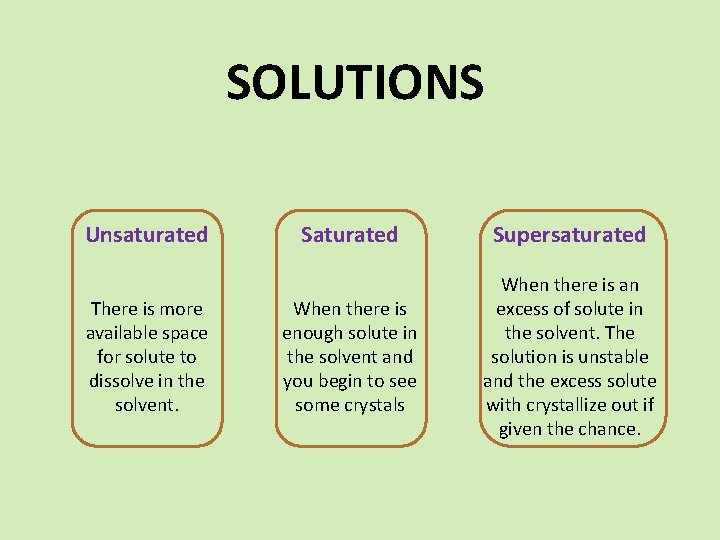
SOLUTIONS Unsaturated There is more available space for solute to dissolve in the solvent. Saturated Supersaturated When there is enough solute in the solvent and you begin to see some crystals When there is an excess of solute in the solvent. The solution is unstable and the excess solute with crystallize out if given the chance.
SOLUTIONS The factors affecting the rate of solubility. v Agitation – stirring or shaking puts the solute in contact with the solvent more often. v Temperature – raising the temperature makes the particles move faster which puts the solute in contact with the solvent more often. v Particle Size – smaller particles means more surface area which puts the solute in contact with the solvent more often.
SOLUTIONS The factors that affect solubility. Ø Nature of the solvent and solute - “like dissolves like”. Ø Temperature - increase the temperature and solubility increases. Ø Pressure - increase the pressure and you increase solubility. (only gases) Ø How much is already dissolved?
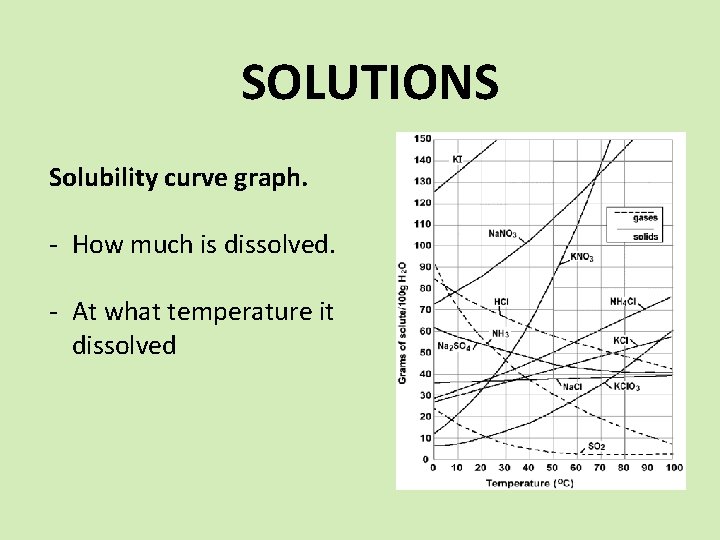
SOLUTIONS Solubility curve graph. - How much is dissolved. - At what temperature it dissolved
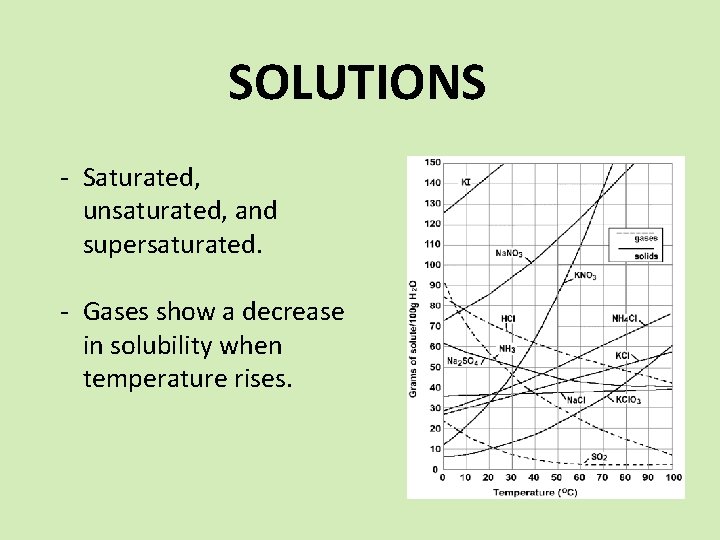
SOLUTIONS - Saturated, unsaturated, and supersaturated. - Gases show a decrease in solubility when temperature rises.
ACIDS AND BASES SPS 6. Obtain, evaluate, and communicate information to explain the properties of solutions. d. Obtain and communicate information to explain the relationship between the structure and properties (e. g. , p. H, and color change in the presence of an indicator) of acids and bases. (Clarification statement: Limited to only the structure of simple acids and bases (e. g. , HCl and Na. OH) that demonstrates the presence of an H+ or OH-. e. Plan and carry out investigations to detect patterns in order to classify common household substances as acidic, basic, or neutral.
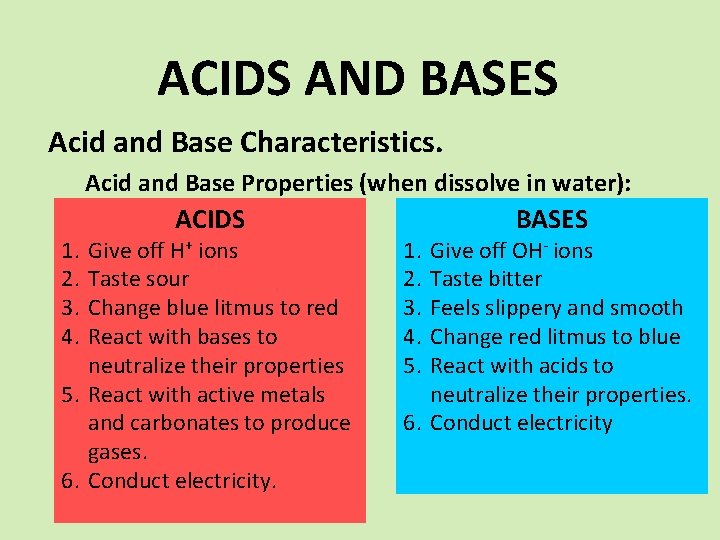
ACIDS AND BASES Acid and Base Characteristics. Acid and Base Properties (when dissolve in water): 1. 2. 3. 4. ACIDS Give off H+ ions Taste sour Change blue litmus to red React with bases to neutralize their properties 5. React with active metals and carbonates to produce gases. 6. Conduct electricity. 1. 2. 3. 4. 5. BASES Give off OH- ions Taste bitter Feels slippery and smooth Change red litmus to blue React with acids to neutralize their properties. 6. Conduct electricity
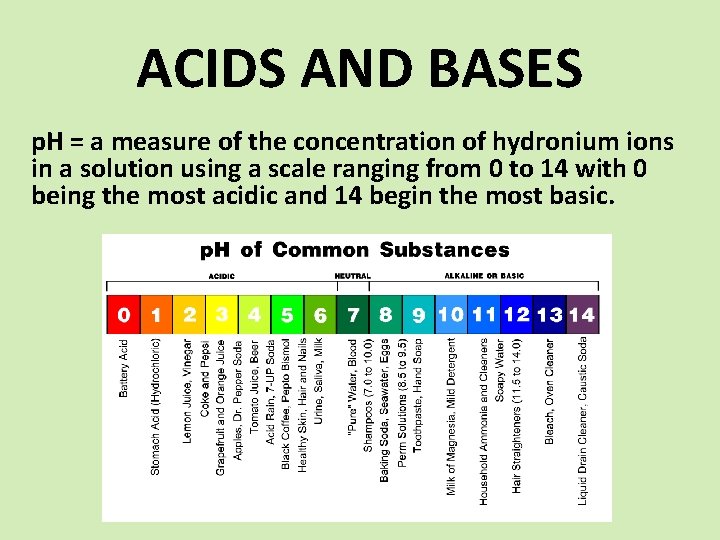
ACIDS AND BASES p. H = a measure of the concentration of hydronium ions in a solution using a scale ranging from 0 to 14 with 0 being the most acidic and 14 begin the most basic.
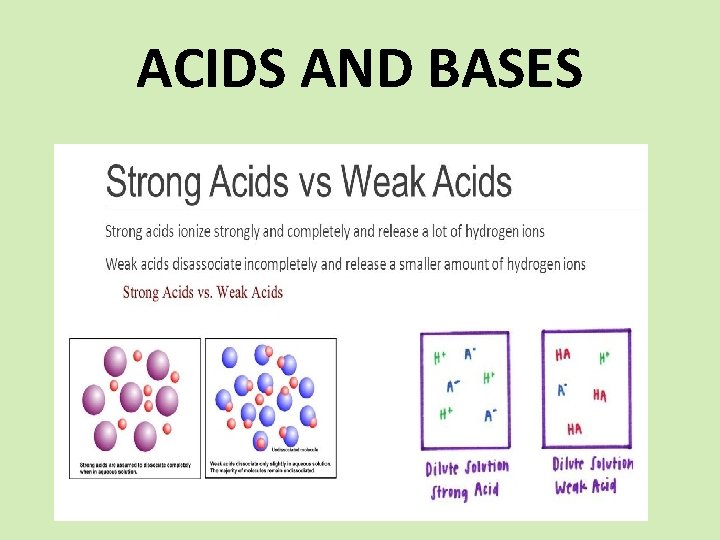
ACIDS AND BASES
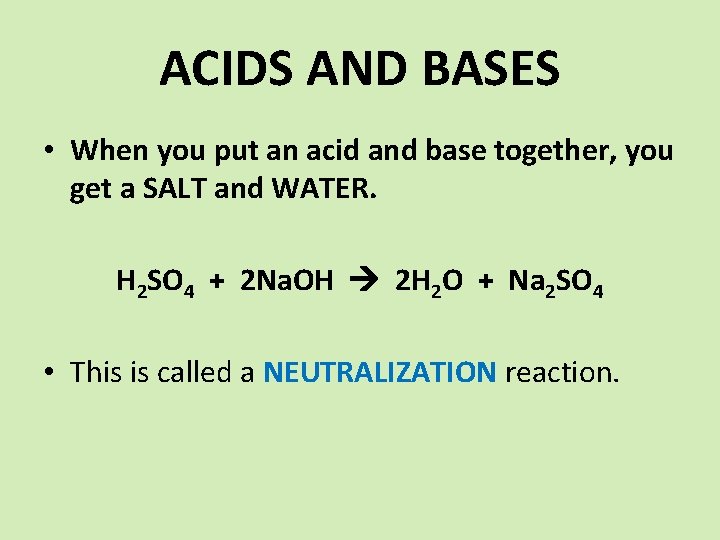
ACIDS AND BASES • When you put an acid and base together, you get a SALT and WATER. H 2 SO 4 + 2 Na. OH 2 H 2 O + Na 2 SO 4 • This is called a NEUTRALIZATION reaction.
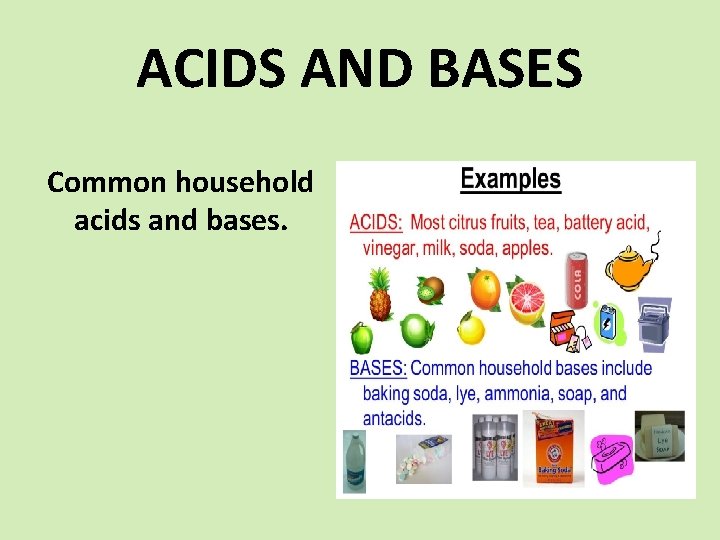
ACIDS AND BASES Common household acids and bases.
- Slides: 35