
Matter How Does It Change Changing States of

- Slides: 10
Matter How Does It Change?
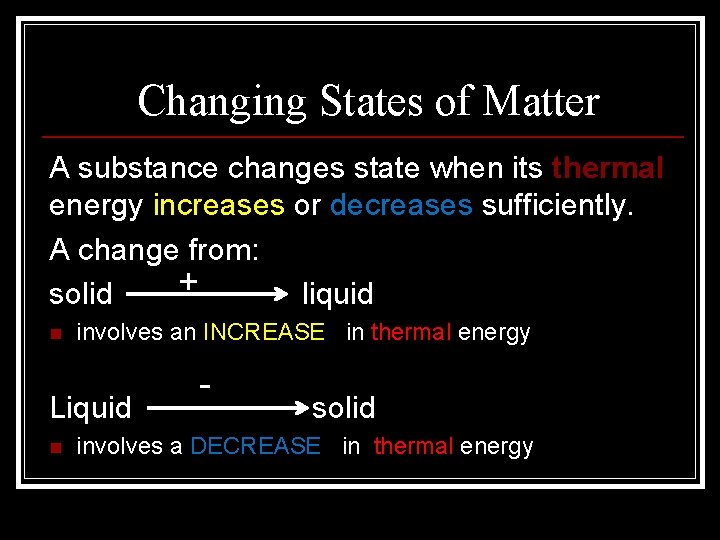
Changing States of Matter A substance changes state when its thermal energy increases or decreases sufficiently. A change from: + solid liquid n involves an INCREASE in thermal energy Liquid n - solid involves a DECREASE in thermal energy
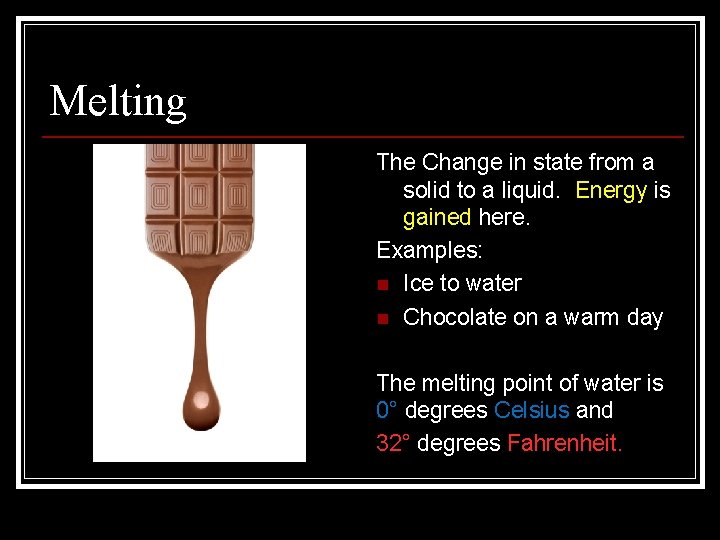
Melting The Change in state from a solid to a liquid. Energy is gained here. Examples: n Ice to water n Chocolate on a warm day The melting point of water is 0° degrees Celsius and 32° degrees Fahrenheit.
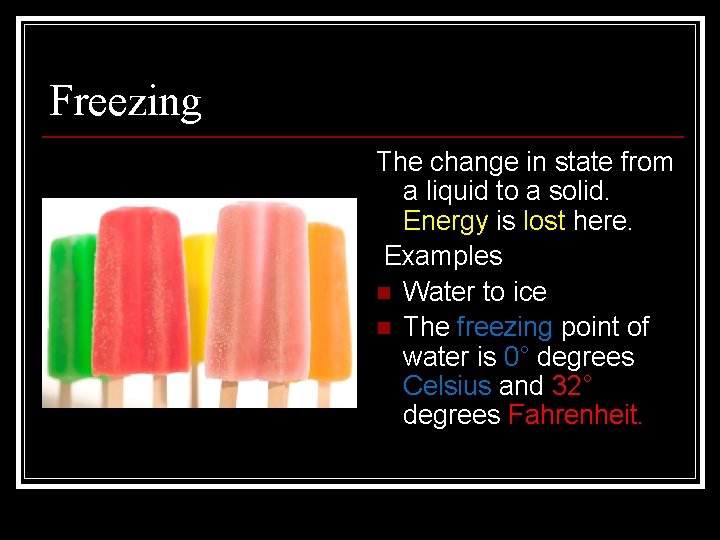
Freezing The change in state from a liquid to a solid. Energy is lost here. Examples n Water to ice n The freezing point of water is 0° degrees Celsius and 32° degrees Fahrenheit.
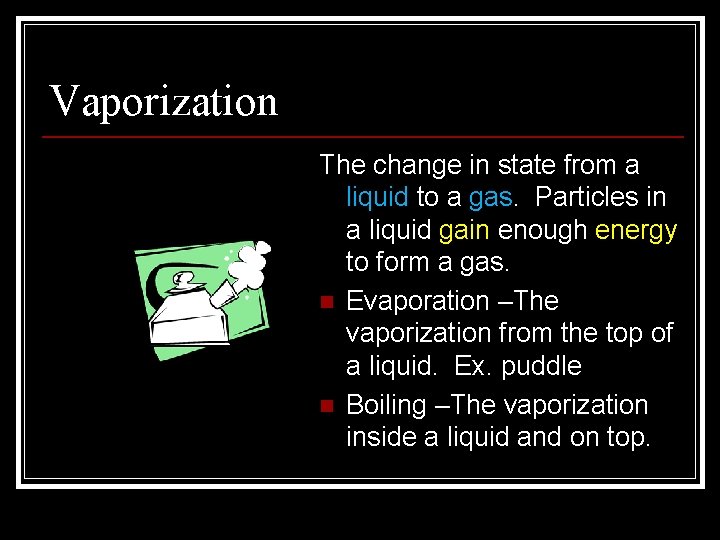
Vaporization The change in state from a liquid to a gas. Particles in a liquid gain enough energy to form a gas. n Evaporation –The vaporization from the top of a liquid. Ex. puddle n Boiling –The vaporization inside a liquid and on top.
Condensation The change of state from a gas to a liquid. Particles in a gas lose enough thermal energy to form a liquid. Examples: n Breathe onto a mirror n Clouds forming n Dew forming on grass
Sublimation The change in state from a solid directly to a gas, without passing through the liquid state. A lot of energy is gained in this process. n Examples: n Dry ice – solid carbon dioxide
The End
Weight A measure of the force of gravity on an object. Measured in ounces, pounds and tons. Mr. Lake weighs 215 lbs. (too much!)
Density The measurement of how much mass of a substance is contained in a given volume. Density = Mass / Volume D=M / V Measured in grams per cubic centimeters. (g/cm 3)