
MATTER AND ITS PROPERTIES What is Matter Sort
- Slides: 16
MATTER AND ITS PROPERTIES
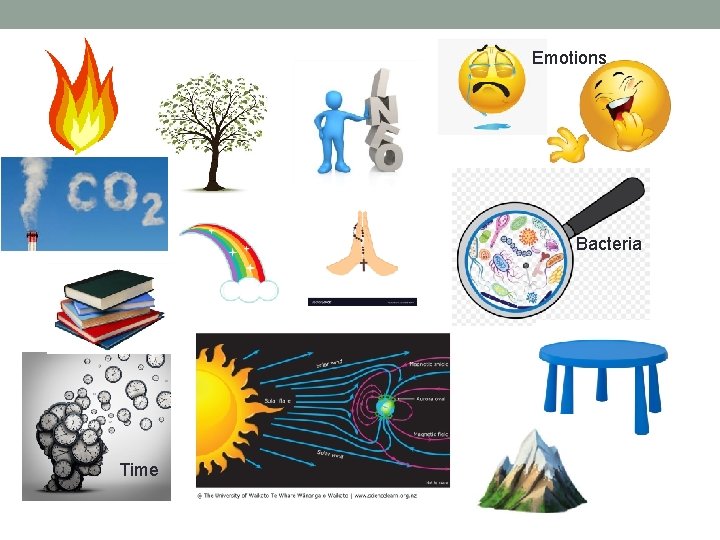
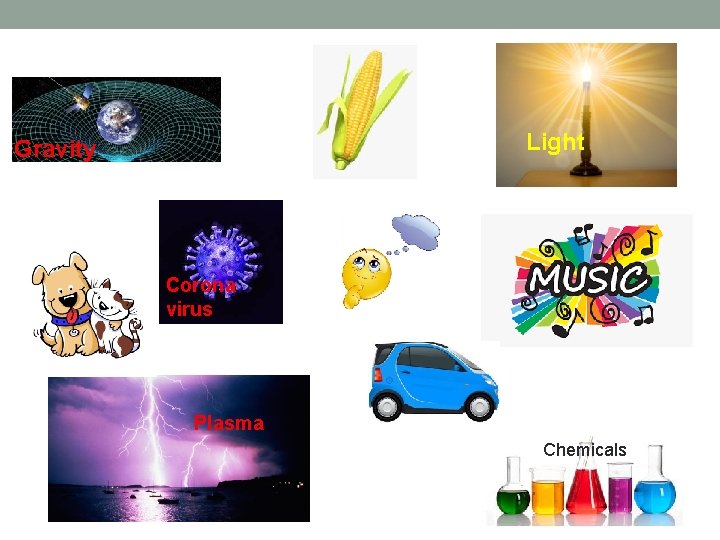
What is Matter? Sort the following into the appropriate column. • Matter • Not Matter
Emotions Bacteria Time
Light Gravity Corona virus Plasma Chemicals
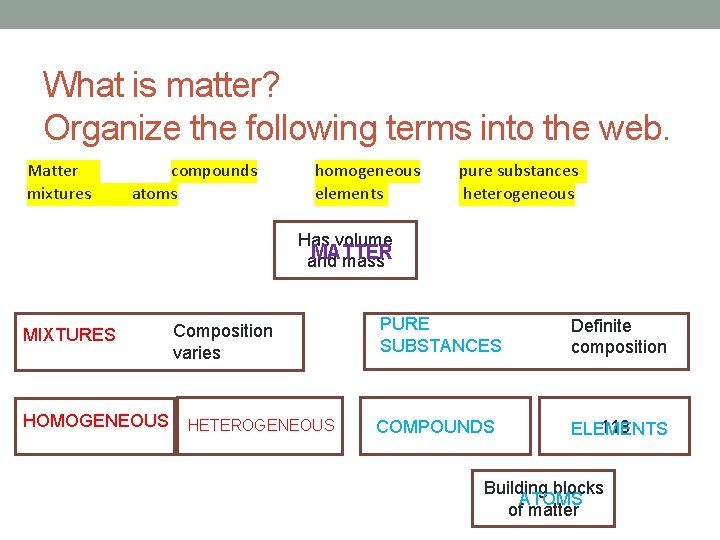
What is matter? Organize the following terms into the web. Matter mixtures compounds atoms homogeneous elements pure substances heterogeneous Has volume MATTER and mass MIXTURES HOMOGENEOUS Composition varies HETEROGENEOUS PURE SUBSTANCES Definite composition COMPOUNDS 118 ELEMENTS Building blocks ATOMS of matter
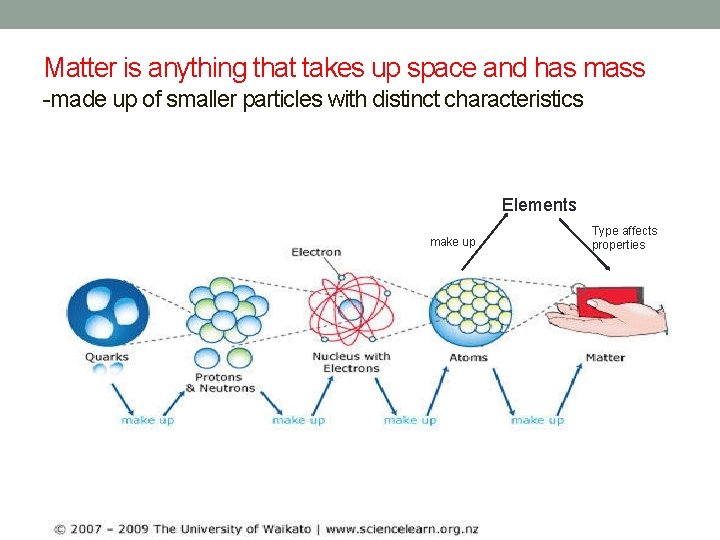
Matter is anything that takes up space and has mass -made up of smaller particles with distinct characteristics Elements make up Type affects properties
Matter can divided into two main groups Mixtures and Pure Substances. Mixtures – two or more substances mixed together in any proportions There are two basic types of mixtures: • In heterogeneous mixtures, you can see the different aspects that make up the mixture and they can be separated (think of a salad). • In a homogenous mixture, components tend to completely mix together and you are unable to see the different components (think about dissolving sugar in water)
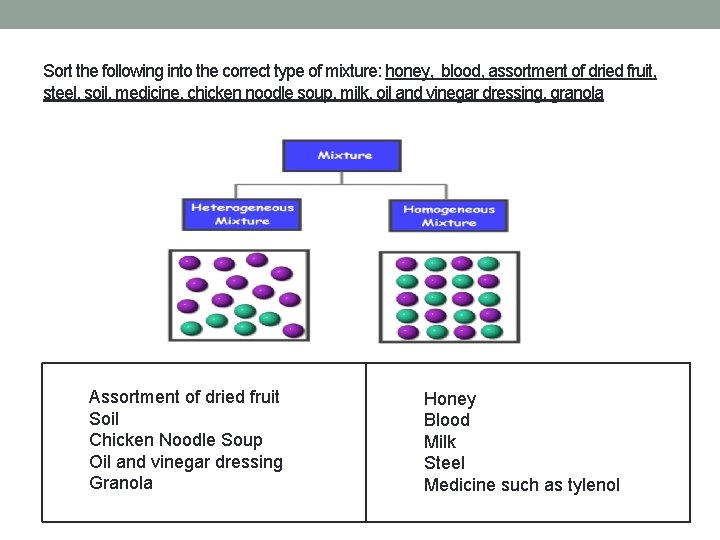
Sort the following into the correct type of mixture: honey, blood, assortment of dried fruit, steel, soil, medicine, chicken noodle soup, milk, oil and vinegar dressing, granola Assortment of dried fruit Soil Chicken Noodle Soup Oil and vinegar dressing Granola Honey Blood Milk Steel Medicine such as tylenol
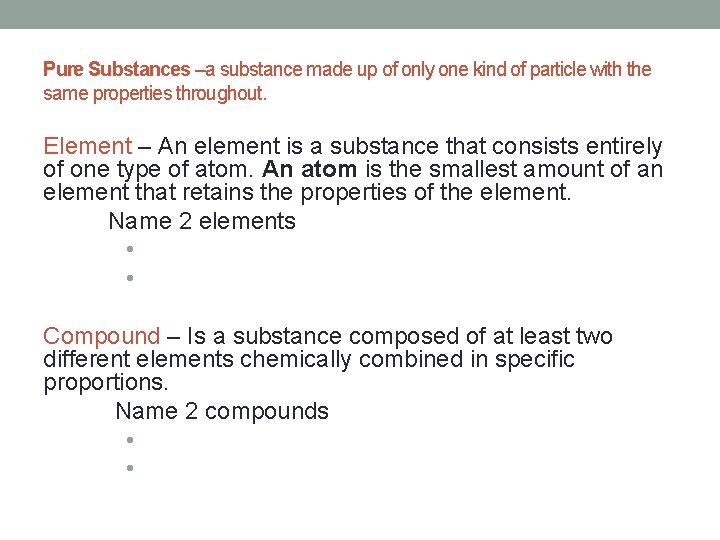
Pure Substances –a substance made up of only one kind of particle with the same properties throughout. Element – An element is a substance that consists entirely of one type of atom. An atom is the smallest amount of an element that retains the properties of the element. Name 2 elements • • Compound – Is a substance composed of at least two different elements chemically combined in specific proportions. Name 2 compounds • •
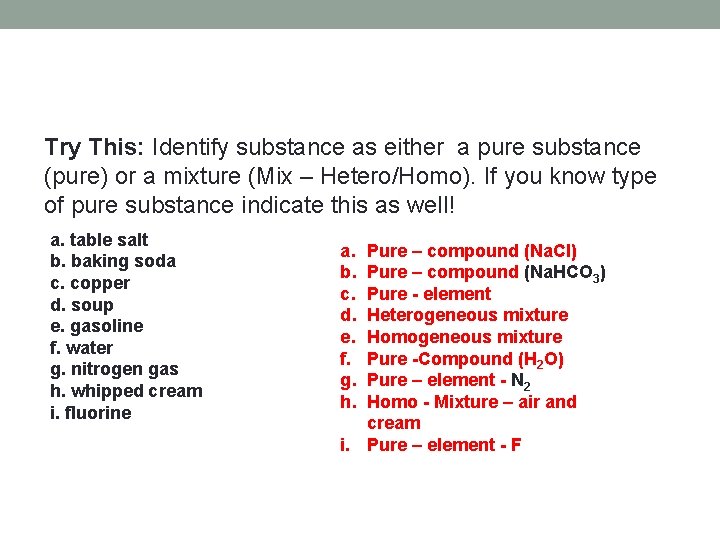
Try This: Identify substance as either a pure substance (pure) or a mixture (Mix – Hetero/Homo). If you know type of pure substance indicate this as well! a. table salt b. baking soda c. copper d. soup e. gasoline f. water g. nitrogen gas h. whipped cream i. fluorine a. b. c. d. e. f. g. h. Pure – compound (Na. Cl) Pure – compound (Na. HCO 3) Pure - element Heterogeneous mixture Homogeneous mixture Pure -Compound (H 2 O) Pure – element - N 2 Homo - Mixture – air and cream i. Pure – element - F
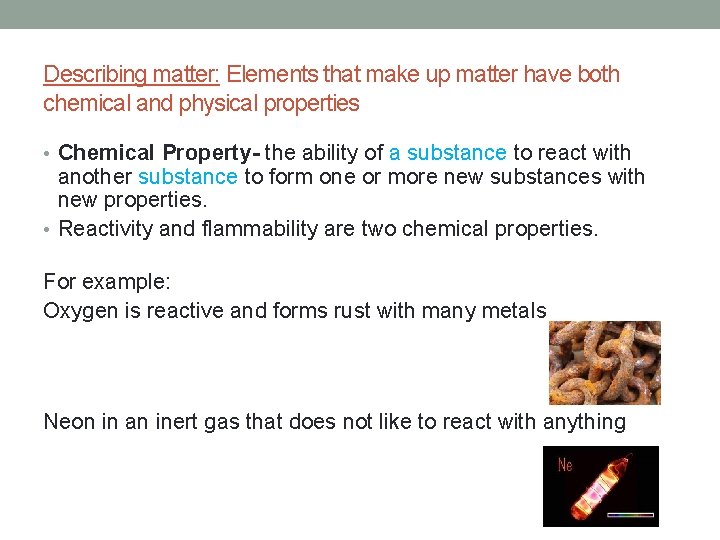
Describing matter: Elements that make up matter have both chemical and physical properties • Chemical Property- the ability of a substance to react with another substance to form one or more new substances with new properties. • Reactivity and flammability are two chemical properties. For example: Oxygen is reactive and forms rust with many metals Neon in an inert gas that does not like to react with anything
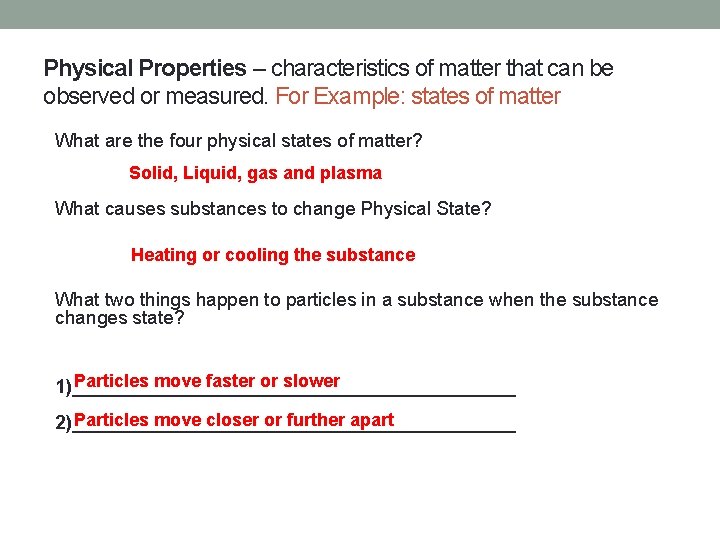
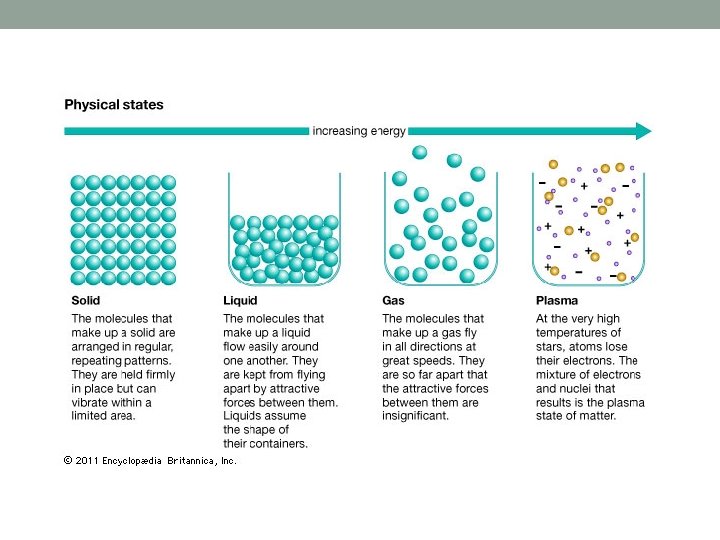
Physical Properties – characteristics of matter that can be observed or measured. For Example: states of matter What are the four physical states of matter? Solid, Liquid, gas and plasma What causes substances to change Physical State? Heating or cooling the substance What two things happen to particles in a substance when the substance changes state? Particles move faster or slower 1)_____________________ Particles move closer or further apart 2)_____________________
Some other physical properties of matter are density, colour, malleability, ductility, crystallinity, magnetism, solubility, conductivity, viscosity, melting/freezing point and boiling/condensing point Match these terms with the appropriate description and complete the table! Use the internet to look up terms you do not know.
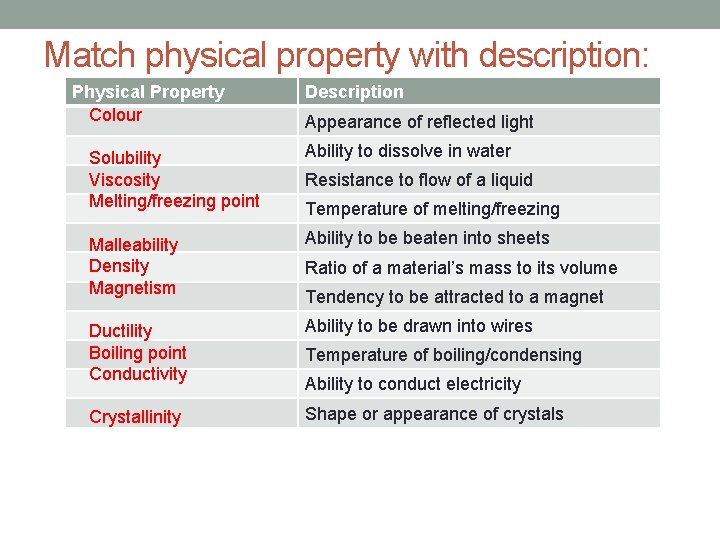
Match physical property with description: Physical Property Colour Description Appearance of reflected light Solubility Viscosity Melting/freezing point Ability to dissolve in water Malleability Density Magnetism Ability to be beaten into sheets Ductility Boiling point Conductivity Ability to be drawn into wires Crystallinity Shape or appearance of crystals Resistance to flow of a liquid Temperature of melting/freezing Ratio of a material’s mass to its volume Tendency to be attracted to a magnet Temperature of boiling/condensing Ability to conduct electricity
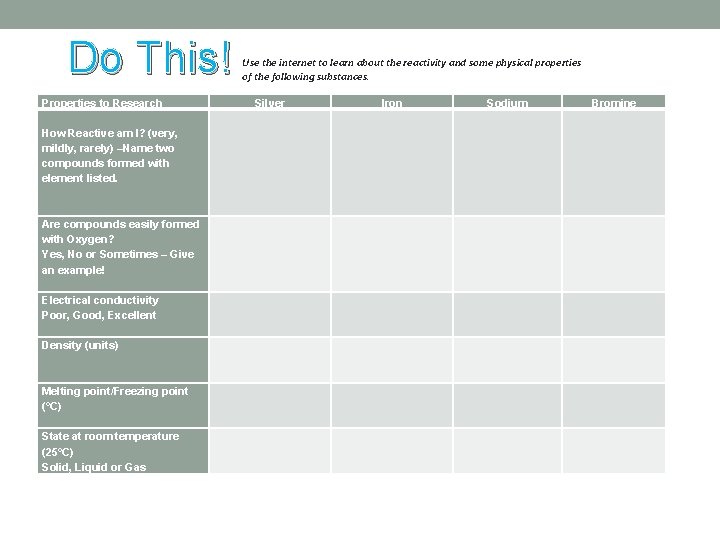
Do This! Properties to Research How Reactive am I? (very, mildly, rarely) –Name two compounds formed with element listed. Are compounds easily formed with Oxygen? Yes, No or Sometimes – Give an example! Electrical conductivity Poor, Good, Excellent Density (units) Melting point/Freezing point (°C) State at room temperature (25°C) Solid, Liquid or Gas Use the internet to learn about the reactivity and some physical properties of the following substances. Silver Iron Sodium Bromine