
MATTER AND ENERGY INTEGRATED SCIENCE C MRS BROSTROM
MATTER AND ENERGY INTEGRATED SCIENCE C MRS. BROSTROM
OBJECTIVES: • Describe the effects of adding energy to matter in terms of the motion of atoms and molecules, and the resulting phase changes.
KINETIC THEORY • The kinetic theory of matter states that matter is made of atoms and molecules that are always in motion. • The faster the particles move, the higher the temperature of the substance • At the same temperature, more massive particles move slower than less massive ones Helps to understand the differences between solids, liquids, and gases
STATES OF MATTER • Can be classified by whether the shape and volume are definite or indefinite • Solids have a definite shape and volume • Atoms are held closely together by strong attractions and vibrate in place • Liquids have a definite volume, but indefinite shape • Particles move more rapidly, than in a solid, & overcome the forces of attraction • Liquids flow freely • Gases have an indefinite shape and volume • Particles move fast enough to break away from each other • Fill their container • Plasma has an indefinite shape and volume • Particles are ionized (electrically charged)
ENERGY OF MATTER • Remember that energy is the ability to change or move matter, or to do work. • The energy of motion is called kinetic energy. • Temperature is a measure of the average kinetic energy of the particles in an object • When you measure an object’s temperature, you measure the average kinetic energy of the particles in the object. • The more kinetic energy the particles of an object have, the higher the temperature of the object is
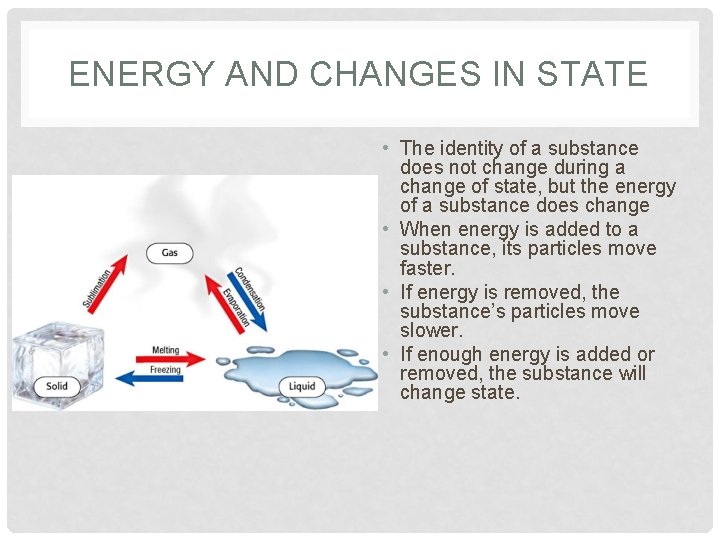
ENERGY AND CHANGES IN STATE • The identity of a substance does not change during a change of state, but the energy of a substance does change • When energy is added to a substance, its particles move faster. • If energy is removed, the substance’s particles move slower. • If enough energy is added or removed, the substance will change state.
SOME CHANGES OF STATE REQUIRE ENERGY • Heating a solid transfers energy to the particles, which vibrate faster as they gain energy. Eventually, they break from their fixed positions, and the solid melts. • melting, evaporation, and sublimation all require energy • Condensation is when water vapor in the air becomes a liquid energy is released from the water to its surroundings- Energy is released from the gas, and the particles slow down • Energy is also released during freezing
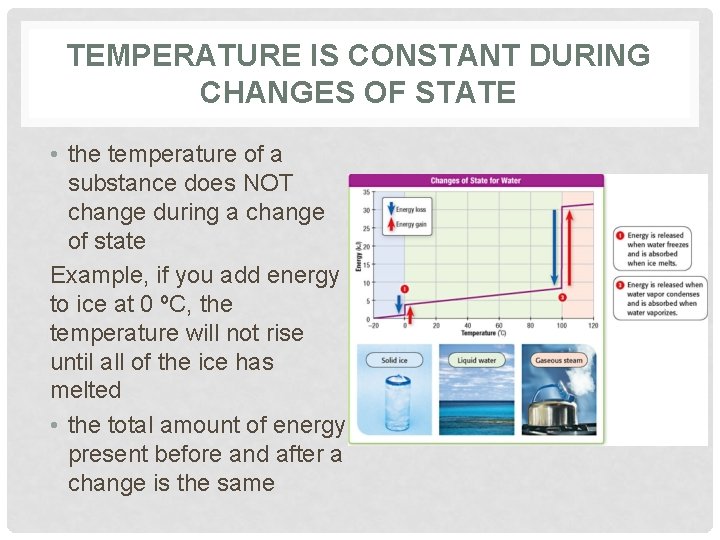
TEMPERATURE IS CONSTANT DURING CHANGES OF STATE • the temperature of a substance does NOT change during a change of state Example, if you add energy to ice at 0 ºC, the temperature will not rise until all of the ice has melted • the total amount of energy present before and after a change is the same
- Slides: 8