
Matter and Chemical Change Grade 9 Science Ms
- Slides: 17
Matter and Chemical Change Grade 9 Science Ms. Cheung (Modified 08/09)
Chemistry is the study of matter, it’s properties and how different forms of matter react with each other.
Topic 1: What’s the Matter!? Matter: anything that has mass and occupies space.
The Particle Theory of Matter. . . • All Matter is made up of tiny particles. • Each pure substance has one type of particle, which is different from all other pure substances. • Particles are attracted to one another • Particles are always moving. • Particles move faster when energy is added to them.
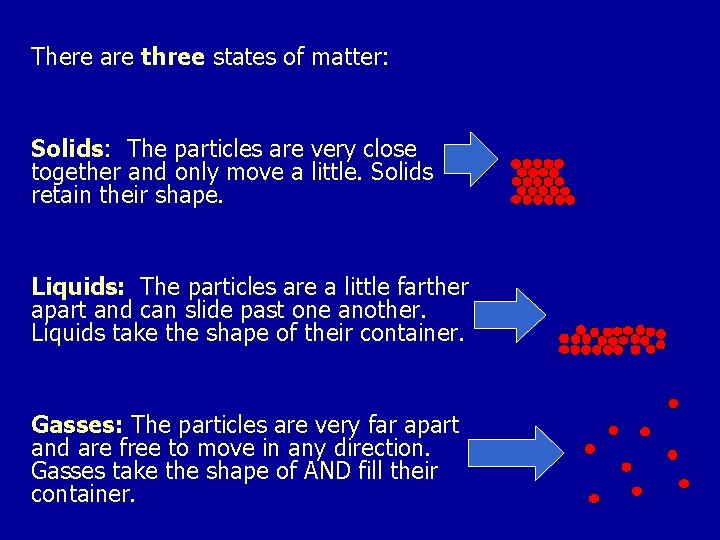
There are three states of matter: Solids: The particles are very close together and only move a little. Solids retain their shape. Liquids: The particles are a little farther apart and can slide past one another. Liquids take the shape of their container. Gasses: The particles are very far apart and are free to move in any direction. Gasses take the shape of AND fill their container.
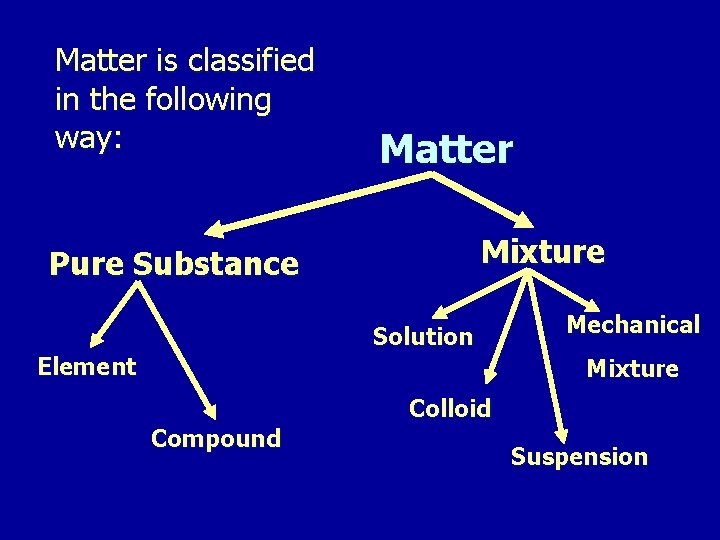
Matter is classified in the following way: Matter Mixture Pure Substance Solution Element Mechanical Mixture Colloid Compound Suspension
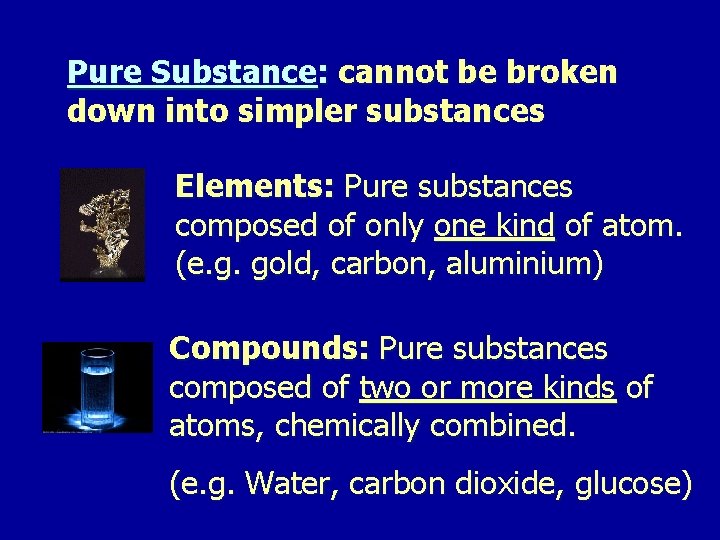
Pure Substance: cannot be broken down into simpler substances Elements: Pure substances composed of only one kind of atom. (e. g. gold, carbon, aluminium) Compounds: Pure substances composed of two or more kinds of atoms, chemically combined. (e. g. Water, carbon dioxide, glucose)
A mixture is any substance that can be separated into its component parts by physical means. Mechanical Mixture Suspension Colloid Solution
Matter can be described and identified by both it’s physical properties, AND its chemical properties. Physical Properties are easily observable characteristics of the substance. E. g. melting point, density, hardness, state at room temperature, colour. Chemical Properties describe how the substance reacts (or doesn’t react) with other substances. E. g. reacts with oxygen to form rust (what we call an ‘oxide’), or explodes in the presence of water.
Topic 2: Lab Safety (is common sense!)
There are TWO sets of symbols that may appear on a product or chemical: 1) Hazard Symbols 2) WHMIS Symbols There is some overlap between the symbol systems in what they cover.
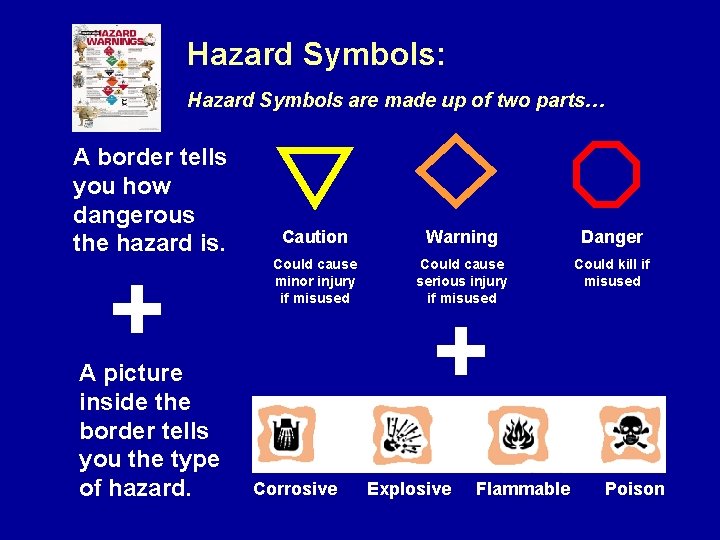
Hazard Symbols: Hazard Symbols are made up of two parts… A border tells you how dangerous the hazard is. + A picture inside the border tells you the type of hazard. Caution Warning Danger Could cause minor injury if misused Could cause serious injury if misused Could kill if misused Corrosive + Explosive Flammable Poison
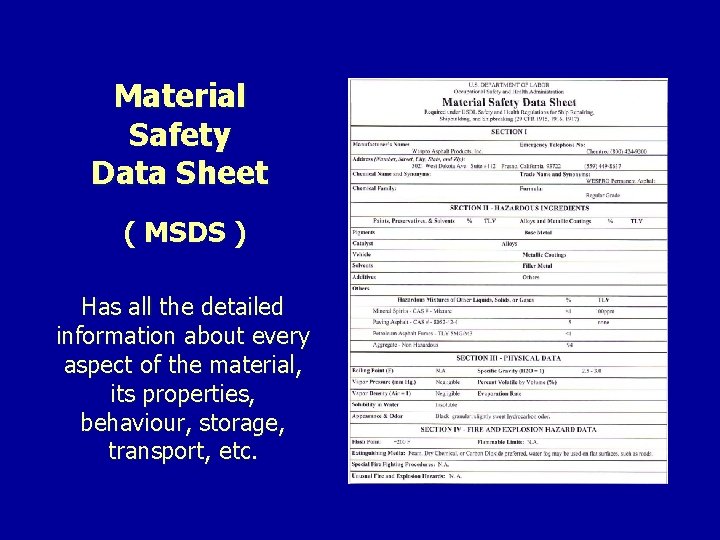
WHMIS is a way to give you information about the hazardous materials used in your school or workplace, so that you know about the possible dangers of these materials, and how to handle them safely. The system is composed of THREE parts: 1) A Warning Symbol System 2) Labeling on containers 3) Material Safety Data Sheets (MSDS) - which describe everything there is to know about a substance, including handling, first aid treatment
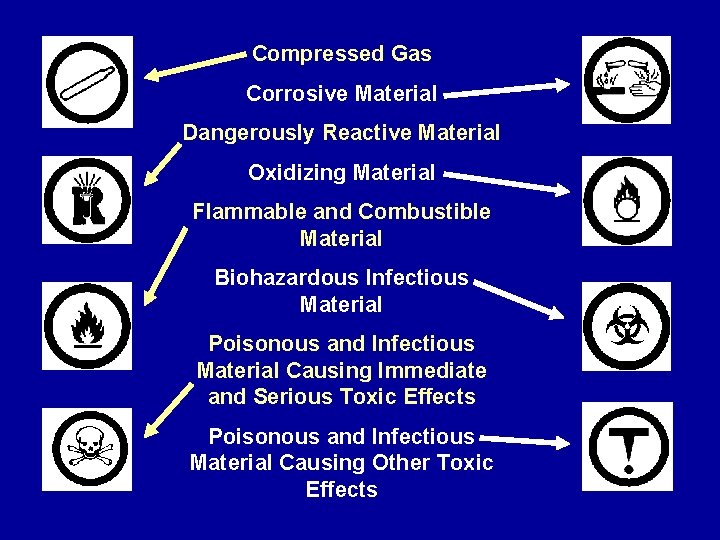
Compressed Gas Corrosive Material Dangerously Reactive Material Oxidizing Material Flammable and Combustible Material Biohazardous Infectious Material Poisonous and Infectious Material Causing Immediate and Serious Toxic Effects Poisonous and Infectious Material Causing Other Toxic Effects
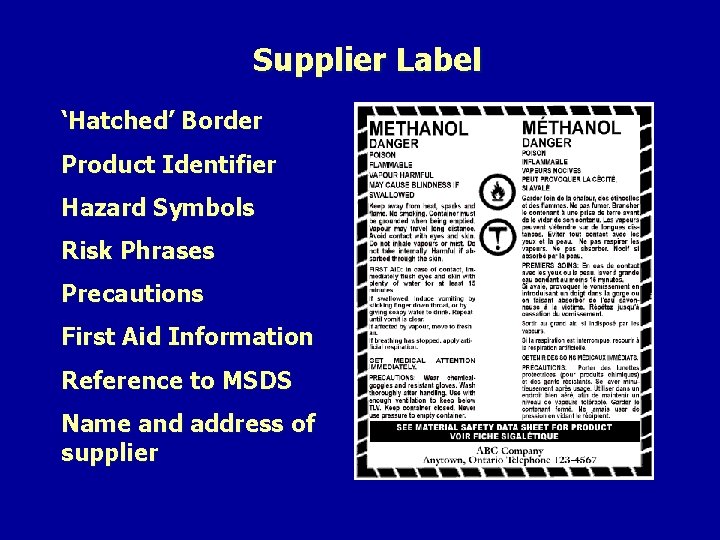
Supplier Label ‘Hatched’ Border Product Identifier Hazard Symbols Risk Phrases Precautions First Aid Information Reference to MSDS Name and address of supplier
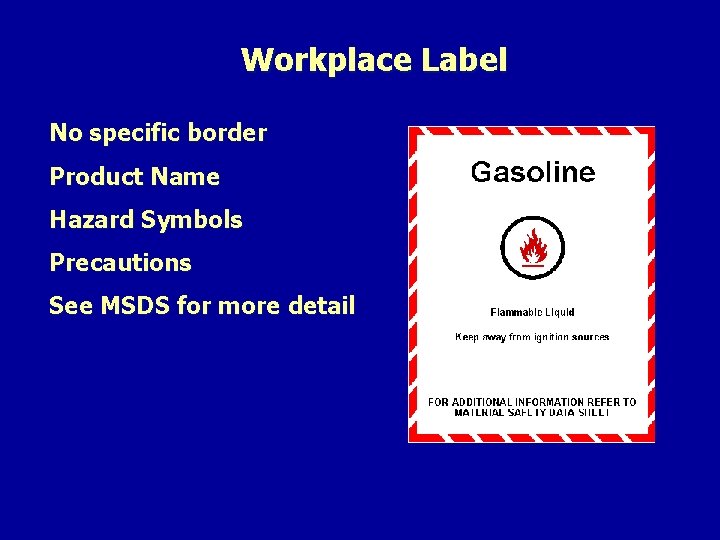
Workplace Label No specific border Product Name Hazard Symbols Precautions See MSDS for more detail
Material Safety Data Sheet ( MSDS ) Has all the detailed information about every aspect of the material, its properties, behaviour, storage, transport, etc.