
Matter and Atoms 1 are smallest parts of
- Slides: 62
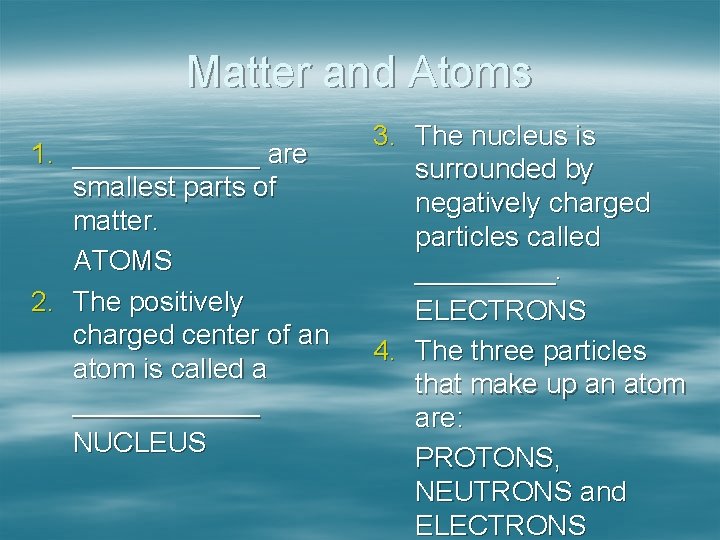
Matter and Atoms 1. ______ are smallest parts of matter. ATOMS 2. The positively charged center of an atom is called a ______ NUCLEUS 3. The nucleus is surrounded by negatively charged particles called _____. ELECTRONS 4. The three particles that make up an atom are: PROTONS, NEUTRONS and ELECTRONS
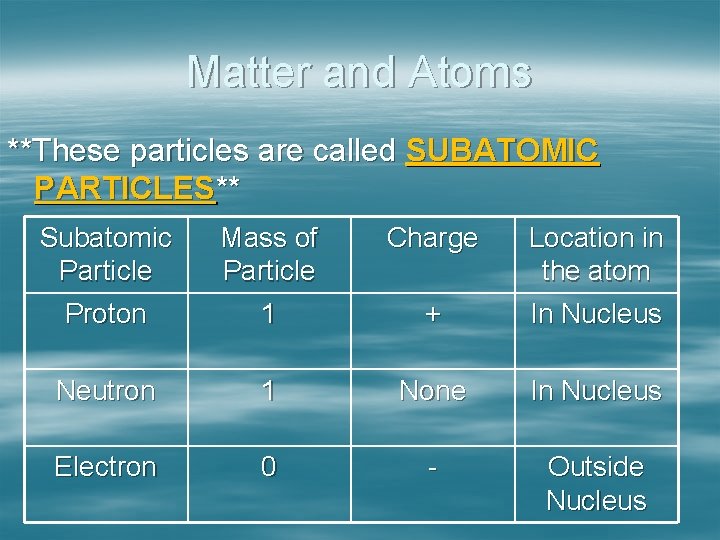
Matter and Atoms **These particles are called SUBATOMIC PARTICLES** Subatomic Particle Proton Mass of Particle 1 Charge + Location in the atom In Nucleus Neutron 1 None In Nucleus Electron 0 - Outside Nucleus
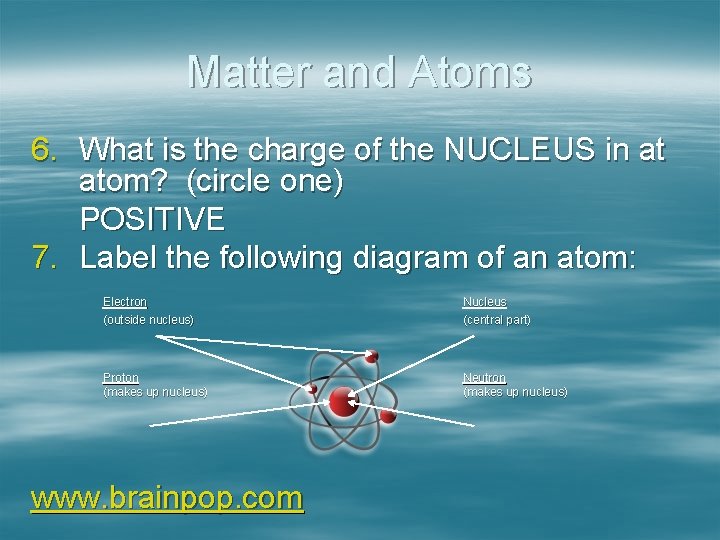
Matter and Atoms 6. What is the charge of the NUCLEUS in at atom? (circle one) POSITIVE 7. Label the following diagram of an atom: Electron (outside nucleus) Nucleus (central part) Proton (makes up nucleus) Neutron (makes up nucleus) www. brainpop. com
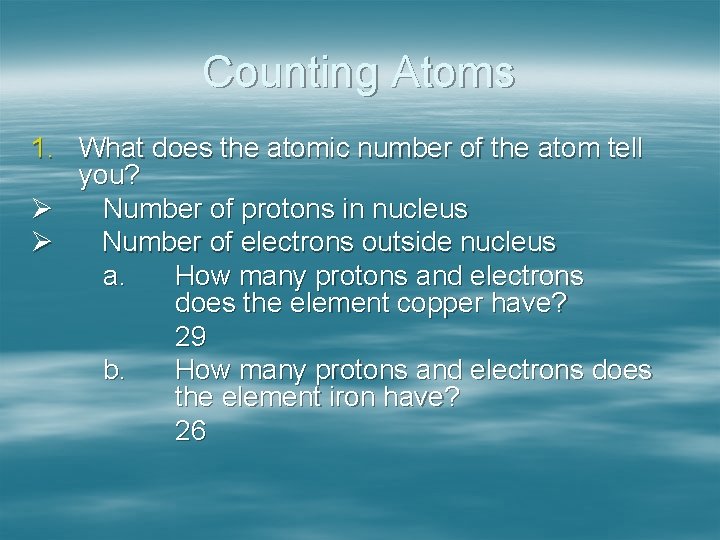
Counting Atoms 1. What does the atomic number of the atom tell you? Ø Number of protons in nucleus Ø Number of electrons outside nucleus a. How many protons and electrons does the element copper have? 29 b. How many protons and electrons does the element iron have? 26
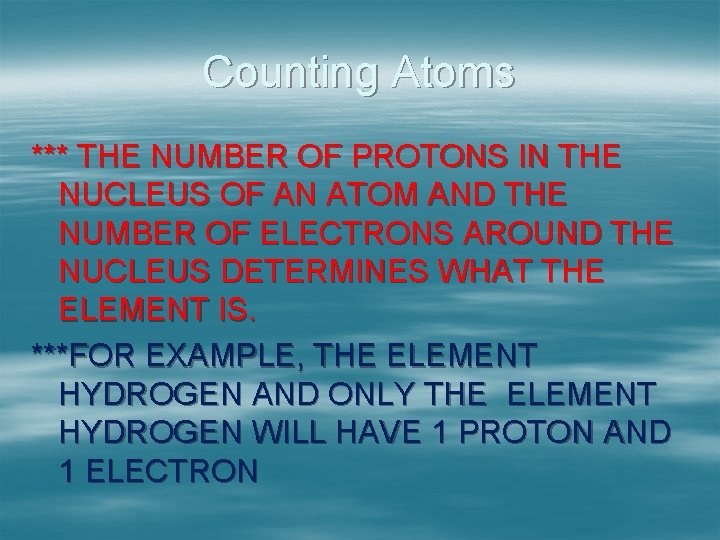
Counting Atoms *** THE NUMBER OF PROTONS IN THE NUCLEUS OF AN ATOM AND THE NUMBER OF ELECTRONS AROUND THE NUCLEUS DETERMINES WHAT THE ELEMENT IS. ***FOR EXAMPLE, THE ELEMENT HYDROGEN AND ONLY THE ELEMENT HYDROGEN WILL HAVE 1 PROTON AND 1 ELECTRON
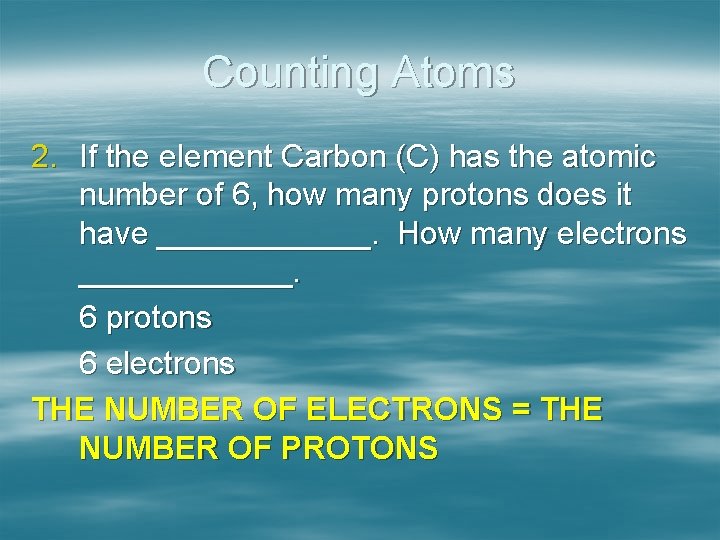
Counting Atoms 2. If the element Carbon (C) has the atomic number of 6, how many protons does it have ______. How many electrons ______. 6 protons 6 electrons THE NUMBER OF ELECTRONS = THE NUMBER OF PROTONS
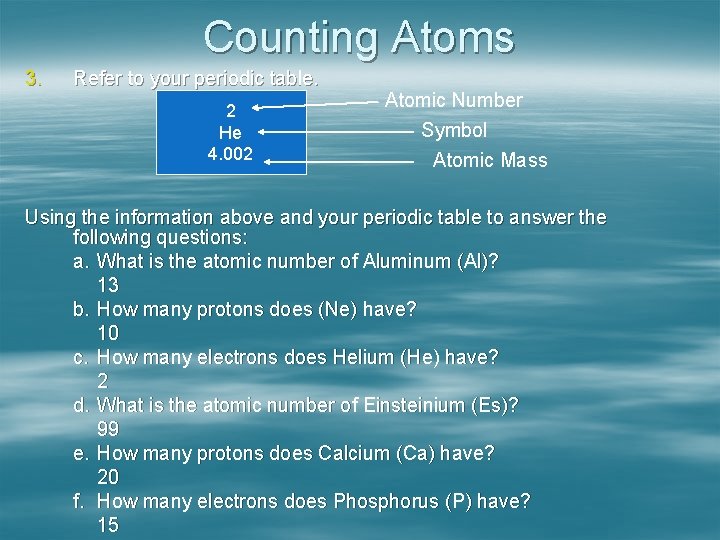
Counting Atoms 3. Refer to your periodic table. 2 He 4. 002 Atomic Number Symbol Atomic Mass Using the information above and your periodic table to answer the following questions: a. What is the atomic number of Aluminum (Al)? 13 b. How many protons does (Ne) have? 10 c. How many electrons does Helium (He) have? 2 d. What is the atomic number of Einsteinium (Es)? 99 e. How many protons does Calcium (Ca) have? 20 f. How many electrons does Phosphorus (P) have? 15
Agenda for 11/14/16 § § § Turn in Yellow Packet #2 Periodic Table Puns The Atom: A Cloudy View Notes The Atoms Family worksheet HW – Finish Atom’s Family Worksheet § Atomic Structure Quiz on Friday § 30 Element Quiz next Tuesday
The Atom: A Cloudy View *An electron cloud is a region where electrons are most probably found. The electron cloud surrounds the nucleus of an atom. https: //www. youtube. com/watch? v=lr 9 WZP 9 gjh. M
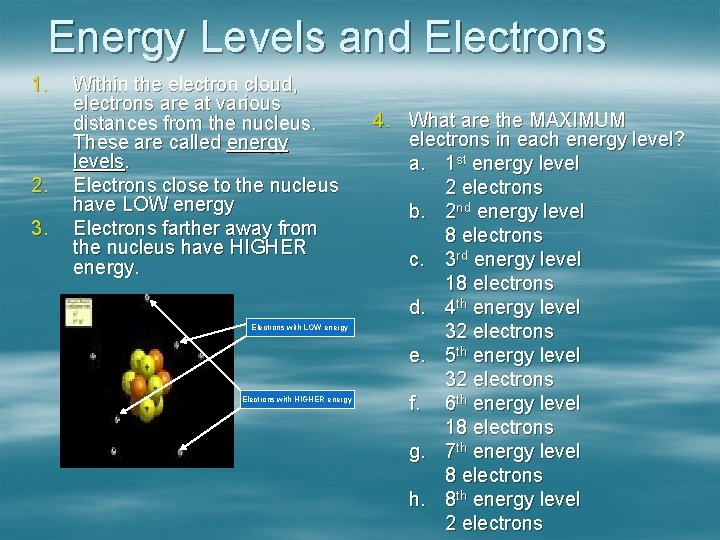
Energy Levels and Electrons 1. 2. 3. Within the electron cloud, electrons are at various distances from the nucleus. These are called energy levels. Electrons close to the nucleus have LOW energy Electrons farther away from the nucleus have HIGHER energy. Electrons with LOW energy Electrons with HIGHER energy 4. What are the MAXIMUM electrons in each energy level? a. 1 st energy level 2 electrons b. 2 nd energy level 8 electrons c. 3 rd energy level 18 electrons d. 4 th energy level 32 electrons e. 5 th energy level 32 electrons f. 6 th energy level 18 electrons g. 7 th energy level 8 electrons h. 8 th energy level 2 electrons
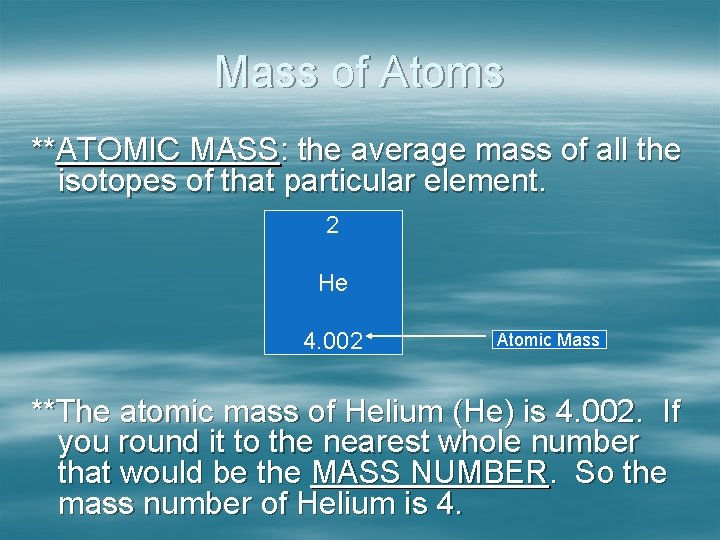
Mass of Atoms **ATOMIC MASS: the average mass of all the isotopes of that particular element. 2 He 4. 002 Atomic Mass **The atomic mass of Helium (He) is 4. 002. If you round it to the nearest whole number that would be the MASS NUMBER. So the mass number of Helium is 4.
Use your periodic table to determine the following: 1. What is the atomic mass of Oxygen (O)? 15. 994 What is the mass number of Oxygen (O)? 16 2. What is the atomic mass of Nitrogen (N)? 14. 0067 What is the mass number of Nitrogen (N)? 14
Mass Number 1. The sum of the number of protons (atomic number) and the number of neutrons in an atom is called the MASS NUMBER. OR Mass Number = Number of Protons + Number of Neutrons
2. What is the mass number of an element with 8 protons and 6 neutrons? 14 3. How many neutrons are in an atom with a mass number of 19 and 9 protons? 10
Use your periodic table for the following: 4. What is the atomic number of Magnesium (Mg)? 12 5. What is the mass number of Mg? 24 6. How many protons are in Mg? 12 7. How many neutrons are in Mg? 12 8. How many electrons are in Mg? 12
Isotopes of an Element 1. Isotope - atoms of the same element that have different numbers of neutrons. 2. Why isn’t the atomic mass of an element a whole number? It is the average mass of an element of its isotopes. 3. How are isotopes of an element alike and how are they different? Alike - The element name, symbol and atomic number are the same. Different - The number of neutrons and mass number are different.
Isotopes of an Element § § Whenever you have an element that has at least two different values of neutrons, you have what is called an ISOTOPE. Example of isotope: Potassium (K) has the atomic number of 19. This will never change. However, there are situations where Potassium could have an atomic mass of 39. 10 (mass number of 39 = 19 protons and 20 neutrons). Potassium could also have an atomic mass of 39. 72 (mass number of 40 = 19 protons and 21 neutrons).
Isotope or Different Element? § If comparing 2 substances and they have the same # of protons and different number of neutrons = isotopes § If comparing 2 substances and they have a different amount of protons and same/different # of neutrons = different element
Isotopes or Different Elements? Identify as isotopes or different elements and name of element(s). Element A has 34 protons and 45 neutrons. Element B has 34 protons and 46 neutrons. Answer: isotopes (Se – Selenium) Element C has 2 electrons and 7 neutrons. Element D has 3 electrons and 9 neutrons. Answer: different elements (He – Helium and Li – Lithium) Element E has an atomic number or 54 and 67 neutrons. Element F has an atomic number of 54 and 69 neutrons. Answer: isotopes (Xe – Xenon)
Atomic Structure Sheet #1 § 1) Explain how the following terms are related – Atomic number and proton – the atomic number tells you how many protons there are in an element – Isotope and neutron – isotopes are based on different number of neutrons – Electrons and energy levels – electrons are found in energy levels. Energy levels are used to predict the location of electrons – Mass number and isotope – the mass number is found by averaging all of the isotopes of an element
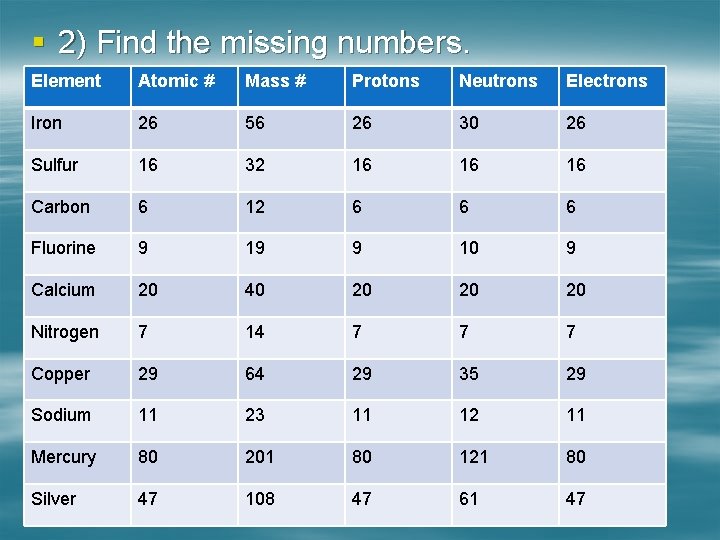
§ 2) Find the missing numbers. Element Atomic # Mass # Protons Neutrons Electrons Iron 26 56 26 30 26 Sulfur 16 32 16 16 16 Carbon 6 12 6 6 6 Fluorine 9 19 9 10 9 Calcium 20 40 20 20 20 Nitrogen 7 14 7 7 7 Copper 29 64 29 35 29 Sodium 11 23 11 12 11 Mercury 80 201 80 121 80 Silver 47 108 47 61 47
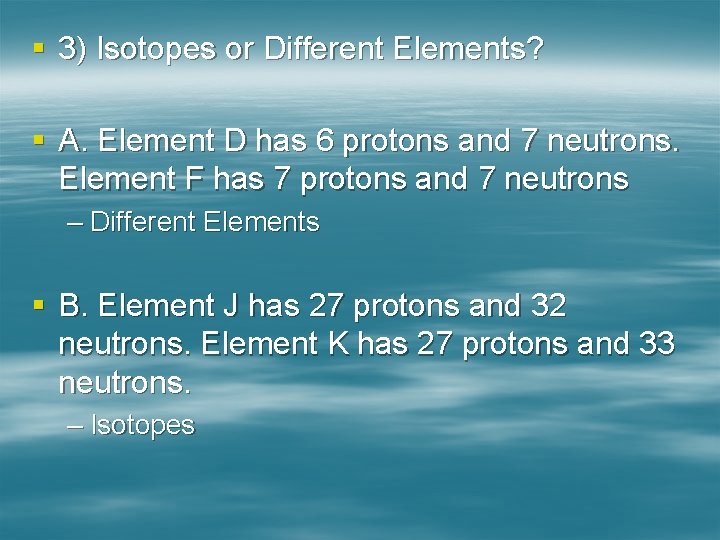
§ 3) Isotopes or Different Elements? § A. Element D has 6 protons and 7 neutrons. Element F has 7 protons and 7 neutrons – Different Elements § B. Element J has 27 protons and 32 neutrons. Element K has 27 protons and 33 neutrons. – Isotopes
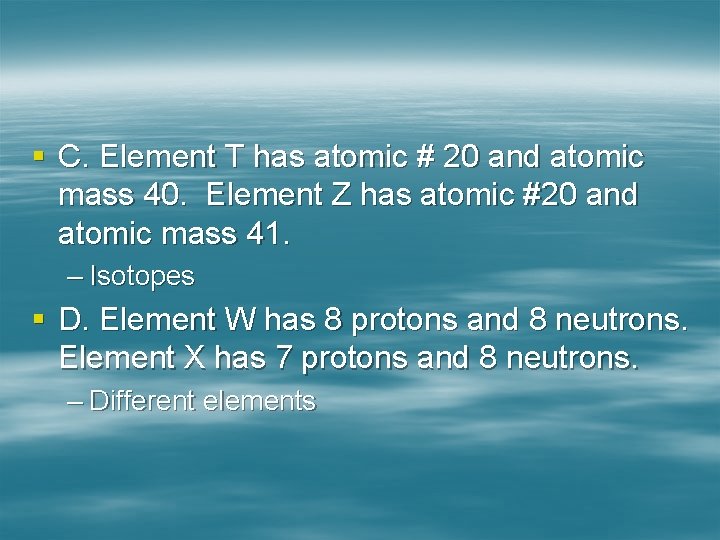
§ C. Element T has atomic # 20 and atomic mass 40. Element Z has atomic #20 and atomic mass 41. – Isotopes § D. Element W has 8 protons and 8 neutrons. Element X has 7 protons and 8 neutrons. – Different elements
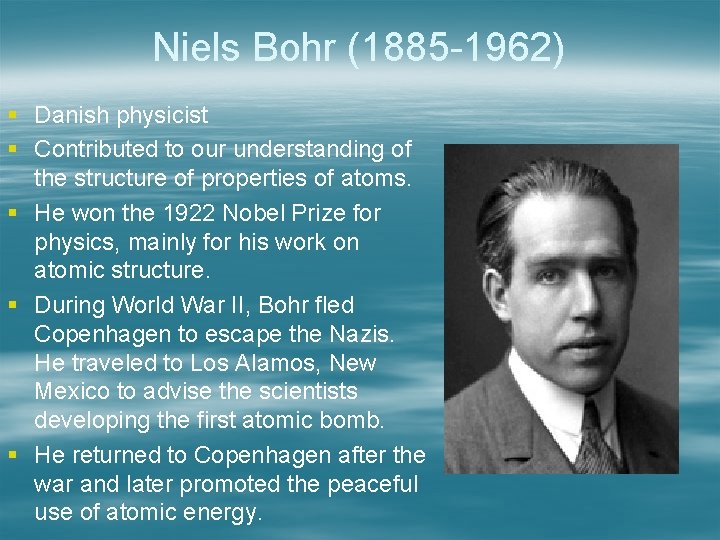
Niels Bohr (1885 -1962) § Danish physicist § Contributed to our understanding of the structure of properties of atoms. § He won the 1922 Nobel Prize for physics, mainly for his work on atomic structure. § During World War II, Bohr fled Copenhagen to escape the Nazis. He traveled to Los Alamos, New Mexico to advise the scientists developing the first atomic bomb. § He returned to Copenhagen after the war and later promoted the peaceful use of atomic energy.
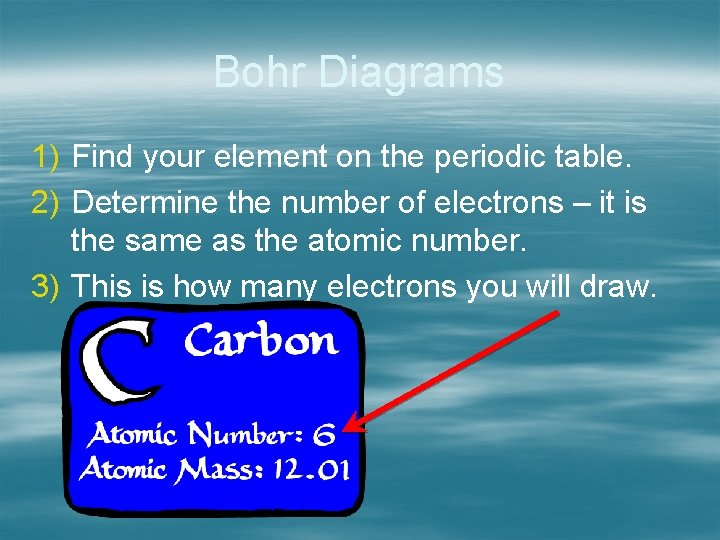
Bohr Diagrams 1) Find your element on the periodic table. 2) Determine the number of electrons – it is the same as the atomic number. 3) This is how many electrons you will draw.
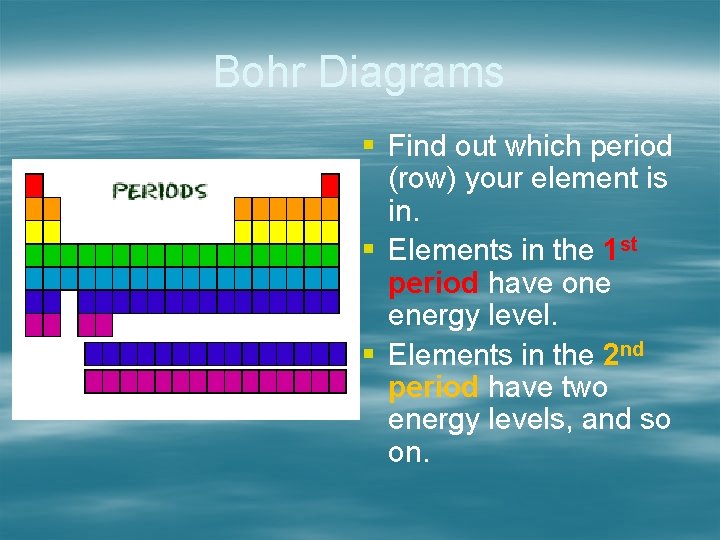
Bohr Diagrams § Find out which period (row) your element is in. § Elements in the 1 st period have one energy level. § Elements in the 2 nd period have two energy levels, and so on.
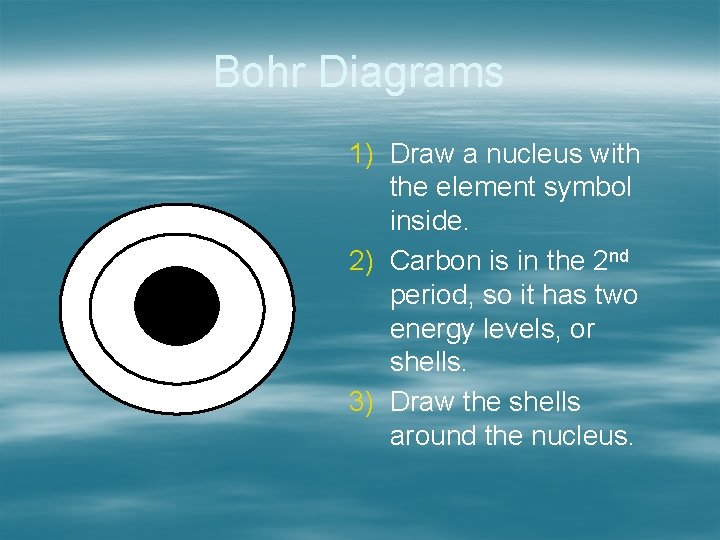
Bohr Diagrams C 1) Draw a nucleus with the element symbol inside. 2) Carbon is in the 2 nd period, so it has two energy levels, or shells. 3) Draw the shells around the nucleus.
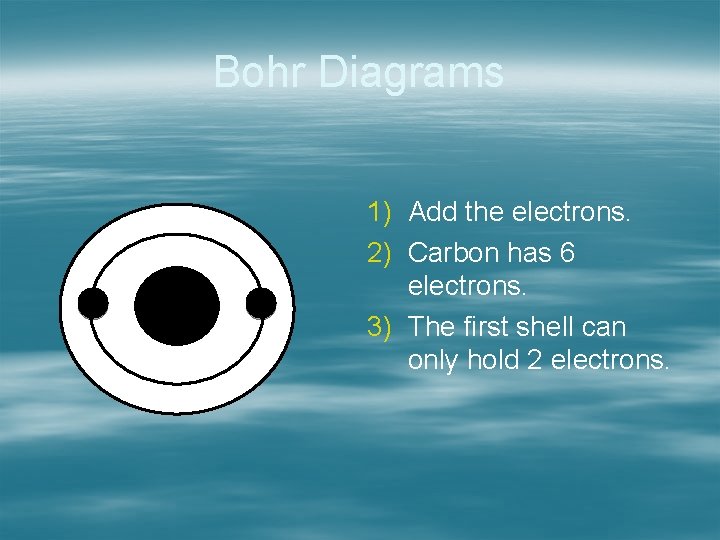
Bohr Diagrams C 1) Add the electrons. 2) Carbon has 6 electrons. 3) The first shell can only hold 2 electrons.
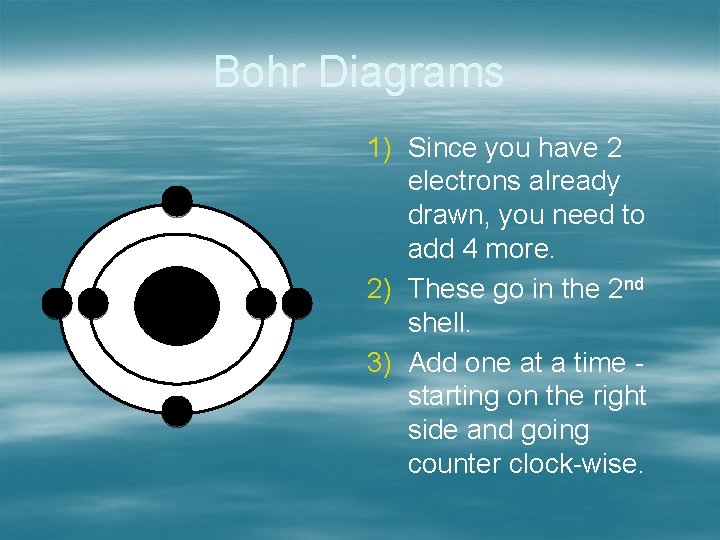
Bohr Diagrams C 1) Since you have 2 electrons already drawn, you need to add 4 more. 2) These go in the 2 nd shell. 3) Add one at a time starting on the right side and going counter clock-wise.
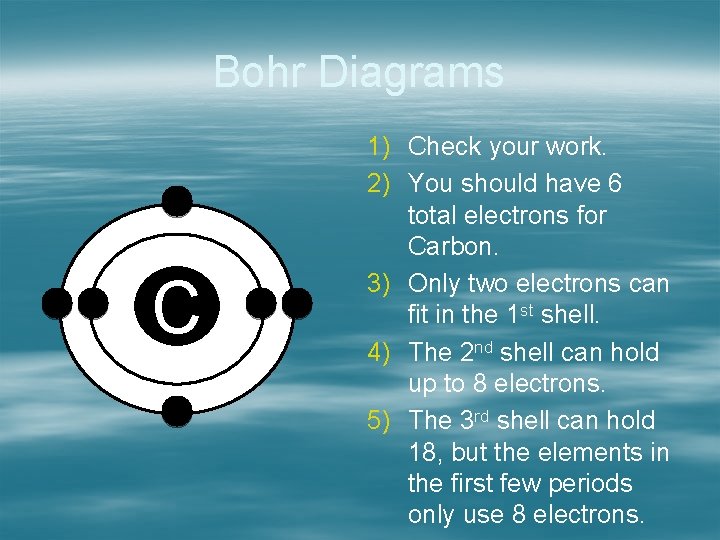
Bohr Diagrams C 1) Check your work. 2) You should have 6 total electrons for Carbon. 3) Only two electrons can fit in the 1 st shell. 4) The 2 nd shell can hold up to 8 electrons. 5) The 3 rd shell can hold 18, but the elements in the first few periods only use 8 electrons.
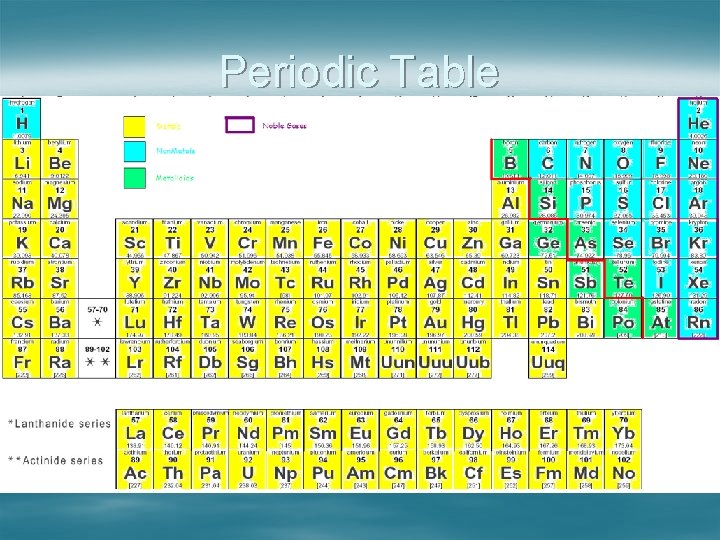
Periodic Table Classification
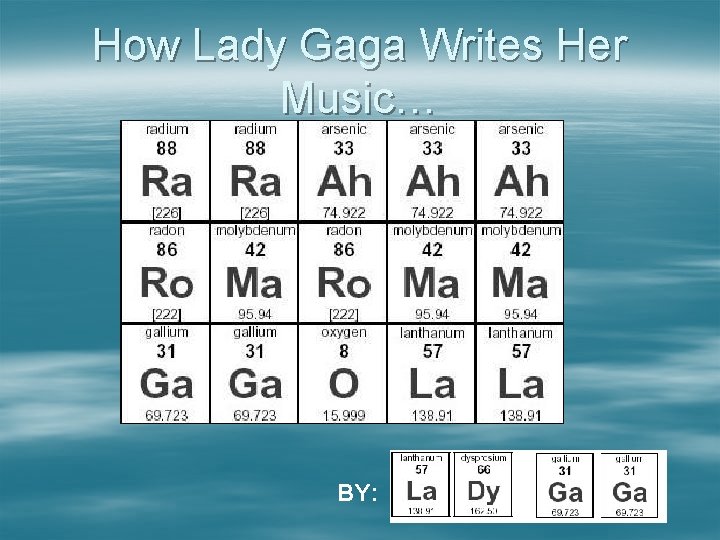
How Lady Gaga Writes Her Music… BY:
Can Anyone Else Spell Their Name Using Periodic Table?
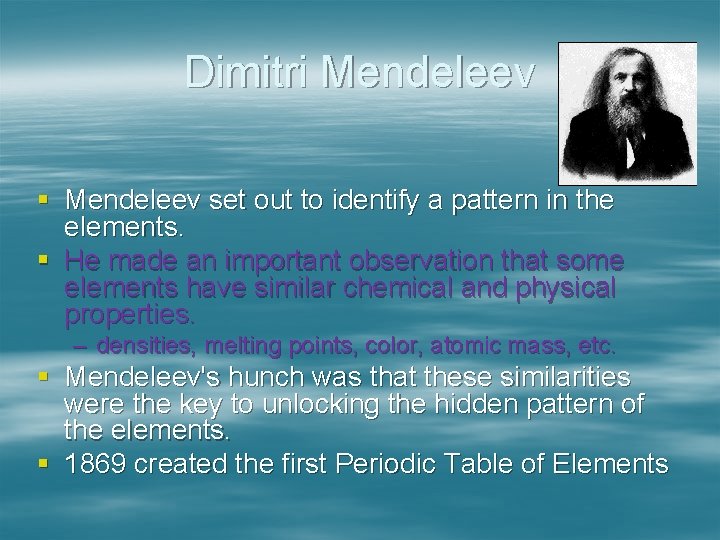
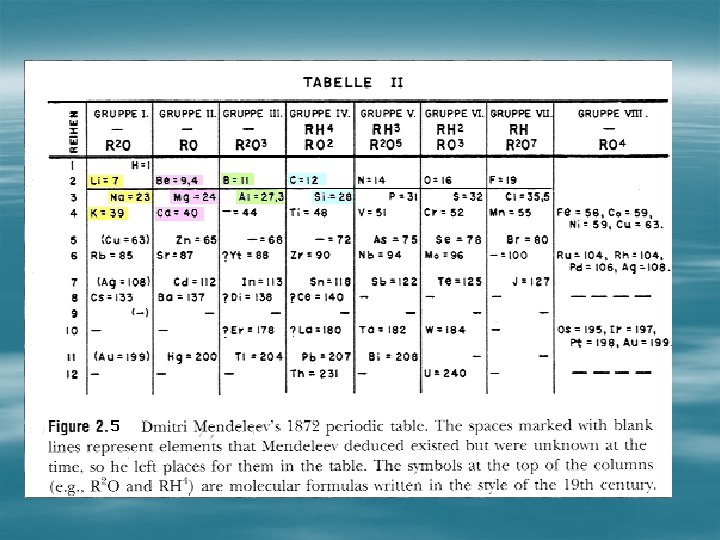
Dimitri Mendeleev § Mendeleev set out to identify a pattern in the elements. § He made an important observation that some elements have similar chemical and physical properties. – densities, melting points, color, atomic mass, etc. § Mendeleev's hunch was that these similarities were the key to unlocking the hidden pattern of the elements. § 1869 created the first Periodic Table of Elements
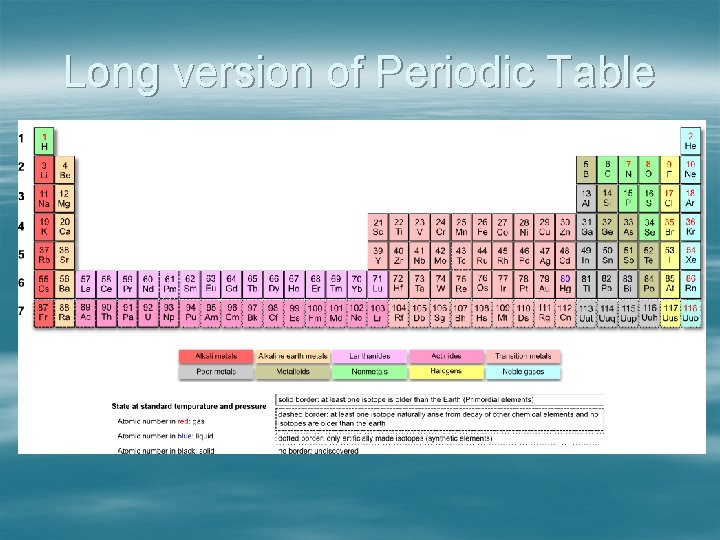
Long version of Periodic Table
§ Periodic - means that there is a repeating pattern – the properties of the elements repeat with each row, or period, of the table § The elements are arranged in rows and columns – Rows are also called periods – Columns are also called groups or families
Groups or Families § Groups or families are the 18 Vertical columns § Elements in the same group or family have similar but not identical characteristics.
§ Groups or families have elements with similar characteristics. § Group 1 elements all react violently with water. http: //www. youtube. com/watch? v=ODf_s. Pex. S 2 Q http: //www. youtube. com/watch? v=Jy 1 DC 6 Euqj 4
Periods § Elements in a period are not alike in properties § Atomic number and atomic mass increases from left to right
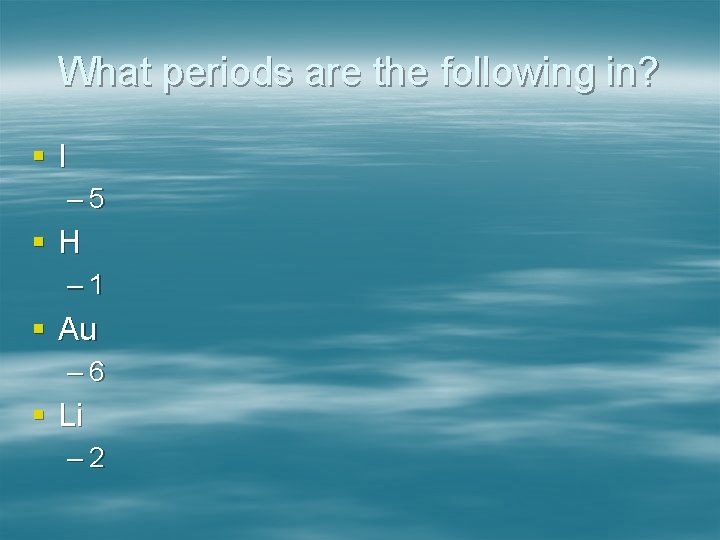
What periods are the following in? §I – 5 §H – 1 § Au – 6 § Li – 2
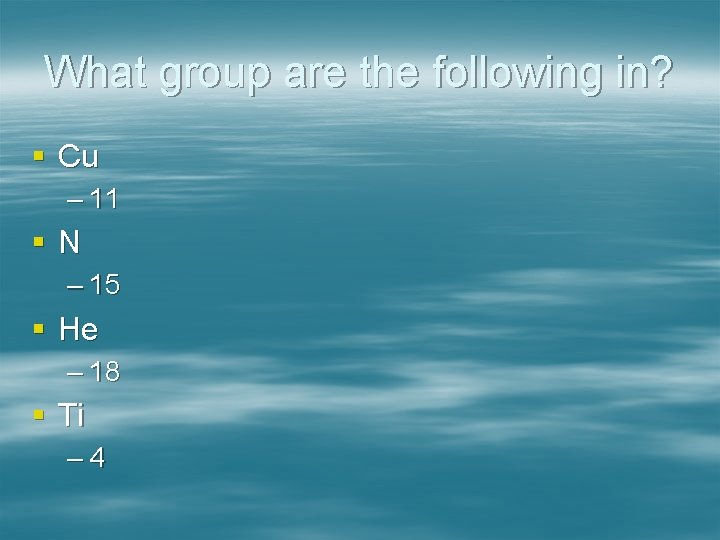
What group are the following in? § Cu – 11 §N – 15 § He – 18 § Ti – 4
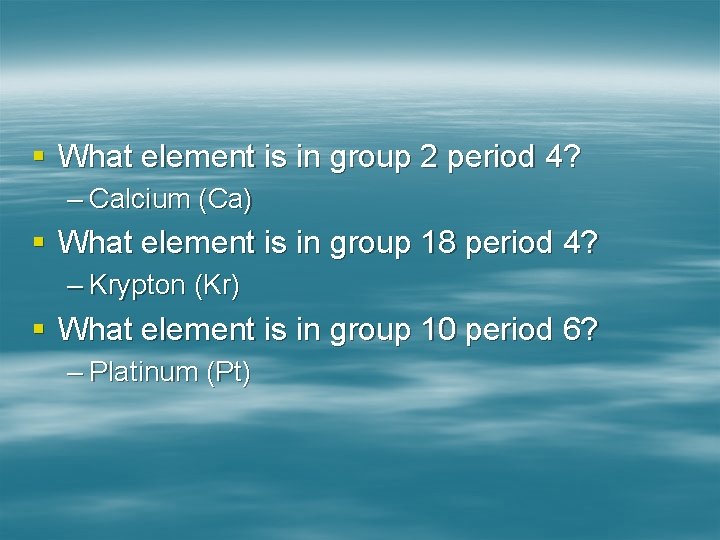
§ What element is in group 2 period 4? – Calcium (Ca) § What element is in group 18 period 4? – Krypton (Kr) § What element is in group 10 period 6? – Platinum (Pt)
Periodic Table Classification
Elements are grouped according to metallic characteristics: METALS Physical properties: 1. High Luster (shininess). 2. Malleable (able to hammer into thin sheets). 3. Ductile (able to make into wires). 4. Good conductors of heat and electricity.
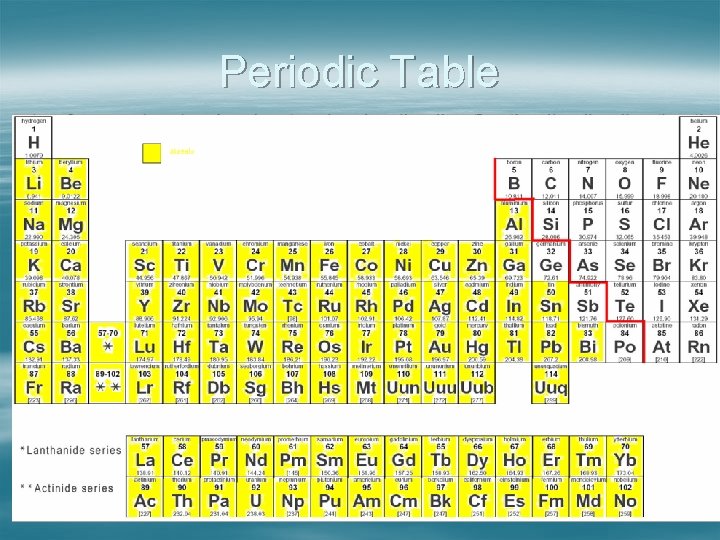
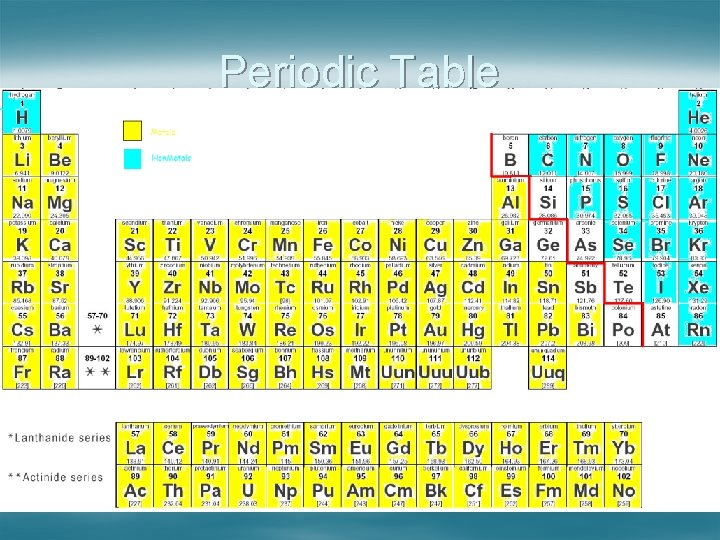
Location: Left side of the stairs (except H). Most metallic in bottom left (Fr) and least metallic in top right (Al). 2/3 of all elements are METALS!!
Periodic Table
NON-METALS Physical Properties: 1. Little or no luster. 2. Not malleable. 3. Not ductile. 4. Good insulators; doesn’t conduct electricity or heat well. 5. Brittle. Location: Right side of the stairs. Most non-metallic is (O) and least nonmetallic is (Se).
Periodic Table
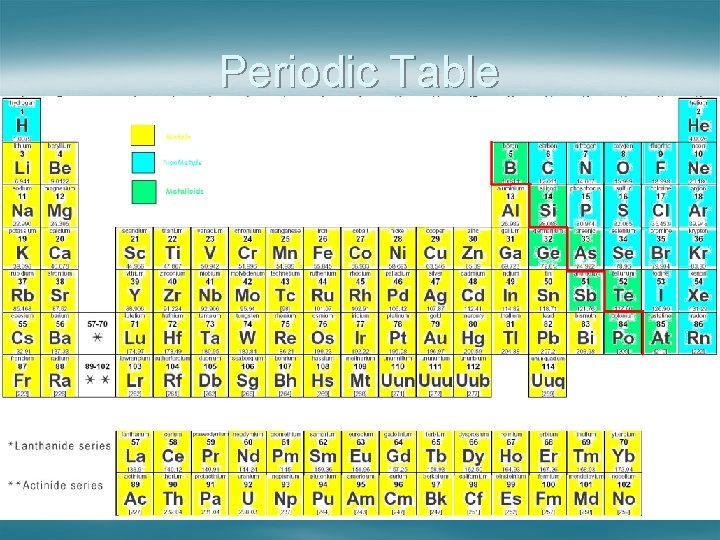
METALLOIDS Physical Properties: 1. Have properties of both metals and non-metals. Location: Found along stairs (B, Si, Ge, As, Sb, Te, Po, At) NOT Aluminum (Al)
Periodic Table
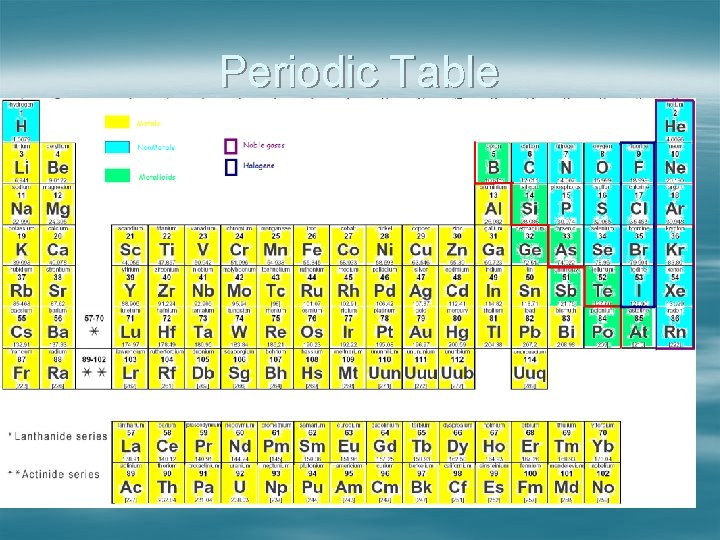
NOBLE GASES (INERT GASES) Physical Properties: 1. Do not combine chemically with other elements (does not form compounds). 2. All are gases at room temperature. Location: Last column – Group 18 (He, Ne, Ar, Kr, Xe, Rn). Spectrum Tube Demo
Periodic Table
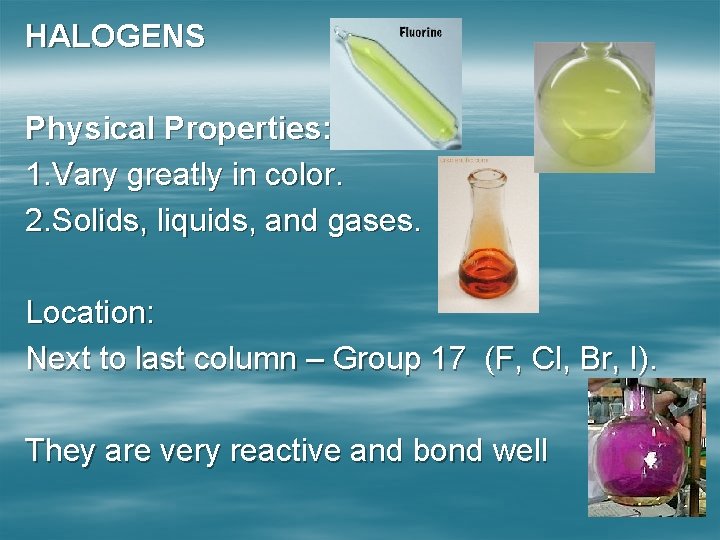
HALOGENS Physical Properties: 1. Vary greatly in color. 2. Solids, liquids, and gases. Location: Next to last column – Group 17 (F, Cl, Br, I). They are very reactive and bond well
Periodic Table
STATES OF MATTER AT ROOM TEMPERATURE Liquids: Gases: Solids: Periodic Table Br, Hg (2) H, He, N, O, F, Cl, Ar, Kr, Xe, Rn, Ne (11) All the rest of the elements
Radioactivity Some elements will change (decay) into another element. Ex: Radon gas turns into lead. These elements are called: RADIOACTIVE When these elements decay their nucleus changes into another element and they give off RADIATION.
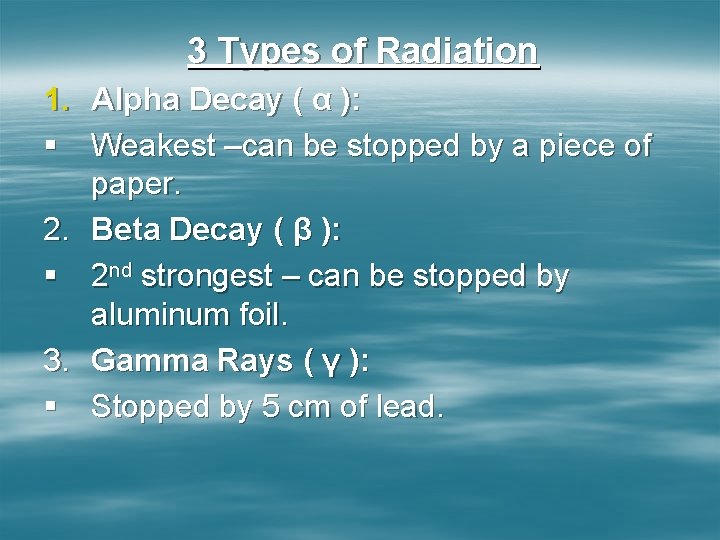
3 Types of Radiation 1. Alpha Decay ( α ): § Weakest –can be stopped by a piece of paper. 2. Beta Decay ( β ): § 2 nd strongest – can be stopped by aluminum foil. 3. Gamma Rays ( γ ): § Stopped by 5 cm of lead.
Each radioactive element has a certain HALF – LIFE. Half – Life: The amount of time it takes for half of the element to decay (change).
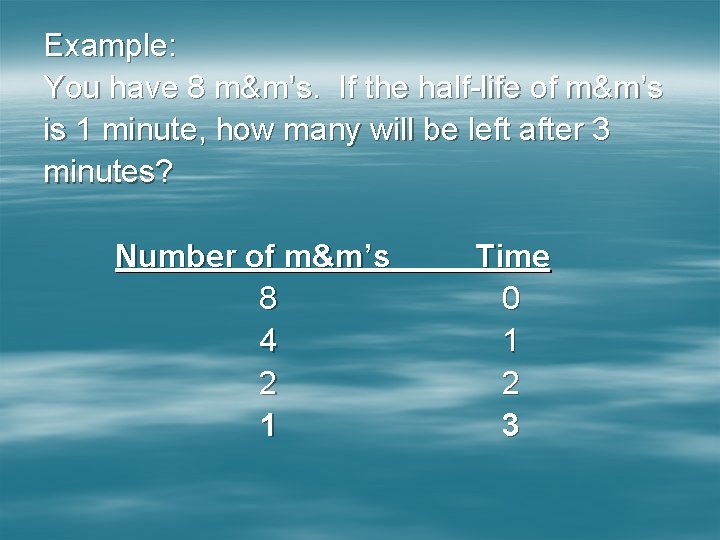
Example: You have 8 m&m’s. If the half-life of m&m’s is 1 minute, how many will be left after 3 minutes? Number of m&m’s 8 4 2 1 Time 0 1 2 3
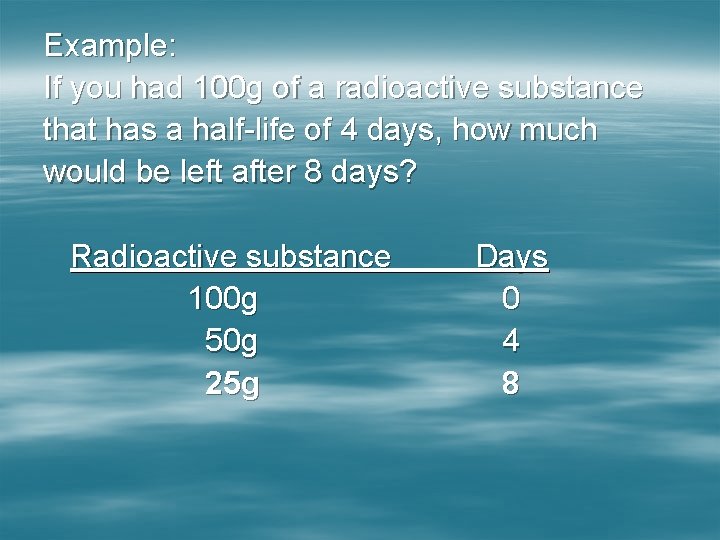
Example: If you had 100 g of a radioactive substance that has a half-life of 4 days, how much would be left after 8 days? Radioactive substance 100 g 50 g 25 g Days 0 4 8
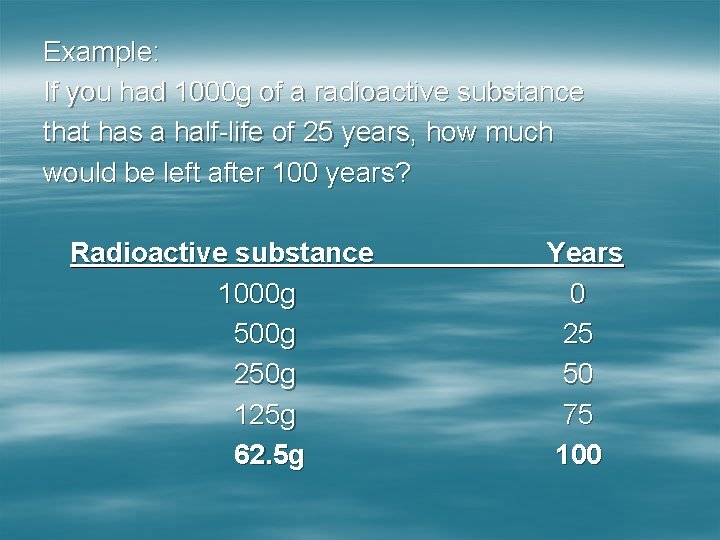
Example: If you had 1000 g of a radioactive substance that has a half-life of 25 years, how much would be left after 100 years? Radioactive substance 1000 g 500 g 250 g 125 g 62. 5 g Years 0 25 50 75 100