
Matrix Systems for Restorative Dentistry Chapter 49 Copyright








- Slides: 23
Matrix Systems for Restorative Dentistry Chapter 49 Copyright © 2009, 2006 by Saunders, an imprint of Elsevier Inc. All rights reserved.
Chapter 49 Lesson 49. 1 Copyright © 2009, 2006 by Saunders, an imprint of Elsevier Inc. All rights reserved.
Learning Objectives Pronounce, define, and spell the Key Terms. Describe the use of matrix systems in class II, III, and IV restorations. Describe the type of matrices used for posterior restorations. Describe the purpose and use of a wedge. Discuss alternative methods of matrix systems used in restorative dentistry. Assemble a universal retainer and matrix band. (Cont’d) Copyright © 2009, 2006 by Saunders, an imprint of Elsevier Inc. All rights reserved.
Learning Objectives (Cont’d) Place and remove a matrix band wedge for a class II restoration. Place and remove a matrix band wedge for a class III restoration. Copyright © 2009, 2006 by Saunders, an imprint of Elsevier Inc. All rights reserved.
Introduction A matrix system provides a “temporary wall” for the restoration process in class II, III and IV preparations. Copyright © 2009, 2006 by Saunders, an imprint of Elsevier Inc. All rights reserved.
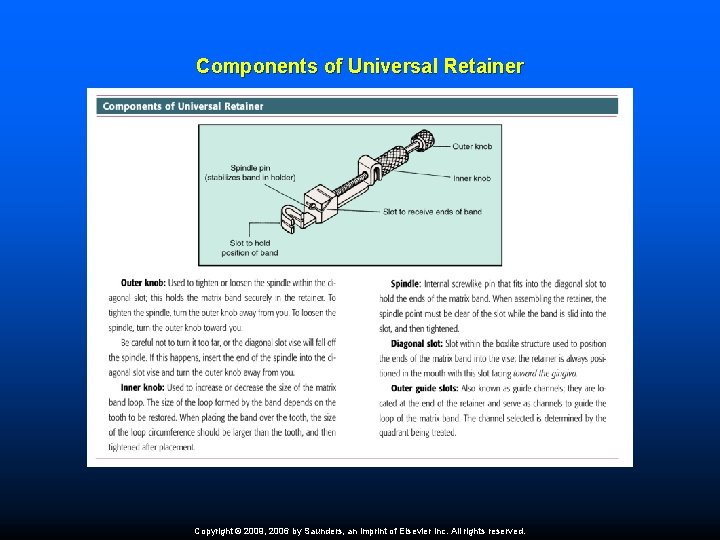
Posterior Matrix System Universal retainer Also referred to as Tofflemire retainer Holds the matrix band in position Ø Positioned most commonly from the buccal surface of the tooth being restored Ø Copyright © 2009, 2006 by Saunders, an imprint of Elsevier Inc. All rights reserved.
Components of Universal Retainer Copyright © 2009, 2006 by Saunders, an imprint of Elsevier Inc. All rights reserved.
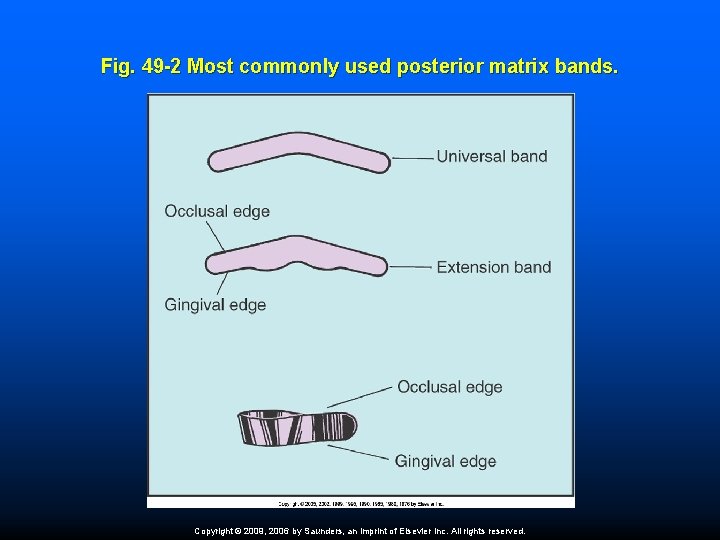
Matrix Bands Thin, flexible stainless steel Common designs Universal Ø Extension Ø Guidelines for placement Larger circumference: occlusal edge Ø Smaller circumference: gingival edge Ø Copyright © 2009, 2006 by Saunders, an imprint of Elsevier Inc. All rights reserved.
Fig. 49 -2 Most commonly used posterior matrix bands. Copyright © 2009, 2006 by Saunders, an imprint of Elsevier Inc. All rights reserved.
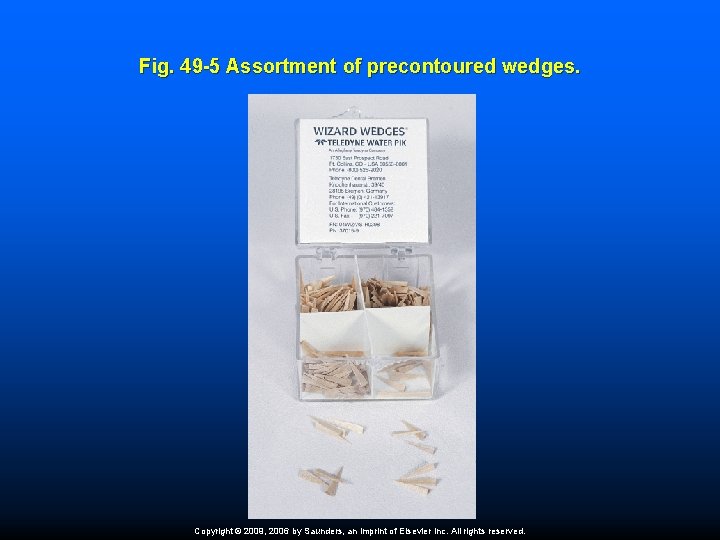
Wedges Positioned into the lingual embrasure of a class II preparation after band placement Ø Positions the matrix band firmly against the gingival margin of the preparation Various sizes Triangular/round Ø Wood/plastic Ø Copyright © 2009, 2006 by Saunders, an imprint of Elsevier Inc. All rights reserved.
Fig. 49 -5 Assortment of precontoured wedges. Copyright © 2009, 2006 by Saunders, an imprint of Elsevier Inc. All rights reserved.
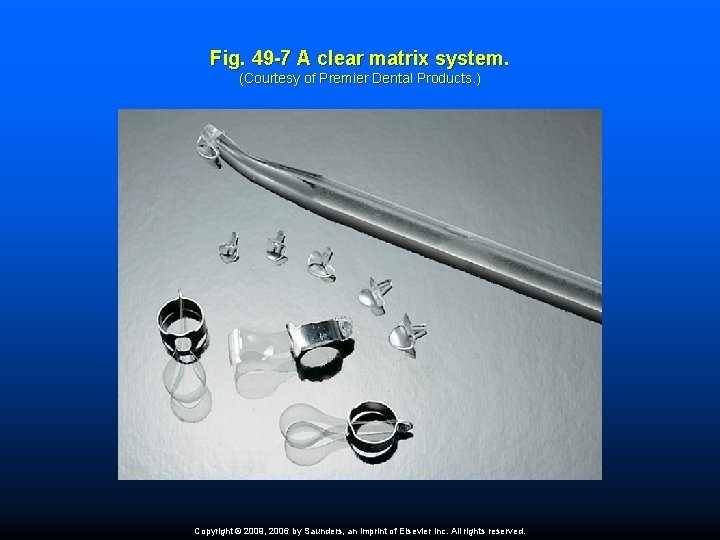
Anterior Matrix Systems Plastic matrix Also referred to as: Ø Celluloid matrix Ø Mylar strip Ø Used in Class III and IV restorations Ø Copyright © 2009, 2006 by Saunders, an imprint of Elsevier Inc. All rights reserved.
Fig. 49 -7 A clear matrix system. (Courtesy of Premier Dental Products. ) Copyright © 2009, 2006 by Saunders, an imprint of Elsevier Inc. All rights reserved.
Using an Anterior Matrix Placed interproximally before the etching and bonding of a tooth. After the placement of composite material, a matrix is pulled tightly around the tooth to help reconstruct its natural contour. A clear plastic matrix allows curing light to penetrate the material and complete the curing process. Copyright © 2009, 2006 by Saunders, an imprint of Elsevier Inc. All rights reserved.
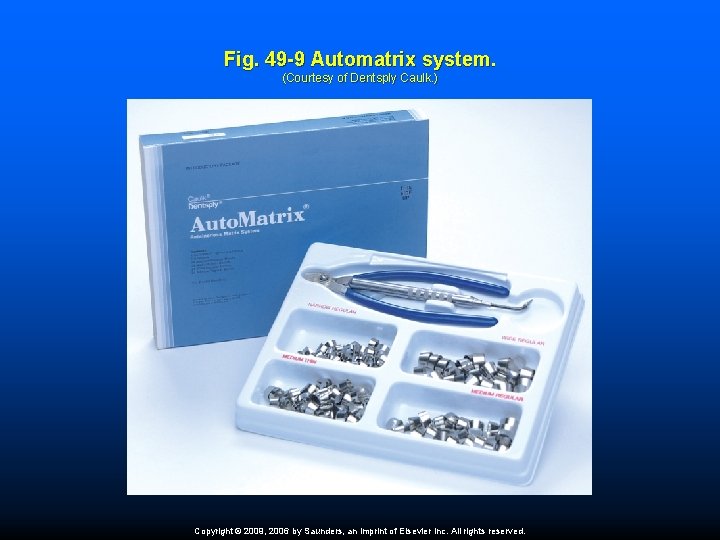
Automatrix System The automatrix system is an alternative to a universal retainer. No retainer is used to hold the band in place. Preformed bands available in assorted sizes in both metal and plastic. Each band has a coil-like auto-lock loop. A tightening wrench is inserted into the coil and turned clockwise to tighten the band. When the band is to be removed, a tightening wrench is inserted into the coil and turned counterclockwise to loosen the band. Removing pliers are used to cut the band. Copyright © 2009, 2006 by Saunders, an imprint of Elsevier Inc. All rights reserved.
Fig. 49 -9 Automatrix system. (Courtesy of Dentsply Caulk. ) Copyright © 2009, 2006 by Saunders, an imprint of Elsevier Inc. All rights reserved.
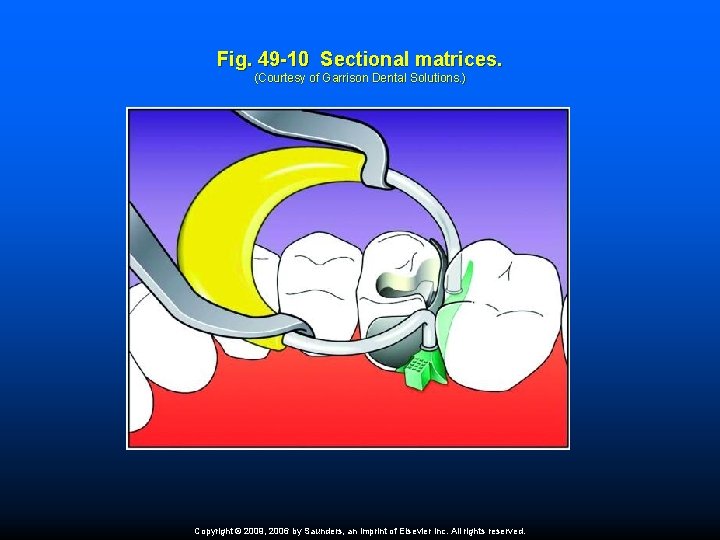
Sectional Matrices A thin, polished palodent-type band tension ring produce tight anatomic contact for composite resin materials in class II restorations. Copyright © 2009, 2006 by Saunders, an imprint of Elsevier Inc. All rights reserved.
Fig. 49 -10 Sectional matrices. (Courtesy of Garrison Dental Solutions. ) Copyright © 2009, 2006 by Saunders, an imprint of Elsevier Inc. All rights reserved.
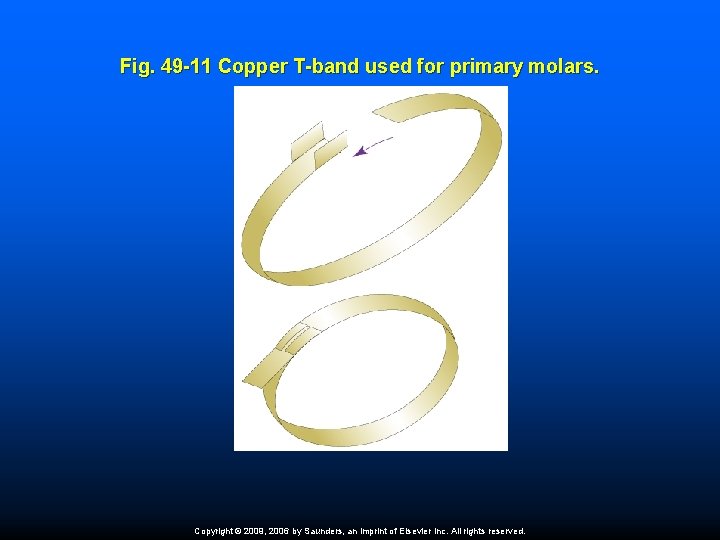
Matrix Systems for Primary Teeth T-band Ø When formed, the top portion of the T allows the straight portion to adjust and fit the circumference of the primary molar. Spot-welded band Ø Form-fitted band placed around a prepared tooth; removed and placed in a smaller form of a welder, fusing the metal together to make a custom band. Copyright © 2009, 2006 by Saunders, an imprint of Elsevier Inc. All rights reserved.
Fig. 49 -11 Copper T-band used for primary molars. Copyright © 2009, 2006 by Saunders, an imprint of Elsevier Inc. All rights reserved.
Preparing the T-Band Matrix The wings of the T-band are bent to form a Ushaped trough. The free end of the band is slipped loosely through the U formation. The wings are closed, and the free end is pulled to make a small circle of the band. Holding the free end toward the facial surface, place the band on the tooth to be prepared. Copyright © 2009, 2006 by Saunders, an imprint of Elsevier Inc. All rights reserved.
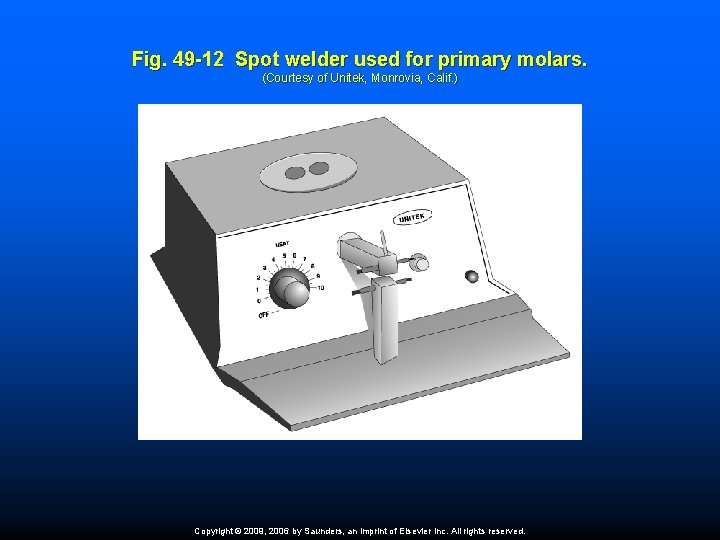
Fig. 49 -12 Spot welder used for primary molars. (Courtesy of Unitek, Monrovia, Calif. ) Copyright © 2009, 2006 by Saunders, an imprint of Elsevier Inc. All rights reserved.
Preparing a Spot-Welded Matrix Band Measure ¾ to 1 inch of stainless-steel matrix material. Fit the matrix band around the prepared tooth. Adapt the band, making sure that the ends of the matrix material are at the facial surface for the sake of visibility and control. Using Howe pliers, hold the ends tightly and remove the band in an occlusal direction. Place the band in the spot welder. Spot-weld the matrix at three positions. Copyright © 2009, 2006 by Saunders, an imprint of Elsevier Inc. All rights reserved.