
Matrix Reactions The Fun Begins The Mitochondria Since

Matrix Reactions The Fun Begins
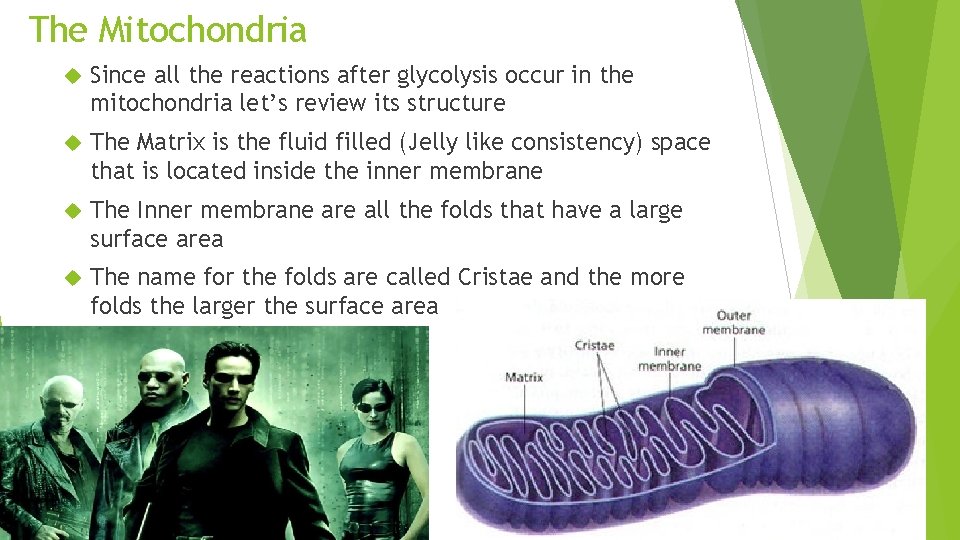
The Mitochondria Since all the reactions after glycolysis occur in the mitochondria let’s review its structure The Matrix is the fluid filled (Jelly like consistency) space that is located inside the inner membrane The Inner membrane are all the folds that have a large surface area The name for the folds are called Cristae and the more folds the larger the surface area
Pyruvate Oxidation: Preparing for Krebs For each step remember it is X 2 as there are 2 pyruvate molecules The pyruvate molecule moves from the cytosol to the matrix of the mitochondria Once the pyruvate enters the matrix a carboxyl group is removed forming CO 2 In a second step the acetyl group is oxidized and NAD+ is reduced forming NADH + H+ In the third step a molecule called coenzyme A is added to the acetyl group forming acetyl-Co. A Steps 1 -3 are simultaneous and take place on the pyruvate dehydrogenase complex
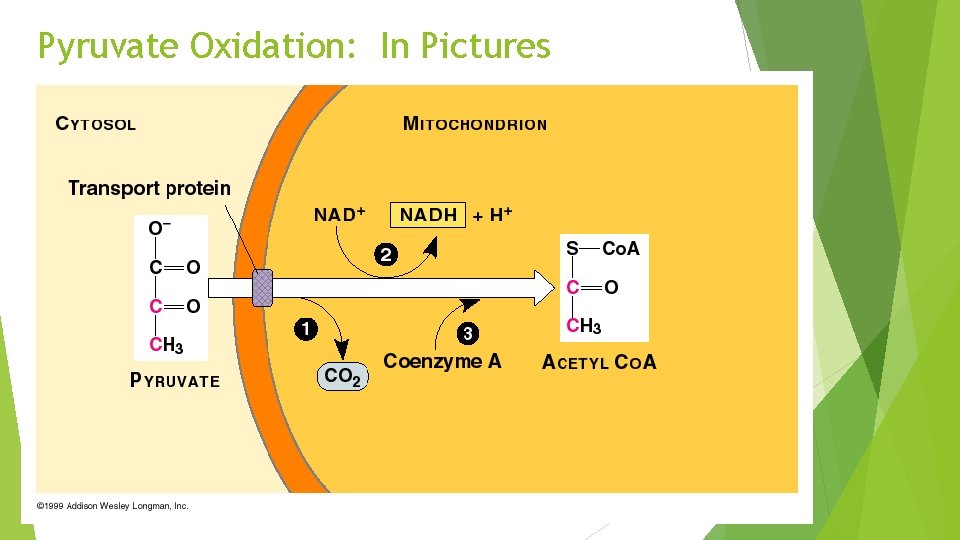
Pyruvate Oxidation: In Pictures
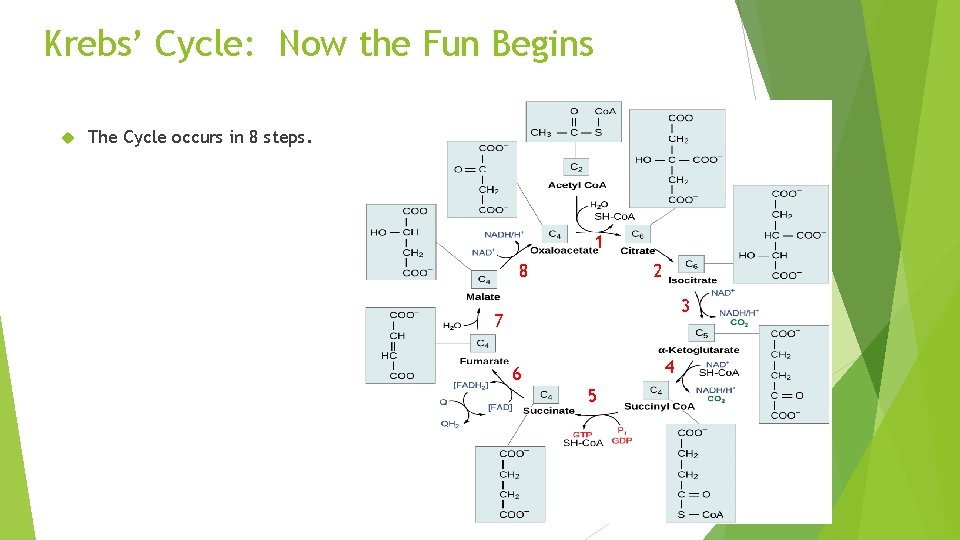
Krebs’ Cycle: Now the Fun Begins The Cycle occurs in 8 steps. 1 8 2 3 7 4 6 5
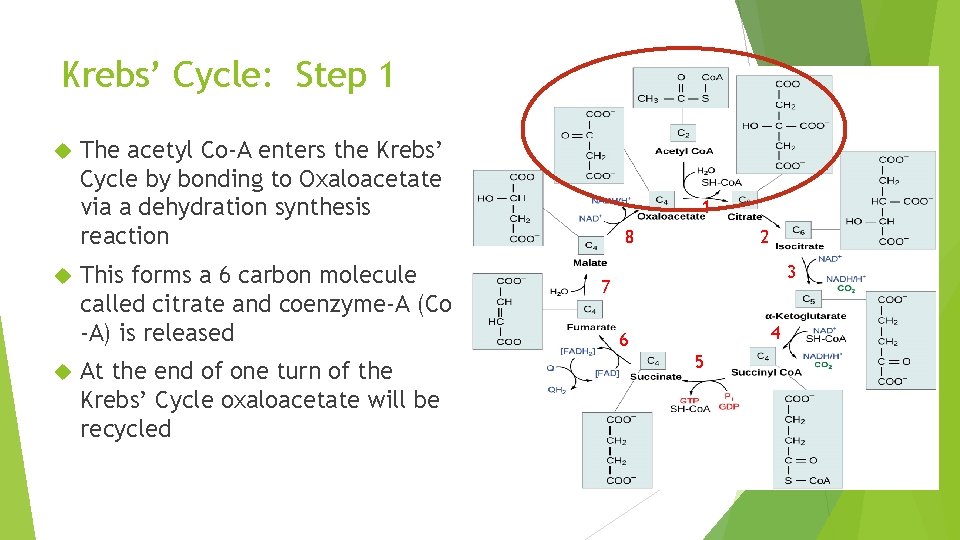
Krebs’ Cycle: Step 1 The acetyl Co-A enters the Krebs’ Cycle by bonding to Oxaloacetate via a dehydration synthesis reaction This forms a 6 carbon molecule called citrate and coenzyme-A (Co -A) is released At the end of one turn of the Krebs’ Cycle oxaloacetate will be recycled 1 8 2 3 7 4 6 5
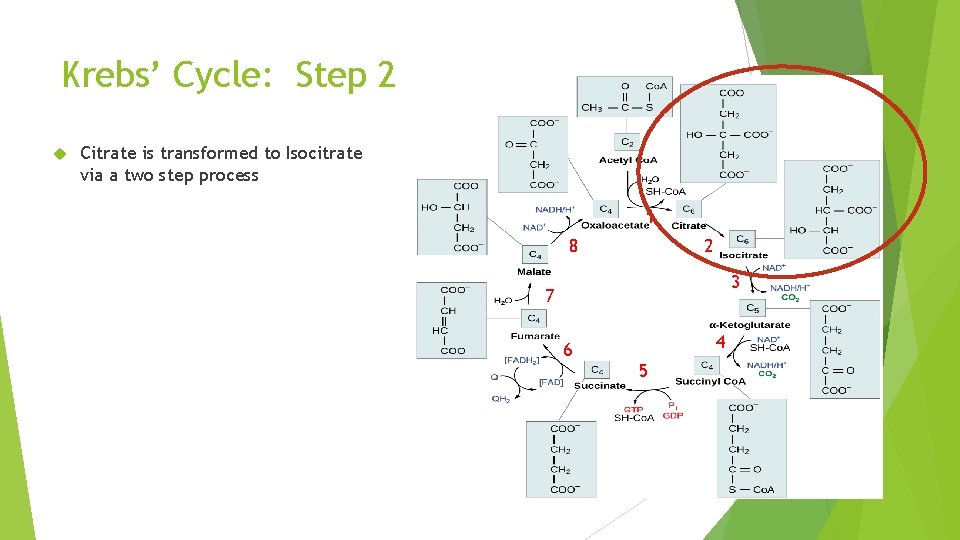
Krebs’ Cycle: Step 2 Citrate is transformed to Isocitrate via a two step process 1 8 2 3 7 4 6 5
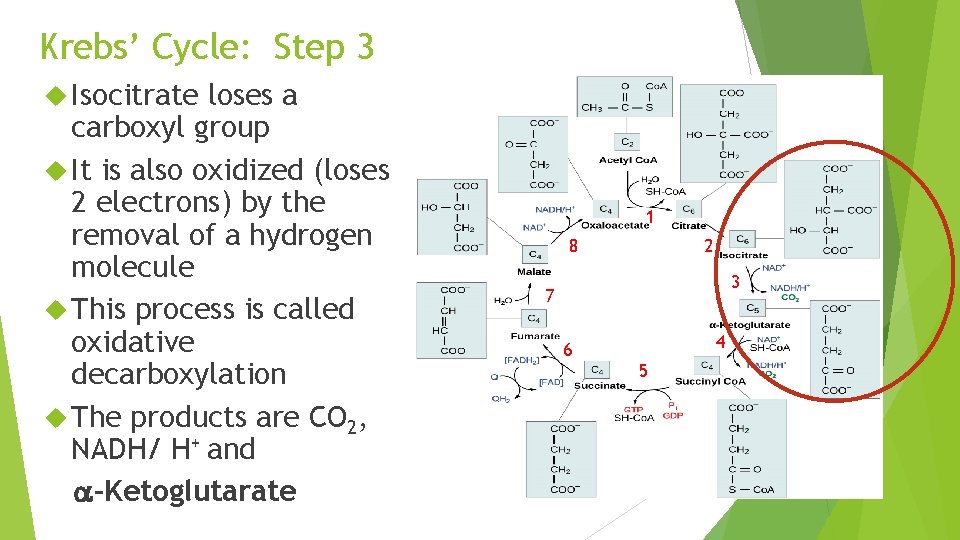
Krebs’ Cycle: Step 3 Isocitrate loses a carboxyl group It is also oxidized (loses 2 electrons) by the removal of a hydrogen molecule This process is called oxidative decarboxylation The products are CO 2, NADH/ H+ and a-Ketoglutarate 1 8 2 3 7 4 6 5
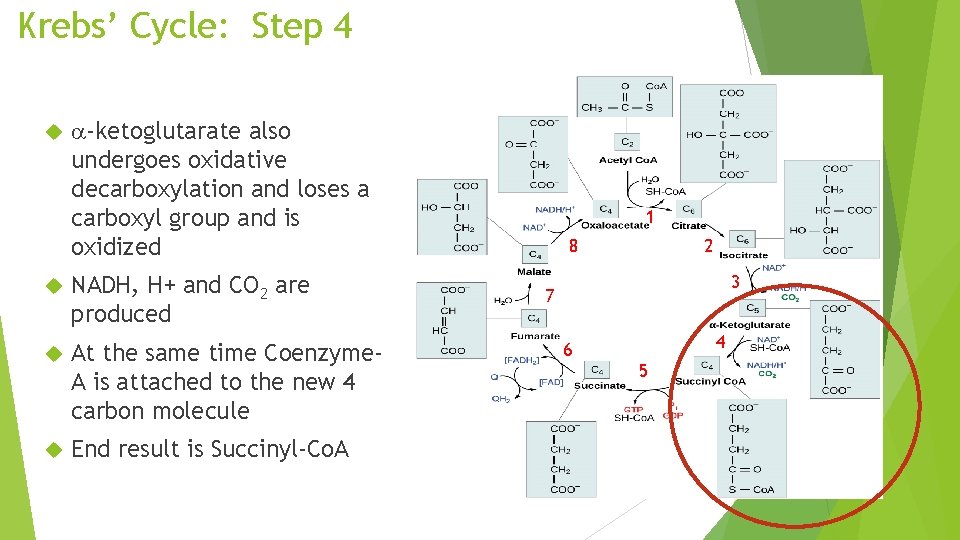
Krebs’ Cycle: Step 4 a-ketoglutarate also undergoes oxidative decarboxylation and loses a carboxyl group and is oxidized NADH, H+ and CO 2 are produced At the same time Coenzyme. A is attached to the new 4 carbon molecule End result is Succinyl-Co. A 1 8 2 3 7 4 6 5
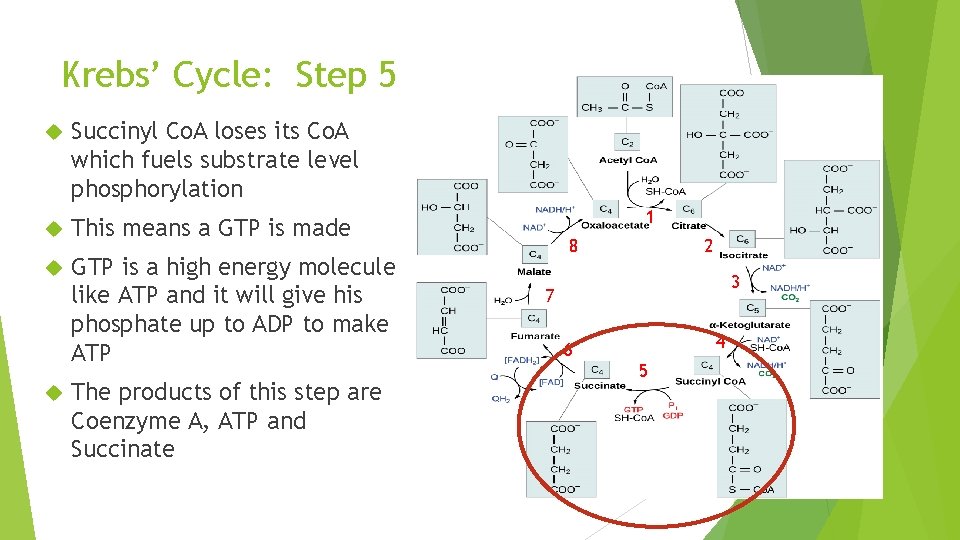
Krebs’ Cycle: Step 5 Succinyl Co. A loses its Co. A which fuels substrate level phosphorylation This means a GTP is made GTP is a high energy molecule like ATP and it will give his phosphate up to ADP to make ATP The products of this step are Coenzyme A, ATP and Succinate 1 8 2 3 7 4 6 5
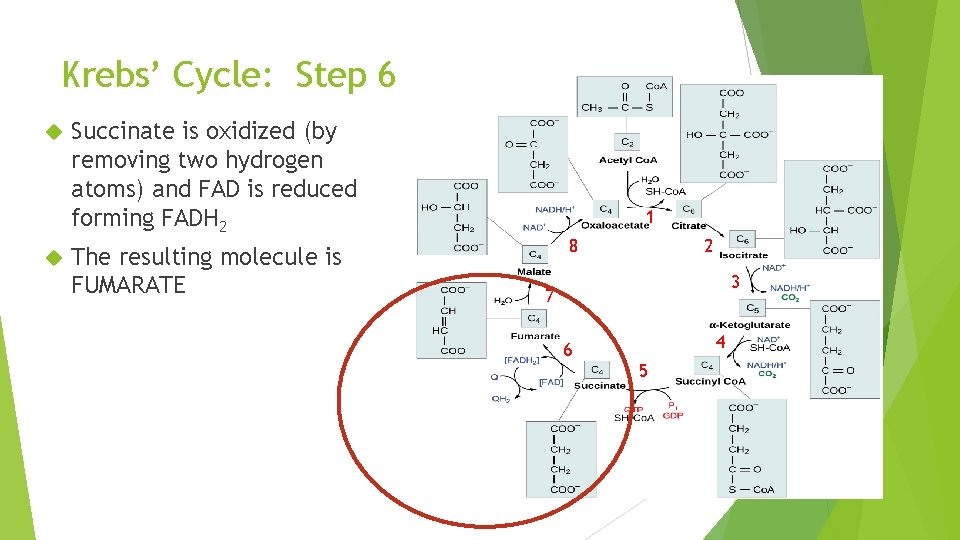
Krebs’ Cycle: Step 6 Succinate is oxidized (by removing two hydrogen atoms) and FAD is reduced forming FADH 2 The resulting molecule is FUMARATE 1 8 2 3 7 4 6 5
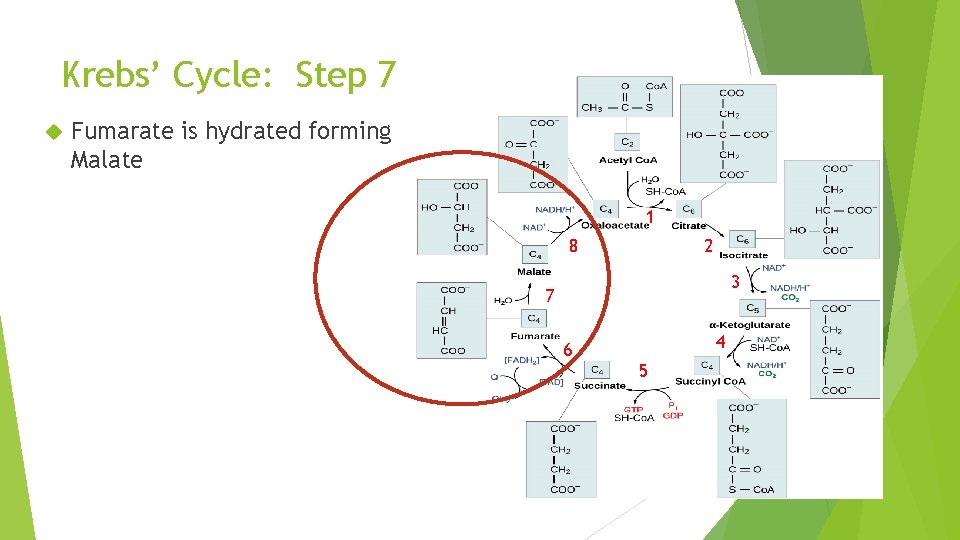
Krebs’ Cycle: Step 7 Fumarate is hydrated forming Malate 1 8 2 3 7 4 6 5
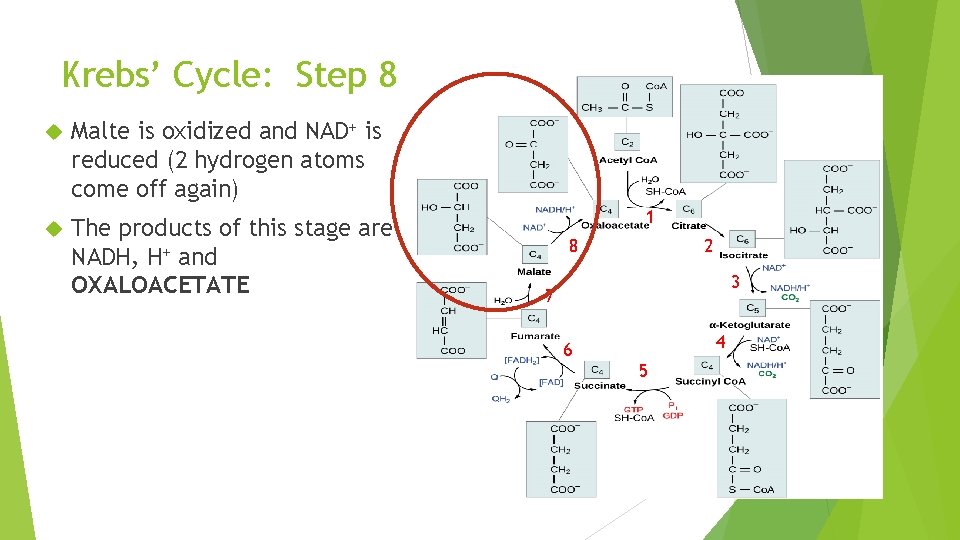
Krebs’ Cycle: Step 8 Malte is oxidized and NAD+ is reduced (2 hydrogen atoms come off again) The products of this stage are NADH, H+ and OXALOACETATE 1 8 2 3 7 4 6 5
Krebs’ Cycle Summary Net Result for 1 turn of the Krebs’ Cycle is : (2 CO 2, 3 NADH, ATP and FADH 2) x 2 (2 pyruvate per glucose) Grand Total is: 4 CO 2 + 6 NADH + 2 ATP + 2 FADH 2
Matrix Reaction Summary At the end of the matrix reactions for both pyruvate molecules you end up with: 6 CO 2 + 8 NADH + 2 ATP + 2 FADH 2
- Slides: 15