
Matrix Computation in Numerical Polynomial Algebraic Geometry and
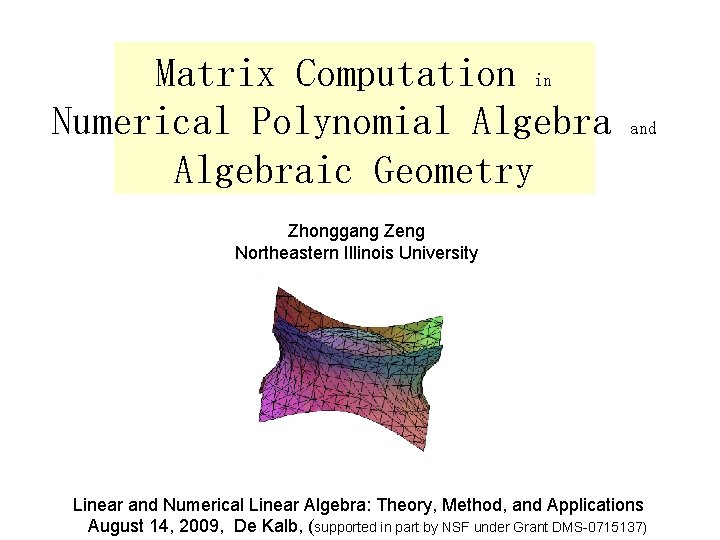
Matrix Computation in Numerical Polynomial Algebraic Geometry and Zhonggang Zeng Northeastern Illinois University Linear and Numerical Linear Algebra: Theory, Method, and Applications August 14, 2009, De Kalb, (supported in part by NSF under Grant DMS-0715137)
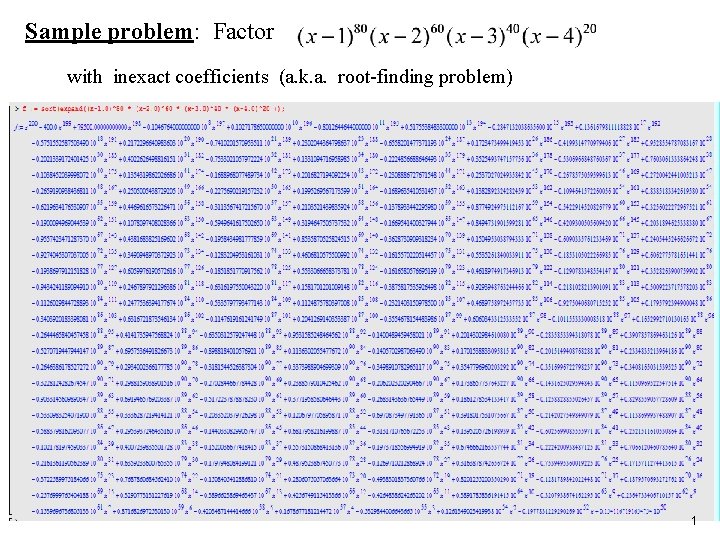
Sample problem: Factor with inexact coefficients (a. k. a. root-finding problem) 1
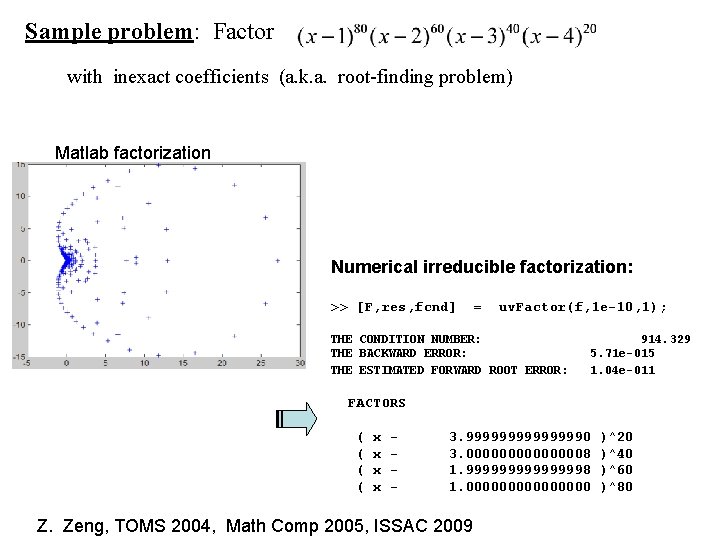
Sample problem: Factor with inexact coefficients (a. k. a. root-finding problem) Matlab factorization Numerical irreducible factorization: >> [F, res, fcnd] = uv. Factor(f, 1 e-10, 1); THE CONDITION NUMBER: THE BACKWARD ERROR: THE ESTIMATED FORWARD ROOT ERROR: 914. 329 5. 71 e-015 1. 04 e-011 FACTORS ( ( x x - 3. 99999990 3. 00000008 1. 99999998 1. 00000000 Z. Zeng, TOMS 2004, Math Comp 2005, ISSAC 2009 )^20 )^40 )^60 )^80
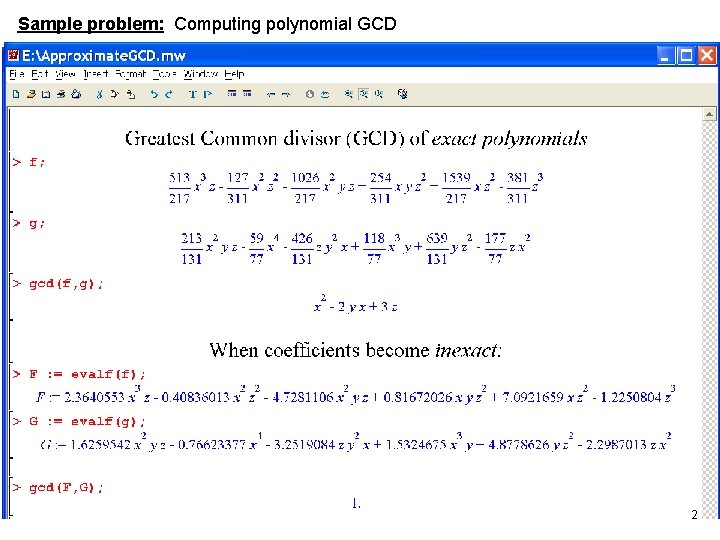
Sample problem: Computing polynomial GCD 2
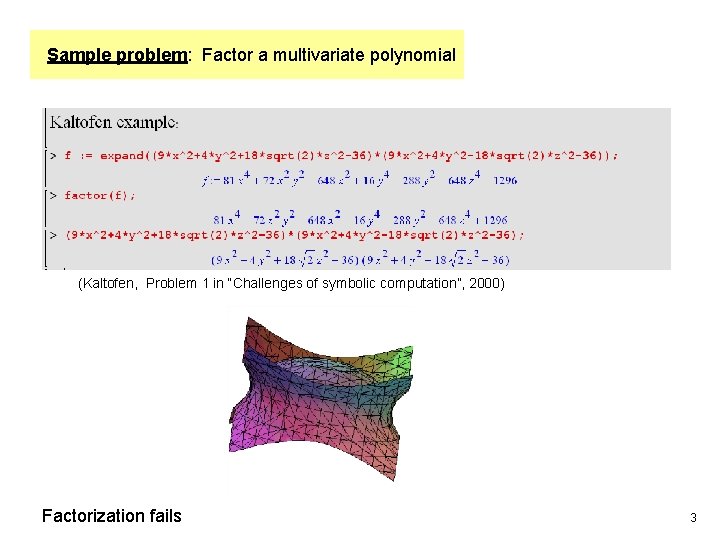
Sample problem: Factor a multivariate polynomial (Kaltofen, Problem 1 in “Challenges of symbolic computation”, 2000) Factorization fails 3
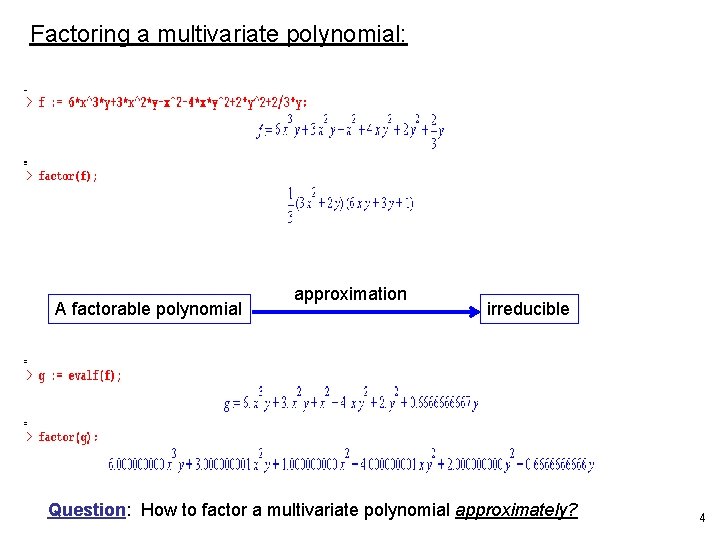
Factoring a multivariate polynomial: A factorable polynomial approximation irreducible Question: How to factor a multivariate polynomial approximately? 4
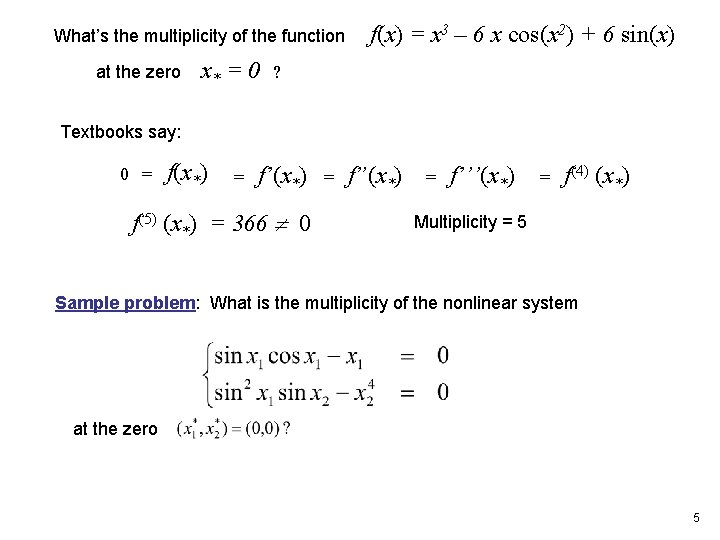
What’s the multiplicity of the function at the zero x* = 0 f(x) = x 3 – 6 x cos(x 2) + 6 sin(x) ? Textbooks say: 0 = f(x*) = f’(x*) f(5) (x*) = 366 0 = f”(x*) = f’’’(x*) = f(4) (x*) Multiplicity = 5 Sample problem: What is the multiplicity of the nonlinear system at the zero 5
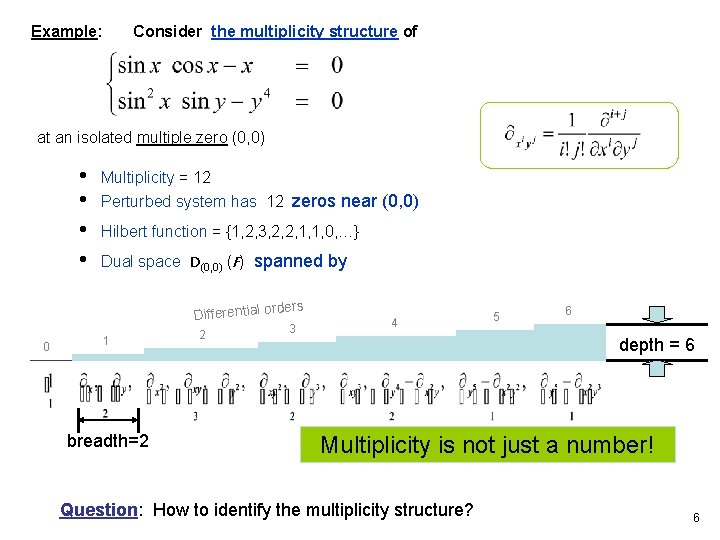
Example: Consider the multiplicity structure of at an isolated multiple zero (0, 0) • • Multiplicity = 12 Perturbed system has 12 zeros near (0, 0) Hilbert function = {1, 2, 3, 2, 2, 1, 1, 0, …} Dual space D(0, 0) (F) spanned by ers Differential ord 0 1 breadth=2 2 3 4 5 6 depth = 6 Multiplicity is not just a number! Question: How to identify the multiplicity structure? 6
Symbolic computation has thrived for decades in polynomial algebra and algebraic geometry • Gröbner basis • Polynomial factorization • Computer Algebra Systems (Maple, Mathematica, etc) Bruno Buchberger with limitations. 7

Pioneer works in numerical polynomial algebra and algebraic geometry (incomplete list) • Homotopy method for solving polynomial systems (Li, Sommese, Wampler, Verschelde, …) • Numerical Algebraic Geometry (Sommese, Wampler, Verschelde, …) • Numerical Polynomial Algerba (Stetter) A frontier in scientific computing, and may be the beginning of Numerical Nonlinear Algebra 8
Recent progress in numerical polynomial algebra • Solving polynomial systems (Li, Sommese, Verschelde, …) • Approximate multiple roots/factorization (Zeng 2005, 2009) • Approximate GCD (Zeng-Dayton 2004) • Approximate irreducible factorization (Sommesse-Wampler-Verschelde 2003, Gao et al 2003, 2004, Zeng in progress) • Computing multiplicity structure (Dayton-Zeng 05, Bates-Peterson-Sommese ’ 06) • Polynomial elimination (Zeng, 2008) Feedback from num. polyn. algebra to numerical linear algebra: • Approximate rank/kernel (Li, Zeng 2005, Lee, Li, Zeng 2009) • Approximate Jordan Canonical Form (Zeng-Li in progress) 9

Among many challenges in numerical polynomial algebra: • Regularizing ill-posed problems for approximate solutions • numerical polynomial algebra via matrix computations • Handling huge matrices with subspace strategies 10
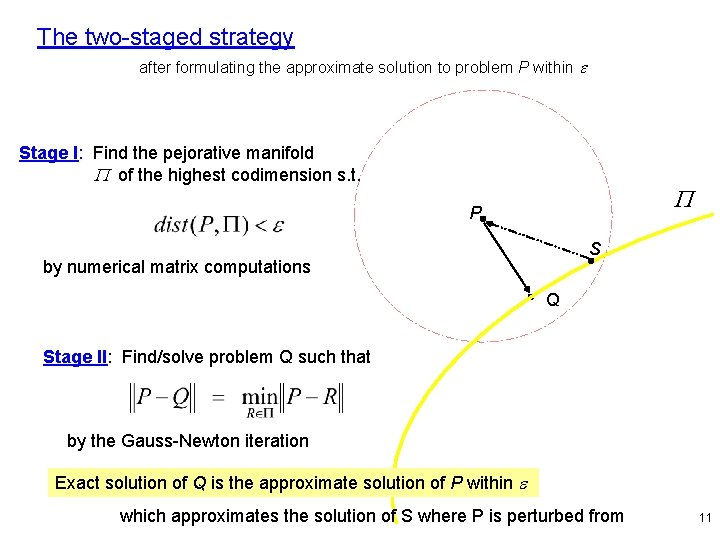
The two-staged strategy after formulating the approximate solution to problem P within e Stage I: Find the pejorative manifold P of the highest codimension s. t. P P S by numerical matrix computations Q Stage II: Find/solve problem Q such that by the Gauss-Newton iteration Exact solution of Q is the approximate solution of P within e which approximates the solution of S where P is perturbed from 11
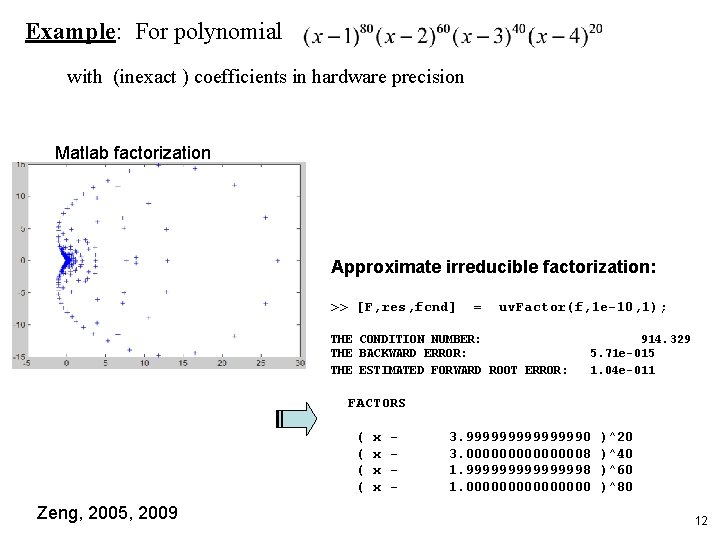
Example: For polynomial with (inexact ) coefficients in hardware precision Matlab factorization Approximate irreducible factorization: >> [F, res, fcnd] = uv. Factor(f, 1 e-10, 1); THE CONDITION NUMBER: THE BACKWARD ERROR: THE ESTIMATED FORWARD ROOT ERROR: 914. 329 5. 71 e-015 1. 04 e-011 FACTORS ( ( Zeng, 2005, 2009 x x - 3. 99999990 3. 00000008 1. 99999998 1. 00000000 )^20 )^40 )^60 )^80 12

How to identify the solution structure? Answer: Matrix computations 13
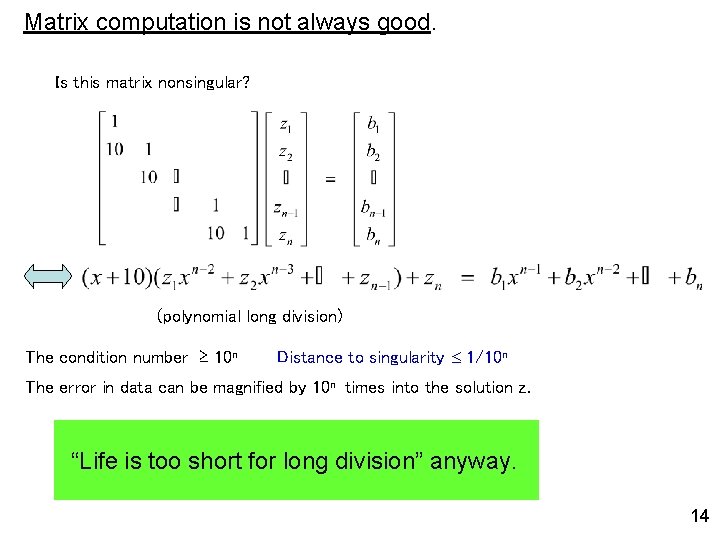
Matrix computation is not always good. Is this matrix nonsingular? (polynomial long division) The condition number ≥ 10 n Distance to singularity 1/10 n The error in data can be magnified by 10 n times into the solution z. “Life is too short for long division” anyway. 14
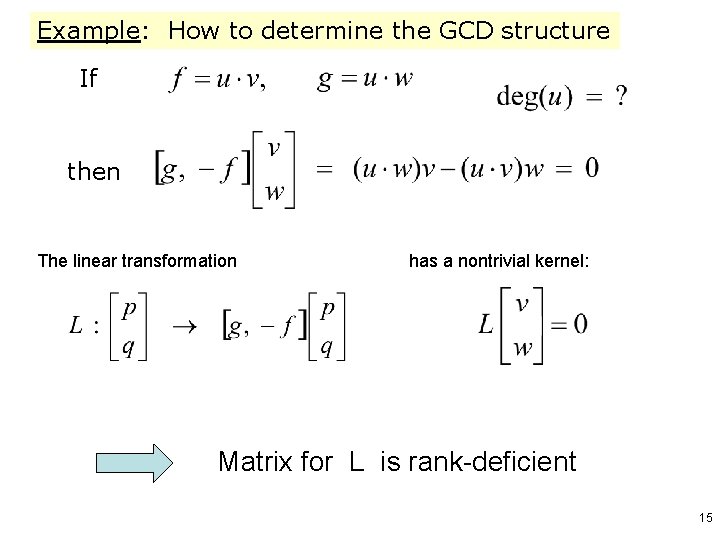
Example: How to determine the GCD structure If then The linear transformation has a nontrivial kernel: Matrix for L is rank-deficient 15
![Moreover xj xj The linear transformation xj [ ] On the vector space Has](http://slidetodoc.com/presentation_image/44ba9053efc67539dfa03c68792e6c13/image-18.jpg "Moreover xj xj The linear transformation xj [ ] On the vector space Has")
Moreover xj xj The linear transformation xj [ ] On the vector space Has the kernel Linear transformation L Sylverster matrix S(f, g) James J. Sylvester Numerical rank-deficiency = degree of the approx. GCD 16
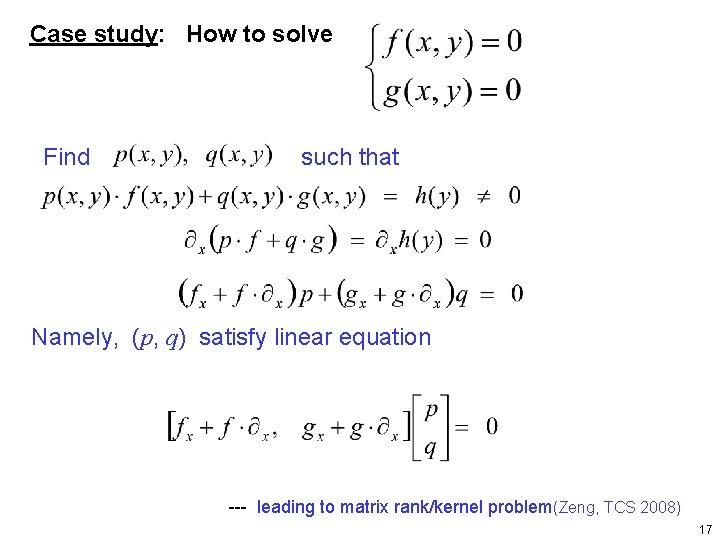
Case study: How to solve Find such that Namely, (p, q) satisfy linear equation --- leading to matrix rank/kernel problem(Zeng, TCS 2008) 17
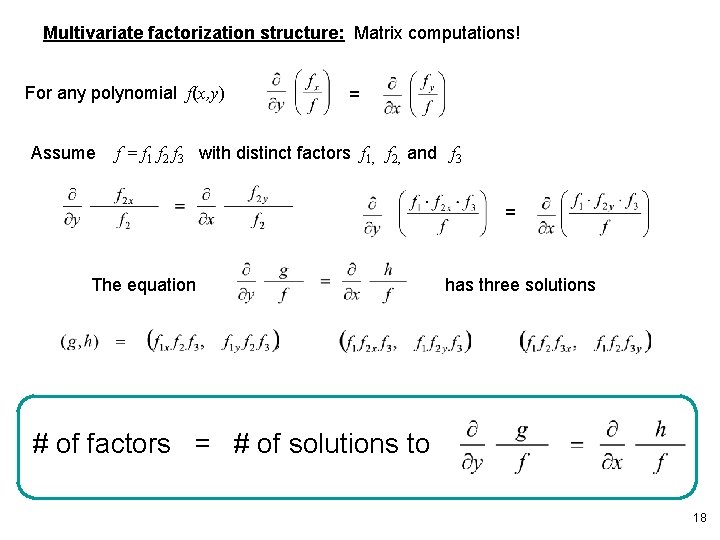
Multivariate factorization structure: Matrix computations! For any polynomial f(x, y) Assume = f 1 f 2 f 3 with distinct factors f 1, f 2, and f 3 = The equation has three solutions # of factors = # of solutions to 18
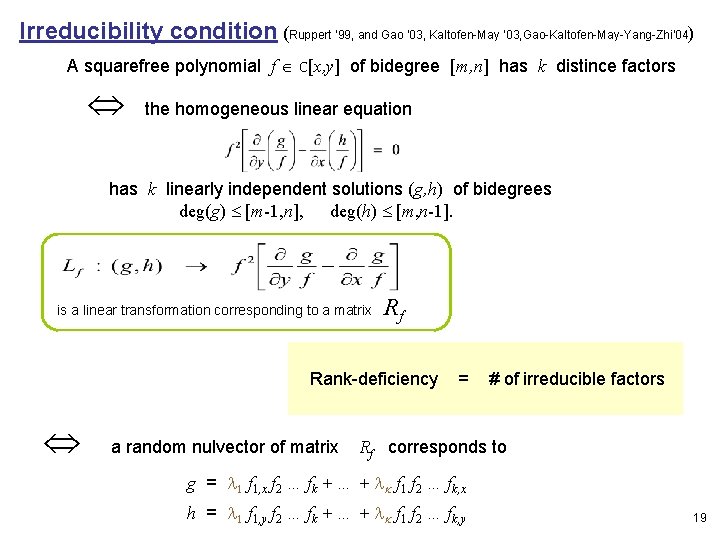
Irreducibility condition (Ruppert ‘ 99, and Gao ‘ 03, Kaltofen-May ’ 03, Gao-Kaltofen-May-Yang-Zhi’ 04) A squarefree polynomial f C[x, y] of bidegree [m, n] has k distince factors the homogeneous linear equation has k linearly independent solutions (g, h) of bidegrees deg(g) [m-1, n], deg(h) [m, n-1]. is a linear transformation corresponding to a matrix Rf Rank-deficiency a random nulvector of matrix = # of irreducible factors Rf corresponds to g = l 1 f 1, x f 2 … fk + … + lk f 1 f 2 … fk, x h = l 1 f 1, y f 2 … fk + … + lk f 1 f 2 … fk, y 19
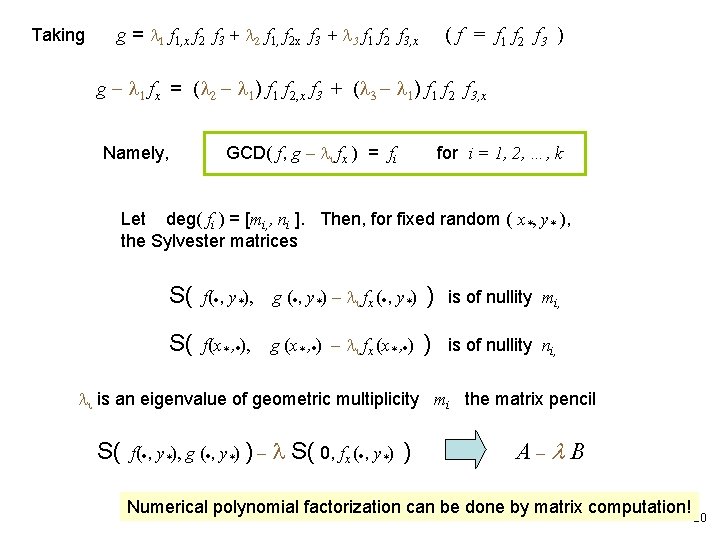
Taking g = l 1 f 1, x f 2 f 3 + l 2 f 1, f 2 x f 3 + l 3 f 1 f 2 f 3, x ( f = f 1 f 2 f 3 ) g - l 1 fx = (l 2 - l 1) f 1 f 2, x f 3 + (l 3 - l 1) f 1 f 2 f 3, x GCD( f, g - li fx ) = fi Namely, for i = 1, 2, …, k Let deg( fi ) = [mi, , ni ]. Then, for fixed random ( x*, y* ), the Sylvester matrices S( f( , y*), g ( , y * ) - l i f x ( , y * ) ) is of nullity mi, S( f(x* , ), g (x* , ) - li fx (x* , ) ) is of nullity ni, li is an eigenvalue of geometric multiplicity mi the matrix pencil S( f( , y*), g ( , y*) ) - l S( 0, fx ( , y*) ) A-l B Numerical polynomial factorization can be done by matrix computation! 20
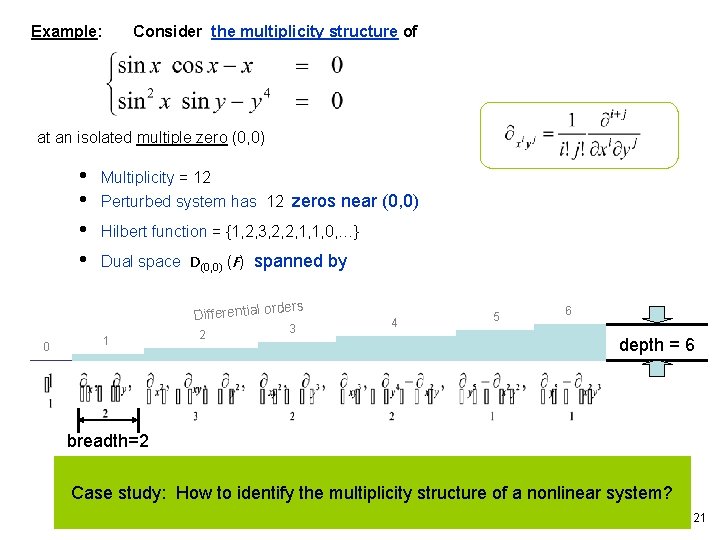
Example: Consider the multiplicity structure of at an isolated multiple zero (0, 0) • • Multiplicity = 12 Perturbed system has 12 zeros near (0, 0) Hilbert function = {1, 2, 3, 2, 2, 1, 1, 0, …} Dual space D(0, 0) (F) spanned by ers Differential ord 0 1 2 3 4 5 6 depth = 6 breadth=2 Case study: How to identify the multiplicity structure of a nonlinear system? 21
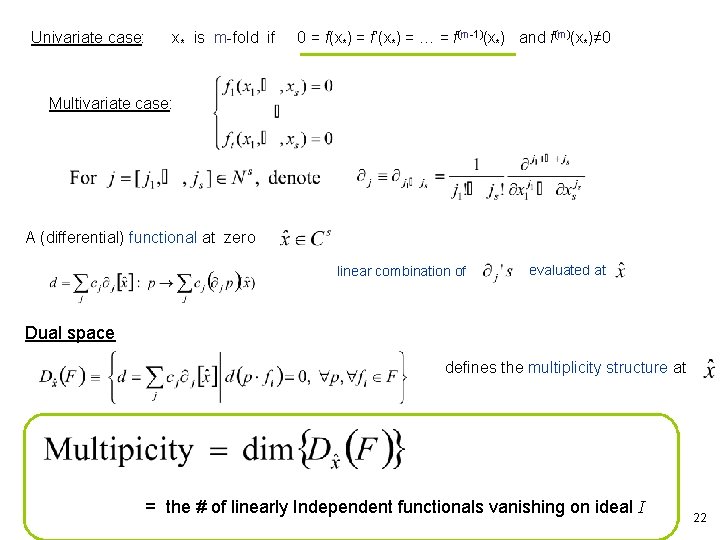
Univariate case: x* is m-fold if 0 = f(x*) = f’(x*) = … = f(m-1)(x*) and f(m)(x*)≠ 0 Multivariate case: A (differential) functional at zero linear combination of evaluated at Dual space defines the multiplicity structure at = the # of linearly Independent functionals vanishing on ideal I 22
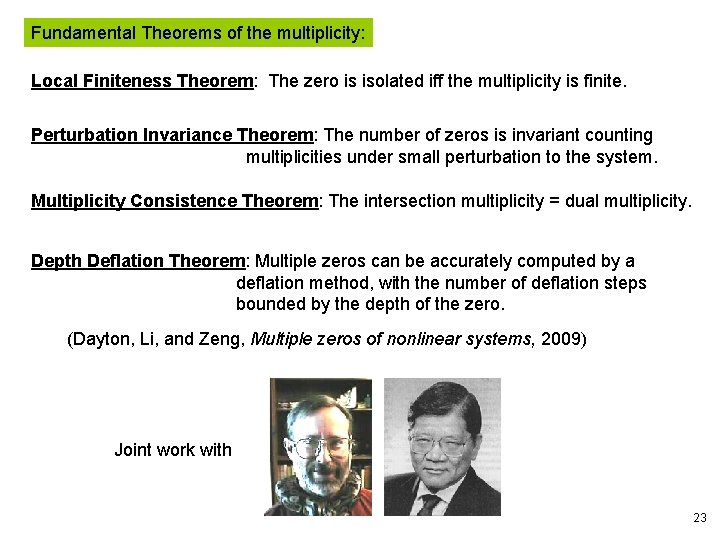
Fundamental Theorems of the multiplicity: Local Finiteness Theorem: The zero is isolated iff the multiplicity is finite. Perturbation Invariance Theorem: The number of zeros is invariant counting multiplicities under small perturbation to the system. Multiplicity Consistence Theorem: The intersection multiplicity = dual multiplicity. Depth Deflation Theorem: Multiple zeros can be accurately computed by a deflation method, with the number of deflation steps bounded by the depth of the zero. (Dayton, Li, and Zeng, Multiple zeros of nonlinear systems, 2009) Joint work with 23
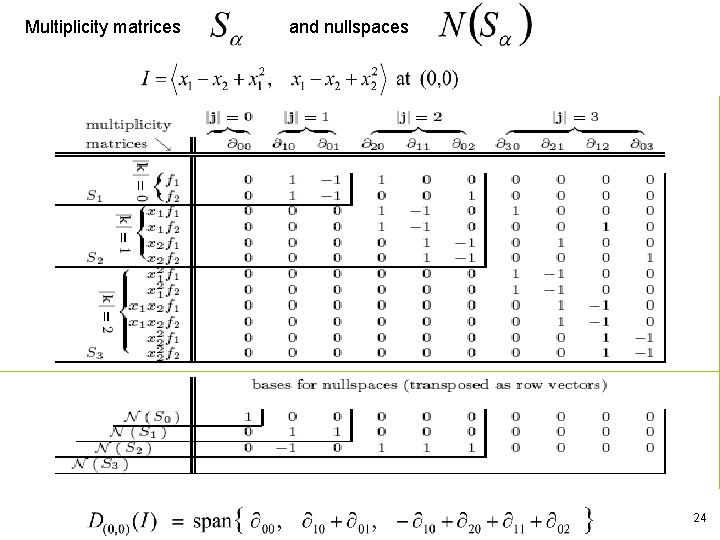
Multiplicity matrices and nullspaces 24
- Slides: 26