
MATJHABENG LOCAL MUNICIPALITY Municipal Profile introduction The Housing
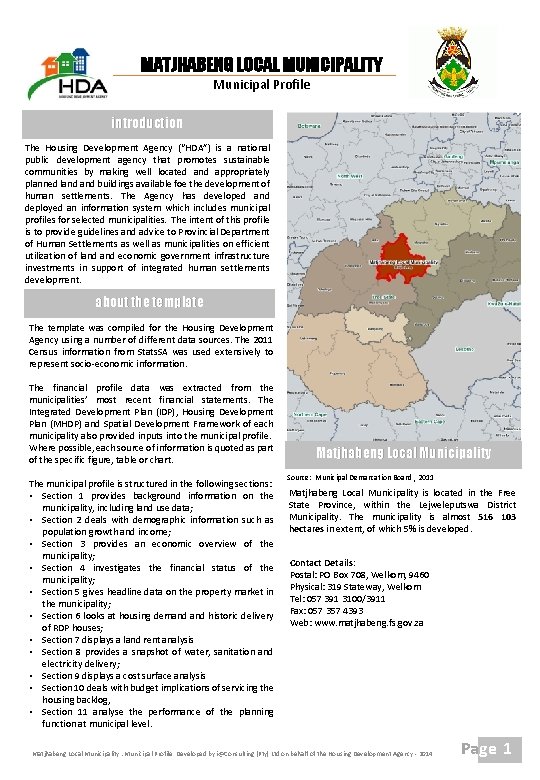
MATJHABENG LOCAL MUNICIPALITY Municipal Profile introduction The Housing Development Agency (“HDA”) is a national public development agency that promotes sustainable communities by making well located and appropriately planned land buildings available foe the development of human settlements. The Agency has developed and deployed an information system which includes municipal profiles for selected municipalities. The intent of this profile is to provide guidelines and advice to Provincial Department of Human Settlements as well as municipalities on efficient utilization of land economic government infrastructure investments in support of integrated human settlements development. about the template The template was compiled for the Housing Development Agency using a number of different data sources. The 2011 Census information from Stats. SA was used extensively to represent socio-economic information. The financial profile data was extracted from the municipalities’ most recent financial statements. The Integrated Development Plan (IDP), Housing Development Plan (MHDP) and Spatial Development Framework of each municipality also provided inputs into the municipal profile. Where possible, each source of information is quoted as part of the specific figure, table or chart. The municipal profile is structured in the following sections: • Section 1 provides background information on the municipality, including land use data; • Section 2 deals with demographic information such as population growth and income; • Section 3 provides an economic overview of the municipality; • Section 4 investigates the financial status of the municipality; • Section 5 gives headline data on the property market in the municipality; • Section 6 looks at housing demand historic delivery of RDP houses; • Section 7 displays a land rent analysis • Section 8 provides a snapshot of water, sanitation and electricity delivery; • Section 9 displays a cost surface analysis • Section 10 deals with budget implications of servicing the housing backlog, • Section 11 analyse the performance of the planning function at municipal level. Matjhabeng Local Municipality Source: Municipal Demarcation Board , 2011 Matjhabeng Local Municipality is located in the Free State Province, within the Lejweleputswa District Municipality. The municipality is almost 516 103 hectares in extent, of which 5% is developed. Contact Details: Postal: PO Box 708, Welkom, 9460 Physical: 319 Stateway, Welkom Tel: 057 391 3100/3911 Fax: 057 357 4393 Web: www. matjhabeng. fs. gov. za Matjhabeng Local Municipality : Municipal Profile. Developed by i@Consulting (Pty) Ltd on behalf of the Housing Development Agency - 2014 Page 1
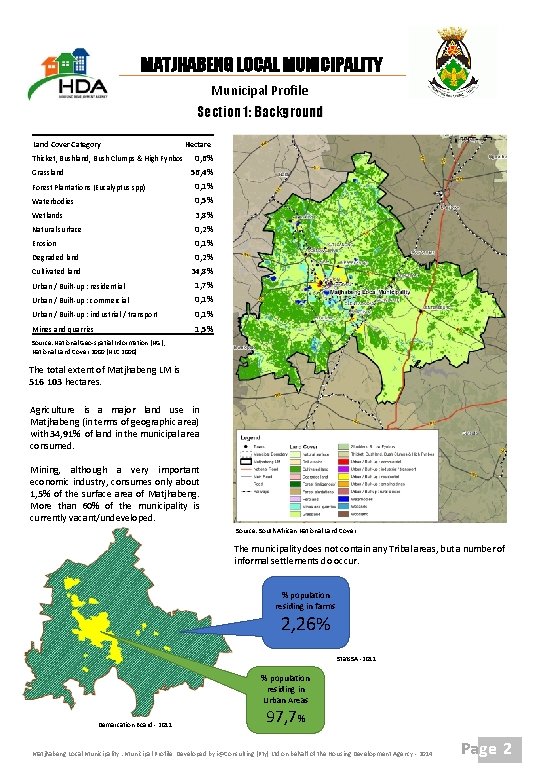
MATJHABENG LOCAL MUNICIPALITY Municipal Profile Section 1: Background Land Cover Category Thicket, Bushland, Bush Clumps & High Fynbos Hectare 0, 6% 56, 4% Grassland Forest Plantations (Eucalyptus spp) 0, 1% Waterbodies 0, 5% Wetlands 3, 8% Natural surface 0, 2% Erosion 0, 1% Degraded land 0, 2% Cultivated land 34, 8% Urban / Built-up : residential 1, 7% Urban / Built-up : commercial 0, 1% Urban / Built-up : industrial / transport 0, 1% Mines and quarries 1, 5% Source: National Geo-spatial Information (NGI), National Land Cover 2000 (NLC 2000). The total extent of Matjhabeng LM is 516 103 hectares. Agriculture is a major land use in Matjhabeng (in terms of geographic area) with 34, 91% of land in the municipal area consumed. Mining, although a very important economic industry, consumes only about 1, 5% of the surface area of Matjhabeng. More than 60% of the municipality is currently vacant/undeveloped. Source: South African National Land Cover The municipality does not contain any Tribal areas, but a number of informal settlements do occur. % population residing in farms 2, 26% Stats. SA -2011 % population residing in Urban Areas Demarcation Board - 2011 97, 7% Matjhabeng Local Municipality : Municipal Profile. Developed by i@Consulting (Pty) Ltd on behalf of the Housing Development Agency - 2014 Page 2

MATJHABENG LOCAL MUNICIPALITY Municipal Profile Section 2: Demographics population Matjhabeng has the second largest population in the Free State Province with 406 461 people (Stats. SA, 2011). The last 3 census figures indicate that the municipality has in fact decreased in population since 1996. Population 1996 - 2020 475, 892 408, 169 6/ 18 /1 6/ 90 20 5 1 /1 2 6/ 90 : 00 22 5 1 : 0 /1 2 0 6/ 90 : 00 AM 24 5 1 : 0 /1 2 0 6/ 90 : 00 AM 26 5 1 : 0 /1 2 0 6/ 90 : 00 AM 5 : 0 28 /1 12: 0 A 6/ 90 00 M 30 5 1 : 0 /1 2: 0 A 7/ 905 00: 0 M 2/ 12 0 A 19 : 05 00: M 1 00 2: 00 AM : 0 0 AM 406, 461 Year 1996 RSA Population 40 340 660 Matjhabeng Population 475 895 % 1, 17% 2001 44 816 888 408 169 0. 91% 2011 51 770 560 406 461 0. 79% Growth R 2 = 1. 00 -0. 04 % -2. 85% Matjhabeng LM has a VERY LOW POPULATION DENSITY OF 0, 79 people per hectare, largely due to 96, 64% of the municipality not being developed. income By 2020, the population of Matjhabeng LM is expected to be 558 601 Households that may qualify for subsidies based on income - 2001 Household Monthly Income 2011 15, 408 25, 000 From 2001 - 2011, the % people earning less than R 3500/month reduced with: 2, 66% per annum. 20, 000 15, 000 10, 000 R 204 801 or more R 102 401 - R 204 800 R 51 201 - R 102 400 R 25 601 - R 51 200 R 6 401 - R 12 800 R 12 801 - R 25 600 R 3 201 - R 6 400 R 1 601 - R 3 200 R 801 - R 1 600 R 401 - R 800 No income R 1 - R 400 5, 000 0 People in Matjhabeng are relatively poor with almost 16, 09% of the households earning no income at all. There has been significant growth in the income bracket earning between R 3500 and R 12800/month – a clear signal for rental or gap market housing options. Source: Statistics South Africa, 2011 2001 to 2011 1996 to 2001 108, 264 Less than R 3500/month R 3 500 - R 12 801/Month Households that may qualify for subsidies based on income - 2011 From 2001 - 2011, the % people earning between R 3500 to R 12801/month grew at: 9, 84% per annum. 30, 572 Less than R 3500/month 79, 432 R 3 500 - R 12 801/Month Matjhabeng Local Municipality : Municipal Profile. Developed by i@Consulting (Pty) Ltd on behalf of the Housing Development Agency - 2014 Page 3

MATJHABENG LOCAL MUNICIPALITY Municipal Profile Section 2: Demographics level of education Highest level of education achieved in 2011 Highest level of education 2011 The percentage of population with no schooling decreased between 2001 and 2011 with 8, 69% Other Higher Degree (Masters / Ph. D) Honours degree Bachelors Degree and Post graduate Diploma Bachelors Degree Post Higher Diploma (Masters, Doctoral Diploma) Higher Diploma with Grade 12 / Std 10 Certificate with Grade 12 / Std 10 NTC VI / N 6 NTC V / N 5 NTC IV / N 4 NTC III / N 3 / NIC / (V) Level 4 Grade 12 / Standard 10 / Form 5 / Matric / NTC 111 Grade 12 / Std 10 / Form 5 Diploma with less than Grade 12 / Std 10 Certificate with less than Grade 12 / Std 10 NTC II / N 2 / NIC / (V) Level 3 NTC I / N 1 / NIC / (V) Level 2 Grade 11 / Standard 9 / Form 4 Grade 10 / Standard 8 / Form 3 Grade 9 / Standard 7 / Form 2 / ABET 4 Grade 8 / Standard 6 / Form 1 Grade 7 / Standard 5 / ABET 3 Grade 6 / Standard 4 Grade 5 / Standard 3 / ABET 2 Grade 4 / Standard 2 Grade 3 / Standard 1 / ABET 1 (Kha Ri Gude, SANLI) Grade 2 / Sub B Grade 1 / Sub A Grade 0 No schooling 0 10, 000 20, 000 30, 000 40, 000 50, 000 Number of people 60, 000 70, 000 80, 000 Source: Statistics South Africa, 2011 gender distribution Gender Distribution 1996 - 2011 60% Number of people 50% 55. 31% 44. 69% 49. 08% 50. 92% 49. 54% 50. 46% 2001 2011 40% 30% 20% 10% 0% 1996 Male In 2011, the male gender constituted approximately 49, 54% of the total population. This is down from around 55, 31% in 1996. This may be due to a declining mining sector. Female Matjhabeng Local Municipality : Municipal Profile. Developed by i@Consulting (Pty) Ltd on behalf of the Housing Development Agency - 2014 Page 4

MATJHABENG LOCAL MUNICIPALITY Municipal Profile Section 3: Economics economic sector & strength Economic Strength - GVA (R Millions Economic strength Share of GVA 2009 13. 36% 2008 re M in M an ing uf ac tu rin El ec tri g c Co ns ity tru ct io n Re ta i Tr an l sp or t Fin a nc Co e m m un Ge it ne y a n ra l g d so ov cia er nm l en t ric Ag 2011 2010 40. 51% ul tu % Share 50% 40% 30% 20% 10% 0% Share of employment 2007 2006 2005 2004 Economic sector 0 The dominant economic sector in is clearly Mining, which contributes to more than 40, 51% of the GVA of the municipality. This sector employs more than 13, 36% of Majthabeng’s people. All other economic sectors contribute less than 15% each of the GVA of Matjhabeng LM. 50000 Metro Average 100000 150000 Matjhabeng Local Municipality In 2011, Matjhabeng LM contributed to 0, 77% of the National GVA. Municipality Economic Growth Rate 2008 2009 2010 2011 Average City of Cape Town 4, 0% -1, 1% 3, 0% 3, 1% Buffalo City LM 3, 3% -1, 3% 1, 2% 2, 1% 2, 0% 6% Nelson Mandela Bay Metro 0, 0% -4, 6% 0, 6% -0, 2% 4% Mangaung 4, 8% -0, 9% 1, 8% 2, 4% 2, 8% 2% e. Thekwini 2, 9% -1, 6% 2, 1% 2, 4% 2, 2% Ekurhuleni 4, 1% -3, 5% 3, 3% 3, 8% 2, 7% City of Johannesburg 5, 7% -1, 0% 2, 9% 3, 8% 3, 6% City of Tshwane 2, 6% 3, 1% 3, 0% 3, 1% 3, 7% Matjhabeng LM -1, 4% -4, 9% 6, 9% 0, 6% 0, 48% Comparison of Economic Growth Rates (2007 - 2011) 8% 0% -2% 2007 2008 2009 2010 2011 -4% -6% Matjhabeng LM Metro Average Free State GVA National GDP In 2011, the unemployment rate was: 37% Of the 8 metropolitan municipalities in South Africa, only Nelson Mandela Bay exhibits a lower average annual economic growth rate (2008 -2011) than Matjhabeng LM. Matjhabeng Local Municipality : Municipal Profile. Developed by i@Consulting (Pty) Ltd on behalf of the Housing Development Agency - 2014 Page 5

MATJHABENG LOCAL MUNICIPALITY Municipal Profile Section 4: Financial Status of the municipality annual collection rate 66, 56% of all billed Annual Collection Rate (2013) revenue has been collected, the benchmark is 95% Rand/Million R 1, 000 R 500 R 0 2013 (Rand/million) R 960 Revenue billed Renevue collected R 639 Loss in cash flow R 321 The payment level of 66, 56% resulted in a loss of R 320 million in cash flow which should have been utilised in service delivery or in capital investment. Future sustainability and growth is dependent on a collection rate of approximately 95% and a focused revenue collection strategy should be implemented. own revenue to total operating revenue Total Revenue (excl. Capital grants), R 1, 546 Own revenue, R 1, 108 Operational grants, R 438 R 0 R 1, 000 Rand/Million asset turnover R 4, 654 Service revenue to assets employed (asset turnover) measures whethere is sufficient investment in economic assets. The benchmark is 20% R 4, 433 The historic infrastructure base is sufficient to support the current service delivery demands. R 5, 000 R 4, 000 R 3, 000 R 2, 000 71, 67% of the Municipality’s revenue was internally generated in 2013, this has increased from 71, 46% during 2012, which indicates a decreasing dependency on government grants to sustain R 2, 000 operations. 17, 66% 15, 80% R 735 R 783 R 1, 000 R 0 2012 (Rand/million) 2013 (Rand/million) The upward trend indicates the municipalities growth in economic assets thus ensuring excellent revenue growth. Infrastructure carrying value Service charges Matjhabeng Local Municipality : Municipal Profile. Developed by i@Consulting (Pty) Ltd on behalf of the Housing Development Agency - 2014 Page 6

MATJHABENG LOCAL MUNICIPALITY Municipal Profile Section 4: Financial status of the municipality budget implementation Revenue and expenditure management 121, 68% R 2, 000, 000 Indicates to what extent the Municipality is able to deliver on its planned budget. The 95, 60% target is 100%. 70, 27% actual expenditure on capital budget R 1, 500, 000 R 1, 000, 000 121, 68% actual expenditure on operational budget 70, 27% R 500, 000 95, 60% actual revenue realised R 0 Capital Expenditure Operating Expenditure Budgeted Operating Revenue Actual The consistent realisation of revenue below the budgeted revenue over the past three years is indicative of unrealistic revenue projections. Section 5: Property market Average land value(R/m²) per land use R 370. 15 Vacant State-Owned R 0. 58 Residential Municipal Mining R 31. 12 R 47. 82 R 19. 77 Industrial R 242. 98 Business Instututional Agricultural R 1, 326. 26 R 130. 25 R 104. 24 160 140 120 100 80 60 40 20 0 BE RIE S DE BE S W LIA ECK EL (W ST KO DA EL AD M GB KO EX RE M T 1 EK (W T EXT H 3 E A LK B ) DO OR R OM ONG N IEB EX (W EE T JA N E C 4 CI VI LKO KS ) LL RG M TA IE RS INI EX D P A C T AR E 2) K NT VI ( W RAL RG EL IN KO IA. . . AL LA ST PAR H NR E K ID LEN JIM G FO V N E E A A E UC N UD XT HE TER EV 1 P SB ILL AR U E K R TH ( W G R EU EL D NI KO SS. . . EN R D No of Transfers Total Number of Transfers (above 20 transfers) Source: Matjhabeng Valuation Roll 2011/2015 Highest Transfers (above R 1 million) R 250000000 R 20000 R 150000000 R 10000 R 50000000 R 0 WELKOM VENTERSBURG RD THEUNISSEN RD ODENDAALSRUS RD KROONSTAD RD WELKOM EXT 8 RIEBEECKSTAD WELKOM (CENTRAL) VIRGINIA CENTRAL VOORSPOED ( WELK. . . JIM FOUCHE PARK (. . . SS WELKOM REITZ PARK ( WELKO. . . WELKOM RD WELKOM EXT 12 ST HELENA WELKOM CENTRAL (. . . BEDELIA ( WELKOM. . . ODENDAALSRUS CEN. . . JAN CILLIERS PARK (. . . DOORN (WELKOM E. . . DAGBREEK (WELKO. . . BEDELIA (WELKOM E. . . RIEBEECKSTAD EXT 1 DOORN (WELKOM) ALLANRIDGE EXT 1 VOORSPOED ( WELK. . . Private Open Space R 3, 282. 74 Matjhabeng Local Municipality : Municipal Profile. Developed by i@Consulting (Pty) Ltd on behalf of the Housing Development Agency - 2014 Page 7
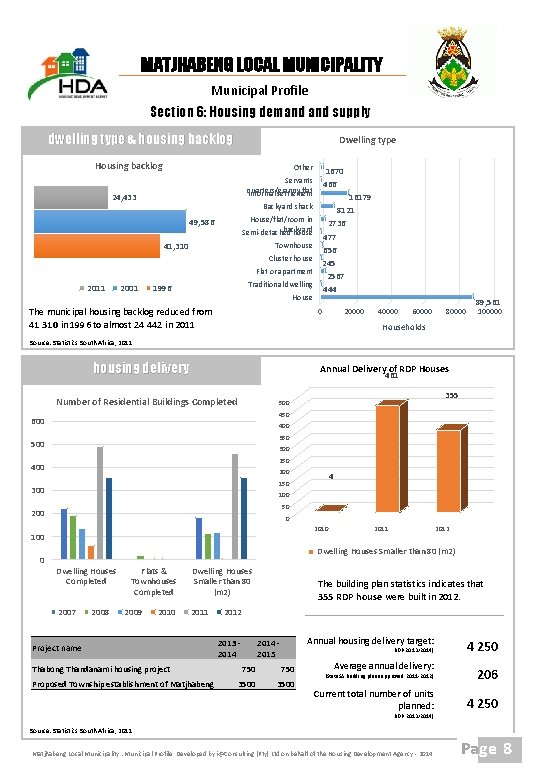
MATJHABENG LOCAL MUNICIPALITY Municipal Profile Section 6: Housing demand supply dwelling type & housing backlog Dwelling type Housing backlog Other 24, 433 House/flat/room in backyard Semi-detached house 477 656 Cluster house 245 Flat or apartment 2567 Traditional dwelling 444 41, 310 2001 16179 8121 2736 Backyard shack 49, 586 2011 1670 466 Servants quarters/granny flat Informal settlement Townhouse 1996 House The municipal housing backlog reduced from 41 310 in 1996 to almost 24 442 in 2011 0 20000 40000 60000 89, 561 100000 Households Source: Statistics South Africa, 2011 housing delivery Annual Delivery of RDP Houses 461 Number of Residential Buildings Completed 450 600 400 350 500 300 250 400 200 4 150 300 100 50 200 0 2010 100 0 355 500 2011 2012 Dwelling Houses Smaller than 80 (m 2) Dwelling Houses Completed 2007 2008 Flats & Townhouses Completed 2009 2010 Dwelling Houses Smaller than 80 (m 2) 2011 Project name Thabong Thandanami housing project Proposed Township establishment of Matjhabeng The building plan statistics indicates that 355 RDP house were built in 2012 2013 2014 Annual housing delivery target: 2014 2015 (IDP 2013/2014) 750 3500 Average annual delivery: (Stats. SA Building plans approved 2011 -2012) Current total number of units planned: (IDP 2013/2014) 4 250 206 4 250 Source: Statistics South Africa, 2011 Matjhabeng Local Municipality : Municipal Profile. Developed by i@Consulting (Pty) Ltd on behalf of the Housing Development Agency - 2014 Page 8
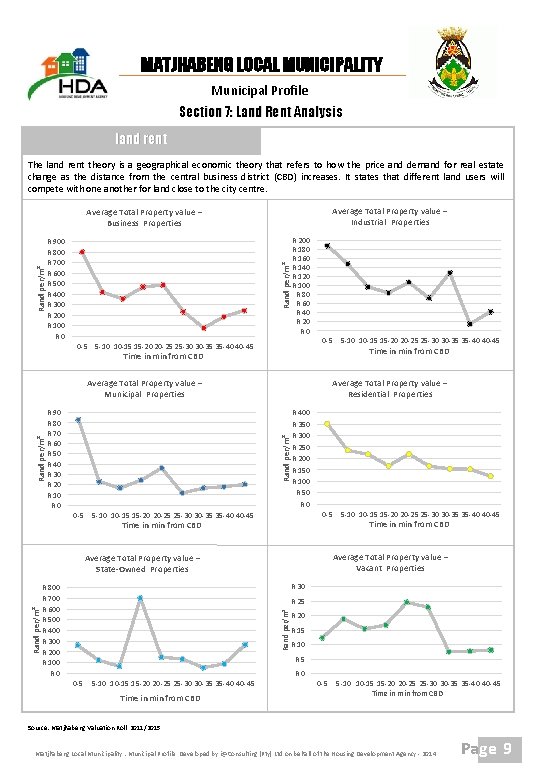
MATJHABENG LOCAL MUNICIPALITY Municipal Profile Section 7: Land Rent Analysis land rent The land rent theory is a geographical economic theory that refers to how the price and demand for real estate change as the distance from the central business district (CBD) increases. It states that different land users will compete with one another for land close to the city centre. Average Total Property value – Industrial Properties R 900 R 800 R 700 R 600 R 500 R 400 R 300 R 200 R 100 R 0 Rand per/m² Average Total Property value – Business Properties R 200 R 180 R 160 R 140 R 120 R 100 R 80 R 60 R 40 R 20 R 0 0 -5 5 -10 10 -15 15 -20 20 -25 25 -30 30 -35 35 -40 40 -45 Time in min from CBD R 90 R 80 R 70 R 60 R 50 R 40 R 30 R 20 R 10 R 0 0 -5 R 400 R 350 R 300 R 250 R 200 R 150 R 100 R 50 R 0 0 -5 5 -10 10 -15 15 -20 20 -25 25 -30 30 -35 35 -40 40 -45 Time in min from CBD Average Total Property value – State-Owned Properties Average Total Property value – Vacant Properties R 30 R 800 R 700 R 600 R 500 R 400 R 300 R 200 R 100 R 25 Rand per/m² Average Total Property value – Residential Properties Rand per/m² Average Total Property value – Municipal Properties R 20 R 15 R 10 R 5 0 -5 5 -10 10 -15 15 -20 20 -25 25 -30 30 -35 35 -40 40 -45 Time in min from CBD R 0 0 -5 5 -10 10 -15 15 -20 20 -25 25 -30 30 -35 35 -40 40 -45 Time in min from CBD Source: Matjhabeng Valuation Roll 2011/2015 Matjhabeng Local Municipality : Municipal Profile. Developed by i@Consulting (Pty) Ltd on behalf of the Housing Development Agency - 2014 Page 9
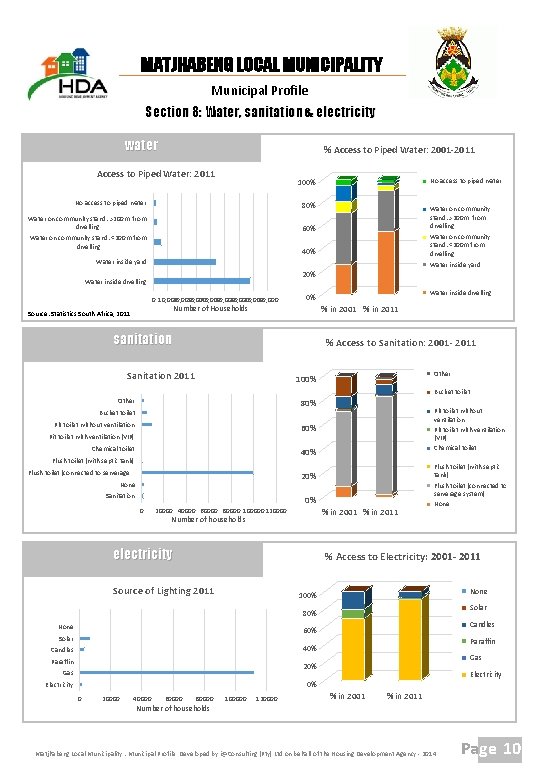
MATJHABENG LOCAL MUNICIPALITY Municipal Profile Section 8: Water, sanitation & electricity water % Access to Piped Water: 2001 -2011 Access to Piped Water: 2011 No access to piped water 100% No access to piped water 80% Water on community stand: >200 m from dwelling 60% Water on community stand: <200 m from dwelling 40% Water inside yard 20% Water inside dwelling 0 10, 000 20, 000 30, 000 40, 000 50, 000 60, 000 70, 000 80, 000 Number of Households Source: Statistics South Africa, 2011 Water inside dwelling 0% % in 2001 % in 2011 sanitation % Access to Sanitation: 2001 - 2011 Sanitation 2011 Other 100% Bucket toilet Other 80% Bucket toilet Pit toilet without ventilation Pit toilet with ventilation (VIP) Chemical toilet 60% Pit toilet with ventilation (VIP) Chemical toilet 40% Flush toilet (with septic tank) Flush toilet (connected to sewerage. . . 20% None Sanitation 0% 0 20000 40000 60000 80000 100000 120000 % in 2001 % in 2011 Number of households electricity Flush toilet (with septic tank) Flush toilet (connected to sewerage system) None % Access to Electricity: 2001 - 2011 Source of Lighting 2011 None 100% Solar 80% None Candles 60% Solar Paraffin 40% Candles Paraffin Gas 20% Gas Electricity 0% Electricity 0 20000 40000 60000 80000 Number of households 100000 120000 % in 2001 % in 2011 Matjhabeng Local Municipality : Municipal Profile. Developed by i@Consulting (Pty) Ltd on behalf of the Housing Development Agency - 2014 Page 10
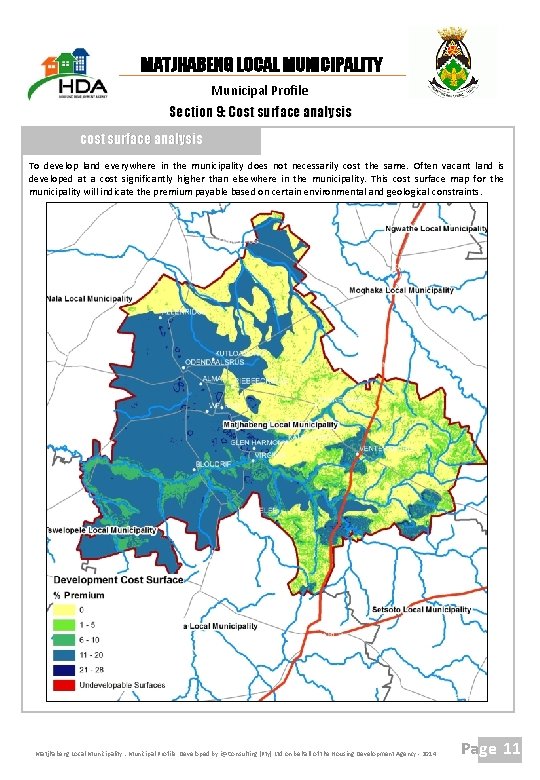
MATJHABENG LOCAL MUNICIPALITY Municipal Profile Section 9: Cost surface analysis cost surface analysis To develop land everywhere in the municipality does not necessarily cost the same. Often vacant land is developed at a cost significantly higher than elsewhere in the municipality. This cost surface map for the municipality will indicate the premium payable based on certain environmental and geological constraints. Matjhabeng Local Municipality : Municipal Profile. Developed by i@Consulting (Pty) Ltd on behalf of the Housing Development Agency - 2014 Page 11
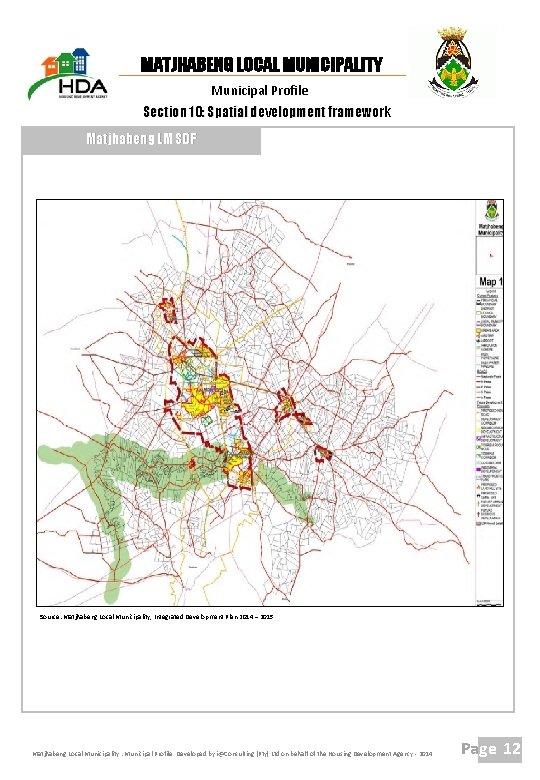
MATJHABENG LOCAL MUNICIPALITY Municipal Profile Section 10: Spatial development framework Matjhabeng LM SDF Source: Matjhabeng Local Municipality, Integrated Development Plan 2014 – 2015. Matjhabeng Local Municipality : Municipal Profile. Developed by i@Consulting (Pty) Ltd on behalf of the Housing Development Agency - 2014 Page 12
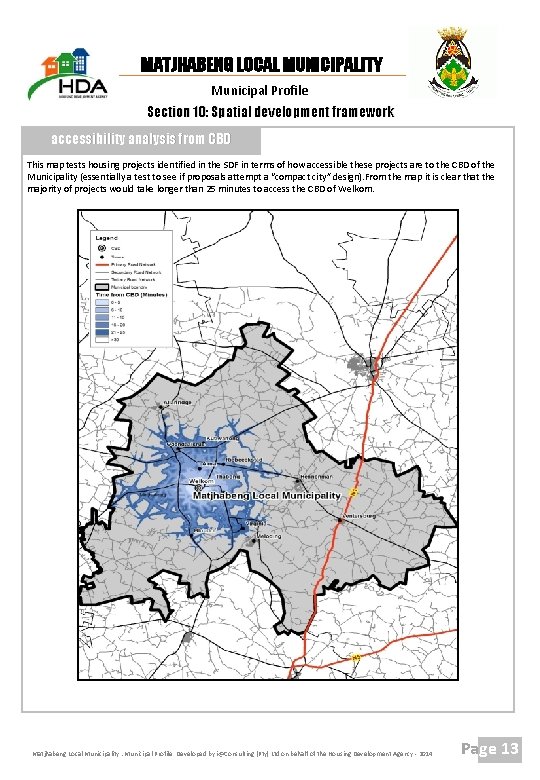
MATJHABENG LOCAL MUNICIPALITY Municipal Profile Section 10: Spatial development framework accessibility analysis from CBD This map tests housing projects identified in the SDF in terms of how accessible these projects are to the CBD of the Municipality (essentially a test to see if proposals attempt a “compact city” design). From the map it is clear that the majority of projects would take longer than 25 minutes to access the CBD of Welkom. Matjhabeng Local Municipality : Municipal Profile. Developed by i@Consulting (Pty) Ltd on behalf of the Housing Development Agency - 2014 Page 13
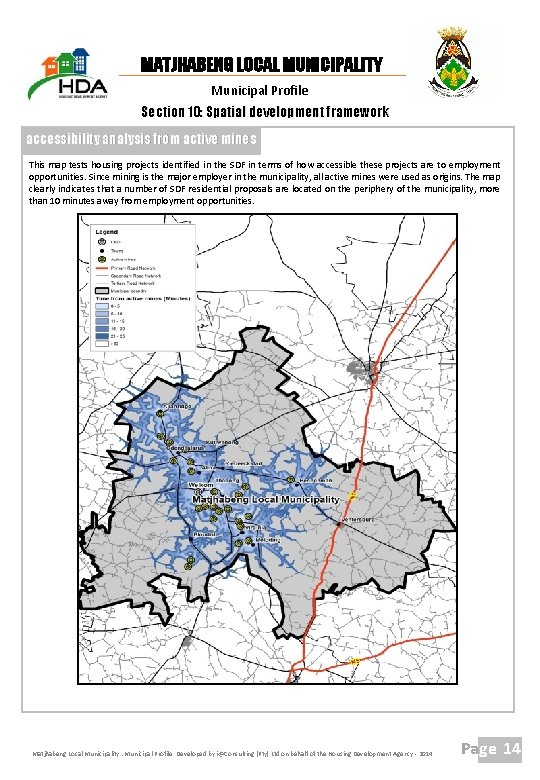
MATJHABENG LOCAL MUNICIPALITY Municipal Profile Section 10: Spatial development framework accessibility analysis from active mines This map tests housing projects identified in the SDF in terms of how accessible these projects are to employment opportunities. Since mining is the major employer in the municipality, all active mines were used as origins. The map clearly indicates that a number of SDF residential proposals are located on the periphery of the municipality, more than 10 minutes away from employment opportunities. Matjhabeng Local Municipality : Municipal Profile. Developed by i@Consulting (Pty) Ltd on behalf of the Housing Development Agency - 2014 Page 14
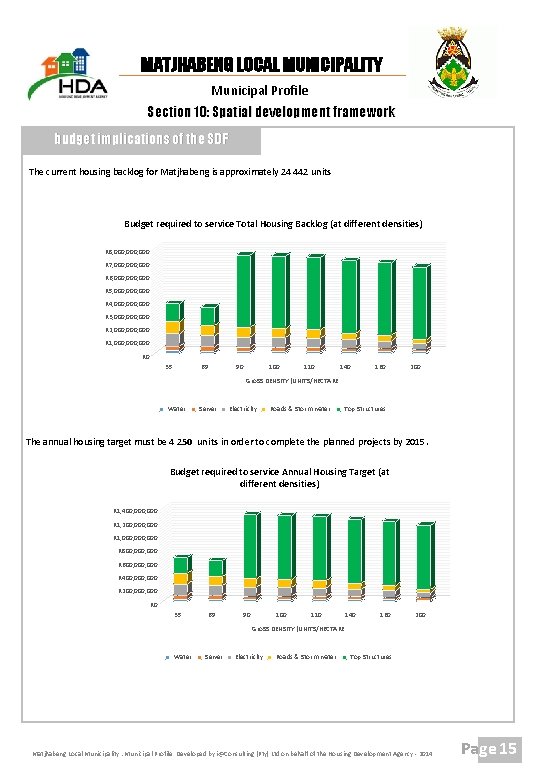
MATJHABENG LOCAL MUNICIPALITY Municipal Profile Section 10: Spatial development framework budget implications of the SDF The current housing backlog for Matjhabeng is approximately 24 442 units Budget required to service Total Housing Backlog (at different densities) R 8, 000, 000 R 7, 000, 000 R 6, 000, 000 R 5, 000, 000 R 4, 000, 000 R 3, 000, 000 R 2, 000, 000 R 1, 000, 000 R 0 35 69 90 100 110 140 160 200 Gro. SS DENSITY (UNITS/HECTARE Water Sewer Electricity Roads & Storm water Top Structures The annual housing target must be 4 250 units in order to complete the planned projects by 2015. Budget required to service Annual Housing Target (at different densities) R 1, 400, 000 R 1, 200, 000 R 1, 000, 000 R 800, 000 R 600, 000 R 400, 000 R 200, 000 R 0 35 69 90 100 110 140 160 200 Gro. SS DENSITY (UNITS/HECTARE Water Sewer Electricity Roads & Storm water Top Structures Matjhabeng Local Municipality : Municipal Profile. Developed by i@Consulting (Pty) Ltd on behalf of the Housing Development Agency - 2014 Page 15
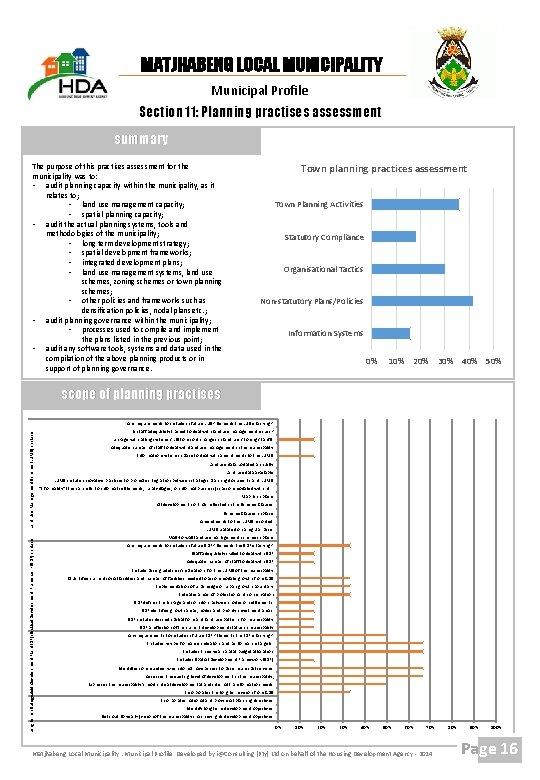
MATJHABENG LOCAL MUNICIPALITY Municipal Profile Section 11: Planning practises assessment summary The purpose of this practises assessment for the municipality was to: • audit planning capacity within the municipality, as it relates to; • land use management capacity; • spatial planning capacity; • audit the actual planning systems, tools and methodologies of the municipality; • long term development strategy; • spatial development frameworks; • integrated development plans; • land use management systems, land use schemes, zoning schemes or town planning schemes; • other policies and frameworks such as densification policies, nodal plans etc. ; • audit planning governance within the municipality; • processes used to compile and implement the plans listed in the previous point; • audit any software tools, systems and data used in the compilation of the above planning products or in support of planning governance. Town planning practices assessment Town Planning Activities Statutory Compliance Organisational Tactics Non-statutory Plans/Policies Information Systems 0% 10% 20% 30% 40% 50% scope of planning practises Long term strategic plan Integrated Development Plan (IDP) in place Spatial Development Framework (SDF) in place Land Use Management Scheme (LUMS) in place Any requirements to include in future LUS? Elements the LUS is lacking? Is staff adequately trained to deal with land use management issues? Linkage with billing systems / LIS to record changes in land use / zoning / tariffs Adequate number of staff to deal with land use management in the municipality Information system in place to deal with amendments to the LUMS Land use data updated annually Land use data available LUMS include innovative practises to promote integration between strategic planning documents and LUMS "Informality" (this can refer to informal settlements, rural villages, or informal business) is accommodated within t. . . Map 3 s in place All development controls reflected in the Scheme Clauses in place Amendments to the LUMS recorded LUMS updated on a regular basis Wall-to-wall land use management scheme in place Any requirements to include in future SDF? Elements the SDF is lacking? Staff adequately skilled to deal with SDF Adequate number of staff to deal with SDF Include basic guidelines/implications for the LUMS of the municipality Quantifies current social facilities and number of facilities needed to accommodate growth from GDS Implementation of urban edge or urban growth boundary Indicates areas of protection and conservation SDF defines the linkage and corridors between nodes or settlements SDF identifies growth areas, nodes and priority investment areas SDF includes desired spatial form and land use patterns for municipality SDF a reflection of the current development status in municipality Any requirements to include in future IDP? Elements the IDP is lacking? Includes key performance indicators and performance targets. Includes three year capital budget allocation Includes Spatial Development Framework (SDF) Identifies communities which do not have access to basic municipal services Assesses the existing level of development in the municipality, Expresses the municipality’s most critical developmental and internal transformation needs Incorporates the long term vision from GDS Incorporates national and provincial planning directives Identify long term development objectives Sets out 20 year(+) vision of the municipality in achieving its development objectives 0% 10% 20% 30% 40% 50% 60% 70% Matjhabeng Local Municipality : Municipal Profile. Developed by i@Consulting (Pty) Ltd on behalf of the Housing Development Agency - 2014 80% 90% 100% Page 16
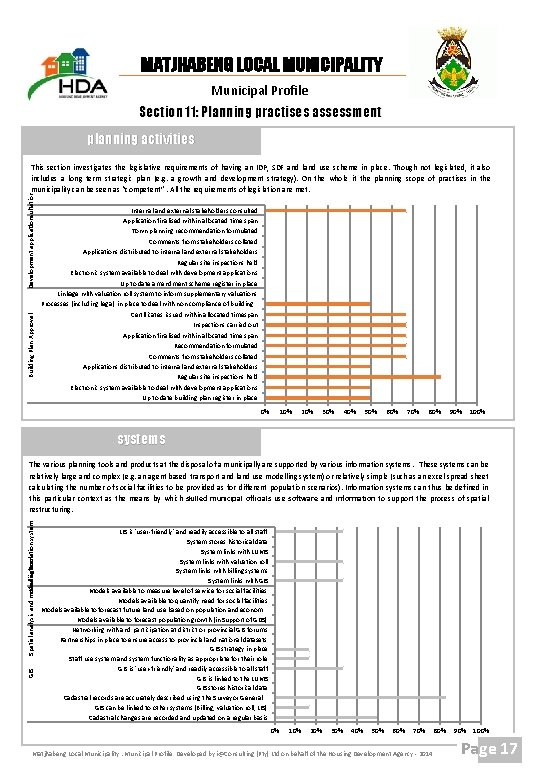
MATJHABENG LOCAL MUNICIPALITY Municipal Profile Section 11: Planning practises assessment planning activities Building Plan Approval Development applications Consultation This section investigates the legislative requirements of having an IDP, SDF and land use scheme in place. Though not legislated, it also includes a long term strategic plan (e. g. a growth and development strategy). On the whole it the planning scope of practises in the municipality can be seen as “competent”. All the requirements of legislation are met. Internal and external stakeholders consulted Application finalised within allocated time span Town planning recommendation formulated Comments from stakeholders collated Applications distributed to internal and external stakeholders Regular site inspections held Electronic system available to deal with development applications Up to date amendment scheme register in place Linkage with valuation roll system to inform supplementary valuations Processes (including legal) in place to deal with non compliance of building. . . Certificates issued within allocated timespan Inspections carried out Application finalised within allocated time span Recommendation formulated Comments from stakeholders collated Applications distributed to internal and external stakeholders Regular site inspections held Electronic system available to deal with development applications Up to date building plan register in place 0% 10% 20% 30% 40% 50% 60% 70% 80% 90% 100% systems GIS Spatial analysis and modelling tools Land information system The various planning tools and products at the disposal of a municipally are supported by various information systems. These systems can be relatively large and complex (e. g. an agent based transport and land use modelling system) or relatively simple (such as an excel spread sheet calculating the number of social facilities to be provided as for different population scenarios). Information systems can thus be defined in this particular context as the means by which skilled municipal officials use software and information to support the process of spatial restructuring. LIS is 'user-friendly' and readily accessible to all staff System stores historical data System links with LUMS System links with valuation roll System links with billing systems System links with GIS Models available to measure level of service for social facilities Models available to quantify need for social facilities Models available to forecast future land use based on population and econom. . . Models available to forecast population growth (in Support of GDS) Networking with and participation at district or provincial GIS forums Partnerships in place to ensure access to provincial and national datasets GIS strategy in place Staff use system and system functionality as appropriate for their role GIS is 'user-friendly' and readily accessible to all staff GIS is linked to the LUMS GIS stores historical data Cadastral records are accurately described using the Surveyor General. . . GIS can be linked to other systems (Billing, valuation roll, LIS) Cadastral changes are recorded and updated on a regular basis 0% 10% 20% 30% 40% 50% 60% 70% 80% Matjhabeng Local Municipality : Municipal Profile. Developed by i@Consulting (Pty) Ltd on behalf of the Housing Development Agency - 2014 90% 100% Page 17
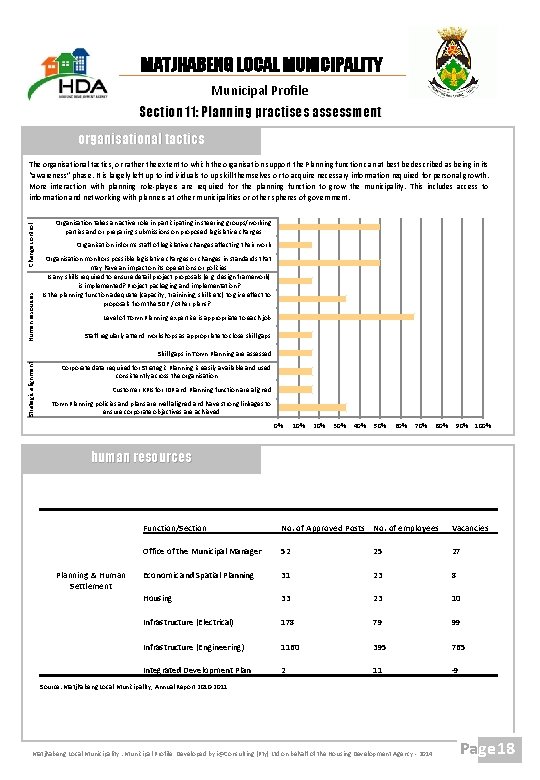
MATJHABENG LOCAL MUNICIPALITY Municipal Profile Section 11: Planning practises assessment organisational tactics Human resources Change control The organisational tactics, or rather the extent to which the organisation support the Planning function can at best be described as being in its “awareness” phase. It is largely left up to individuals to up skill themselves or to acquire necessary information required for personal growth. More interaction with planning role-players are required for the planning function to grow the municipality. This includes access to information and networking with planners at other municipalities or other spheres of government. Organisation takes an active role in participating in steering groups/working parties and or preparing submissions on proposed legislative changes Organisation informs staff of legislative changes affecting their work Organisation monitors possible legislative changes or changes in standards that may have an impact on its operations or policies Is any skills required to ensure detail project proposals (e. g. design framework) is implemented? Project packaging and implementation? Is the planning function adequate (capacity, trainining, skills etc) to give effect to proposals from the SDF / other plans? Level of Town Planning expertise is appropriate to each job Staff regularly attend workshops as appropriate to close skill gaps Strategic alignment Skill gaps in Town Planning are assessed Corporate data required for Strategic Planning is easily available and used consistently across the organisation Customer KPIs for IDP and Planning function are aligned Town Planning policies and plans are well aligned and have strong linkages to ensure corporate objectives are achieved 0% 10% 20% 30% 40% 50% 60% 70% 80% 90% 100% human resources Planning & Human Settlement Function/Section No. of Approved Posts No. of employees Vacancies Office of the Municipal Manager 52 25 27 Economic and Spatial Planning 31 23 8 Housing 33 23 10 Infrastructure (Electrical) 178 79 99 Infrastructure (Engineering) 1160 395 765 Integrated Development Plan 2 11 -9 Source: Matjhabeng Local Municipality, Annual Report 2010 -2011. Matjhabeng Local Municipality : Municipal Profile. Developed by i@Consulting (Pty) Ltd on behalf of the Housing Development Agency - 2014 Page 18
- Slides: 18