
Maths Use a Map Scale to Work Out
- Slides: 6
Maths Use a Map Scale to Work Out a Length and Vice Versa Mr Bond 1
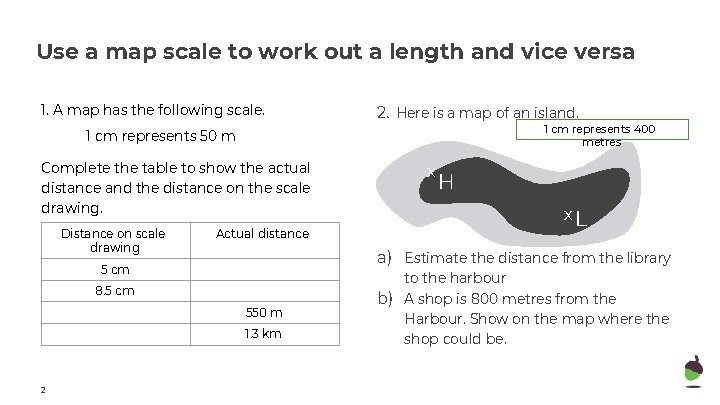
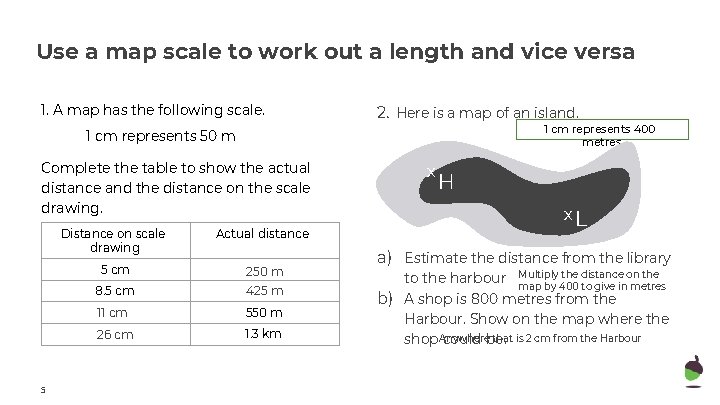
Use a map scale to work out a length and vice versa 1. A map has the following scale. 2. Here is a map of an island. 1 cm represents 400 metres 1 cm represents 50 m Complete the table to show the actual distance and the distance on the scale drawing. Distance on scale drawing Actual distance H x. L a) Estimate the distance from the library 5 cm 8. 5 cm 550 m 1. 3 km 2 x to the harbour b) A shop is 800 metres from the Harbour. Show on the map where the shop could be.
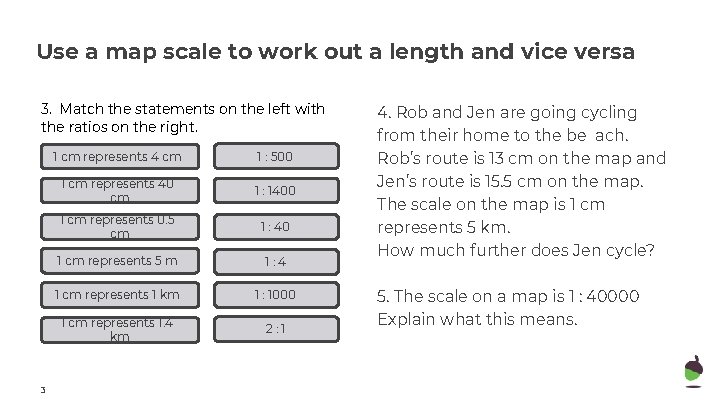
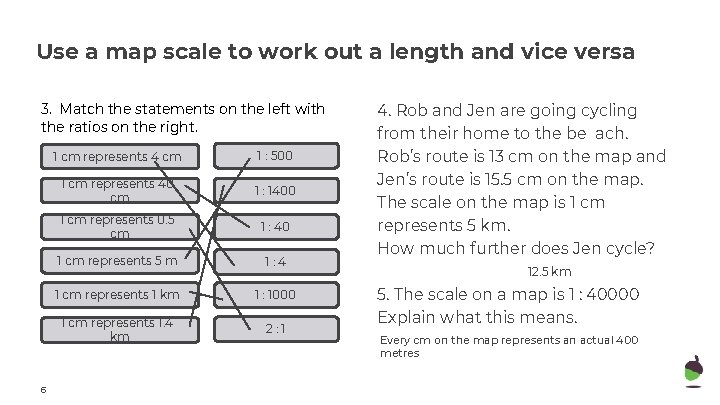
Use a map scale to work out a length and vice versa 3. Match the statements on the left with the ratios on the right. 3 1 cm represents 4 cm 1 : 500 1 cm represents 40 cm 1 : 1400 1 cm represents 0. 5 cm 1 : 40 1 cm represents 5 m 1: 4 1 cm represents 1 km 1 : 1000 1 cm represents 1. 4 km 2: 1 4. Rob and Jen are going cycling from their home to the be ach. Rob’s route is 13 cm on the map and Jen’s route is 15. 5 cm on the map. The scale on the map is 1 cm represents 5 km. How much further does Jen cycle? 5. The scale on a map is 1 : 40000 Explain what this means.
Answers 4
Use a map scale to work out a length and vice versa 1. A map has the following scale. 2. Here is a map of an island. 1 cm represents 400 metres 1 cm represents 50 m Complete the table to show the actual distance and the distance on the scale drawing. 5 Distance on scale drawing Actual distance 5 cm 250 m 8. 5 cm 425 m 11 cm 550 m 26 cm 1. 3 km x H x. L a) Estimate the distance from the library the distance on the to the harbour Multiply map by 400 to give in metres b) A shop is 800 metres from the Harbour. Show on the map where that is 2 cm from the Harbour shop. Anywhere could be.
Use a map scale to work out a length and vice versa 3. Match the statements on the left with the ratios on the right. 6 1 cm represents 4 cm 1 : 500 1 cm represents 40 cm 1 : 1400 1 cm represents 0. 5 cm 1 : 40 1 cm represents 5 m 1: 4 1 cm represents 1 km 1 : 1000 1 cm represents 1. 4 km 2: 1 4. Rob and Jen are going cycling from their home to the be ach. Rob’s route is 13 cm on the map and Jen’s route is 15. 5 cm on the map. The scale on the map is 1 cm represents 5 km. How much further does Jen cycle? 12. 5 km 5. The scale on a map is 1 : 40000 Explain what this means. Every cm on the map represents an actual 400 metres