
Maths Knowledge Organiser Set 3 H CALCULATIONS CHECKING
- Slides: 33
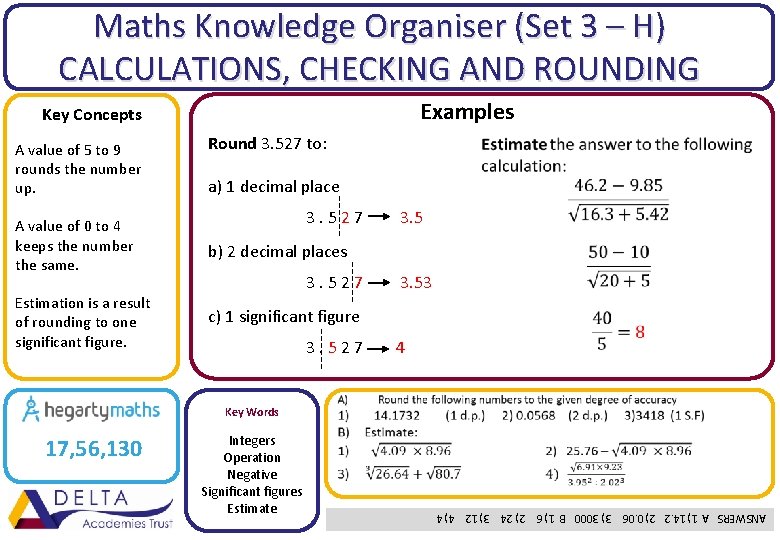
Maths Knowledge Organiser (Set 3 – H) CALCULATIONS, CHECKING AND ROUNDING Examples Key Concepts A value of 5 to 9 rounds the number up. Round 3. 527 to: a) 1 decimal place 3. 527 A value of 0 to 4 keeps the number the same. b) 2 decimal places Estimation is a result of rounding to one significant figure. c) 1 significant figure 3. 527 3. 53 4 Key Words Integers Operation Negative Significant figures Estimate ANSWERS A 1) 14. 2 2) 0. 06 3) 3000 B 1) 6 2) 24 3) 12 4) 4 17, 56, 130
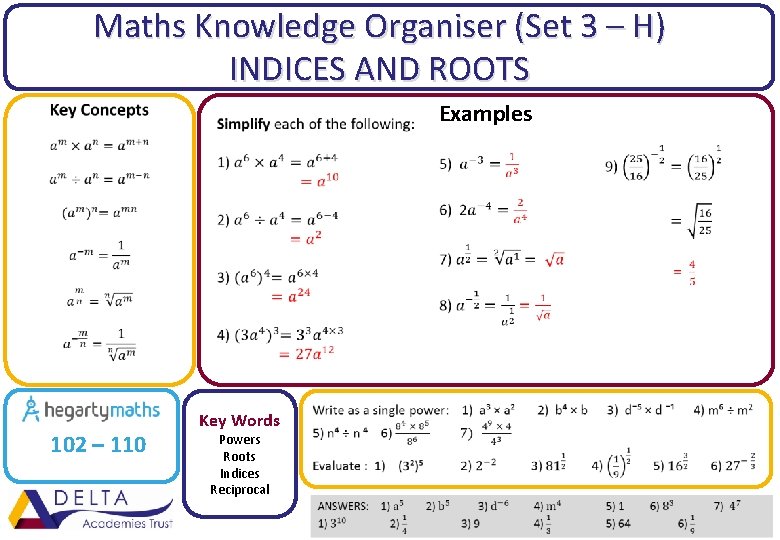
Maths Knowledge Organiser (Set 3 – H) INDICES AND ROOTS Examples 102 – 110 Key Words Powers Roots Indices Reciprocal
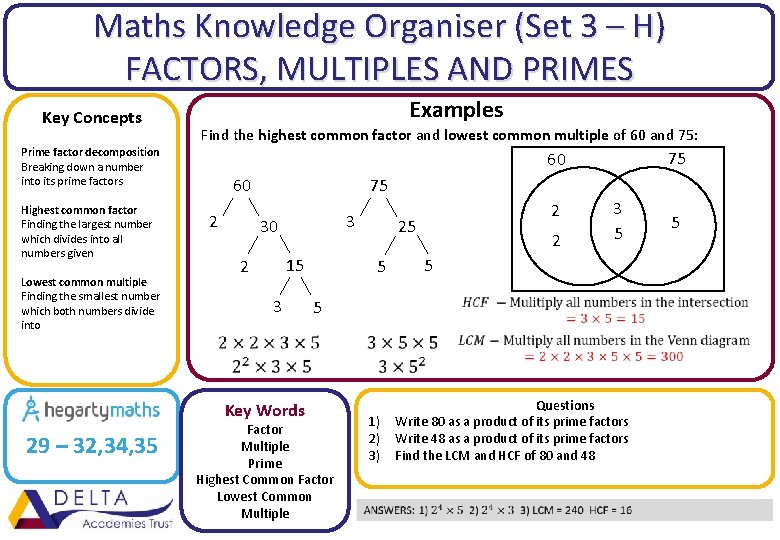
Maths Knowledge Organiser (Set 3 – H) FACTORS, MULTIPLES AND PRIMES Key Concepts Examples Find the highest common factor and lowest common multiple of 60 and 75: Prime factor decomposition Breaking down a number into its prime factors Highest common factor Finding the largest number which divides into all numbers given Lowest common multiple Finding the smallest number which both numbers divide into 60 2 75 3 30 15 2 3 Key Words 29 – 32, 34, 35 75 60 2 25 5 2 3 5 5 5 Factor Multiple Prime Highest Common Factor Lowest Common Multiple 1) 2) 3) Questions Write 80 as a product of its prime factors Write 48 as a product of its prime factors Find the LCM and HCF of 80 and 48 5
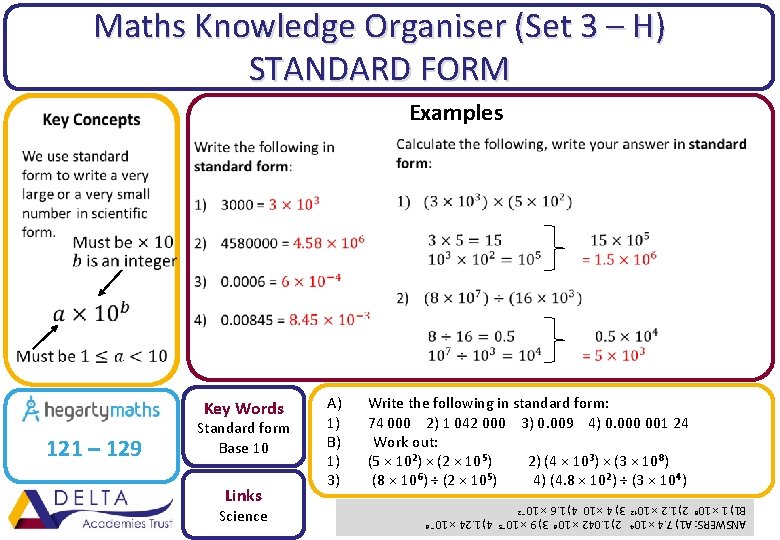
Maths Knowledge Organiser (Set 3 – H) STANDARD FORM Examples 121 – 129 Standard form Base 10 Links Science A) 1) B) 1) 3) Write the following in standard form: 74 000 2) 1 042 000 3) 0. 009 4) 0. 000 001 24 Work out: (5 × 10²) × (2 × 10⁵) 2) (4 × 10³) × (3 × 10⁸) (8 × 10⁶) ÷ (2 × 10⁵) 4) (4. 8 × 10²) ÷ (3 × 10⁴) ANSWERS: A 1) 7. 4 × 10⁴ 2) 1. 042 × 10⁶ 3) 9 × 10¯³ 4) 1. 24 × 10¯⁶ B 1) 1 × 10⁸ 2) 1. 2 × 10¹² 3) 4 × 10 4) 1. 6 × 10¯² Key Words
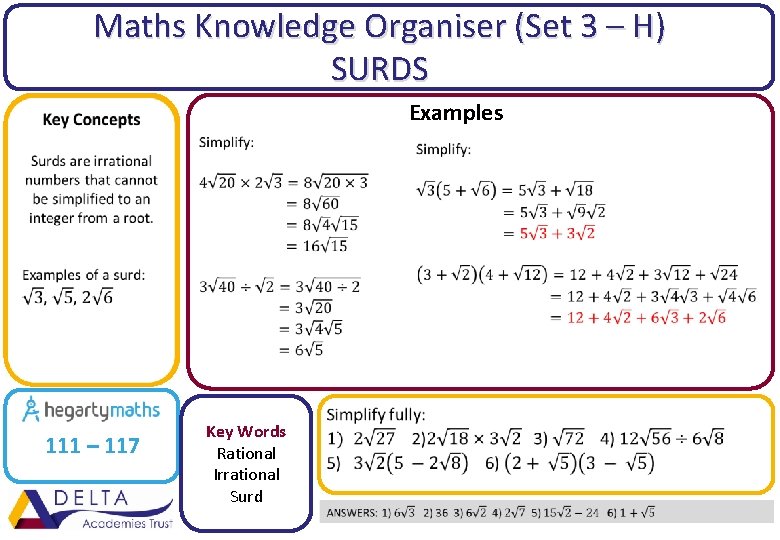
Maths Knowledge Organiser (Set 3 – H) SURDS Examples 111 – 117 Key Words Rational Irrational Surd
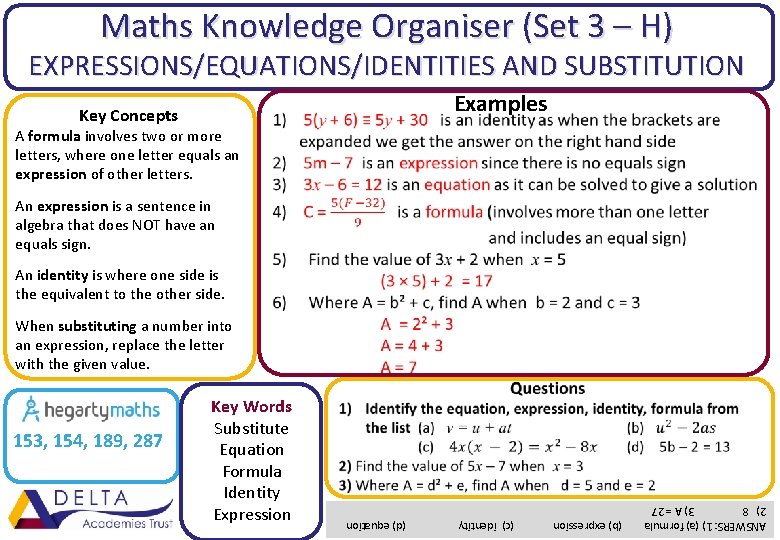
Maths Knowledge Organiser (Set 3 – H) EXPRESSIONS/EQUATIONS/IDENTITIES AND SUBSTITUTION Examples Key Concepts A formula involves two or more letters, where one letter equals an expression of other letters. An expression is a sentence in algebra that does NOT have an equals sign. An identity is where one side is the equivalent to the other side. When substituting a number into an expression, replace the letter with the given value. ANSWERS: 1) (a) formula 2) 8 3) A = 27 (b) expression (c) identity (d) equation 153, 154, 189, 287 Key Words Substitute Equation Formula Identity Expression
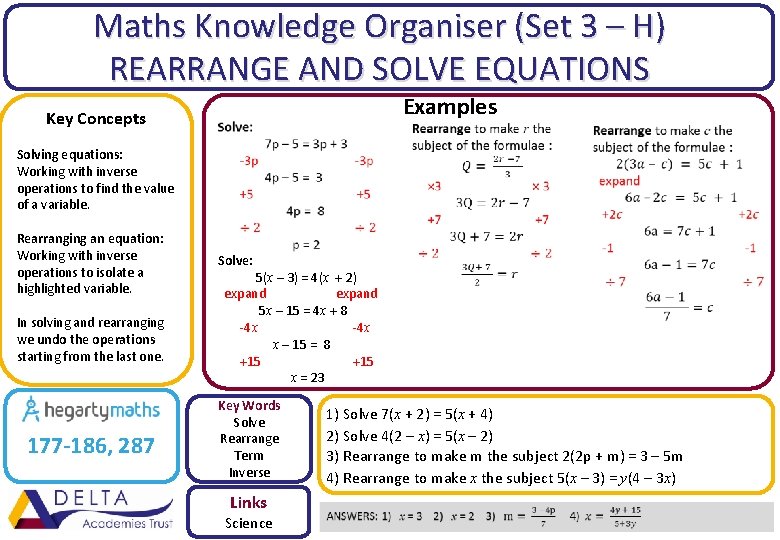
Maths Knowledge Organiser (Set 3 – H) REARRANGE AND SOLVE EQUATIONS Examples Key Concepts Solving equations: Working with inverse operations to find the value of a variable. Rearranging an equation: Working with inverse operations to isolate a highlighted variable. In solving and rearranging we undo the operations starting from the last one. 177 -186, 287 Solve: 5(x – 3) = 4(x + 2) expand 5 x – 15 = 4 x + 8 -4 x x – 15 = 8 +15 x = 23 Key Words Solve Rearrange Term Inverse Links Science 1) Solve 7(x + 2) = 5(x + 4) 2) Solve 4(2 – x) = 5(x – 2) 3) Rearrange to make m the subject 2(2 p + m) = 3 – 5 m 4) Rearrange to make x the subject 5(x – 3) = y(4 – 3 x)
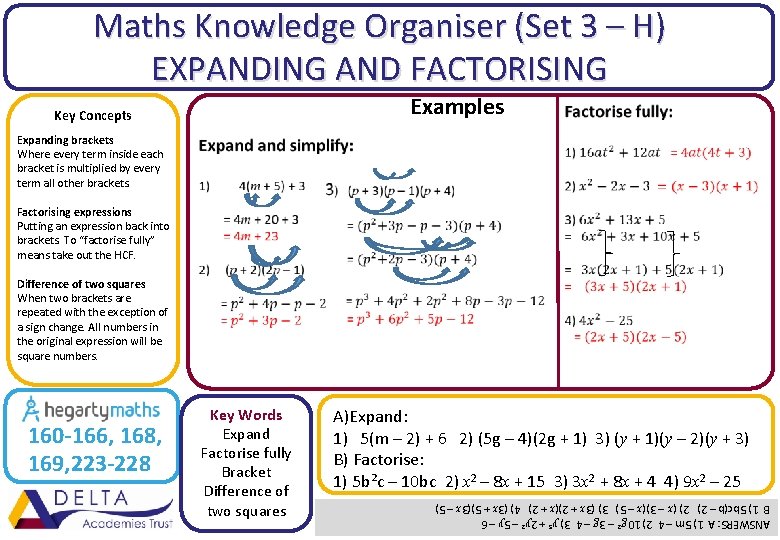
Maths Knowledge Organiser (Set 3 – H) EXPANDING AND FACTORISING Examples Key Concepts Expanding brackets Where every term inside each bracket is multiplied by every term all other brackets. Factorising expressions Putting an expression back into brackets. To “factorise fully” means take out the HCF. Difference of two squares When two brackets are repeated with the exception of a sign change. All numbers in the original expression will be square numbers. A)Expand: 1) 5(m – 2) + 6 2) (5 g – 4)(2 g + 1) 3) (y + 1)(y – 2)(y + 3) B) Factorise: 1) 5 b²c – 10 bc 2) x 2 – 8 x + 15 3) 3 x 2 + 8 x + 4 4) 9 x 2 – 25 ANSWERS: A 1) 5 m – 4 2) 10 g² – 3 g – 4 3) y³ + 2 y² – 5 y – 6 B 1) 5 bc(b – 2) 2) (x – 3)(x – 5) 3) (3 x + 2)(x + 2) 4) (3 x + 5)(3 x – 5) 160 -166, 168, 169, 223 -228 Key Words Expand Factorise fully Bracket Difference of two squares
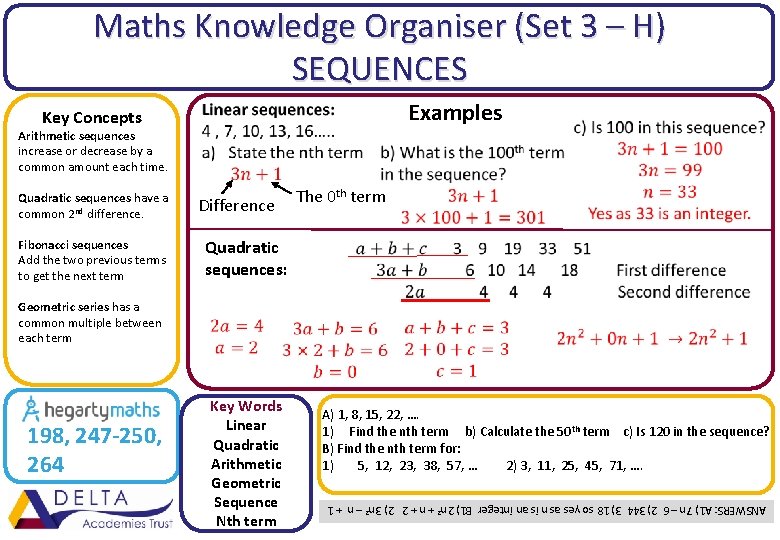
Maths Knowledge Organiser (Set 3 – H) SEQUENCES Examples Key Concepts Arithmetic sequences increase or decrease by a common amount each time. Quadratic sequences have a common 2 nd difference. Fibonacci sequences Add the two previous terms to get the next term Difference The 0 th term Quadratic sequences: Geometric series has a common multiple between each term A) 1, 8, 15, 22, …. 1) Find the nth term b) Calculate the 50 th term c) Is 120 in the sequence? B), Find the nth term for: 1) 5, 12, 23, 38, 57, … 2) 3, 11, 25, 45, 71, …. ANSWERS: A 1) 7 n – 6 2) 344 3) 18 so yes as n is an integer B 1) 2 n² + n + 2 2) 3 n² – n + 1 198, 247 -250, 264 Key Words Linear Quadratic Arithmetic Geometric Sequence Nth term
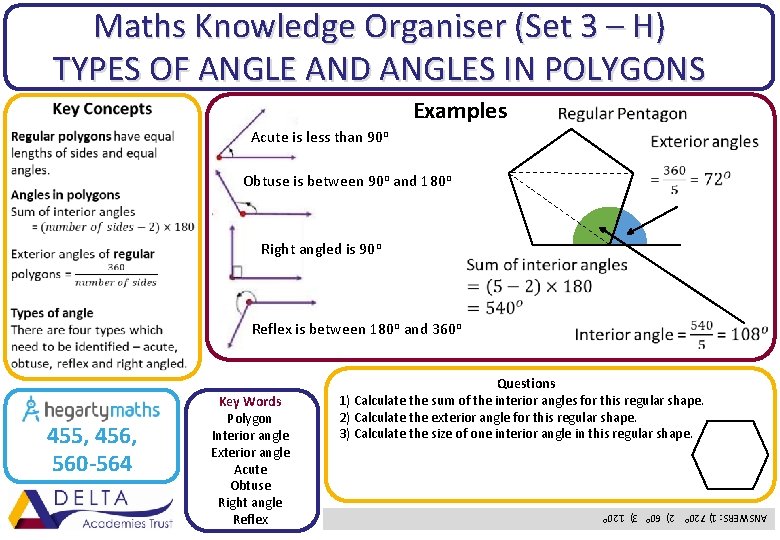
Maths Knowledge Organiser (Set 3 – H) TYPES OF ANGLE AND ANGLES IN POLYGONS Examples Acute is less than 90 o Obtuse is between 90 o and 180 o Right angled is 90 o Reflex is between 180 o and 360 o ANSWERS: 1) 720 o 2) 60 o 3) 120 o 455, 456, 560 -564 Key Words Polygon Interior angle Exterior angle Acute Obtuse Right angle Reflex Questions 1) Calculate the sum of the interior angles for this regular shape. 2) Calculate the exterior angle for this regular shape. 3) Calculate the size of one interior angle in this regular shape.
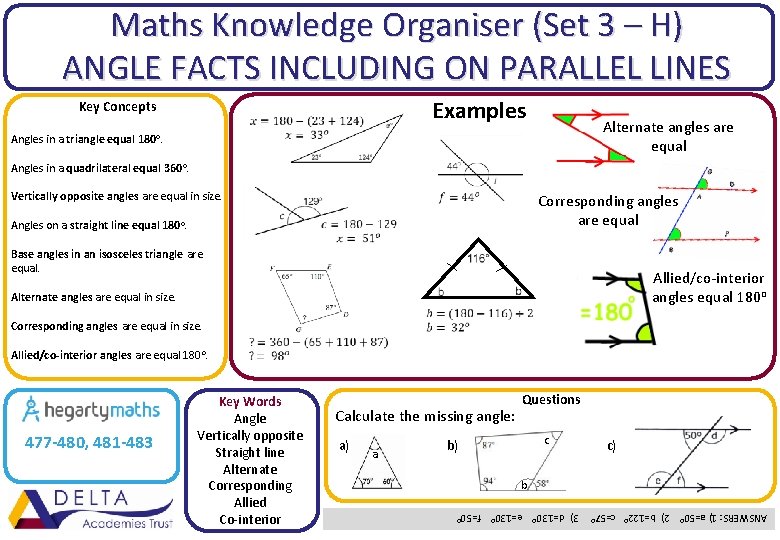
Maths Knowledge Organiser (Set 3 – H) ANGLE FACTS INCLUDING ON PARALLEL LINES Examples Key Concepts Alternate angles are equal Angles in a triangle equal 180 o. Angles in a quadrilateral equal 360 o. Vertically opposite angles are equal in size. Corresponding angles are equal Angles on a straight line equal 180 o. Base angles in an isosceles triangle are equal. Allied/co-interior angles equal 180 o Alternate angles are equal in size. Corresponding angles are equal in size. Allied/co-interior angles are equal 180 o. Calculate the missing angle: a c b) c) b 3) d=130 o e=130 o f=50 o a) Questions ANSWERS: 1) a=50 o 2) b=122 o c=57 o 477 -480, 481 -483 Key Words Angle Vertically opposite Straight line Alternate Corresponding Allied Co-interior
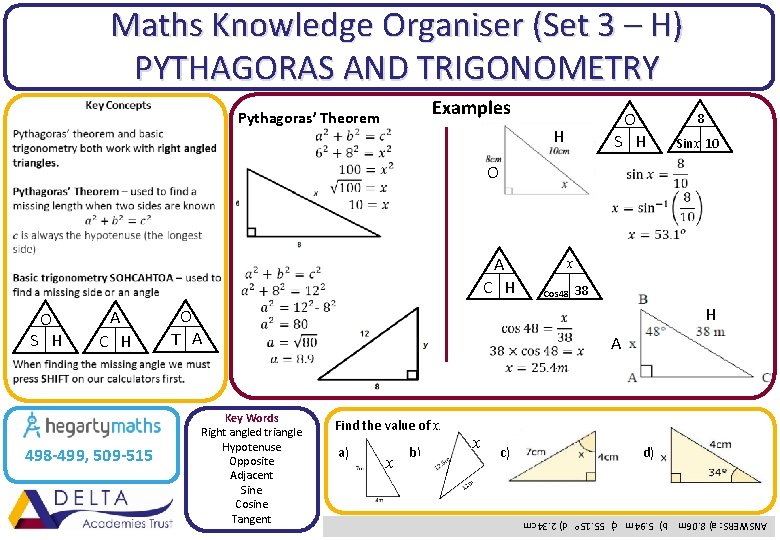
Maths Knowledge Organiser (Set 3 – H) PYTHAGORAS AND TRIGONOMETRY Examples Pythagoras’ Theorem O S H H 8 Sinx 10 O A C H 498 -499, 509 -515 38 H O T A Key Words Right angled triangle Hypotenuse Opposite Adjacent Sine Cosine Tangent Cos 48 A Find the value of x. a) x b) x c) d) ANSWERS: a) 8. 06 m b) 5. 94 m c) 55. 15 o d) 2. 34 cm O S H x
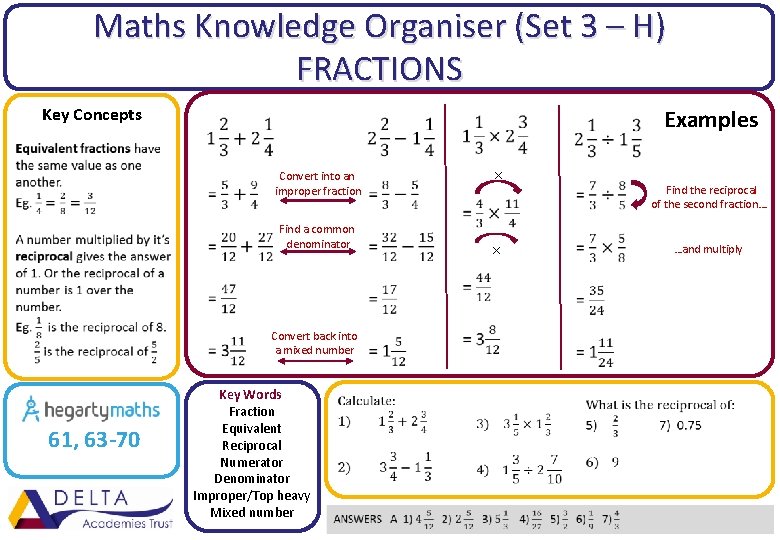
Maths Knowledge Organiser (Set 3 – H) FRACTIONS Key Concepts Examples Convert into an improper fraction Find a common denominator Convert back into a mixed number 61, 63 -70 Key Words Fraction Equivalent Reciprocal Numerator Denominator Improper/Top heavy Mixed number × × Find the reciprocal of the second fraction…. …and multiply
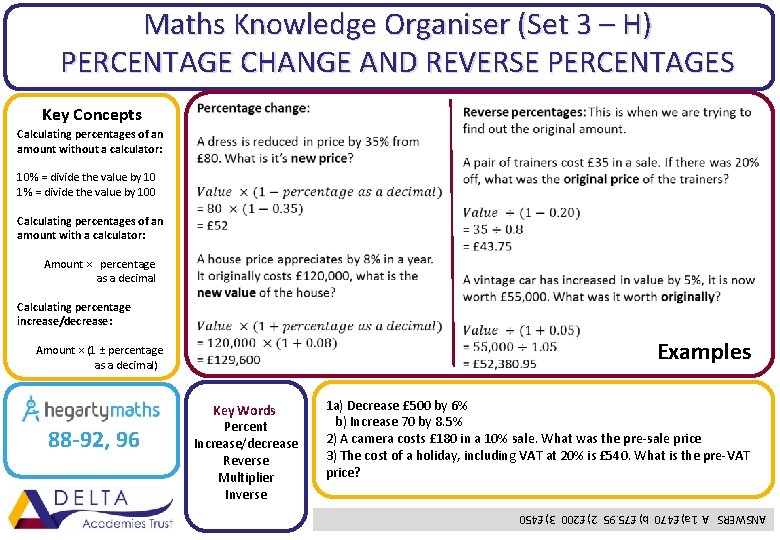
Maths Knowledge Organiser (Set 3 – H) PERCENTAGE CHANGE AND REVERSE PERCENTAGES Key Concepts Calculating percentages of an amount without a calculator: 10% = divide the value by 10 1% = divide the value by 100 Calculating percentages of an amount with a calculator: Amount × percentage as a decimal Calculating percentage increase/decrease: Examples 88 -92, 96 Key Words Percent Increase/decrease Reverse Multiplier Inverse 1 a) Decrease £ 500 by 6% b) Increase 70 by 8. 5% 2) A camera costs £ 180 in a 10% sale. What was the pre-sale price 3) The cost of a holiday, including VAT at 20% is £ 540. What is the pre-VAT price? ANSWERS A 1 a) £ 470 b) £ 75. 95 2) £ 200 3) £ 450 Amount × (1 ± percentage as a decimal)
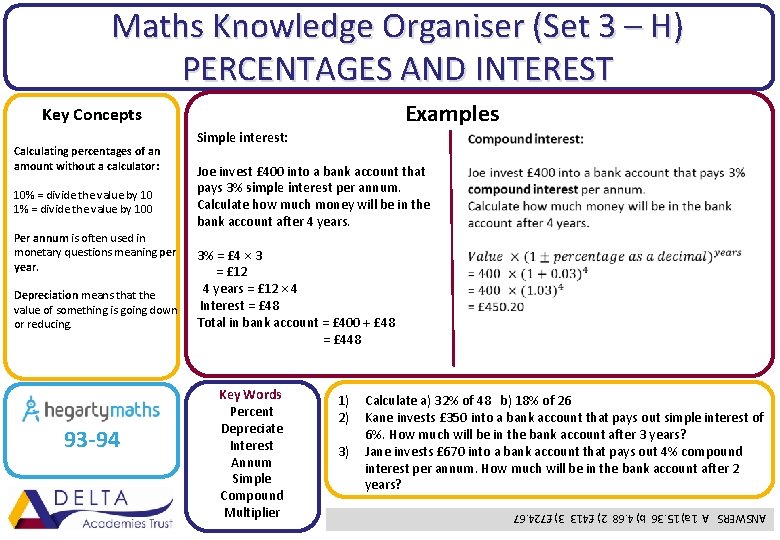
Maths Knowledge Organiser (Set 3 – H) PERCENTAGES AND INTEREST Examples Key Concepts 10% = divide the value by 10 1% = divide the value by 100 Per annum is often used in monetary questions meaning per year. Depreciation means that the value of something is going down or reducing. 93 -94 Simple interest: Joe invest £ 400 into a bank account that pays 3% simple interest per annum. Calculate how much money will be in the bank account after 4 years. 3% = £ 4 × 3 = £ 12 4 years = £ 12 × 4 Interest = £ 48 Total in bank account = £ 400 + £ 48 = £ 448 Key Words Percent Depreciate Interest Annum Simple Compound Multiplier 1) 2) 3) Calculate a) 32% of 48 b) 18% of 26 Kane invests £ 350 into a bank account that pays out simple interest of 6%. How much will be in the bank account after 3 years? Jane invests £ 670 into a bank account that pays out 4% compound interest per annum. How much will be in the bank account after 2 years? ANSWERS A 1 a) 15. 36 b) 4. 68 2) £ 413 3) £ 724. 67 Calculating percentages of an amount without a calculator:
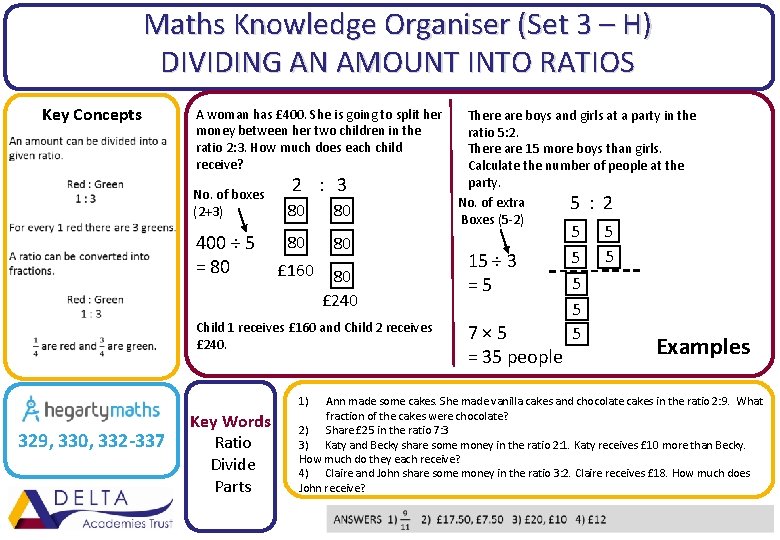
Maths Knowledge Organiser (Set 3 – H) DIVIDING AN AMOUNT INTO RATIOS Key Concepts A woman has £ 400. She is going to split her money between her two children in the ratio 2: 3. How much does each child receive? No. of boxes (2+3) 400 ÷ 5 = 80 2 : 3 80 80 £ 160 80 £ 240 Child 1 receives £ 160 and Child 2 receives £ 240. 1) 329, 330, 332 -337 Key Words Ratio Divide Parts There are boys and girls at a party in the ratio 5: 2. There are 15 more boys than girls. Calculate the number of people at the party. No. of extra 5 : 2 Boxes (5 -2) 15 ÷ 3 =5 7× 5 = 35 people 5 5 5 5 Examples Ann made some cakes. She made vanilla cakes and chocolate cakes in the ratio 2: 9. What fraction of the cakes were chocolate? 2) Share £ 25 in the ratio 7: 3 3) Katy and Becky share some money in the ratio 2: 1. Katy receives £ 10 more than Becky. How much do they each receive? 4) Claire and John share some money in the ratio 3: 2. Claire receives £ 18. How much does John receive?
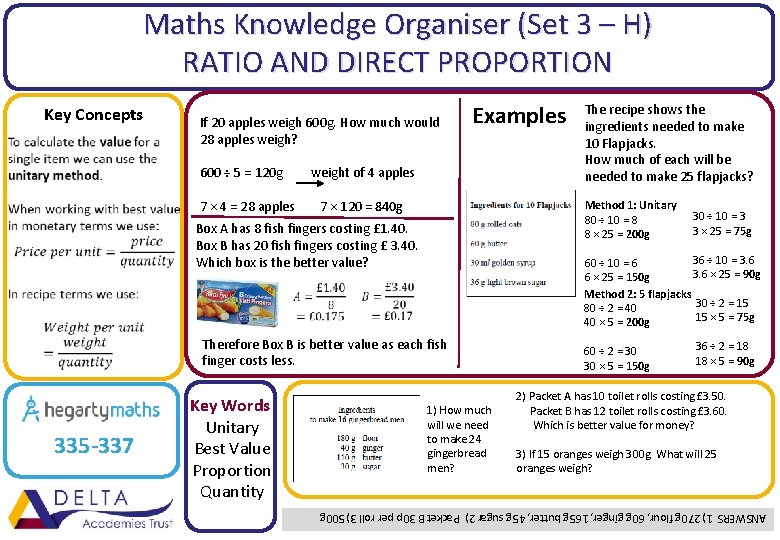
Maths Knowledge Organiser (Set 3 – H) RATIO AND DIRECT PROPORTION Key Concepts If 20 apples weigh 600 g. How much would 28 apples weigh? 600 ÷ 5 = 120 g 7 × 4 = 28 apples Examples weight of 4 apples 7 × 120 = 840 g Method 1: Unitary 80 ÷ 10 = 8 8 × 25 = 200 g Box A has 8 fish fingers costing £ 1. 40. Box B has 20 fish fingers costing £ 3. 40. Which box is the better value? 1) How much will we need to make 24 gingerbread men? 60 ÷ 2 = 30 30 × 5 = 150 g 36 ÷ 2 = 18 18 × 5 = 90 g 2) Packet A has 10 toilet rolls costing £ 3. 50. Packet B has 12 toilet rolls costing £ 3. 60. Which is better value for money? 3) If 15 oranges weigh 300 g. What will 25 oranges weigh? ANSWERS 1) 270 g flour, 60 g ginger, 165 g butter, 45 g sugar 2) Packet B 30 p per roll 3) 500 g 335 -337 30 ÷ 10 = 3 3 × 25 = 75 g 36 ÷ 10 = 3. 6 60 ÷ 10 = 6 3. 6 × 25 = 90 g 6 × 25 = 150 g Method 2: 5 flapjacks 30 ÷ 2 = 15 80 ÷ 2 = 40 15 × 5 = 75 g 40 × 5 = 200 g Therefore Box B is better value as each fish finger costs less. Key Words Unitary Best Value Proportion Quantity The recipe shows the ingredients needed to make 10 Flapjacks. How much of each will be needed to make 25 flapjacks?
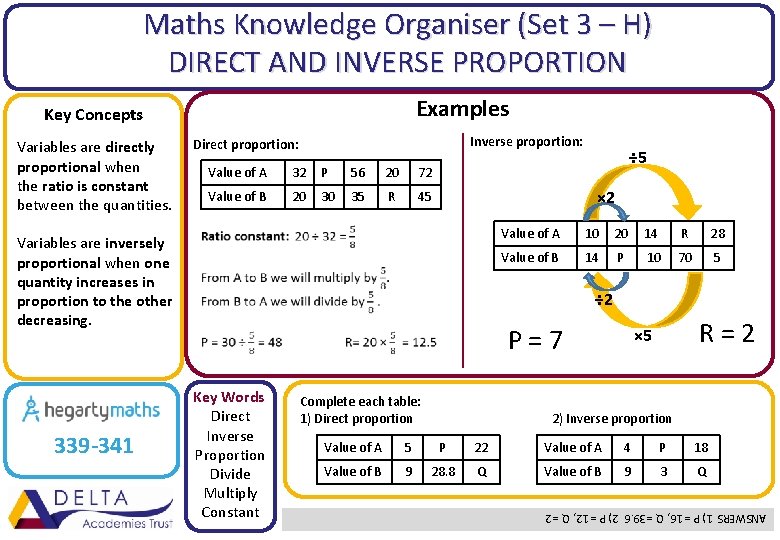
Maths Knowledge Organiser (Set 3 – H) DIRECT AND INVERSE PROPORTION Examples Key Concepts Inverse proportion: Direct proportion: Value of A 32 P 56 20 72 Value of B 20 30 35 R 45 × 2 Variables are inversely proportional when one quantity increases in proportion to the other decreasing. 339 -341 ÷ 5 Value of A 10 20 14 R 28 Value of B 14 P 10 70 5 ÷ 2 P=7 Key Words Direct Inverse Proportion Divide Multiply Constant Complete each table: 1) Direct proportion R=2 × 5 2) Inverse proportion Value of A 5 P 22 Value of A 4 P 18 Value of B 9 28. 8 Q Value of B 9 3 Q ANSWERS 1) P = 16, Q = 39. 6 2) P = 12, Q = 2 Variables are directly proportional when the ratio is constant between the quantities.
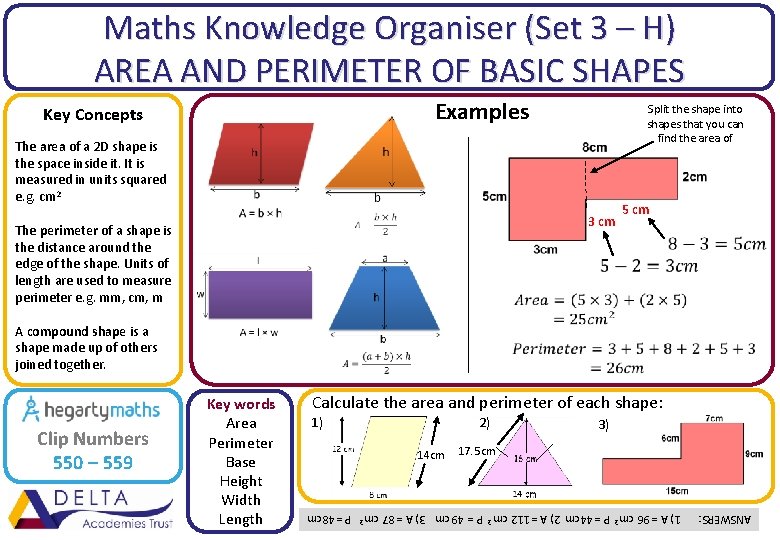
Maths Knowledge Organiser (Set 3 – H) AREA AND PERIMETER OF BASIC SHAPES Examples Key Concepts Split the shape into shapes that you can find the area of The area of a 2 D shape is the space inside it. It is measured in units squared e. g. cm 2 3 cm The perimeter of a shape is the distance around the edge of the shape. Units of length are used to measure perimeter e. g. mm, cm, m 5 cm A compound shape is a shape made up of others joined together. Calculate the area and perimeter of each shape: 2) 1) 14 cm 3) 17. 5 cm ANSWERS: 1) A = 96 cm 2 P = 44 cm 2) A = 112 cm 2 P = 49 cm 3) A = 87 cm 2 P = 48 cm Clip Numbers 550 – 559 Key words Area Perimeter Base Height Width Length
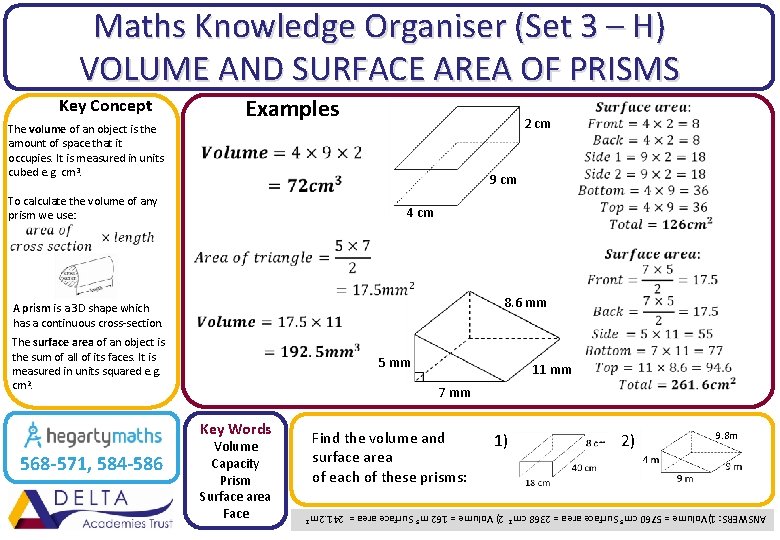
Maths Knowledge Organiser (Set 3 – H) VOLUME AND SURFACE AREA OF PRISMS Key Concept The volume of an object is the amount of space that it occupies. It is measured in units cubed e. g. cm 3. Examples 2 cm 9 cm To calculate the volume of any prism we use: 4 cm 8. 6 mm A prism is a 3 D shape which has a continuous cross-section. The surface area of an object is the sum of all of its faces. It is measured in units squared e. g. cm 2. 5 mm 7 mm Volume Capacity Prism Surface area Face Find the volume and surface area of each of these prisms: 1) 2) 9. 8 m ANSWERS: 1)Volume = 5760 cm 3 Surface area = 2368 cm 2 2) Volume = 162 m 3 Surface area = 241. 2 m 2 Key Words 568 -571, 584 -586 11 mm
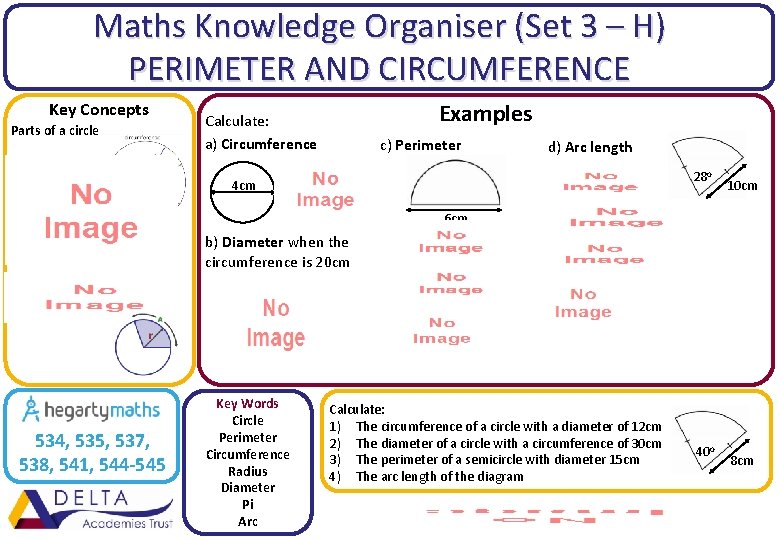
Maths Knowledge Organiser (Set 3 – H) PERIMETER AND CIRCUMFERENCE Key Concepts Parts of a circle Examples Calculate: a) Circumference c) Perimeter d) Arc length 28 o 4 cm 10 cm 6 cm b) Diameter when the circumference is 20 cm 534, 535, 537, 538, 541, 544 -545 Key Words Circle Perimeter Circumference Radius Diameter Pi Arc Calculate: 1) The circumference of a circle with a diameter of 12 cm 2) The diameter of a circle with a circumference of 30 cm 3) The perimeter of a semicircle with diameter 15 cm 4) The arc length of the diagram 40 o 8 cm
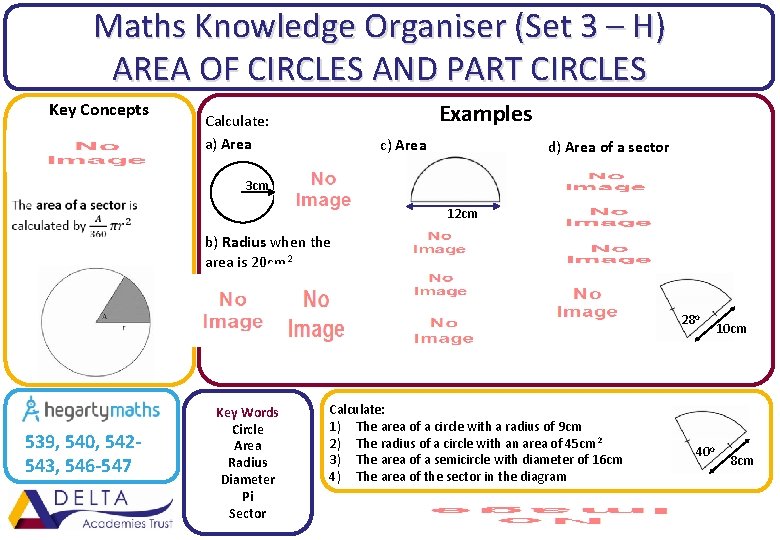
Maths Knowledge Organiser (Set 3 – H) AREA OF CIRCLES AND PART CIRCLES Key Concepts Examples Calculate: a) Area c) Area d) Area of a sector 3 cm 12 cm b) Radius when the area is 20 cm 2 28 o 539, 540, 542543, 546 -547 Key Words Circle Area Radius Diameter Pi Sector Calculate: 1) The area of a circle with a radius of 9 cm 2) The radius of a circle with an area of 45 cm 2 3) The area of a semicircle with diameter of 16 cm 4) The area of the sector in the diagram 40 o 10 cm 8 cm
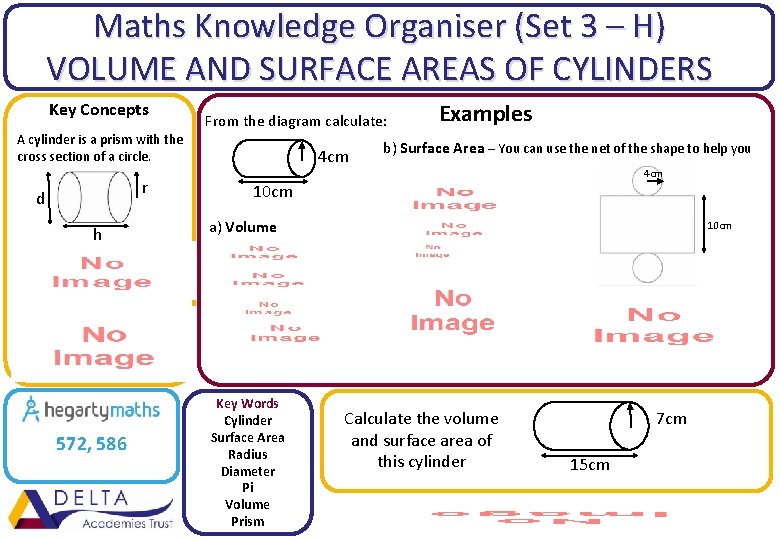
Maths Knowledge Organiser (Set 3 – H) VOLUME AND SURFACE AREAS OF CYLINDERS Key Concepts From the diagram calculate: A cylinder is a prism with the cross section of a circle. r d h 572, 586 4 cm Examples b) Surface Area – You can use the net of the shape to help you 4 cm 10 cm a) Volume Key Words Cylinder Surface Area Radius Diameter Pi Volume Prism 10 cm Calculate the volume and surface area of this cylinder 7 cm 15 cm
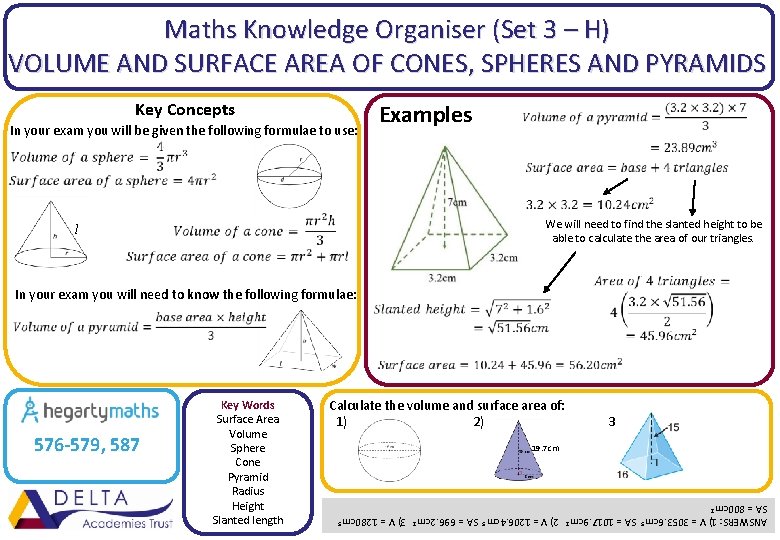
Maths Knowledge Organiser (Set 3 – H) VOLUME AND SURFACE AREA OF CONES, SPHERES AND PYRAMIDS Key Concepts In your exam you will be given the following formulae to use: Examples We will need to find the slanted height to be able to calculate the area of our triangles. l In your exam you will need to know the following formulae: Calculate the volume and surface area of: 1) 2) 3) 19. 7 cm ANSWERS: 1) V = 3053. 6 cm 3 SA = 1017. 9 cm 2 2) V = 1206. 4 cm 3 SA = 696. 2 cm 2 3) V = 1280 cm 3 SA = 800 cm 2 576 -579, 587 Key Words Surface Area Volume Sphere Cone Pyramid Radius Height Slanted length
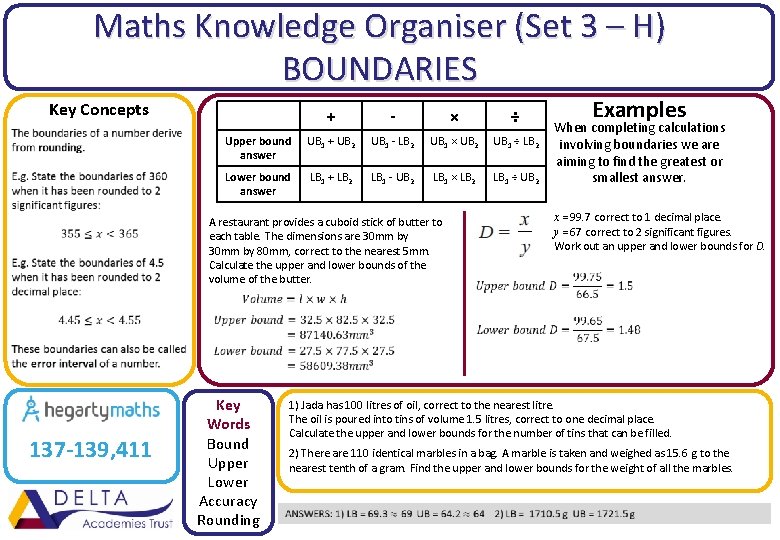
Maths Knowledge Organiser (Set 3 – H) BOUNDARIES Key Concepts + - × ÷ Upper bound answer UB 1 + UB 2 UB 1 - LB 2 UB 1 × UB 2 UB 1 ÷ LB 2 Lower bound answer LB 1 + LB 2 LB 1 - UB 2 LB 1 × LB 2 LB 1 ÷ UB 2 A restaurant provides a cuboid stick of butter to each table. The dimensions are 30 mm by 80 mm, correct to the nearest 5 mm. Calculate the upper and lower bounds of the volume of the butter. 137 -139, 411 Key Words Bound Upper Lower Accuracy Rounding Examples When completing calculations involving boundaries we are aiming to find the greatest or smallest answer. x = 99. 7 correct to 1 decimal place. y = 67 correct to 2 significant figures. Work out an upper and lower bounds for D. 1) Jada has 100 litres of oil, correct to the nearest litre. The oil is poured into tins of volume 1. 5 litres, correct to one decimal place. Calculate the upper and lower bounds for the number of tins that can be filled. 2) There are 110 identical marbles in a bag. A marble is taken and weighed as 15. 6 g to the nearest tenth of a gram. Find the upper and lower bounds for the weight of all the marbles.
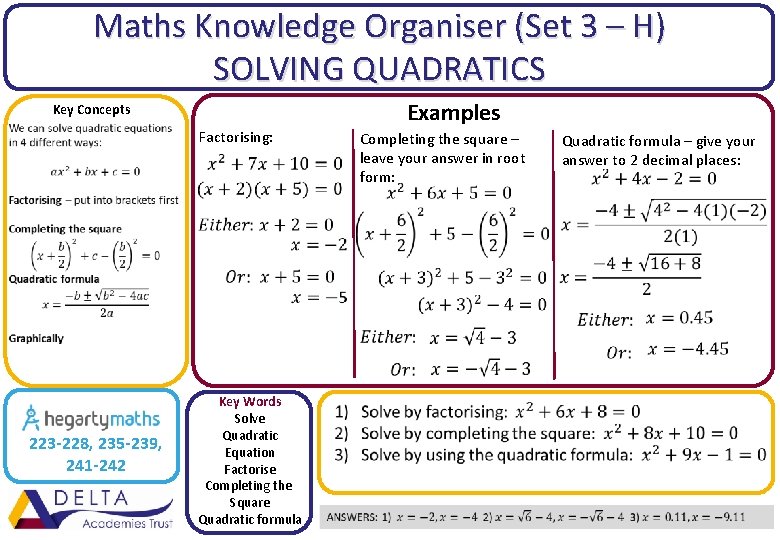
Maths Knowledge Organiser (Set 3 – H) SOLVING QUADRATICS Examples Key Concepts Factorising: 223 -228, 235 -239, 241 -242 Key Words Solve Quadratic Equation Factorise Completing the Square Quadratic formula Completing the square – leave your answer in root form: Quadratic formula – give your answer to 2 decimal places:
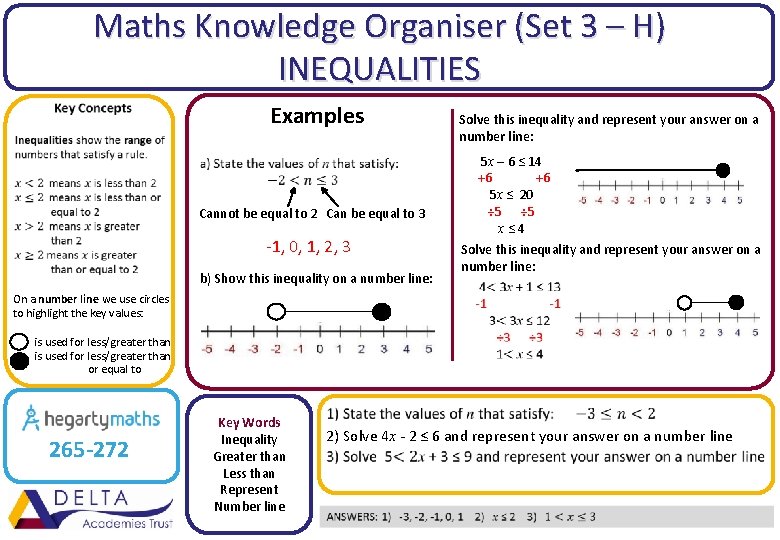
Maths Knowledge Organiser (Set 3 – H) INEQUALITIES Examples Cannot be equal to 2 Can be equal to 3 -1, 0, 1, 2, 3 b) Show this inequality on a number line: Solve this inequality and represent your answer on a number line: 5 x – 6 ≤ 14 +6 +6 5 x ≤ 20 ÷ 5 x≤ 4 Solve this inequality and represent your answer on a number line: On a number line we use circles to highlight the key values: is used for less/greater than or equal to 265 -272 Key Words Inequality Greater than Less than Represent Number line 2) Solve 4 x - 2 ≤ 6 and represent your answer on a number line
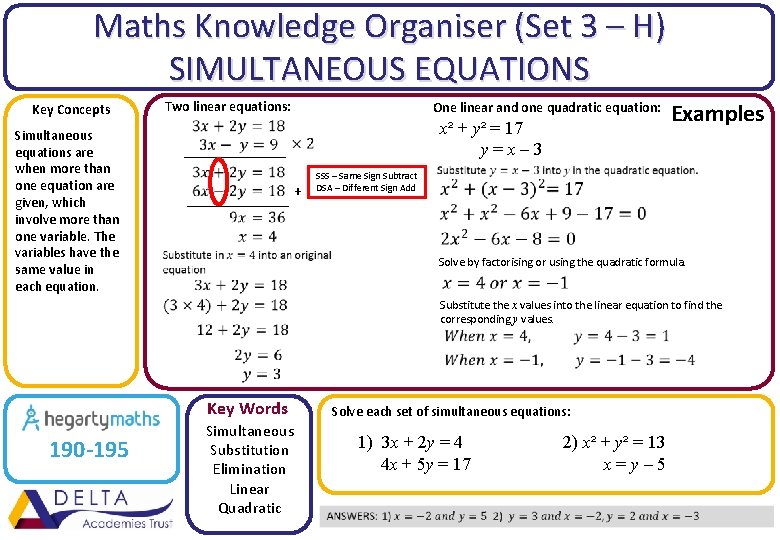
Maths Knowledge Organiser (Set 3 – H) SIMULTANEOUS EQUATIONS Key Concepts Two linear equations: One linear and one quadratic equation: x² + y² = 17 y=x– 3 Simultaneous equations are when more than one equation are given, which involve more than one variable. The variables have the same value in each equation. + Examples SSS – Same Sign Subtract DSA – Different Sign Add Solve by factorising or using the quadratic formula. Substitute the x values into the linear equation to find the corresponding y values. Key Words 190 -195 Simultaneous Substitution Elimination Linear Quadratic Solve each set of simultaneous equations: 1) 3 x + 2 y = 4 4 x + 5 y = 17 2) x² + y² = 13 x=y– 5
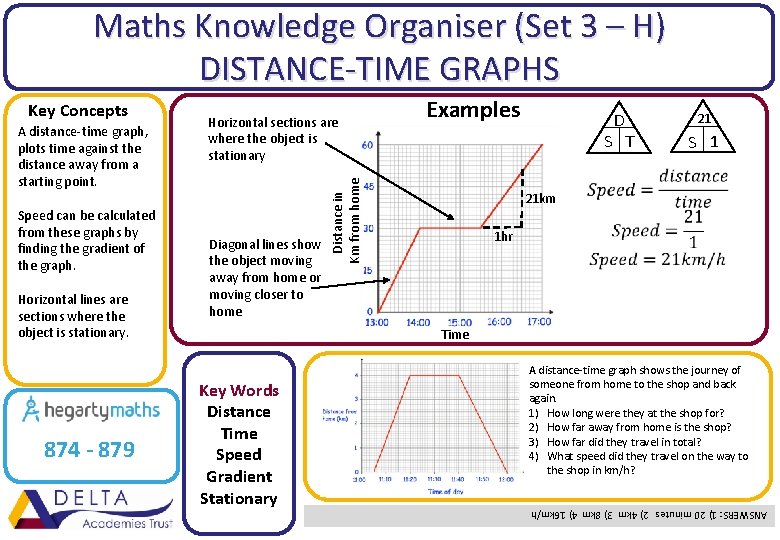
Maths Knowledge Organiser (Set 3 – H) DISTANCE-TIME GRAPHS Speed can be calculated from these graphs by finding the gradient of the graph. Horizontal lines are sections where the object is stationary. 874 - 879 Diagonal lines show the object moving away from home or moving closer to home Examples D S T Distance in Km from home A distance-time graph, plots time against the distance away from a starting point. Horizontal sections are where the object is stationary 21 S 1 21 km 1 hr Time Key Words Distance Time Speed Gradient Stationary A distance-time graph shows the journey of someone from home to the shop and back again. 1) How long were they at the shop for? 2) How far away from home is the shop? 3) How far did they travel in total? 4) What speed did they travel on the way to the shop in km/h? ANSWERS: 1) 20 minutes 2) 4 km 3) 8 km 4) 16 km/h Key Concepts
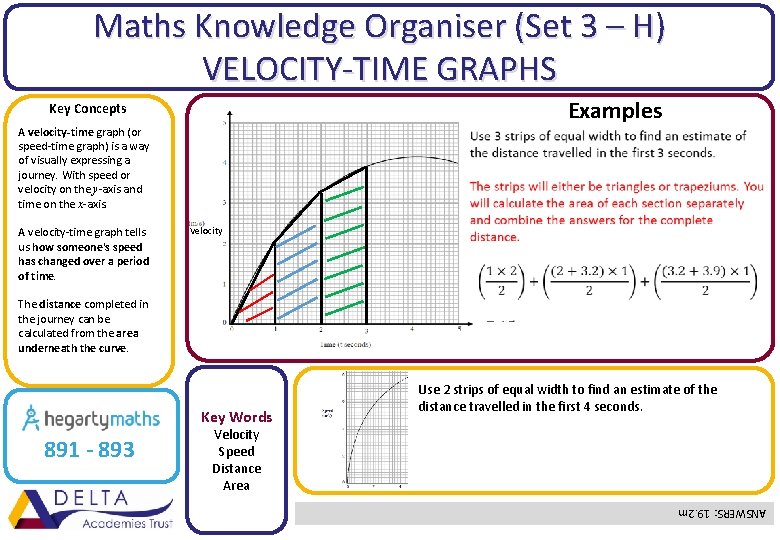
Maths Knowledge Organiser (Set 3 – H) VELOCITY-TIME GRAPHS Examples Key Concepts A velocity-time graph (or speed-time graph) is a way of visually expressing a journey. With speed or velocity on the y-axis and time on the x-axis. A velocity-time graph tells us how someone's speed has changed over a period of time. Velocity The distance completed in the journey can be calculated from the area underneath the curve. Key Words Velocity Speed Distance Area ANSWERS: 19. 2 m 891 - 893 Use 2 strips of equal width to find an estimate of the distance travelled in the first 4 seconds.
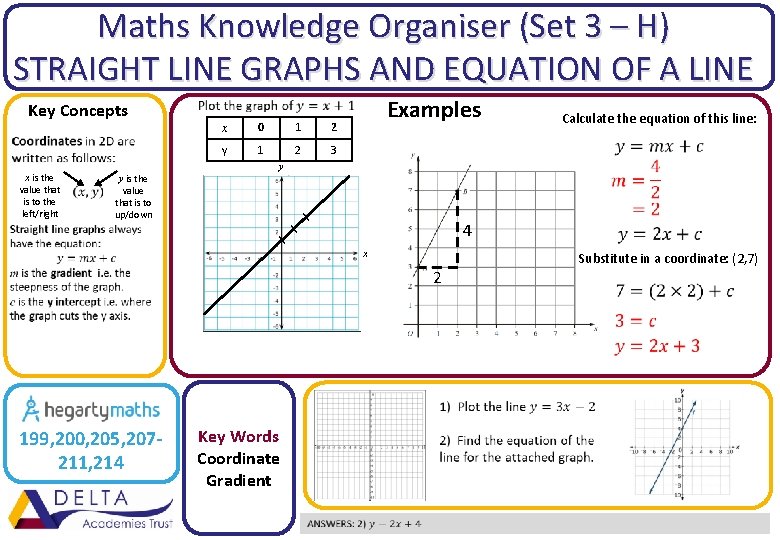
Maths Knowledge Organiser (Set 3 – H) STRAIGHT LINE GRAPHS AND EQUATION OF A LINE Key Concepts x is the value that is to the left/right x 0 1 2 y 1 2 3 Examples Calculate the equation of this line: y y is the value that is to up/down x x x 4 x 2 199, 200, 205, 207211, 214 Key Words Coordinate Gradient Substitute in a coordinate: (2, 7)
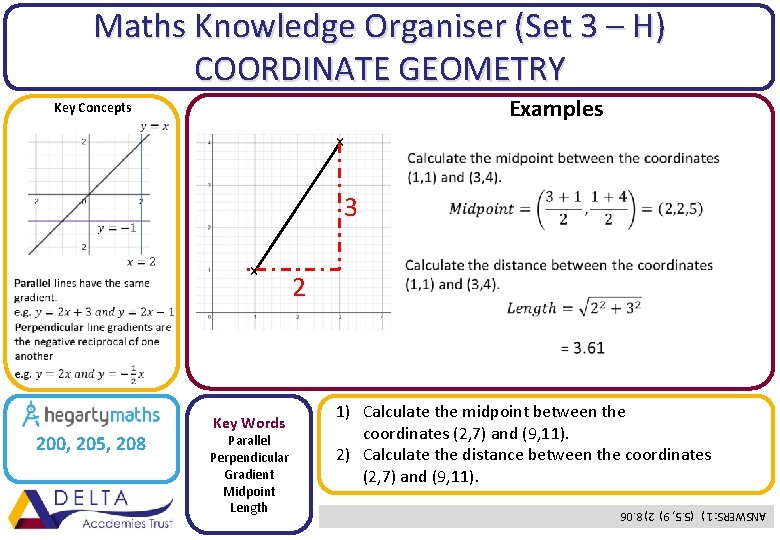
Maths Knowledge Organiser (Set 3 – H) COORDINATE GEOMETRY Examples Key Concepts x 3 200, 205, 208 Key Words Parallel Perpendicular Gradient Midpoint Length 2 1) Calculate the midpoint between the coordinates (2, 7) and (9, 11). 2) Calculate the distance between the coordinates (2, 7) and (9, 11). ANSWERS: 1) (5. 5, 9) 2) 8. 06 x
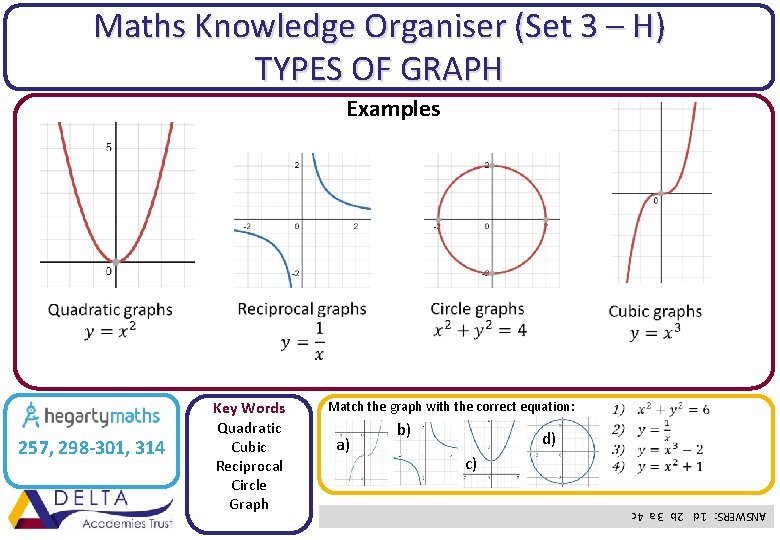
Maths Knowledge Organiser (Set 3 – H) TYPES OF GRAPH Examples Match the graph with the correct equation: a) b) d) c) ANSWERS: 1 d 2 b 3 a 4 c 257, 298 -301, 314 Key Words Quadratic Cubic Reciprocal Circle Graph