
Maths Knowledge Organiser set 2 Set 2 Maths
- Slides: 16
Maths Knowledge Organiser (set 2) Set 2
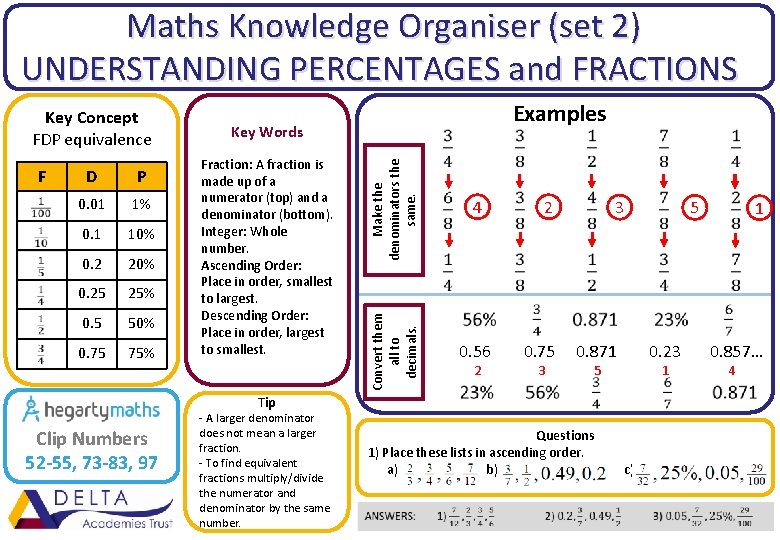
Maths Knowledge Organiser (set 2) UNDERSTANDING PERCENTAGES and FRACTIONS P 0. 01 1% 0. 1 10% 0. 2 20% 0. 25 25% 0. 5 50% 0. 75 75% Fraction: A fraction is made up of a numerator (top) and a denominator (bottom). Integer: Whole number. Ascending Order: Place in order, smallest to largest. Descending Order: Place in order, largest to smallest. Tip Clip Numbers 52 -55, 73 -83, 97 - A larger denominator does not mean a larger fraction. - To find equivalent fractions multiply/divide the numerator and denominator by the same number. Make the denominators the same. D Key Words Convert them all to decimals. F Examples 4 2 3 5 1 0. 56 0. 75 0. 871 0. 23 0. 857… 2 3 5 1 4 Questions 1) Place these lists in ascending order. a) b) c) Key Concept FDP equivalence
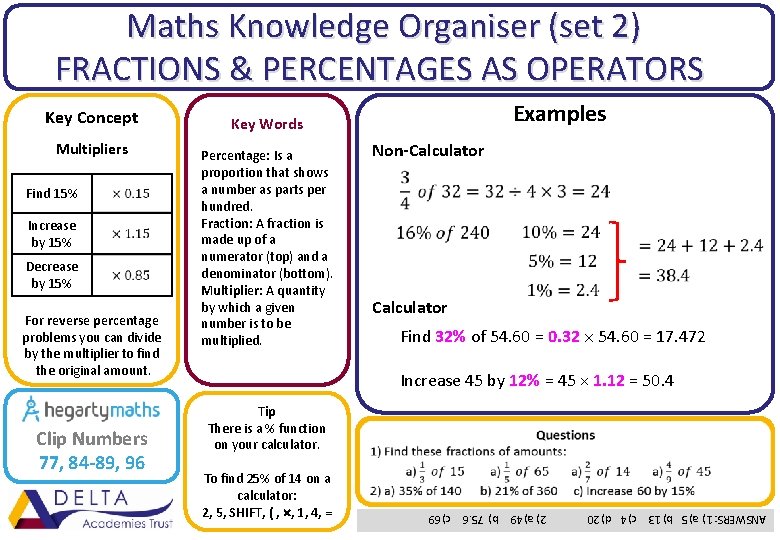
Maths Knowledge Organiser (set 2) FRACTIONS & PERCENTAGES AS OPERATORS Multipliers Find 15% Increase by 15% Decrease by 15% For reverse percentage problems you can divide by the multiplier to find the original amount. Clip Numbers 77, 84 -89, 96 Examples Key Words Percentage: Is a proportion that shows a number as parts per hundred. Fraction: A fraction is made up of a numerator (top) and a denominator (bottom). Multiplier: A quantity by which a given number is to be multiplied. Non-Calculator Find 32% of 54. 60 = 0. 32 54. 60 = 17. 472 Increase 45 by 12% = 45 × 1. 12 = 50. 4 Tip There is a % function on your calculator. To find 25% of 14 on a calculator: 2, 5, SHIFT, ( , , 1, 4, = ANSWERS: 1) a) 5 b) 13 c) 4 d) 20 2) a) 49 b) 75. 6 c) 69 Key Concept
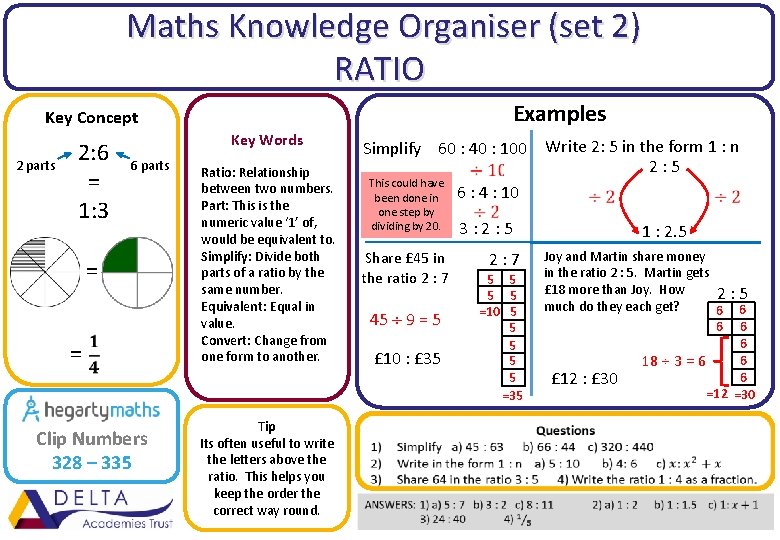
Maths Knowledge Organiser (set 2) RATIO Examples Key Concept Key Words 6 parts = = Clip Numbers 328 – 335 Ratio: Relationship between two numbers. Part: This is the numeric value ‘ 1’ of, would be equivalent to. Simplify: Divide both parts of a ratio by the same number. Equivalent: Equal in value. Convert: Change from one form to another. Tip Its often useful to write the letters above the ratio. This helps you keep the order the correct way round. Simplify 60 : 40 : 100 This could have been done in 6 : 4 : 10 one step by dividing by 20. 3 : 2 : 5 Write 2: 5 in the form 1 : n 2 : 5 Share £ 45 in the ratio 2 : 7 Joy and Martin share money in the ratio 2 : 5. Martin gets £ 18 more than Joy. How 2 : 5 much do they each get? 6 6 6 18 3 = 6 6 £ 12 : £ 30 =12 =30 45 9 = 5 £ 10 : £ 35 2 : 7 5 5 =10 5 5 5 =35 1 : 2. 5 2 parts 2: 6 = 1: 3
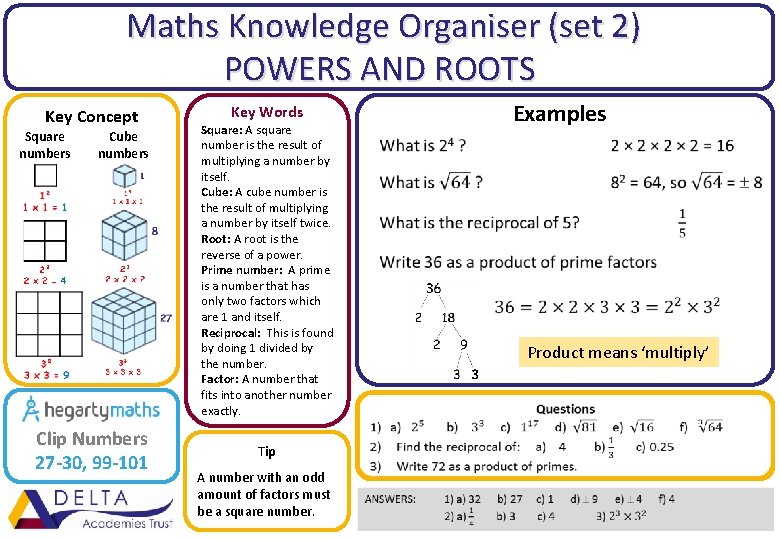
Maths Knowledge Organiser (set 2) POWERS AND ROOTS Square numbers Cube numbers Clip Numbers 27 -30, 99 -101 Examples Key Words Square: A square number is the result of multiplying a number by itself. Cube: A cube number is the result of multiplying a number by itself twice. Root: A root is the reverse of a power. Prime number: A prime is a number that has only two factors which are 1 and itself. Reciprocal: This is found by doing 1 divided by the number. Factor: A number that fits into another number exactly. Product means ‘multiply’ Tip A number with an odd amount of factors must be a square number. Key Concept
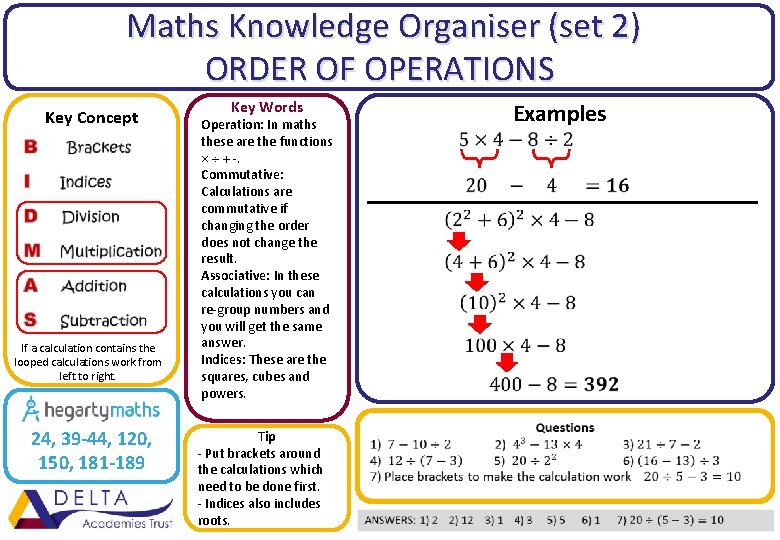
Maths Knowledge Organiser (set 2) ORDER OF OPERATIONS If a calculation contains the looped calculations work from left to right. 24, 39 -44, 120, 150, 181 -189 Key Words Examples Operation: In maths these are the functions + -. Commutative: Calculations are commutative if changing the order does not change the result. Associative: In these calculations you can re-group numbers and you will get the same answer. Indices: These are the squares, cubes and powers. Tip - Put brackets around the calculations which need to be done first. - Indices also includes roots. Key Concept
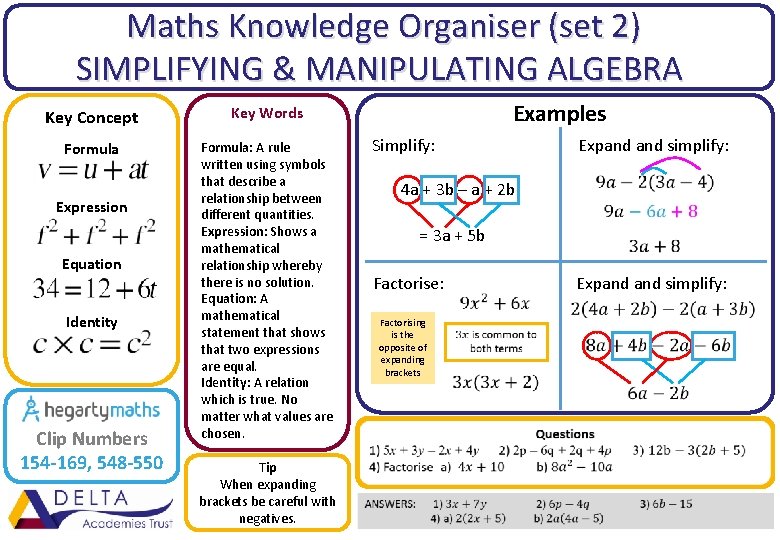
Maths Knowledge Organiser (set 2) SIMPLIFYING & MANIPULATING ALGEBRA Key Words Formula: A rule written using symbols that describe a relationship between different quantities. Expression: Shows a mathematical relationship whereby there is no solution. Equation: A mathematical statement that shows that two expressions are equal. Identity: A relation which is true. No matter what values are chosen. Expression Equation Identity Clip Numbers 154 -169, 548 -550 Tip When expanding brackets be careful with negatives. Examples Simplify: 4 a + 3 b – a + 2 b Expand simplify: = 3 a + 5 b Factorise: Factorising is the opposite of expanding brackets Expand simplify: Key Concept
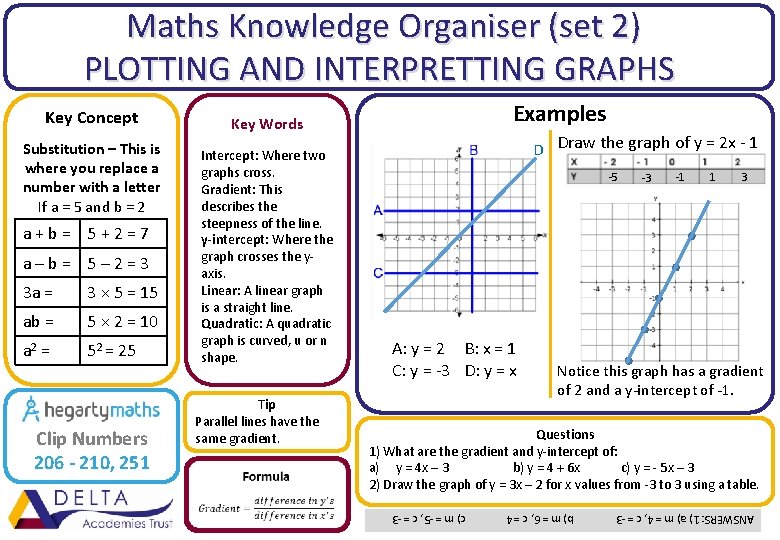
Maths Knowledge Organiser (set 2) PLOTTING AND INTERPRETTING GRAPHS a + b = 5 + 2 = 7 a – b = 5 – 2 = 3 3 × 5 = 15 ab = 5 × 2 = 10 a 2 = 52 = 25 Clip Numbers 206 - 210, 251 Tip Parallel lines have the same gradient. -5 A: y = 2 B: x = 1 C: y = -3 D: y = x -3 -1 1 3 Notice this graph has a gradient of 2 and a y-intercept of -1. Questions 1) What are the gradient and y-intercept of: a) y = 4 x – 3 b) y = 4 + 6 x c) y = - 5 x – 3 2) Draw the graph of y = 3 x – 2 for x values from -3 to 3 using a table. c) m = -5, c = -3 Intercept: Where two graphs cross. Gradient: This describes the steepness of the line. y-intercept: Where the graph crosses the yaxis. Linear: A linear graph is a straight line. Quadratic: A quadratic graph is curved, u or n shape. D Draw the graph of y = 2 x - 1 b) m = 6, c = 4 Substitution – This is where you replace a number with a letter If a = 5 and b = 2 3 a = Examples Key Words ANSWERS: 1) a) m = 4, c = -3 Key Concept
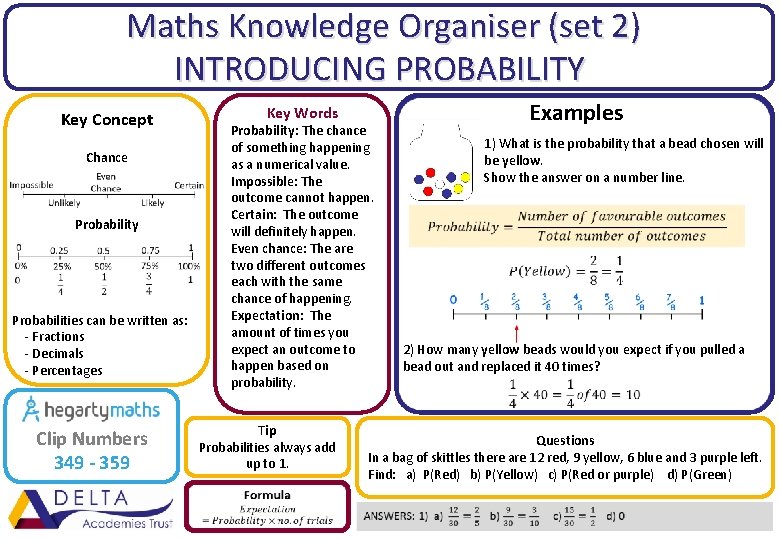
Maths Knowledge Organiser (set 2) INTRODUCING PROBABILITY Probability: The chance of something happening as a numerical value. Impossible: The outcome cannot happen. Certain: The outcome will definitely happen. Even chance: The are two different outcomes each with the same chance of happening. Expectation: The amount of times you expect an outcome to happen based on probability. Chance Probability Probabilities can be written as: - Fractions - Decimals - Percentages Clip Numbers 349 - 359 Tip Probabilities always add up to 1. Examples 1) What is the probability that a bead chosen will be yellow. Show the answer on a number line. 2) How many yellow beads would you expect if you pulled a bead out and replaced it 40 times? Questions In a bag of skittles there are 12 red, 9 yellow, 6 blue and 3 purple left. Find: a) P(Red) b) P(Yellow) c) P(Red or purple) d) P(Green) Key Words Key Concept
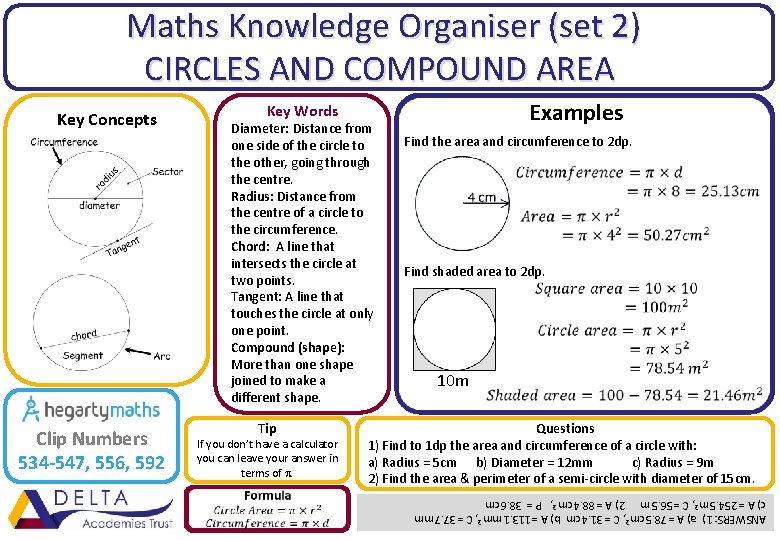
Maths Knowledge Organiser (set 2) CIRCLES AND COMPOUND AREA Clip Numbers 534 -547, 556, 592 Diameter: Distance from one side of the circle to the other, going through the centre. Radius: Distance from the centre of a circle to the circumference. Chord: A line that intersects the circle at two points. Tangent: A line that touches the circle at only one point. Compound (shape): More than one shape joined to make a different shape. Tip If you don’t have a calculator you can leave your answer in terms of . Examples Find the area and circumference to 2 dp. Find shaded area to 2 dp. 10 m Questions 1) Find to 1 dp the area and circumference of a circle with: a) Radius = 5 cm b) Diameter = 12 mm c) Radius = 9 m 2) Find the area & perimeter of a semi-circle with diameter of 15 cm. ANSWERS: 1) a) A = 78. 5 cm 2, C = 31. 4 cm b) A = 113. 1 mm 2, C = 37. 7 mm c) A = 254. 5 m 2, C = 56. 5 m 2) A = 88. 4 cm 2, P = 38. 6 cm Key Words Key Concepts
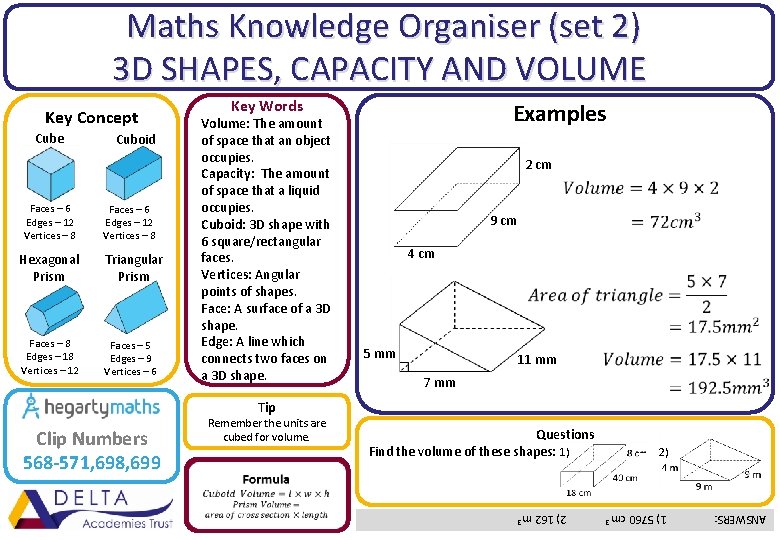
Maths Knowledge Organiser (set 2) 3 D SHAPES, CAPACITY AND VOLUME Key Words Key Concept Cube Faces – 6 Edges – 12 Vertices – 8 Volume: The amount of space that an object occupies. Capacity: The amount of space that a liquid occupies. Cuboid: 3 D shape with 6 square/rectangular faces. Vertices: Angular points of shapes. Face: A surface of a 3 D shape. Edge: A line which connects two faces on a 3 D shape. Cuboid Faces – 6 Edges – 12 Vertices – 8 Hexagonal Prism Triangular Prism Faces – 8 Edges – 18 Vertices – 12 Faces – 5 Edges – 9 Vertices – 6 Examples 2 cm 9 cm 4 cm 5 mm 11 mm 7 mm Tip Questions Find the volume of these shapes: 1) 2) ANSWERS: 1) 5760 cm 3 2) 162 m 3 Clip Numbers 568 -571, 698, 699 Remember the units are cubed for volume.
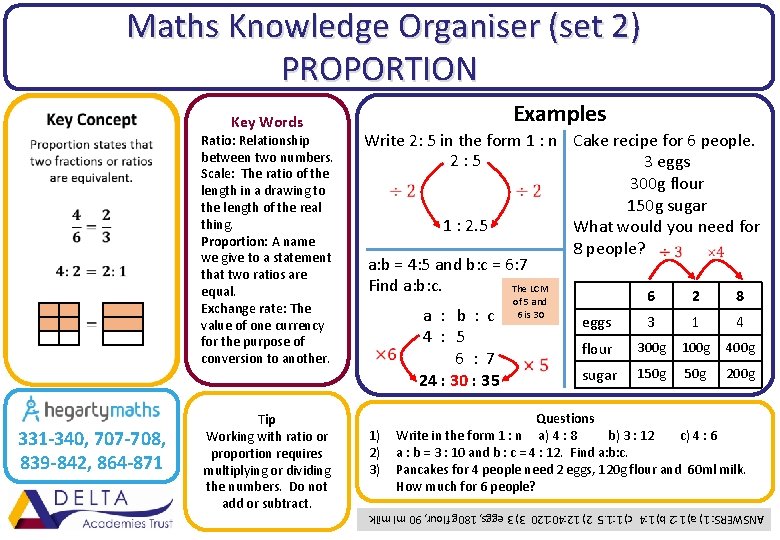
Maths Knowledge Organiser (set 2) PROPORTION Key Words 331 -340, 707 -708, 839 -842, 864 -871 Ratio: Relationship between two numbers. Scale: The ratio of the length in a drawing to the length of the real thing. Proportion: A name we give to a statement that two ratios are equal. Exchange rate: The value of one currency for the purpose of conversion to another. Tip Working with ratio or proportion requires multiplying or dividing the numbers. Do not add or subtract. Examples Write 2: 5 in the form 1 : n Cake recipe for 6 people. 2 : 5 3 eggs 300 g flour 150 g sugar 1 : 2. 5 What would you need for 8 people? a: b = 4: 5 and b: c = 6: 7 Find a: b: c. The LCM 1) 2) 3) a : b : c 4 : 5 6 : 7 24 : 30 : 35 of 5 and 6 is 30 6 2 8 eggs 3 1 4 flour 300 g 100 g 400 g sugar 150 g 200 g Questions Write in the form 1 : n a) 4 : 8 b) 3 : 12 c) 4 : 6 a : b = 3 : 10 and b : c = 4 : 12. Find a: b: c. Pancakes for 4 people need 2 eggs, 120 g flour and 60 ml milk. How much for 6 people? ANSWERS: 1) a) 1: 2 b) 1: 4 c) 1: 1. 5 2) 12: 40: 120 3) 3 eggs, 180 g flour, 90 ml milk.
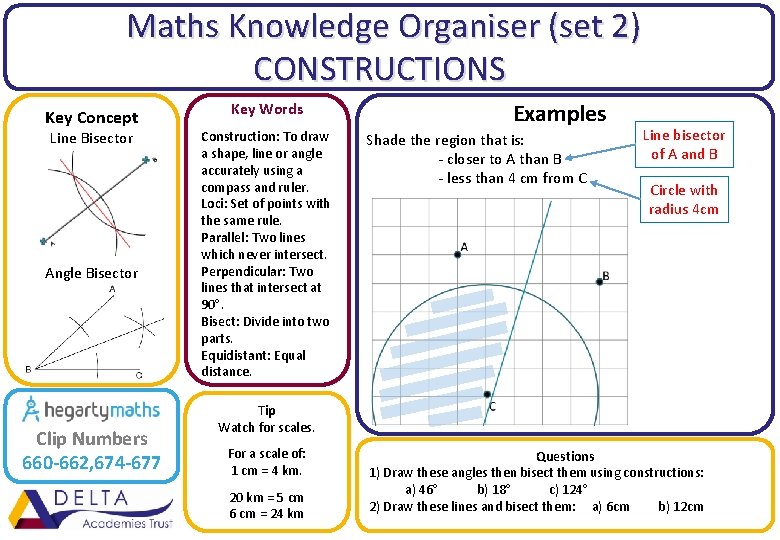
Maths Knowledge Organiser (set 2) CONSTRUCTIONS Key Concept Line Bisector Angle Bisector Clip Numbers 660 -662, 674 -677 Key Words Construction: To draw a shape, line or angle accurately using a compass and ruler. Loci: Set of points with the same rule. Parallel: Two lines which never intersect. Perpendicular: Two lines that intersect at 90. Bisect: Divide into two parts. Equidistant: Equal distance. Examples Shade the region that is: - closer to A than B - less than 4 cm from C Line bisector of A and B Circle with radius 4 cm Tip Watch for scales. For a scale of: 1 cm = 4 km. 20 km = 5 cm 6 cm = 24 km Questions 1) Draw these angles then bisect them using constructions: a) 46 b) 18 c) 124 2) Draw these lines and bisect them: a) 6 cm b) 12 cm
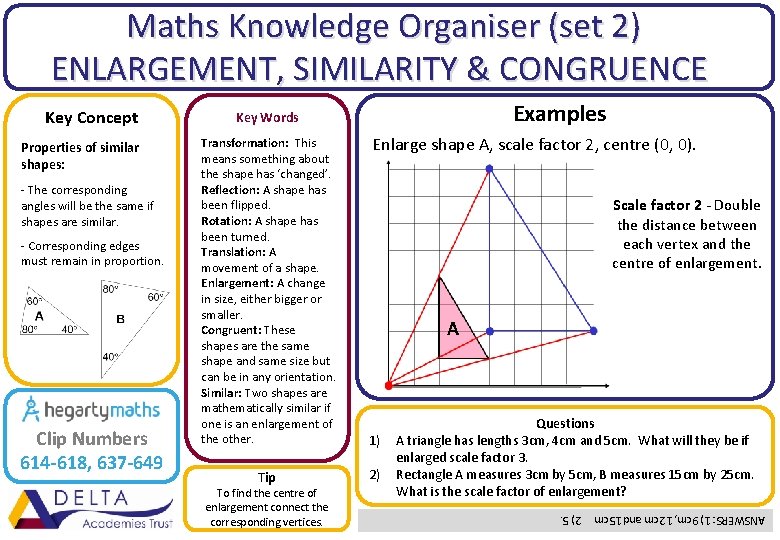
Maths Knowledge Organiser (set 2) ENLARGEMENT, SIMILARITY & CONGRUENCE Properties of similar shapes: - The corresponding angles will be the same if shapes are similar. - Corresponding edges must remain in proportion. Clip Numbers 614 -618, 637 -649 Examples Key Words Enlarge shape A, scale factor 2, centre (0, 0). Transformation: This means something about the shape has ‘changed’. Reflection: A shape has been flipped. Rotation: A shape has been turned. Translation: A movement of a shape. Enlargement: A change in size, either bigger or smaller. Congruent: These shapes are the same shape and same size but can be in any orientation. Similar: Two shapes are mathematically similar if one is an enlargement of the other. 1) Tip 2) To find the centre of enlargement connect the corresponding vertices. Scale factor 2 - Double the distance between each vertex and the centre of enlargement. A Questions A triangle has lengths 3 cm, 4 cm and 5 cm. What will they be if enlarged scale factor 3. Rectangle A measures 3 cm by 5 cm, B measures 15 cm by 25 cm. What is the scale factor of enlargement? ANSWERS: 1) 9 cm, 12 cm and 15 cm 2) 5. Key Concept
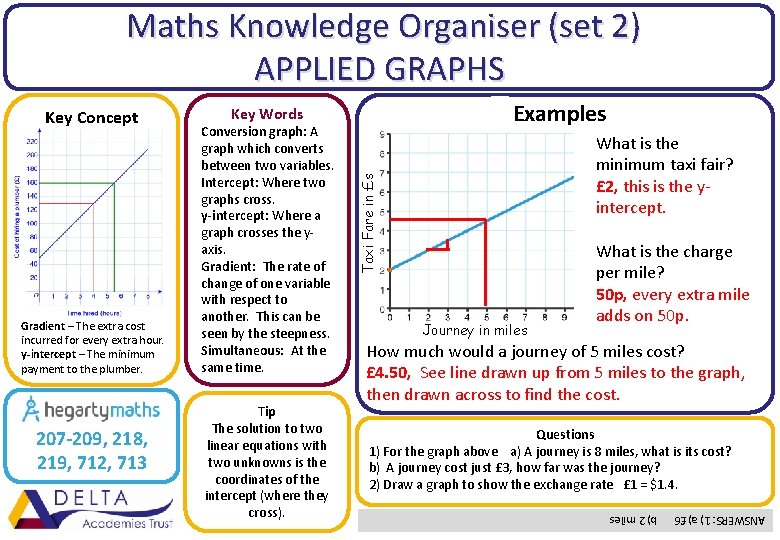
Maths Knowledge Organiser (set 2) APPLIED GRAPHS Gradient – The extra cost incurred for every extra hour. y-intercept – The minimum payment to the plumber. 207 -209, 218, 219, 712, 713 Examples Conversion graph: A graph which converts between two variables. Intercept: Where two graphs cross. y-intercept: Where a graph crosses the yaxis. Gradient: The rate of change of one variable with respect to another. This can be seen by the steepness. Simultaneous: At the same time. Tip The solution to two linear equations with two unknowns is the coordinates of the intercept (where they cross). What is the minimum taxi fair? £ 2, this is the yintercept. Taxi Fare in £s Key Words Journey in miles What is the charge per mile? 50 p, every extra mile adds on 50 p. How much would a journey of 5 miles cost? £ 4. 50, See line drawn up from 5 miles to the graph, then drawn across to find the cost. Questions 1) For the graph above a) A journey is 8 miles, what is its cost? b) A journey cost just £ 3, how far was the journey? 2) Draw a graph to show the exchange rate £ 1 = $1. 4. ANSWERS: 1) a) £ 6 b) 2 miles Key Concept
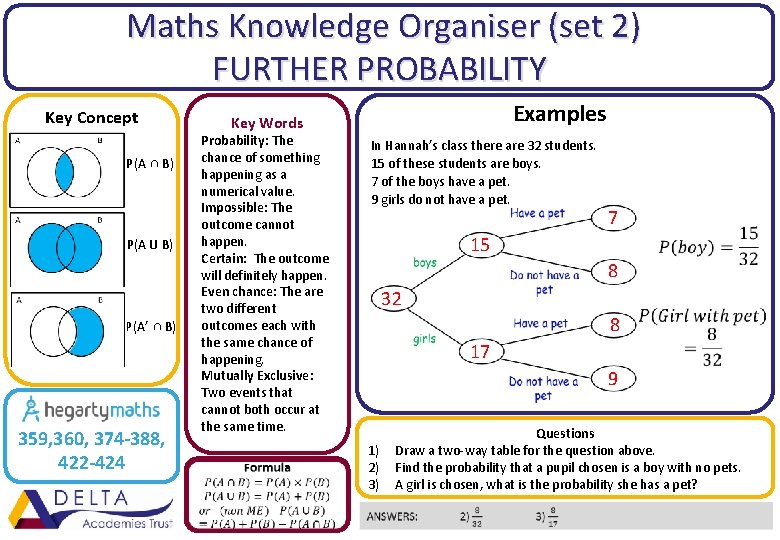
Maths Knowledge Organiser (set 2) FURTHER PROBABILITY Probability: The chance of something happening as a numerical value. Impossible: The outcome cannot happen. Certain: The outcome will definitely happen. Even chance: The are two different outcomes each with the same chance of happening. Mutually Exclusive: Two events that cannot both occur at the same time. P(A ∩ B) P(A U B) P(A’ ∩ B) 359, 360, 374 -388, 422 -424 Examples Key Words In Hannah’s class there are 32 students. 15 of these students are boys. 7 of the boys have a pet. 9 girls do not have a pet. 7 15 8 32 8 17 9 1) 2) 3) Questions Draw a two-way table for the question above. Find the probability that a pupil chosen is a boy with no pets. A girl is chosen, what is the probability she has a pet? Key Concept