
Maths Exloring at Homenumber Year 4 Exploring Number

Maths. Exloring at Home-number Year 4 Exploring Number 1 An array is a mathematical picture that shows equal groups in rows and equal groups in columns. This 2 x 3 array has 2 rows and 3 columns with a total number of 6 dots. How many dots are there in a 3 x 3 array? A 4 x 6 array? What could my array look like if I have a total of 24 dots? Can you make an array using objects in your home? (e. g. milk bottle tops, pasta pieces)? patterns in number 2 3 Mathematicians are always making mistakes! Look at the calculations below. Can you fix them? 4 x 7 = 27 36 = 5 x 6 2 x 3 = 33 55 = 11 x 6 Have a look at these sequences of numbers. What do you notice? Can you continue them? Can you explain them? 2, 7, 12, 17, 22 …… 85, 76, 67, 58, 49 …. . 28, 31, 34, 37, 40 …. . Change any of the digits to make the calculations correct. Can you make up your own number sequences? reasoning about number sequences of numbers 4 You need a partner to play this game. Write the digits 0 - 9 on pieces of paper and then put them in a box or bag. You each choose 4 digits – without looking. First see who can make the biggest number, then the smallest number, odd number, even number, multiple of 3. . Keep score! exploring numbers 5 You need a partner and seven objects to play this game. Place the objects in a pile and take turns to choose either one or two objects. The person who takes the last object wins. Swap who goes first. Can you work out how to win each time? Does it matter who goes first? What happens if you start with more objects? reasoning about numbers Did you know … ? • A male peacock has 200 long feathers that stand up from his back? • 1 googol is the number 1 followed by 100 zeros? • On average, people spend 25 years asleep? • Rice is the staple food for 50% of the world’s population? © Mathematics Mastery 2020
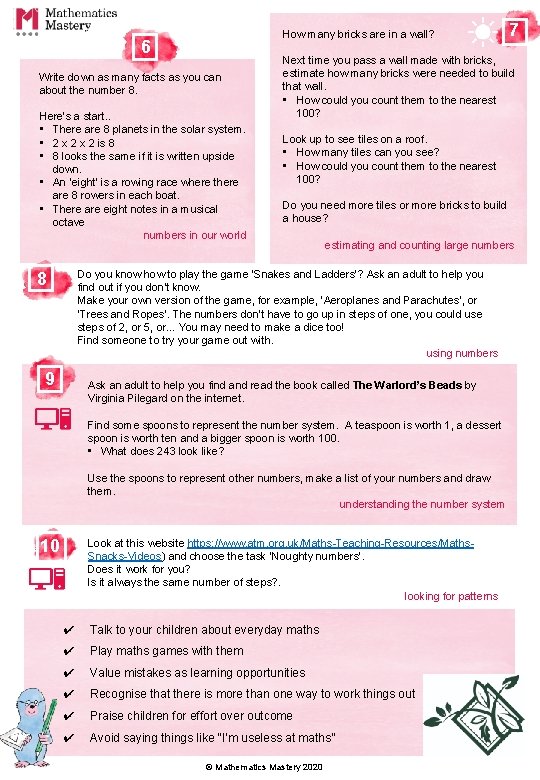
How many bricks are in a wall? 6 Write down as many facts as you can about the number 8. Here’s a start. . • There are 8 planets in the solar system. • 2 x 2 is 8 • 8 looks the same if it is written upside down. • An ‘eight’ is a rowing race where there are 8 rowers in each boat. • There are eight notes in a musical octave numbers in our world Next time you pass a wall made with bricks, estimate how many bricks were needed to build that wall. • How could you count them to the nearest 100? Look up to see tiles on a roof. • How many tiles can you see? • How could you count them to the nearest 100? Do you need more tiles or more bricks to build a house? estimating and counting large numbers Do you know how to play the game ‘Snakes and Ladders’? Ask an adult to help you find out if you don't know. Make your own version of the game, for example, ‘Aeroplanes and Parachutes’, or ‘Trees and Ropes’. The numbers don’t have to go up in steps of one, you could use steps of 2, or 5, or. . . You may need to make a dice too! Find someone to try your game out with. using numbers 8 9 Ask an adult to help you find and read the book called The Warlord’s Beads by Virginia Pilegard on the internet. Find some spoons to represent the number system. A teaspoon is worth 1, a dessert spoon is worth ten and a bigger spoon is worth 100. • What does 243 look like? Use the spoons to represent other numbers, make a list of your numbers and draw them. understanding the number system 10 7 Look at this website https: //www. atm. org. uk/Maths-Teaching-Resources/Maths. Snacks-Videos) and choose the task ‘Noughty numbers’. Does it work for you? Is it always the same number of steps? . looking for patterns ✔ Talk to your children about everyday maths ✔ Play maths games with them ✔ Value mistakes as learning opportunities ✔ Recognise that there is more than one way to work things out ✔ Praise children for effort over outcome ✔ Avoid saying things like “I’m useless at maths” © Mathematics Mastery 2020
- Slides: 2