
Maths Day Four Measuring capacity Dont forget to
- Slides: 25
Maths ~ Day Four Measuring capacity. Don’t forget to click on the ‘Present’ tab to start.
MORNING YEAR 4! Remember the slide presentation is just to guide you through the learning. It will ask you some questions but they are talking points. ON THE GREEN SLIDES ARE THE QUESTIONS YOU WILL NEED TO ANSWER IN YOUR LEARNING JOURNALS!
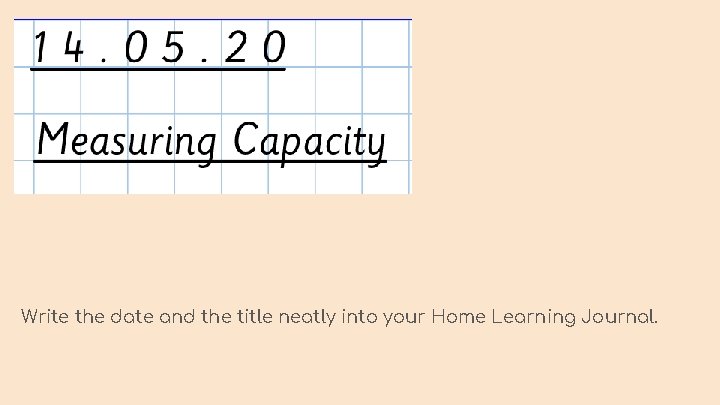
Write the date and the title neatly into your Home Learning Journal.
What is capacity?
What is capacity?
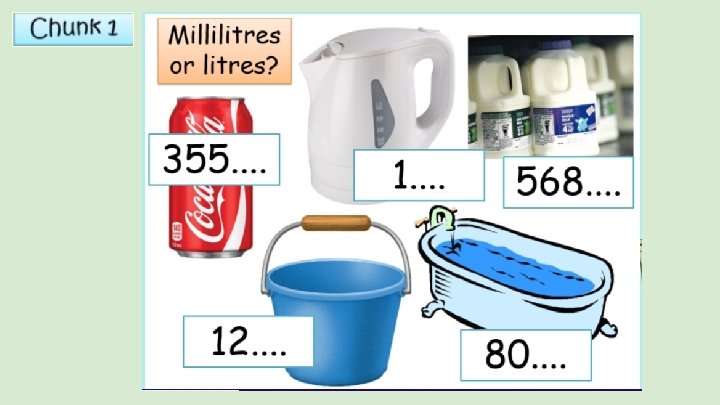
We measure capacity in… and
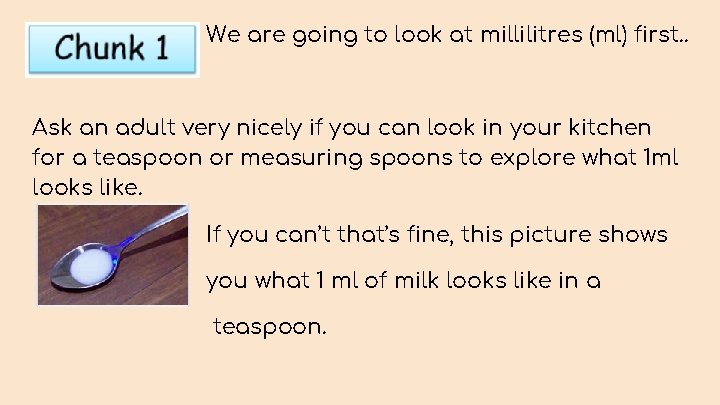
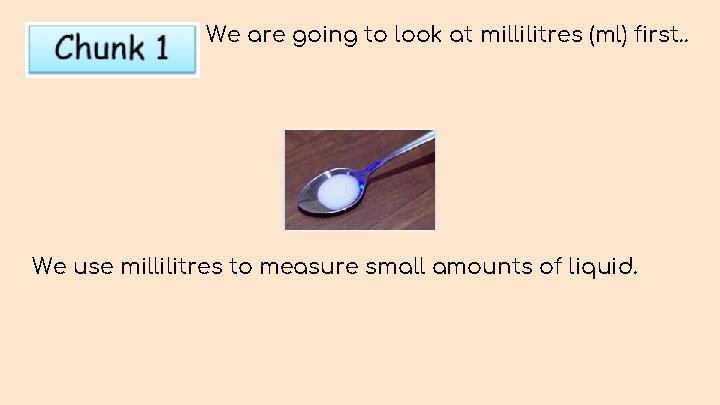
We are going to look at millilitres (ml) first. . Ask an adult very nicely if you can look in your kitchen for a teaspoon or measuring spoons to explore what 1 ml looks like. If you can’t that’s fine, this picture shows you what 1 ml of milk looks like in a teaspoon.
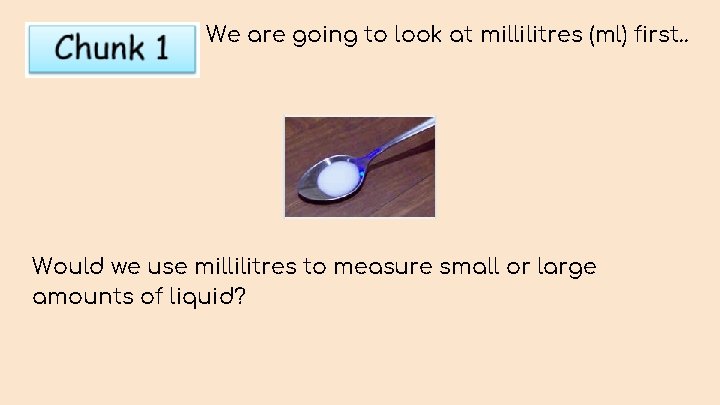
We are going to look at millilitres (ml) first. . Would we use millilitres to measure small or large amounts of liquid?
We are going to look at millilitres (ml) first. . We use millilitres to measure small amounts of liquid.
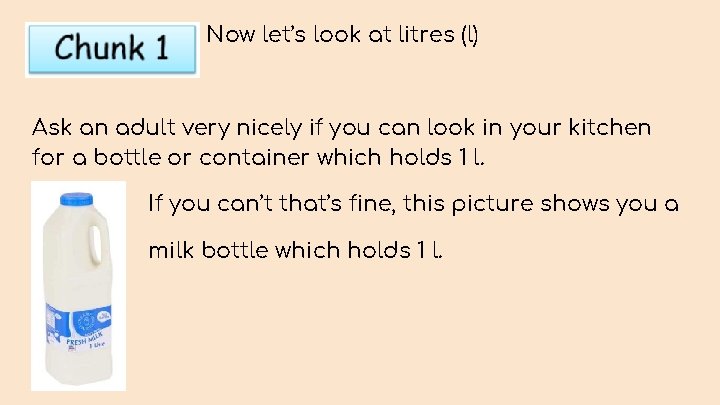
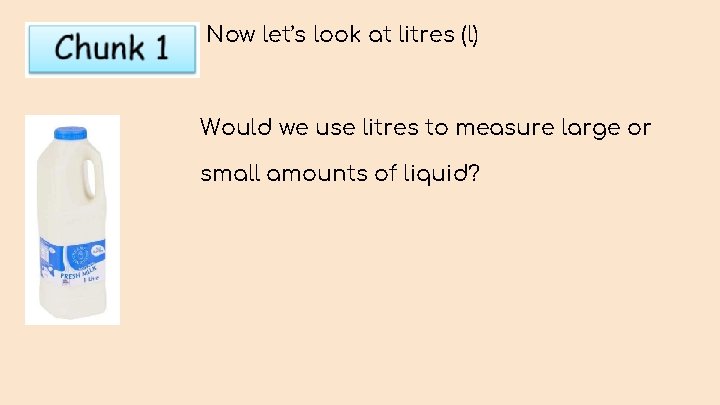
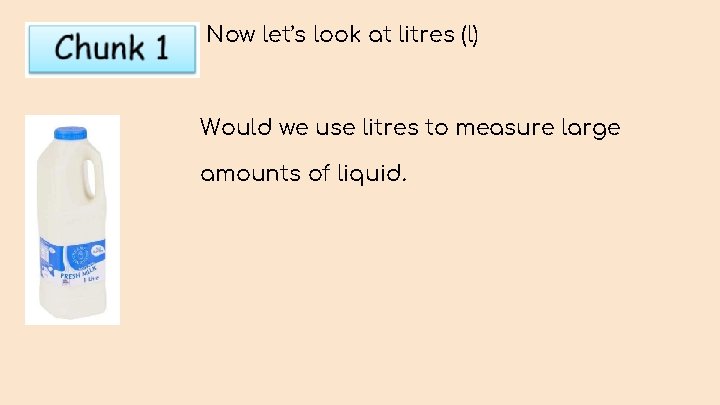
Now let’s look at litres (l) Ask an adult very nicely if you can look in your kitchen for a bottle or container which holds 1 l. If you can’t that’s fine, this picture shows you a milk bottle which holds 1 l.
Now let’s look at litres (l) Would we use litres to measure large or small amounts of liquid?
Now let’s look at litres (l) Would we use litres to measure large amounts of liquid.
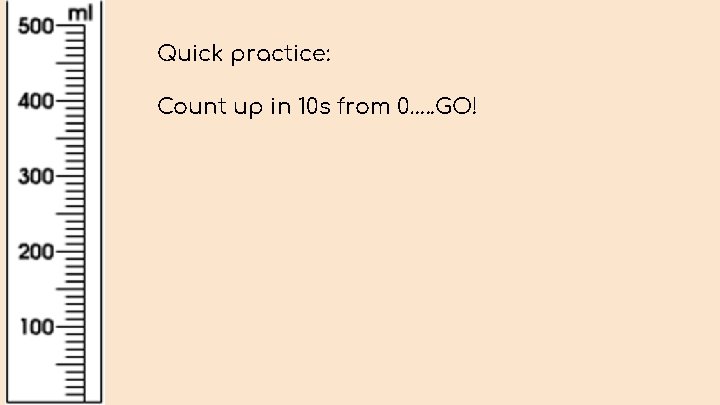
Quick practice: Count up in 10 s from 0…. . GO!
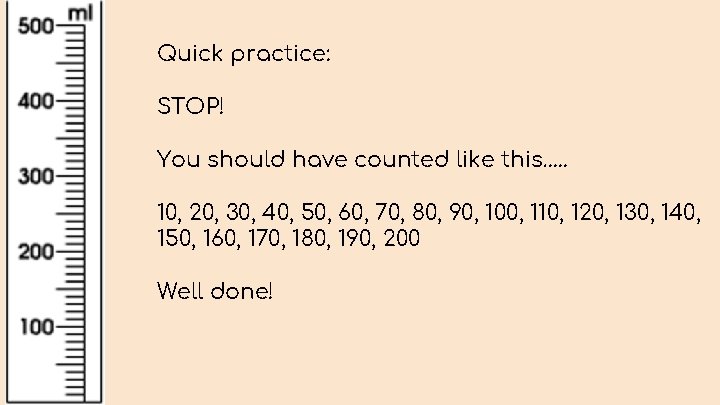
Quick practice: STOP! You should have counted like this…. . 10, 20, 30, 40, 50, 60, 70, 80, 90, 100, 110, 120, 130, 140, 150, 160, 170, 180, 190, 200 Well done!
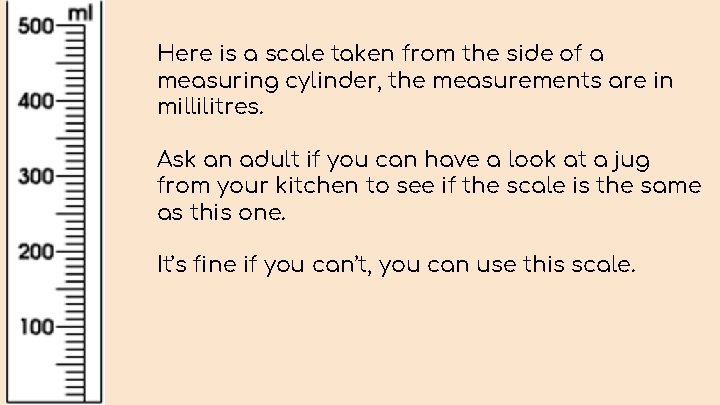
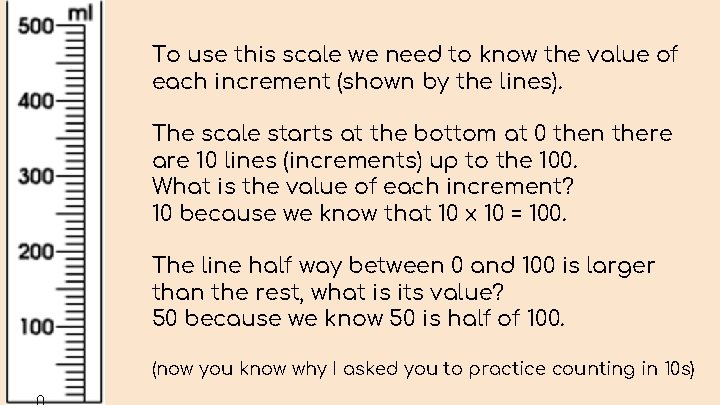
Here is a scale taken from the side of a measuring cylinder, the measurements are in millilitres. Ask an adult if you can have a look at a jug from your kitchen to see if the scale is the same as this one. It’s fine if you can’t, you can use this scale.
To use this scale we need to know the value of each increment (shown by the lines). The scale starts at the bottom at 0 then there are 10 lines (increments) up to the 100. What is the value of each increment? 10 because we know that 10 x 10 = 100. The line half way between 0 and 100 is larger than the rest, what is its value? 50 because we know 50 is half of 100. (now you know why I asked you to practice counting in 10 s)
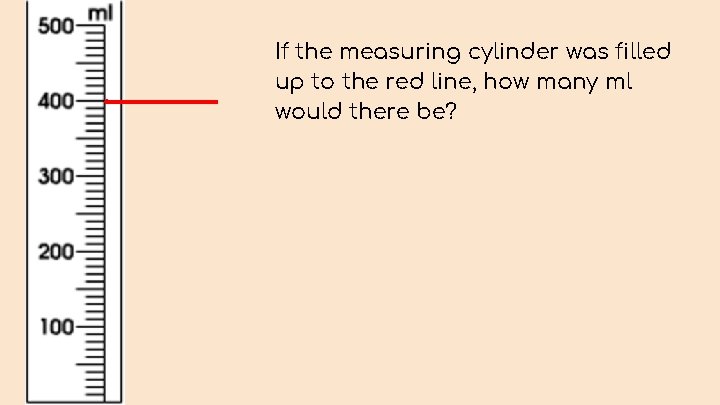
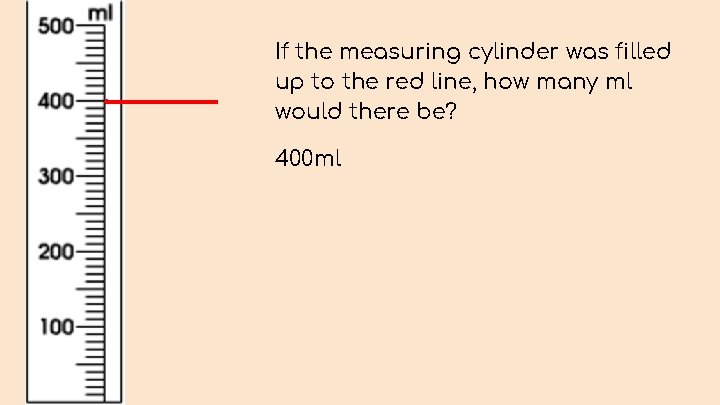
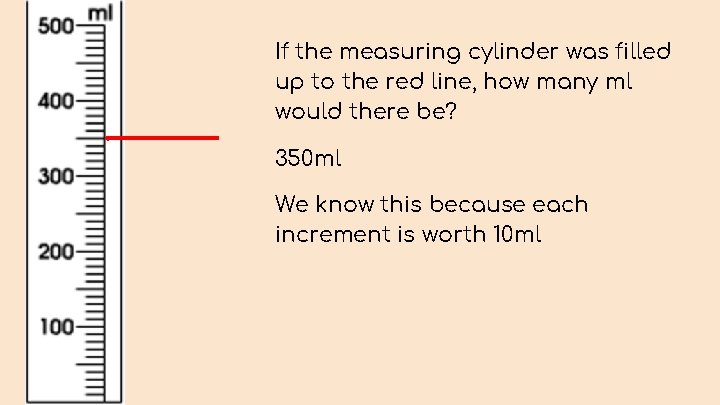
If the measuring cylinder was filled up to the red line, how many ml would there be?
If the measuring cylinder was filled up to the red line, how many ml would there be? 400 ml
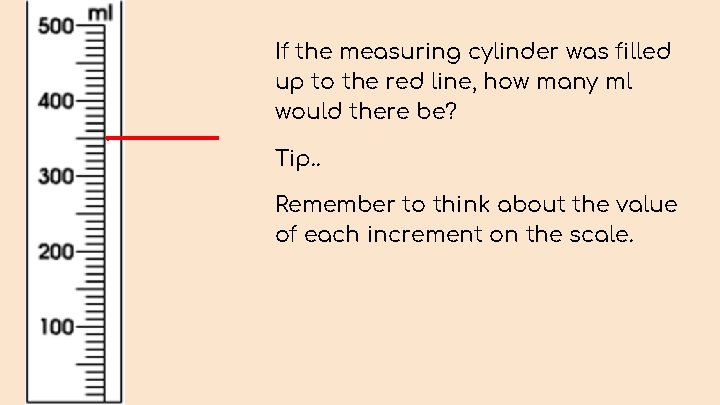
If the measuring cylinder was filled up to the red line, how many ml would there be? Tip. . Remember to think about the value of each increment on the scale.
If the measuring cylinder was filled up to the red line, how many ml would there be? 350 ml We know this because each increment is worth 10 ml
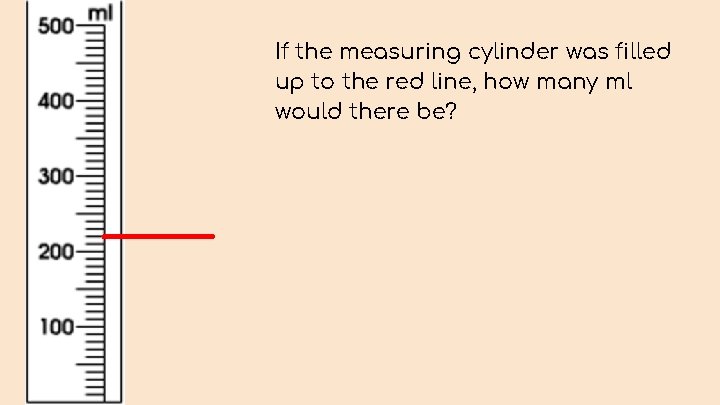
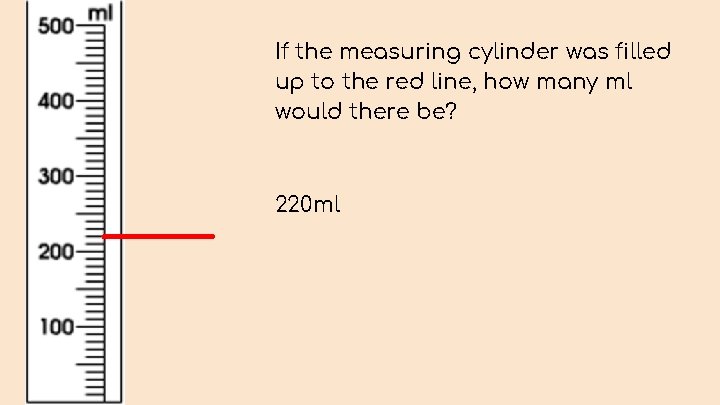
If the measuring cylinder was filled up to the red line, how many ml would there be?
If the measuring cylinder was filled up to the red line, how many ml would there be? 220 ml
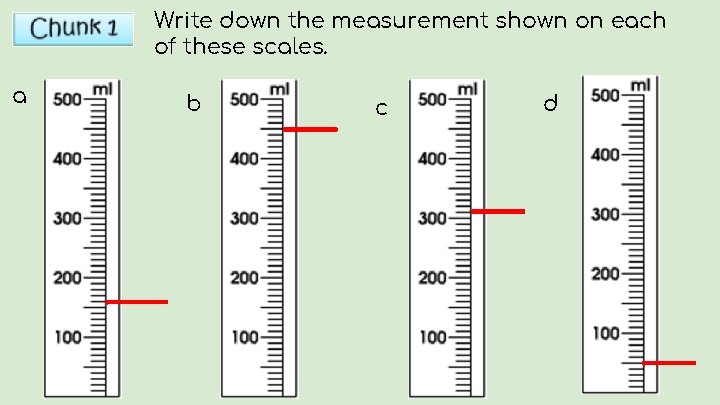
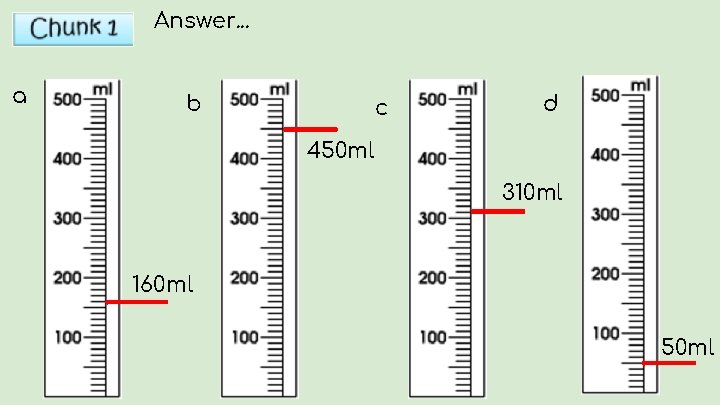
Write down the measurement shown on each of these scales. a b c d
Answer. . . a b c d 450 ml 310 ml 160 ml 50 ml