
Maths at Home EYFS 1 Early Learning Goals
- Slides: 6
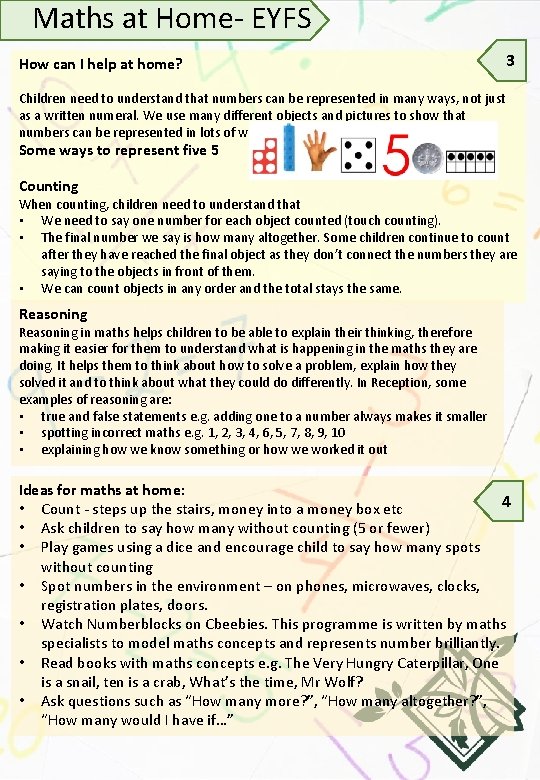
Maths at Home- EYFS 1 Early Learning Goals in Reception There are two Early Learning Goals for Maths. This is what most children in Reception are expected to be able to do by the end of their first year at school. Number: Children count reliably with numbers from one to 20, place them in order and say which number is one more or one less than a given number. Using quantities and objects, they add and subtract two single-digit numbers and count on or back to find the answer. They solve problems, including doubling, halving and sharing. Shape, Space and Measure: Children use everyday language to talk about size, weight, capacity, position, distance, time and money to compare quantities and objects and to solve problems. They recognise, create and describe patterns. They explore characteristics of everyday objects and shapes and use mathematical language to describe them. What is Teaching for Mastery? 2 We believe that everyone can do maths and there’s no such thing as a maths person. Maths is a subject that everyone can and should be able to perform confidently and competently. Maths Mastery is based on three key principles: Conceptual Understanding, Language and Communications and Mathematical Thinking.
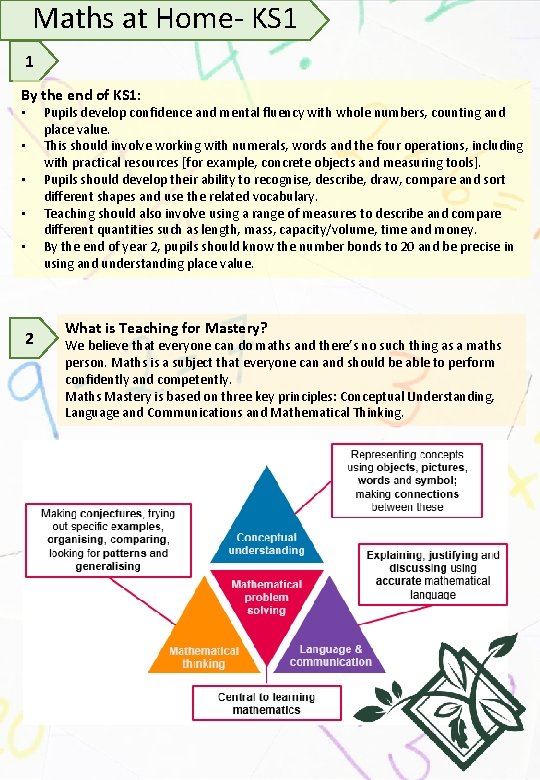
Maths at Home- EYFS How can I help at home? 3 Children need to understand that numbers can be represented in many ways, not just as a written numeral. We use many different objects and pictures to show that numbers can be represented in lots of ways. Some ways to represent five 5 Counting When counting, children need to understand that • We need to say one number for each object counted (touch counting). • The final number we say is how many altogether. Some children continue to count after they have reached the final object as they don’t connect the numbers they are saying to the objects in front of them. • We can count objects in any order and the total stays the same. Reasoning in maths helps children to be able to explain their thinking, therefore making it easier for them to understand what is happening in the maths they are doing. It helps them to think about how to solve a problem, explain how they solved it and to think about what they could do differently. In Reception, some examples of reasoning are: • true and false statements e. g. adding one to a number always makes it smaller • spotting incorrect maths e. g. 1, 2, 3, 4, 6, 5, 7, 8, 9, 10 • explaining how we know something or how we worked it out Ideas for maths at home: 4 • Count - steps up the stairs, money into a money box etc • Ask children to say how many without counting (5 or fewer) • Play games using a dice and encourage child to say how many spots without counting • Spot numbers in the environment – on phones, microwaves, clocks, registration plates, doors. • Watch Numberblocks on Cbeebies. This programme is written by maths specialists to model maths concepts and represents number brilliantly. • Read books with maths concepts e. g. The Very Hungry Caterpillar, One is a snail, ten is a crab, What’s the time, Mr Wolf? • Ask questions such as “How many more? ”, “How many altogether? ”, “How many would I have if…”
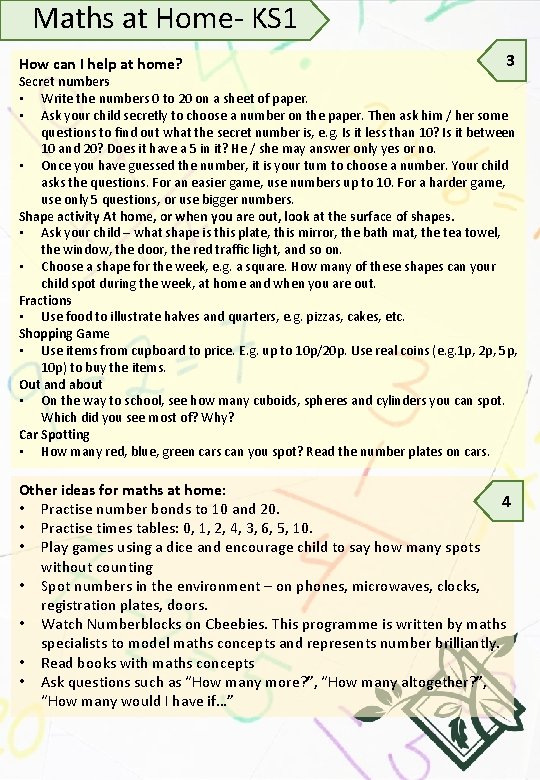
Maths at Home- KS 1 1 By the end of KS 1: • • • 2 Pupils develop confidence and mental fluency with whole numbers, counting and place value. This should involve working with numerals, words and the four operations, including with practical resources [for example, concrete objects and measuring tools]. Pupils should develop their ability to recognise, describe, draw, compare and sort different shapes and use the related vocabulary. Teaching should also involve using a range of measures to describe and compare different quantities such as length, mass, capacity/volume, time and money. By the end of year 2, pupils should know the number bonds to 20 and be precise in using and understanding place value. What is Teaching for Mastery? We believe that everyone can do maths and there’s no such thing as a maths person. Maths is a subject that everyone can and should be able to perform confidently and competently. Maths Mastery is based on three key principles: Conceptual Understanding, Language and Communications and Mathematical Thinking.
Maths at Home- KS 1 How can I help at home? 3 Secret numbers • Write the numbers 0 to 20 on a sheet of paper. • Ask your child secretly to choose a number on the paper. Then ask him / her some questions to find out what the secret number is, e. g. Is it less than 10? Is it between 10 and 20? Does it have a 5 in it? He / she may answer only yes or no. • Once you have guessed the number, it is your turn to choose a number. Your child asks the questions. For an easier game, use numbers up to 10. For a harder game, use only 5 questions, or use bigger numbers. Shape activity At home, or when you are out, look at the surface of shapes. • Ask your child – what shape is this plate, this mirror, the bath mat, the tea towel, the window, the door, the red traffic light, and so on. • Choose a shape for the week, e. g. a square. How many of these shapes can your child spot during the week, at home and when you are out. Fractions • Use food to illustrate halves and quarters, e. g. pizzas, cakes, etc. Shopping Game • Use items from cupboard to price. E. g. up to 10 p/20 p. Use real coins (e. g. 1 p, 2 p, 5 p, 10 p) to buy the items. Out and about • On the way to school, see how many cuboids, spheres and cylinders you can spot. Which did you see most of? Why? Car Spotting • How many red, blue, green cars can you spot? Read the number plates on cars. Other ideas for maths at home: 4 • Practise number bonds to 10 and 20. • Practise times tables: 0, 1, 2, 4, 3, 6, 5, 10. • Play games using a dice and encourage child to say how many spots without counting • Spot numbers in the environment – on phones, microwaves, clocks, registration plates, doors. • Watch Numberblocks on Cbeebies. This programme is written by maths specialists to model maths concepts and represents number brilliantly. • Read books with maths concepts • Ask questions such as “How many more? ”, “How many altogether? ”, “How many would I have if…”
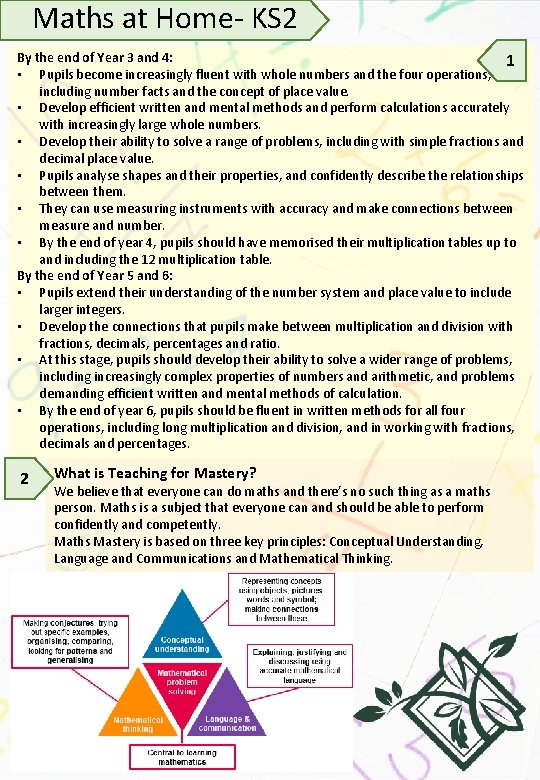
Maths at Home- KS 2 By the end of Year 3 and 4: 1 • Pupils become increasingly fluent with whole numbers and the four operations, including number facts and the concept of place value. • Develop efficient written and mental methods and perform calculations accurately with increasingly large whole numbers. • Develop their ability to solve a range of problems, including with simple fractions and decimal place value. • Pupils analyse shapes and their properties, and confidently describe the relationships between them. • They can use measuring instruments with accuracy and make connections between measure and number. • By the end of year 4, pupils should have memorised their multiplication tables up to and including the 12 multiplication table. By the end of Year 5 and 6: • Pupils extend their understanding of the number system and place value to include larger integers. • Develop the connections that pupils make between multiplication and division with fractions, decimals, percentages and ratio. • At this stage, pupils should develop their ability to solve a wider range of problems, including increasingly complex properties of numbers and arithmetic, and problems demanding efficient written and mental methods of calculation. • By the end of year 6, pupils should be fluent in written methods for all four operations, including long multiplication and division, and in working with fractions, decimals and percentages. 2 What is Teaching for Mastery? We believe that everyone can do maths and there’s no such thing as a maths person. Maths is a subject that everyone can and should be able to perform confidently and competently. Maths Mastery is based on three key principles: Conceptual Understanding, Language and Communications and Mathematical Thinking.
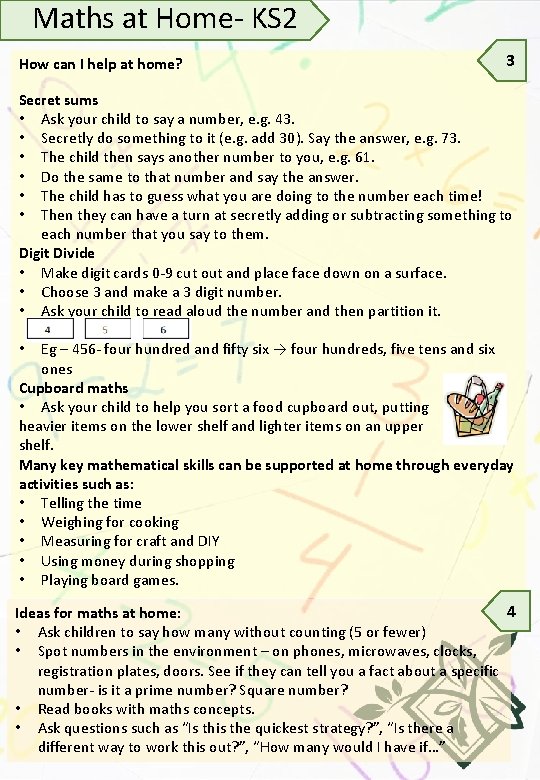
Maths at Home- KS 2 How can I help at home? 3 Secret sums • Ask your child to say a number, e. g. 43. • Secretly do something to it (e. g. add 30). Say the answer, e. g. 73. • The child then says another number to you, e. g. 61. • Do the same to that number and say the answer. • The child has to guess what you are doing to the number each time! • Then they can have a turn at secretly adding or subtracting something to each number that you say to them. Digit Divide • Make digit cards 0 -9 cut out and place face down on a surface. • Choose 3 and make a 3 digit number. • Ask your child to read aloud the number and then partition it. Eg – 456 - four hundred and fifty six → four hundreds, five tens and six ones Cupboard maths • Ask your child to help you sort a food cupboard out, putting heavier items on the lower shelf and lighter items on an upper shelf. Many key mathematical skills can be supported at home through everyday activities such as: • Telling the time • Weighing for cooking • Measuring for craft and DIY • Using money during shopping • Playing board games. • 4 Ideas for maths at home: • Ask children to say how many without counting (5 or fewer) • Spot numbers in the environment – on phones, microwaves, clocks, registration plates, doors. See if they can tell you a fact about a specific number- is it a prime number? Square number? • Read books with maths concepts. • Ask questions such as “Is this the quickest strategy? ”, “Is there a different way to work this out? ”, “How many would I have if…”