
Mathematics Statistics Topic 5 Continuous Random Variables and
Mathematics & Statistics Topic 5 Continuous Random Variables and Probability Distributions
Topic Goals After completing this topic, you should be able to: § § Explain the difference between a discrete and a continuous random variable Describe the characteristics of the uniform and normal distributions Translate normal distribution problems into standardized normal distribution problems Find probabilities using a normal distribution table
Topic Goals (continued) After completing this topic, you should be able to: § § § Evaluate the normality assumption Use the normal approximation to the binomial distribution Explain jointly distributed variables and linear combinations of random variables
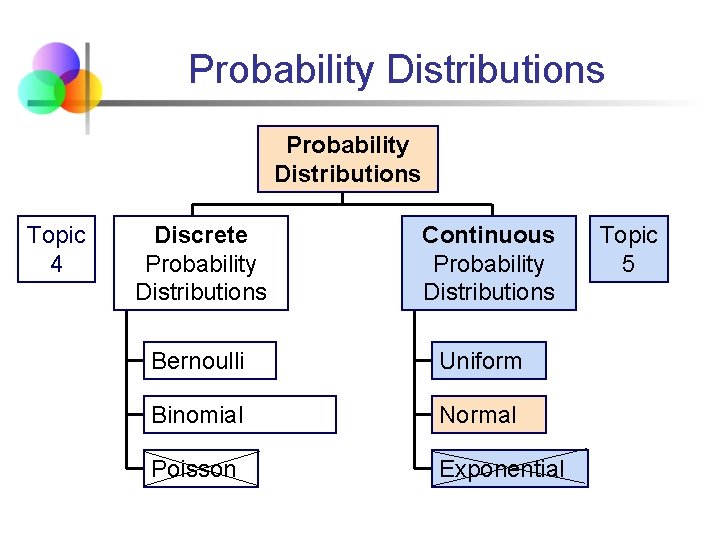
Probability Distributions Topic 4 Discrete Probability Distributions Continuous Probability Distributions Bernoulli Uniform Binomial Normal Poisson Exponential Topic 5
(6. 1) Continuous Probability Distributions § A continuous random variable is a variable that can assume any value in an interval § § § thickness of an item time required to complete a task return on a portfolio height, in cms These can potentially take on any value, depending only on the ability to measure accurately. Problem: P(X=x)=0, for all x § So, we cannot use a distribution function like before

(6. 1) Cumulative Distribution Function § § The cumulative distribution function, F(x), for a (continuous) random variable X expresses the probability that X does not exceed the value of x Let a and b be two possible values of X, with a < b. The probability that X lies between a and b is
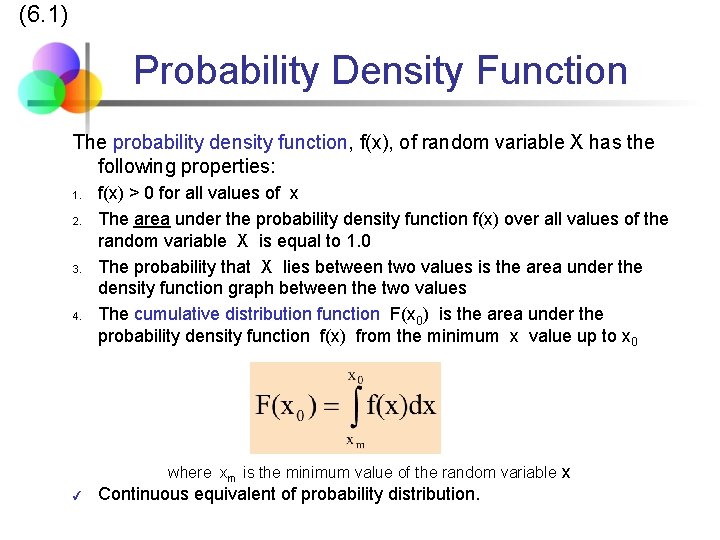
(6. 1) Probability Density Function The probability density function, f(x), of random variable X has the following properties: 1. 2. 3. 4. f(x) > 0 for all values of x The area under the probability density function f(x) over all values of the random variable X is equal to 1. 0 The probability that X lies between two values is the area under the density function graph between the two values The cumulative distribution function F(x 0) is the area under the probability density function f(x) from the minimum x value up to x 0 where xm is the minimum value of the random variable x 4 Continuous equivalent of probability distribution.
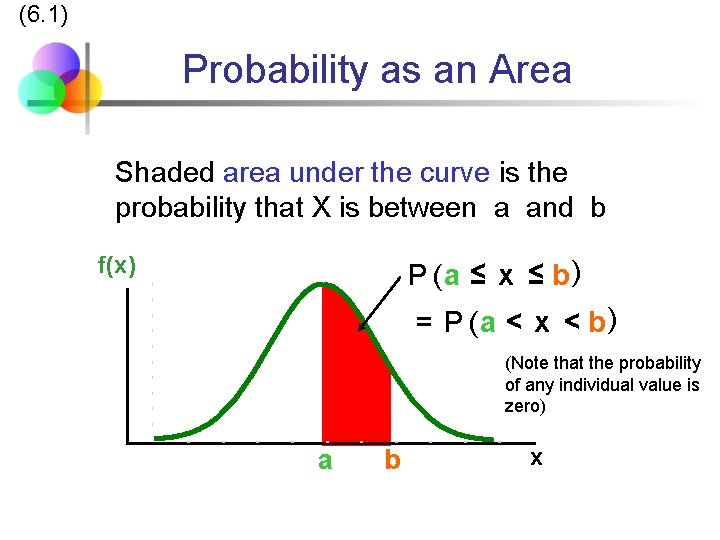
(6. 1) Probability as an Area Shaded area under the curve is the probability that X is between a and b f(x) P (a ≤ x ≤ b) = P (a < x < b) (Note that the probability of any individual value is zero) a b x
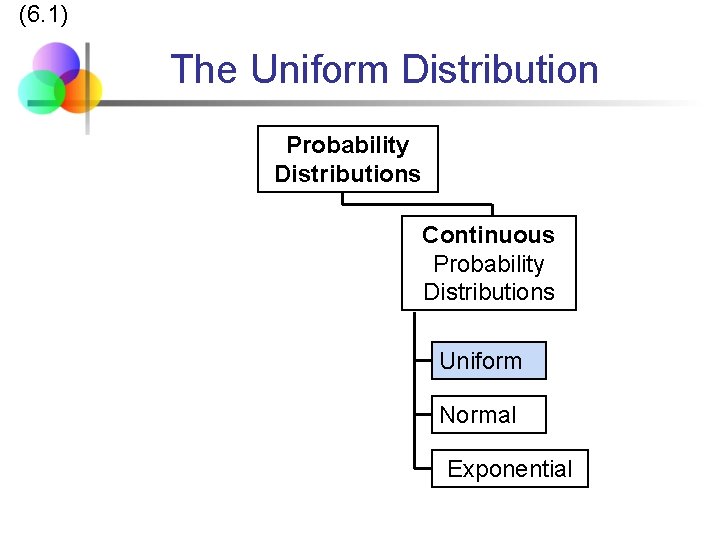
(6. 1) The Uniform Distribution Probability Distributions Continuous Probability Distributions Uniform Normal Exponential
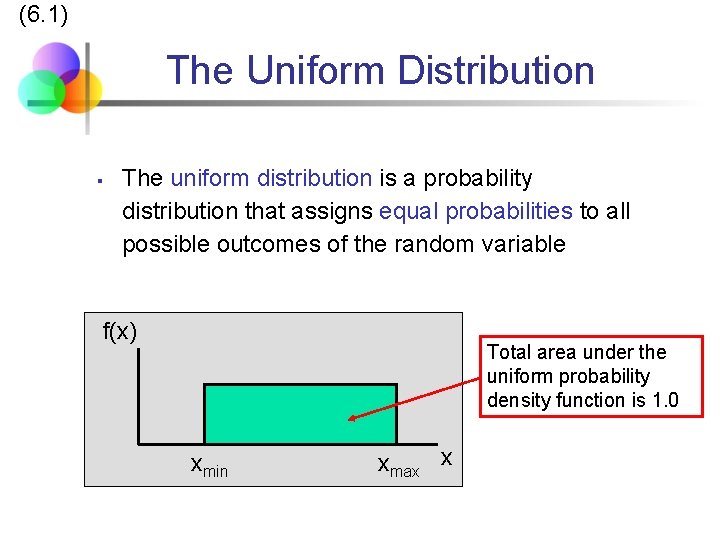
(6. 1) The Uniform Distribution § The uniform distribution is a probability distribution that assigns equal probabilities to all possible outcomes of the random variable f(x) Total area under the uniform probability density function is 1. 0 xmin xmax x
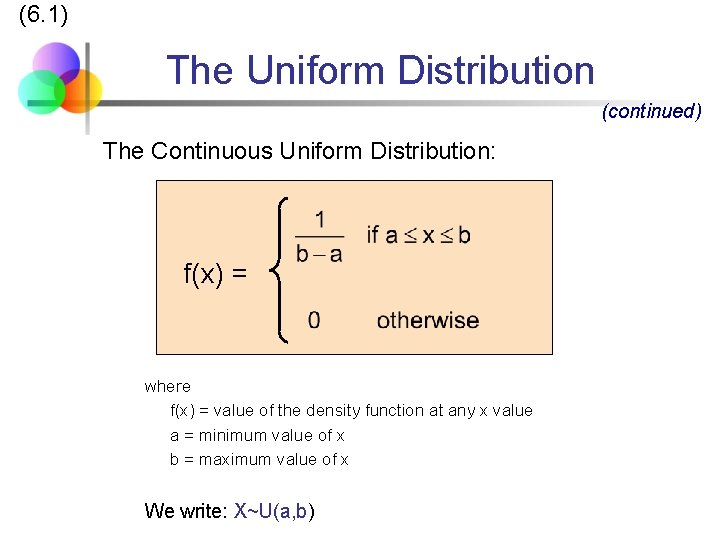
(6. 1) The Uniform Distribution (continued) The Continuous Uniform Distribution: f(x) = where f(x) = value of the density function at any x value a = minimum value of x b = maximum value of x We write: X~U(a, b)
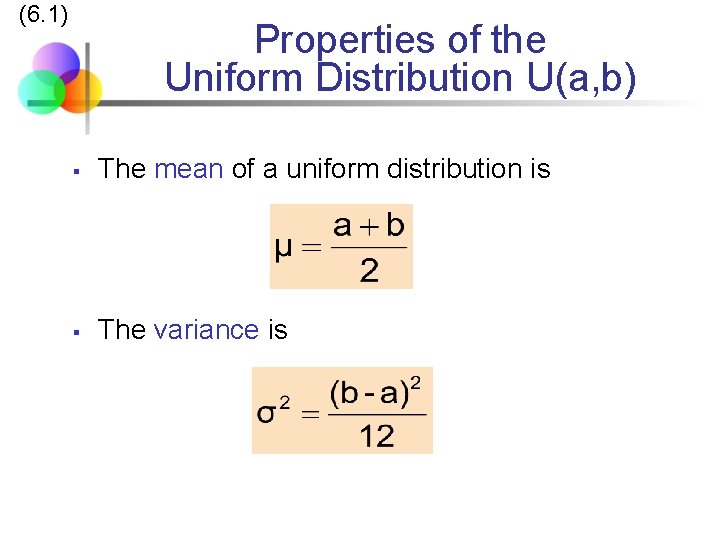
(6. 1) Properties of the Uniform Distribution U(a, b) § The mean of a uniform distribution is § The variance is

(6. 1) Uniform Distribution Example: X~U(2, 6): Uniform probability distribution over the range 2 ≤ x ≤ 6: 1 f(x) = 6 - 2 =. 25 for 2 ≤ x ≤ 6 f(x). 25 2 6 x
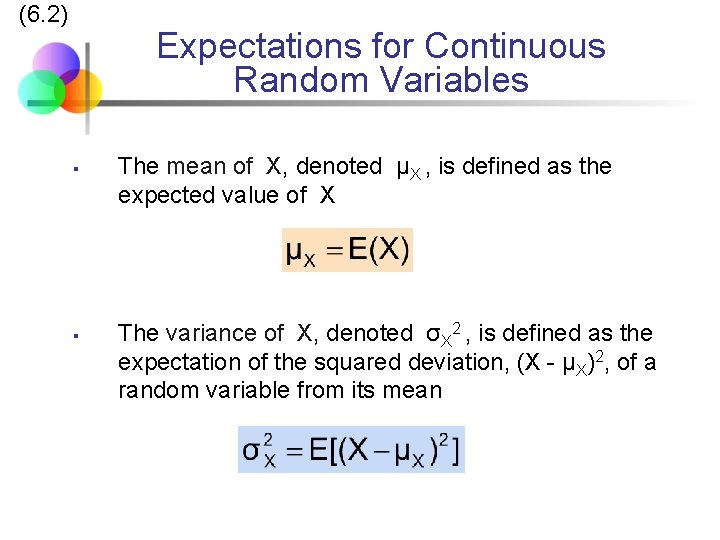
(6. 2) Expectations for Continuous Random Variables § § The mean of X, denoted μX , is defined as the expected value of X The variance of X, denoted σX 2 , is defined as the expectation of the squared deviation, (X - μX)2, of a random variable from its mean
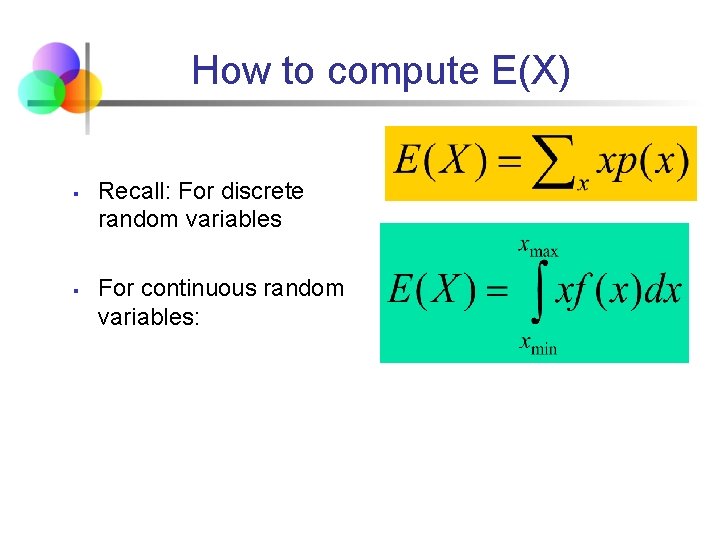
How to compute E(X) § § Recall: For discrete random variables For continuous random variables:
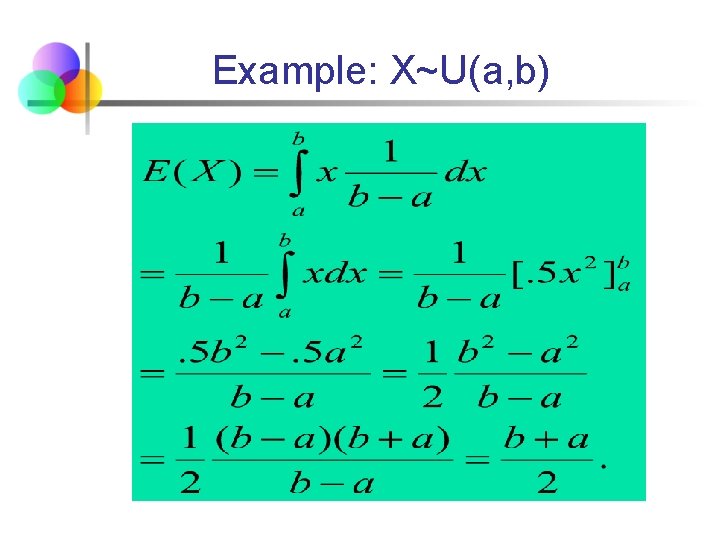
Example: X~U(a, b)
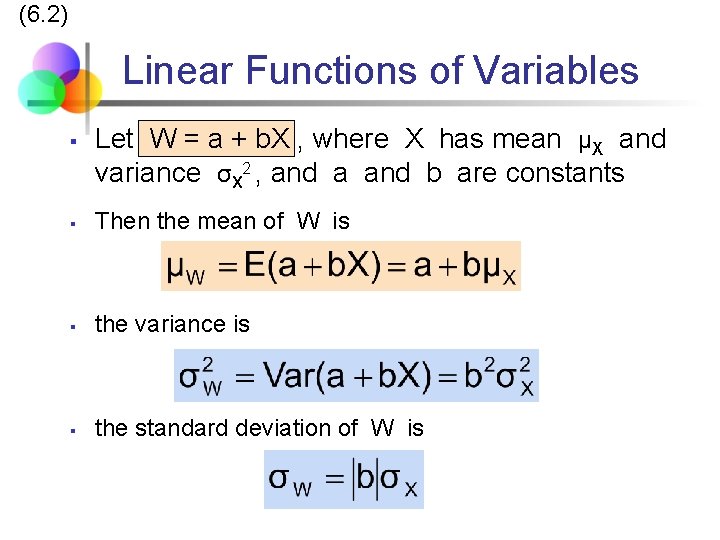
(6. 2) Linear Functions of Variables § Let W = a + b. X , where X has mean μX and variance σX 2 , and a and b are constants § Then the mean of W is § the variance is § the standard deviation of W is
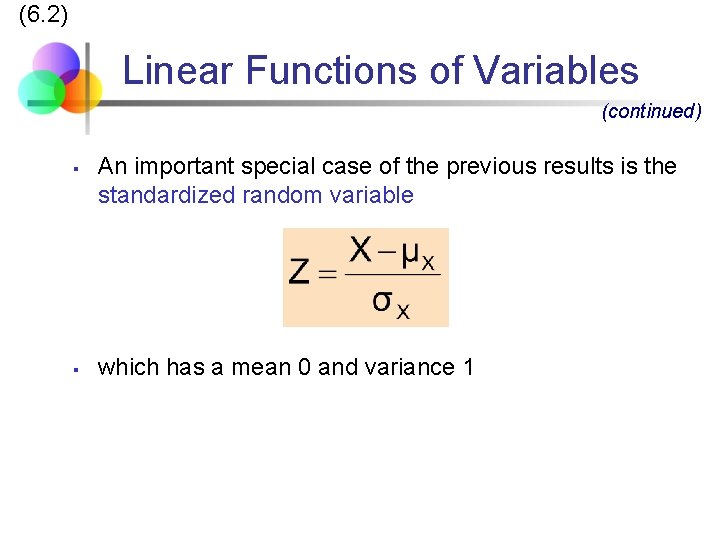
(6. 2) Linear Functions of Variables (continued) § § An important special case of the previous results is the standardized random variable which has a mean 0 and variance 1
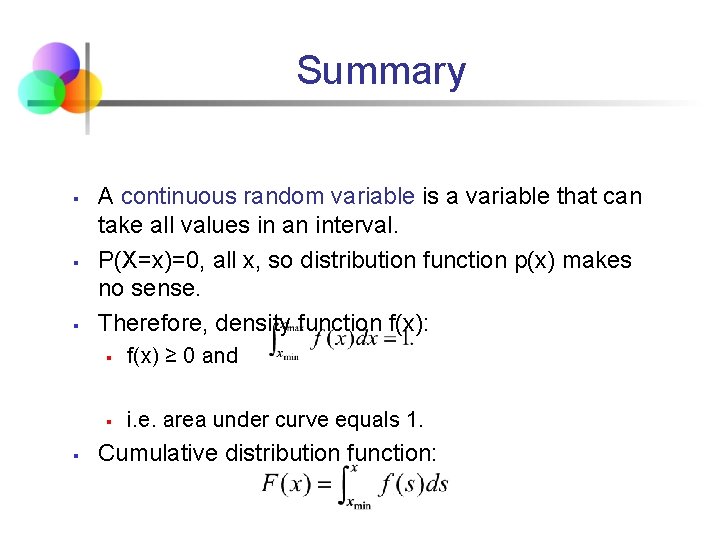
Summary § § A continuous random variable is a variable that can take all values in an interval. P(X=x)=0, all x, so distribution function p(x) makes no sense. Therefore, density function f(x): § f(x) ≥ 0 and § i. e. area under curve equals 1. Cumulative distribution function:
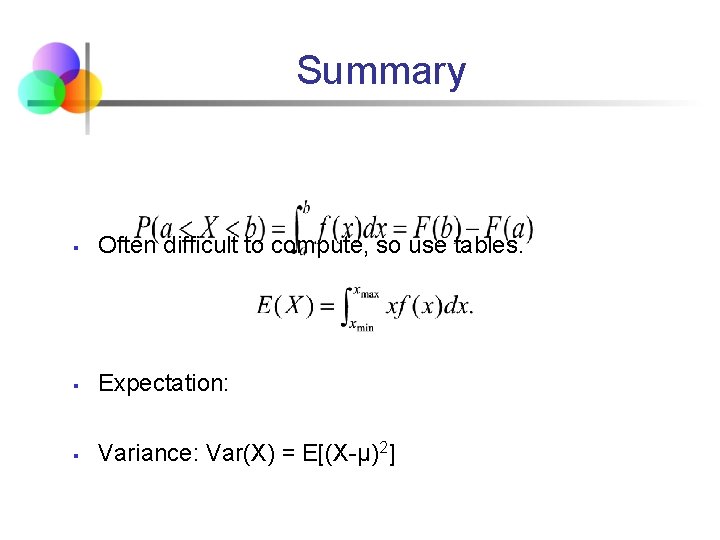
Summary § Often difficult to compute, so use tables. § Expectation: § Variance: Var(X) = E[(X-μ)2]

Summary § Example: Uniform distribution X~U(a, b) § § § f(x) = 1/(b-a) E(X) = (a+b)/2 Var(X) = (b-a)2/12 E(a+b. X) = a+b. E(X) Var(a+b. X) = b 2 Var(X)
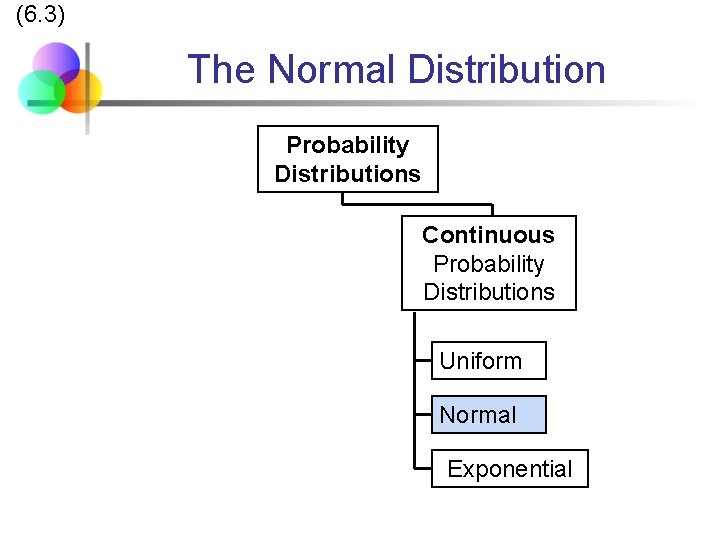
(6. 3) The Normal Distribution Probability Distributions Continuous Probability Distributions Uniform Normal Exponential
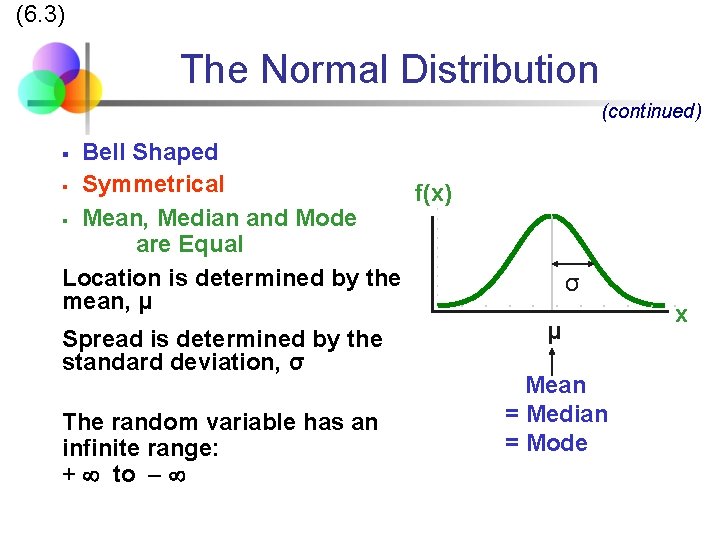
(6. 3) The Normal Distribution (continued) ‘Bell Shaped’ § Symmetrical f(x) § Mean, Median and Mode are Equal Location is determined by the mean, μ § Spread is determined by the standard deviation, σ The random variable has an infinite range: + to σ μ Mean = Median = Mode x
(6. 3) The Normal Distribution (continued) § § The normal distribution closely approximates the probability distributions of a wide range of random variables Distributions of sample means approach a normal distribution given a “large” sample size (next topic) Computations of probabilities are direct and elegant The normal probability distribution has led to good business decisions for a number of applications (and also some very bad ones when applied in wrong way)
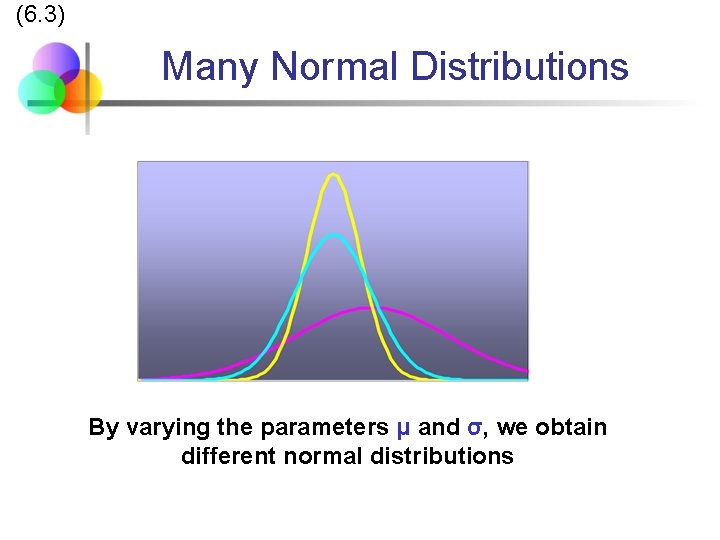
(6. 3) Many Normal Distributions By varying the parameters μ and σ, we obtain different normal distributions
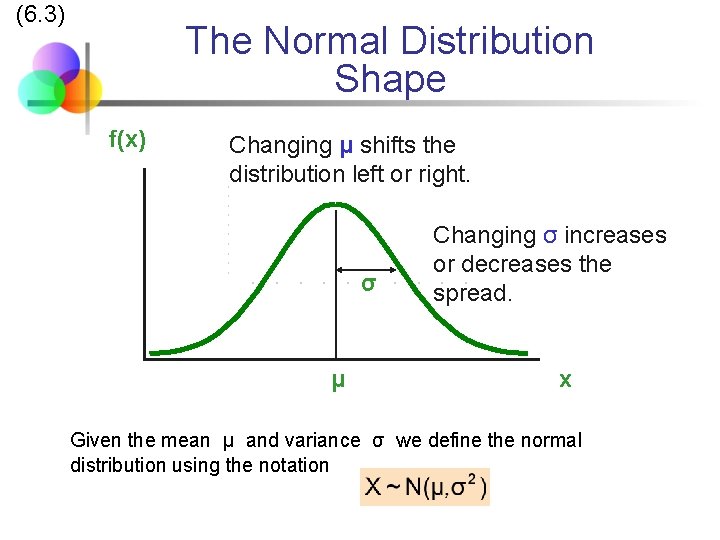
(6. 3) The Normal Distribution Shape f(x) Changing μ shifts the distribution left or right. σ μ Changing σ increases or decreases the spread. x Given the mean μ and variance σ we define the normal distribution using the notation
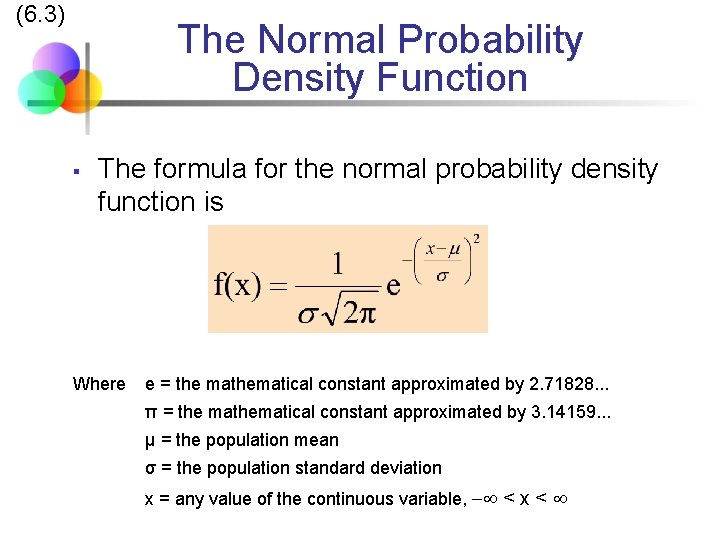
(6. 3) The Normal Probability Density Function § The formula for the normal probability density function is Where e = the mathematical constant approximated by 2. 71828. . . π = the mathematical constant approximated by 3. 14159. . . μ = the population mean σ = the population standard deviation x = any value of the continuous variable, < x <
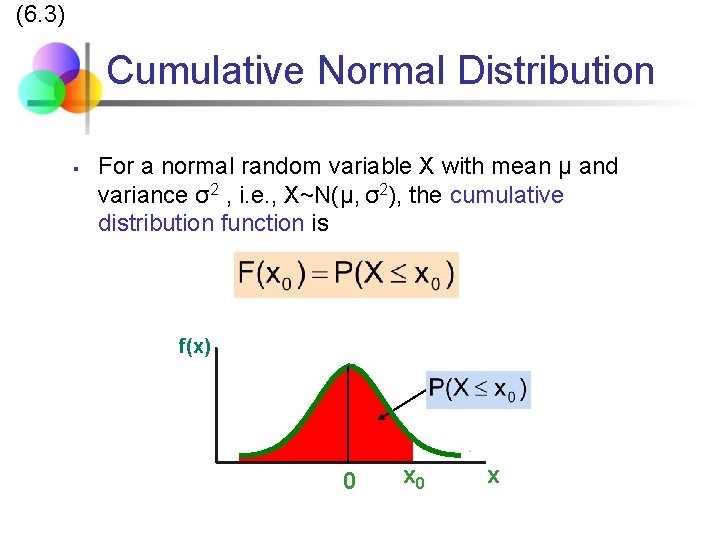
(6. 3) Cumulative Normal Distribution § For a normal random variable X with mean μ and variance σ2 , i. e. , X~N(μ, σ2), the cumulative distribution function is f(x) 0 x
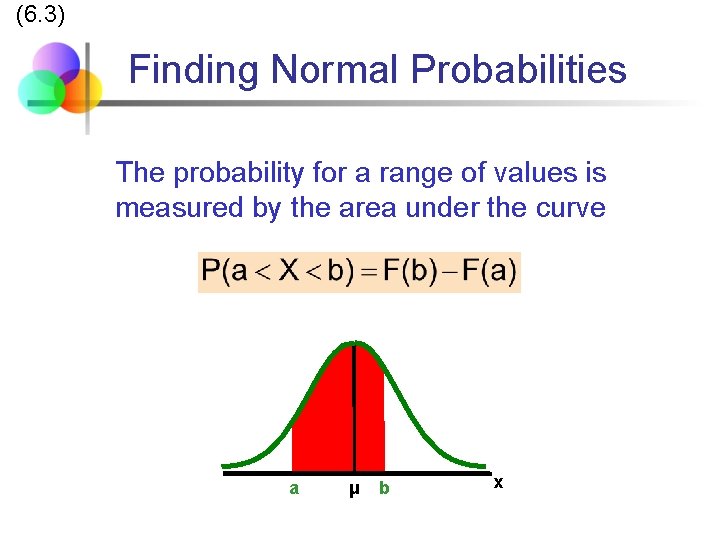
(6. 3) Finding Normal Probabilities The probability for a range of values is measured by the area under the curve a μ b x

(6. 3) Finding Normal Probabilities (continued) a μ b x
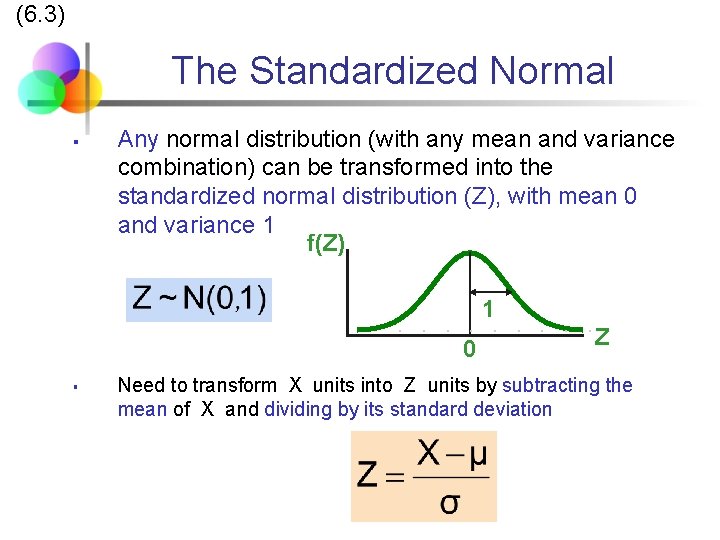
(6. 3) The Standardized Normal § Any normal distribution (with any mean and variance combination) can be transformed into the standardized normal distribution (Z), with mean 0 and variance 1 f(Z) 1 0 § Z Need to transform X units into Z units by subtracting the mean of X and dividing by its standard deviation
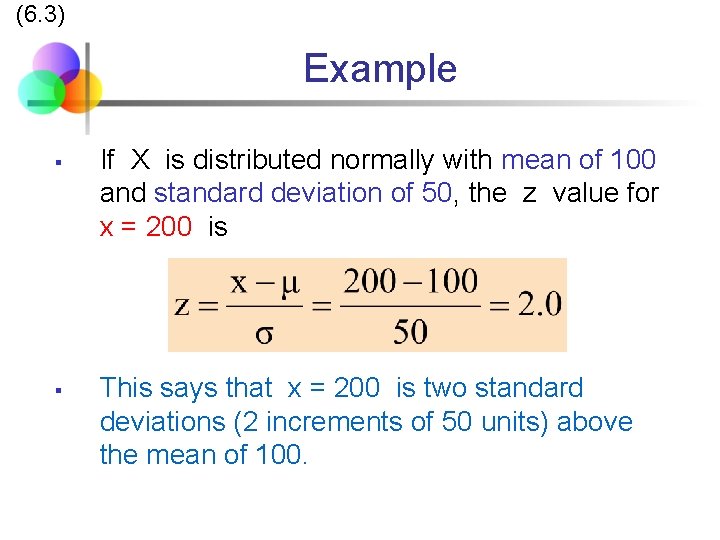
(6. 3) Example § § If X is distributed normally with mean of 100 and standard deviation of 50, the z value for x = 200 is This says that x = 200 is two standard deviations (2 increments of 50 units) above the mean of 100.
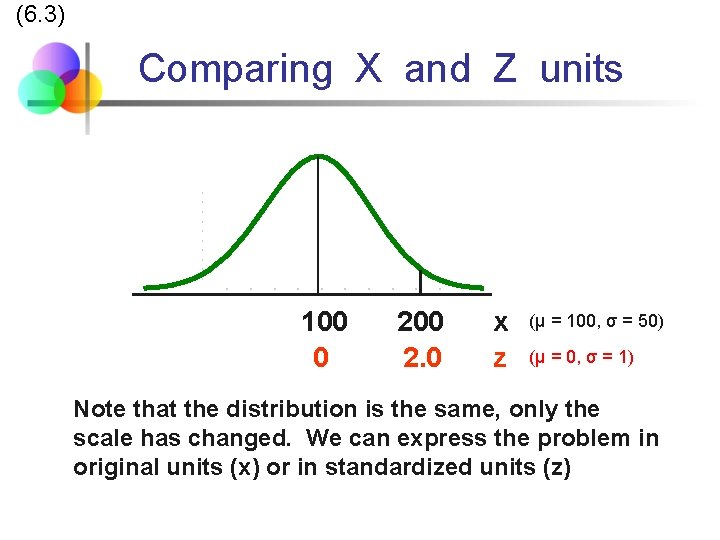
(6. 3) Comparing X and Z units 100 0 200 2. 0 x z (μ = 100, σ = 50) (μ = 0, σ = 1) Note that the distribution is the same, only the scale has changed. We can express the problem in original units (x) or in standardized units (z)

(6. 3) Finding Normal Probabilities f(x) a µ 0 b x z
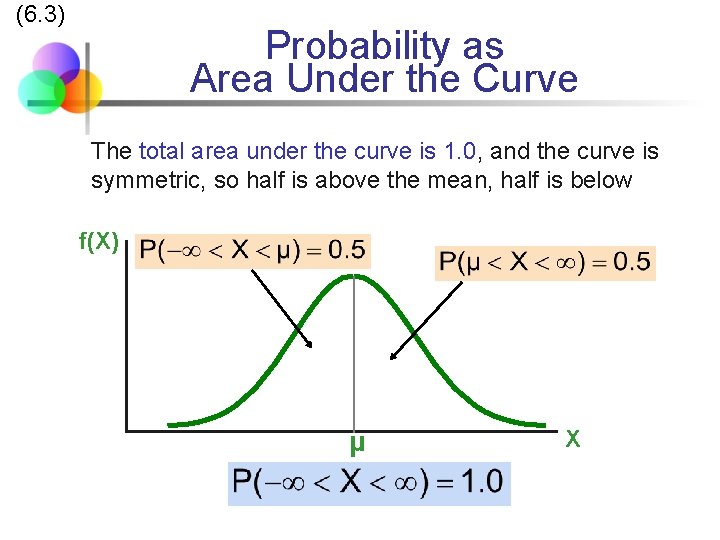
(6. 3) Probability as Area Under the Curve The total area under the curve is 1. 0, and the curve is symmetric, so half is above the mean, half is below f(X) 0. 5 μ X
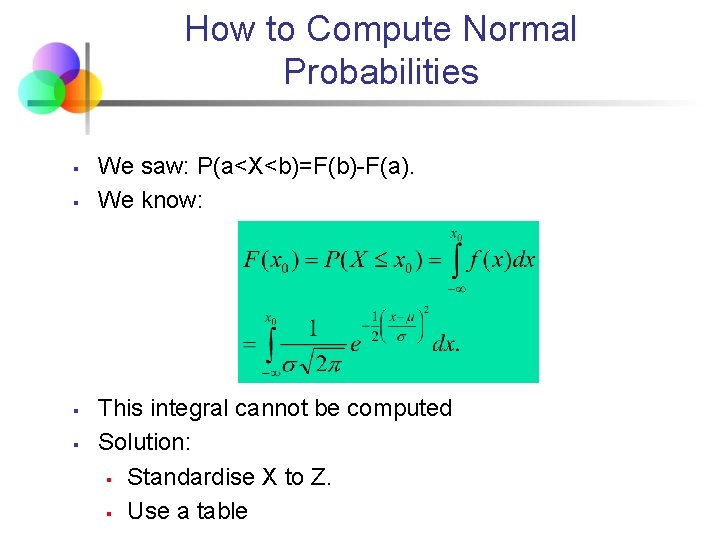
How to Compute Normal Probabilities § § We saw: P(a<X<b)=F(b)-F(a). We know: This integral cannot be computed Solution: § Standardise X to Z. § Use a table
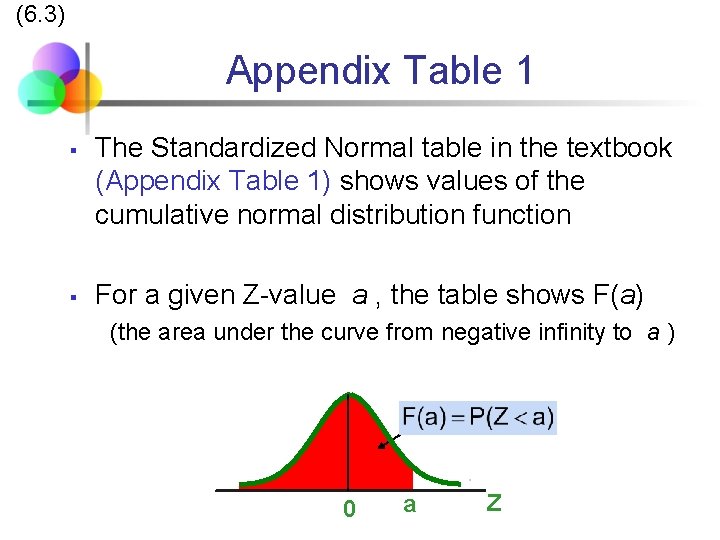
(6. 3) Appendix Table 1 § § The Standardized Normal table in the textbook (Appendix Table 1) shows values of the cumulative normal distribution function For a given Z-value a , the table shows F(a) (the area under the curve from negative infinity to a ) 0 a Z
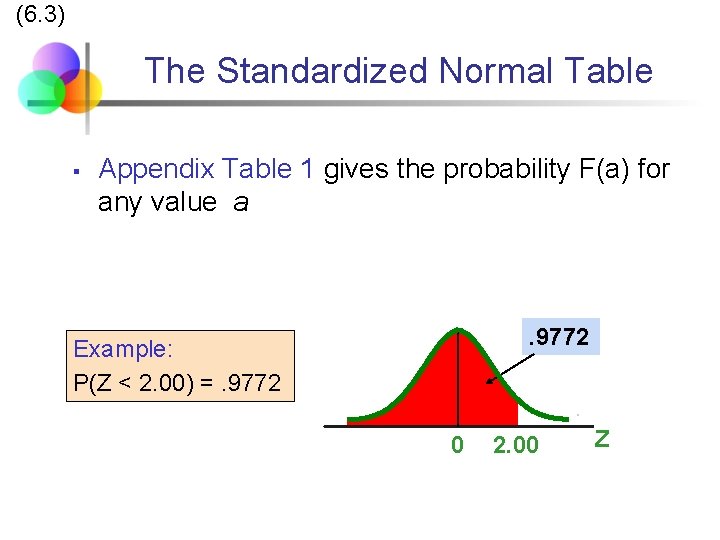
(6. 3) The Standardized Normal Table § Appendix Table 1 gives the probability F(a) for any value a . 9772 Example: P(Z < 2. 00) =. 9772 0 2. 00 Z
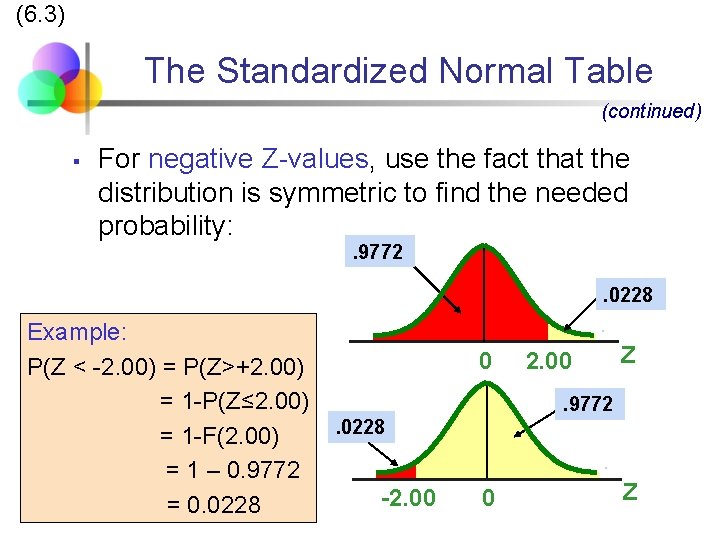
(6. 3) The Standardized Normal Table (continued) § For negative Z-values, use the fact that the distribution is symmetric to find the needed probability: . 9772 . 0228 Example: P(Z < -2. 00) = P(Z>+2. 00) = 1 -P(Z≤ 2. 00) = 1 -F(2. 00) = 1 – 0. 9772 = 0. 0228 0 2. 00 Z . 9772. 0228 -2. 00 0 Z

(6. 3) General Procedure for Finding Probabilities To find P(a < X < b) when X is distributed normally N(μ, σ2): Draw the normal curve for the problem in terms of X § Translate X-values to Z-values using Z=(X-μ)/σ. Then Z~N(0, 1) (NB this only holds for normally distributes RVs) § Use the Cumulative Normal Table for N(0, 1) to find §

4 Standard Problems § § § Let X~N(μ, σ2). Find P(X ≤ a), given a. Find P(X > a), given a. Find a such that P(X > a) = p, given p. Find a such that P(|X|> a) = p, given p.
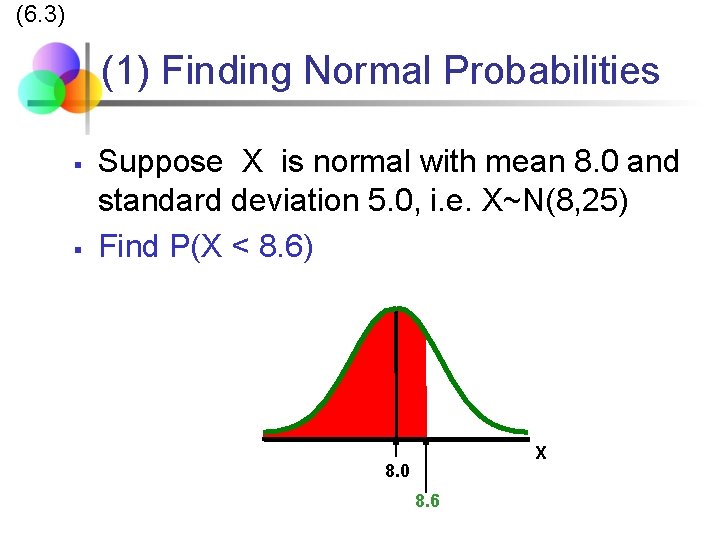
(6. 3) (1) Finding Normal Probabilities § § Suppose X is normal with mean 8. 0 and standard deviation 5. 0, i. e. X~N(8, 25) Find P(X < 8. 6) X 8. 0 8. 6
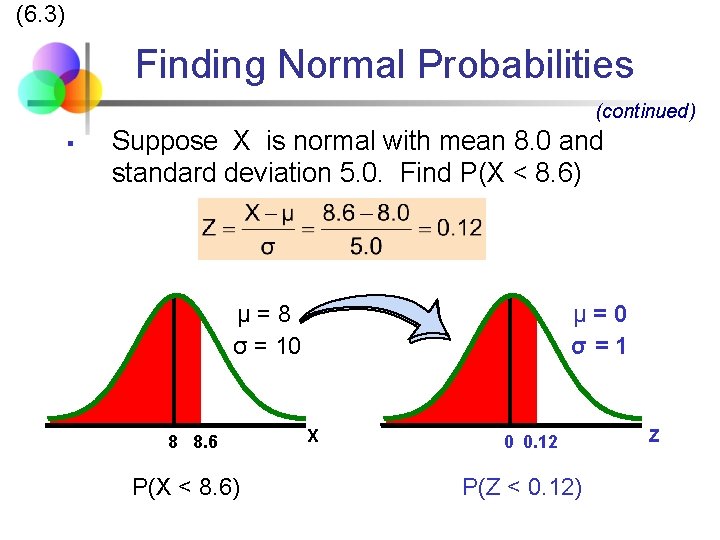
(6. 3) Finding Normal Probabilities (continued) § Suppose X is normal with mean 8. 0 and standard deviation 5. 0. Find P(X < 8. 6) μ=8 σ = 10 8 8. 6 P(X < 8. 6) μ=0 σ=1 X 0 0. 12 P(Z < 0. 12) Z
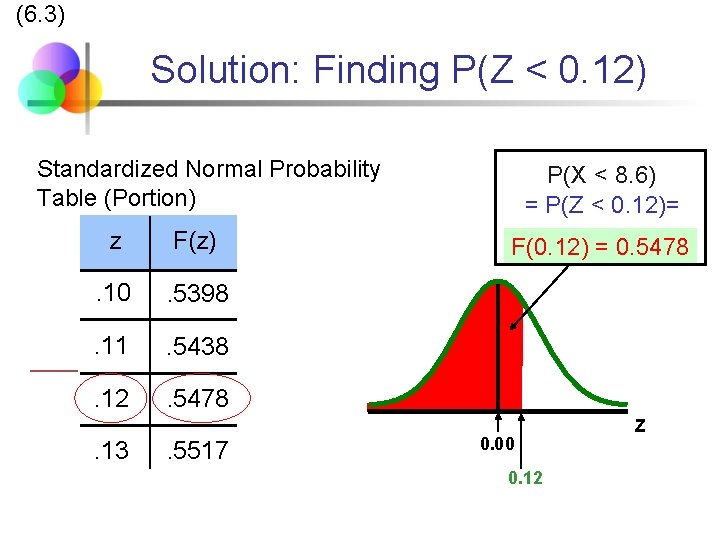
(6. 3) Solution: Finding P(Z < 0. 12) Standardized Normal Probability Table (Portion) z F(z) . 10 . 5398 . 11 . 5438 . 12 . 5478 . 13 . 5517 P(X < 8. 6) = P(Z < 0. 12)= F(0. 12) = 0. 5478 0. 00 0. 12 Z
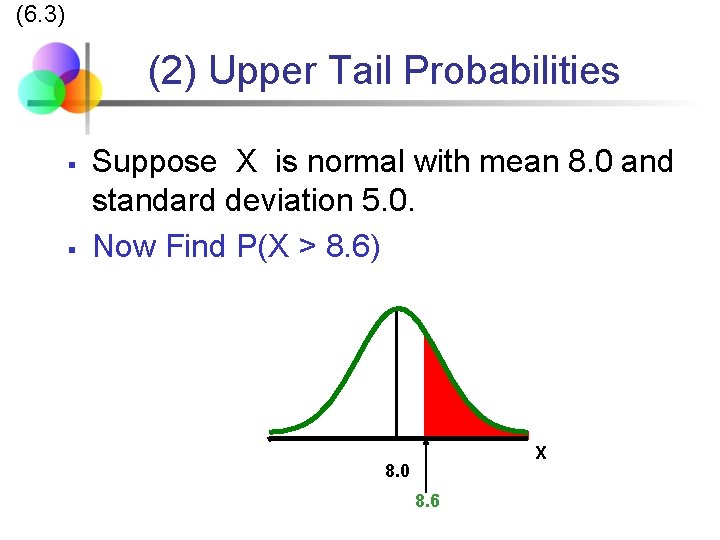
(6. 3) (2) Upper Tail Probabilities § § Suppose X is normal with mean 8. 0 and standard deviation 5. 0. Now Find P(X > 8. 6) X 8. 0 8. 6
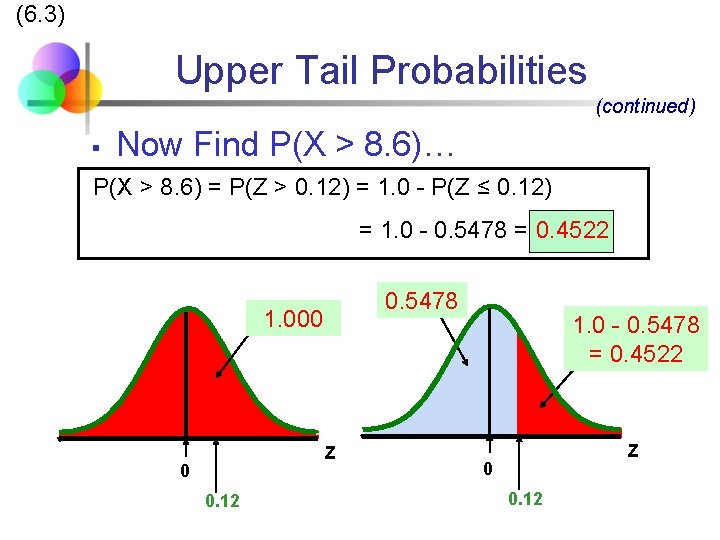
(6. 3) Upper Tail Probabilities (continued) § Now Find P(X > 8. 6)… P(X > 8. 6) = P(Z > 0. 12) = 1. 0 - P(Z ≤ 0. 12) = 1. 0 - 0. 5478 = 0. 4522 0. 5478 1. 000 Z 0 0. 12 1. 0 - 0. 5478 = 0. 4522 Z 0 0. 12
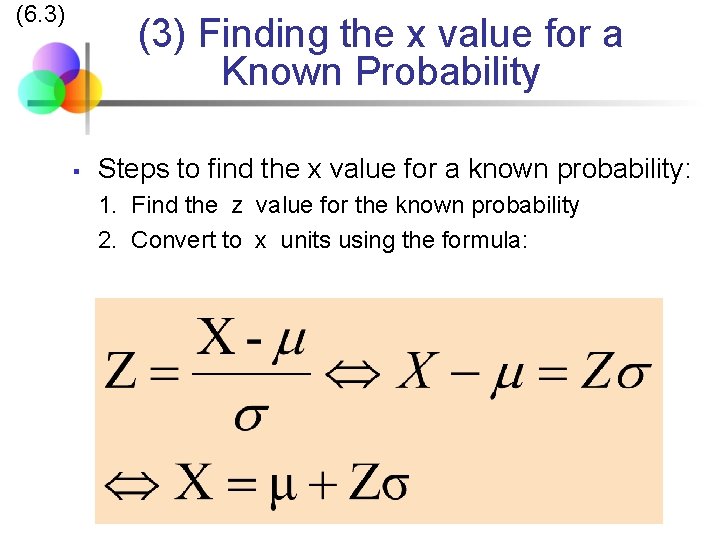
(6. 3) (3) Finding the x value for a Known Probability § Steps to find the x value for a known probability: 1. Find the z value for the known probability 2. Convert to x units using the formula:
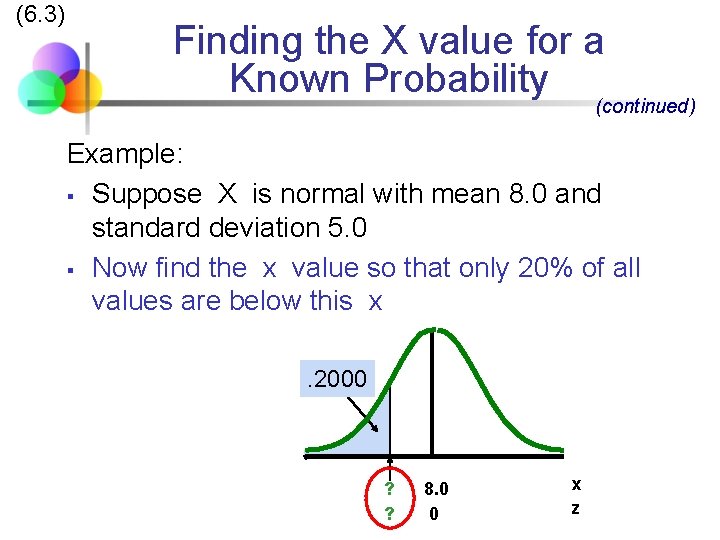
(6. 3) Finding the X value for a Known Probability (continued) Example: § Suppose X is normal with mean 8. 0 and standard deviation 5. 0 § Now find the x value so that only 20% of all values are below this x. 2000 ? ? 8. 0 0 x z
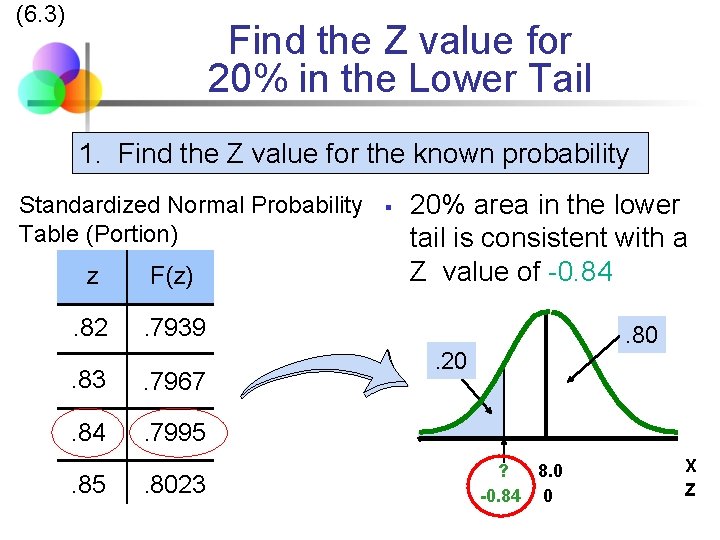
(6. 3) Find the Z value for 20% in the Lower Tail 1. Find the Z value for the known probability Standardized Normal Probability Table (Portion) z F(z) . 82 . 7939 . 83 . 7967 . 84 . 7995 . 8023 § 20% area in the lower tail is consistent with a Z value of -0. 84. 80 . 20 ? 8. 0 -0. 84 0 X Z
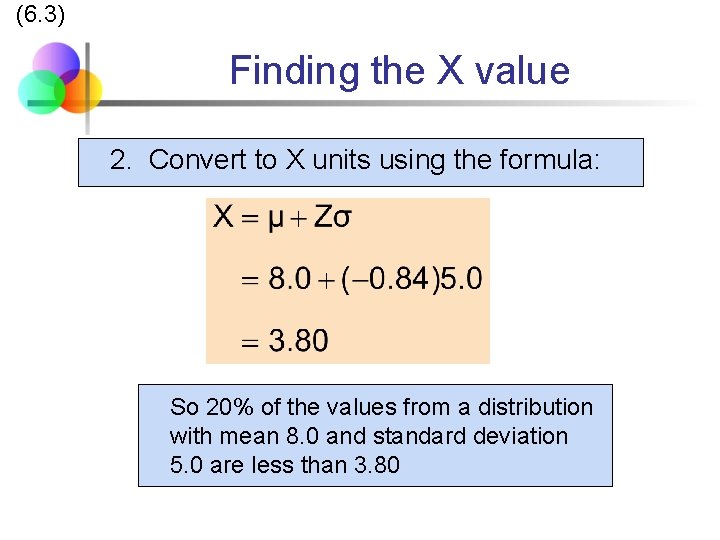
(6. 3) Finding the X value 2. Convert to X units using the formula: So 20% of the values from a distribution with mean 8. 0 and standard deviation 5. 0 are less than 3. 80

(4) Finding the X value for a Known Probability § § Find x such that P(|X|>x)=p, for some given p. Note that: |Z|<z -z 0 z
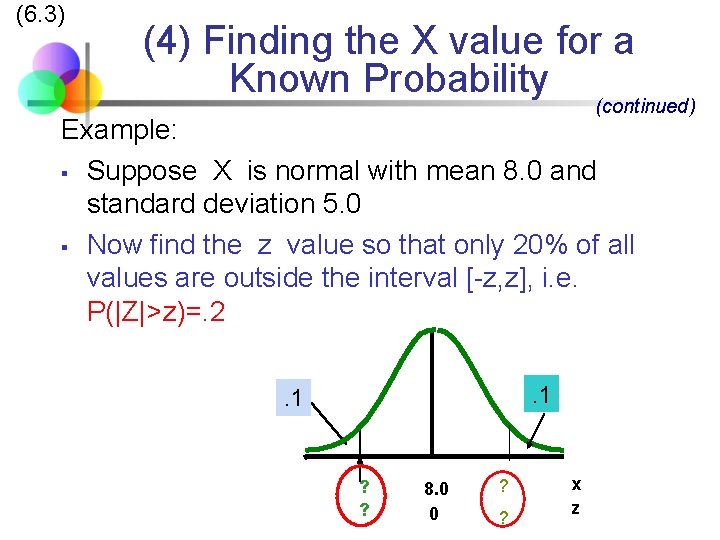
(6. 3) (4) Finding the X value for a Known Probability (continued) Example: § Suppose X is normal with mean 8. 0 and standard deviation 5. 0 § Now find the z value so that only 20% of all values are outside the interval [-z, z], i. e. P(|Z|>z)=. 2. 1 ? ? 8. 0 0 ? ? x z
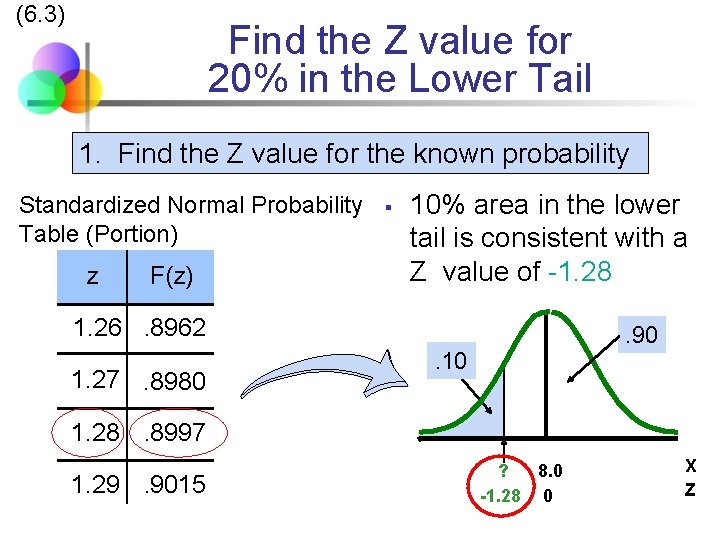
(6. 3) Find the Z value for 20% in the Lower Tail 1. Find the Z value for the known probability Standardized Normal Probability Table (Portion) z F(z) § 10% area in the lower tail is consistent with a Z value of -1. 28 1. 26. 8962 1. 27. 8980 . 90 . 10 1. 28. 8997 1. 29. 9015 ? 8. 0 -1. 28 0 X Z
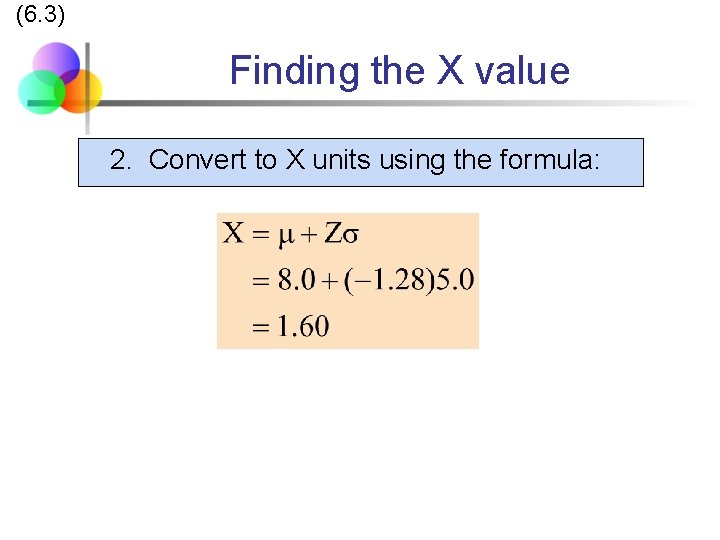
(6. 3) Finding the X value 2. Convert to X units using the formula:
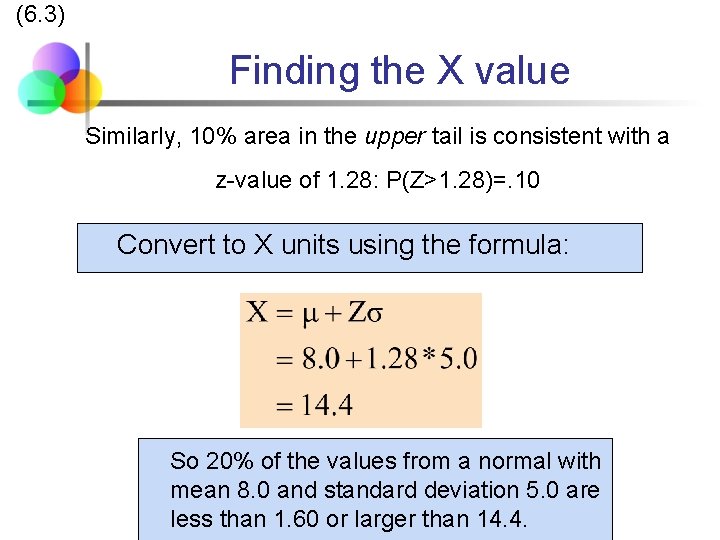
(6. 3) Finding the X value Similarly, 10% area in the upper tail is consistent with a z-value of 1. 28: P(Z>1. 28)=. 10 Convert to X units using the formula: So 20% of the values from a normal with mean 8. 0 and standard deviation 5. 0 are less than 1. 60 or larger than 14. 4.
(6. 3) Assessing Normality § § Not all continuous random variables are normally distributed It is important to evaluate how well the data is approximated by a normal distribution
(6. 3) The Normal Probability Plot § Normal probability plot § Arrange data from low to high values § Find cumulative normal probabilities for all values § § Examine a plot of the observed values vs. cumulative probabilities (with the cumulative normal probability on the vertical axis and the observed data values on the horizontal axis) Evaluate the plot for evidence of linearity
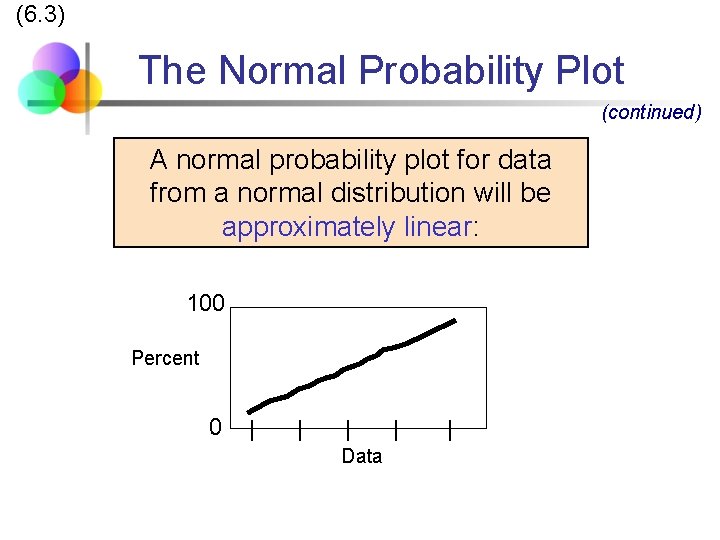
(6. 3) The Normal Probability Plot (continued) A normal probability plot for data from a normal distribution will be approximately linear: 100 Percent 0 Data
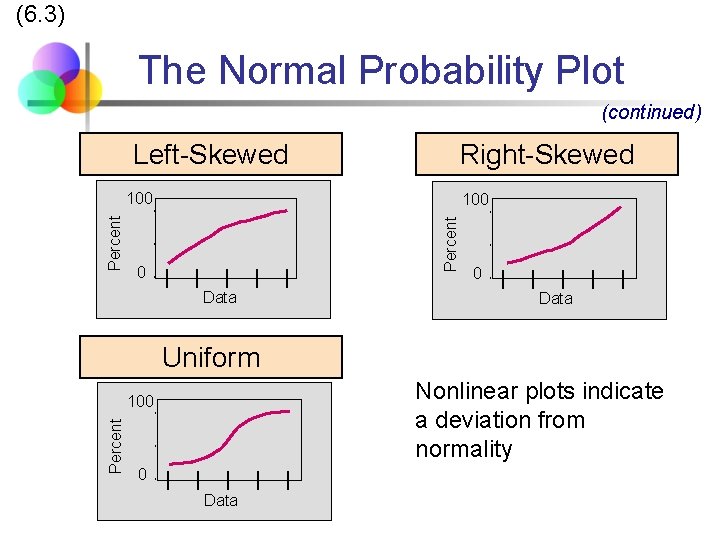
(6. 3) The Normal Probability Plot (continued) Left-Skewed Right-Skewed 100 Percent 100 0 Data Uniform Nonlinear plots indicate a deviation from normality Percent 100 0 Data
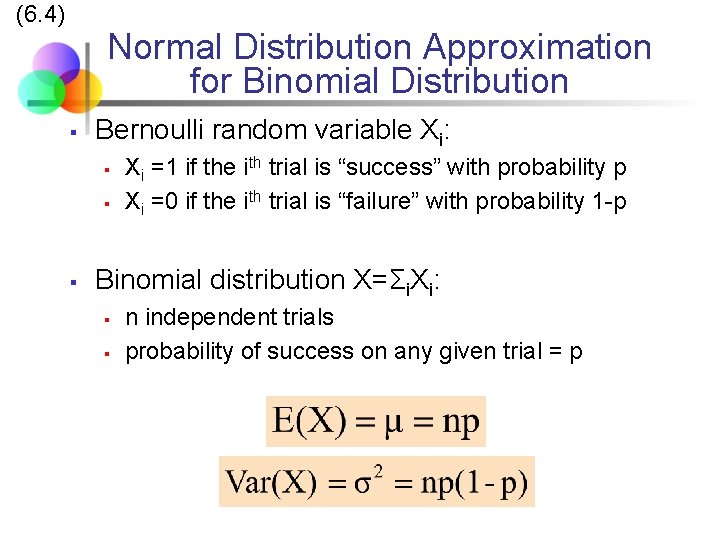
(6. 4) Normal Distribution Approximation for Binomial Distribution § Bernoulli random variable Xi: § § § Xi =1 if the ith trial is “success” with probability p Xi =0 if the ith trial is “failure” with probability 1 -p Binomial distribution X=Σi. Xi: § § n independent trials probability of success on any given trial = p
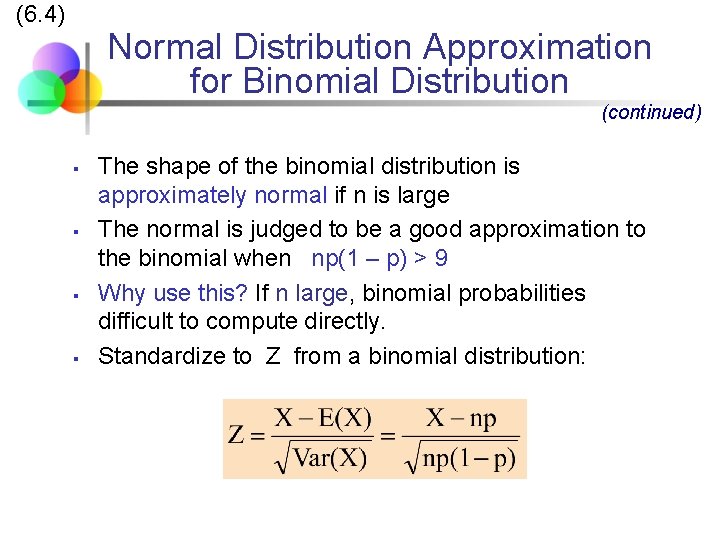
(6. 4) Normal Distribution Approximation for Binomial Distribution (continued) § § The shape of the binomial distribution is approximately normal if n is large The normal is judged to be a good approximation to the binomial when np(1 – p) > 9 Why use this? If n large, binomial probabilities difficult to compute directly. Standardize to Z from a binomial distribution:
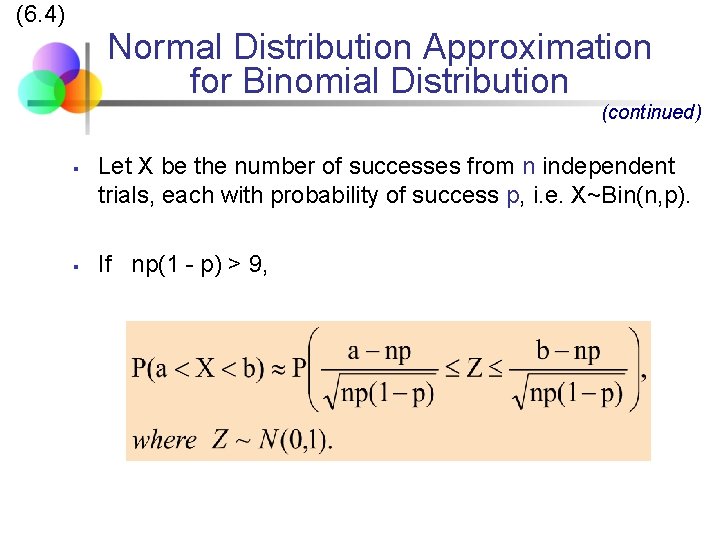
(6. 4) Normal Distribution Approximation for Binomial Distribution (continued) § § Let X be the number of successes from n independent trials, each with probability of success p, i. e. X~Bin(n, p). If np(1 - p) > 9,
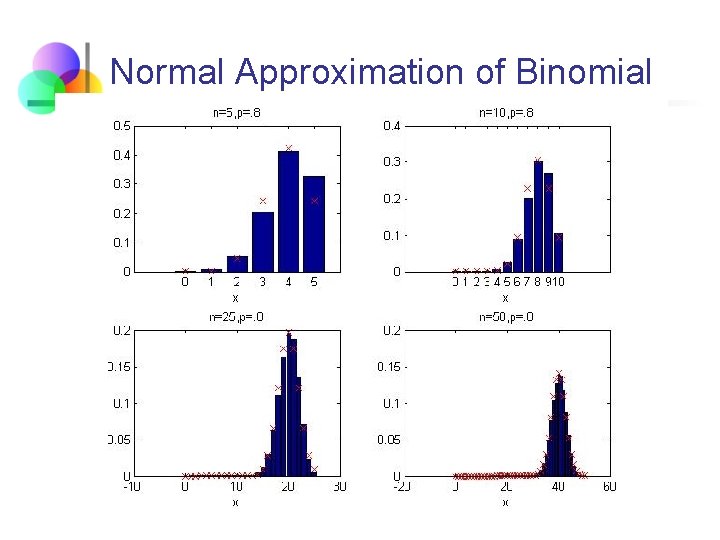
Normal Approximation of Binomial
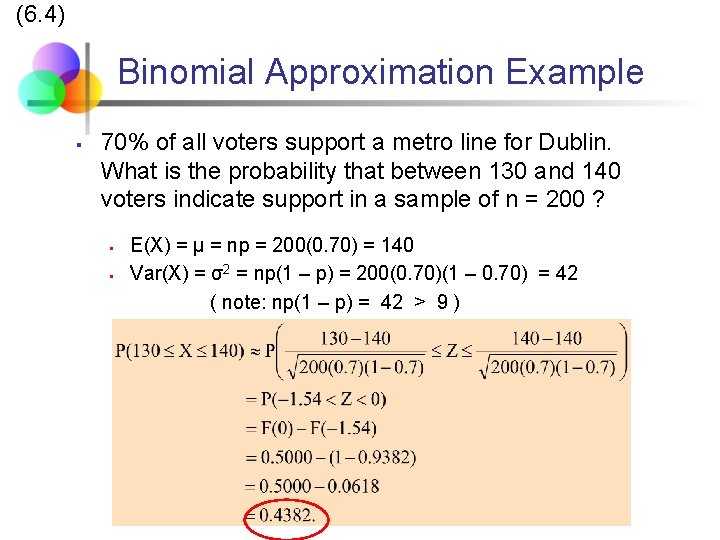
(6. 4) Binomial Approximation Example § 70% of all voters support a metro line for Dublin. What is the probability that between 130 and 140 voters indicate support in a sample of n = 200 ? § § E(X) = µ = np = 200(0. 70) = 140 Var(X) = σ2 = np(1 – p) = 200(0. 70)(1 – 0. 70) = 42 ( note: np(1 – p) = 42 > 9 )
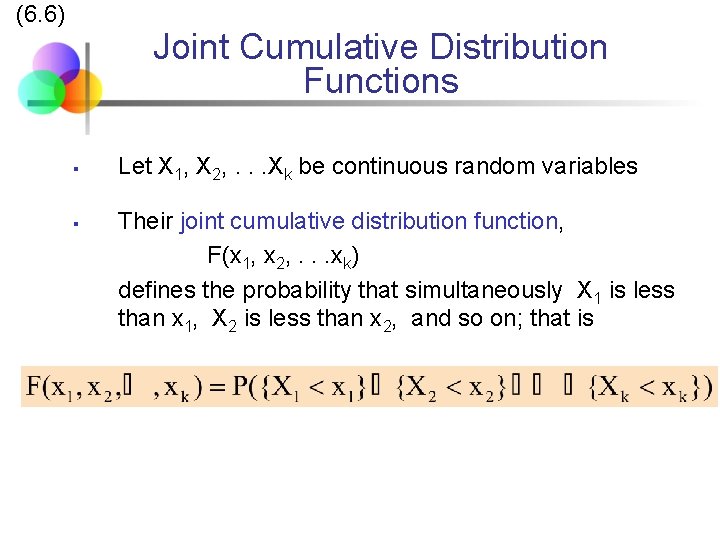
(6. 6) Joint Cumulative Distribution Functions § § Let X 1, X 2, . . . Xk be continuous random variables Their joint cumulative distribution function, F(x 1, x 2, . . . xk) defines the probability that simultaneously X 1 is less than x 1, X 2 is less than x 2, and so on; that is
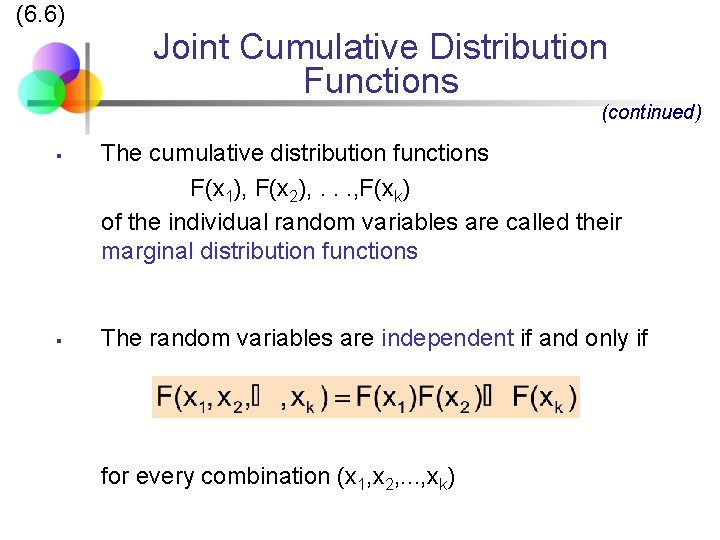
(6. 6) Joint Cumulative Distribution Functions (continued) § § The cumulative distribution functions F(x 1), F(x 2), . . . , F(xk) of the individual random variables are called their marginal distribution functions The random variables are independent if and only if for every combination (x 1, x 2, . . . , xk)
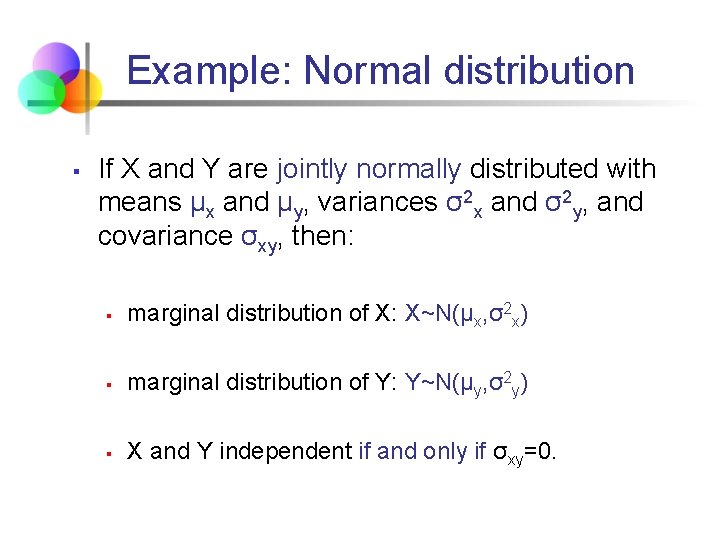
Example: Normal distribution § If X and Y are jointly normally distributed with means μx and μy, variances σ2 x and σ2 y, and covariance σxy, then: § marginal distribution of X: X~N(μx, σ2 x) § marginal distribution of Y: Y~N(μy, σ2 y) § X and Y independent if and only if σxy=0.
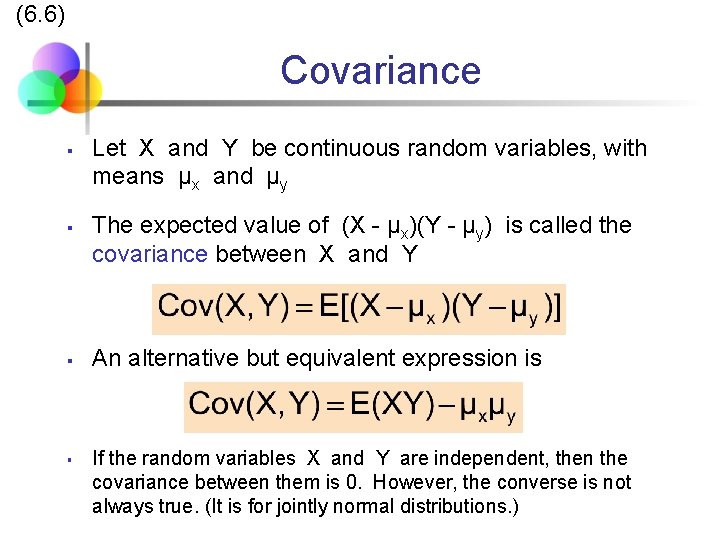
(6. 6) Covariance § § Let X and Y be continuous random variables, with means μx and μy The expected value of (X - μx)(Y - μy) is called the covariance between X and Y An alternative but equivalent expression is If the random variables X and Y are independent, then the covariance between them is 0. However, the converse is not always true. (It is for jointly normal distributions. )
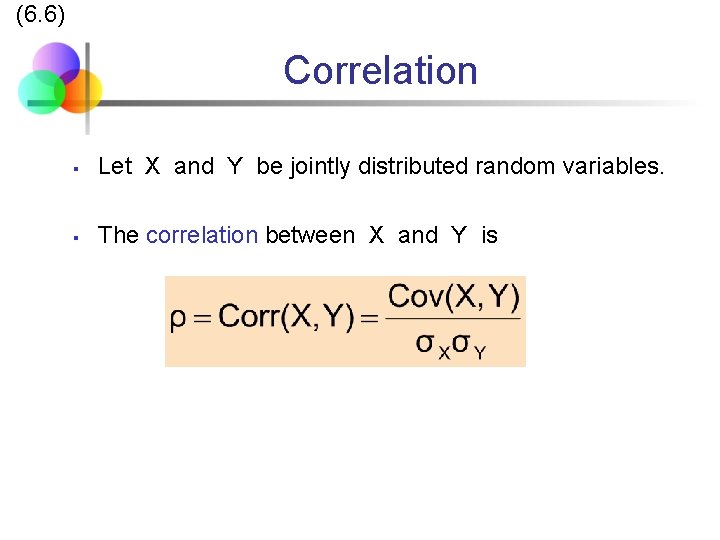
(6. 6) Correlation § Let X and Y be jointly distributed random variables. § The correlation between X and Y is
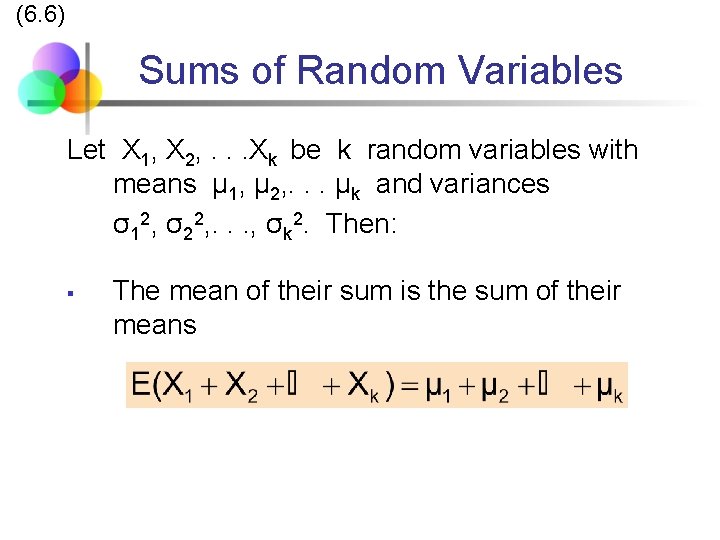
(6. 6) Sums of Random Variables Let X 1, X 2, . . . Xk be k random variables with means μ 1, μ 2, . . . μk and variances σ12, σ22, . . . , σk 2. Then: § The mean of their sum is the sum of their means

(6. 6) Sums of Random Variables (continued) Let X 1, X 2, . . . Xk be k random variables with means μ 1, μ 2, . . . μk and variances σ12, σ22, . . . , σk 2. Then: § § If the random variables are independent, then the variance of their sum is the sum of their variances However, if the random variables are not independent, the variance of their sum is
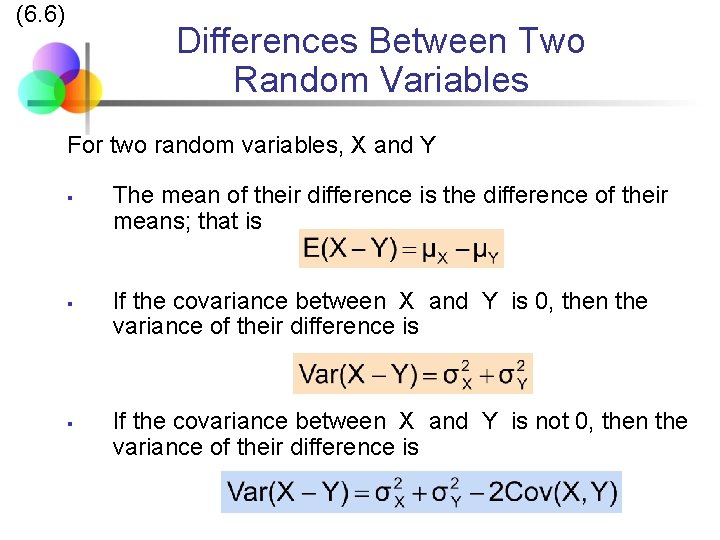
(6. 6) Differences Between Two Random Variables For two random variables, X and Y § § § The mean of their difference is the difference of their means; that is If the covariance between X and Y is 0, then the variance of their difference is If the covariance between X and Y is not 0, then the variance of their difference is
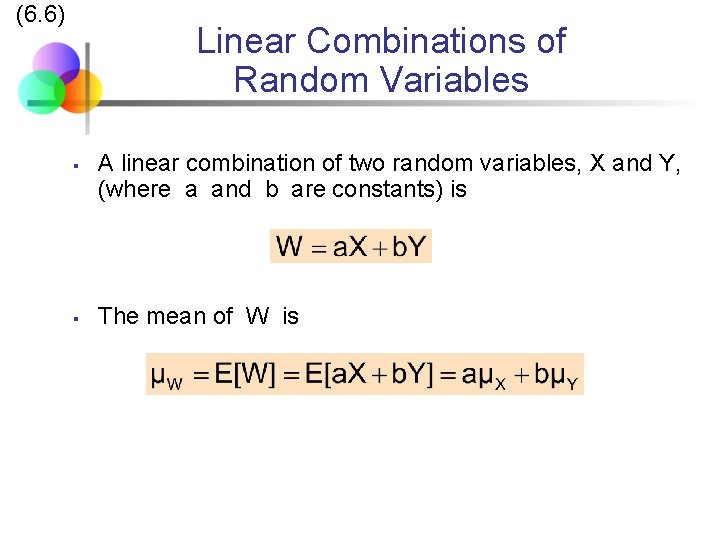
(6. 6) Linear Combinations of Random Variables § § A linear combination of two random variables, X and Y, (where a and b are constants) is The mean of W is
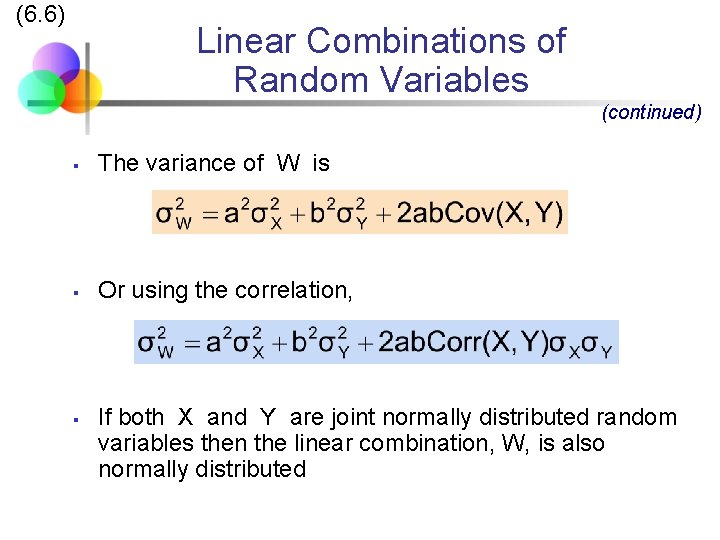
(6. 6) Linear Combinations of Random Variables (continued) § The variance of W is § Or using the correlation, § If both X and Y are joint normally distributed random variables then the linear combination, W, is also normally distributed
(6. 6) Example § § Two tasks must be performed by the same worker. § X = minutes to complete task 1; μx = 20, σx = 5 § Y = minutes to complete task 2; μy = 30, σy = 8 § X and Y are normally distributed and independent What is the mean and standard deviation of the time to complete both tasks?
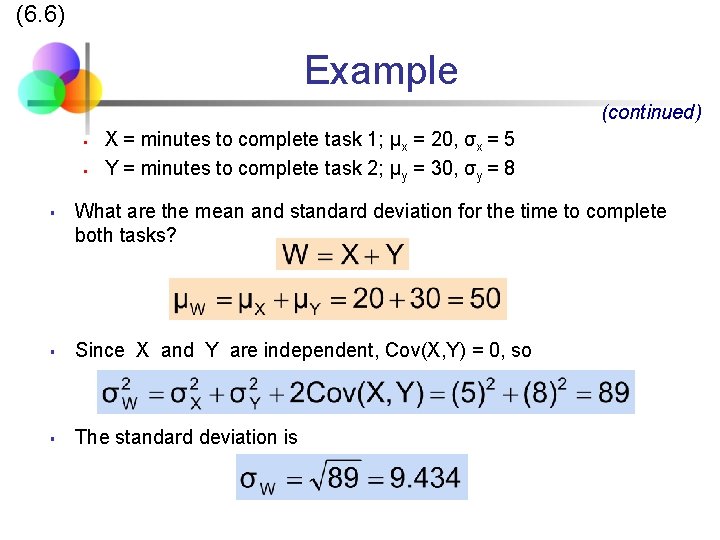
(6. 6) Example (continued) § § § X = minutes to complete task 1; μx = 20, σx = 5 Y = minutes to complete task 2; μy = 30, σy = 8 What are the mean and standard deviation for the time to complete both tasks? § Since X and Y are independent, Cov(X, Y) = 0, so § The standard deviation is
Topic Summary § § Defined continuous random variables Presented key continuous probability distributions and their properties § uniform and normal § Found probabilities using formulas and tables § Interpreted normal probability plots § Examined when to apply different distributions § § Applied the normal approximation to the binomial distribution Reviewed properties of jointly distributed continuous random variables
- Slides: 77