
Mathematics N 6 Module 1 Differentiation INTRODUCTION Differentiation
- Slides: 21
Mathematics N 6
Module 1: Differentiation INTRODUCTION Differentiation is one of the most important fundamental concepts to understand in mathematics. It allows us to find the rate of change of one variable with respect to another variable. www. futuremanagers. com
Module 1: Differentiation (continued) PARTIAL DIFFERENTIATION The partial derivative of a function of several variables is the derivative with respect to one of the variables, while the other variables are held constant. Partial derivatives are themselves functions of the variables concerned and as such, they can also be differentiated. www. futuremanagers. com
Module 1: Differentiation (continued) DIFFERENTIATION OF PARAMETRIC EQUATIONS Parametric equations are a number of equations that take into account several different independent variables or parameters in order to express coordinate points. This is done to define complex geometric objects such as surfaces and curves. www. futuremanagers. com
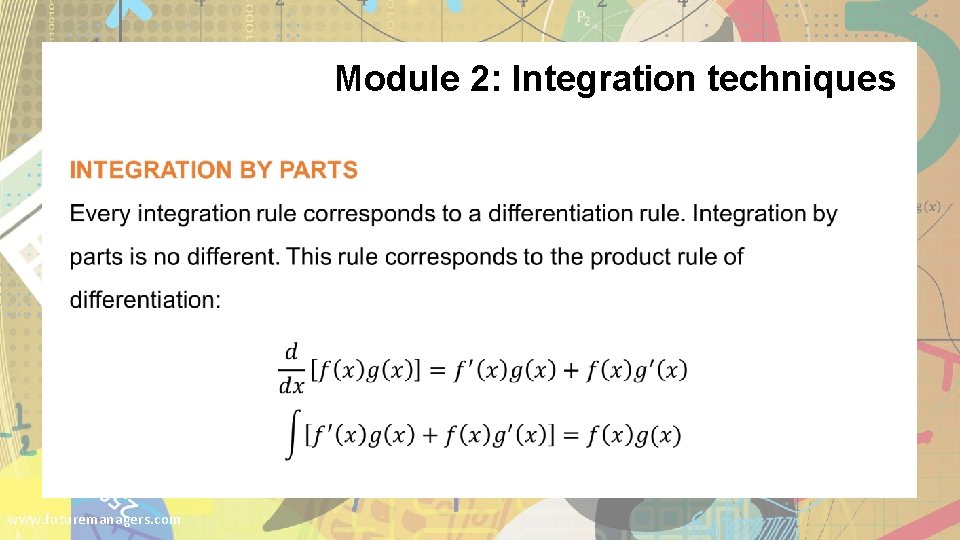
Module 2: Integration techniques www. futuremanagers. com
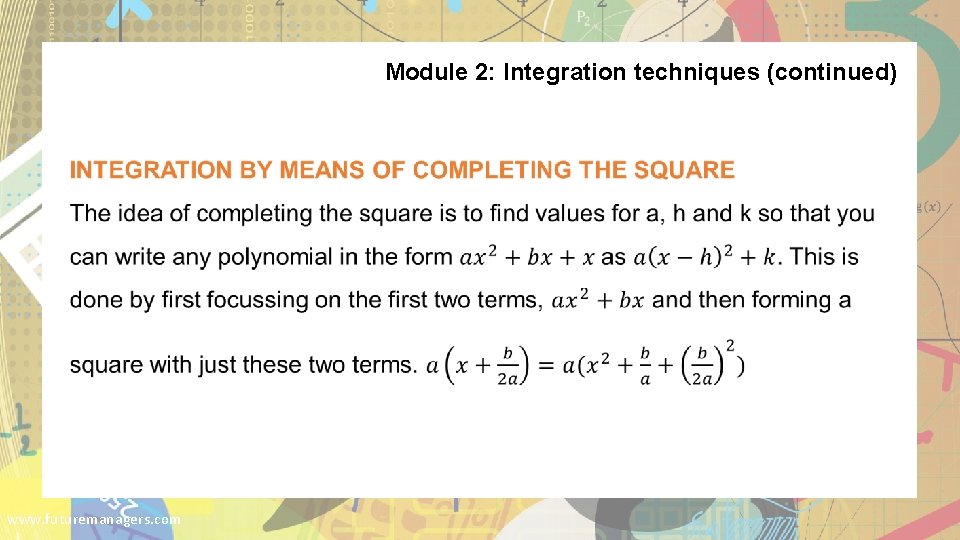
Module 2: Integration techniques (continued) www. futuremanagers. com
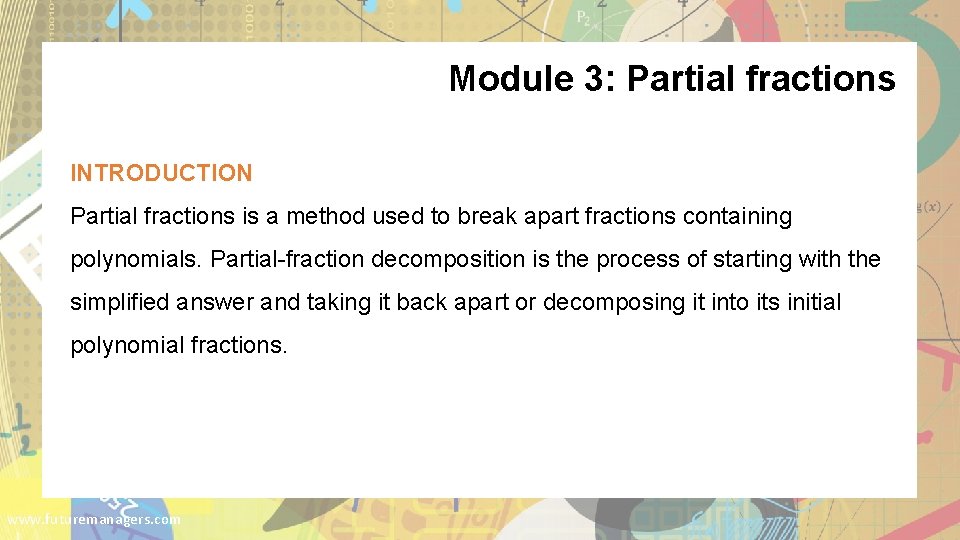
Module 3: Partial fractions INTRODUCTION Partial fractions is a method used to break apart fractions containing polynomials. Partial-fraction decomposition is the process of starting with the simplified answer and taking it back apart or decomposing it into its initial polynomial fractions. www. futuremanagers. com
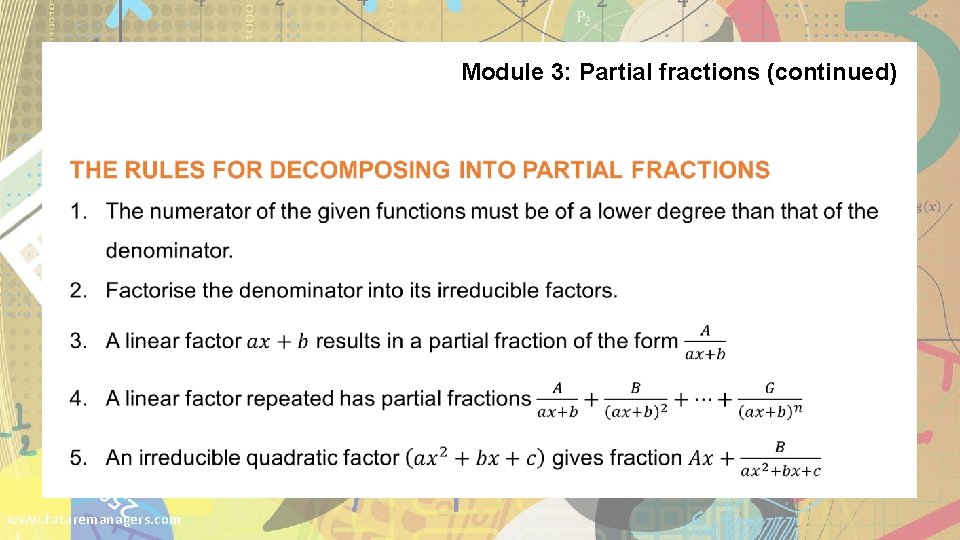
Module 3: Partial fractions (continued) www. futuremanagers. com
Module 4: Differential equations INTRODUCTION A differential equation is an equation that involves the derivatives of one or more functions. These equations can be used to model very complex systems and they are an important aspect of calculus. www. futuremanagers. com
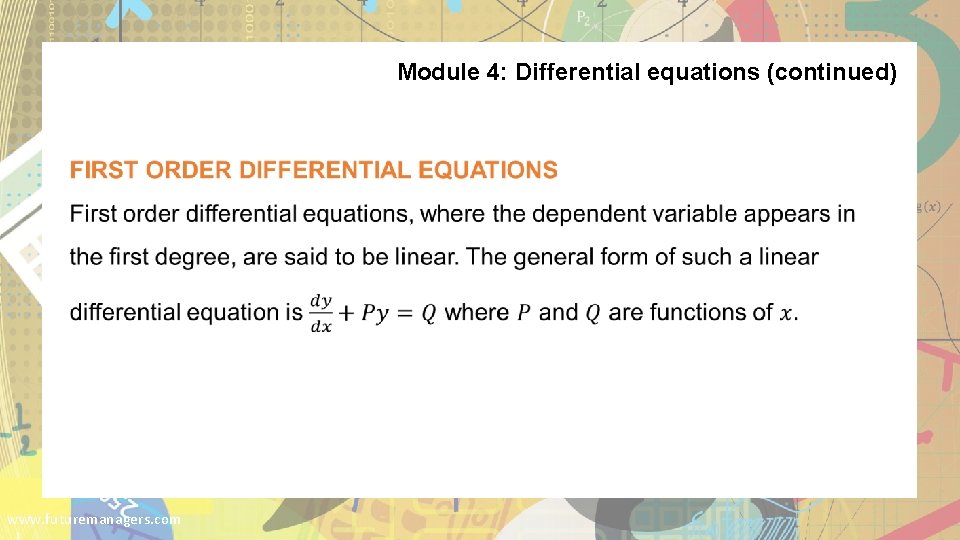
Module 4: Differential equations (continued) www. futuremanagers. com
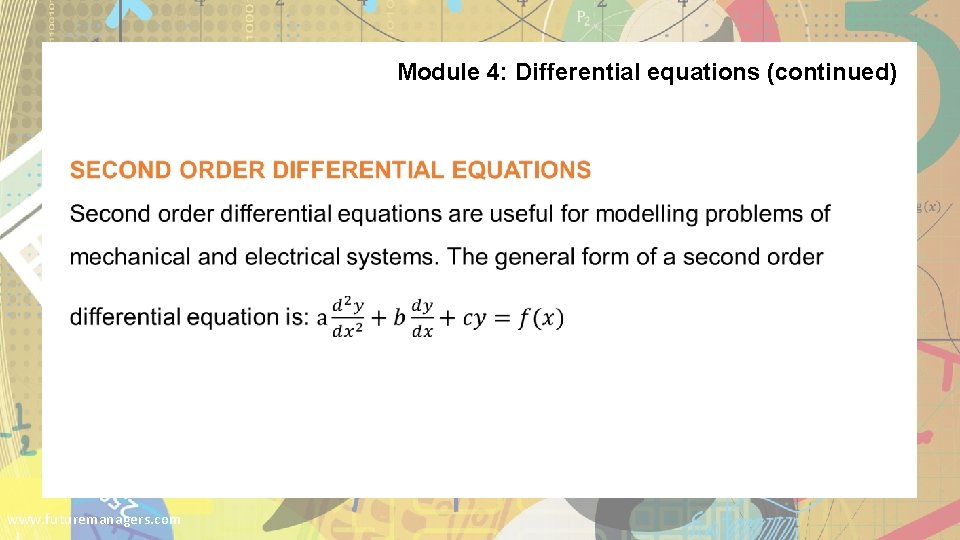
Module 4: Differential equations (continued) www. futuremanagers. com
Module 4: Differential equations (continued) NON-HOMOGENOUS DIFFERENTIAL EQUATIONS Non-homogeneous equations are the same as homogeneous differential equations, except they can have terms involving only x (and constants) on the right side. www. futuremanagers. com
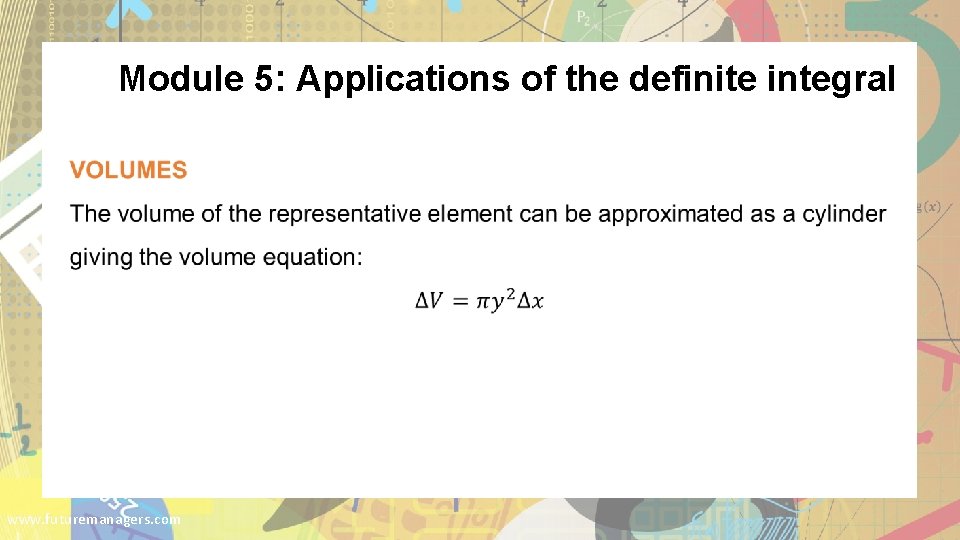
Module 5: Applications of the definite integral www. futuremanagers. com
Module 5: Applications of the definite integral (continued) CENTROIDS The geometric centre of an object; the arithmetic mean position of all points in a shape. The centroid of any shape can be found using x- and y coordinates on a cartesian plane. www. futuremanagers. com
Module 5: Applications of the definite integral (continued) CENTRES OF GRAVITY The centre of gravity is the average location of the weight of an object. Also known as the centre of mass (when the gravitational field is uniform across the object). www. futuremanagers. com
Module 5: Applications of the definite integral (continued) SECOND MOMENT OF AREA The second moment of area is a geometrical property of a specific area which describes how all the points of the area are distributed with regard to a particular axis. This concept helps to determine the resistance of an object to bending along a certain axis. This is extremely important in structural engineering and helps to identify how and where beams will bend when subjected to a load. www. futuremanagers. com
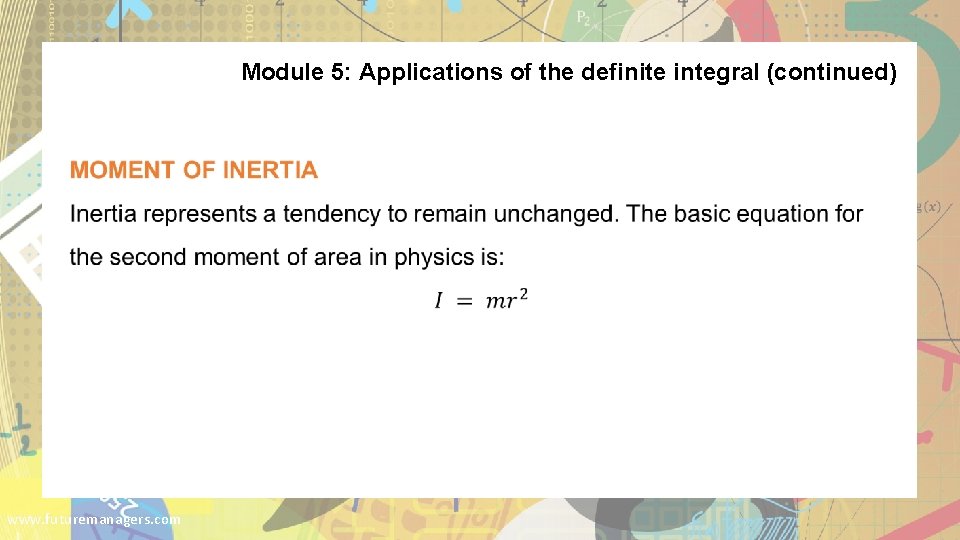
Module 5: Applications of the definite integral (continued) www. futuremanagers. com
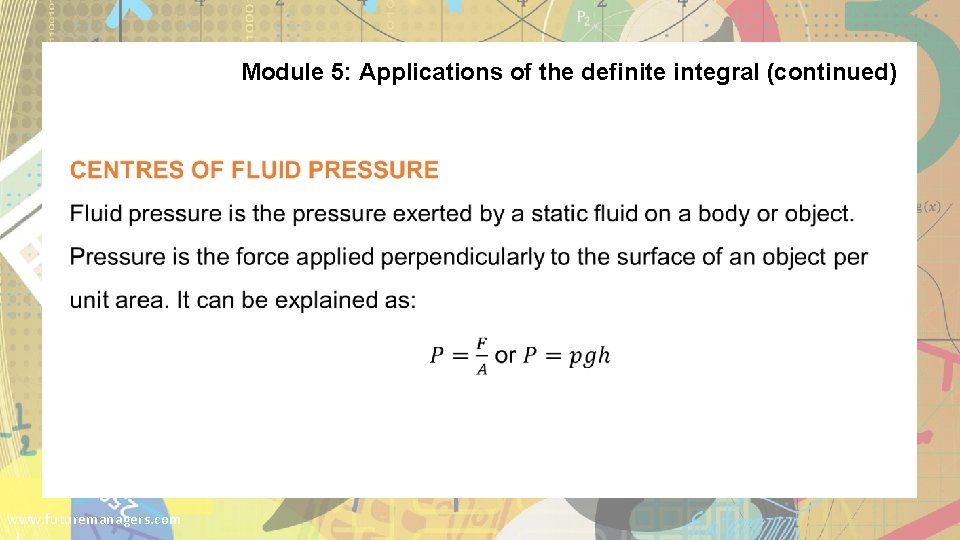
Module 5: Applications of the definite integral (continued) www. futuremanagers. com
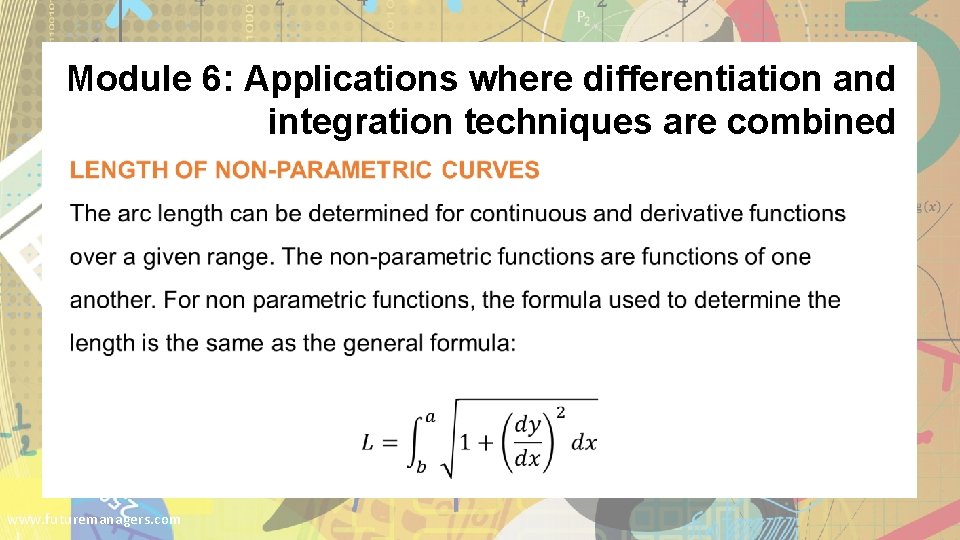
Module 6: Applications where differentiation and integration techniques are combined www. futuremanagers. com
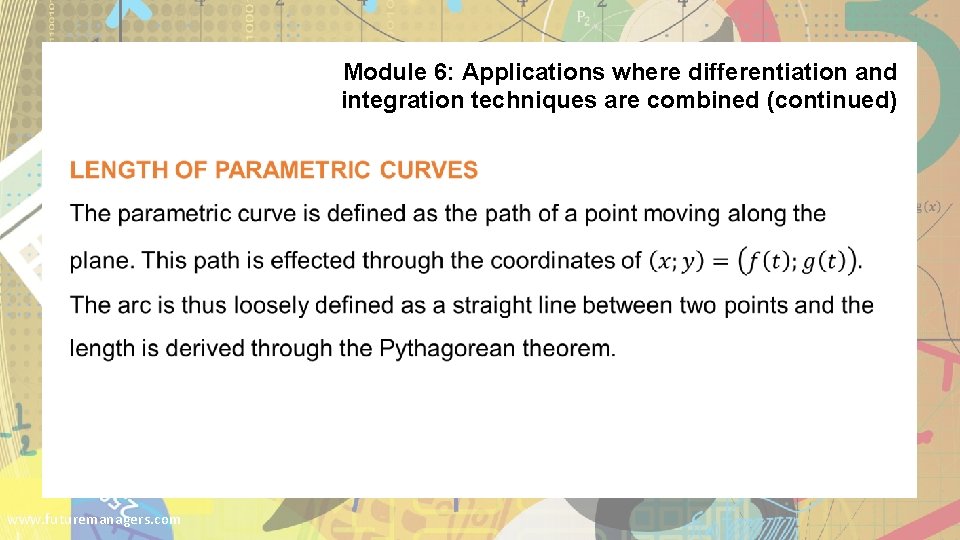
Module 6: Applications where differentiation and integration techniques are combined (continued) www. futuremanagers. com
Module 6: Applications where differentiation and integration techniques are combined (continued) SURFACES OF REVOLUTION A surface of revolution is formed when a curve is rotated about a line. Using integration and differentiation techniques, it is possible to determine the area of such curve. www. futuremanagers. com