
Mathematics Learning using ALEKS in K12 and Higher
- Slides: 1
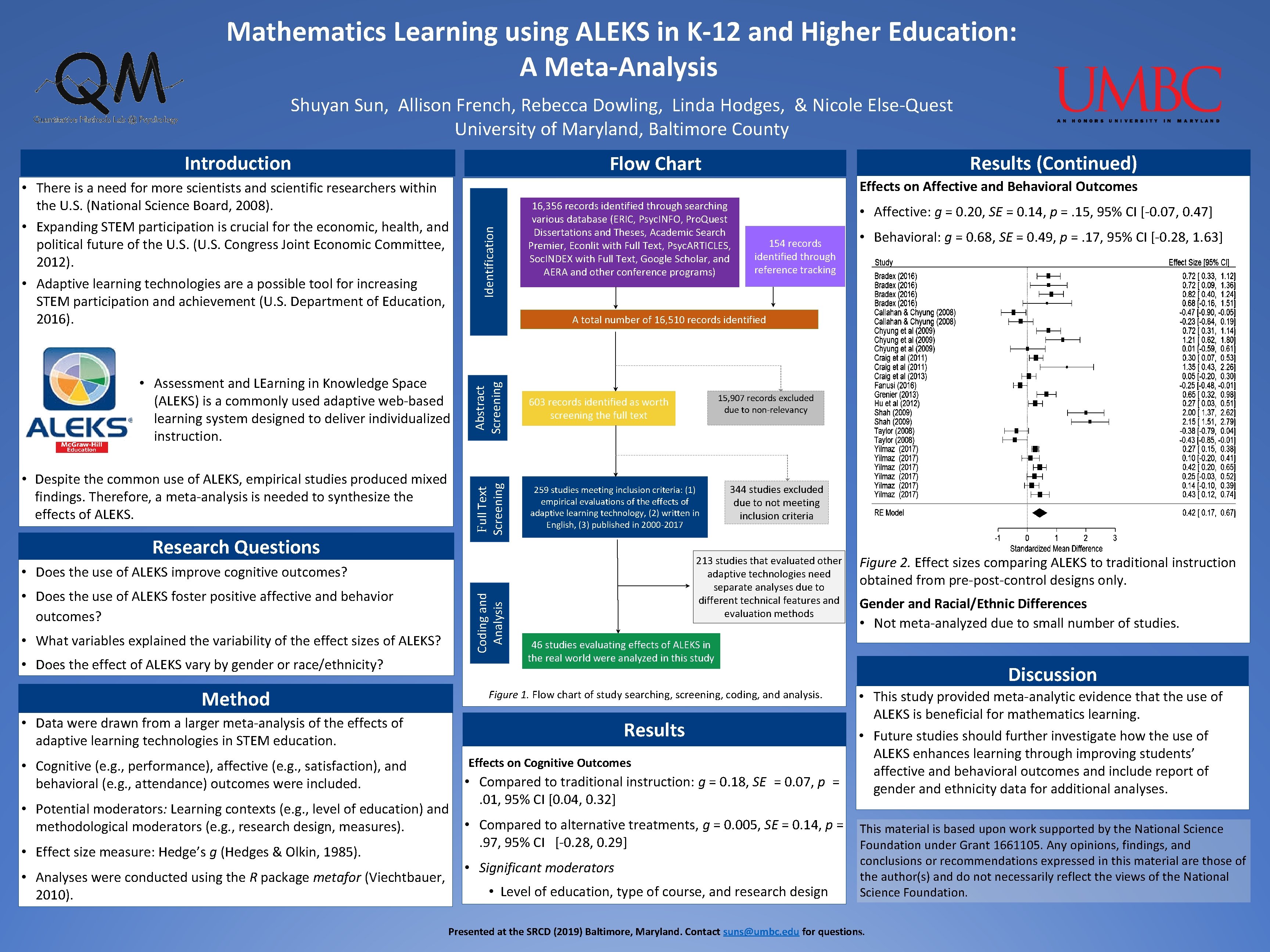
Mathematics Learning using ALEKS in K-12 and Higher Education: A Meta-Analysis Shuyan Sun, Allison French, Rebecca Dowling, Linda Hodges, & Nicole Else-Quest University of Maryland, Baltimore County Introduction • Despite the common use of ALEKS, empirical studies produced mixed findings. Therefore, a meta-analysis is needed to synthesize the effects of ALEKS. Identification 16, 356 records identified through searching various database (ERIC, Psyc. INFO, Pro. Quest Dissertations and Theses, Academic Search Premier, Econlit with Full Text, Psyc. ARTICLES, Soc. INDEX with Full Text, Google Scholar, and AERA and other conference programs) 603 records identified as worth screening the full text 259 studies meeting inclusion criteria: (1) empirical evaluations of the effects of adaptive learning technology, (2) written in English, (3) published in 2000 -2017 • Does the effect of ALEKS vary by gender or race/ethnicity? Method • Data were drawn from a larger meta-analysis of the effects of adaptive learning technologies in STEM education. • Cognitive (e. g. , performance), affective (e. g. , satisfaction), and behavioral (e. g. , attendance) outcomes were included. Coding and Analysis • What variables explained the variability of the effect sizes of ALEKS? 154 records identified through reference tracking • Behavioral: g = 0. 68, SE = 0. 49, p =. 17, 95% CI [-0. 28, 1. 63] 15, 907 records excluded due to non-relevancy 344 studies excluded due to not meeting inclusion criteria 213 studies that evaluated other adaptive technologies need separate analyses due to different technical features and evaluation methods • Does the use of ALEKS improve cognitive outcomes? • Does the use of ALEKS foster positive affective and behavior outcomes? • Affective: g = 0. 20, SE = 0. 14, p =. 15, 95% CI [-0. 07, 0. 47] A total number of 16, 510 records identified Abstract Screening • Assessment and LEarning in Knowledge Space (ALEKS) is a commonly used adaptive web-based learning system designed to deliver individualized instruction. Effects on Affective and Behavioral Outcomes Full Text Screening • There is a need for more scientists and scientific researchers within the U. S. (National Science Board, 2008). • Expanding STEM participation is crucial for the economic, health, and political future of the U. S. (U. S. Congress Joint Economic Committee, 2012). • Adaptive learning technologies are a possible tool for increasing STEM participation and achievement (U. S. Department of Education, 2016). Research Questions Results (Continued) Flow Chart Figure 2. Effect sizes comparing ALEKS to traditional instruction obtained from pre-post-control designs only. Gender and Racial/Ethnic Differences • Not meta-analyzed due to small number of studies. 46 studies evaluating effects of ALEKS in the real world were analyzed in this study Figure 1. Flow chart of study searching, screening, coding, and analysis. Results Effects on Cognitive Outcomes • Compared to traditional instruction: g = 0. 18, SE = 0. 07, p = . 01, 95% CI [0. 04, 0. 32] Discussion • This study provided meta-analytic evidence that the use of ALEKS is beneficial for mathematics learning. • Future studies should further investigate how the use of ALEKS enhances learning through improving students’ affective and behavioral outcomes and include report of gender and ethnicity data for additional analyses. • Potential moderators: Learning contexts (e. g. , level of education) and • Compared to alternative treatments, g = 0. 005, SE = 0. 14, p = This material is based upon work supported by the National Science methodological moderators (e. g. , research design, measures). . 97, 95% CI [-0. 28, 0. 29] Foundation under Grant 1661105. Any opinions, findings, and • Effect size measure: Hedge’s g (Hedges & Olkin, 1985). conclusions or recommendations expressed in this material are those of • Significant moderators the author(s) and do not necessarily reflect the views of the National • Analyses were conducted using the R package metafor (Viechtbauer, • Level of education, type of course, and research design Science Foundation. 2010). Presented at the SRCD (2019) Baltimore, Maryland. Contact suns@umbc. edu for questions.