
Mathematics Kings Worthy Primary School 1 st May
- Slides: 34
Mathematics Kings Worthy Primary School 1 st May 2012 Brenda Robertson Teaching and Learning Advisor Primary Mathematics
When you were at school…. . • How did you feel about maths? • What were your experiences of maths like? • How do you feel about maths now?
Maths in school today…. • Maths is fun! • Children are encouraged to “have a go”! • They are not afraid to be wrong – they learn from mistakes. • Maths is made purposeful and interesting
Why has maths changed? • Children used to learn “standard methods” – we were shown what to do. • If you couldn’t remember, or hadn’t understood the methods…you went wrong. • Today, we teach methods that help children to understand the underlying maths and the basic concepts involved • Children need to develop “number sense” – more insight into mathematics
Today’s techniques… • …are not just about getting the right answer – but about knowing and understanding how you got there • …are not new – many pre-date the techniques you learned • …eventually join up with the ones you did in school – but the children understand them thoroughly • …reduce the chance of mistakes being made • …build a firm foundation for understanding more complicated mathematics later on
A balanced mathematical diet… • Using and applying mathematics • Counting and understanding number • Knowing and using number facts • Calculating • Understanding shape • Measuring • Handling data
Place Value • Our number system consists of ten digits 0, 1, 2, 3, 4, 5, 6, 7, 8, 9 • The place of each digit determines its value. • For example, the “ 6” digit can represent for 6, sixty, six hundred, six thousand…it depends where we place it… 6…. 653… 6782…
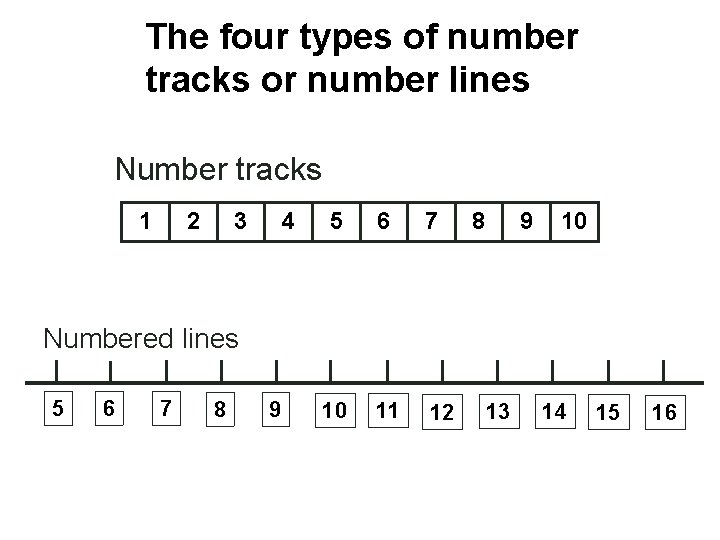
Number Lines • They help to develop an ability to order numbers, and give children a sense of where numbers sit in our number system • They allow children to draw a picture – or model – in their heads when calculating • They allow us to see the strategy being used – and the refinements that occur. • Can be used in a range of aspects of mathematics – numbers and the number system, fractions, decimals, percentages, addition, subtraction, multiplication, division, measures, handling data
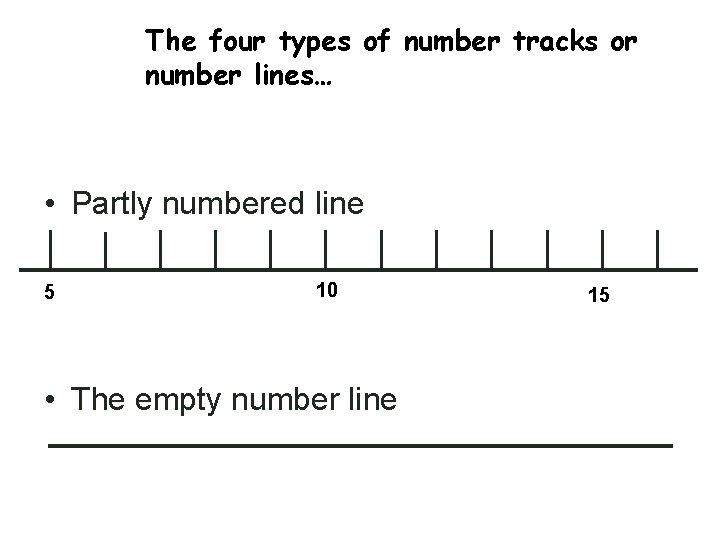
The four types of number tracks or number lines Number tracks 1 2 3 4 5 6 7 10 11 12 8 9 10 Numbered lines 5 6 7 8 9 13 14 15 16
The four types of number tracks or number lines… • Partly numbered line 5 10 • The empty number line 15
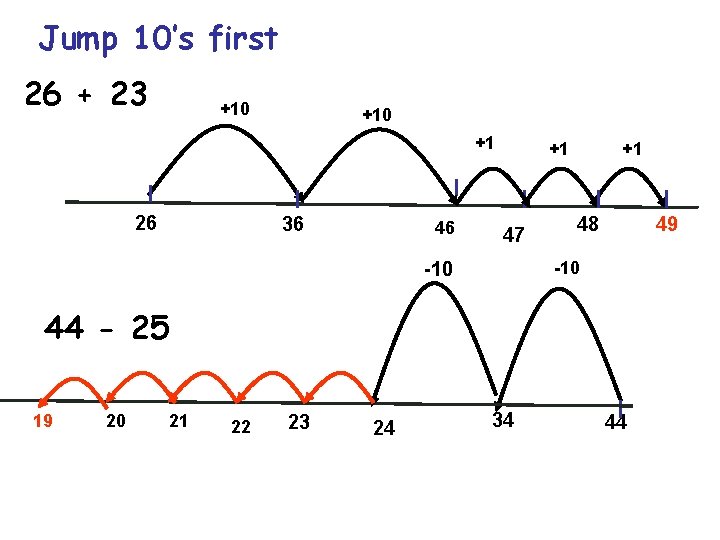
Jump 10’s first 26 + 23 +10 +1 26 36 46 +1 47 +1 48 49 -10 44 - 25 19 20 21 22 23 24 34 44
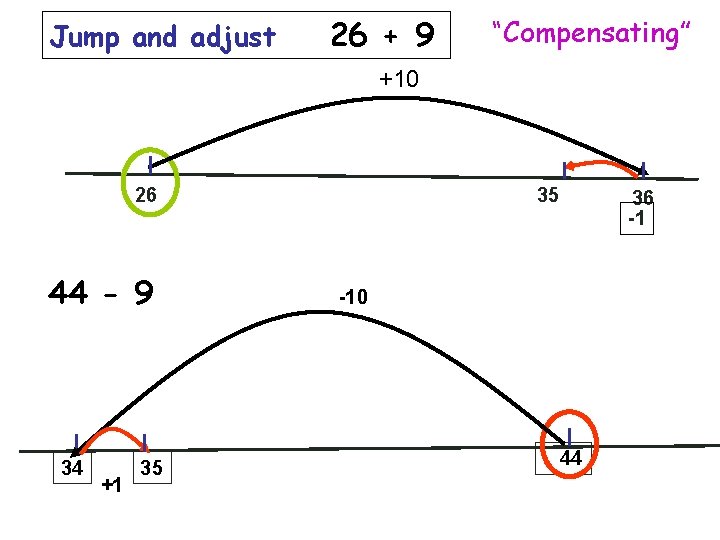
Jump and adjust 26 + 9 “Compensating” +10 26 44 - 9 34 +1 35 35 36 -1 -10 44
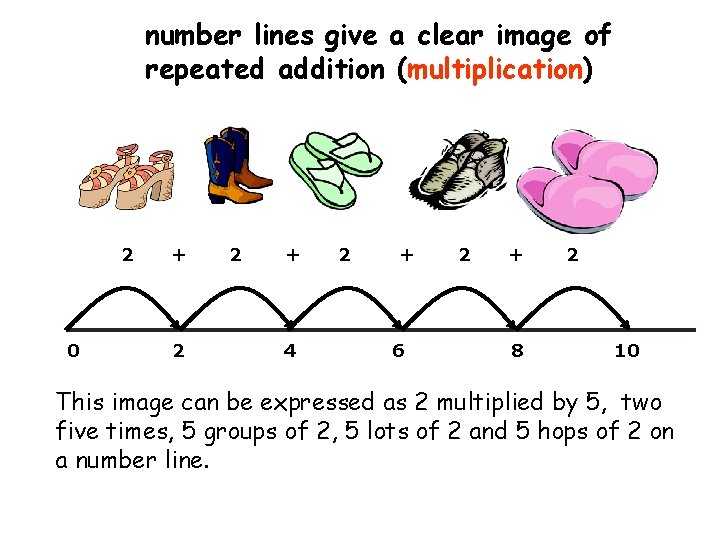
number lines give a clear image of repeated addition (multiplication) 2 0 + 2 2 + 4 2 + 6 2 + 8 2 10 This image can be expressed as 2 multiplied by 5, two five times, 5 groups of 2, 5 lots of 2 and 5 hops of 2 on a number line.
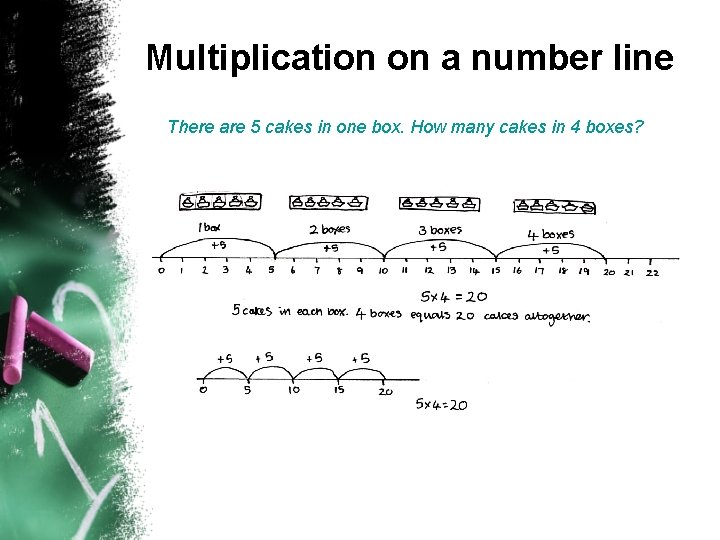
Multiplication on a number line There are 5 cakes in one box. How many cakes in 4 boxes?
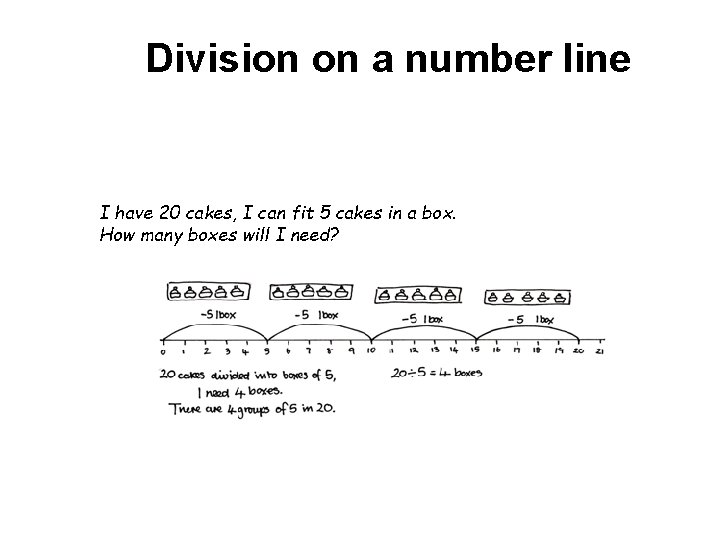
Division on a number line I have 20 cakes, I can fit 5 cakes in a box. How many boxes will I need?
Mental skills and strategies We constantly draw upon mental strategies that we know and have internalized when we carry out calculations • • • doubling adding multiples of ten Partitioning compensating applying known facts Children need to learn and understand these strategies – and know how and when to apply them.
Partitioning • This means breaking up numbers into smaller numbers • All numbers can be partitioned in many different ways • If children understand about partitioning numbers in different ways, they will calculate more efficiently – and with understanding.
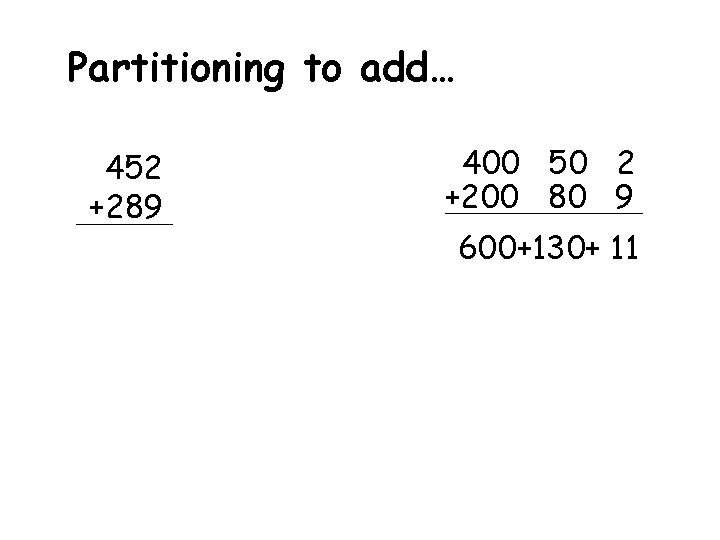
Partitioning to add… 452 +289 400 50 2 +200 80 9 600+130+ 11
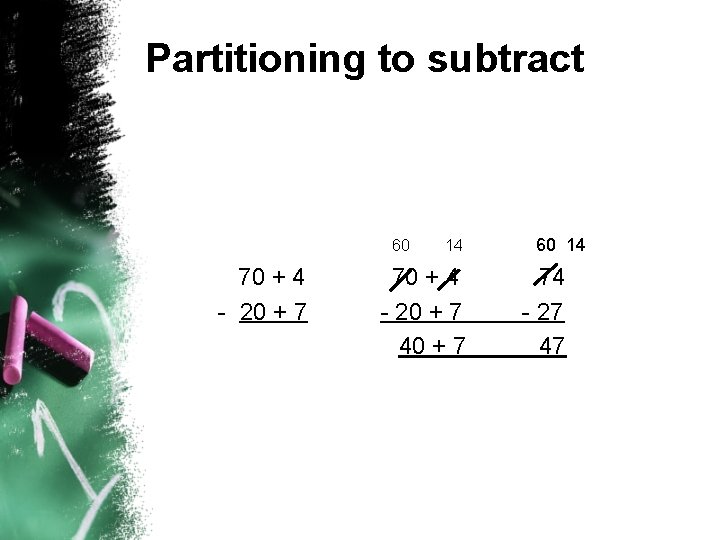
Partitioning to subtract 60 70 + 4 - 20 + 7 14 70 + 4 - 20 + 7 40 + 7 60 14 74 - 27 47
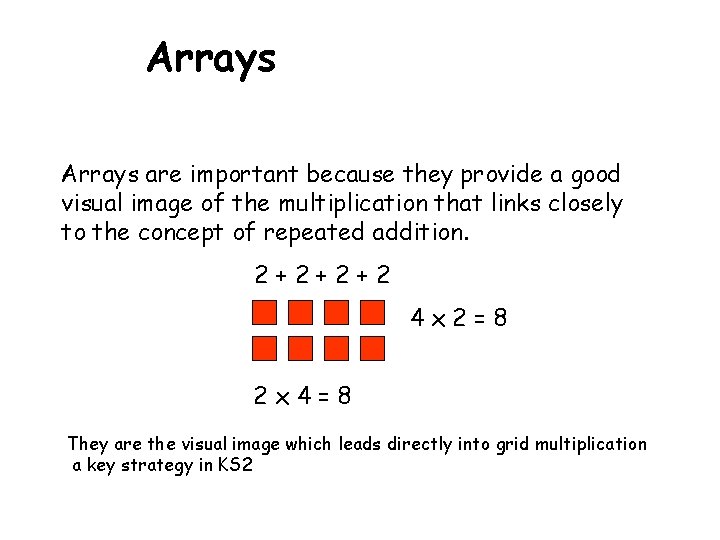
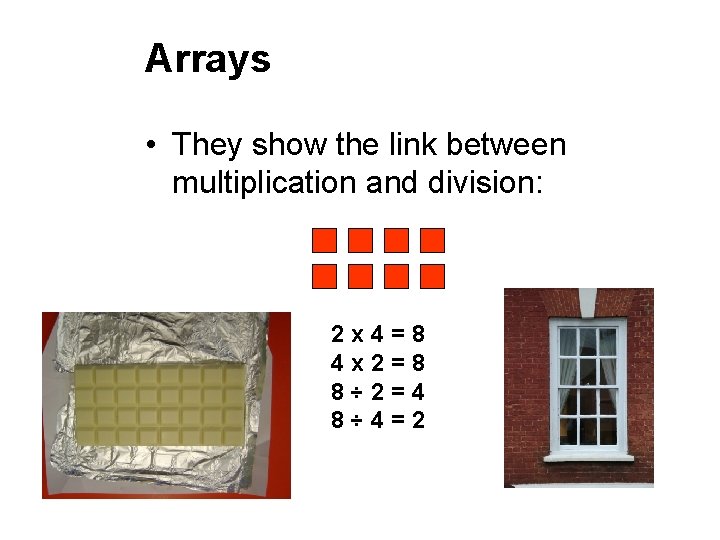
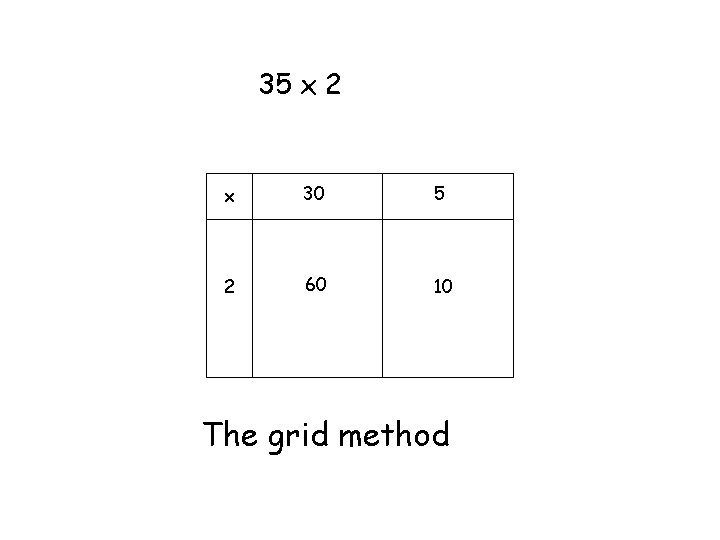
Arrays are important because they provide a good visual image of the multiplication that links closely to the concept of repeated addition. 2+2+2+2 4 x 2=8 2 x 4=8 They are the visual image which leads directly into grid multiplication a key strategy in KS 2
Arrays • They show the link between multiplication and division: 2 x 4=8 4 x 2=8 8÷ 2=4 8÷ 4=2
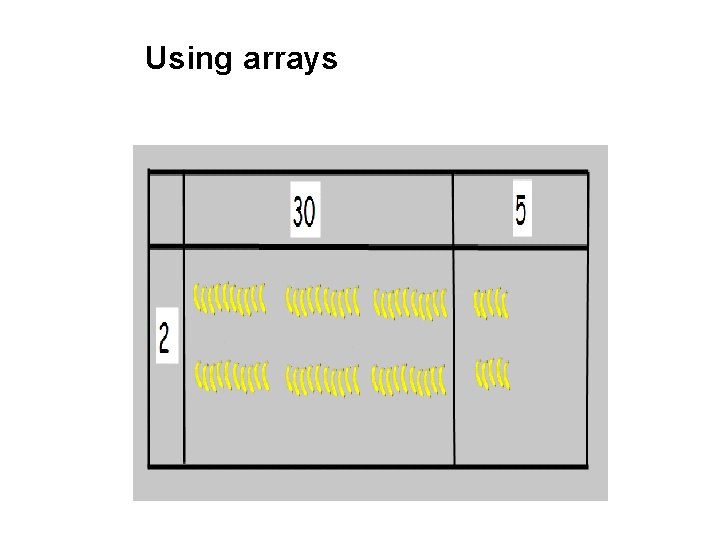
Using arrays
35 x 2 x 30 5 2 60 10 The grid method
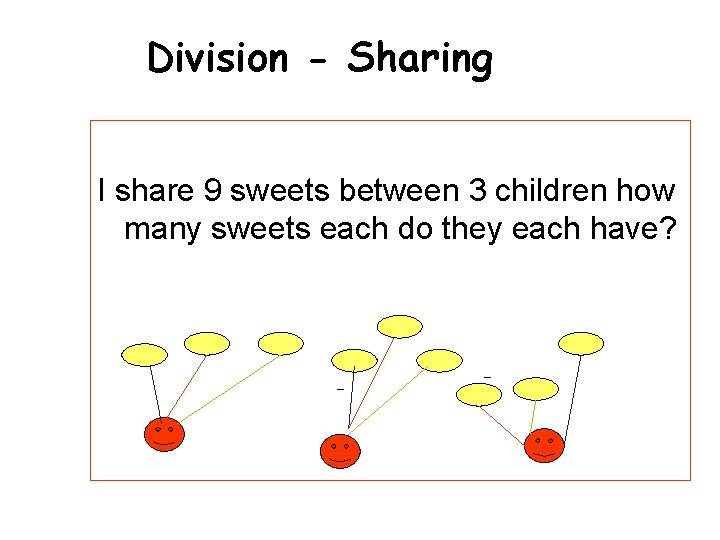
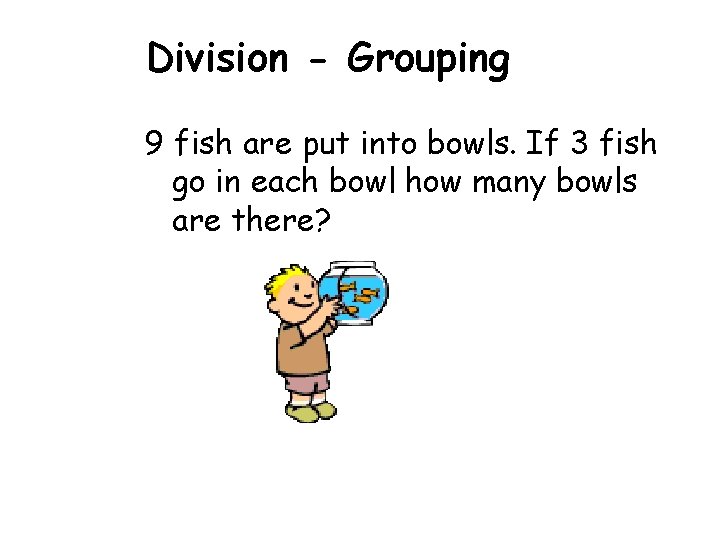
Division… “grouping” or “sharing”? • I have 48 toffees and I want to share them equally into 8 bags. How many toffees will be in each bag? • I have 48 toffees and I want to put them into bags of 8. How many bags do I need?
Division - Sharing I share 9 sweets between 3 children how many sweets each do they each have?
Division - Grouping 9 fish are put into bowls. If 3 fish go in each bowl how many bowls are there?
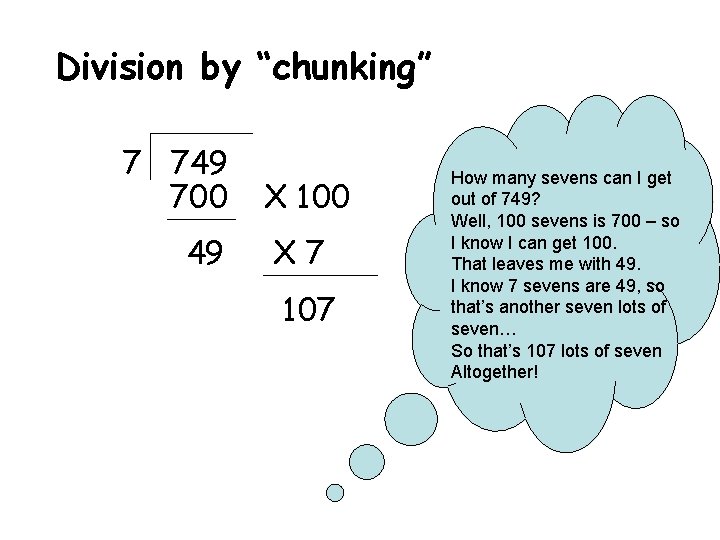
Division – formal written methods Let’s look at an example… Eleanor wanted to cut a piece of ribbon that measured 749 cm long into 7 equal pieces. How long would each piece be?
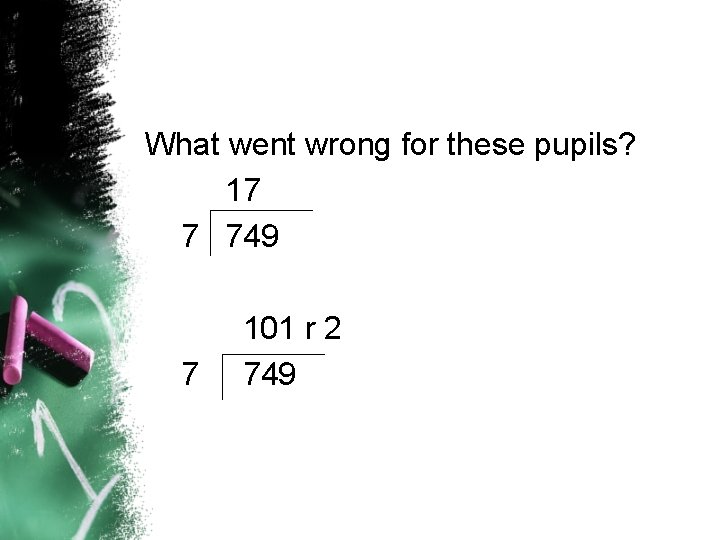
What went wrong for these pupils? 17 7 749 7 101 r 2 749
Division by “chunking” 7 749 700 49 X 100 X 7 107 How many sevens can I get out of 749? Well, 100 sevens is 700 – so I know I can get 100. That leaves me with 49. I know 7 sevens are 49, so that’s another seven lots of seven… So that’s 107 lots of seven Altogether!
Division by “chunking” or “grouping” • This is an extended method that allows children to use what they know to solve the problem – and to develop understanding about the process • Large “chunks” or “groups” are being subtracted from the number being divided into. • Most children will eventually understand how long division works if they refine and use this extended method first.
• Resources, models and images help children to visualise and understand mathematical concepts • They build up – and remember - the mental picture in their minds • They should be available throughout the primary years. Children will rely on them less and less
When tackling a mathematical problem, children will ask themselves… • What do I know about these numbers? • Can I do this in my head? • Do I know the approximate size of the answer? • If I can’t do it all in my head, what do I need to write down to help me?
“Above all – have fun! Children often say that maths is their favourite subject and they get quicker and better at it when they understand what they are doing. There’s no need for you to “teach” your child: you help by helping them to explain their thinking and their understanding” From “Count on me – 200 ways to help with mathematics”
• “It’s the school’s job to provide the structured learning…. Your role is to nurture and support your child’s mathematical knowledge away from school, to bring it into their real lives and, most important of all, to turn it into an exciting adventure” From “Maths for Mums and Dads” – Rob Eastaway and Mike Askew