
Mathematics in the EYFS Aims To give you


- Slides: 25
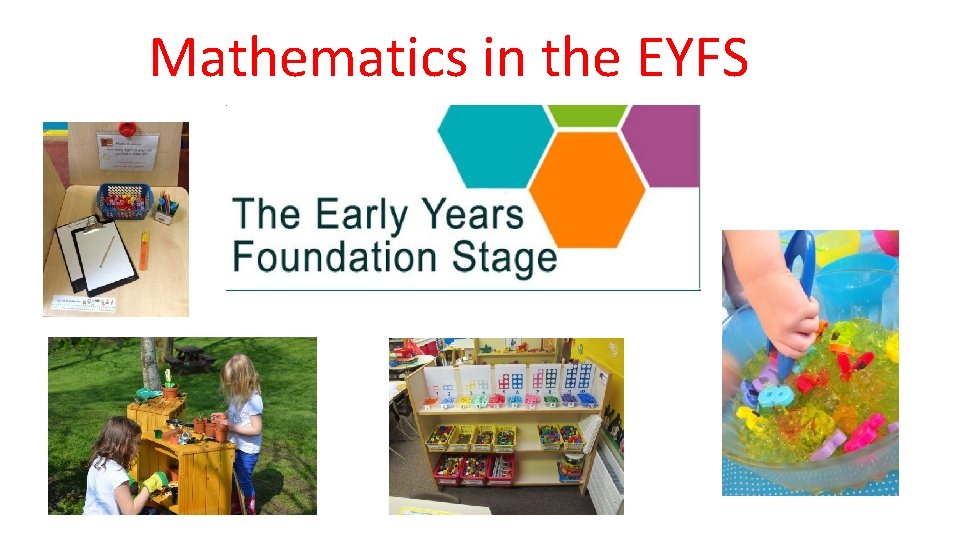
Mathematics in the EYFS
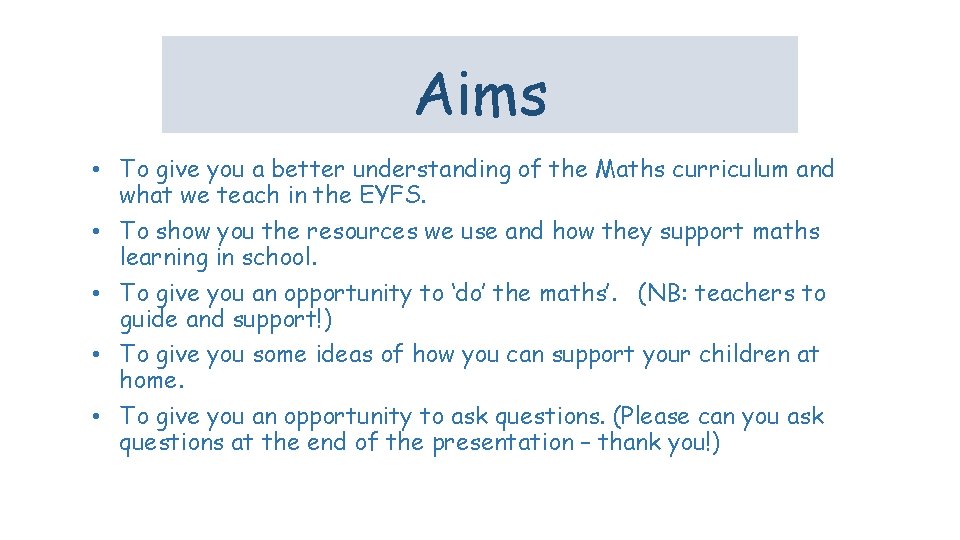
Aims • To give you a better understanding of the Maths curriculum and what we teach in the EYFS. • To show you the resources we use and how they support maths learning in school. • To give you an opportunity to ‘do’ the maths’. (NB: teachers to guide and support!) • To give you some ideas of how you can support your children at home. • To give you an opportunity to ask questions. (Please can you ask questions at the end of the presentation – thank you!)
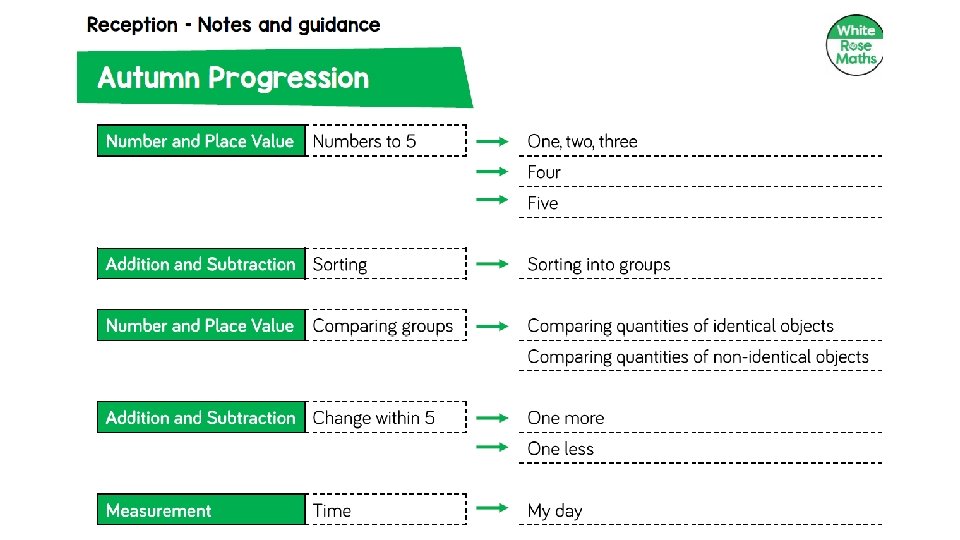
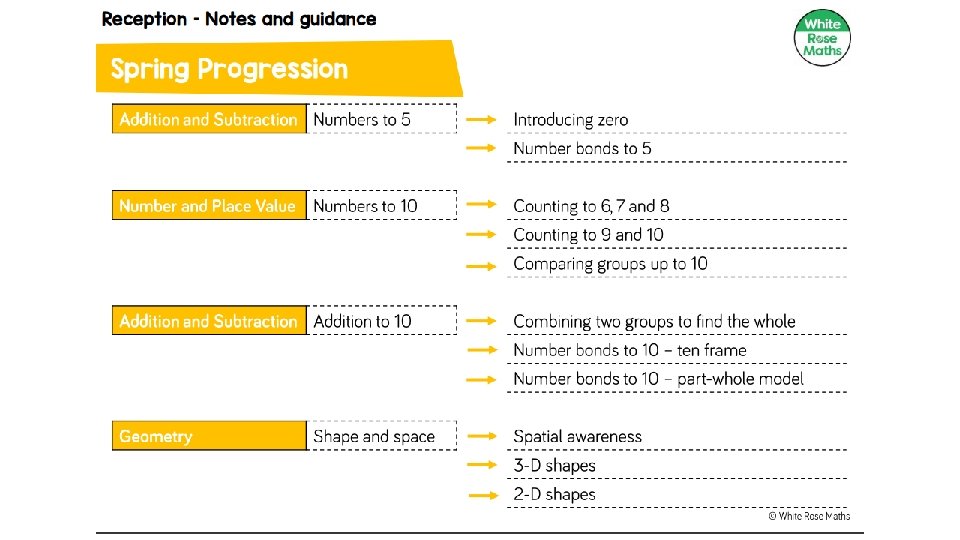
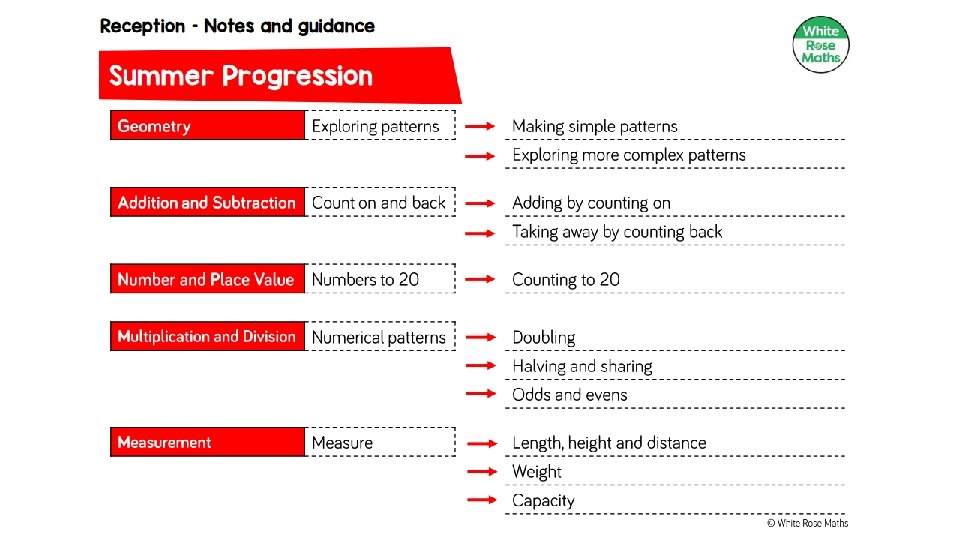
Our curriculum https: //whiterosemaths. com/resources/schemes-of-learning/reception-sol/ • At Chandag Infant School, we follow White Rose Maths schemes of learning for maths teaching which covers our Statutory Framework. We also supplement our planning with other schemes and resources, such as NRICH and Twinkl to deliver a broad and balanced curriculum, with plenty of challenge. • We teach discrete maths carpet times to teach direct knowledge and to excite learners to explore maths concepts in their play. • We strongly believe that ‘maths is everywhere’ and our planning is childled, which allows your child to follow their own mathematical curiosities and interests. As a whole school, we believe in ‘Creating Curiosity’ so children WANT to do maths. We are always seeking ‘in the moment’ opportunities for maths teaching and learning.
“But how do children do maths at Chandag Infant School? ” At Chandag Infant School, we believe maths should be fun and ‘hands-on’. We believe children are naturally enquiring and it is our role to provide opportunities for children to explore, investigate, problem-solve, reason and have plenty of opportunities to talk about maths.
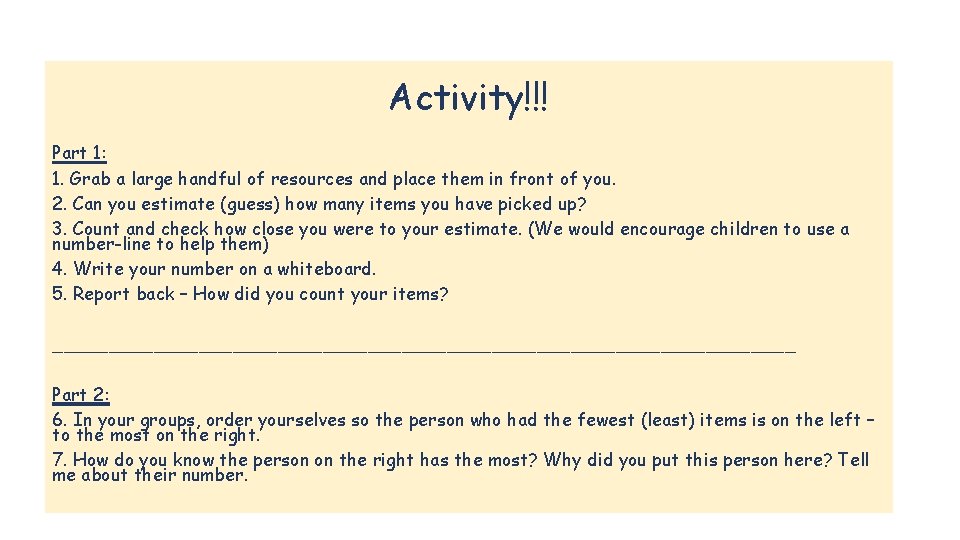
Activity!!! Part 1: 1. Grab a large handful of resources and place them in front of you. 2. Can you estimate (guess) how many items you have picked up? 3. Count and check how close you were to your estimate. (We would encourage children to use a number-line to help them) 4. Write your number on a whiteboard. 5. Report back – How did you count your items? _________________________________ Part 2: 6. In your groups, order yourselves so the person who had the fewest (least) items is on the left – to the most on the right. 7. How do you know the person on the right has the most? Why did you put this person here? Tell me about their number.
“What resources do you use to teach maths at Chandag Infant School? ” At Chandag Infant School, we believe children should be able to ‘see the maths’. We believe children need plenty of opportunities to make connections between numbers and operations and to see, and then talk about, their discoveries and the patterns that emerge. A range of resources (and structures) allow children to ‘see the maths’.
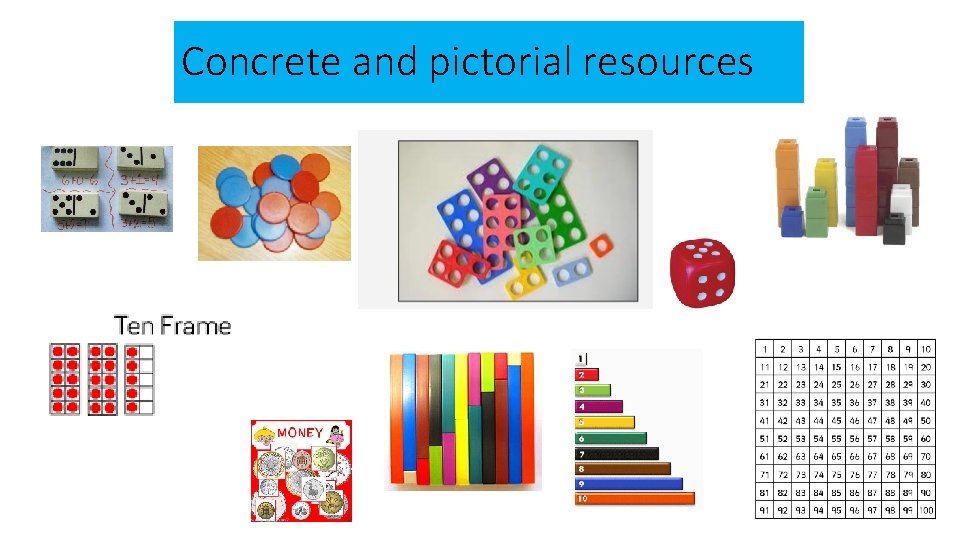
Concrete and pictorial resources
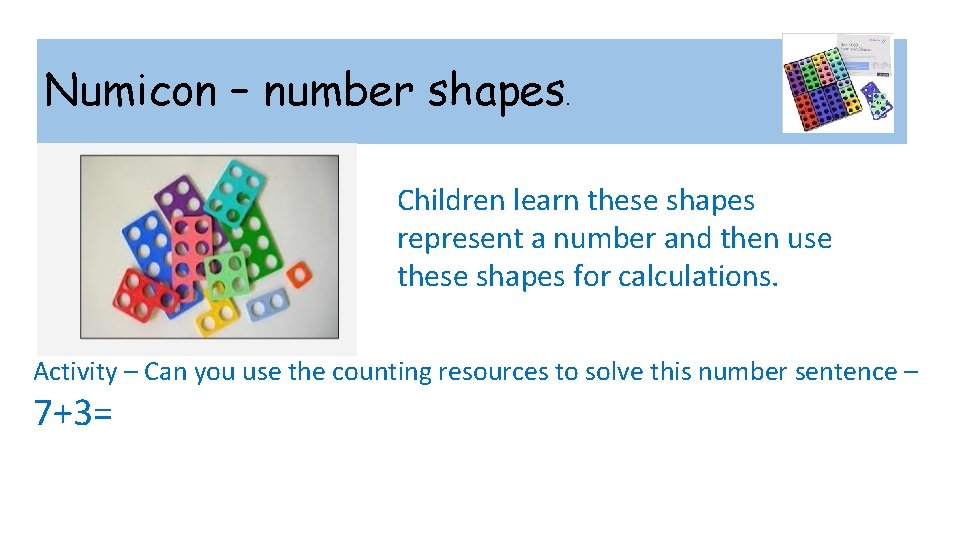
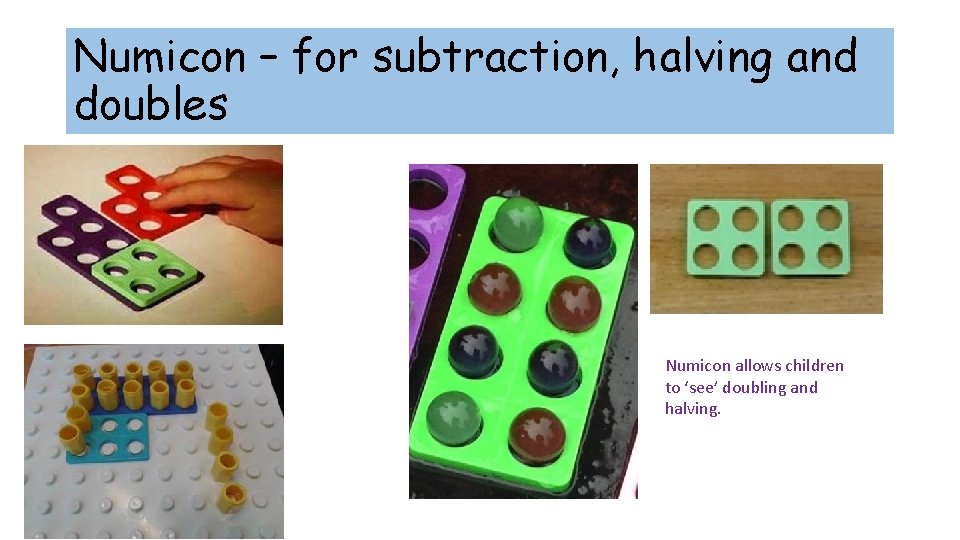
Numicon – number shapes. Children learn these shapes represent a number and then use these shapes for calculations. Activity – Can you use the counting resources to solve this number sentence – 7+3=
Numicon – for subtraction, halving and doubles Numicon allows children to ‘see’ doubling and halving.
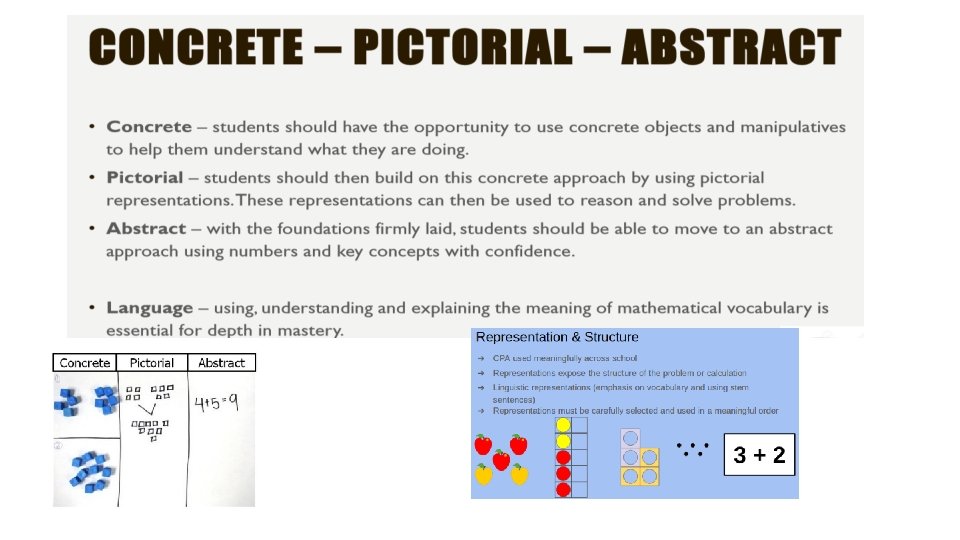
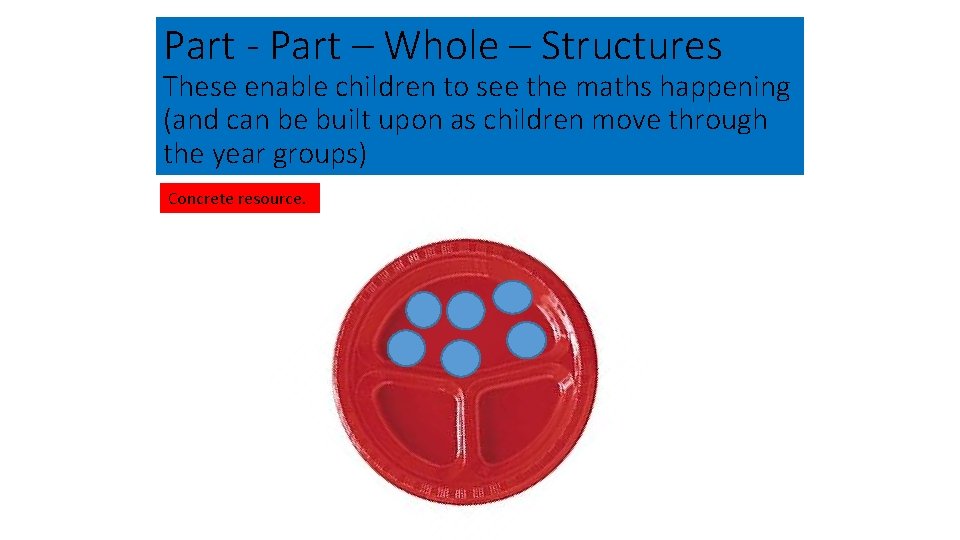
Part - Part – Whole – Structures These enable children to see the maths happening (and can be built upon as children move through the year groups) Concrete resource.
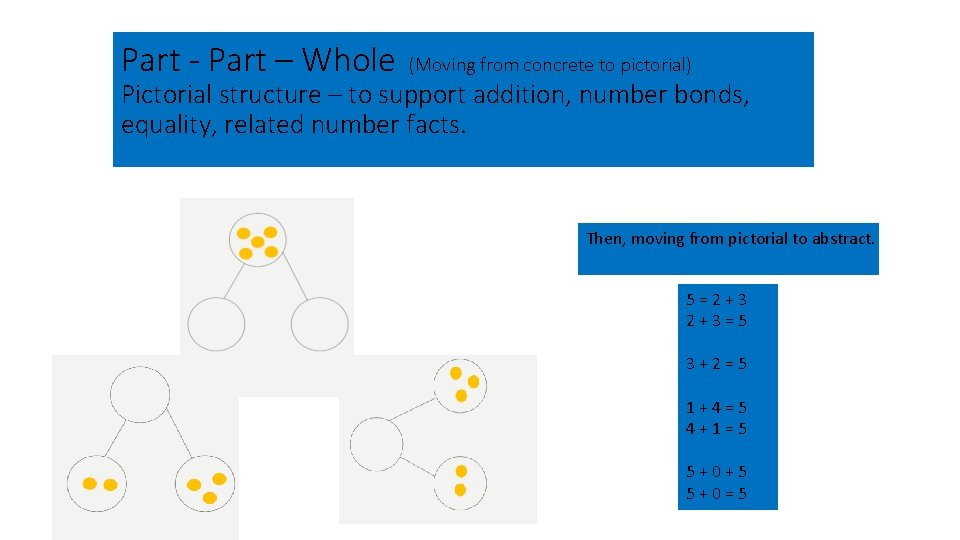
Part - Part – Whole (Moving from concrete to pictorial) Pictorial structure – to support addition, number bonds, equality, related number facts. Then, moving from pictorial to abstract. 5=2+3 2+3=5 3+2=5 1+4=5 4+1=5 5+0+5 5+0=5
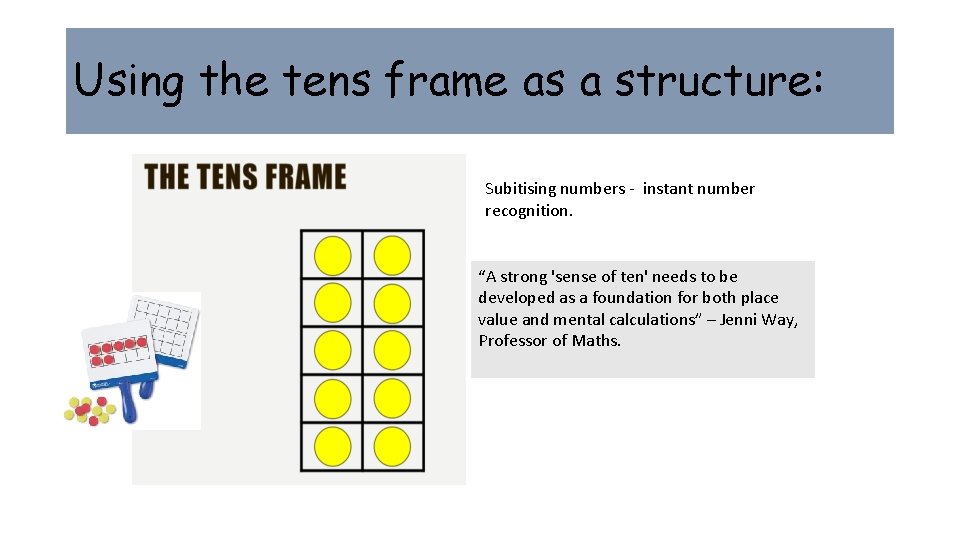
Using the tens frame as a structure: Subitising numbers - instant number recognition. “A strong 'sense of ten' needs to be developed as a foundation for both place value and mental calculations” – Jenni Way, Professor of Maths.
Activity. I will show you some tens frames. Can you tell me what numbers you see? (Extend: Can you tell me some number facts / sentences that the tens frame is showing? ) https: //www. youtube. com/watch? v=t 8 U_z. Z-r. W 1 E (PLAY!)
How to further support your child / children at home…….
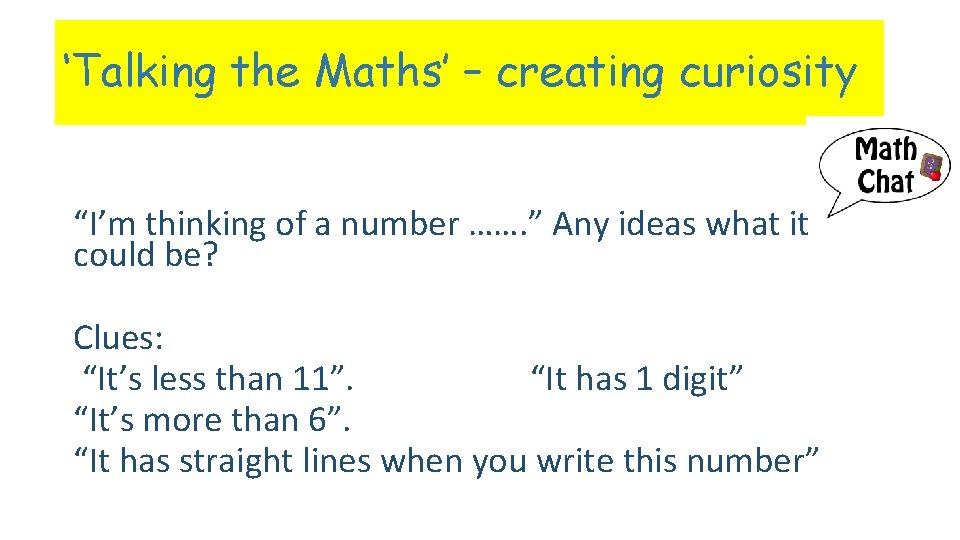
‘Talking the Maths’ – creating curiosity “I’m thinking of a number ……. ” Any ideas what it could be? Clues: “It’s less than 11”. “It has 1 digit” “It’s more than 6”. “It has straight lines when you write this number”
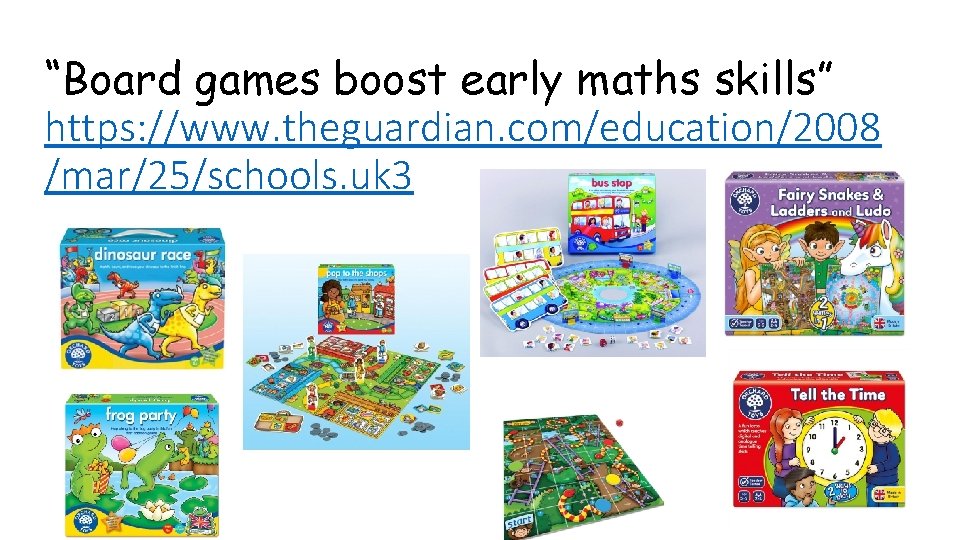
“Board games boost early maths skills” https: //www. theguardian. com/education/2008 /mar/25/schools. uk 3
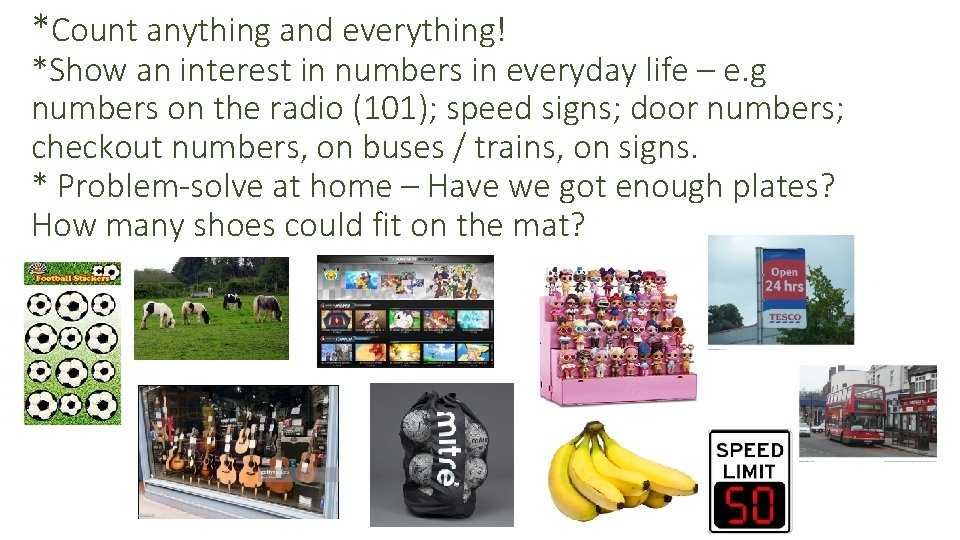
*Count anything and everything! *Show an interest in numbers in everyday life – e. g numbers on the radio (101); speed signs; door numbers; checkout numbers, on buses / trains, on signs. * Problem-solve at home – Have we got enough plates? How many shoes could fit on the mat?
Doodlemaths