
Mathematics for the General Class Ham Radio Operator
- Slides: 33
Mathematics for the General Class Ham Radio Operator
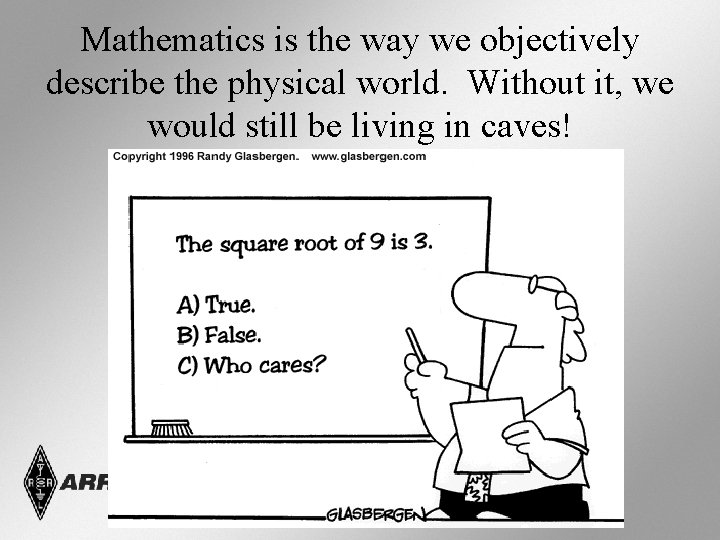
Mathematics is the way we objectively describe the physical world. Without it, we would still be living in caves!
Math Vocabulary • • What is an equation? What is an operator? What is a variable? What is a formula?
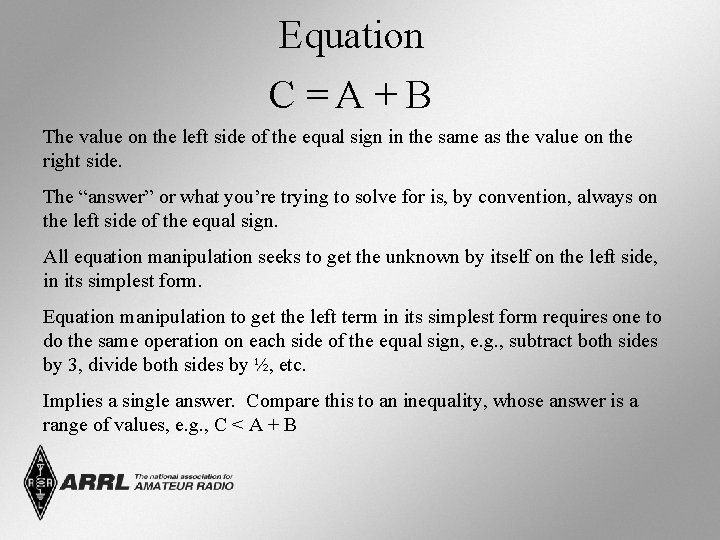
Equation • What does solving an equation mean? • Getting the equation to its most simple form so it can be of use to answer a practical question.
Equation C =A + B The value on the left side of the equal sign in the same as the value on the right side. The “answer” or what you’re trying to solve for is, by convention, always on the left side of the equal sign. All equation manipulation seeks to get the unknown by itself on the left side, in its simplest form. Equation manipulation to get the left term in its simplest form requires one to do the same operation on each side of the equal sign, e. g. , subtract both sides by 3, divide both sides by ½, etc. Implies a single answer. Compare this to an inequality, whose answer is a range of values, e. g. , C < A + B
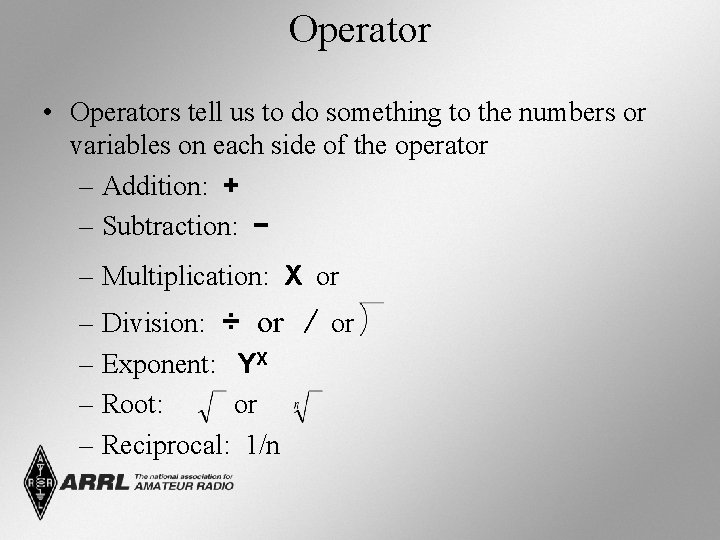
Operator • Operators tell us to do something to the numbers or variables on each side of the operator – Addition: + – Subtraction: − – Multiplication: X or – Division: ÷ or ∕ or – Exponent: YX – Root: or – Reciprocal: 1/n
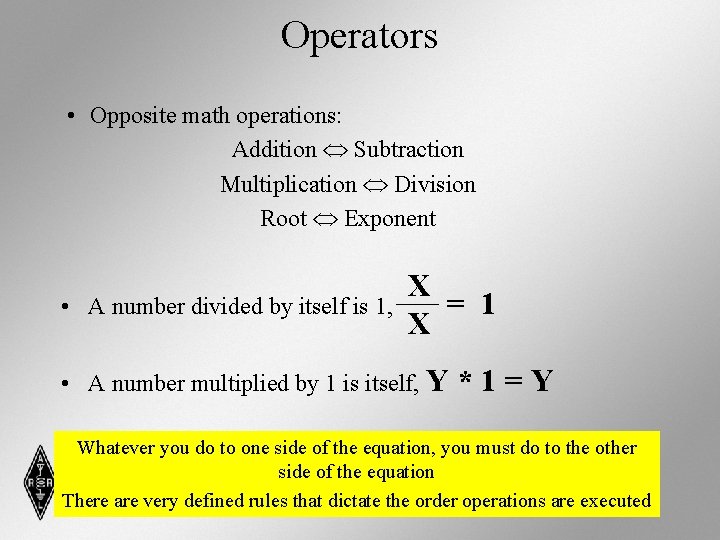
Operators • Opposite math operations: Addition Subtraction Multiplication Division Root Exponent • A number divided by itself is 1, X = 1 X • A number multiplied by 1 is itself, Y *1=Y Whatever you do to one side of the equation, you must do to the other side of the equation There are very defined rules that dictate the order operations are executed
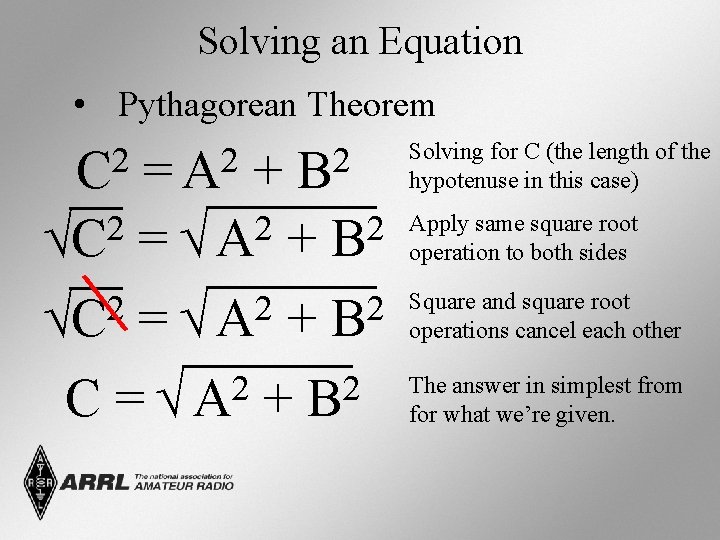
Solving an Equation • Pythagorean Theorem 2 C 2 =A 2 B + 2 2 2 C = A + B 2 2 C = A + B Solving for C (the length of the hypotenuse in this case) Apply same square root operation to both sides Square and square root operations cancel each other The answer in simplest from for what we’re given.
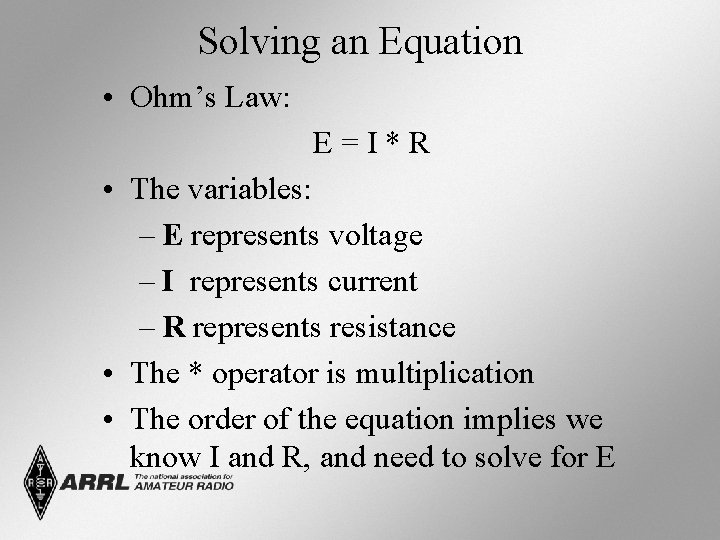
Solving an Equation • Ohm’s Law: E=I*R • The variables: – E represents voltage – I represents current – R represents resistance • The * operator is multiplication • The order of the equation implies we know I and R, and need to solve for E
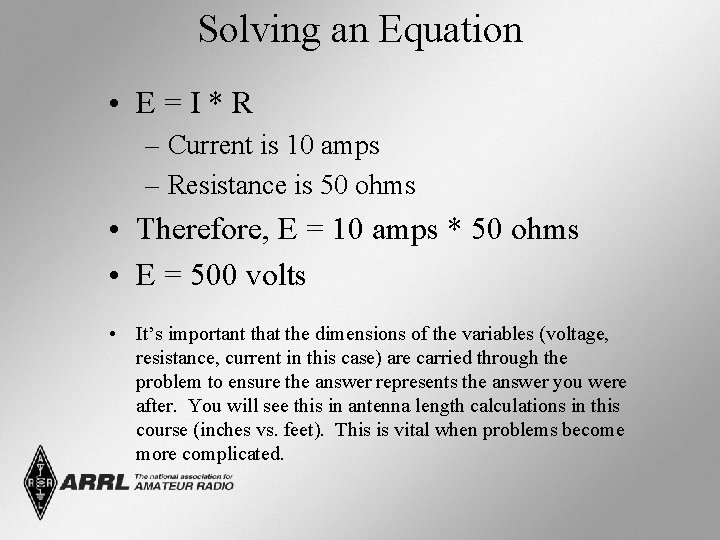
Solving an Equation • E=I*R – Current is 10 amps – Resistance is 50 ohms • Therefore, E = 10 amps * 50 ohms • E = 500 volts • It’s important that the dimensions of the variables (voltage, resistance, current in this case) are carried through the problem to ensure the answer represents the answer you were after. You will see this in antenna length calculations in this course (inches vs. feet). This is vital when problems become more complicated.
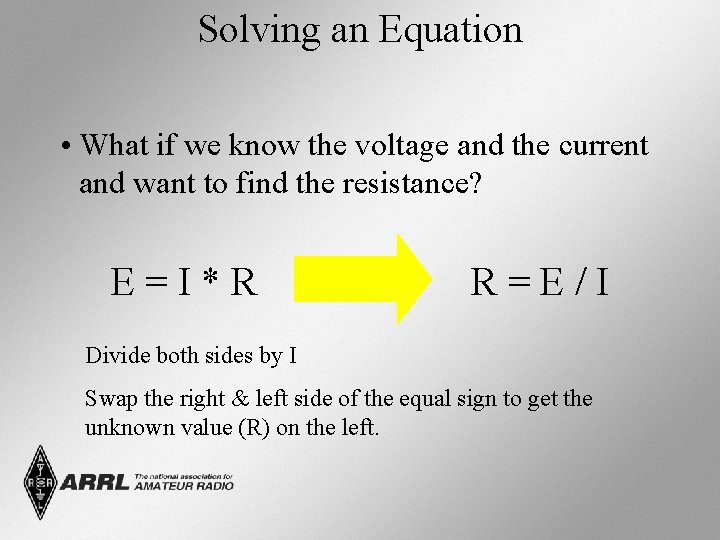
Solving an Equation • What if we know the voltage and the current and want to find the resistance? E=I*R R=E/I Divide both sides by I Swap the right & left side of the equal sign to get the unknown value (R) on the left.
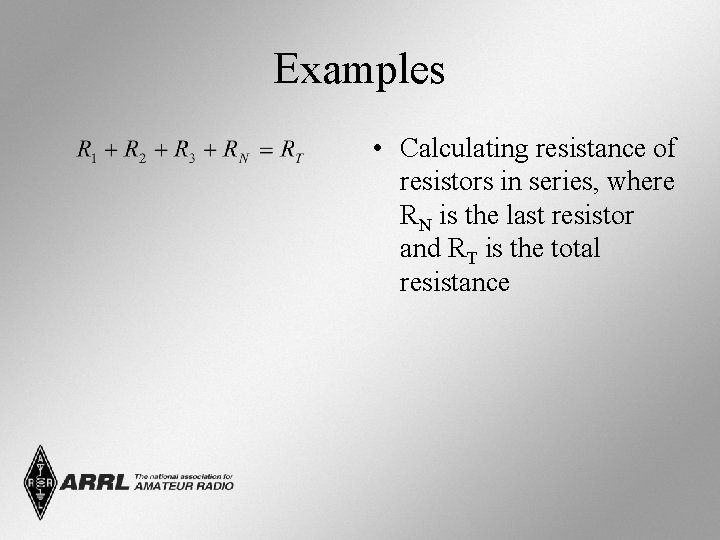
Examples • Calculating resistance of resistors in series, where RN is the last resistor and RT is the total resistance
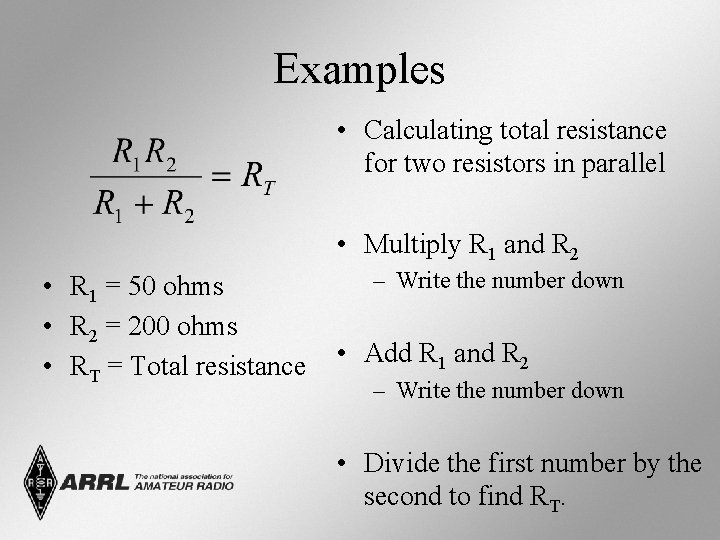
Examples • Calculating total resistance for two resistors in parallel • Multiply R 1 and R 2 • R 1 = 50 ohms • R 2 = 200 ohms • RT = Total resistance – Write the number down • Add R 1 and R 2 – Write the number down • Divide the first number by the second to find RT.
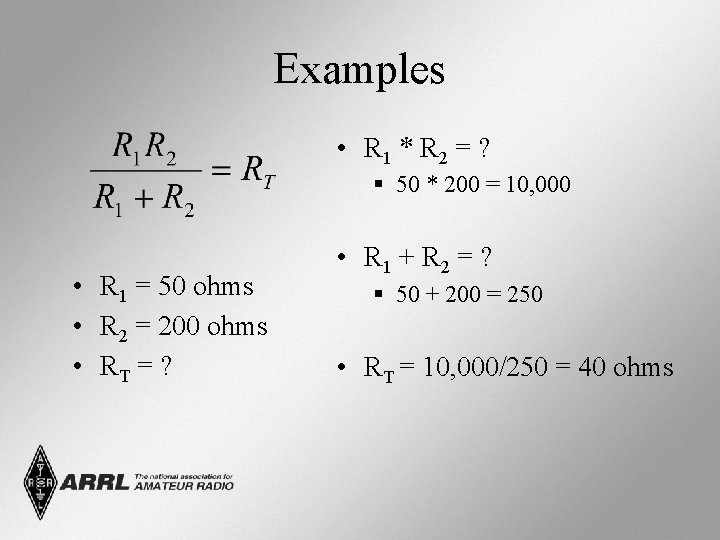
Examples • R 1 * R 2 = ? § 50 * 200 = 10, 000 • R 1 = 50 ohms • R 2 = 200 ohms • RT = ? • R 1 + R 2 = ? § 50 + 200 = 250 • RT = 10, 000/250 = 40 ohms
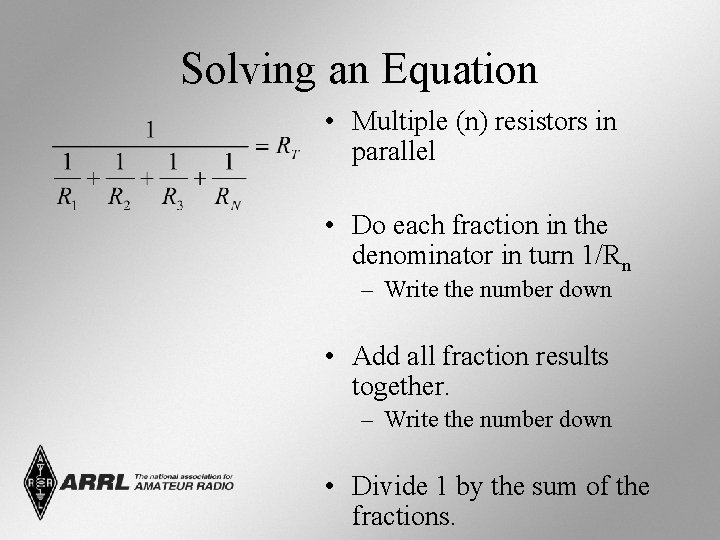
Solving an Equation • Multiple (n) resistors in parallel • Do each fraction in the denominator in turn 1/Rn – Write the number down • Add all fraction results together. – Write the number down • Divide 1 by the sum of the fractions.
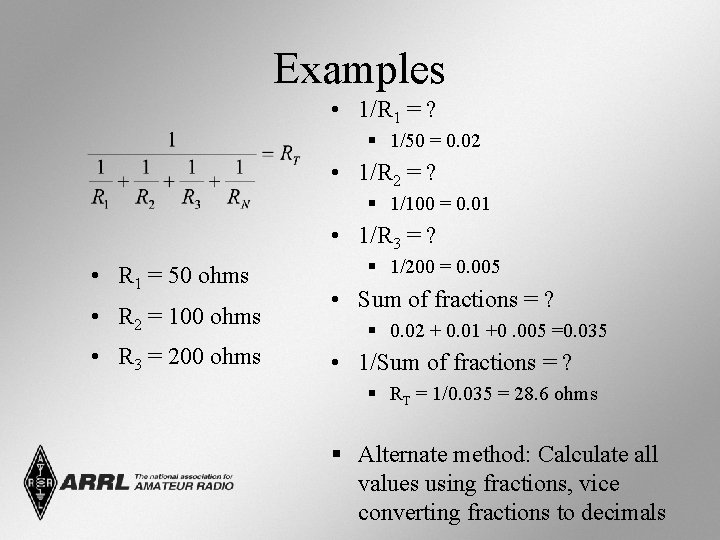
Examples • 1/R 1 = ? § 1/50 = 0. 02 • 1/R 2 = ? § 1/100 = 0. 01 • 1/R 3 = ? • R 1 = 50 ohms • R 2 = 100 ohms • R 3 = 200 ohms § 1/200 = 0. 005 • Sum of fractions = ? § 0. 02 + 0. 01 +0. 005 =0. 035 • 1/Sum of fractions = ? § RT = 1/0. 035 = 28. 6 ohms § Alternate method: Calculate all values using fractions, vice converting fractions to decimals
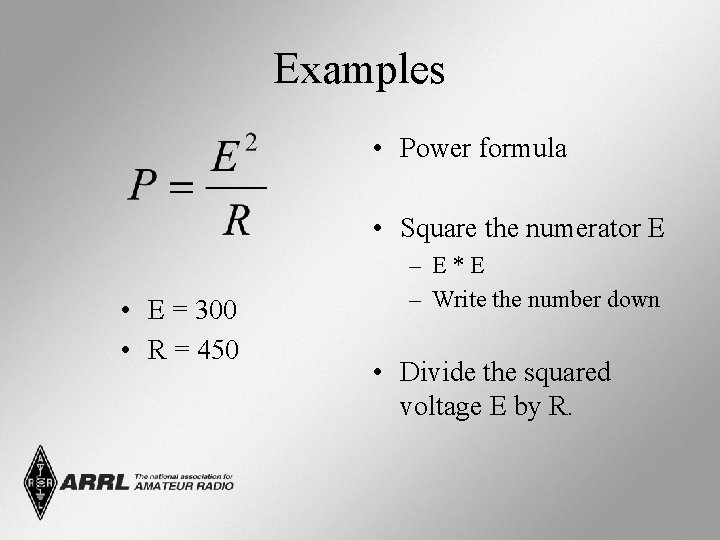
Examples • Power formula • Square the numerator E • E = 300 • R = 450 – E*E – Write the number down • Divide the squared voltage E by R.
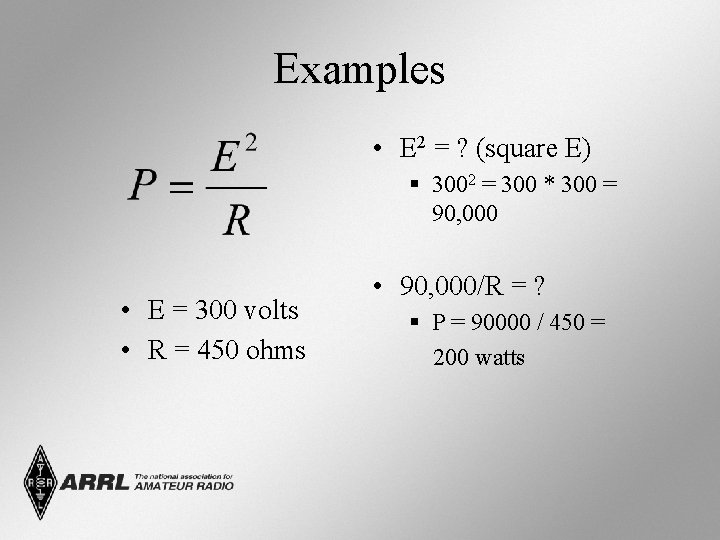
Examples • E 2 = ? (square E) § 3002 = 300 * 300 = 90, 000 • E = 300 volts • R = 450 ohms • 90, 000/R = ? § P = 90000 / 450 = 200 watts
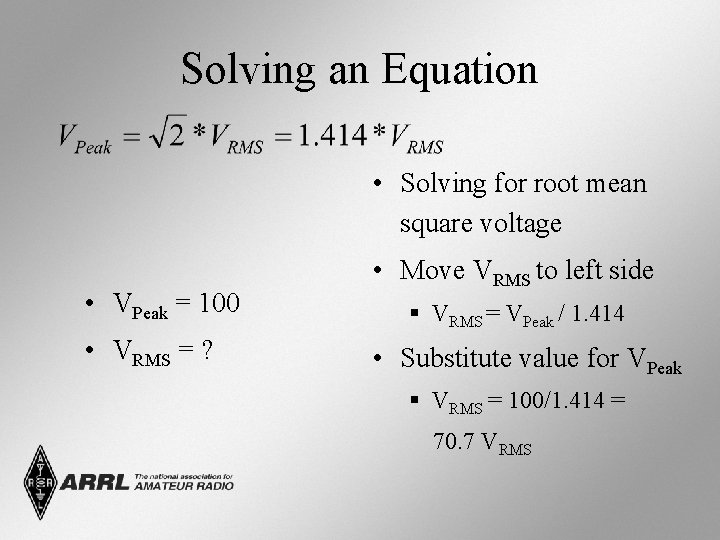
Solving an Equation • Solving for root mean square voltage • VPeak = 100 • VRMS = ? • Move VRMS to left side § VRMS = VPeak / 1. 414 • Substitute value for VPeak § VRMS = 100/1. 414 = 70. 7 VRMS
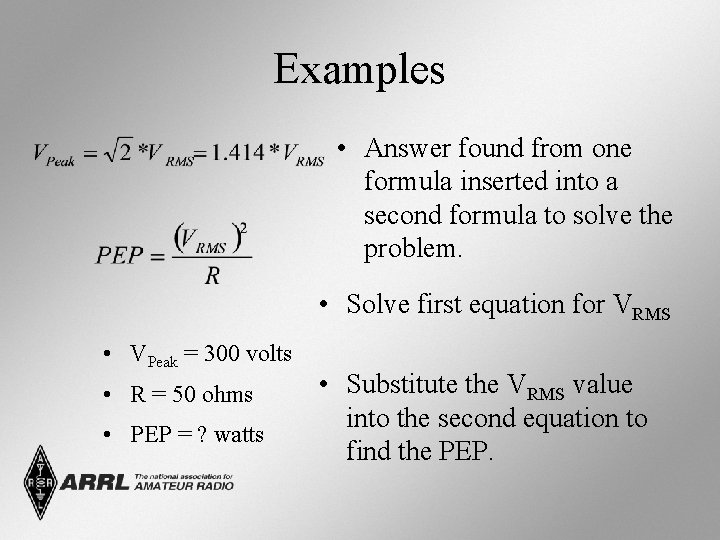
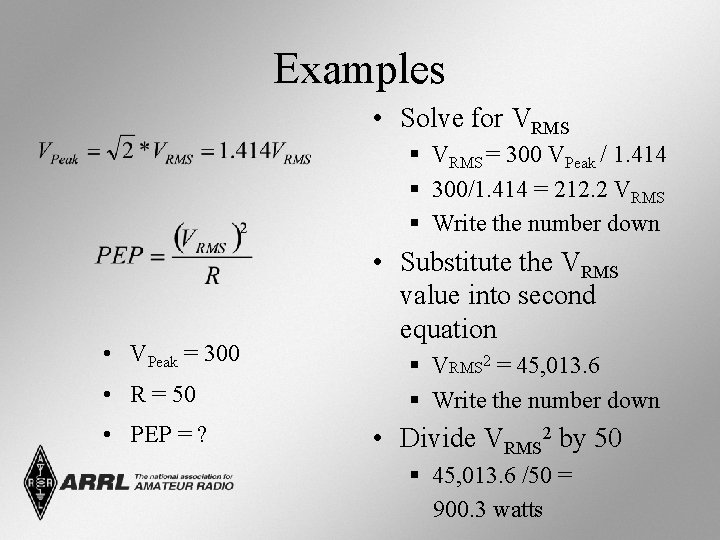
Examples • Answer found from one formula inserted into a second formula to solve the problem. • Solve first equation for VRMS • VPeak = 300 volts • R = 50 ohms • PEP = ? watts • Substitute the VRMS value into the second equation to find the PEP.
Examples • Solve for VRMS § VRMS = 300 VPeak / 1. 414 § 300/1. 414 = 212. 2 VRMS § Write the number down • VPeak = 300 • R = 50 • PEP = ? • Substitute the VRMS value into second equation § VRMS 2 = 45, 013. 6 § Write the number down • Divide VRMS 2 by 50 § 45, 013. 6 /50 = 900. 3 watts
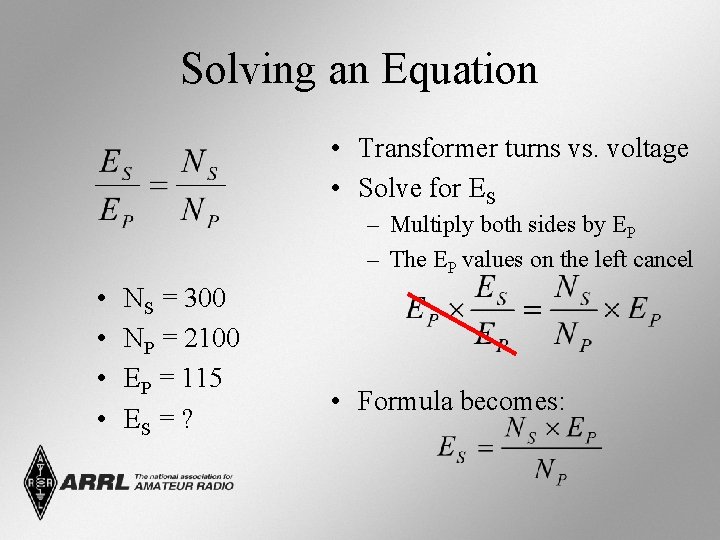
Solving an Equation • Transformer turns vs. voltage • Solve for ES – Multiply both sides by EP – The EP values on the left cancel • • NS = 300 NP = 2100 EP = 115 ES = ? • Formula becomes:
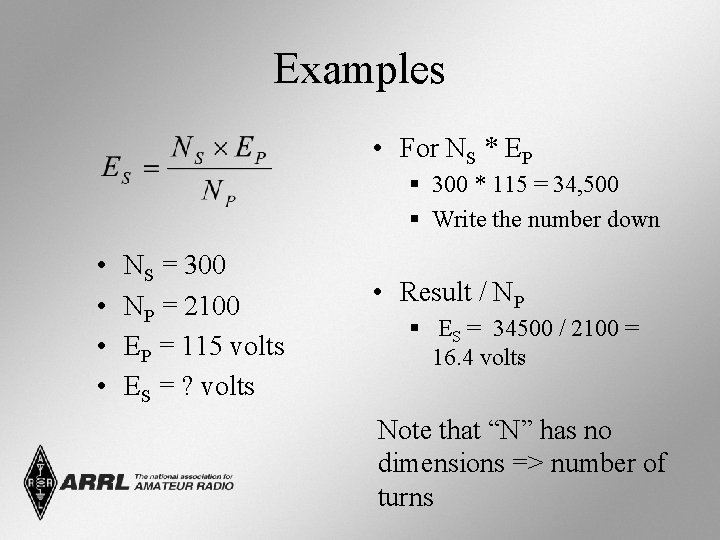
Examples • For NS * EP § 300 * 115 = 34, 500 § Write the number down • • NS = 300 NP = 2100 EP = 115 volts ES = ? volts • Result / NP § ES = 34500 / 2100 = 16. 4 volts Note that “N” has no dimensions => number of turns
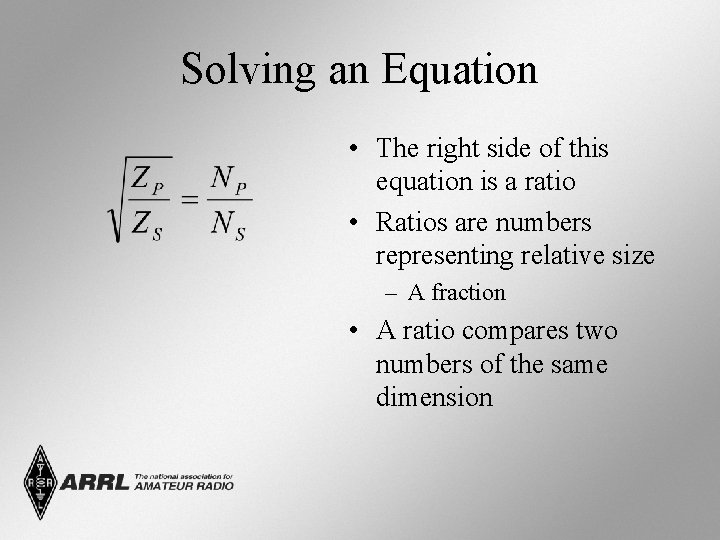
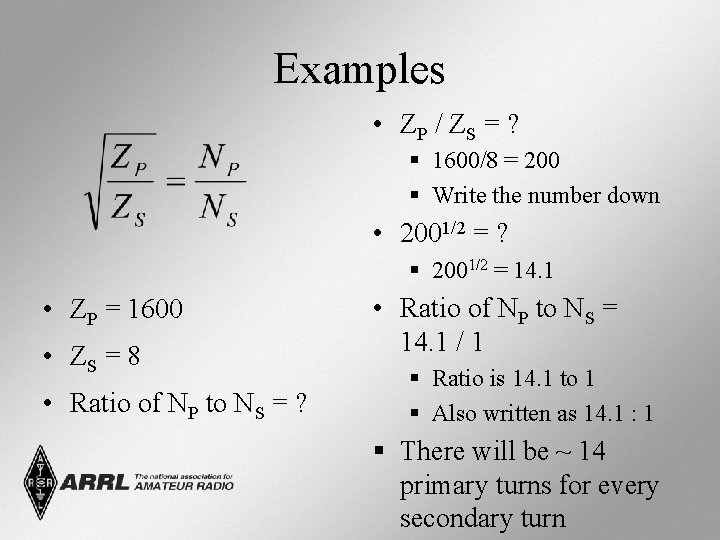
Solving an Equation • The right side of this equation is a ratio • Ratios are numbers representing relative size – A fraction • A ratio compares two numbers of the same dimension
Examples • ZP / Z S = ? § 1600/8 = 200 § Write the number down • 2001/2 = ? § 2001/2 = 14. 1 • ZP = 1600 • ZS = 8 • Ratio of NP to NS = ? • Ratio of NP to NS = 14. 1 / 1 § Ratio is 14. 1 to 1 § Also written as 14. 1 : 1 § There will be ~ 14 primary turns for every secondary turn
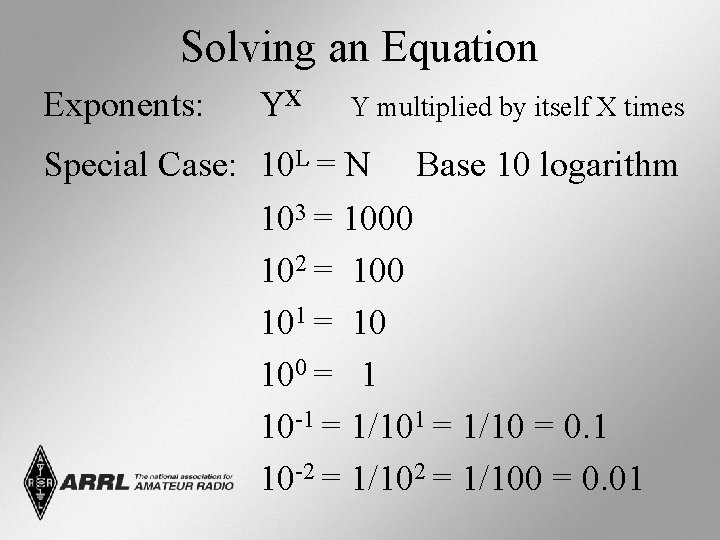
Solving an Equation Exponents: YX Y multiplied by itself X times Special Case: 10 L = N Base 10 logarithm 103 = 1000 102 = 100 101 = 10 100 = 1 10 -1 = 1/10 = 0. 1 10 -2 = 1/100 = 0. 01
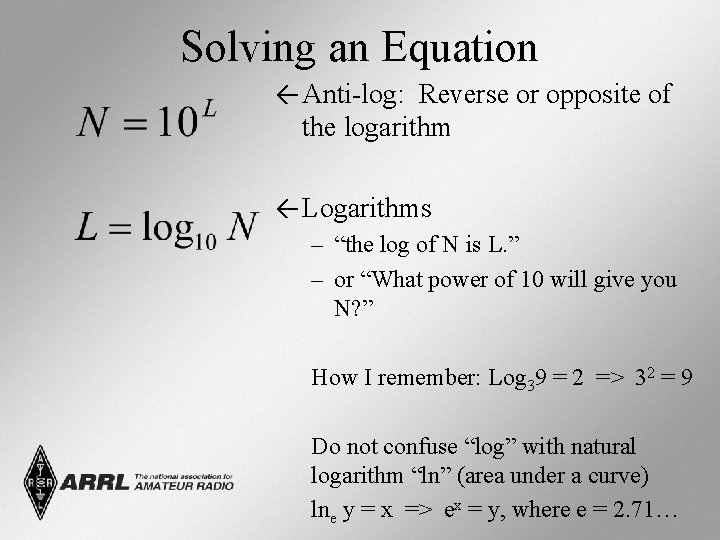
Solving an Equation ← Anti-log: Reverse or opposite of the logarithm ← Logarithms – “the log of N is L. ” – or “What power of 10 will give you N? ” How I remember: Log 39 = 2 => 32 = 9 Do not confuse “log” with natural logarithm “ln” (area under a curve) lne y = x => ex = y, where e = 2. 71…
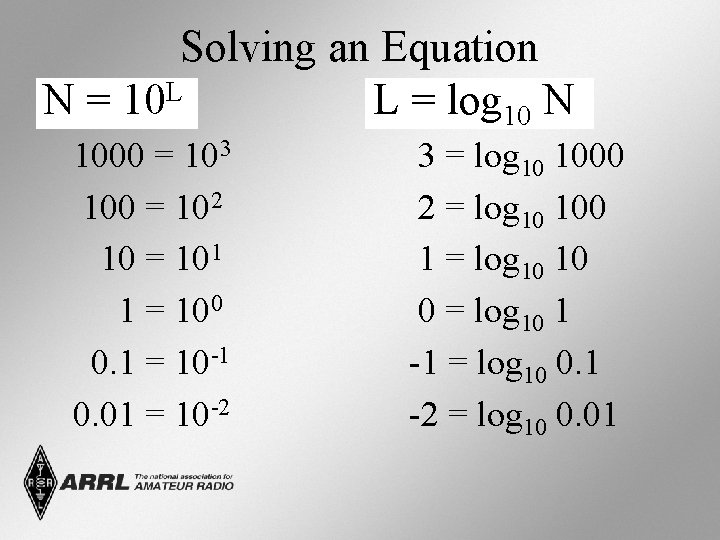
Solving an Equation N = 10 L L = log 10 N 1000 = 103 100 = 102 10 = 101 1 = 100 0. 1 = 10 -1 0. 01 = 10 -2 3 = log 10 1000 2 = log 10 100 1 = log 10 10 0 = log 10 1 -1 = log 10 0. 1 -2 = log 10 0. 01
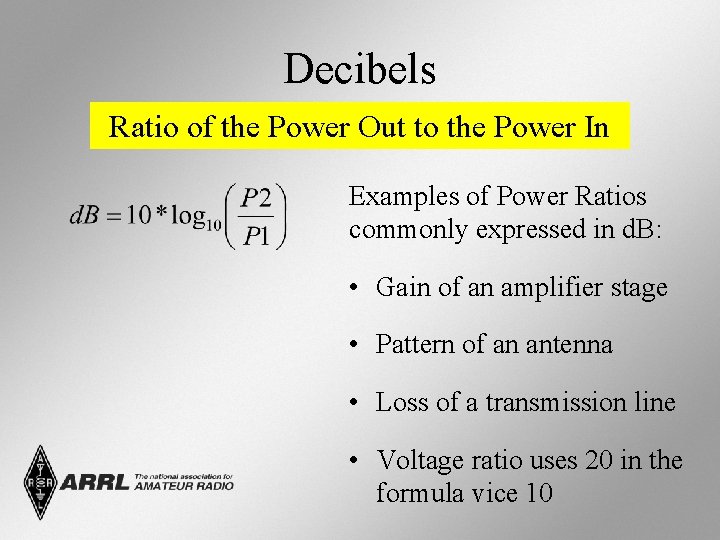
Decibels Ratio of the Power Out to the Power In Examples of Power Ratios commonly expressed in d. B: • Gain of an amplifier stage • Pattern of an antenna • Loss of a transmission line • Voltage ratio uses 20 in the formula vice 10
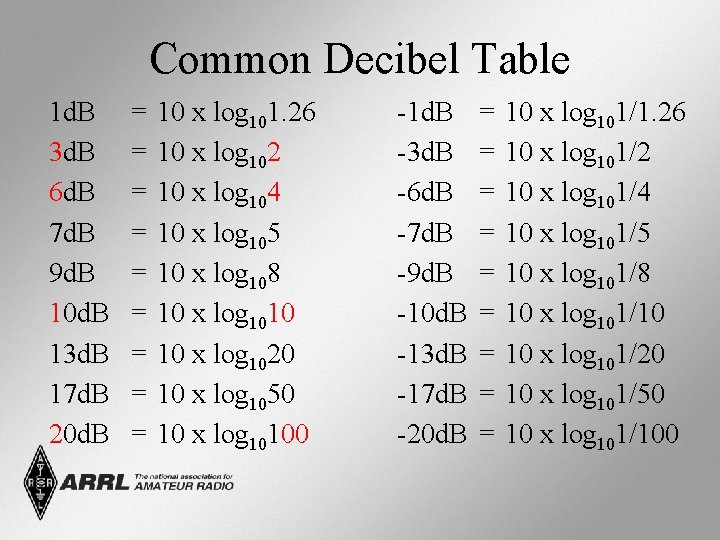
Common Decibel Table 1 d. B 3 d. B 6 d. B 7 d. B 9 d. B 10 d. B 13 d. B 17 d. B 20 d. B = = = = = 10 x log 101. 26 10 x log 102 10 x log 104 10 x log 105 10 x log 108 10 x log 1010 10 x log 1020 10 x log 1050 10 x log 10100 -1 d. B -3 d. B -6 d. B -7 d. B -9 d. B -10 d. B -13 d. B -17 d. B -20 d. B = = = = = 10 x log 101/1. 26 10 x log 101/2 10 x log 101/4 10 x log 101/5 10 x log 101/8 10 x log 101/10 10 x log 101/20 10 x log 101/50 10 x log 101/100
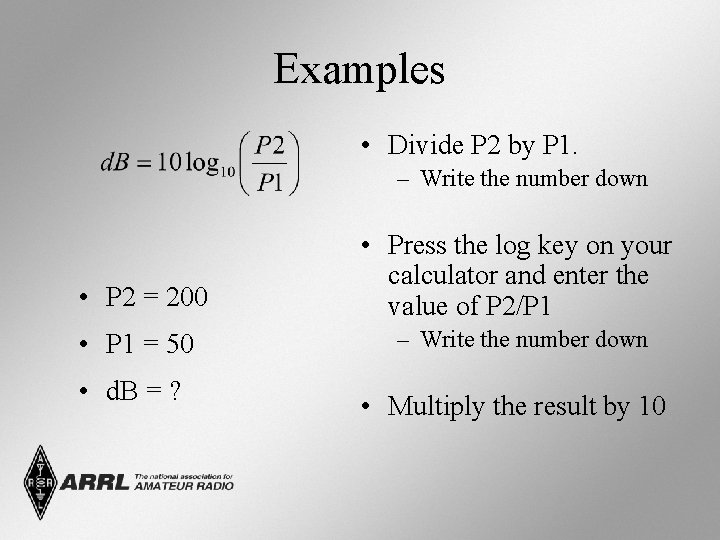
Examples • Divide P 2 by P 1. – Write the number down • P 2 = 200 • Press the log key on your calculator and enter the value of P 2/P 1 • P 1 = 50 – Write the number down • d. B = ? • Multiply the result by 10
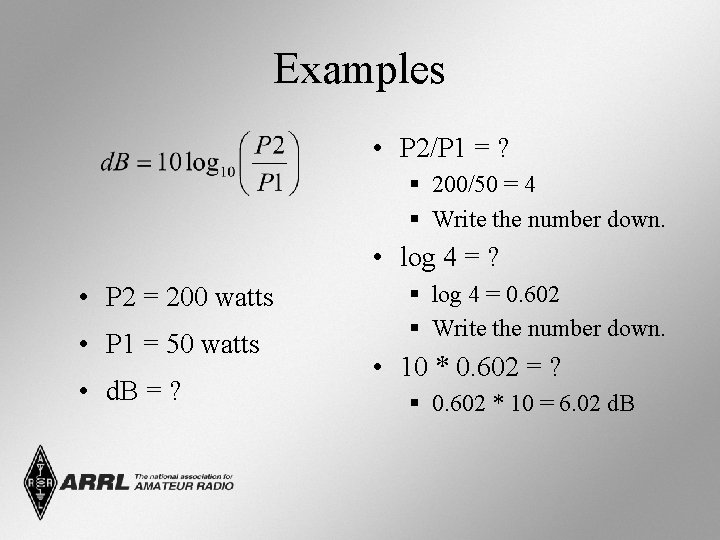
Examples • P 2/P 1 = ? § 200/50 = 4 § Write the number down. • log 4 = ? • P 2 = 200 watts • P 1 = 50 watts • d. B = ? § log 4 = 0. 602 § Write the number down. • 10 * 0. 602 = ? § 0. 602 * 10 = 6. 02 d. B
Math is not to be feared, but revered!