
Mathematics Dissertations Understanding the marking scheme your audience







- Slides: 22
Mathematics Dissertations Understanding the marking scheme & your audience English Language Education
• • Understanding expectations for your project: unpacking the criteria. Understanding your audience.
The marking scheme ▪ Descriptor templates MSc Dissertations: Dissertation Grade Descriptors 3
The marking scheme: Pause and think Download the marking scheme. How many criteria are being graded? Which is the most important criteria? 4
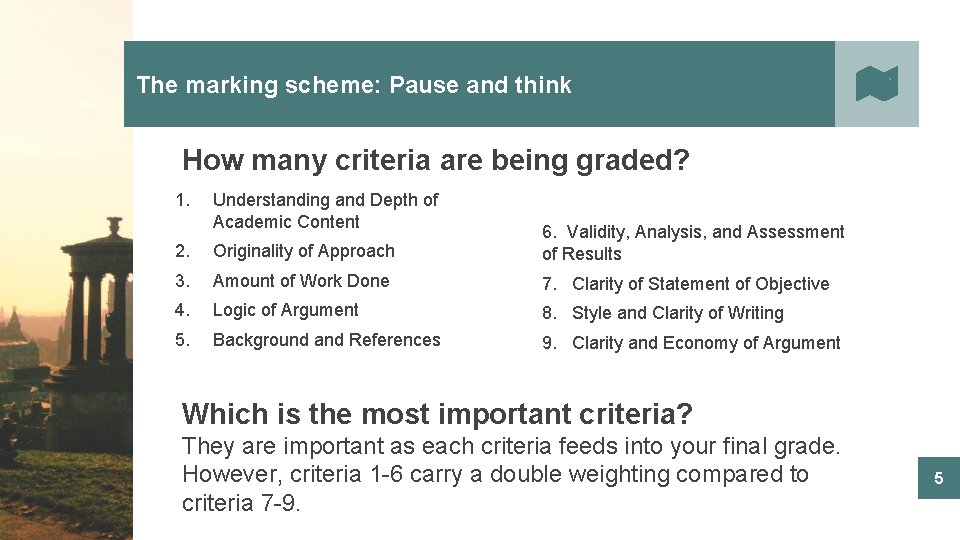
The marking scheme: Pause and think How many criteria are being graded? 1. Understanding and Depth of Academic Content 2. Originality of Approach 6. Validity, Analysis, and Assessment of Results 3. Amount of Work Done 7. Clarity of Statement of Objective 4. Logic of Argument 8. Style and Clarity of Writing 5. Background and References 9. Clarity and Economy of Argument Which is the most important criteria? They are important as each criteria feeds into your final grade. However, criteria 1 -6 carry a double weighting compared to criteria 7 -9. 5
Key language points: Pause and think Look at the marking scheme again: Which criteria refer to academic language and style? 6
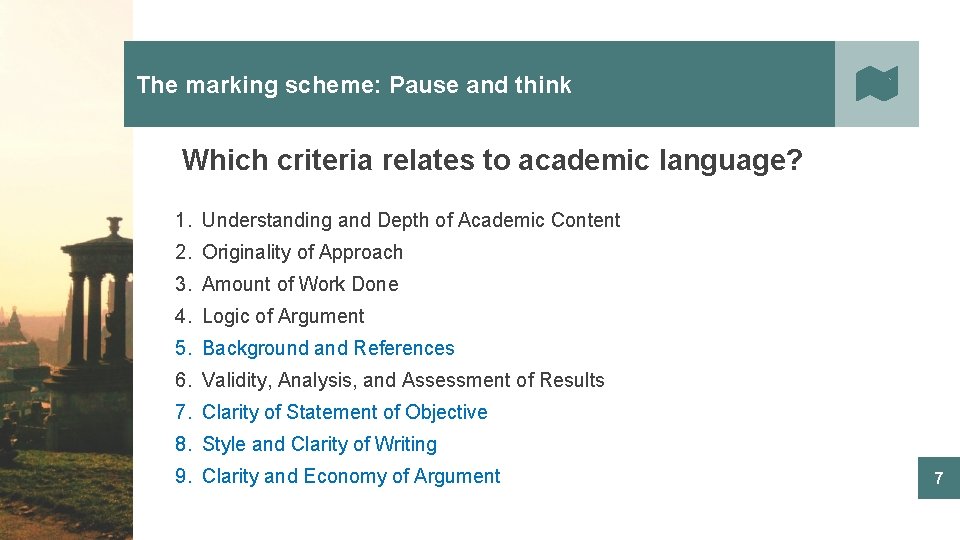
The marking scheme: Pause and think Which criteria relates to academic language? 1. Understanding and Depth of Academic Content 2. Originality of Approach 3. Amount of Work Done 4. Logic of Argument 5. Background and References 6. Validity, Analysis, and Assessment of Results 7. Clarity of Statement of Objective 8. Style and Clarity of Writing 9. Clarity and Economy of Argument 7
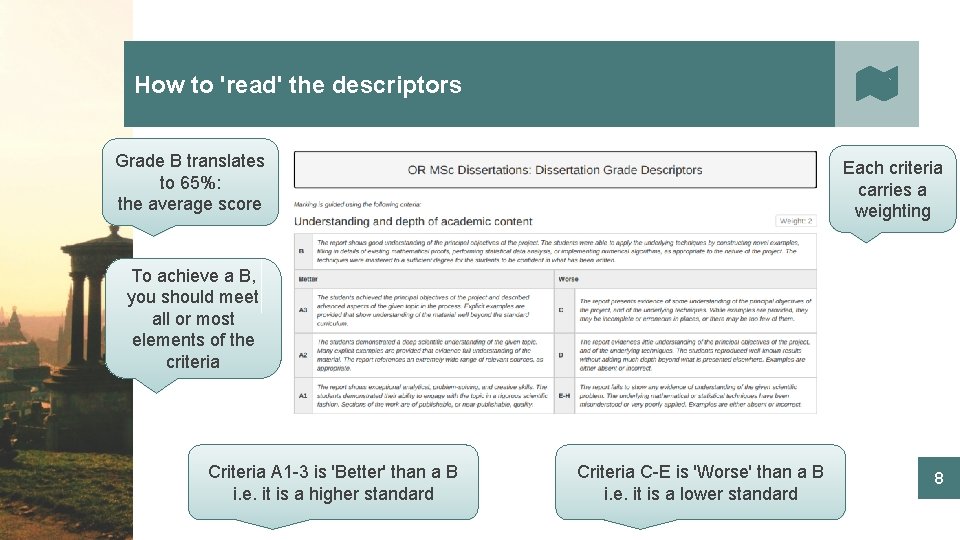
How to 'read' the descriptors Grade B translates to 65%: the average score Each criteria carries a weighting To achieve a B, you should meet all or most elements of the criteria Criteria A 1 -3 is 'Better' than a B i. e. it is a higher standard Criteria C-E is 'Worse' than a B i. e. it is a lower standard 8
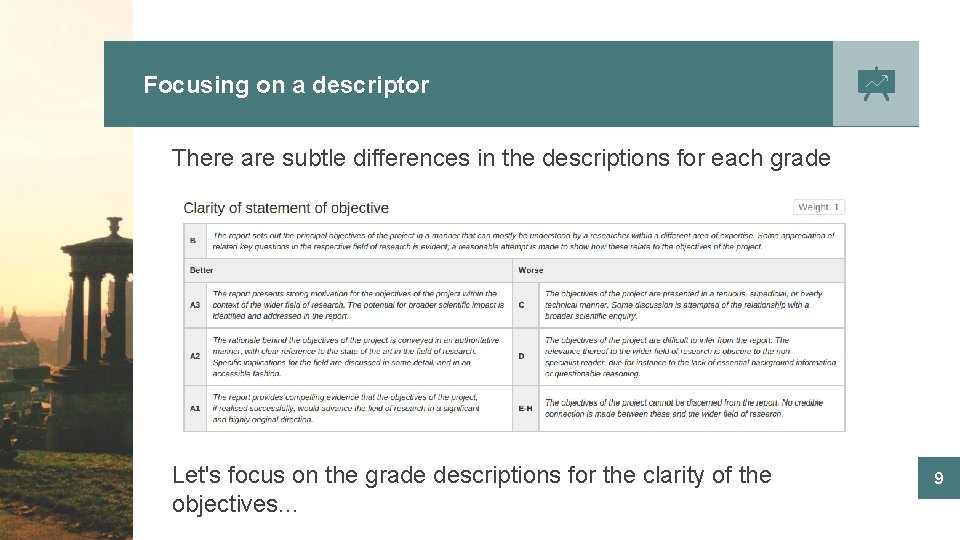
Focusing on a descriptor There are subtle differences in the descriptions for each grade Let's focus on the grade descriptions for the clarity of the objectives. . . 9
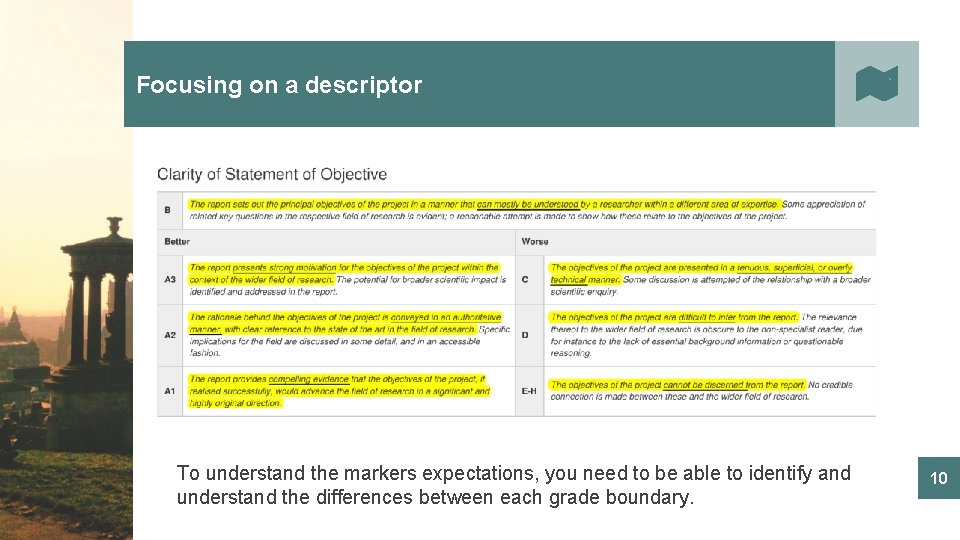
Focusing on a descriptor To understand the markers expectations, you need to be able to identify and understand the differences between each grade boundary. 10
The marking scheme: Task ▪ To understand the markers expectations, you need to be able to identify and understand the differences between each grade boundary. ▪ Task: Download the complete marking scheme. Underline or highlight the adjectives and adverbs in each descriptor Example on the following slide. . . 11
Obtaining an A 3 Category Criteria Style and clarity of The report is laid out clearly throughout. Figures, tables, and mathematical formulae are supported through well-chosen labels, captions, or clarifying remarks. Mathematical writing notation is near-flawless. The writing is of high quality; instances of awkward phrasing, or lapses in grammar or spelling, are rare. Clarity and Economy of Argument The relevance of any included material to the overall content is clear. Occasional effort is required by the reader to understand the argument in full, such as due to concepts being used without proper introduction. Clarity of Statement of Objective The report presents strong motivation for the objectives of the project within the context of the wider field of research. The potential for broader scientific impact is identified and addressed in the report. 12
Key language points: Pause and think Focus on the marking scheme: What are the key language points you should consider? 13
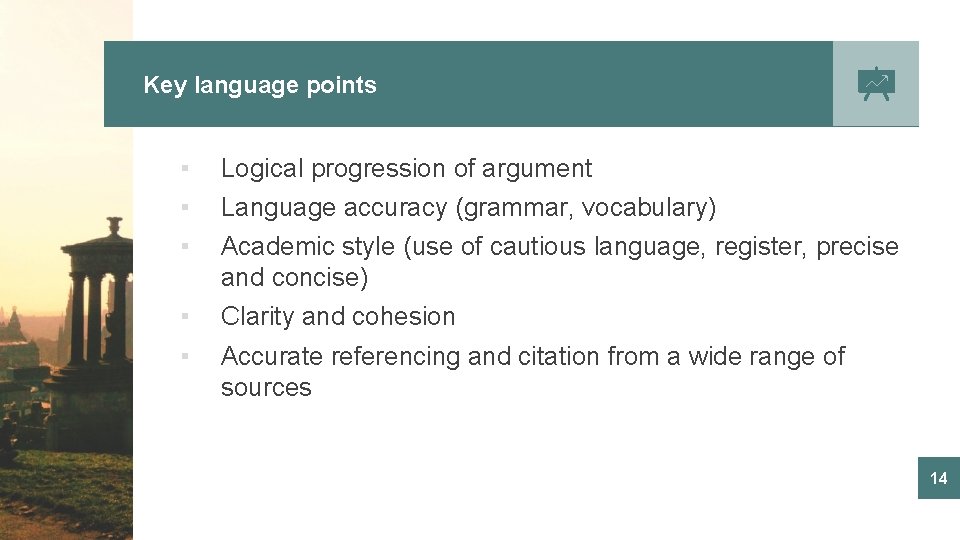
Key language points ▪ Logical progression of argument ▪ Language accuracy (grammar, vocabulary) ▪ Academic style (use of cautious language, register, precise and concise) ▪ Clarity and cohesion ▪ Accurate referencing and citation from a wide range of sources 14
Understanding your audience: Pause and think Who are you writing for? How will this affect the information you include and the language that you use? 15
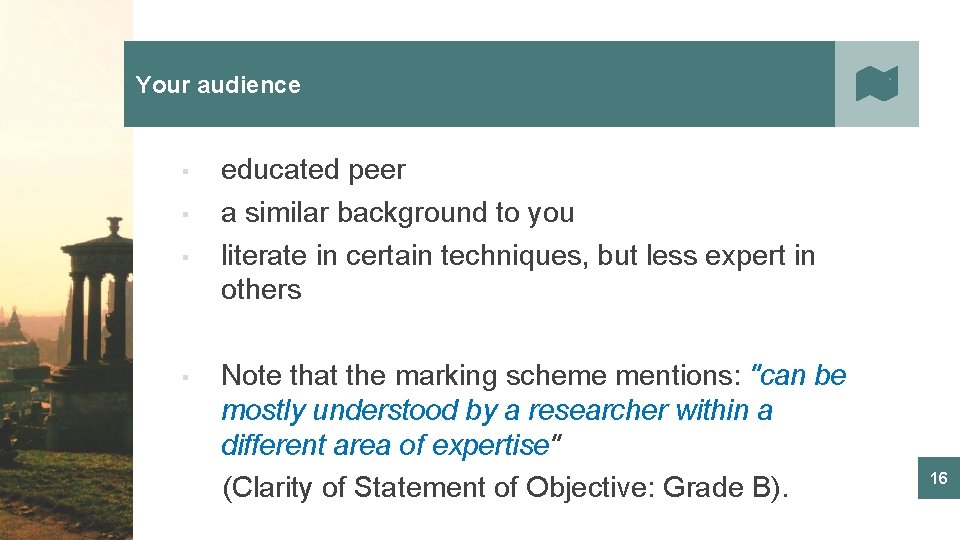
Your audience ▪ ▪ educated peer a similar background to you literate in certain techniques, but less expert in others Note that the marking scheme mentions: "can be mostly understood by a researcher within a different area of expertise" (Clarity of Statement of Objective: Grade B). 16
Your audience Assume : ▪ A consistent level of reader knowledge ▪ A general mathematical background including a basic background in your programme (Statistics and/or Operational Research) ▪ The reader does not know all your sources 17
Audience: Points to consider ▪ ▪ Provide definitions of terms and notations that you will be using Always keep your audience in mind- ask yourself 'would my peers understand this? ' Share an extract with a friend, can they understand it? Talk through your project 18
Your audience: Peer review ▪ Ask a friend of family member to read a section of your text. Choose a reviewer who is not an expert in the topic of your investigation. ▪ Ask them to identify any sections that are difficult to understand. ▪ Consider how you could make these sections clearer. ▪ With a peer on your course you could do a more detailed peer review using the checklist accompanying this session. 19
Review ▪ Engaging with the marking criteria will help you understand the expectations of your marker ▪ Understanding your audience will help you choose what information to include and the language you choose 20
“ Resources Aliotta, M. , 2018. Mastering academic writing in the sciences : a step-by-step guide. CRC Press. Glasman-Deal, H. 2010. Science research writing for non-native speakers of English. World Scientific Publishing Co. Higham, N. J. 1998. Handbook of writing for the mathematical sciences 2 nd ed. Society for Industrial and Applied Mathematics 21
22