
Mathematics Digital Portfolio Week 1 By Andrea Jones
Mathematics Digital Portfolio Week 1 By Andrea Jones
Week 1 – Synthesise: Big Ideas • To be able to assess whether a child understands a concept is to try using different strategies to come to the same conclusion. This way, if a child has trouble using different strategies to come to the same answer, they are only proficient with the concept, where as if they can use different strategies to obtain the same answer, then they are proficient in the skill also. • Addition is the next step moving forward from teaching students basic counting skills. This becomes the basis for further development or other number concepts and skills (Baroody and Wilkins, (1999).
Week 1 – Demonstrate: Mathematical Concept, Skills and Strategies (a) A mathematics concept • A mathematics concept is having the idea or picture of how to do a mathematical equation (or anything/skill). (b) A mathematics skill • Whereas a mathematics skill is being able to use different strategies to be able to actual perform the mathematical concept, the skill has to come after the concept. (c) Describe the difference between them using addition • The concept is knowing the number sequence in a continuing line of numbers while counting from any given number. E. g. 5, 6, 7, 8…… • The skill is being able to use a strategy such as count on. E. g. clap on 5, finger count 6, 7, 8……. Doubles, rainbow facts, add 10.
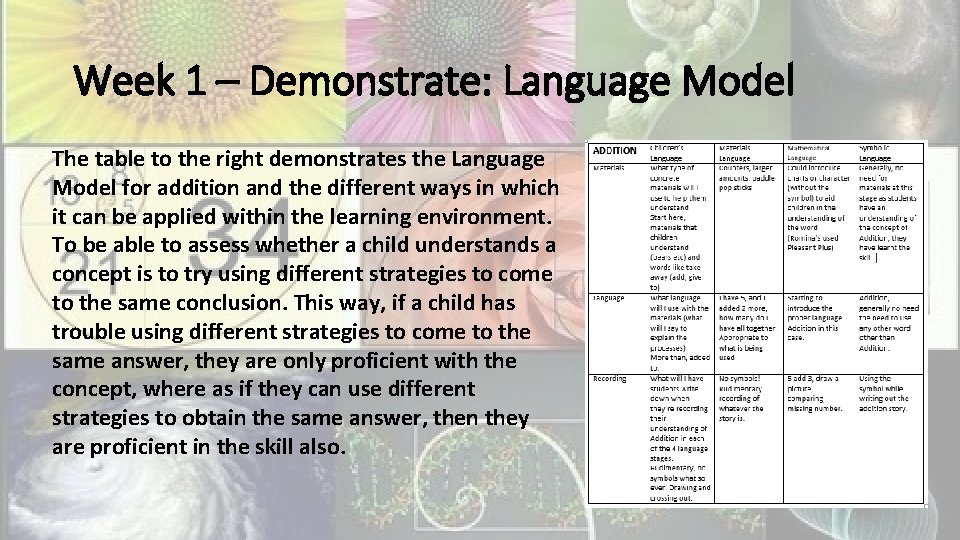
Week 1 – Demonstrate: Language Model The table to the right demonstrates the Language Model for addition and the different ways in which it can be applied within the learning environment. To be able to assess whether a child understands a concept is to try using different strategies to come to the same conclusion. This way, if a child has trouble using different strategies to come to the same answer, they are only proficient with the concept, where as if they can use different strategies to obtain the same answer, then they are proficient in the skill also.
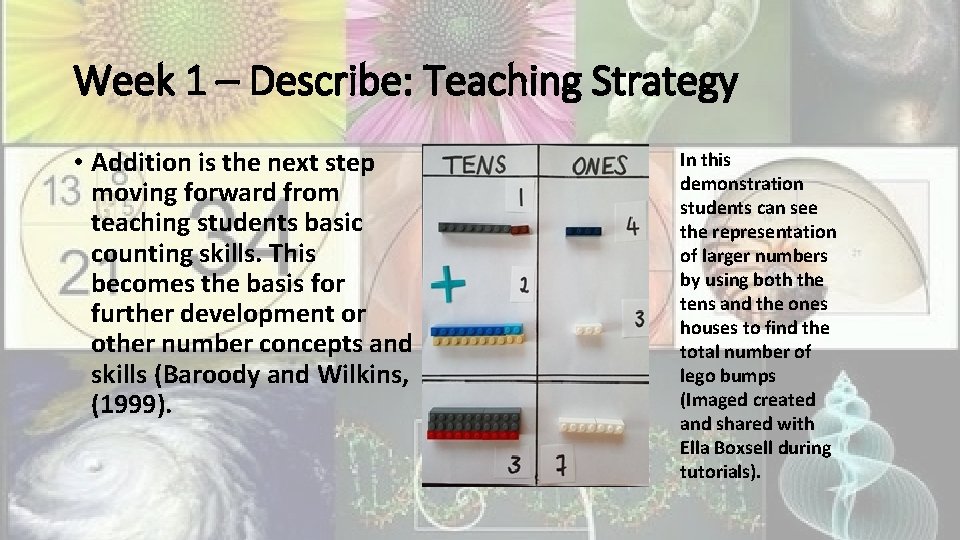
Week 1 – Describe: Teaching Strategy • Addition is the next step moving forward from teaching students basic counting skills. This becomes the basis for further development or other number concepts and skills (Baroody and Wilkins, (1999). In this demonstration students can see the representation of larger numbers by using both the tens and the ones houses to find the total number of lego bumps (Imaged created and shared with Ella Boxsell during tutorials).

Week 1 – Demonstrate: Misconception A misconception for addition for example could be when a student has given an answer for an addition problem such as 7 add 6 = 13 but is not able to provide the problem solving skill used to gain the answer (as demonstrated by Mathematics Navigator - Misconceptions and Errors, p 4). For example has worked out the answer by using their fingers instead of using a strategy such as doubles add 1. 6 and 6 = 12 add 1 is 13.
Week 1 – Provide: ACARA Links • Year: Foundation • Strand: Number and Algebra - http: //www. australiancurriculum. edu. au/mathematics/curriculum/f-10? layout=1#level. F • Substrand: Number and place value • Content description: Represent practical situations to model addition and sharing (ACMNA 004) • Elaborations: Estimating and calculating with whole numbers • Scootle: https: //www. scootle. edu. au/ec/view. Metadata. action? id=M 015957&q=&topic=&start=0&sort=alignment&contentsource=&content provider=&resourcetype=&v=text&show. Lom. Commercial. Resources=false&field=title&field=text. all&field=topic&learningarea=%22 M athematics%22&contenttype=all&contenttype=%22 Interactive%20 resource%22&contenttype=%22 Collection%22&contenttype=%22 Image%22&contenttype=%22 Moving%20 image%22&contenttype=%22 Sound%22&contenttype=%22 Assessment%20 resource%22&c ontenttype=%22 Teacher%20 guide%22&contenttype=%22 Dataset%22&contenttype=%22 Text%22&contenttype=%22 Still. Image%22& contenttype=%22 Moving. Image%22&comm. Res. Content. Type=all&comm. Res. Content. Type=%22 App%20(mobile)%22&comm. Res. Conten t. Type=%22 Audio%22&comm. Res. Content. Type=%22 Book%20(electronic)%22&comm. Res. Content. Type=%22 Book%20(printed)%22&co mm. Res. Content. Type=%22 Digital%20 item%22&comm. Res. Content. Type=%22 Learning%20 object%22&comm. Res. Content. Type=%22 Othe r%22&comm. Res. Content. Type=%22 Printed%20 item%22&comm. Res. Content. Type=%22 Software%22&comm. Res. Content. Type=%22 Teac her%20 resource%22&comm. Res. Content. Type=%22 Video%22&userlevel=(1)&kc=any&lom=true&scot=true&follow=true&topiccounts =true&rows=20&suggested. Resources=S 6184, M 016278, M 018756, M 009165, M 014006, M 019626, S 4970, M 008811, M 017301, M 009395, R 11395, M 019368, M 020068, M 017979, M 017866&acc. Content. Id=ACMNA 015&from. Search=true • http: //splash. abc. net. au/home#!/media/29592/
Week 1 – Provide: Links and Resources • Flocabulary: “From addition and subtraction to linear equations, Flocabulary has resources to bring math to life” (Flocaublary website, 2016). I have add this website as I found it interesting in the way it provides ideas for lessons, games and reflecting on not only mathematical problems but also by incorporating cross curricular strands. Retrieved from: https: //www. flocabulary. com/math-lessons/ • Mathsisfun is a website I was introduced to during last years maths unit and it contains different resources for not only addition but other mathematical algorithms and across all mathematical applications. Retrieved from: http: //www. mathsisfun. com/
Week 1 – Synthesis: Textbook (chapter 1 – 9 & 11 to follow in following weeks) • This chapter of the textbook covered topics including: • What mathematics is and how it is being taught • An understanding of mathematics is a need for getting by in todays society. • The Australian Curriculum: • Number and Algebra • Measurement and Geometry • Statistics and Probability • Different views of mathematics including: • Mathematics is a study of patterns and relationships • Mathematics is a way of thinking • Mathematics is an art, characterised by order and internal consistency • Mathematics is a language that uses carefully defined terms and symbols • Mathematics is a tool • • • The needs of Mathematics in the classroom • “The nature of mathematics helps determine what is taught and when it is taught in primary school years” (Reys, Lindquist, Lambdin, and Smith, 2014). Needs of the child and society • Implemented on the growing needs of how children learn and how mathematics should be delivered • Usefulness in everyday life is affected what is taught and how Touched on topics including: • Research • Resources • History
Week 1 – Reflection • During this week, I have begun to understand different ways in which students understand a mathematical concepts, skills and strategies. I feel I need to build upon my own mathematical language in order to be able to deliver to my future students mathematical concepts that they will be able to build upon confidently. I now have a slightly better understanding of implementing different strategies for students will enable them to be confident in their understanding and implementation of the different mathematical concepts I will teach them. I also feel that by teaching my students to be confident in addition concepts, they will have a better understanding of other mathematical concepts. • Before this week, my definition of addition was taking two or more numbers and adding them together to find a total amount. I know look at addition as being more than that when considering the different strategies required in order to problem solves addition in different ways. I now see addition as being able to use different languages to help students understand the concept of addition, show them different strategies to work out addition concepts and provide them with different strategies to implement addition.
References • Australian Curriculum Assessment and Reporting Authority [ACARA]. (2016). F-10 curriculum Mathematics. Retrieved from: http: //www. australiancurriculum. edu. au/mathematics/curriculum/f-10? layout=1 • Baroody, A. J. , & Wilkins, J. L. (1999). The development of informal counting, number, and arithmetic skills and concepts. Mathematics in the early years, 48 -65. • Felder, R. M. , & Soloman, B. A. (2000). Learning styles and strategies. Retrieved from: http: //www 4. ncsu. edu/unity/lockers/users/f/felder/public/ILSdir/styles. htm • Flocaublary website, 2016). Retrieved from: https: //www. flocabulary. com/math-lessons/ • Image source – slide 5. Created and discussed in tutorials with Ella Boxsell. • Mathematics Navigator - Misconceptions and Errors. Retrieved from: http: //westada. org/cms/lib 8/ID 01904074/Centricity/Domain/207/Misconceptions_Error%202. pdf • Mathsisfun Website (2016). Retrieved from: http: //www. mathsisfun. com/ • Pierce, Rod. (9 Feb 2016). "Math is Fun - Maths Resources". Math Is Fun. Retrieved 26 Mar 2016 from http: //www. mathsisfun. com/index. htm • Reys, R. E. , Lindquist, M. M. , Lambdin, D. V. , & Smith, N. L. (2014). Helping children learn mathematics. John Wiley & Sons. • Scootle (2016). Mathematics resources. Retrieved from: https: //www. scootle. edu. au/ec/ac. Subject? name=%22 Mathematics%22
- Slides: 11