
Mathematics at Ark Conway Primary KS 1 Parent
- Slides: 17
Mathematics at Ark Conway Primary KS 1 Parent Workshop A guide for parents and carers 2018 Sophie Faupel Assistant Principal & Maths Specialist teacher
Mathematics Mastery Programme of Study Vision For every child to enjoy and succeed in mathematics, regardless of background. At Ark Conway, we believe that every pupil is a mathematician. We are committed to providing all pupils with engaging and challenging lessons which inspire and motivate them.
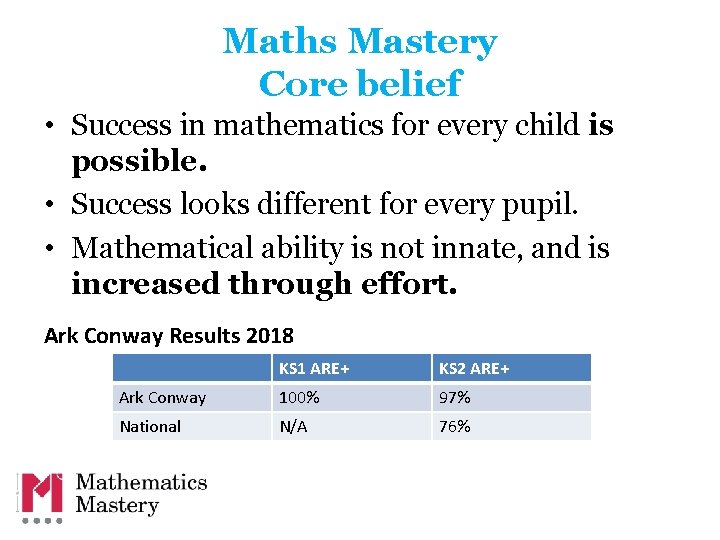
Maths Mastery Core belief • Success in mathematics for every child is possible. • Success looks different for every pupil. • Mathematical ability is not innate, and is increased through effort. Ark Conway Results 2018 KS 1 ARE+ KS 2 ARE+ Ark Conway 100% 97% National N/A 76%
What is mastery? “In mathematics, you know you’ve mastered something when you can apply it to a totally new problem in an unfamiliar situation. ”
What does this mean in practice? • • • Fewer topics in greater depth Mastery for all pupils Number sense and place value come first Problem solving is central Using and applying
Lesson structure • Mathematics Mastery lessons follow a 6 -part structure. This keeps the lesson pacy, gives flow and allows more opportunities to teach creatively, give feedback and assess learning. • Pupils have access to plenty of concrete materials such as bead strings and cubes/counters so that they have time to fully explore mathematics. They also use pictorial representations throughout the school.
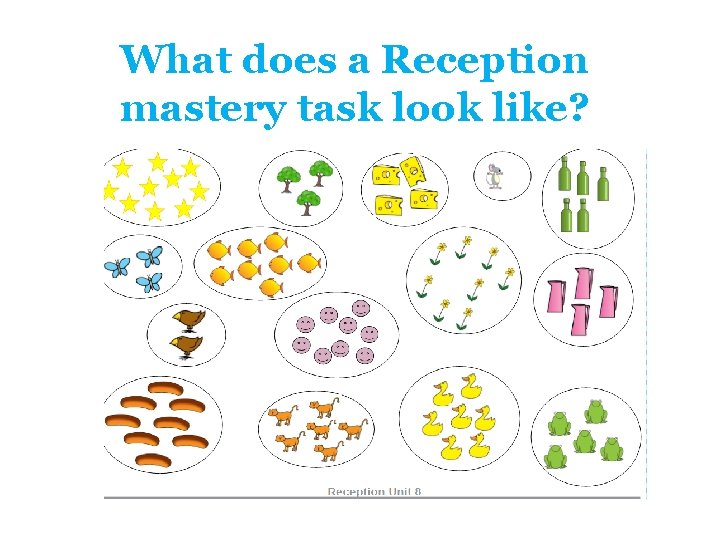
What does a Reception mastery task look like?
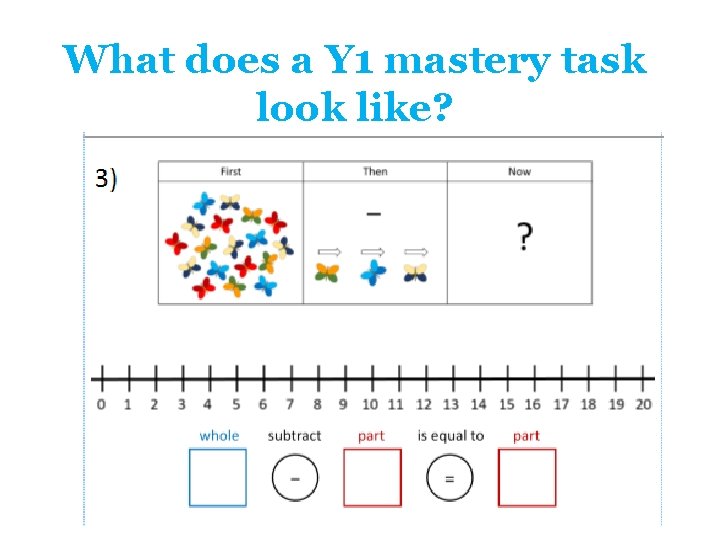
What does a Y 1 mastery task look like?
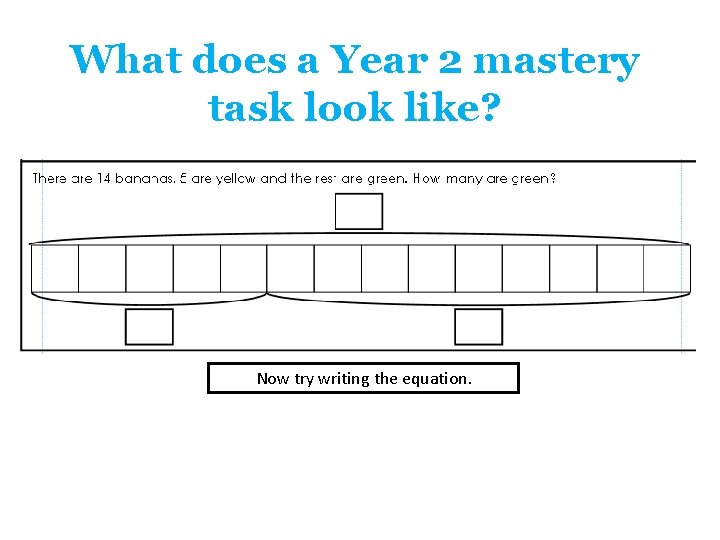
What does a Year 2 mastery task look like? Now try writing the equation.
Curricular principles • Pupils are not going to be working through the curriculum more quickly, but going deeper into it. • For example, in Year 1 it is imperative that pupils have full understanding of number sense, number bonds and place value so pupils revisit these concepts daily. • A secure understanding of these number facts means that can confidently attempt more challenging problems.
Mathematical language • Sharing essential vocabulary at the beginning of every lesson and insisting on its use throughout • Modelling clear sentence structures using mathematical language • Paired language development activities, known as Talk Tasks. Plus, is equal to, first, next, (one) greater/less, (one) more/fewer, same, number, order, equation, addition, sign, symbol, plus, is equal to, altogether, part, whole, equal, unequal, half, share, divide, measure, about, nearly, roughly, close to, size, length, longer, longest, compare bar model, part-whole model, value, known, unknown, data, pictogram, table, collect, sort, interpret, regroup, partition, tens, ones, number line.
• • • How will children’s work be recorded and tracked? Task sheets Books Photographs White boards Exit tickets Tracking Pupil Progress In maths, assessment is continuous but most of this assessment is formative. From the beginning of every lesson, teachers and co-teachers will be assessing what their pupils are, or are not understanding and use this to scaffold each segment of the lesson. Immediate feedback is given throughout the lesson with pupils correcting mistakes immediately. Same day interventions will be both planned for pupils who have not achieved the learning objective. Challenge tasks are planned into every lesson and the expectation is that most pupils move onto and attempt the challenge.
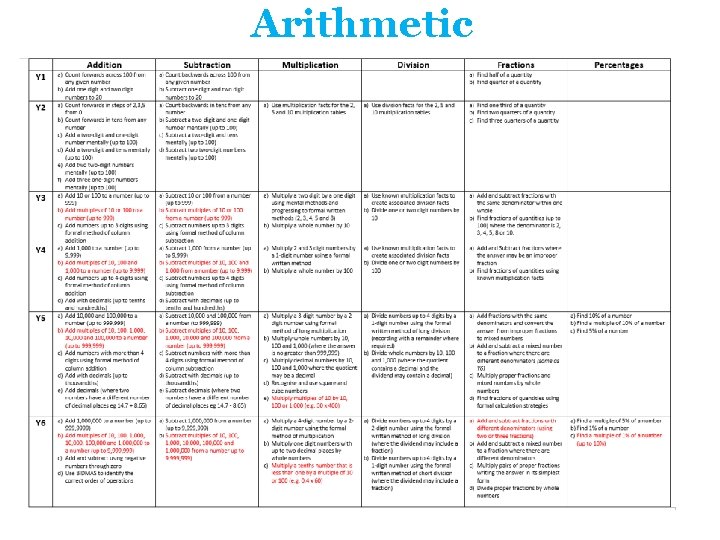
Arithmetic
How can I help at home? • Talk to your child about their learning, what they learned in their maths lessons each day and anything they might be finding challenging. • Discuss maths in the world around them – it’s everywhere! • Encourage them to be problem solvers – asking 'Why? ', 'How? ' or 'Prove it!' rather than simply giving answers. • Speak positively about mathematics !
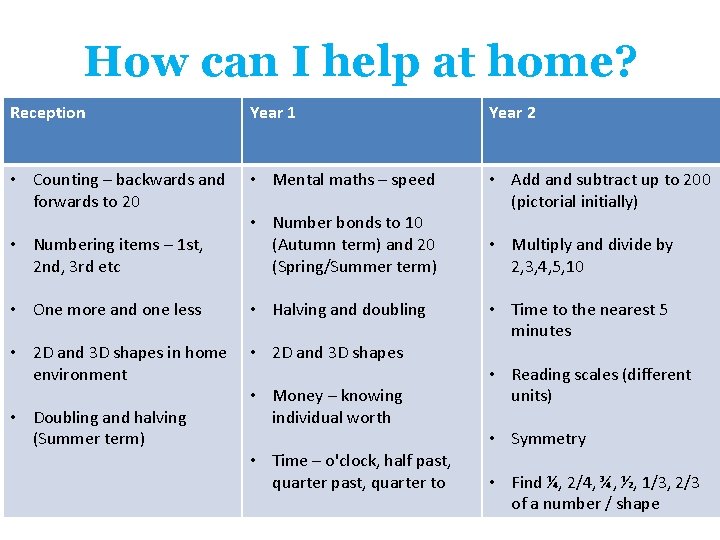
How can I help at home? Reception Year 1 Year 2 • Counting – backwards and forwards to 20 • Mental maths – speed • Add and subtract up to 200 (pictorial initially) • Numbering items – 1 st, 2 nd, 3 rd etc • Number bonds to 10 (Autumn term) and 20 (Spring/Summer term) • One more and one less • Halving and doubling • 2 D and 3 D shapes in home • environment • • Doubling and halving (Summer term) • 2 D and 3 D shapes Money – knowing individual worth Time – o'clock, half past, quarter past, quarter to • Multiply and divide by 2, 3, 4, 5, 10 • Time to the nearest 5 minutes • Reading scales (different units) • Symmetry • Find ¼, 2/4, ¾, ½, 1/3, 2/3 of a number / shape
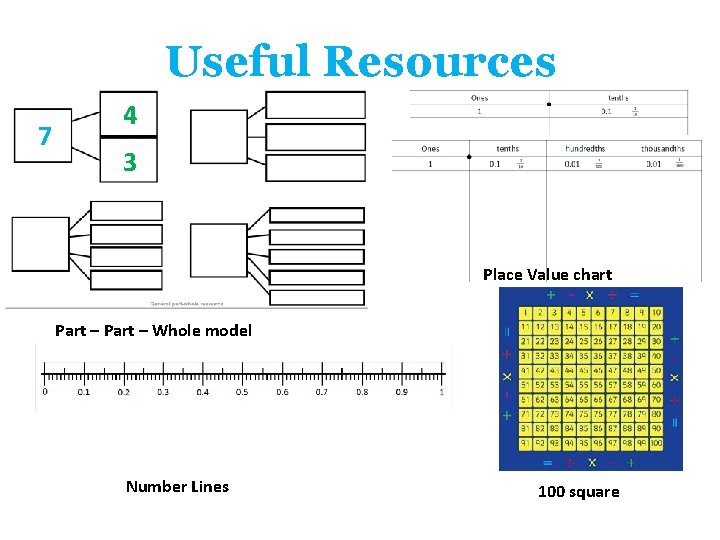
Useful Resources 7 4 3 Place Value chart Part – Whole model Number Lines 100 square
Questions?