
Mathematical Structures of Loopy Belief Propagation and Cluster
Mathematical Structures of Loopy Belief Propagation and Cluster Variation Method Kazuyuki Tanaka Graduate School of Information Sciences Tohoku University, Japan kazu@smapip. is. tohoku. ac. jp http: //www. smapip. is. tohoku. ac. jp/~kazu/ 16 September, 2008 IW-SMI 2008 1
Contents 1. Introduction 2. Conventional Belief Propagation 3. Interpretation of Adaptive TAP method by Cluster Variation Method 4. Extension of Adaptive TAP method 5. Quantum Belief Propagation 6. Concluding Remarks 16 September, 2008 IW-SMI 2008 2
Abstract We review of conventional generalized loopy belief propagation based on cluster variation method. Some interpretations and extensions of the adaptive TAP method are given by using the cluster variation method. Conventional formalisms and extensions of the quantum belief propagation are also summarized. 16 September, 2008 IW-SMI 2008 3
Belief Propagation (BP) has been proposed in order to achieve probabilistic inference systems (Pearl, 1988). It has been suggested that BP has a closed relationship to mean field methods in the statistical mechanics (Kabashima and Saad 1998). Generalizations of the BP have been proposed based on the cluster variation method which is one of the advanced mean field methods in the statistical mechanics (Yedidia, Freeman and Weiss, 2000). 16 September, 2008 IW-SMI 2008 4
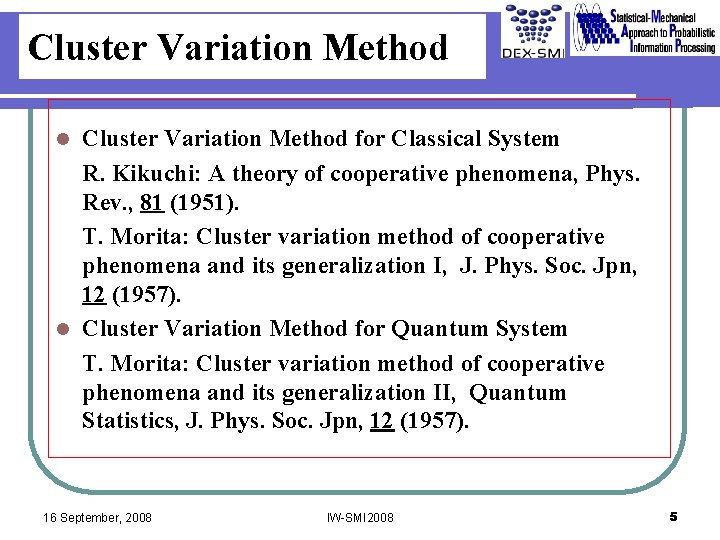
Cluster Variation Method for Classical System R. Kikuchi: A theory of cooperative phenomena, Phys. Rev. , 81 (1951). T. Morita: Cluster variation method of cooperative phenomena and its generalization I, J. Phys. Soc. Jpn, 12 (1957). l Cluster Variation Method for Quantum System T. Morita: Cluster variation method of cooperative phenomena and its generalization II, Quantum Statistics, J. Phys. Soc. Jpn, 12 (1957). l 16 September, 2008 IW-SMI 2008 5
Contents 1. Introduction 2. Conventional Belief Propagation 3. Interpretation of Adaptive TAP method by Cluster Variation Method 4. Extension of Adaptive TAP method 5. Quantum Belief Propagation 6. Summary 16 September, 2008 IW-SMI 2008 6
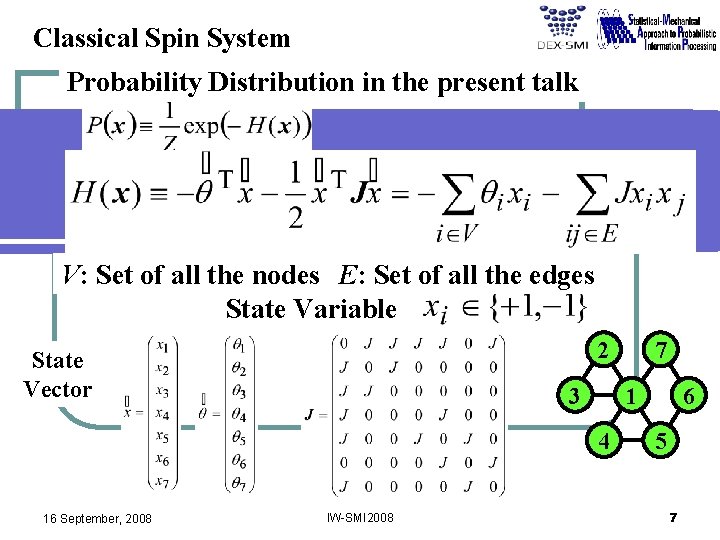
Classical Spin System Probability Distribution in the present talk V: Set of all the nodes E: Set of all the edges State Variable 2 State Vector 3 1 4 16 September, 2008 IW-SMI 2008 7 6 5 7
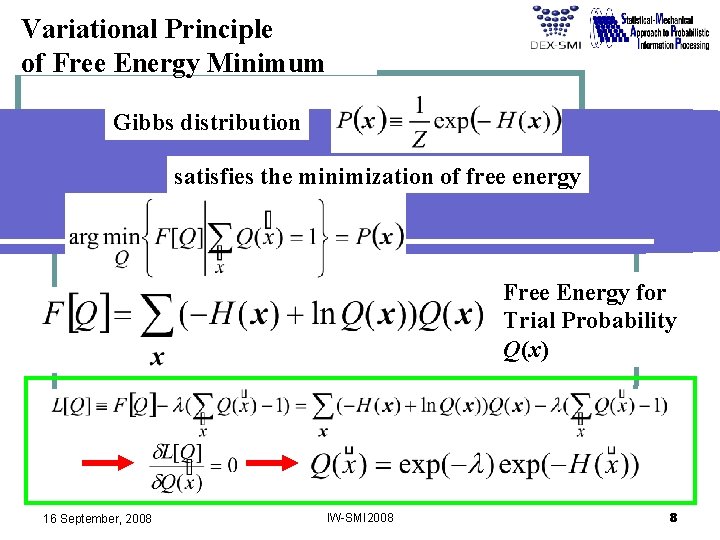
Variational Principle of Free Energy Minimum Gibbs distribution satisfies the minimization of free energy Free Energy for Trial Probability Q(x) 16 September, 2008 IW-SMI 2008 8

Tractable Probabilistic Model In the case of J=0 for all the edges ij Factorizable Form 2 3 1 4 16 September, 2008 IW-SMI 2008 7 6 5 9
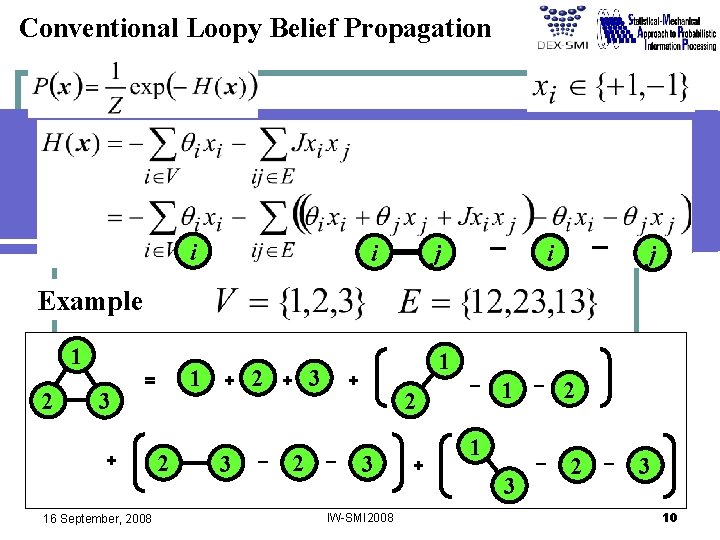
Conventional Loopy Belief Propagation i i - j Example 1 2 3 1 = + 16 September, 2008 2 + 3 + 3 - 2 - 3 IW-SMI 2008 1 2 + - 1 - 2 1 3 - 2 - 3 10
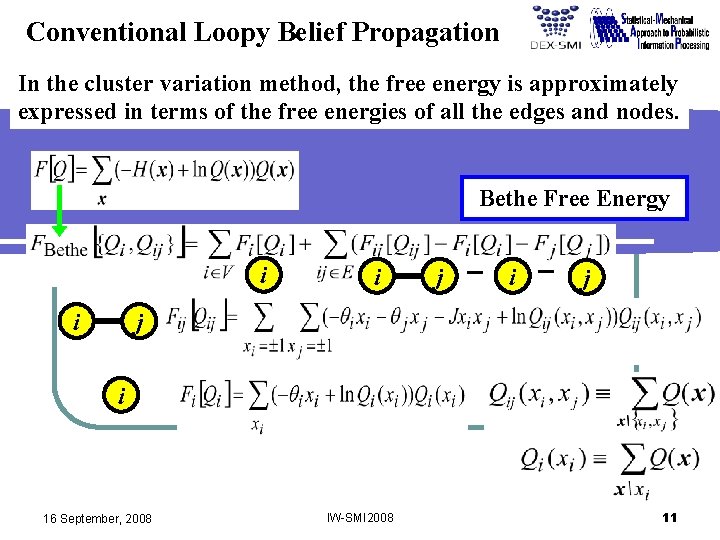
Conventional Loopy Belief Propagation In the cluster variation method, the free energy is approximately expressed in terms of the free energies of all the edges and nodes. Bethe Free Energy i i i j - i - j j i 16 September, 2008 IW-SMI 2008 11
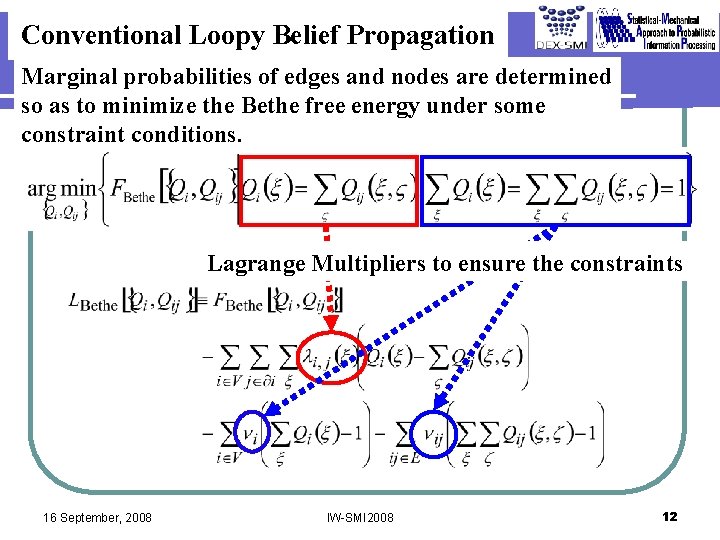
Conventional Loopy Belief Propagation Marginal probabilities of edges and nodes are determined so as to minimize the Bethe free energy under some constraint conditions. Lagrange Multipliers to ensure the constraints 16 September, 2008 IW-SMI 2008 12
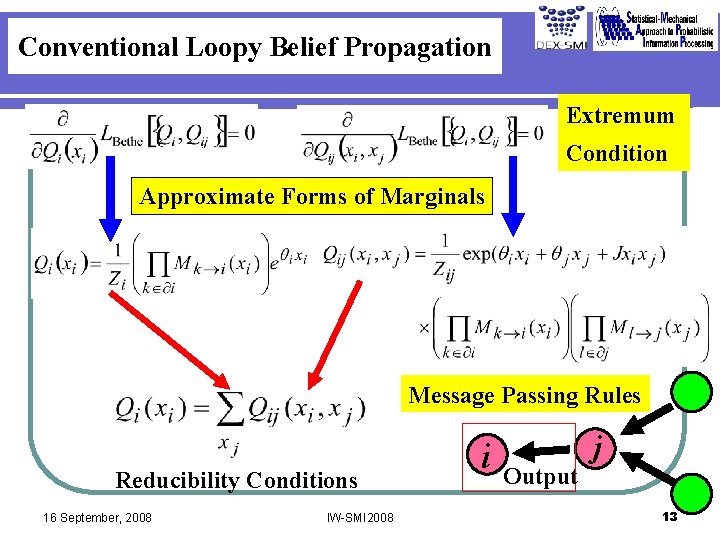
Conventional Loopy Belief Propagation Extremum Condition Approximate Forms of Marginals Message Passing Rules Reducibility Conditions 16 September, 2008 IW-SMI 2008 i Output j 13
Contents 1. Introduction 2. Conventional Belief Propagation 3. Interpretation of Adaptive TAP method by Cluster Variation Method 4. Extension of Adaptive TAP method 5. Quantum Belief Propagation 6. Summary 16 September, 2008 IW-SMI 2008 14

Tractable Probabilistic Model Gaussian graphical model Averages, variances and covariances are exactly calculated by using multidimensional Gaussian integral formulas. 16 September, 2008 IW-SMI 2008 15
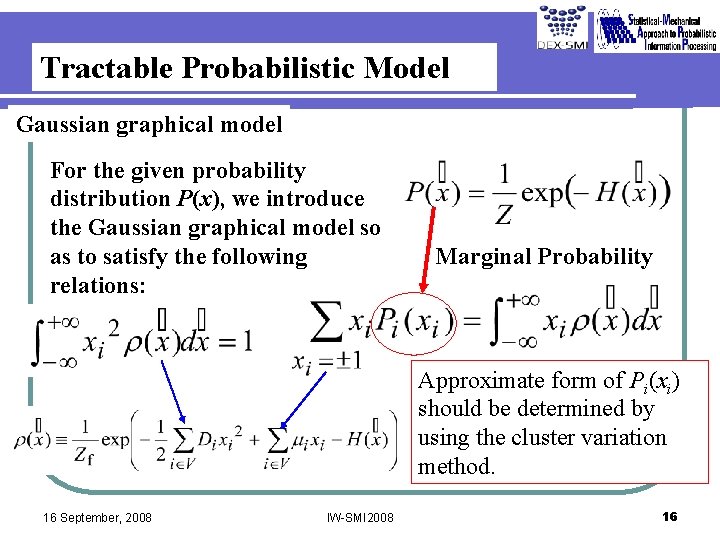
Tractable Probabilistic Model Gaussian graphical model For the given probability distribution P(x), we introduce the Gaussian graphical model so as to satisfy the following relations: Marginal Probability Approximate form of Pi(xi) should be determined by using the cluster variation method. 16 September, 2008 IW-SMI 2008 16
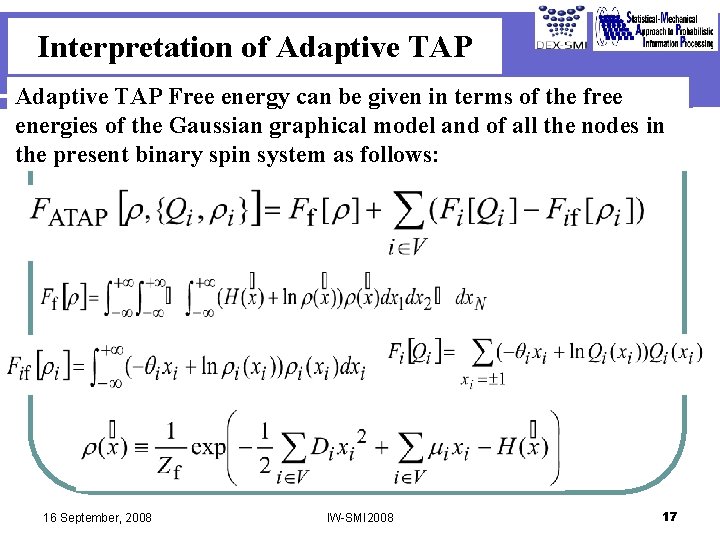
Interpretation of Adaptive TAP Free energy can be given in terms of the free energies of the Gaussian graphical model and of all the nodes in the present binary spin system as follows: 16 September, 2008 IW-SMI 2008 17
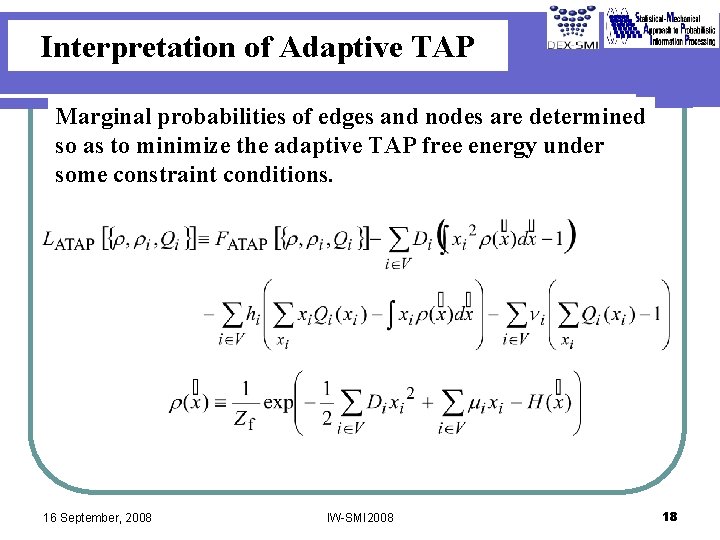
Interpretation of Adaptive TAP Marginal probabilities of edges and nodes are determined so as to minimize the adaptive TAP free energy under some constraint conditions. 16 September, 2008 IW-SMI 2008 18
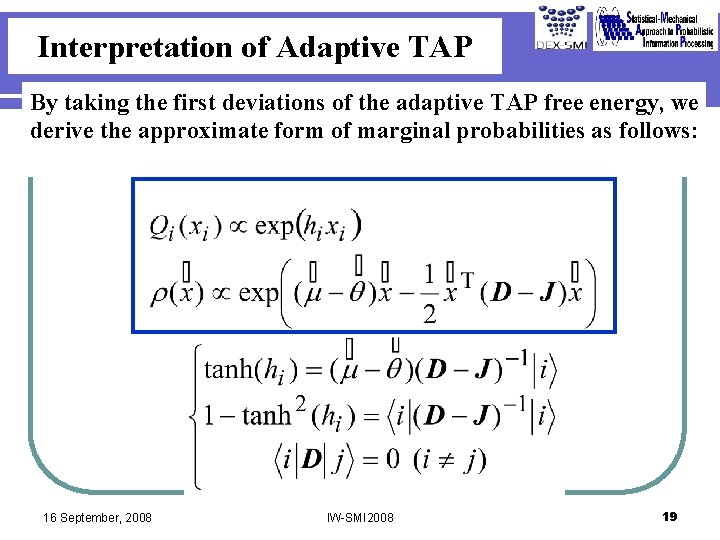
Interpretation of Adaptive TAP By taking the first deviations of the adaptive TAP free energy, we derive the approximate form of marginal probabilities as follows: 16 September, 2008 IW-SMI 2008 19
Contents 1. Introduction 2. Conventional Belief Propagation 3. Interpretation of Adaptive TAP method by Cluster Variation Method 4. Extension of Adaptive TAP method 5. Quantum Belief Propagation 6. Summary 16 September, 2008 IW-SMI 2008 20
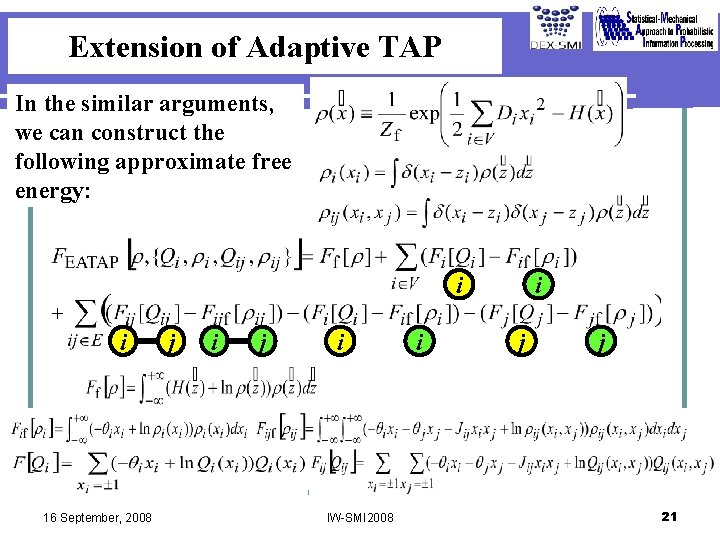
Extension of Adaptive TAP In the similar arguments, we can construct the following approximate free energy: i i 16 September, 2008 j i IW-SMI 2008 i i j j 21
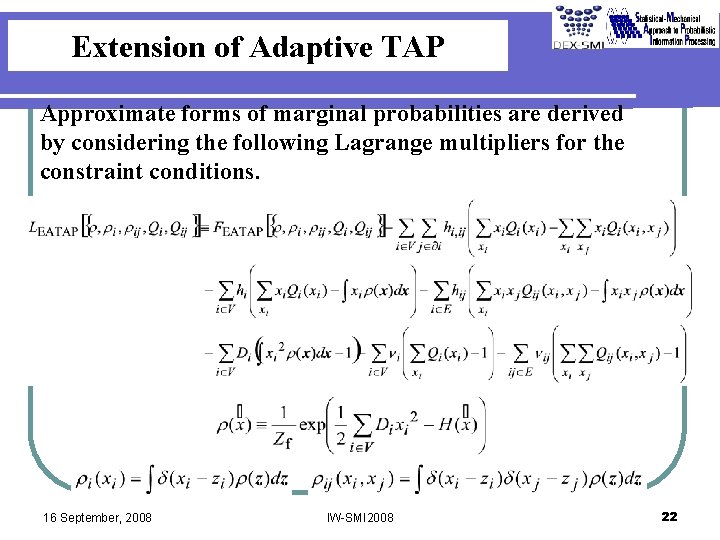
Extension of Adaptive TAP Approximate forms of marginal probabilities are derived by considering the following Lagrange multipliers for the constraint conditions. 16 September, 2008 IW-SMI 2008 22
Contents 1. Introduction 2. Conventional Belief Propagation 3. Interpretation of Adaptive TAP method by Cluster Variation Method 4. Extension of Adaptive TAP method 5. Quantum Belief Propagation 6. Summary 16 September, 2008 IW-SMI 2008 23
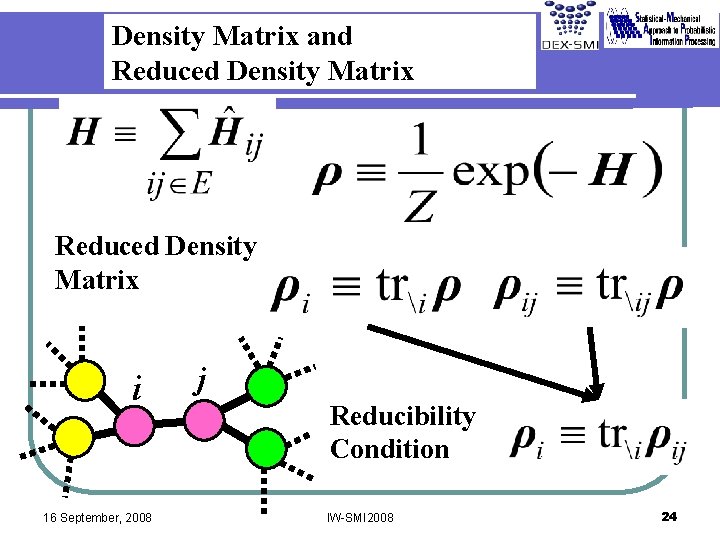
Density Matrix and Reduced Density Matrix i 16 September, 2008 j Reducibility Condition IW-SMI 2008 24
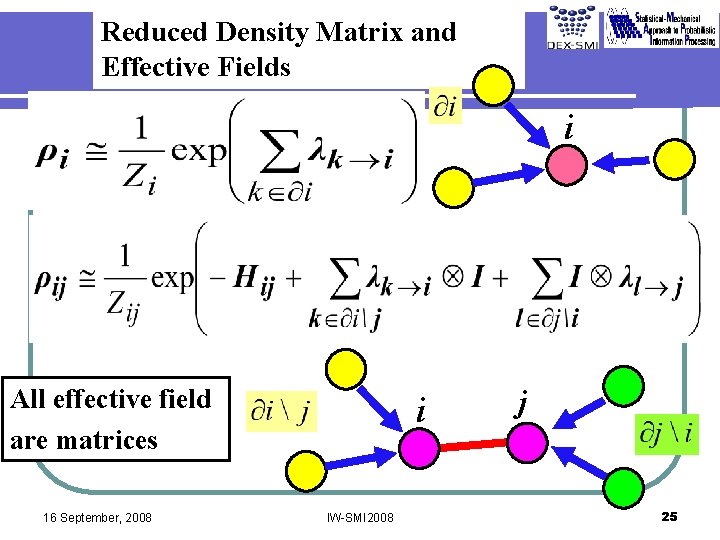
Reduced Density Matrix and Effective Fields i All effective field are matrices 16 September, 2008 i IW-SMI 2008 j 25
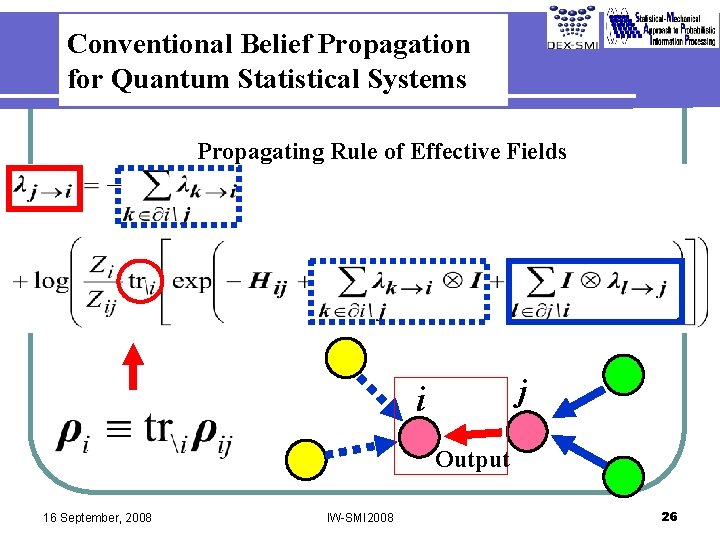
Conventional Belief Propagation for Quantum Statistical Systems Propagating Rule of Effective Fields j i Output 16 September, 2008 IW-SMI 2008 26
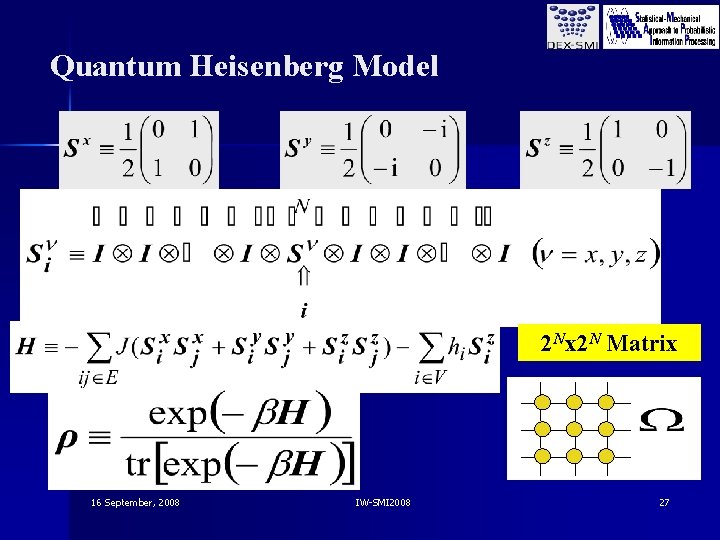
Quantum Heisenberg Model 2 Nx 2 N Matrix 16 September, 2008 IW-SMI 2008 27
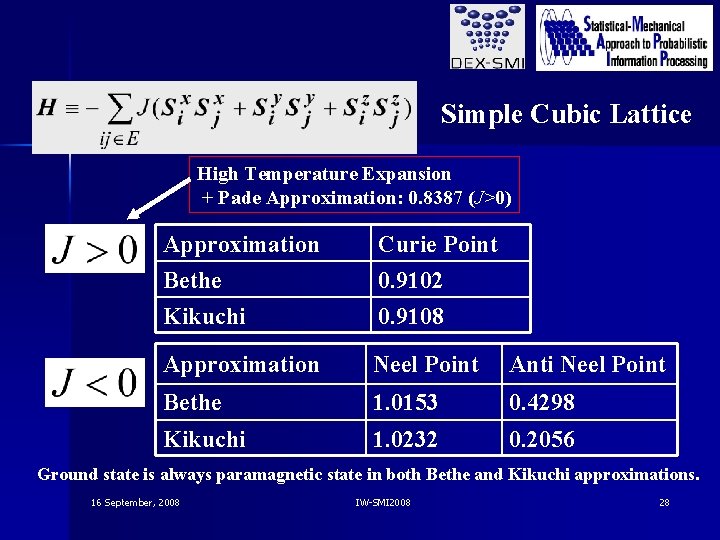
Simple Cubic Lattice High Temperature Expansion + Pade Approximation: 0. 8387 (J>0) Approximation Bethe Kikuchi Curie Point 0. 9102 0. 9108 Approximation Neel Point Anti Neel Point Bethe 1. 0153 0. 4298 Kikuchi 1. 0232 0. 2056 Ground state is always paramagnetic state in both Bethe and Kikuchi approximations. 16 September, 2008 IW-SMI 2008 28
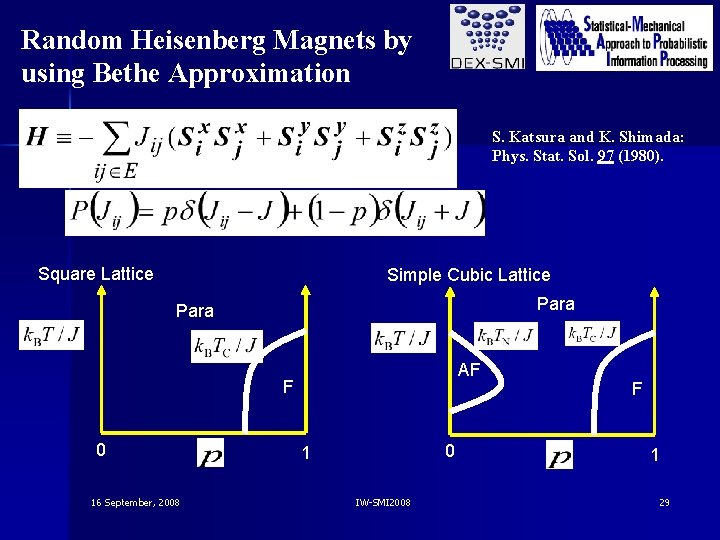
Random Heisenberg Magnets by using Bethe Approximation S. Katsura and K. Shimada: Phys. Stat. Sol. 97 (1980). Square Lattice Simple Cubic Lattice Para AF F 0 16 September, 2008 0 1 IW-SMI 2008 F 1 29
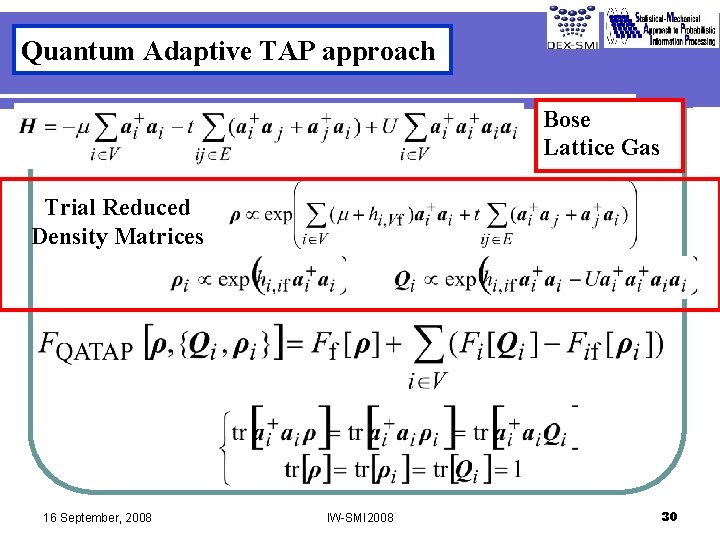
Quantum Adaptive TAP approach Bose Lattice Gas Trial Reduced Density Matrices 16 September, 2008 IW-SMI 2008 30
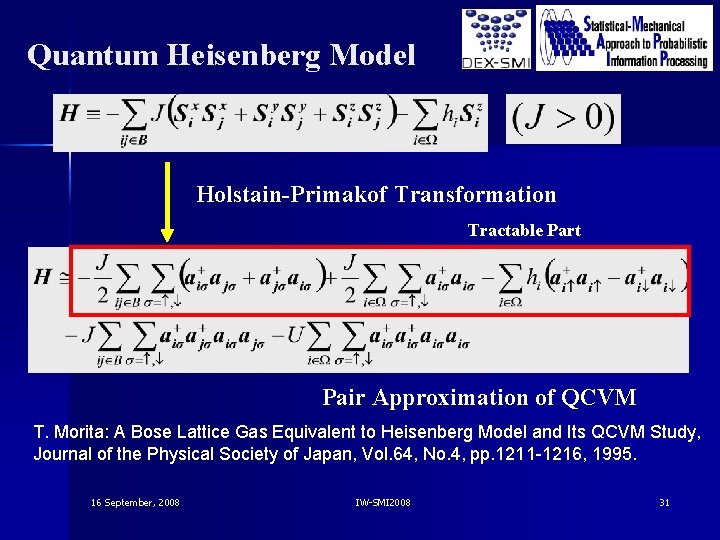
Quantum Heisenberg Model Holstain-Primakof Transformation Tractable Part Pair Approximation of QCVM T. Morita: A Bose Lattice Gas Equivalent to Heisenberg Model and Its QCVM Study, Journal of the Physical Society of Japan, Vol. 64, No. 4, pp. 1211 -1216, 1995. 16 September, 2008 IW-SMI 2008 31
Contents 1. Introduction 2. Conventional Belief Propagation 3. Interpretation of Adaptive TAP method by Cluster Variation Method 4. Extension of Adaptive TAP method 5. Quantum Belief Propagation 6. Summary 16 September, 2008 IW-SMI 2008 32
Summary We reviewed the conventional loopy belief propagation based on cluster variation method. Some interpretations and extensions of the adaptive TAP method have been given by using the cluster variation method. Conventional formalisms and extensions of the quantum belief propagation have been also summarized. 16 September, 2008 IW-SMI 2008 33
- Slides: 33