
Mathematical Reasoning Foundations and Framework Volume 1 2020
- Slides: 35
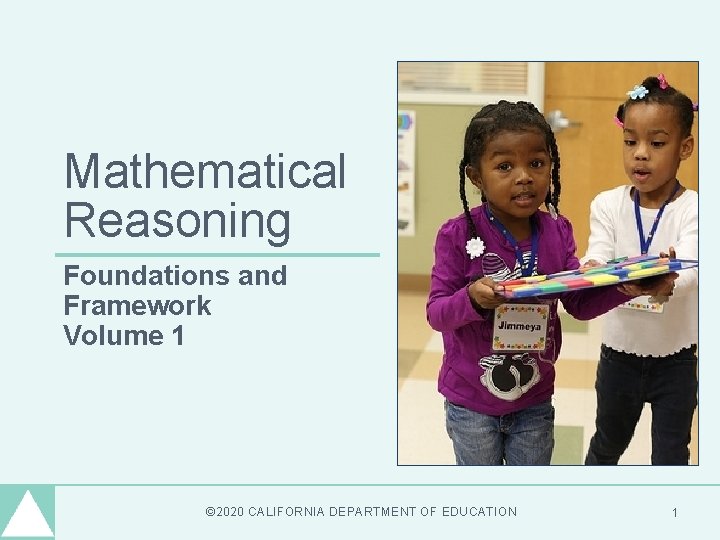
Mathematical Reasoning Foundations and Framework Volume 1 © 2020 CALIFORNIA DEPARTMENT OF EDUCATION 1
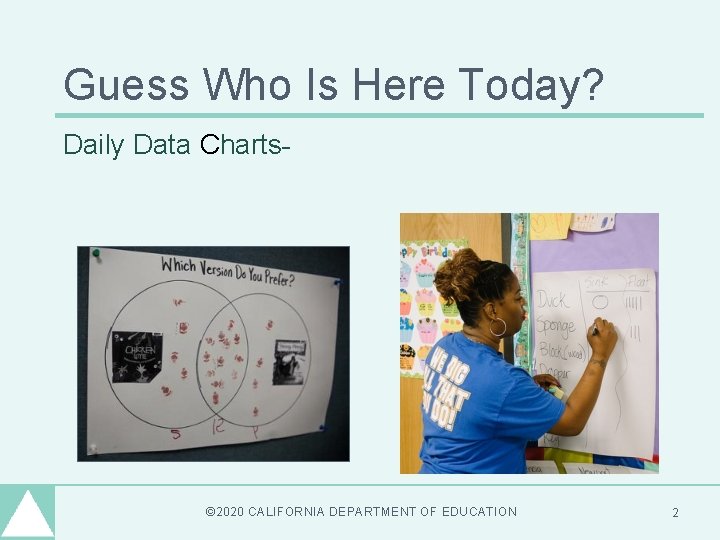
Guess Who Is Here Today? Daily Data Charts © 2020 CALIFORNIA DEPARTMENT OF EDUCATION 2
Objectives • Participants will become aware of key concepts to be developed in the Mathematical Reasoning strand of the California Preschool Learning Foundations (PLF). • Participants will become aware of key strategies in the California Preschool Curriculum Framework (PCF) regarding Mathematical Reasoning development. • Participants will consider how to support the development of mathematical reasoning foundations for children learning English as a second language. • Participants will consider how to adapt curriculum to ensure access for children with varying needs. © 2020 CALIFORNIA DEPARTMENT OF EDUCATION 3
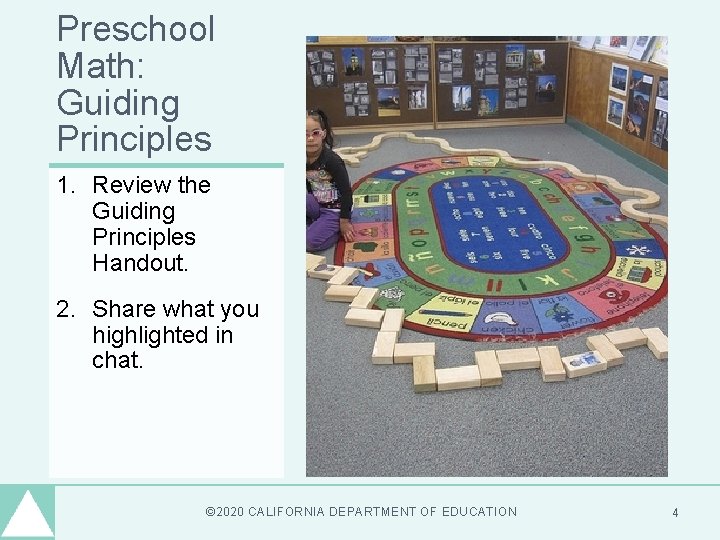
Preschool Math: Guiding Principles 1. Review the Guiding Principles Handout. 2. Share what you highlighted in chat. © 2020 CALIFORNIA DEPARTMENT OF EDUCATION 4
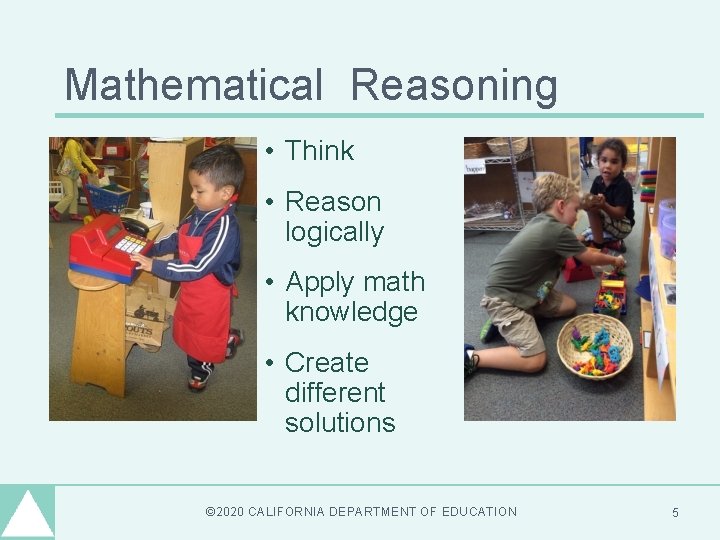
Mathematical Reasoning • Think • Reason logically • Apply math knowledge • Create different solutions © 2020 CALIFORNIA DEPARTMENT OF EDUCATION 5
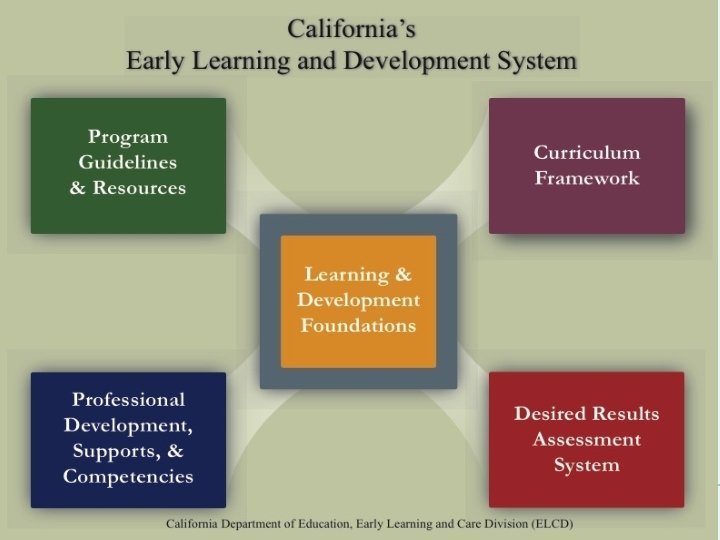
Early Learning Development System Start Here © 2020 CALIFORNIA DEPARTMENT OF EDUCATION 6
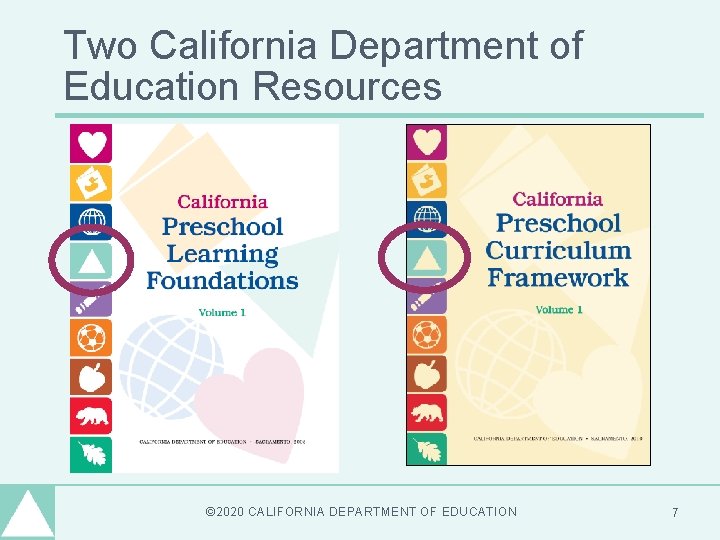
Two California Department of Education Resources © 2020 CALIFORNIA DEPARTMENT OF EDUCATION 7
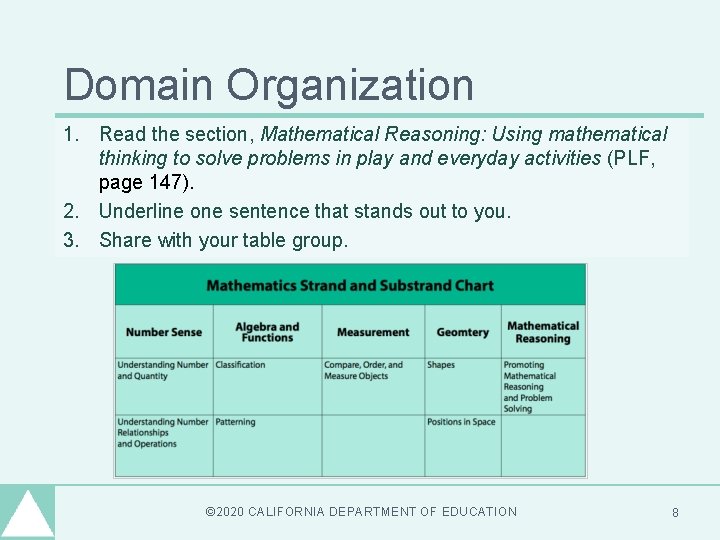
Domain Organization 1. Read the section, Mathematical Reasoning: Using mathematical thinking to solve problems in play and everyday activities (PLF, page 147). 2. Underline one sentence that stands out to you. 3. Share with your table group. © 2020 CALIFORNIA DEPARTMENT OF EDUCATION 8
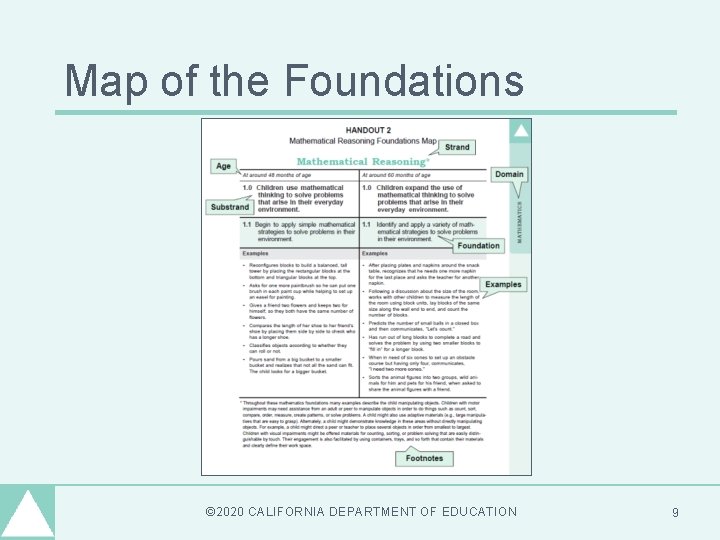
Map of the Foundations © 2020 CALIFORNIA DEPARTMENT OF EDUCATION 9
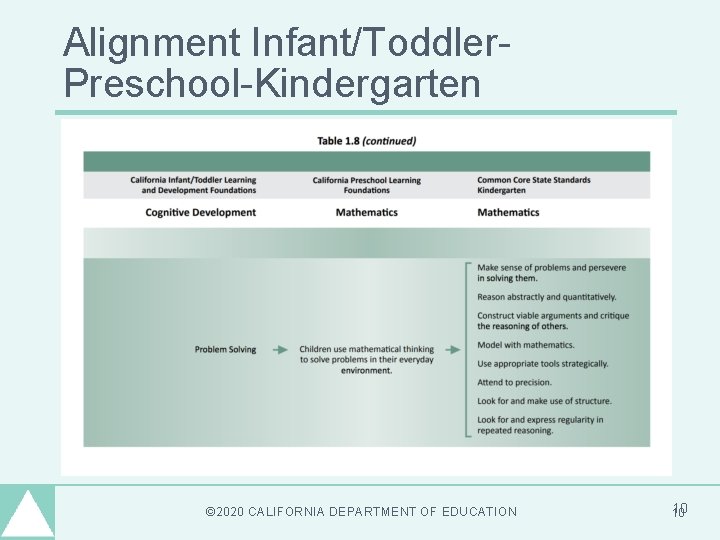
Alignment Infant/Toddler. Preschool-Kindergarten © 2020 CALIFORNIA DEPARTMENT OF EDUCATION 10 10
Overview Video • Watch the video for examples of how mathematical reasoning is integrated with the other four strands: – Algebra and Function – Geometry – Number Sense – Measurement © 2020 CALIFORNIA DEPARTMENT OF EDUCATION 11
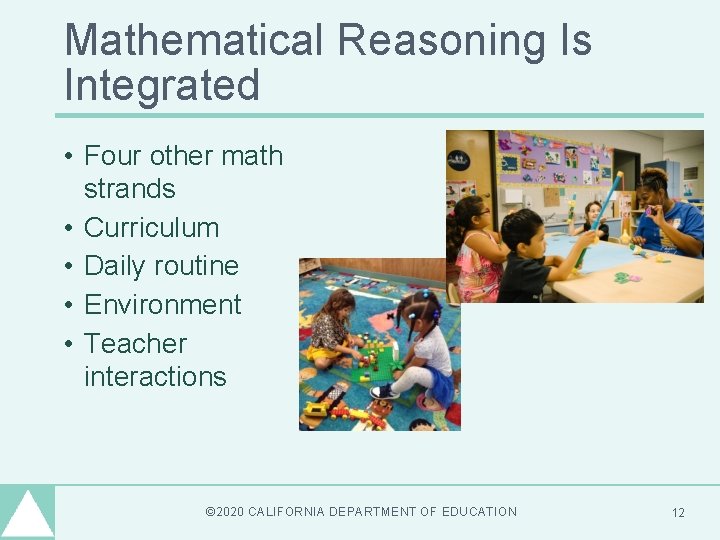
Mathematical Reasoning Is Integrated • Four other math strands • Curriculum • Daily routine • Environment • Teacher interactions © 2020 CALIFORNIA DEPARTMENT OF EDUCATION 12
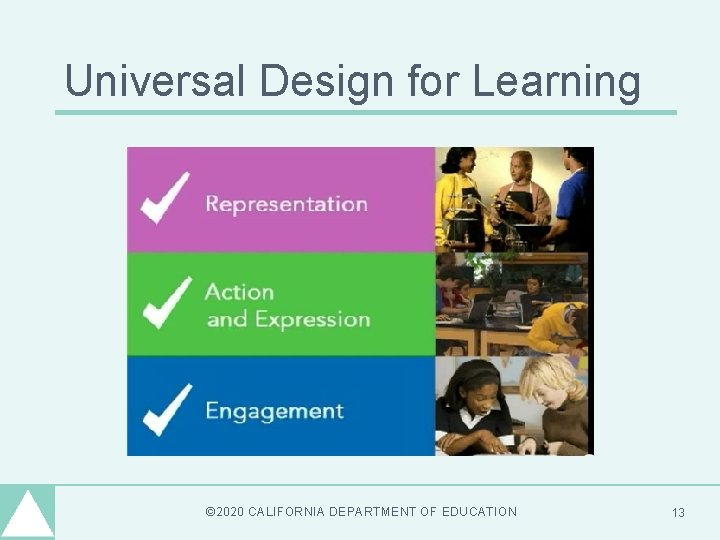
Universal Design for Learning © 2020 CALIFORNIA DEPARTMENT OF EDUCATION 13
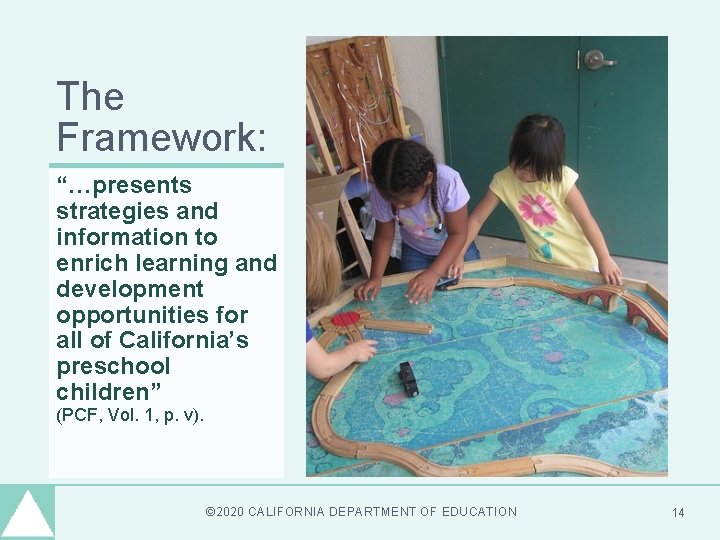
The Framework: “…presents strategies and information to enrich learning and development opportunities for all of California’s preschool children” (PCF, Vol. 1, p. v). © 2020 CALIFORNIA DEPARTMENT OF EDUCATION 14
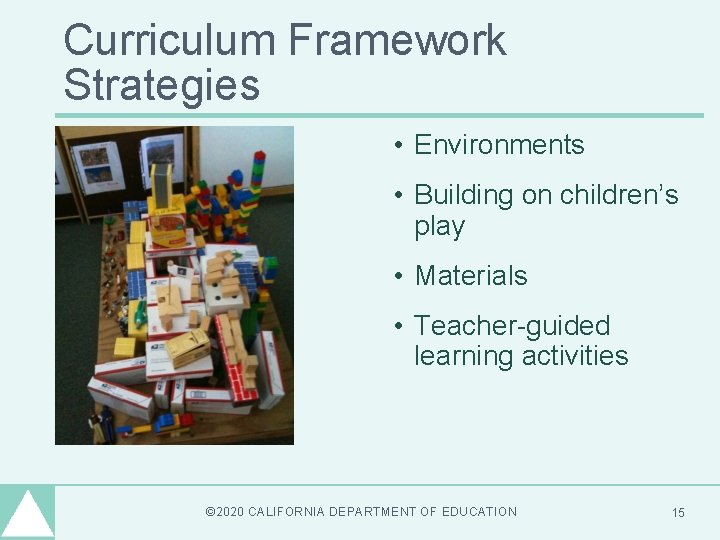
Curriculum Framework Strategies • Environments • Building on children’s play • Materials • Teacher-guided learning activities © 2020 CALIFORNIA DEPARTMENT OF EDUCATION 15
What Do the Mathematical Reasoning Vignettes Have in Common? 1. Each breakroom is assigned a strand. 2. Read a vignette in your strand. 3. Discuss what the adults were doing. 4. Write notes to share with large group. § Are there some things in common? © 2020 CALIFORNIA DEPARTMENT OF EDUCATION 16
Why Early Childhood Is the Right Time to Start Learning Math Dr. Clements says: Children like to play with math! What can you do to provide opportunities for this type of play? © 2020 CALIFORNIA DEPARTMENT OF EDUCATION 17
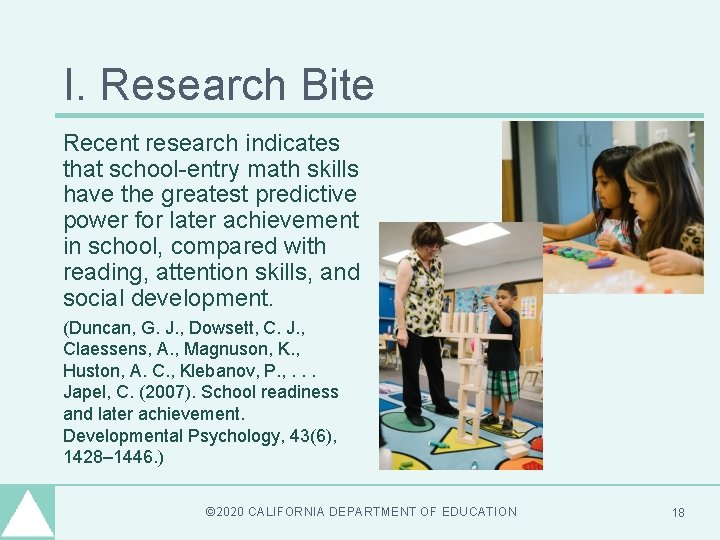
I. Research Bite Recent research indicates that school-entry math skills have the greatest predictive power for later achievement in school, compared with reading, attention skills, and social development. (Duncan, G. J. , Dowsett, C. J. , Claessens, A. , Magnuson, K. , Huston, A. C. , Klebanov, P. , . . . Japel, C. (2007). School readiness and later achievement. Developmental Psychology, 43(6), 1428– 1446. ) © 2020 CALIFORNIA DEPARTMENT OF EDUCATION 18
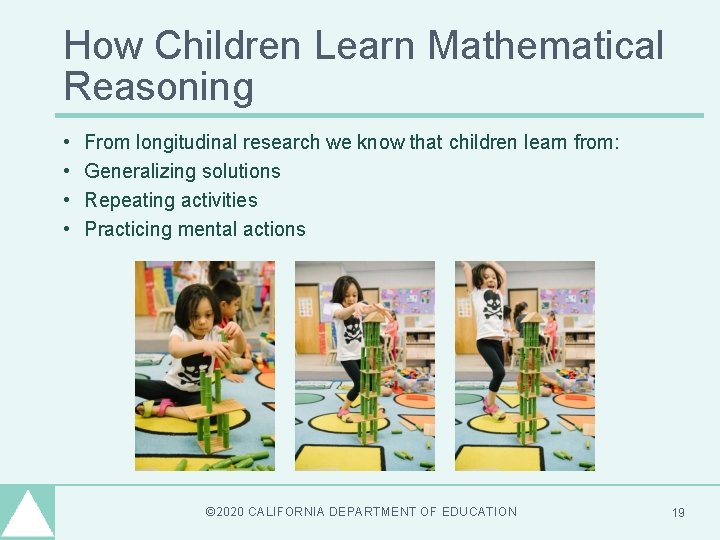
How Children Learn Mathematical Reasoning • • From longitudinal research we know that children learn from: Generalizing solutions Repeating activities Practicing mental actions © 2020 CALIFORNIA DEPARTMENT OF EDUCATION 19
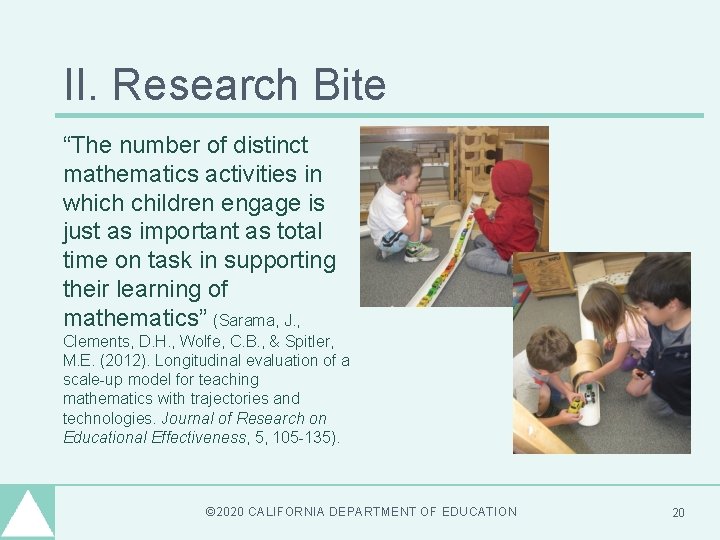
II. Research Bite “The number of distinct mathematics activities in which children engage is just as important as total time on task in supporting their learning of mathematics” (Sarama, J. , Clements, D. H. , Wolfe, C. B. , & Spitler, M. E. (2012). Longitudinal evaluation of a scale-up model for teaching mathematics with trajectories and technologies. Journal of Research on Educational Effectiveness, 5, 105 -135). © 2020 CALIFORNIA DEPARTMENT OF EDUCATION 20
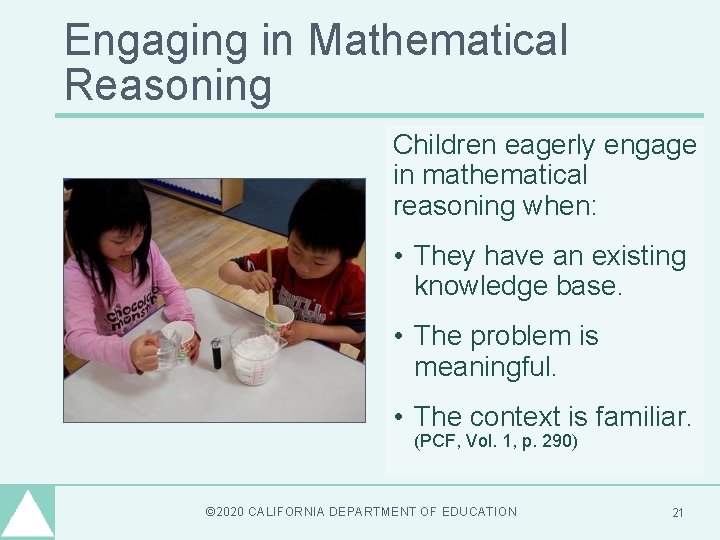
Engaging in Mathematical Reasoning Children eagerly engage in mathematical reasoning when: • They have an existing knowledge base. • The problem is meaningful. • The context is familiar. (PCF, Vol. 1, p. 290) © 2020 CALIFORNIA DEPARTMENT OF EDUCATION 21
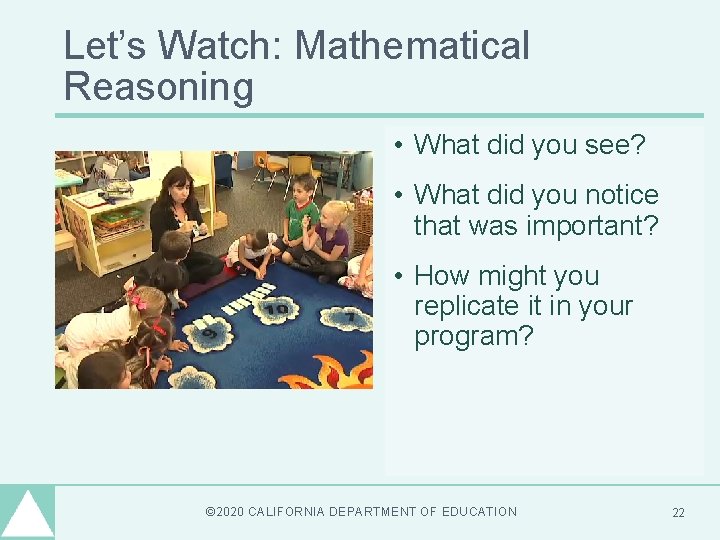
Let’s Watch: Mathematical Reasoning • What did you see? • What did you notice that was important? • How might you replicate it in your program? © 2020 CALIFORNIA DEPARTMENT OF EDUCATION 22
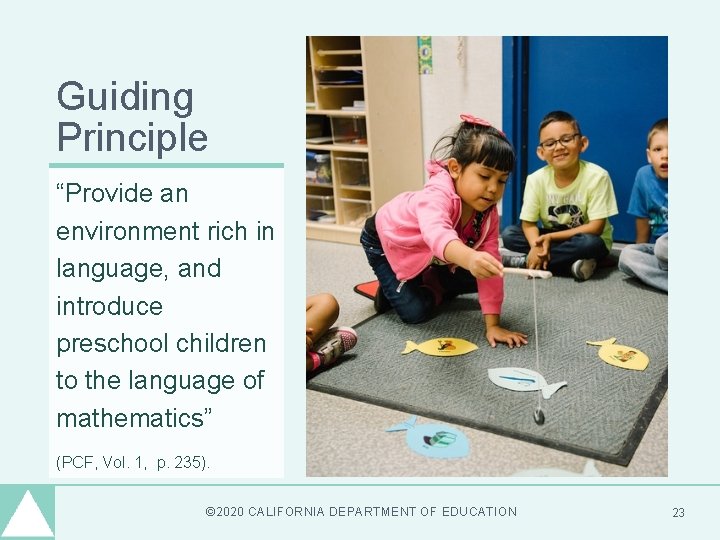
Guiding Principle “Provide an environment rich in language, and introduce preschool children to the language of mathematics” (PCF, Vol. 1, p. 235). © 2020 CALIFORNIA DEPARTMENT OF EDUCATION 23
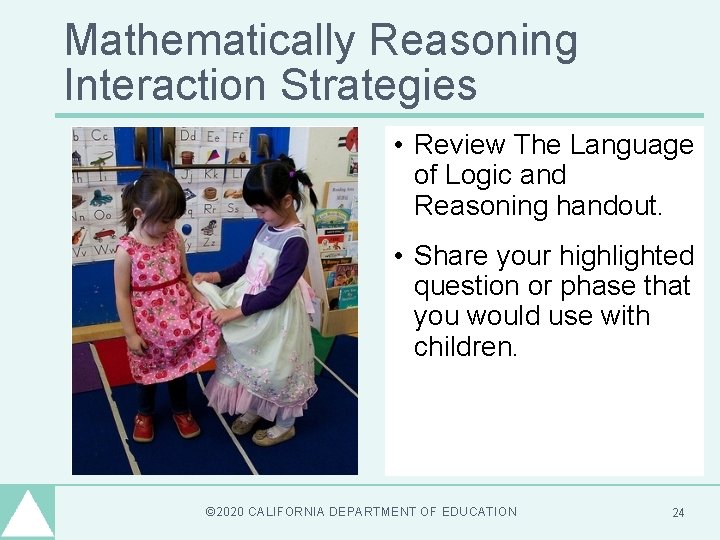
Mathematically Reasoning Interaction Strategies • Review The Language of Logic and Reasoning handout. • Share your highlighted question or phase that you would use with children. © 2020 CALIFORNIA DEPARTMENT OF EDUCATION 24
Minute to Win It • Get ready to write. • You have one minute on the clock. • While watching the silent video, write as many mathematical thinking prompts, questions, or comments a teacher may use during or after this experience. © 2020 CALIFORNIA DEPARTMENT OF EDUCATION 25
Minute to Win It Video © 2020 CALIFORNIA DEPARTMENT OF EDUCATION 26
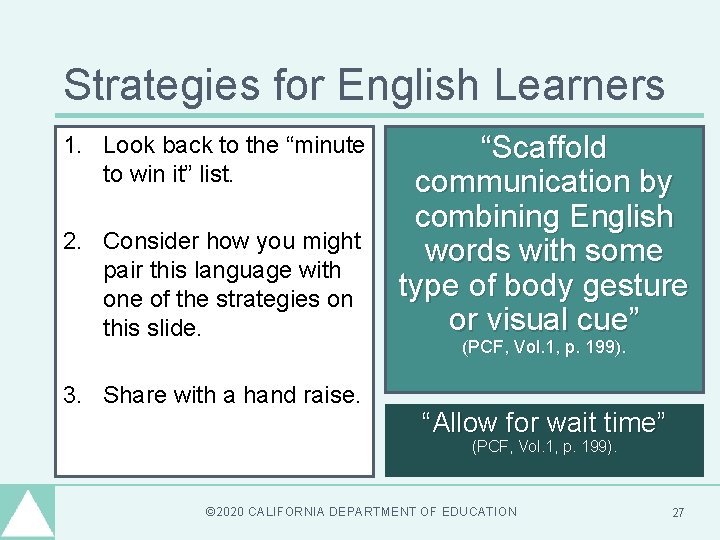
Strategies for English Learners 1. Look back to the “minute to win it” list. 2. Consider how you might pair this language with one of the strategies on this slide. 3. Share with a hand raise. “Scaffold communication by combining English words with some type of body gesture or visual cue” (PCF, Vol. 1, p. 199). “Allow for wait time” (PCF, Vol. 1, p. 199). © 2020 CALIFORNIA DEPARTMENT OF EDUCATION 27
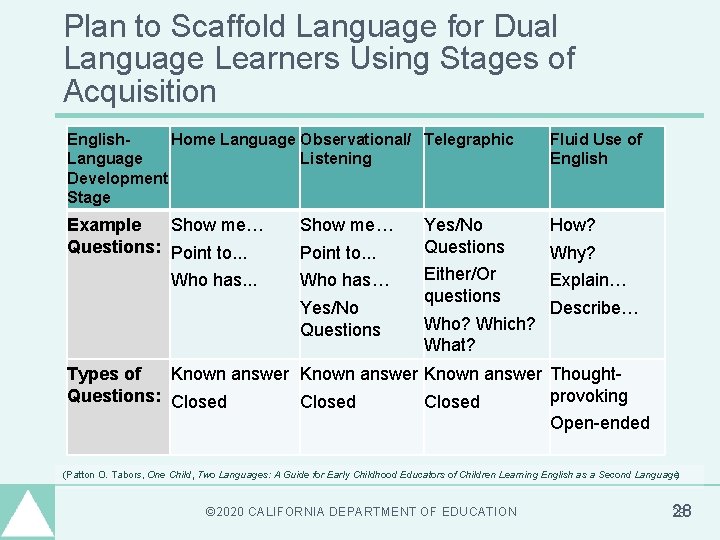
Plan to Scaffold Language for Dual Language Learners Using Stages of Acquisition English. Home Language Observational/ Telegraphic Language Listening Development Stage Fluid Use of English Example Show me… Questions: Point to. . . Yes/No Questions How? Either/Or questions Explain… Who has. . . Show me… Point to. . . Who has… Yes/No Questions Who? Which? What? Why? Describe… Types of Known answer Thought. Questions: Closed provoking Closed Open-ended (Patton O. Tabors, One Child, Two Languages: A Guide for Early Childhood Educators of Children Learning English as a Second Language) © 2020 CALIFORNIA DEPARTMENT OF EDUCATION 28 28
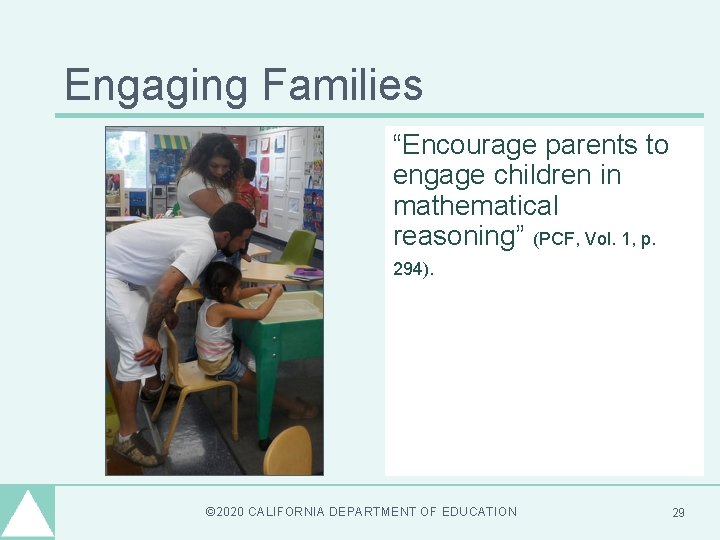
Engaging Families “Encourage parents to engage children in mathematical reasoning” (PCF, Vol. 1, p. 294). © 2020 CALIFORNIA DEPARTMENT OF EDUCATION 29
Encouraging Families It is important to encourage families to: v Recognize mathematics in daily events and interactions. v Ask questions related to everyday situations. v Play mathematical games. v Ask children to explain their thinking. v Model solutions. © 2020 CALIFORNIA DEPARTMENT OF EDUCATION 30
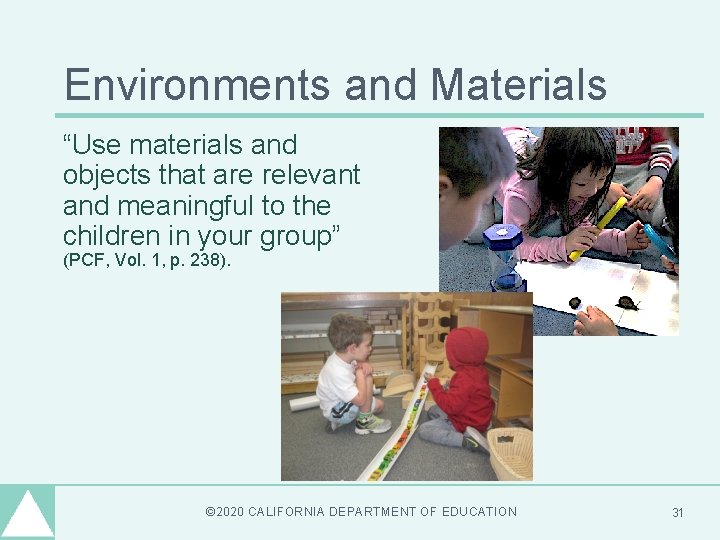
Environments and Materials “Use materials and objects that are relevant and meaningful to the children in your group” (PCF, Vol. 1, p. 238). © 2020 CALIFORNIA DEPARTMENT OF EDUCATION 31
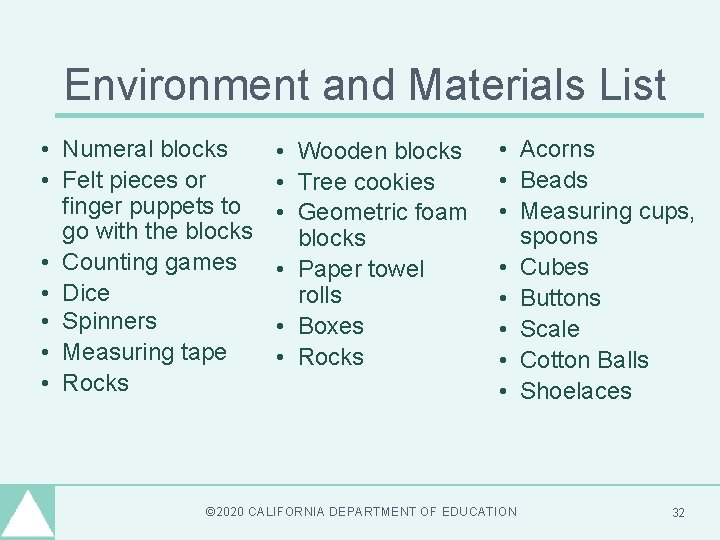
Environment and Materials List • Numeral blocks • Felt pieces or finger puppets to go with the blocks • Counting games • Dice • Spinners • Measuring tape • Rocks • Wooden blocks • Tree cookies • Geometric foam blocks • Paper towel rolls • Boxes • Rocks • Acorns • Beads • Measuring cups, spoons • Cubes • Buttons • Scale • Cotton Balls • Shoelaces © 2020 CALIFORNIA DEPARTMENT OF EDUCATION 32
Mathematize Your Environment • Read Handout: Math Environments and Materials • Write down the ideas/items you would like to add to your classroom on Handout: Creating Invitations Throughout the Environment— Taking Inventory. • Choose two of your favorite ideas. • Be ready to share. © 2020 CALIFORNIA DEPARTMENT OF EDUCATION 33
4 -3 -2 -1: Daily Data How will you add daily data to your classroom? Consider… • 4 ways to add data in the math environment. • 3 ways to partner with families using daily data. • 2 things to consider about the continuum of math reasoning when adding daily data. • 1 planned learning opportunity for daily data. © 2020 CALIFORNIA DEPARTMENT OF EDUCATION 34
Thank you for coming! www. cpin. us © 2018 © 2020 CALIFORNIA DEPARTMENT OF EDUCATION 35 35