
Mathematical Practices and NCTMs Processes Whats the difference
- Slides: 10
Mathematical Practices and NCTM’s Processes What’s the difference? 1
• “These practices rest on important processes and proficiencies with longstanding importance in mathematics education. ” – NCTM Process Standards – Adding it Up – Strands of Mathematical Proficiency Common Core State Standards for Mathematics (2010) 2
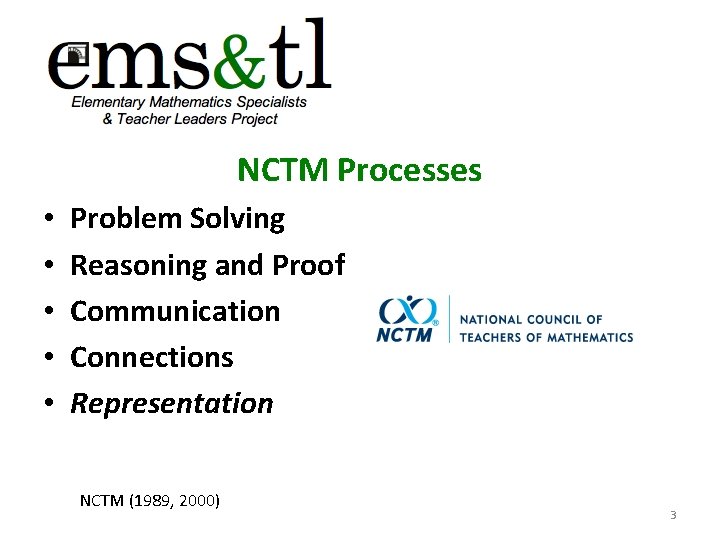
NCTM Processes • • • Problem Solving Reasoning and Proof Communication Connections Representation NCTM (1989, 2000) 3
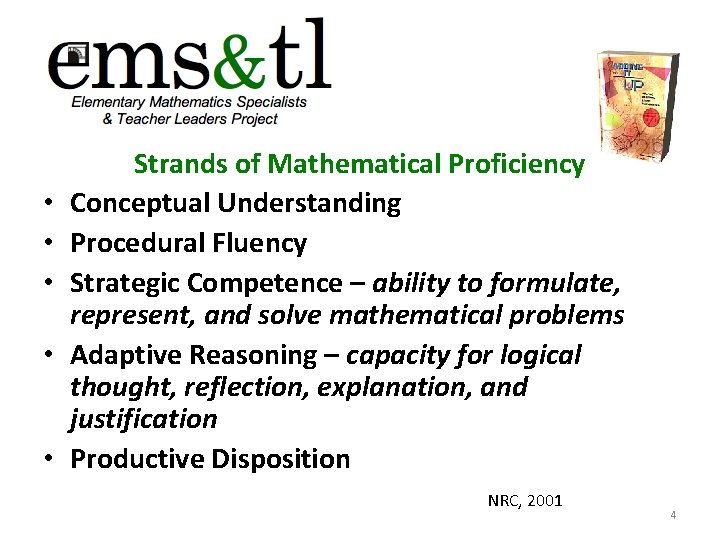
• • • Strands of Mathematical Proficiency Conceptual Understanding Procedural Fluency Strategic Competence – ability to formulate, represent, and solve mathematical problems Adaptive Reasoning – capacity for logical thought, reflection, explanation, and justification Productive Disposition NRC, 2001 4
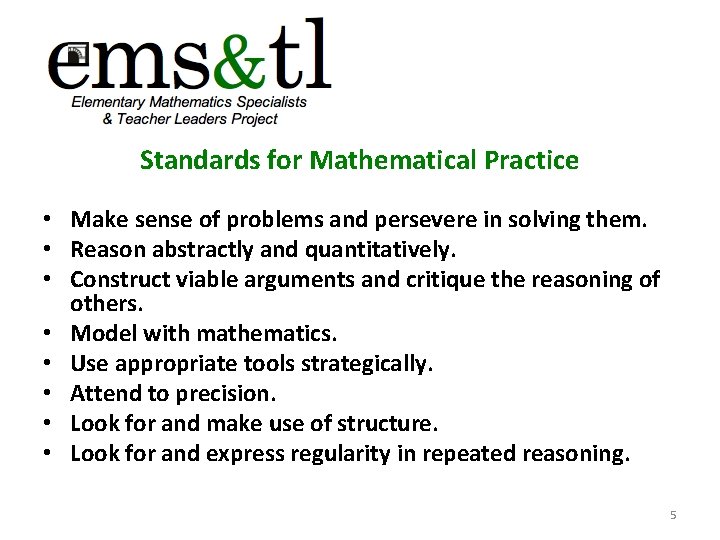
Standards for Mathematical Practice • Make sense of problems and persevere in solving them. • Reason abstractly and quantitatively. • Construct viable arguments and critique the reasoning of others. • Model with mathematics. • Use appropriate tools strategically. • Attend to precision. • Look for and make use of structure. • Look for and express regularity in repeated reasoning. 5
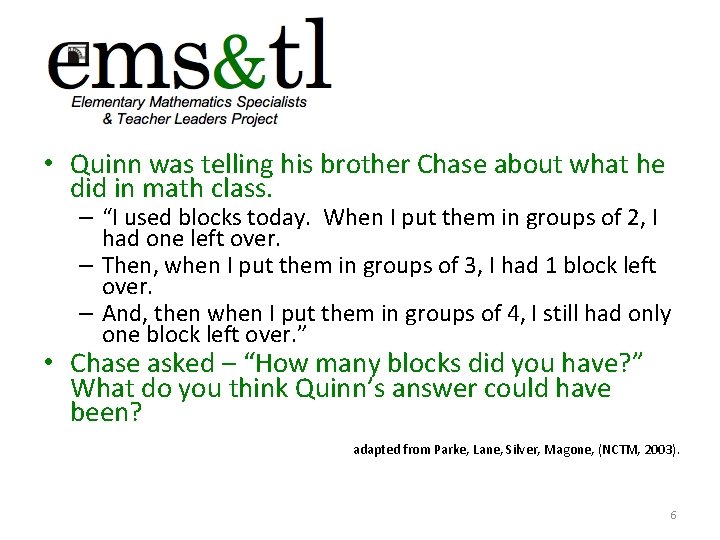
• Quinn was telling his brother Chase about what he did in math class. – “I used blocks today. When I put them in groups of 2, I had one left over. – Then, when I put them in groups of 3, I had 1 block left over. – And, then when I put them in groups of 4, I still had only one block left over. ” • Chase asked – “How many blocks did you have? ” What do you think Quinn’s answer could have been? adapted from Parke, Lane, Silver, Magone, (NCTM, 2003). 6
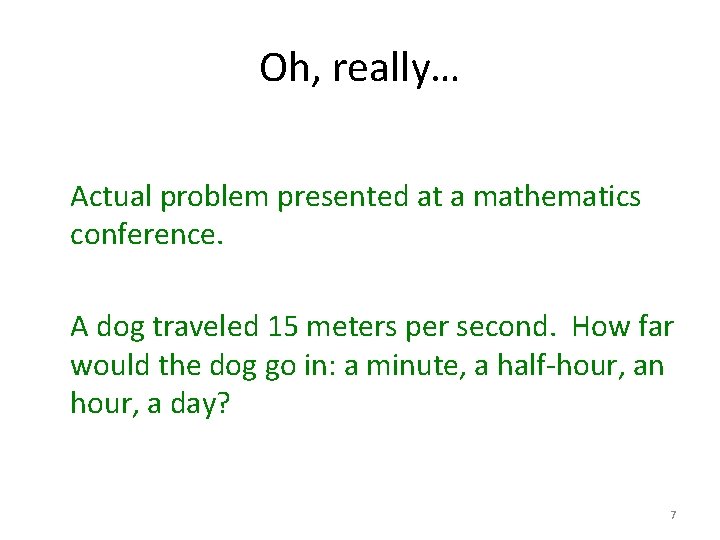
Oh, really… Actual problem presented at a mathematics conference. A dog traveled 15 meters per second. How far would the dog go in: a minute, a half-hour, an hour, a day? 7
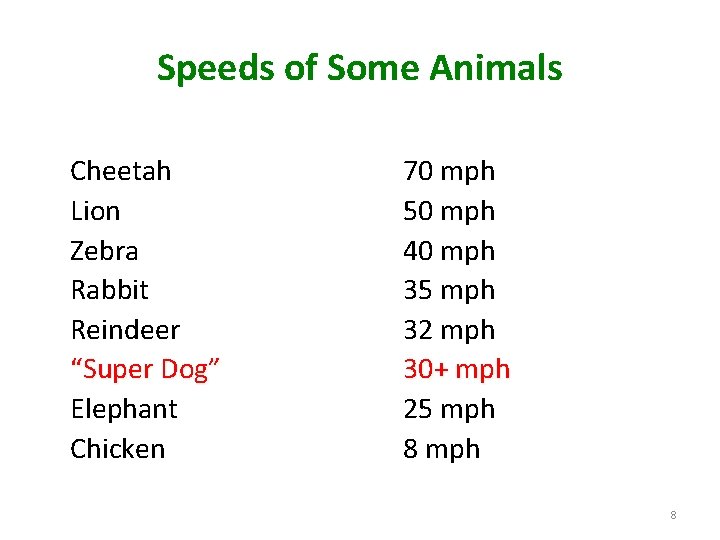
Speeds of Some Animals Cheetah Lion Zebra Rabbit Reindeer “Super Dog” Elephant Chicken 70 mph 50 mph 40 mph 35 mph 32 mph 30+ mph 25 mph 8
• Make sense of problems and persevere in solving them. • Reason abstractly and quantitatively. • Construct viable arguments and critique the reasoning of others. • Model with mathematics. • Use appropriate tools strategically. • Attend to precision. • Look for and make use of structure. • Look for and express regularity in repeated reasoning. Examples…, How might you use these? 9
1. How are the process standards used now? 2. How might the mathematical practices be used? 3. Challenges? 4. Needs? 5. Resources? 6. Other thoughts? 10