
Mathematical Practices 4 Model with mathematics Common Core


- Slides: 19
Mathematical Practices 4 Model with mathematics. Common Core State Standards © Copyright 2010. National Governors Association Center for Best Practices and Council of Chief State School Officers. All rights reserved.
You calculated simple probability. • Calculate experimental probabilities. • Design simulations and summarize data from simulations.
• theoretical probability • experimental probability • relative frequency • simulation • probability model
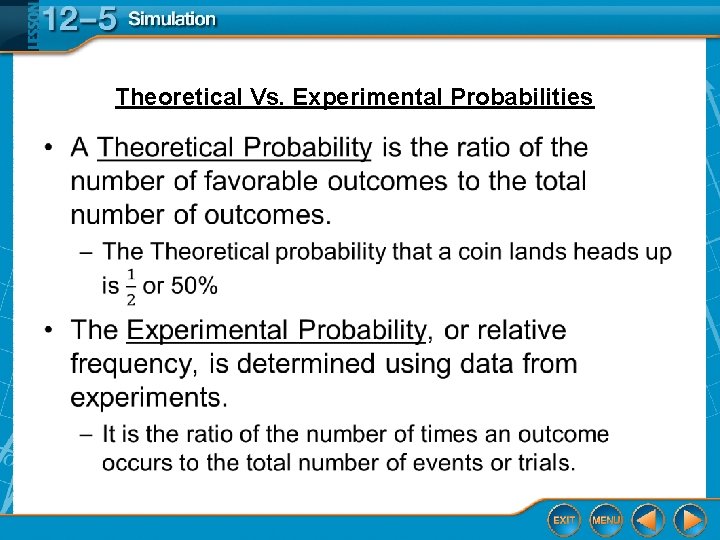
Theoretical Vs. Experimental Probabilities •
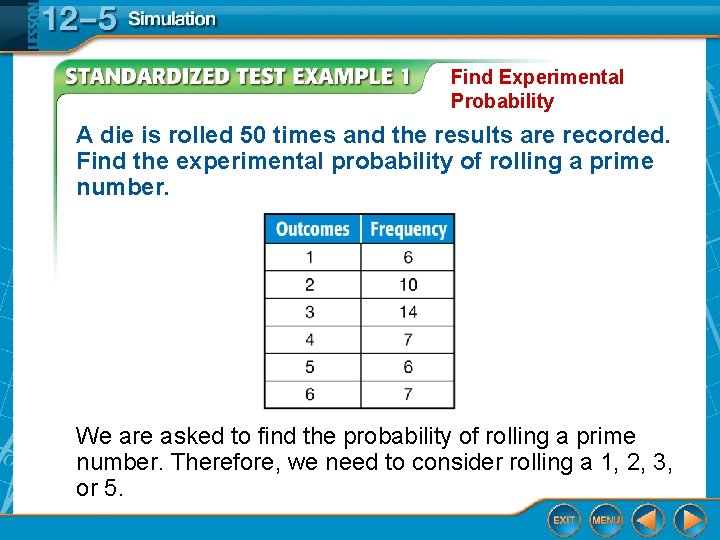
Find Experimental Probability A die is rolled 50 times and the results are recorded. Find the experimental probability of rolling a prime number. We are asked to find the probability of rolling a prime number. Therefore, we need to consider rolling a 1, 2, 3, or 5.
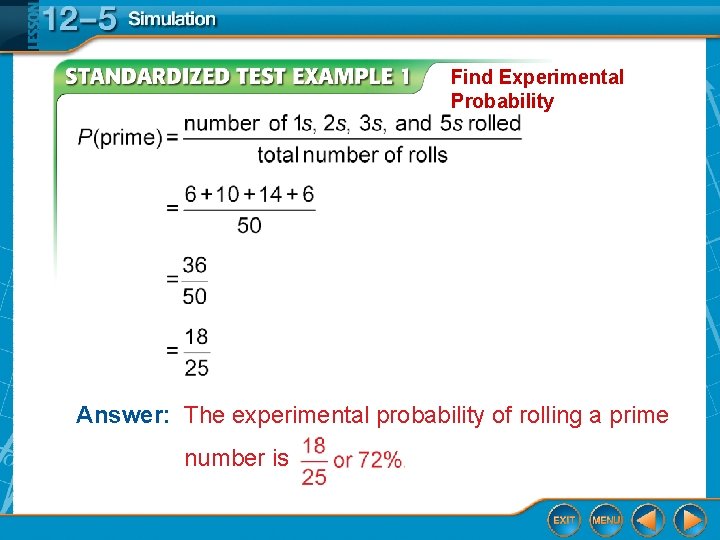
Find Experimental Probability Answer: The experimental probability of rolling a prime number is
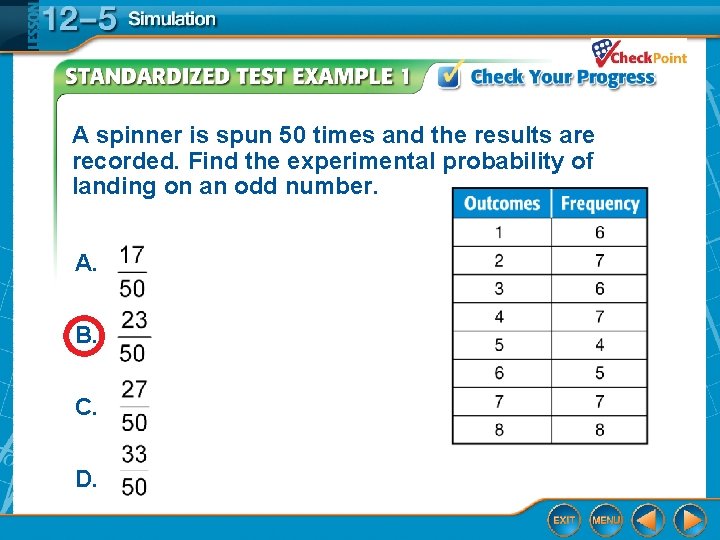
A spinner is spun 50 times and the results are recorded. Find the experimental probability of landing on an odd number. A. B. C. D.
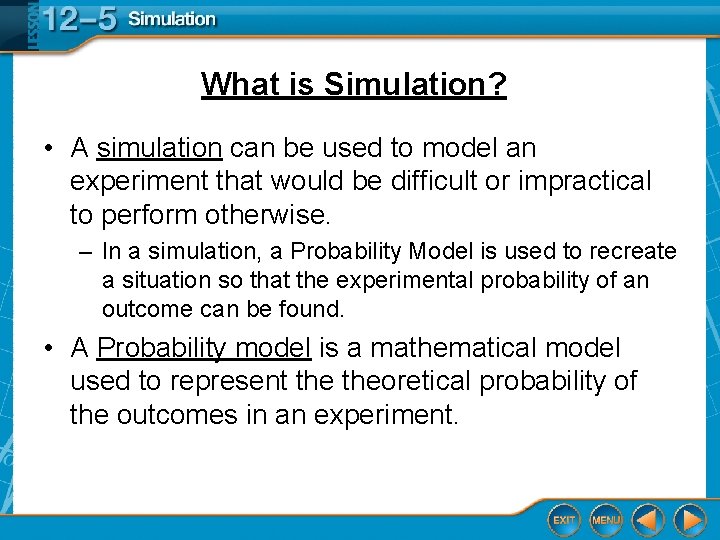
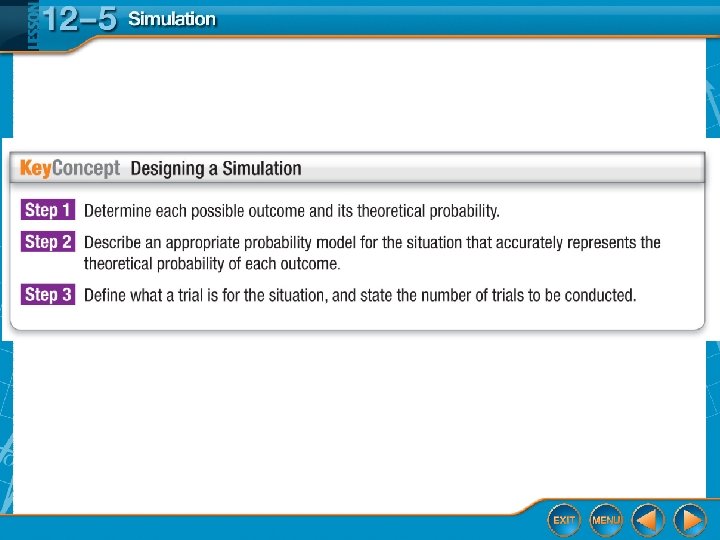
What is Simulation? • A simulation can be used to model an experiment that would be difficult or impractical to perform otherwise. – In a simulation, a Probability Model is used to recreate a situation so that the experimental probability of an outcome can be found. • A Probability model is a mathematical model used to represent theoretical probability of the outcomes in an experiment.
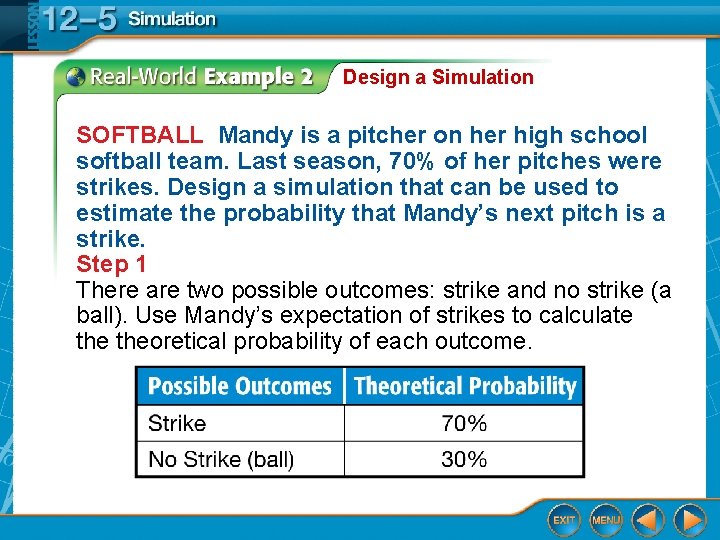
Design a Simulation SOFTBALL Mandy is a pitcher on her high school softball team. Last season, 70% of her pitches were strikes. Design a simulation that can be used to estimate the probability that Mandy’s next pitch is a strike. Step 1 There are two possible outcomes: strike and no strike (a ball). Use Mandy’s expectation of strikes to calculate theoretical probability of each outcome.
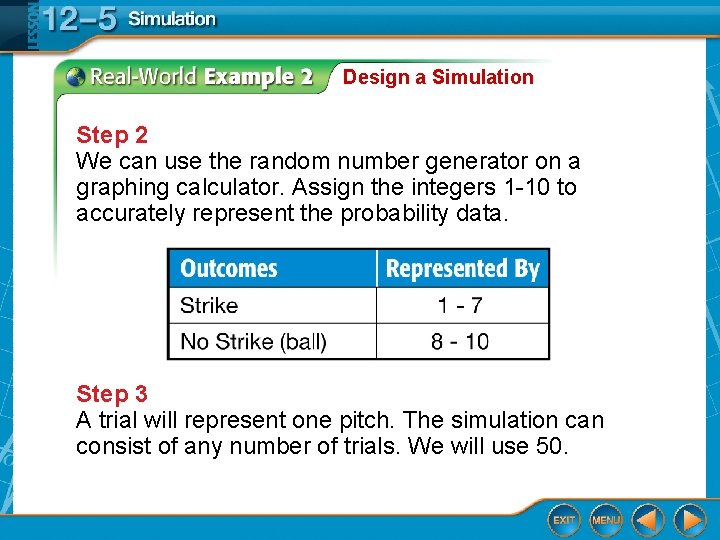
Design a Simulation Step 2 We can use the random number generator on a graphing calculator. Assign the integers 1 -10 to accurately represent the probability data. Step 3 A trial will represent one pitch. The simulation can consist of any number of trials. We will use 50.
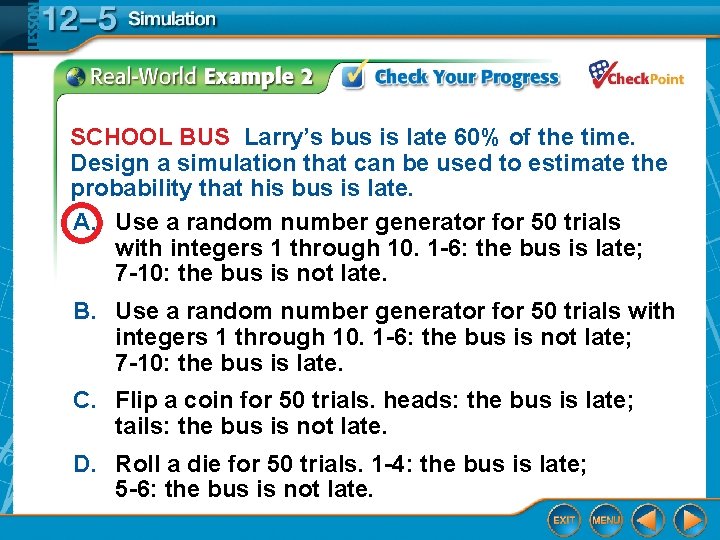
SCHOOL BUS Larry’s bus is late 60% of the time. Design a simulation that can be used to estimate the probability that his bus is late. A. Use a random number generator for 50 trials with integers 1 through 10. 1 -6: the bus is late; 7 -10: the bus is not late. B. Use a random number generator for 50 trials with integers 1 through 10. 1 -6: the bus is not late; 7 -10: the bus is late. C. Flip a coin for 50 trials. heads: the bus is late; tails: the bus is not late. D. Roll a die for 50 trials. 1 -4: the bus is late; 5 -6: the bus is not late.
Conduct and Evaluate a Simulation SOFTBALL Mandy is a pitcher on her high school softball team. Last season, 70% of her pitches were strikes. Conduct the simulation that can be used to estimate the probability that Mandy’s next pitch is a strike.
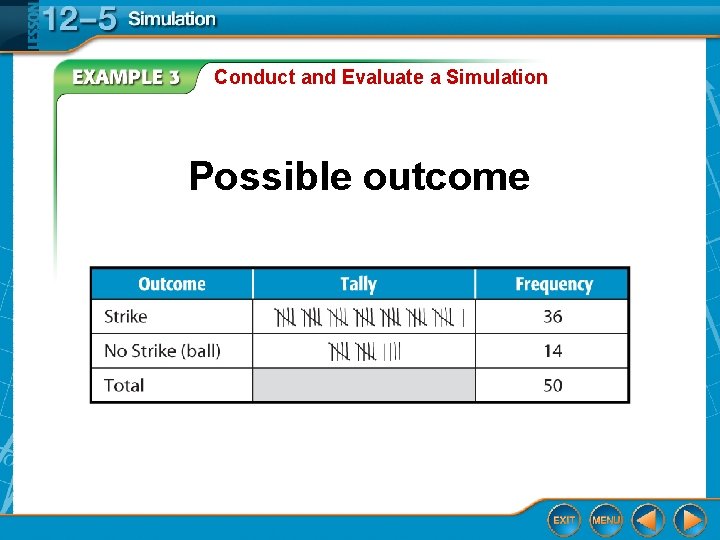
Conduct and Evaluate a Simulation Possible outcome
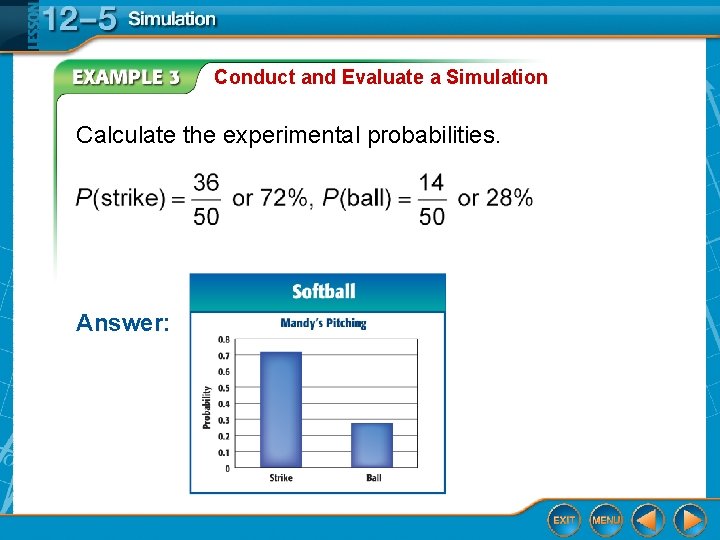
Conduct and Evaluate a Simulation Calculate the experimental probabilities. Answer:
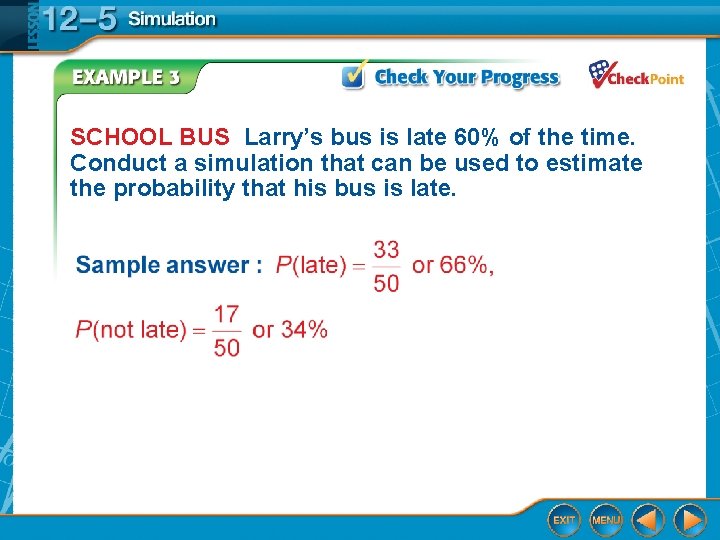
SCHOOL BUS Larry’s bus is late 60% of the time. Conduct a simulation that can be used to estimate the probability that his bus is late.
• Independent Practice/Homework: – P. 783 #’s 3 -8