
Mathematical Multifaceted Integrated Capability Centers MMICCs Sandy Landsberg
Mathematical Multifaceted Integrated Capability Centers (MMICCs) Sandy Landsberg Advanced Scientific Computing Research Office of Science Department of Energy March 6, 2013 1
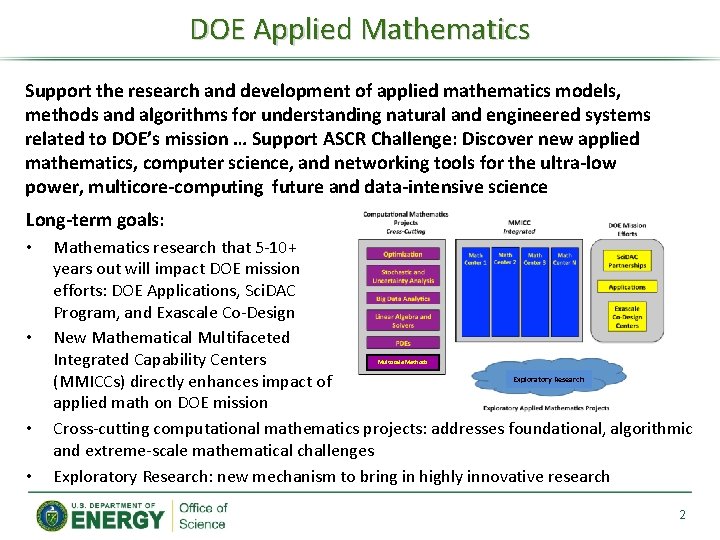
DOE Applied Mathematics Support the research and development of applied mathematics models, methods and algorithms for understanding natural and engineered systems related to DOE’s mission … Support ASCR Challenge: Discover new applied mathematics, computer science, and networking tools for the ultra-low power, multicore-computing future and data-intensive science Long-term goals: • • Mathematics research that 5 -10+ years out will impact DOE mission efforts: DOE Applications, Sci. DAC Program, and Exascale Co-Design New Mathematical Multifaceted Integrated Capability Centers Exploratory Research (MMICCs) directly enhances impact of applied math on DOE mission Cross-cutting computational mathematics projects: addresses foundational, algorithmic and extreme-scale mathematical challenges Exploratory Research: new mechanism to bring in highly innovative research Multiscale Methods • • 2
Mathematical Multifaceted Integrated Capability Centers (MMICCs) FY 12 solicitation for Mathematical Multifaceted Integrated Capability Centers. Proposals must: • Address the long-term mathematical challenges for one or more DOE grand challenges and that require new integrated, iterative processes across multiple mathematical disciplines. • Identify a set of interrelated mathematics research challenges that represent abstractions of the grand challenges. These abstractions would then be optimally addressed through a multifaceted, integrated approach. • Have impact to the DOE mission in the 5 -10+ year timeframe 3
MMICCs Solicitation Summary • Three Centers awarded: – Multifaceted Mathematics for Complex Energy Systems (M 2 ACS), Director: Mihai Anitescu (ANL) – Collaboratory of Mathematics for Mesoscopic Modeling of Materials (CM 4), Director: George Karniadakis (PNNL) – Dia. Mon. D: An Integrated Multifaceted Approach to Mathematics at the Interfaces of Data, Models, and Decisions, Co-Directors: Omar Ghattas (UT Austin) and Karen Willcox (MIT) • Broad DOE mission relevance: – Anitescu: Complex energy systems such as power grid and renewables integration – Karniadakis: Mesoscale modeling applicable to materials, chemistry, and biofuels – Ghattas & Willcox: Multiscale, multiphysics challenges related to subsurface flows and materials for energy storage • Lab and University Comparison – – Anitescu ($3. 5 M/year): $2, 600 K lab (74%), $900 K university subcontract (26%) Karniadakis ($3 M/year): $1, 975 K lab (66%), $1, 025 K university (34%) Ghattas & Willcox ($2. 5 M/year): $265 K lab (10%), $2, 235 K university (90%) Total ($9 M/year): $4, 840 K lab (54%), $4, 160 K university (46%) 4
What’s unique about these MMICCs projects? • Integration of mathematical sub-disciplines: – Allow applied mathematics researchers to take a broader view of the problem as a whole, and devise solution strategies that attack the problem in its entirety by building fundamental, multidisciplinary mathematical capabilities and tools – Requires applied mathematics researchers to work together in large, collaborative teams to more effectively address grand challenge problems • Careful balance with DOE applications – Motivated by DOE grand challenge problems, but this does not have tight coordination and application-focus of Sci. DAC Partnership efforts • A 5 -year research roadmap: – Annual individual research goals and integration goals with metrics of success • Annually reviewed by program manager and external review committee: – Evaluate technical progress against 5 -year roadmap – Evaluate effectiveness of integration toward long-term challenge problems • Outreach to research community – Serve as entry points for external researchers to more readily understand the mathematical challenges of DOE-relevant problems. 5
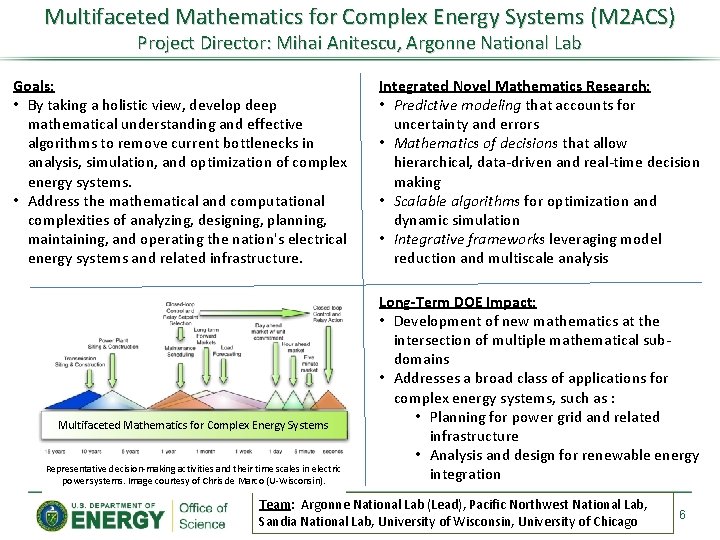
Multifaceted Mathematics for Complex Energy Systems (M 2 ACS) Project Director: Mihai Anitescu, Argonne National Lab Goals: • By taking a holistic view, develop deep mathematical understanding and effective algorithms to remove current bottlenecks in analysis, simulation, and optimization of complex energy systems. • Address the mathematical and computational complexities of analyzing, designing, planning, maintaining, and operating the nation's electrical energy systems and related infrastructure. Multifaceted Mathematics for Complex Energy Systems Representative decision-making activities and their time scales in electric power systems. Image courtesy of Chris de Marco (U-Wisconsin). Integrated Novel Mathematics Research: • Predictive modeling that accounts for uncertainty and errors • Mathematics of decisions that allow hierarchical, data-driven and real-time decision making • Scalable algorithms for optimization and dynamic simulation • Integrative frameworks leveraging model reduction and multiscale analysis Long-Term DOE Impact: • Development of new mathematics at the intersection of multiple mathematical subdomains • Addresses a broad class of applications for complex energy systems, such as : • Planning for power grid and related infrastructure • Analysis and design for renewable energy integration Team: Argonne National Lab (Lead), Pacific Northwest National Lab, Sandia National Lab, University of Wisconsin, University of Chicago 6
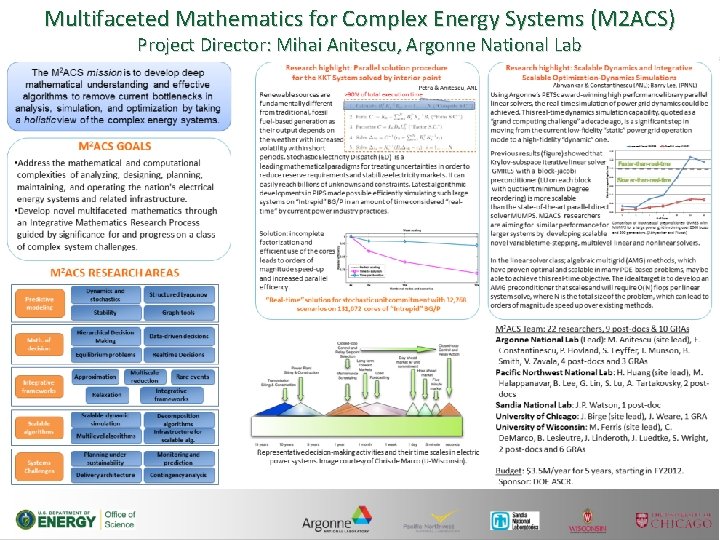
Multifaceted Mathematics for Complex Energy Systems (M 2 ACS) Project Director: Mihai Anitescu, Argonne National Lab 7
M 2 ACS Integration Challenge #1: Temporal Multiscale Modeling for Critical Energy Devices § § Application Motivation: Simulation of critical devices, such as High-Voltage Direct Current (HVDC) substations , which are extremely expensive, in the accurate dynamic range of the rest of the system. Technical Challenge: To achieve this, need to run simulations on microsecond time scale for the device, but impossible for the entire grid. Need to formulate multi-time-scale model. Math Question: Can we define consistent multiscale-in-time mathematical models and derive efficient solvers for it in this application space? Possible plan forwards: Leverage the comprehensive intellectual resources and capabilities of M 2 ACS. – Year 1: Analysis of multiscale in time coupling equations : well-posedness and properties (Tartakovsky, Anitescu, Lu) – Year 1: Multiscale Data Analysis for Determining Fluctuations Models (Lin, Lu) – Year 2: Derive a new multi-rate partitioned implicit-explicit time stepping scheme and the attached linear algebra (Constantinescu, Smith) – Year 2: Derive new nonlinear solvers with scalable linear algebra (Lee, Smith) – Year 2: Inclusion of Dynamics Features in Py. Omo, to support decision that also accounts for maintenance costs of HVDC. (Watson) 8
M 2 ACS Integration Challenge #2: Probabilistic Modeling for Complex Energy Infrastructure § § Application Motivation: The number of energy states in energy infrastructure is too large to ever have enough information to know it exactly. Technical Challenge: To predict in this environment, we need to replace deterministic (point) estimates with probability distributions. Need to formulate novel probabilistic frameworks. Math Question: Can we define probabilistic models consistent with the system and provably accurate statistical tests to validate those for such complex systems? Possible plan forwards: Leverage the comprehensive intellectual resources and capabilities of M 2 ACS. – Year 1: Multiscale Data Analysis. Identify multiscale spatio-temporal probabilistic structure from high resolution data (Lin, Lu) – Year 2: Data-driven decisions. Scalable algorithms for data analysis with complex multiscale correlation structure (Wright, Anitescu) – Year 2: Dynamics and stochastics. New closure approaches for probability density function evolution derived from the nonlinear differential algebraic system equations (Tartakovsky). – Year 3: Graphs. New metrics for probability-driven weighing schemes for graph generation for efficient probabilistic contingency representation (Halappanavar, Hogan) – Year 4: Real-Time decision. Fast and scalable algorithms for stochastic state and probability estimation (Huang, Zavala, Leyffer) 9
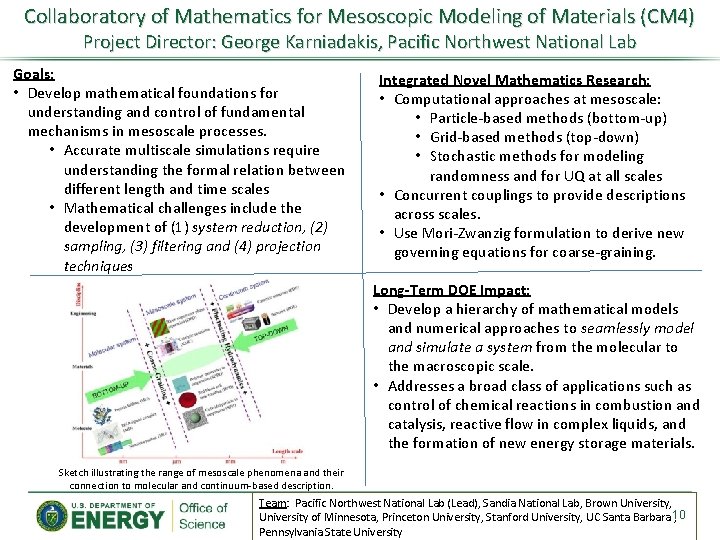
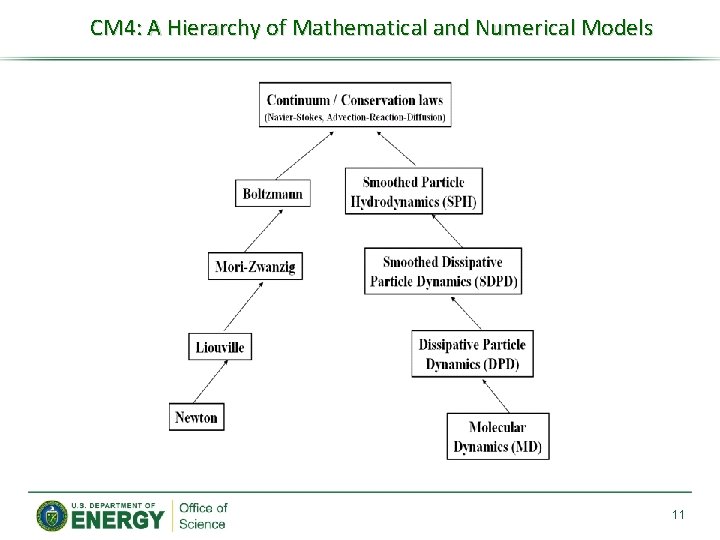
Collaboratory of Mathematics for Mesoscopic Modeling of Materials (CM 4) Project Director: George Karniadakis, Pacific Northwest National Lab Goals: • Develop mathematical foundations for understanding and control of fundamental mechanisms in mesoscale processes. • Accurate multiscale simulations require understanding the formal relation between different length and time scales • Mathematical challenges include the development of (1) system reduction, (2) sampling, (3) filtering and (4) projection techniques Integrated Novel Mathematics Research: • Computational approaches at mesoscale: • Particle-based methods (bottom-up) • Grid-based methods (top-down) • Stochastic methods for modeling randomness and for UQ at all scales • Concurrent couplings to provide descriptions across scales. • Use Mori-Zwanzig formulation to derive new governing equations for coarse-graining. Long-Term DOE Impact: • Develop a hierarchy of mathematical models and numerical approaches to seamlessly model and simulate a system from the molecular to the macroscopic scale. • Addresses a broad class of applications such as control of chemical reactions in combustion and catalysis, reactive flow in complex liquids, and the formation of new energy storage materials. Sketch illustrating the range of mesoscale phenomena and their connection to molecular and continuum-based description. Team: Pacific Northwest National Lab (Lead), Sandia National Lab, Brown University, University of Minnesota, Princeton University, Stanford University, UC Santa Barbara 10 , Pennsylvania State University
CM 4: A Hierarchy of Mathematical and Numerical Models 11
Collaboratory of Mathematics for Mesoscopic Modeling of Materials (CM 4 ) Project Director: George Karniadakis, Pacific Northwest National Lab The CM 4 mission is to develop mathematical foundations for understanding and control of fundamental mechanisms in mesoscale processes addressing to a broad class of applications such as control of chemical reactions in combustion and catalysis, reactive flow in complex liquids, and the formation of new energy storage materials. Team (22 researchers plus 8 post-docs & 8 GRAs) : $3. 0 M /year for 5 years • Pacific Northwest National Lab (Lead) • University of Minnesota • Sandia National Lab • Stanford University – G. Karniadakis (site lead), G. Lin, K. Jarman, – P. Stinis plus 1 post-doc and 1 GRA G. Schenter, T. P. Straatsma plus 5 staff • Princeton University researchers and 3 post-docs – Weinan E plus 1 post-doc and 1 GRA – M. Parks (site lead), P. Bochev, J. Hu, C. Siefert plus 1 post-doc & 1 GRA • Brown University – M. Maxey, B. Caswell plus 1 post-doc and 1 GRA – E. Darve plus 1 GRA • UC Santa Barbara – P. Atzberger plus 1 post-doc & 2 GRAs • Penn State University – J. Xu, X. Hu, plus 1 GRA 12
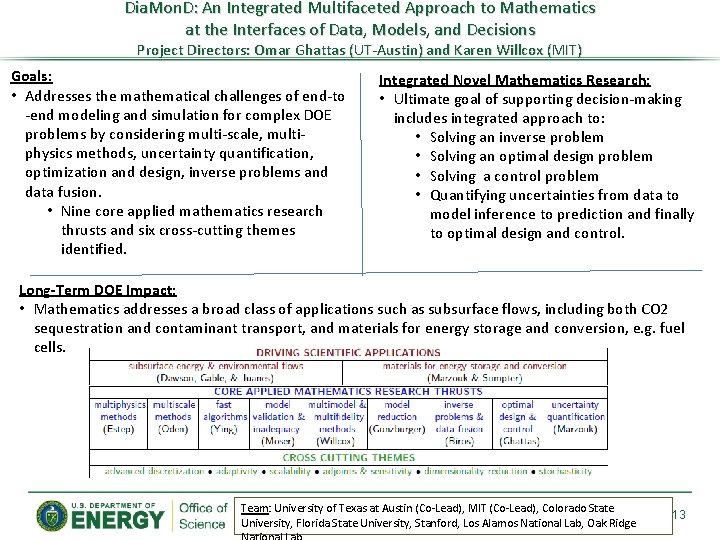
Dia. Mon. D: An Integrated Multifaceted Approach to Mathematics at the Interfaces of Data, Models, and Decisions Project Directors: Omar Ghattas (UT-Austin) and Karen Willcox (MIT) Goals: • Addresses the mathematical challenges of end-to -end modeling and simulation for complex DOE problems by considering multi-scale, multiphysics methods, uncertainty quantification, optimization and design, inverse problems and data fusion. • Nine core applied mathematics research thrusts and six cross-cutting themes identified. Integrated Novel Mathematics Research: • Ultimate goal of supporting decision-making includes integrated approach to: • Solving an inverse problem • Solving an optimal design problem • Solving a control problem • Quantifying uncertainties from data to model inference to prediction and finally to optimal design and control. Long-Term DOE Impact: • Mathematics addresses a broad class of applications such as subsurface flows, including both CO 2 sequestration and contaminant transport, and materials for energy storage and conversion, e. g. fuel cells. Team: University of Texas at Austin (Co-Lead), MIT (Co-Lead), Colorado State University, Florida State University, Stanford, Los Alamos National Lab, Oak Ridge 13
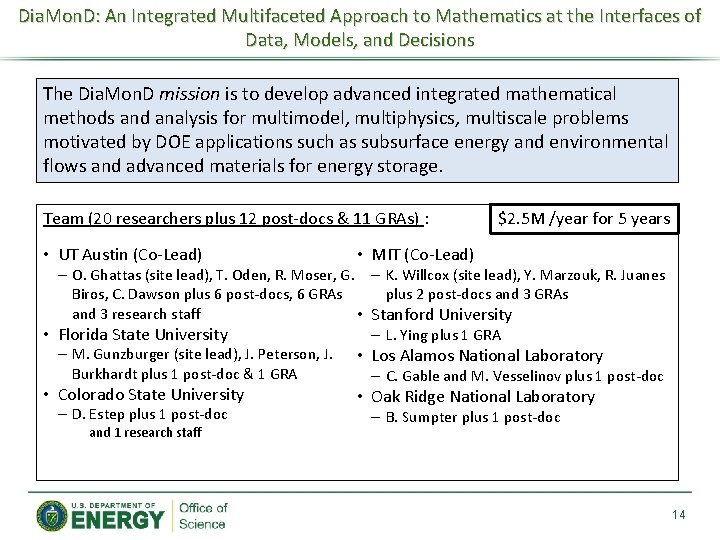
Dia. Mon. D: An Integrated Multifaceted Approach to Mathematics at the Interfaces of Data, Models, and Decisions The Dia. Mon. D mission is to develop advanced integrated mathematical methods and analysis for multimodel, multiphysics, multiscale problems motivated by DOE applications such as subsurface energy and environmental flows and advanced materials for energy storage. Team (20 researchers plus 12 post-docs & 11 GRAs) : $2. 5 M /year for 5 years • UT Austin (Co-Lead) • MIT (Co-Lead) • Colorado State University • Oak Ridge National Laboratory – O. Ghattas (site lead), T. Oden, R. Moser, G. – K. Willcox (site lead), Y. Marzouk, R. Juanes Biros, C. Dawson plus 6 post-docs, 6 GRAs plus 2 post-docs and 3 GRAs and 3 research staff • Stanford University • Florida State University – L. Ying plus 1 GRA – M. Gunzburger (site lead), J. Peterson, J. • Los Alamos National Laboratory Burkhardt plus 1 post-doc & 1 GRA – C. Gable and M. Vesselinov plus 1 post-doc – D. Estep plus 1 post-doc and 1 research staff – B. Sumpter plus 1 post-doc 14
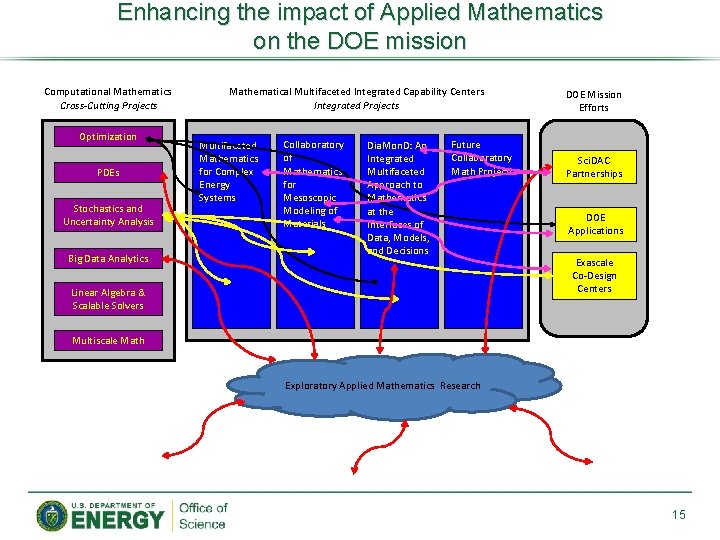
Enhancing the impact of Applied Mathematics on the DOE mission Computational Mathematics Cross-Cutting Projects Optimization PDEs Stochastics and Uncertainty Analysis Big Data Analytics Mathematical Multifaceted Integrated Capability Centers Integrated Projects Multifaceted Mathematics for Complex Energy Systems Collaboratory of Mathematics for Mesoscopic Modeling of Materials Dia. Mon. D: An Integrated Multifaceted Approach to Mathematics at the Interfaces of Data, Models, and Decisions Future Collaboratory Math Projects Linear Algebra & Scalable Solvers DOE Mission Efforts Sci. DAC Partnerships DOE Applications Exascale Co-Design Centers Multiscale Math Exploratory Applied Mathematics Research 15
Thank you. 16
- Slides: 16