
Mathematical Model of Ventilation Response to Inhaled Carbon
Mathematical Model of Ventilation Response to Inhaled Carbon Monoxide Stuhmiller & Stuhmiller, J Appl. Physiol. 98: 2033 -44 (2005) Raymond Yakura May 31, 2006 BIOEN 589
Uses of Model n Fires generate noxious gases • Results in increased carbon dioxide, increased carbon monoxide and reduced oxygen n Dramatic effects on ventilation which vary with gas composition and exposure duration

Model Summary n n n Dynamic Physiological Model Authors used Matlab with Simulink Incorporates models from many different sources into one integrated model • Sources include Duffin et al. , Ursino et al. , Hill et al. , Gomez, Roughton and Darling, Doblar et al.
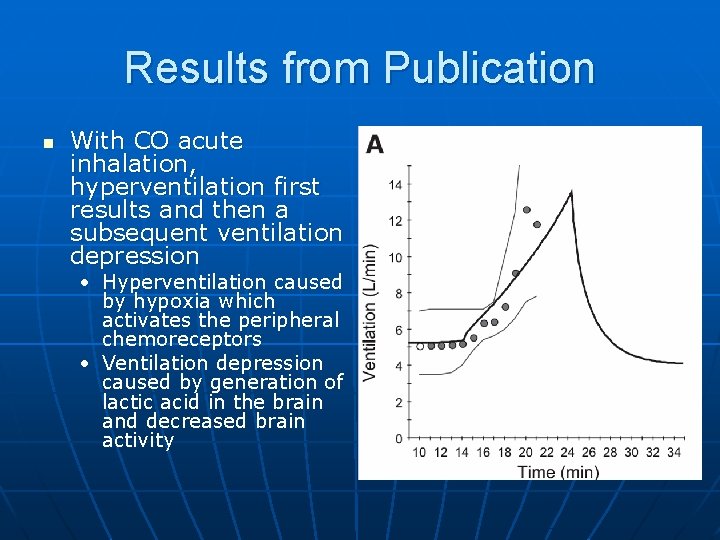
Results from Publication n With CO acute inhalation, hyperventilation first results and then a subsequent ventilation depression • Hyperventilation caused by hypoxia which activates the peripheral chemoreceptors • Ventilation depression caused by generation of lactic acid in the brain and decreased brain activity

Publication Results n Buildup of carboxyhemoglobin with reduction in oxygen delivery to the brain leads to anaerobic glycolysis and buildup of lactate
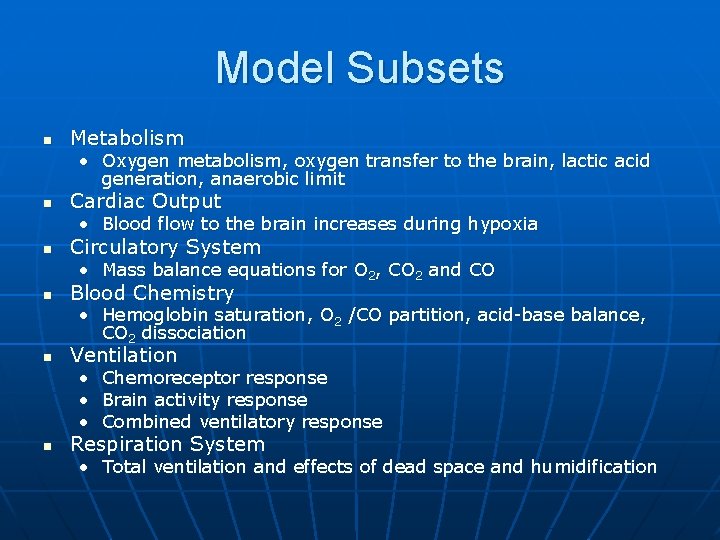
Model Subsets n Metabolism • Oxygen metabolism, oxygen transfer to the brain, lactic acid generation, anaerobic limit n Cardiac Output • Blood flow to the brain increases during hypoxia n Circulatory System • Mass balance equations for O 2, CO 2 and CO n Blood Chemistry • Hemoglobin saturation, O 2 /CO partition, acid-base balance, CO 2 dissociation n Ventilation • • • n Chemoreceptor response Brain activity response Combined ventilatory response Respiration System • Total ventilation and effects of dead space and humidification
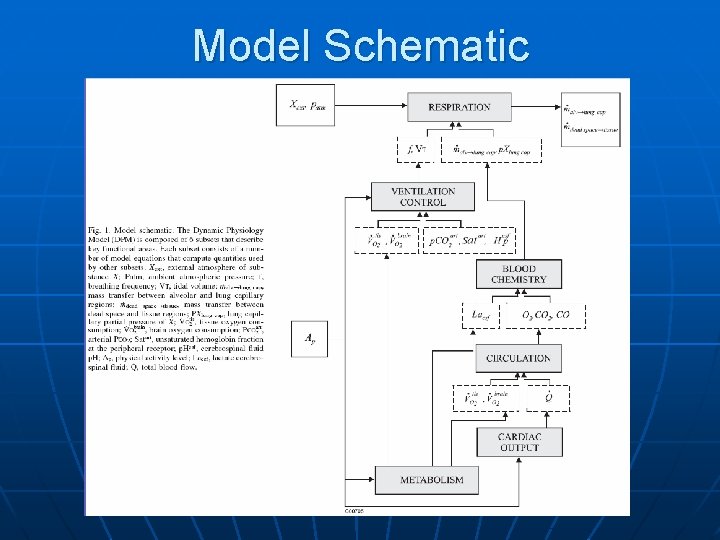
Model Schematic
JSIM model n n n JSim 1. 6. 62 used for this project Event driven to input O 2, CO 2 and CO Introduced memory into system to detect Lactate changes analogous to a D-Flip Flop in digital circuit design
JSIM Model Results - Ventilation n With increase in CO & CO 2, and decrease of O 2, ventilation initially increased and then decreased
JSIM results – Lactate Generation n Lactate generation in the brain due to increased anaerobic respiration due to hypoxia
JSIM results: Brain activity n Brain activity decreased due to lower pressure in the brain capillaries
JSIM results: Tidal volume and Breathing Frequency n n Tidal volume increased due to CO 2 increase Combined f (breathing frequency) started to initially increase due to chemoreceptors activation, but decreased later on due to lower brain activity
JSIM results: CO 2 components n CO 2 components • HCO 3 - is majority of the CO 2 • Carbamino and CO 2 in plasma is in small amounts of CO 2
Model Limitations n Article • Errors and notational changes in the article • Model Schematic and equations do not indicate a feedback loop, although the graphs implicitly indicate a feedback loop n Model in JSIM • • • Not a feedback loop P_O 2_Brain and O 2 art are separate events Convergence issues due to the number of equations and initiation values resulting in increasing the error tolerance that decreases accuracy.
- Slides: 14