
Mathematical Literacy NQF 4 Maths Lit NQF Level

- Slides: 46
Mathematical Literacy NQF 4 Maths Lit NQF Level 4
Tables, graphs and formulae in the workplace Module 12 Maths Lit NQF Level 4
Overview 12. 1 12. 2 12. 3 12. 4 12. 5 Reading values off graphs Plotting graphs of linear relationships Graph of inverse proportion functions The graph of constant ratio patterns Using formulae to determine values of variables using substitution Maths Lit NQF Level 4
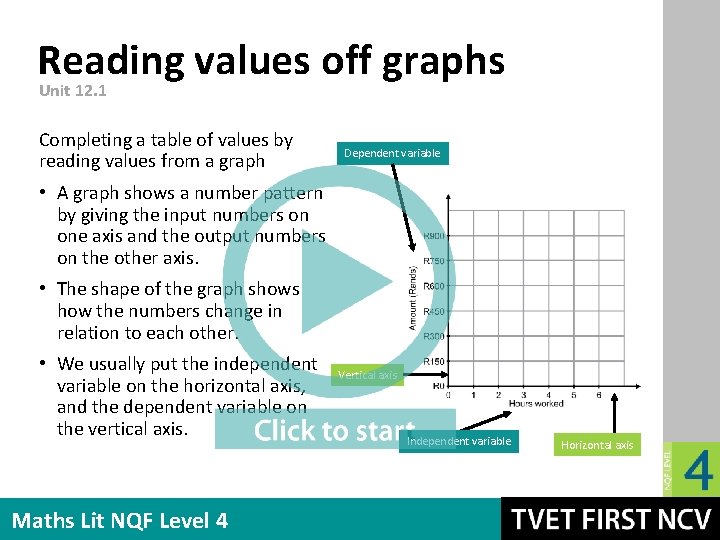
Reading values off graphs Unit 12. 1 Completing a table of values by reading values from a graph Dependent variable • A graph shows a number pattern by giving the input numbers on one axis and the output numbers on the other axis. • The shape of the graph shows how the numbers change in relation to each other. • We usually put the independent variable on the horizontal axis, and the dependent variable on the vertical axis. Maths Lit NQF Level 4 Vertical axis Independent variable Horizontal axis
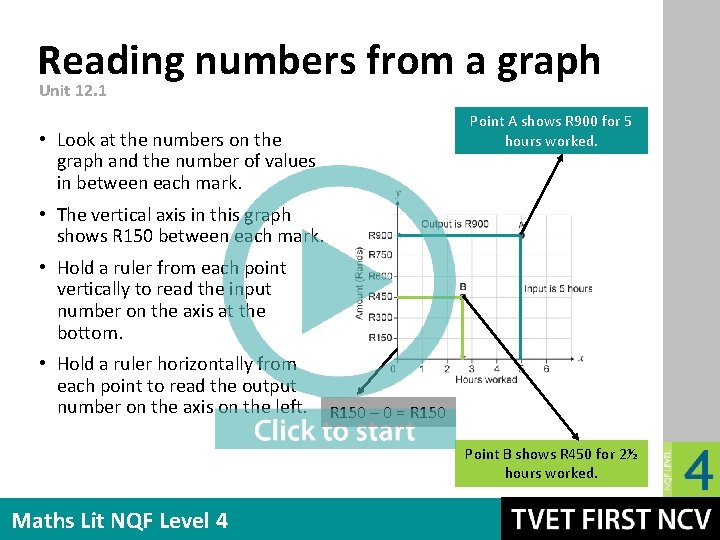
Reading numbers from a graph Unit 12. 1 Point A shows R 900 for 5 hours worked. • Look at the numbers on the graph and the number of values in between each mark. • The vertical axis in this graph shows R 150 between each mark. • Hold a ruler from each point vertically to read the input number on the axis at the bottom. • Hold a ruler horizontally from each point to read the output number on the axis on the left. R 150 – 0 = R 150 Point B shows R 450 for 2½ hours worked. Maths Lit NQF Level 4
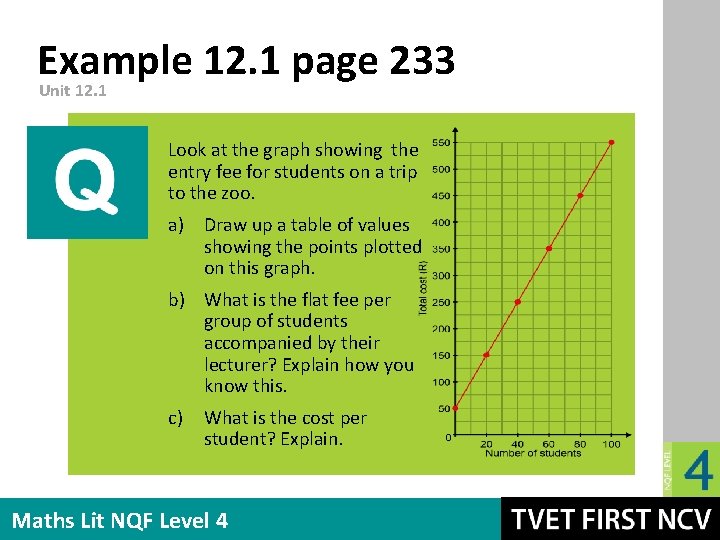
Example 12. 1 page 233 Unit 12. 1 Look at the graph showing the entry fee for students on a trip to the zoo. a) Draw up a table of values showing the points plotted on this graph. b) What is the flat fee per group of students accompanied by their lecturer? Explain how you know this. c) What is the cost per student? Explain. Maths Lit NQF Level 4
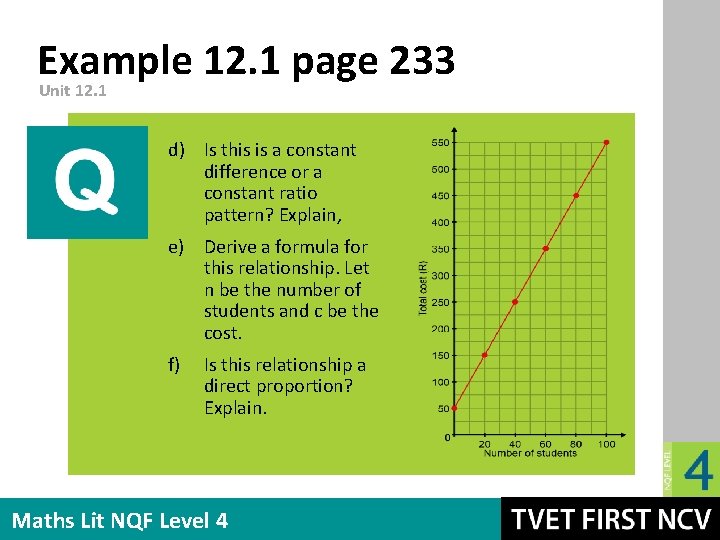
Example 12. 1 page 233 Unit 12. 1 d) Is this is a constant difference or a constant ratio pattern? Explain, e) Derive a formula for this relationship. Let n be the number of students and c be the cost. f) Is this relationship a direct proportion? Explain. Maths Lit NQF Level 4
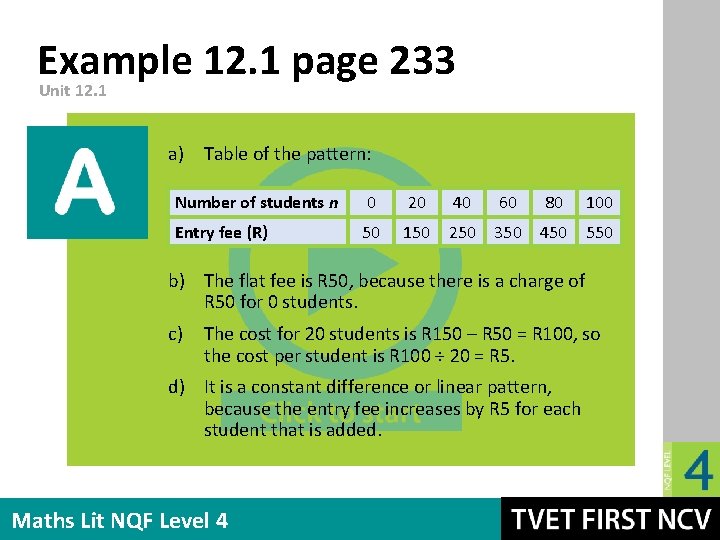
Example 12. 1 page 233 Unit 12. 1 a) Table of the pattern: Number of students n 0 20 40 60 80 100 Entry fee (R) 50 150 250 350 450 550 b) The flat fee is R 50, because there is a charge of R 50 for 0 students. c) The cost for 20 students is R 150 – R 50 = R 100, so the cost per student is R 100 ÷ 20 = R 5. d) It is a constant difference or linear pattern, because the entry fee increases by R 5 for each student that is added. Maths Lit NQF Level 4
Example 12. 1 page 233 Unit 12. 1 e) The difference between the values where n increases by 1 is R 5, so the formula will contain 5 n. The flat fee or constant value is R 50. So the formula is c = 50 + 5 n. f) This is not a direct proportion, for example 40 student : 20 student is not equal to R 250 : R 150. Maths Lit NQF Level 4
Exercise 12. 1 Unit 12. 1 Complete Exercise 12. 1 on page 234 of your Student’s Book Maths Lit NQF Level 4
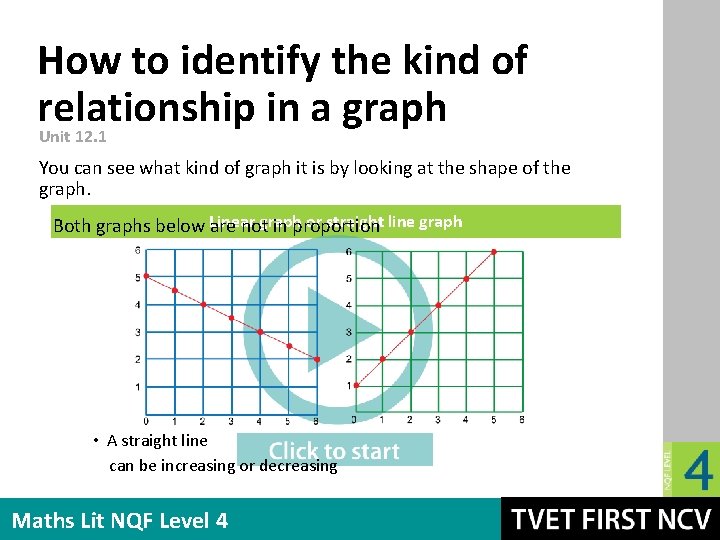
How to identify the kind of relationship in a graph Unit 12. 1 You can see what kind of graph it is by looking at the shape of the graph. or straight line graph Both graphs below Linear are notgraph in proportion • A straight line can be increasing or decreasing Maths Lit NQF Level 4
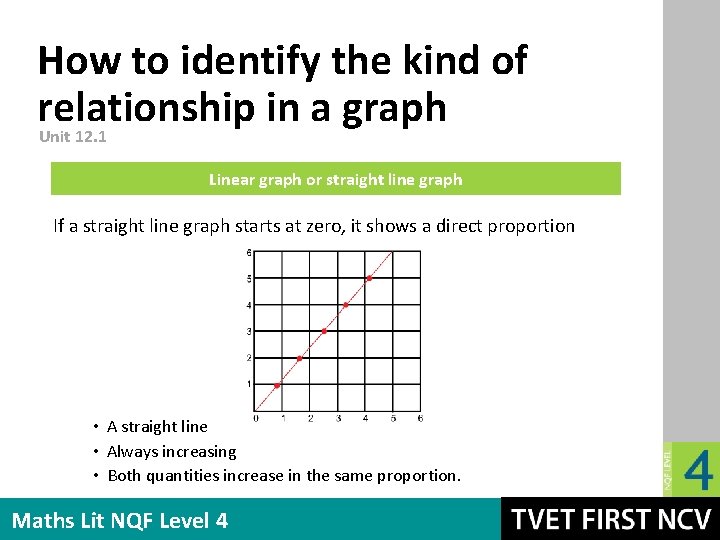
How to identify the kind of relationship in a graph Unit 12. 1 Linear graph or straight line graph If a straight line graph starts at zero, it shows a direct proportion • A straight line • Always increasing • Both quantities increase in the same proportion. Maths Lit NQF Level 4
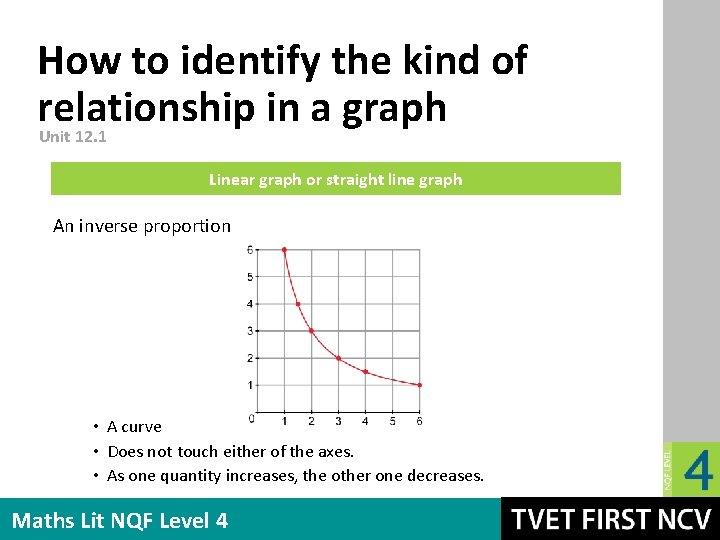
How to identify the kind of relationship in a graph Unit 12. 1 Linear graph or straight line graph An inverse proportion • A curve • Does not touch either of the axes. • As one quantity increases, the other one decreases. Maths Lit NQF Level 4
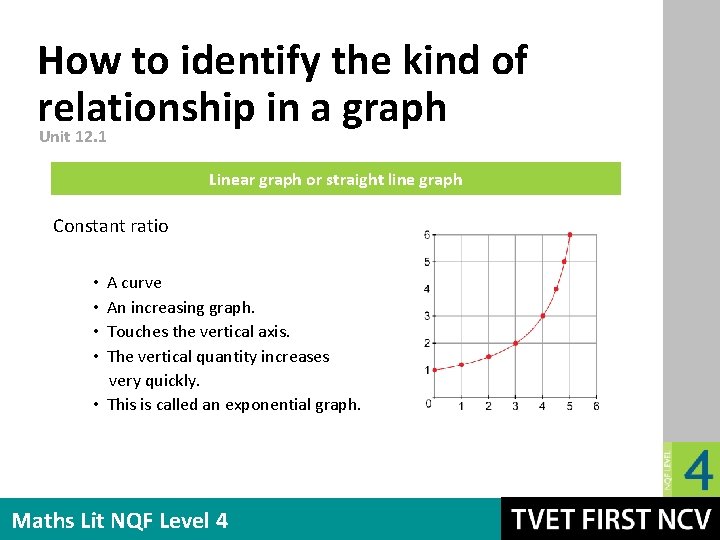
How to identify the kind of relationship in a graph Unit 12. 1 Linear graph or straight line graph Constant ratio A curve An increasing graph. Touches the vertical axis. The vertical quantity increases very quickly. • This is called an exponential graph. • • Maths Lit NQF Level 4
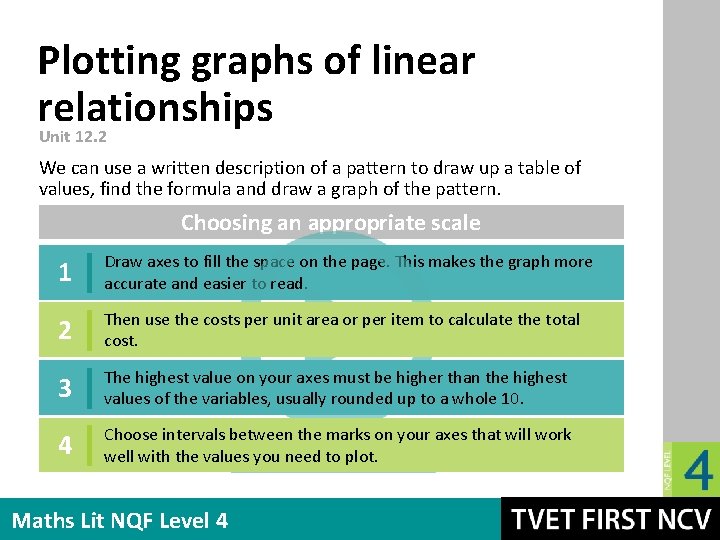
Plotting graphs of linear relationships Unit 12. 2 We can use a written description of a pattern to draw up a table of values, find the formula and draw a graph of the pattern. Choosing an appropriate scale 1 Draw axes to fill the space on the page. This makes the graph more accurate and easier to read. 2 Then use the costs per unit area or per item to calculate the total cost. 3 The highest value on your axes must be higher than the highest values of the variables, usually rounded up to a whole 10. 4 Choose intervals between the marks on your axes that will work well with the values you need to plot. Maths Lit NQF Level 4
Plotting graphs of linear relationships Unit 12. 2 Example • To plot values such as 142, 156 and 178, choose intervals of 10 units apart from 140 to 180. • Choose to increase in multiples of 5 or 10, even when the values to plot are not multiples of 10. Maths Lit NQF Level 4
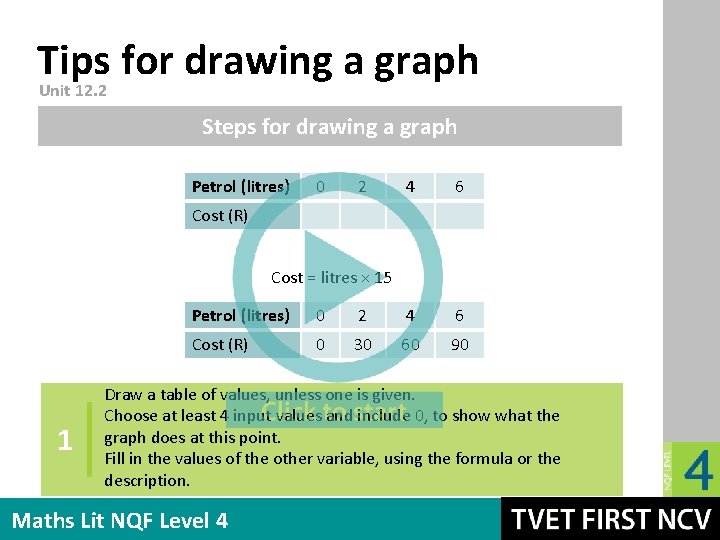
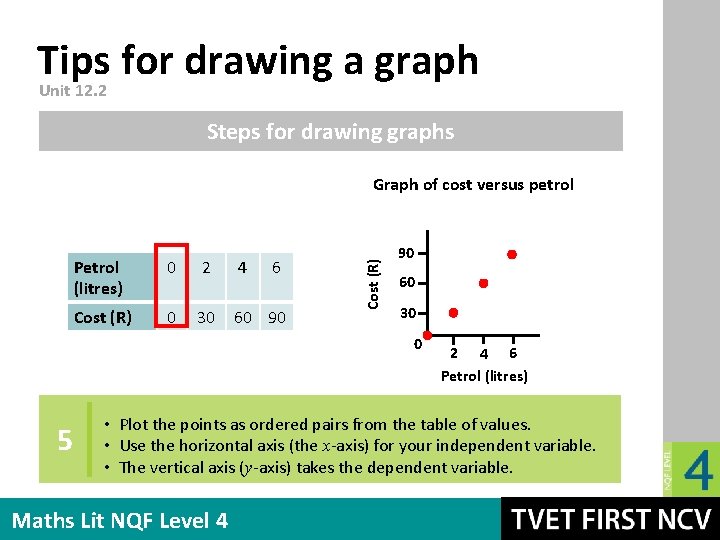
Tips for drawing a graph Unit 12. 2 Steps for drawing a graph Petrol (litres) 0 2 4 6 Cost (R) Cost = litres × 15 1 Petrol (litres) 0 2 4 6 Cost (R) 0 30 60 90 Draw a table of values, unless one is given. Choose at least 4 input values and include 0, to show what the graph does at this point. Fill in the values of the other variable, using the formula or the description. Maths Lit NQF Level 4
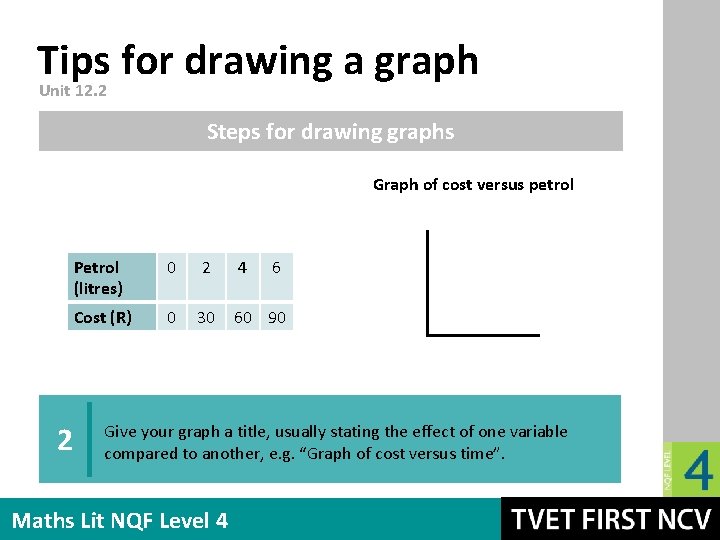
Tips for drawing a graph Unit 12. 2 Steps for drawing graphs Graph of cost versus petrol 2 Petrol (litres) 0 2 4 6 Cost (R) 0 30 60 90 Give your graph a title, usually stating the effect of one variable compared to another, e. g. “Graph of cost versus time”. Maths Lit NQF Level 4
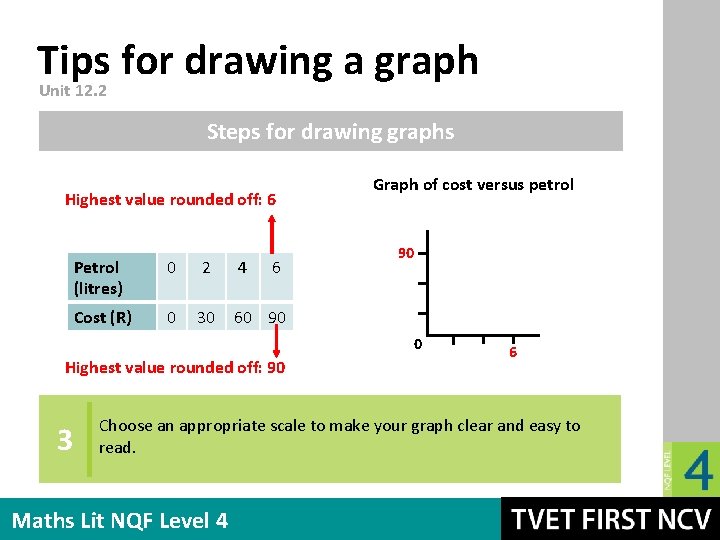
Tips for drawing a graph Unit 12. 2 Steps for drawing graphs Highest value rounded off: 6 Petrol (litres) 0 2 4 6 Cost (R) 0 30 60 90 Graph of cost versus petrol 90 0 Highest value rounded off: 90 3 6 Choose an appropriate scale to make your graph clear and easy to read. Maths Lit NQF Level 4
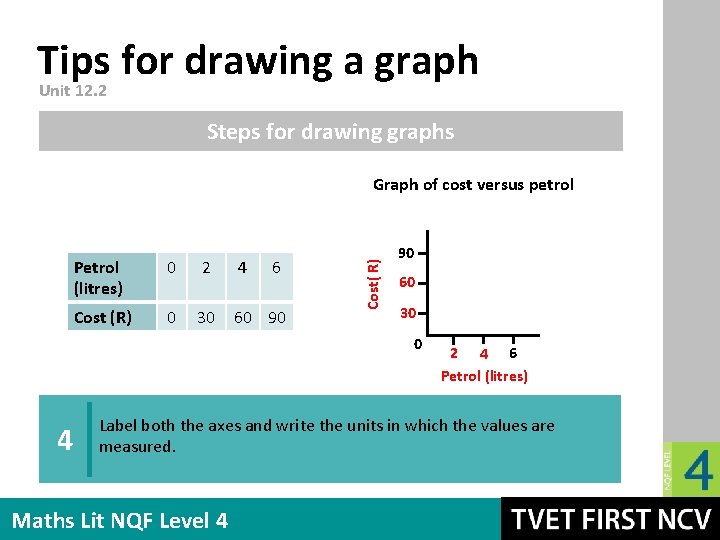
Tips for drawing a graph Unit 12. 2 Steps for drawing graphs Petrol (litres) 0 2 4 6 Cost (R) 0 30 60 90 Cost( R) Graph of cost versus petrol 90 60 30 0 4 2 4 6 Petrol (litres) Label both the axes and write the units in which the values are measured. Maths Lit NQF Level 4
Tips for drawing a graph Unit 12. 2 Steps for drawing graphs Petrol (litres) 0 2 4 6 Cost (R) 0 30 60 90 Cost (R) Graph of cost versus petrol 90 60 30 0 5 2 4 6 Petrol (litres) • Plot the points as ordered pairs from the table of values. • Use the horizontal axis (the x-axis) for your independent variable. • The vertical axis (y-axis) takes the dependent variable. Maths Lit NQF Level 4
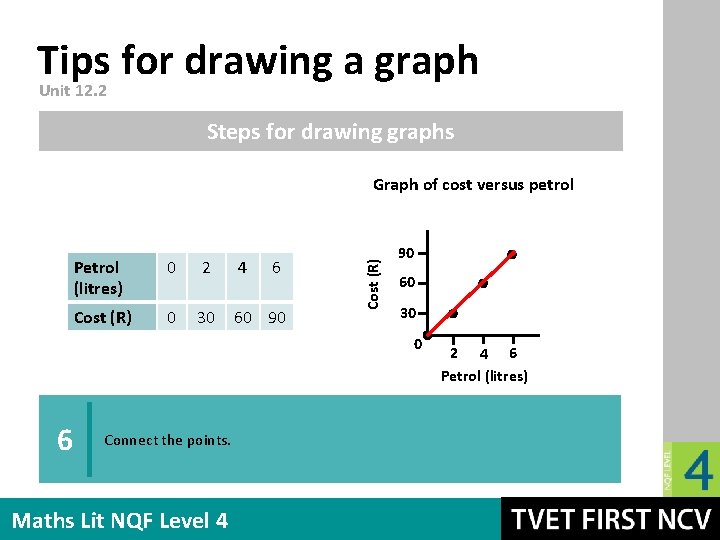
Tips for drawing a graph Unit 12. 2 Steps for drawing graphs Petrol (litres) 0 2 4 6 Cost (R) 0 30 60 90 Cost (R) Graph of cost versus petrol 90 60 30 0 6 Connect the points. Maths Lit NQF Level 4 2 4 6 Petrol (litres)
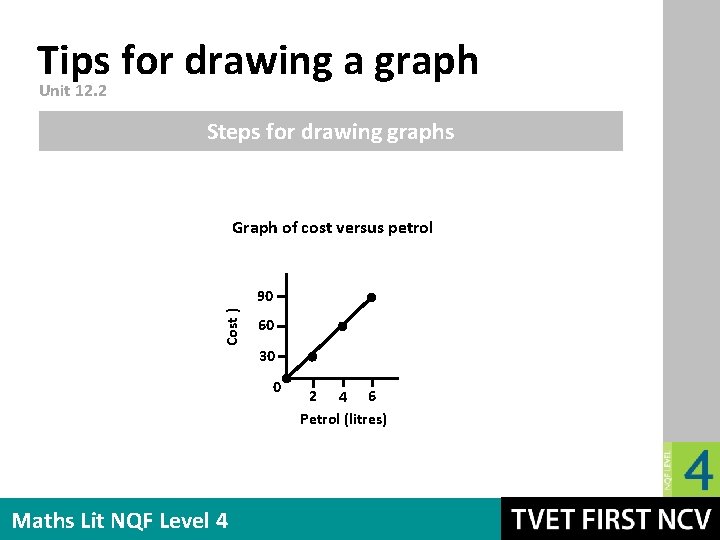
Tips for drawing a graph Unit 12. 2 Steps for drawing graphs Graph of cost versus petrol Cost ) 90 60 30 0 Maths Lit NQF Level 4 2 4 6 Petrol (litres)
Exercise 12. 2 Unit 12. 2 Complete Exercise 12. 2 on page 236 of your Student’s Book Maths Lit NQF Level 4
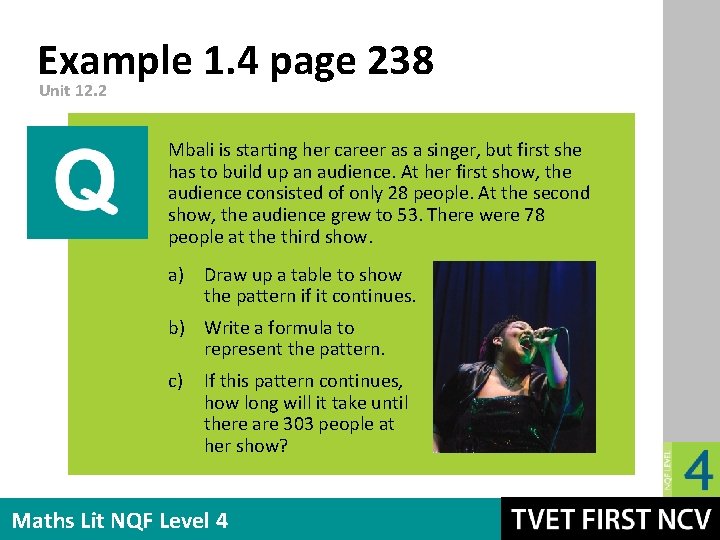
Example 1. 4 page 238 Unit 12. 2 Mbali is starting her career as a singer, but first she has to build up an audience. At her first show, the audience consisted of only 28 people. At the second show, the audience grew to 53. There were 78 people at the third show. a) Draw up a table to show the pattern if it continues. b) Write a formula to represent the pattern. c) If this pattern continues, how long will it take until there are 303 people at her show? Maths Lit NQF Level 4
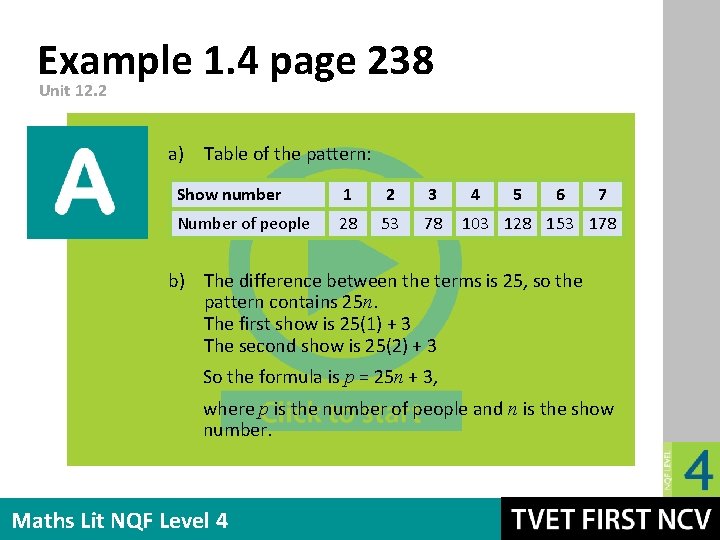
Example 1. 4 page 238 Unit 12. 2 a) Table of the pattern: Show number 1 2 3 Number of people 28 53 78 4 5 6 7 103 128 153 178 b) The difference between the terms is 25, so the pattern contains 25 n. The first show is 25(1) + 3 The second show is 25(2) + 3 So the formula is p = 25 n + 3, where p is the number of people and n is the show number. Maths Lit NQF Level 4
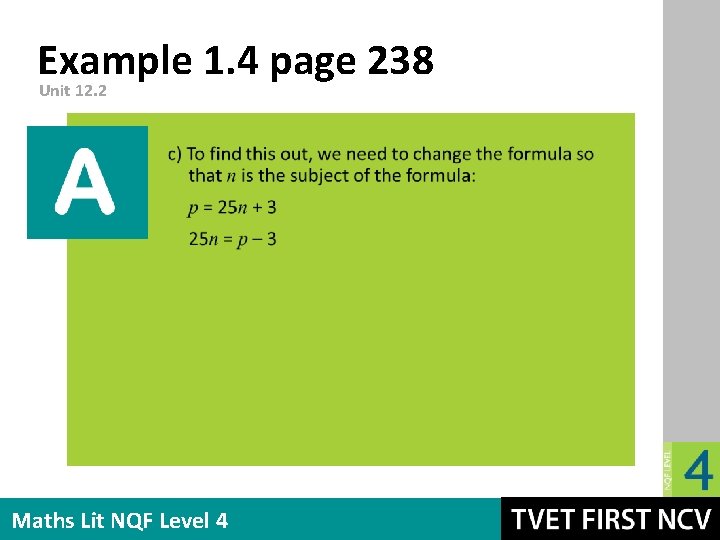
Example 1. 4 page 238 Unit 12. 2 Maths Lit NQF Level 4
Exercise 12. 3 Unit 12. 2 Complete Exercise 12. 3 on page 238 of your Student’s Book Maths Lit NQF Level 4
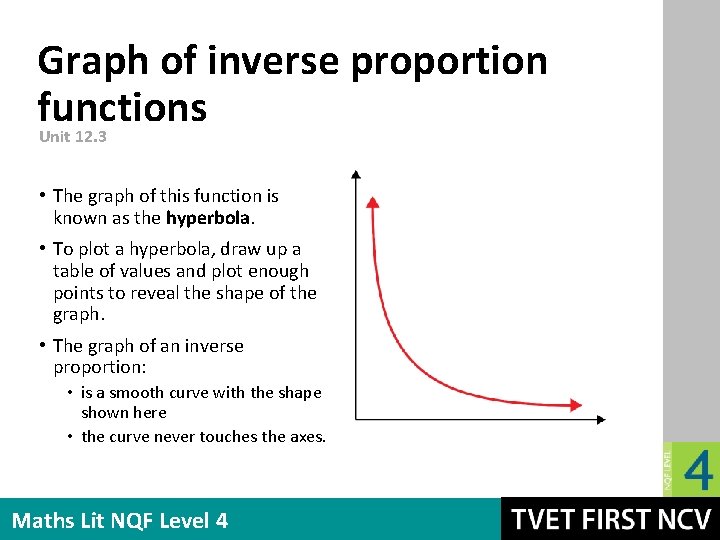
Graph of inverse proportion functions Unit 12. 3 • The graph of this function is known as the hyperbola. • To plot a hyperbola, draw up a table of values and plot enough points to reveal the shape of the graph. • The graph of an inverse proportion: • is a smooth curve with the shape shown here • the curve never touches the axes. Maths Lit NQF Level 4
Graph of inverse proportion functions Unit 12. 3 la u m r Fo How to recognise an indirect proportion relationship In an inverse proportion: as one quantity decreases, the other increases OR as one quantity increases, the other decreases. the product of the quantities is always the same. Maths Lit NQF Level 4
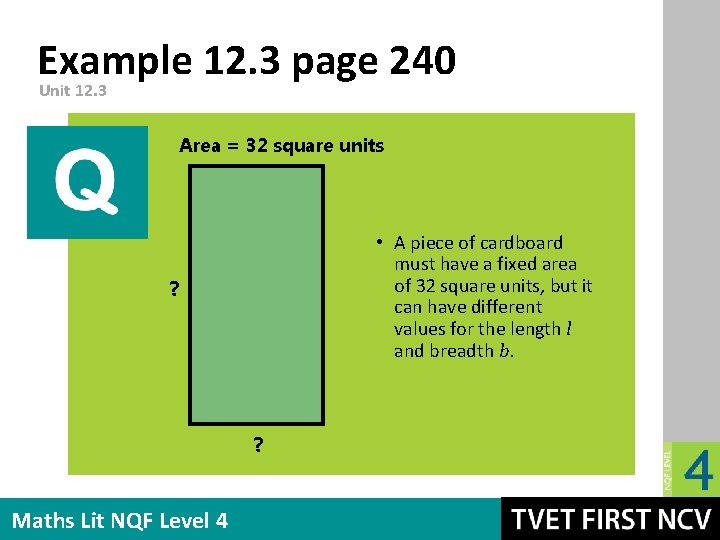
Example 12. 3 page 240 Unit 12. 3 Area = 32 square units • A piece of cardboard must have a fixed area of 32 square units, but it can have different values for the length l and breadth b. ? ? Maths Lit NQF Level 4
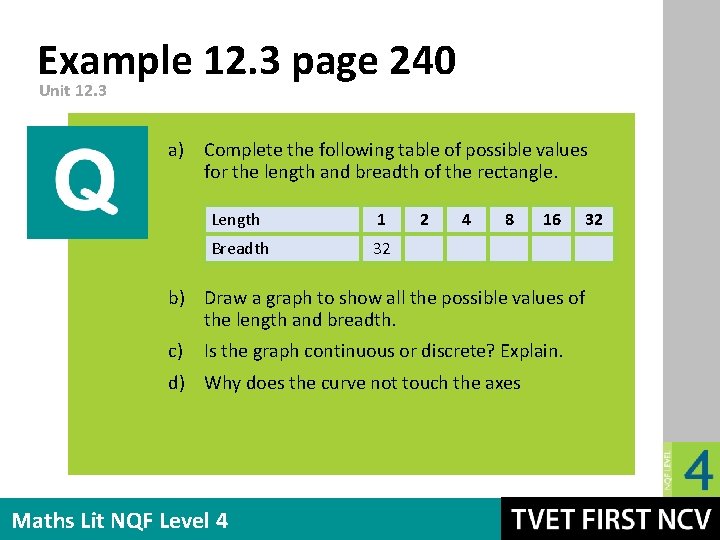
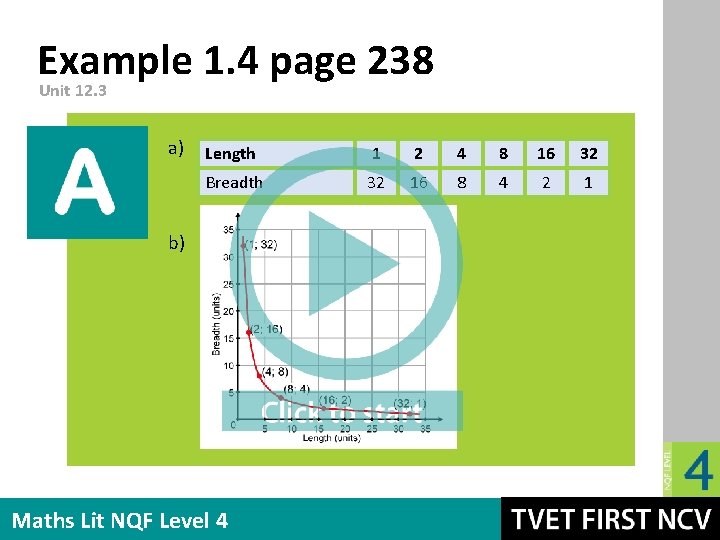
Example 12. 3 page 240 Unit 12. 3 a) Complete the following table of possible values for the length and breadth of the rectangle. Length 1 Breadth 32 2 4 8 16 b) Draw a graph to show all the possible values of the length and breadth. c) Is the graph continuous or discrete? Explain. d) Why does the curve not touch the axes Maths Lit NQF Level 4 32
Example 1. 4 page 238 Unit 12. 3 a) Length 1 2 4 8 16 32 Breadth 32 16 8 4 2 1 b) Maths Lit NQF Level 4
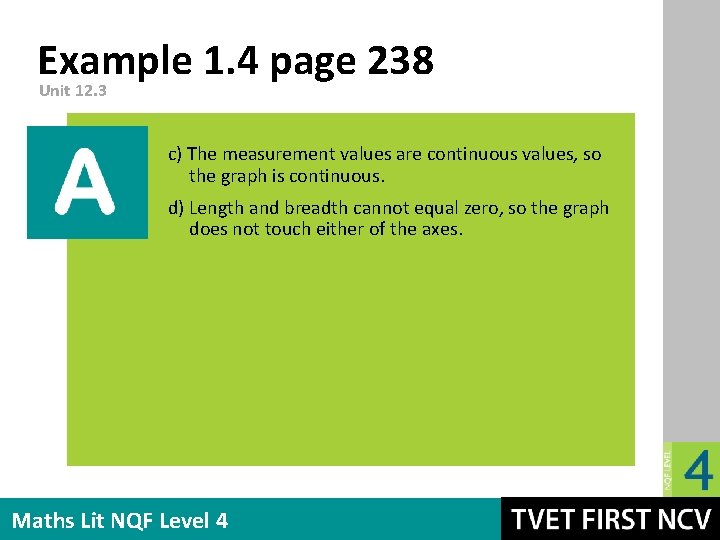
Example 1. 4 page 238 Unit 12. 3 c) The measurement values are continuous values, so the graph is continuous. d) Length and breadth cannot equal zero, so the graph does not touch either of the axes. Maths Lit NQF Level 4
Exercise 12. 4 Unit 12. 3 Complete Exercise 12. 4 on page 241 of your Student’s Book Maths Lit NQF Level 4
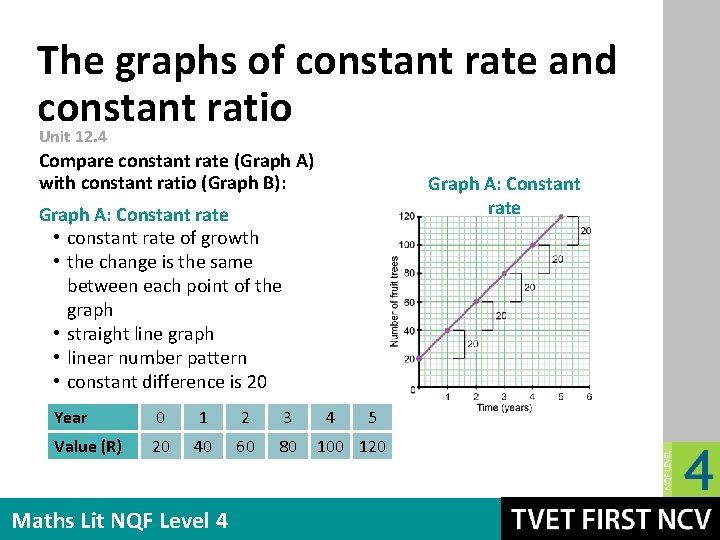
The graphs of constant rate and constant ratio Unit 12. 4 Compare constant rate (Graph A) with constant ratio (Graph B): Graph A: Constant rate • constant rate of growth • the change is the same between each point of the graph • straight line graph • linear number pattern • constant difference is 20 Year 0 1 2 3 Value (R) 20 40 60 80 Maths Lit NQF Level 4 4 5 100 120
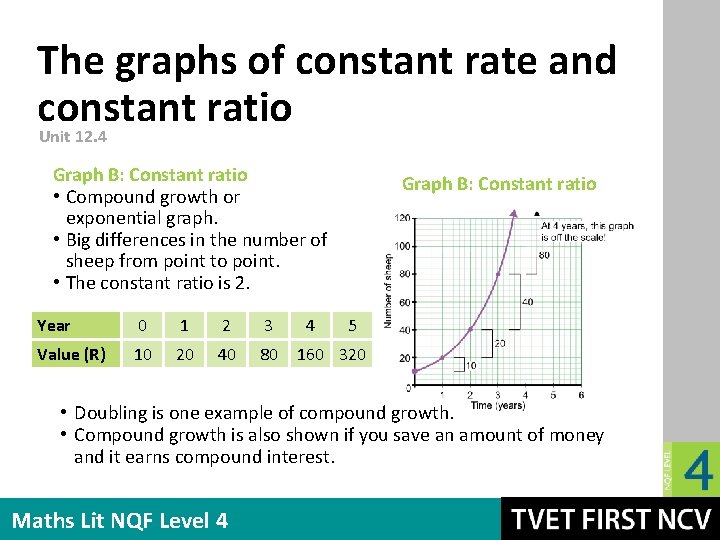
The graphs of constant rate and constant ratio Unit 12. 4 Graph B: Constant ratio • Compound growth or exponential graph. • Big differences in the number of sheep from point to point. • The constant ratio is 2. Year 0 1 2 3 Value (R) 10 20 40 80 4 Graph B: Constant ratio 5 160 320 • Doubling is one example of compound growth. • Compound growth is also shown if you save an amount of money and it earns compound interest. Maths Lit NQF Level 4
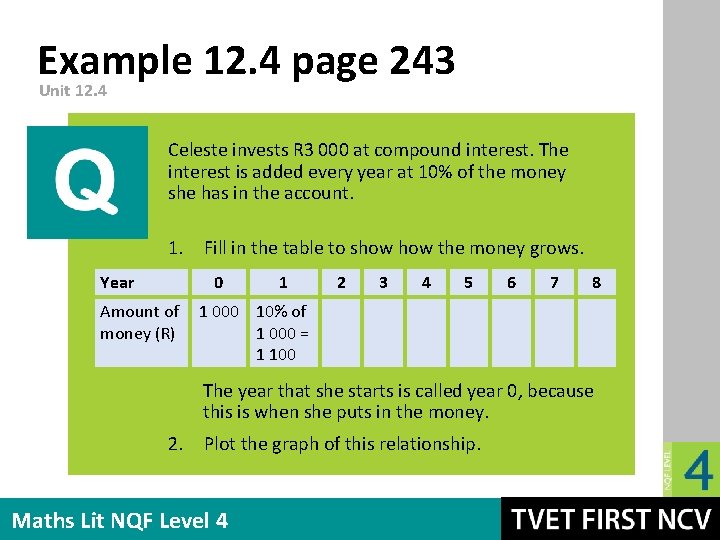
Example 12. 4 page 243 Unit 12. 4 Celeste invests R 3 000 at compound interest. The interest is added every year at 10% of the money she has in the account. 1. Fill in the table to show the money grows. Year 0 Amount of money (R) 1 2 3 4 5 6 7 8 1 000 10% of 1 000 = 1 100 The year that she starts is called year 0, because this is when she puts in the money. 2. Plot the graph of this relationship. Maths Lit NQF Level 4
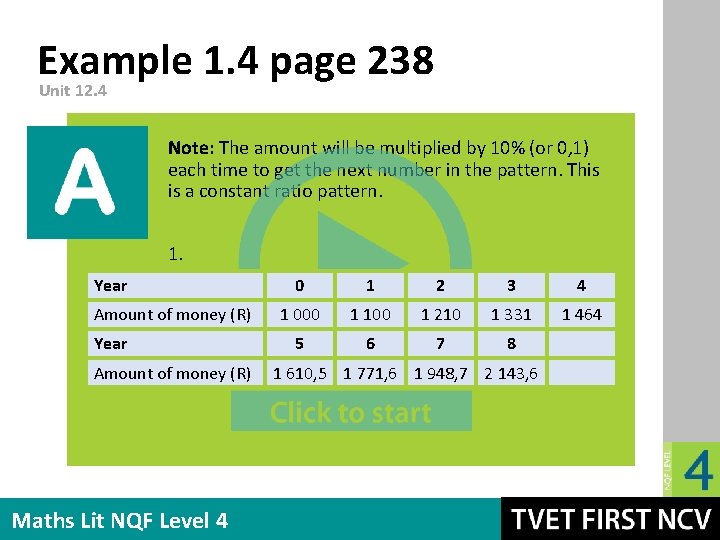
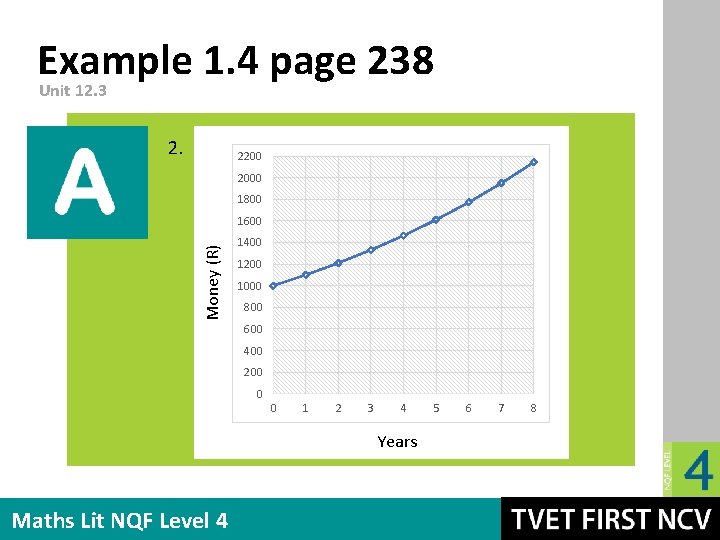
Example 1. 4 page 238 Unit 12. 4 Note: The amount will be multiplied by 10% (or 0, 1) each time to get the next number in the pattern. This is a constant ratio pattern. 1. Year Amount of money (R) Maths Lit NQF Level 4 0 1 2 3 4 1 000 1 100 1 210 1 331 1 464 5 6 7 8 1 610, 5 1 771, 6 1 948, 7 2 143, 6
Example 1. 4 page 238 Unit 12. 3 2. 2200 2000 1800 Money (R) 1600 1400 1200 1000 800 600 400 200 0 0 1 2 3 4 Years Maths Lit NQF Level 4 5 6 7 8
Exercise 12. 5 Unit 12. 4 Complete Exercise 12. 5 on page 243 of your Student’s Book Maths Lit NQF Level 4
Using formulae to determine values of variables using substitution Unit 12. 5 • In formulae, letters such as x and y, or any letters, are used to represent values which are unknown. They can be used in equations or expressions to help solve problems. • The formulae we have been working with show the relationship between two variables. If we know the value of one variable in an equation, we can find the value of the other. • We can substitute the number for the letter. Substitution Putting a number in place of a letter in an equation. Maths Lit NQF Level 4 ”
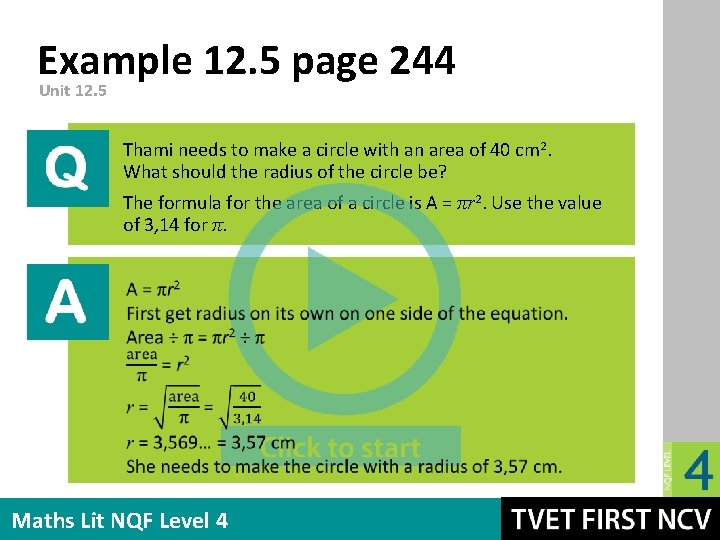
Example 12. 5 page 244 Unit 12. 5 Thami needs to make a circle with an area of 40 cm 2. What should the radius of the circle be? The formula for the area of a circle is A = πr 2. Use the value of 3, 14 for π. Maths Lit NQF Level 4
Exercise 12. 6 Unit 12. 5 Complete Exercise 12. 6 on page 244 of your Student’s Book Maths Lit NQF Level 4
Module assessment Module 12 Complete Module assessment on page 246 of your Student’s Book Maths Lit NQF Level 4
TERMS AND CONDITIONS This Power. Point Presentation has been developed by Macmillan Education South Africa (Pty) Ltd. All texts, images, videos, animations, audio and vector simulations contained in the slides are property of Macmillan South Africa. Reproducing, reselling and redistributing this material without the written permission of Macmillan South Africa is prohibited. Lecturers are granted permission to: (i) modify the slides by adding and removing content; (ii) print copies of the presentation; and (iii) download and save the slides to a computer or local server. Nothing in this copyright notice constitutes permission to assert or imply that your use of the materials is sponsored or endorsed by Macmillan South Africa. Maths Lit NQF Level 4