
Mathematical Literacy NQF 3 Maths Lit NQF Level



- Slides: 47
Mathematical Literacy NQF 3 Maths Lit NQF Level 3
Read, interpret and use representations to make sense of and solve problems in workplace contexts Module 7 Maths Lit NQF Level 3
Overview 7. 1 7. 2 7. 3 7. 4 7. 5 7. 6 Recognising representation concepts Recognise symbols and notations used on plans Working with scale Using road, street and route maps Plans to determine quantities of material needed Interpreting instructions and assembly diagrams Maths Lit NQF Level 3
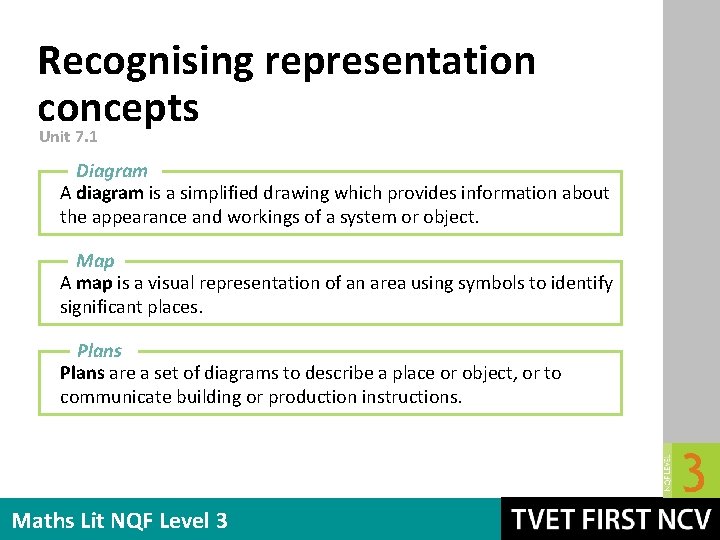
Recognising representation concepts Unit 7. 1 Diagram A diagram is a simplified drawing which provides information about the appearance and workings of a system or object. Map A map is a visual representation of an area using symbols to identify significant places. Plans are a set of diagrams to describe a place or object, or to communicate building or production instructions. Maths Lit NQF Level 3
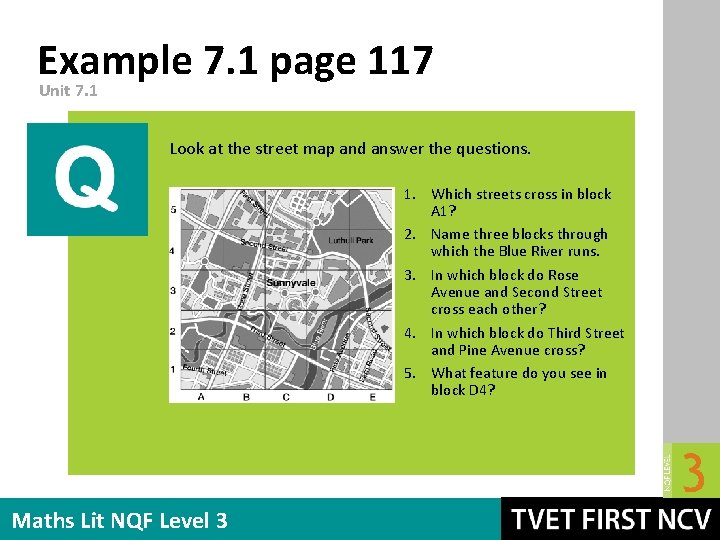
Recognising representation concepts Unit 7. 1 • Maps and plans are often drawn on grids that use line and block references. • The reference of a location identifies the horizontal position first and then the vertical position. Maths Lit NQF Level 3
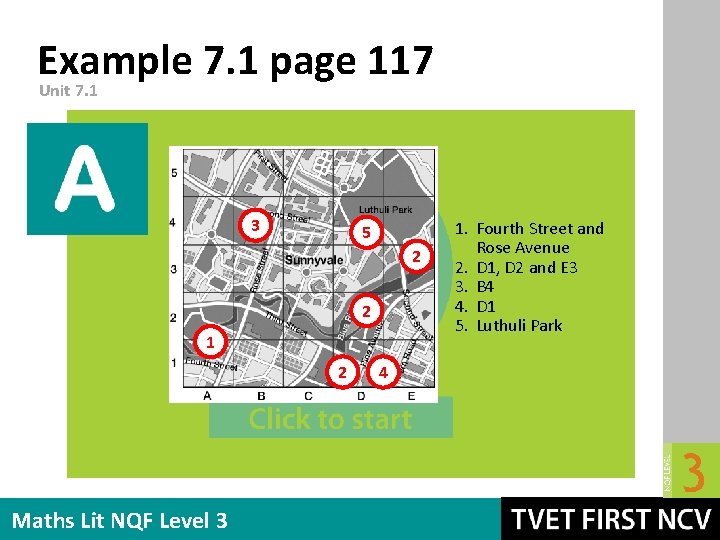
Example 7. 1 page 117 Unit 7. 1 Look at the street map and answer the questions. 1. Which streets cross in block A 1? 2. Name three blocks through which the Blue River runs. 3. In which block do Rose Avenue and Second Street cross each other? 4. In which block do Third Street and Pine Avenue cross? 5. What feature do you see in block D 4? Maths Lit NQF Level 3
Example 7. 1 page 117 Unit 7. 1 3 5 2 2 1 2 Maths Lit NQF Level 3 4 1. Fourth Street and Rose Avenue 2. D 1, D 2 and E 3 3. B 4 4. D 1 5. Luthuli Park
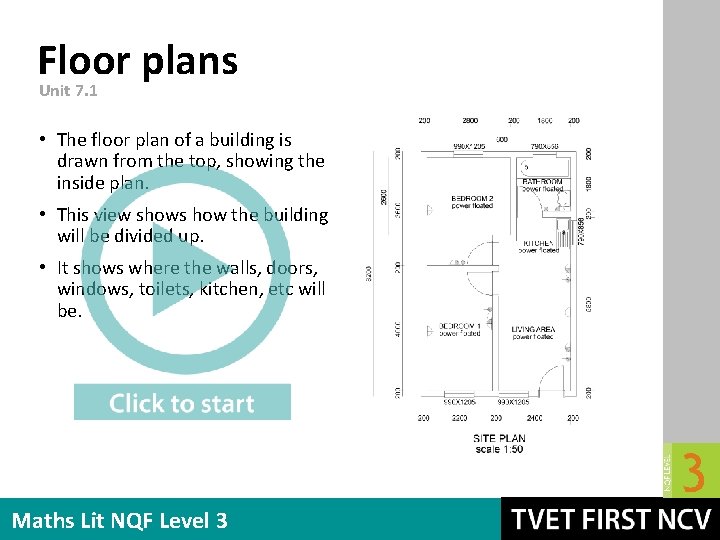
Floor plans Unit 7. 1 • The floor plan of a building is drawn from the top, showing the inside plan. • This view shows how the building will be divided up. • It shows where the walls, doors, windows, toilets, kitchen, etc will be. Maths Lit NQF Level 3
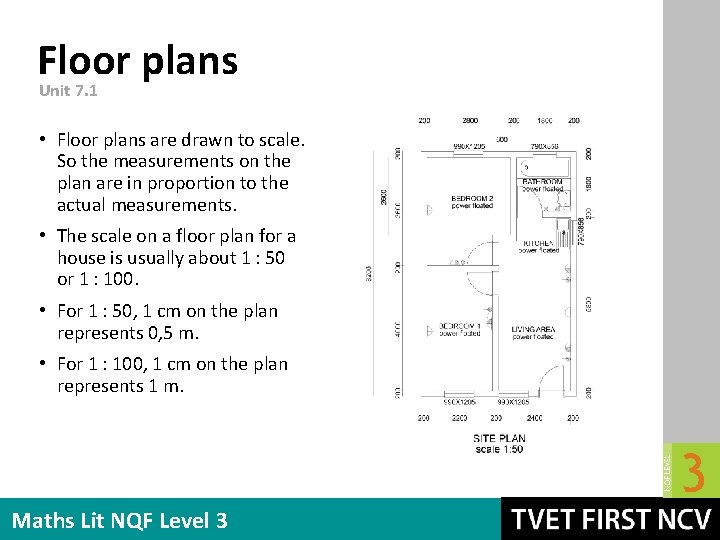
Floor plans Unit 7. 1 • Floor plans are drawn to scale. So the measurements on the plan are in proportion to the actual measurements. • The scale on a floor plan for a house is usually about 1 : 50 or 1 : 100. • For 1 : 50, 1 cm on the plan represents 0, 5 m. • For 1 : 100, 1 cm on the plan represents 1 m. Maths Lit NQF Level 3
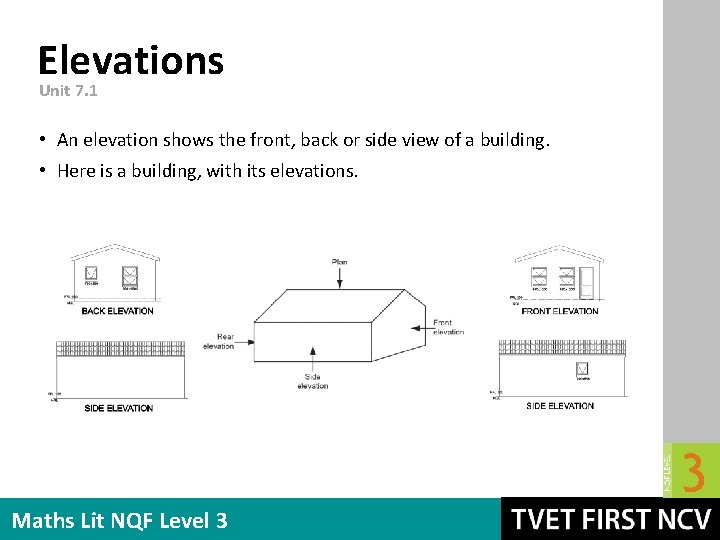
Elevations Unit 7. 1 • An elevation shows the front, back or side view of a building. • Here is a building, with its elevations. Maths Lit NQF Level 3
Scale, scale drawings and distance Unit 7. 1 • Maps and plans are drawn to scale to represent distances accurately. • The distances on the map are proportional to the actual distances. • A map of the world could be on a scale of 1 : 50 000 • Travel maps usually use scales of 1 : 125 000 or 1 : 50 000. • Street maps are usually 1 : 10 000 • Floor plans for buildings often use scales of 1 : 50 or 1 : 100. Maths Lit NQF Level 3
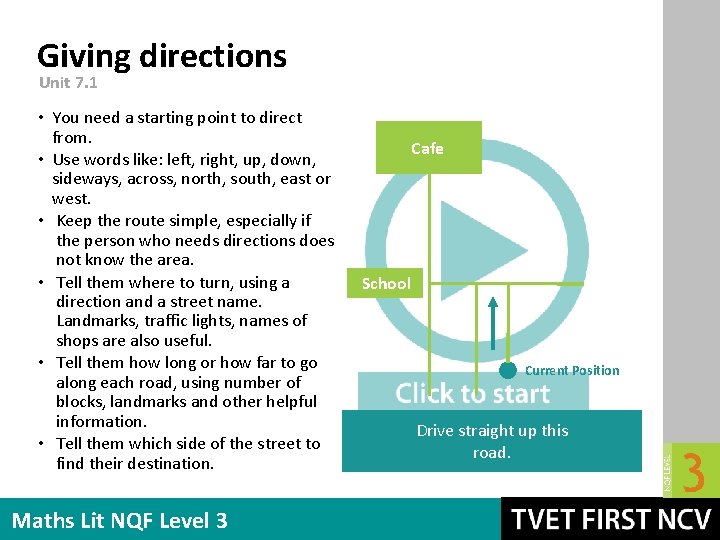
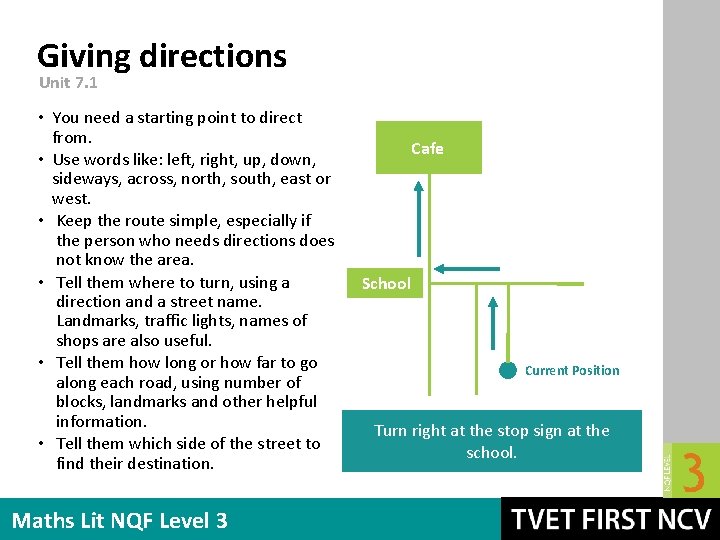
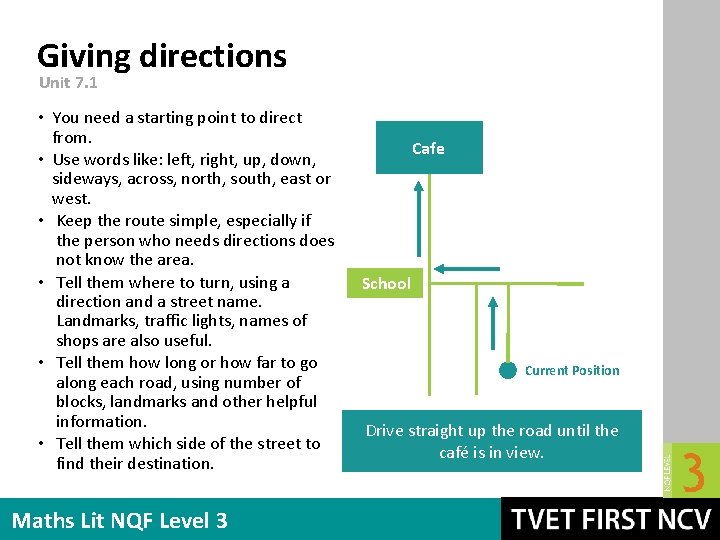
Giving directions Unit 7. 1 • You need a starting point to direct from. • Use words like: left, right, up, down, sideways, across, north, south, east or west. • Keep the route simple, especially if the person who needs directions does not know the area. • Tell them where to turn, using a direction and a street name. Landmarks, traffic lights, names of shops are also useful. • Tell them how long or how far to go along each road, using number of blocks, landmarks and other helpful information. • Tell them which side of the street to find their destination. Maths Lit NQF Level 3 Cafe School Current Position Drive straight up this road.
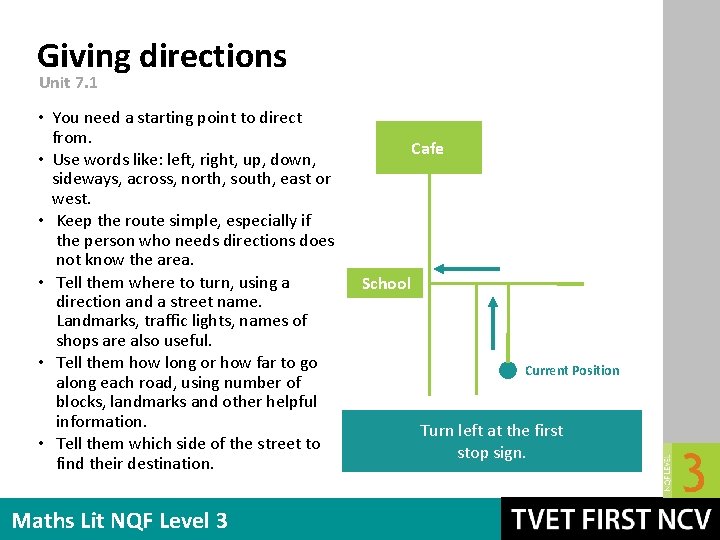
Giving directions Unit 7. 1 • You need a starting point to direct from. • Use words like: left, right, up, down, sideways, across, north, south, east or west. • Keep the route simple, especially if the person who needs directions does not know the area. • Tell them where to turn, using a direction and a street name. Landmarks, traffic lights, names of shops are also useful. • Tell them how long or how far to go along each road, using number of blocks, landmarks and other helpful information. • Tell them which side of the street to find their destination. Maths Lit NQF Level 3 Cafe School Current Position Turn left at the first stop sign.
Giving directions Unit 7. 1 • You need a starting point to direct from. • Use words like: left, right, up, down, sideways, across, north, south, east or west. • Keep the route simple, especially if the person who needs directions does not know the area. • Tell them where to turn, using a direction and a street name. Landmarks, traffic lights, names of shops are also useful. • Tell them how long or how far to go along each road, using number of blocks, landmarks and other helpful information. • Tell them which side of the street to find their destination. Maths Lit NQF Level 3 Cafe School Current Position Turn right at the stop sign at the school.
Giving directions Unit 7. 1 • You need a starting point to direct from. • Use words like: left, right, up, down, sideways, across, north, south, east or west. • Keep the route simple, especially if the person who needs directions does not know the area. • Tell them where to turn, using a direction and a street name. Landmarks, traffic lights, names of shops are also useful. • Tell them how long or how far to go along each road, using number of blocks, landmarks and other helpful information. • Tell them which side of the street to find their destination. Maths Lit NQF Level 3 Cafe School Current Position Drive straight up the road until the café is in view.
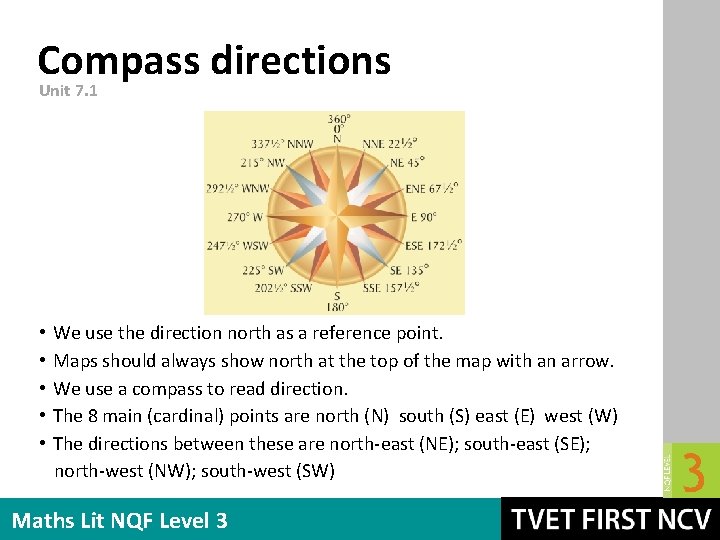
Compass directions Unit 7. 1 • • • We use the direction north as a reference point. Maps should always show north at the top of the map with an arrow. We use a compass to read direction. The 8 main (cardinal) points are north (N) south (S) east (E) west (W) The directions between these are north-east (NE); south-east (SE); north-west (NW); south-west (SW) Maths Lit NQF Level 3
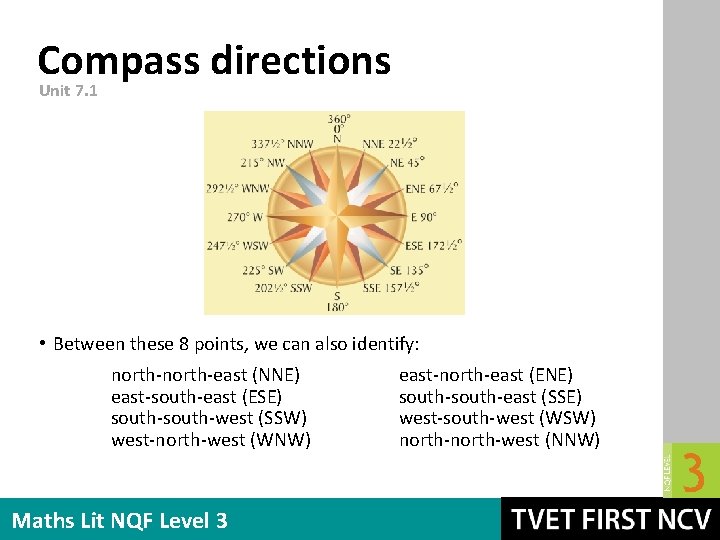
Compass directions Unit 7. 1 • Between these 8 points, we can also identify: north-east (NNE) east-south-east (ESE) south-west (SSW) west-north-west (WNW) Maths Lit NQF Level 3 east-north-east (ENE) south-east (SSE) west-south-west (WSW) north-west (NNW)
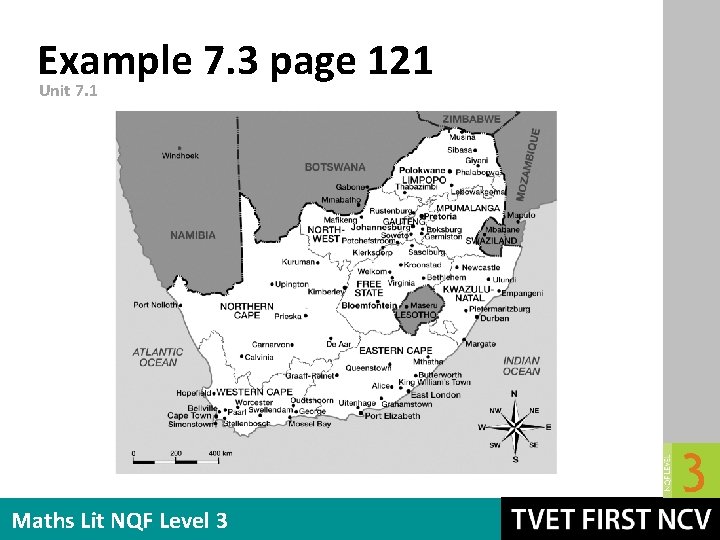
Example 7. 3 page 121 Unit 7. 1 Maths Lit NQF Level 3
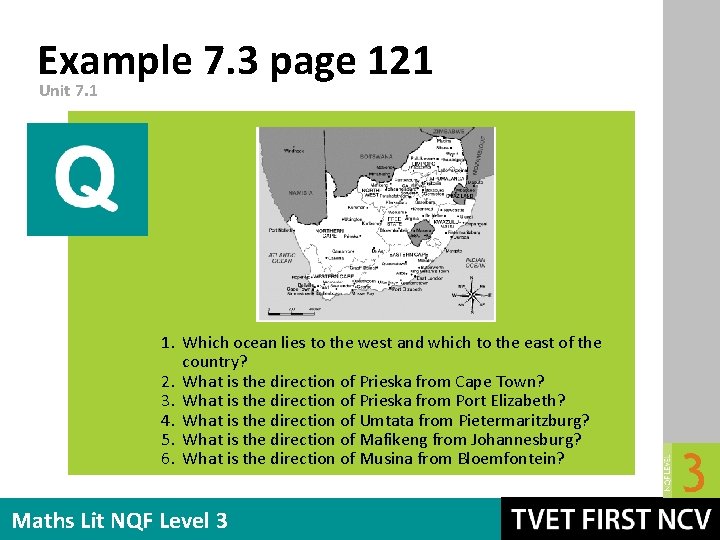
Example 7. 3 page 121 Unit 7. 1 1. Which ocean lies to the west and which to the east of the country? 2. What is the direction of Prieska from Cape Town? 3. What is the direction of Prieska from Port Elizabeth? 4. What is the direction of Umtata from Pietermaritzburg? 5. What is the direction of Mafikeng from Johannesburg? 6. What is the direction of Musina from Bloemfontein? Maths Lit NQF Level 3
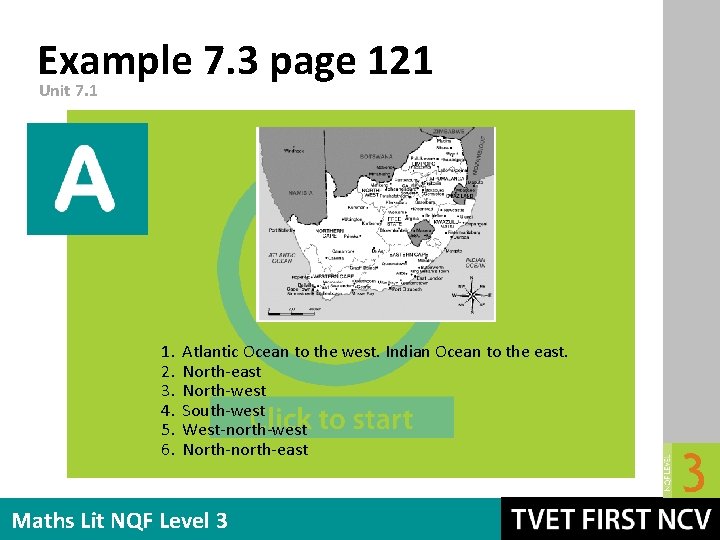
Example 7. 3 page 121 Unit 7. 1 1. 2. 3. 4. 5. 6. Atlantic Ocean to the west. Indian Ocean to the east. North-east North-west South-west West-north-west North-north-east Maths Lit NQF Level 3
Exercise 7. 1 Unit 7. 1 Complete Exercise 7. 1 on page 122 of your Student’s Book Maths Lit NQF Level 3
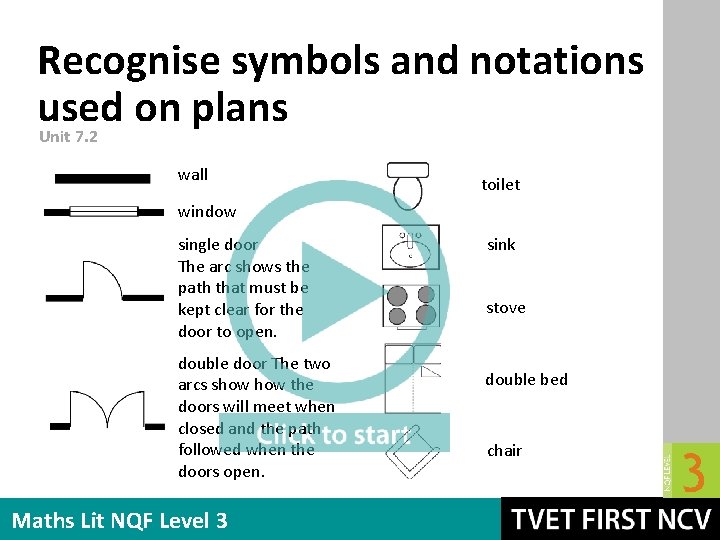
Recognise symbols and notations used on plans Unit 7. 2 wall toilet window single door The arc shows the path that must be kept clear for the door to open. double door The two arcs show the doors will meet when closed and the path followed when the doors open. Maths Lit NQF Level 3 sink stove double bed chair
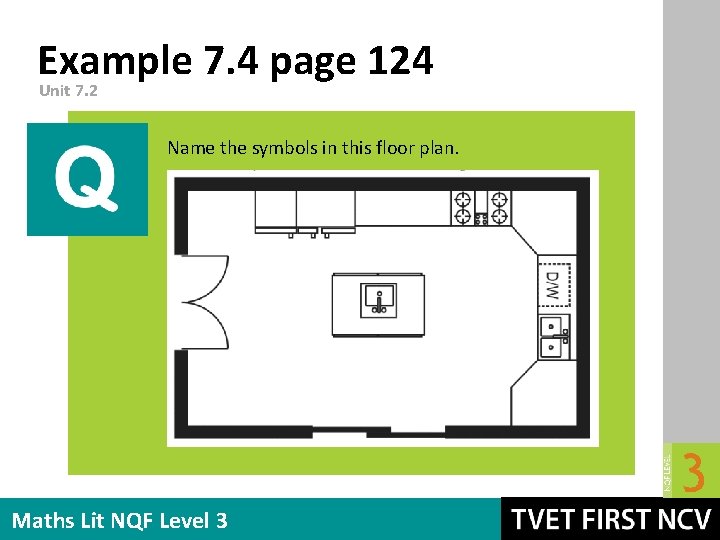
Example 7. 4 page 124 Unit 7. 2 Name the symbols in this floor plan. Maths Lit NQF Level 3
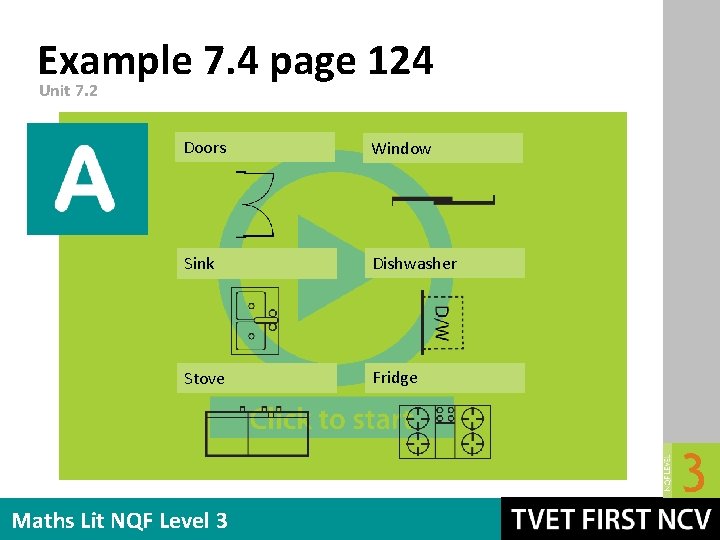
Example 7. 4 page 124 Unit 7. 2 Doors Window Sink Dishwasher Stove Fridge Maths Lit NQF Level 3
Exercise 7. 2 Unit 7. 2 Complete Exercise 7. 2 on page 125 of your Student’s Book Maths Lit NQF Level 3
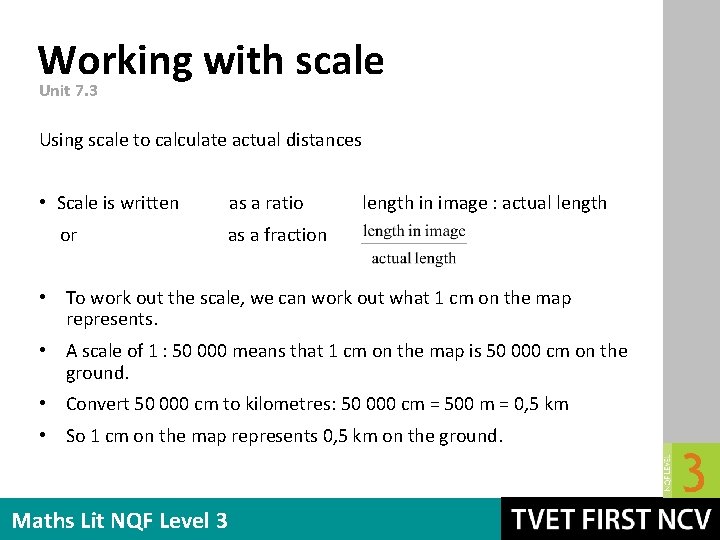
Working with scale Unit 7. 3 Using scale to calculate actual distances • Scale is written or as a ratio length in image : actual length as a fraction • To work out the scale, we can work out what 1 cm on the map represents. • A scale of 1 : 50 000 means that 1 cm on the map is 50 000 cm on the ground. • Convert 50 000 cm to kilometres: 50 000 cm = 500 m = 0, 5 km • So 1 cm on the map represents 0, 5 km on the ground. Maths Lit NQF Level 3
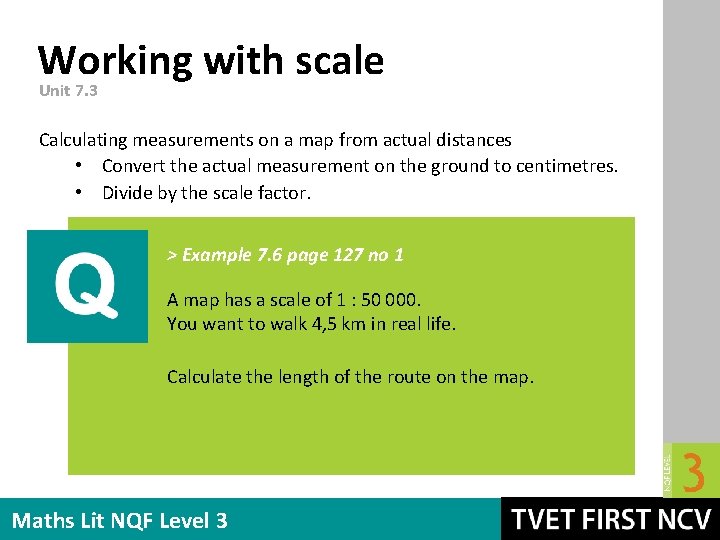
Working with scale Unit 7. 3 Calculating measurements on a map from actual distances • Convert the actual measurement on the ground to centimetres. • Divide by the scale factor. > Example 7. 6 page 127 no 1 A map has a scale of 1 : 50 000. You want to walk 4, 5 km in real life. Calculate the length of the route on the map. Maths Lit NQF Level 3
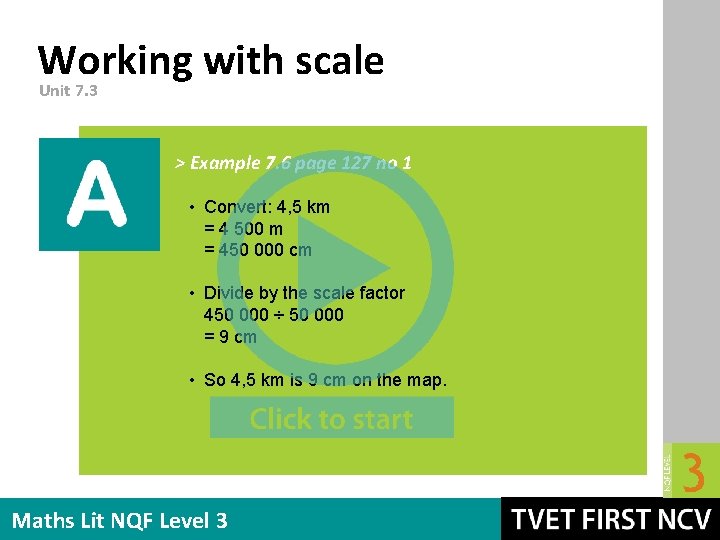
Working with scale Unit 7. 3 > Example 7. 6 page 127 no 1 • Convert: 4, 5 km = 4 500 m = 450 000 cm • Divide by the scale factor 450 000 ÷ 50 000 = 9 cm • So 4, 5 km is 9 cm on the map. Maths Lit NQF Level 3
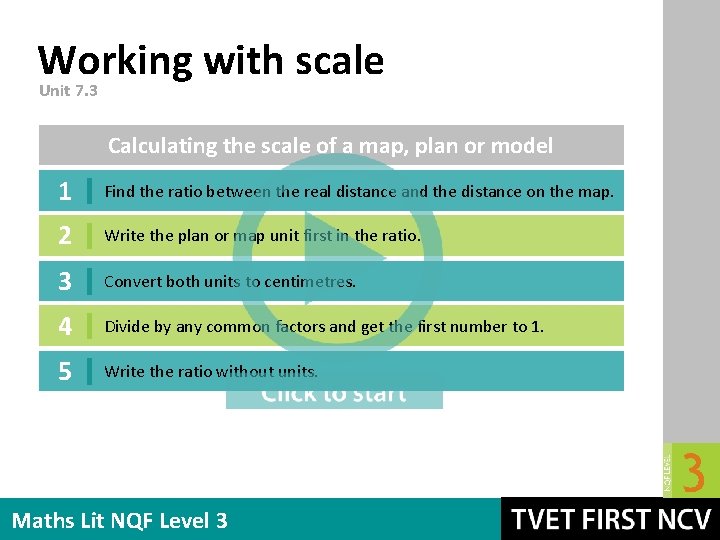
Working with scale Unit 7. 3 Calculating the scale of a map, plan or model 1 Find the ratio between the real distance and the distance on the map. 2 Write the plan or map unit first in the ratio. 3 Convert both units to centimetres. 4 Divide by any common factors and get the first number to 1. 5 Write the ratio without units. Maths Lit NQF Level 3
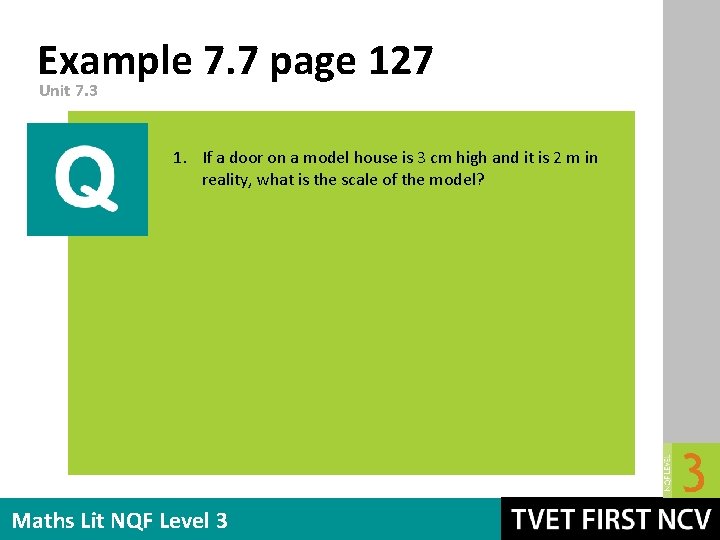
Example 7. 7 page 127 Unit 7. 3 1. If a door on a model house is 3 cm high and it is 2 m in reality, what is the scale of the model? Maths Lit NQF Level 3
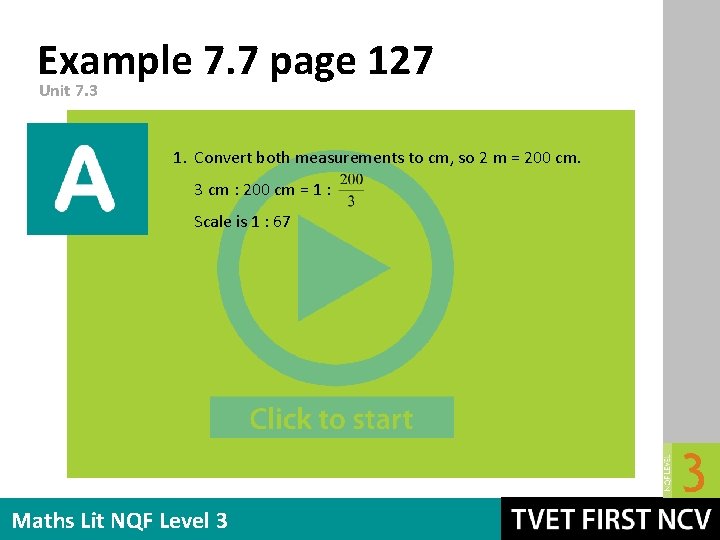
Example 7. 7 page 127 Unit 7. 3 1. Convert both measurements to cm, so 2 m = 200 cm. 3 cm : 200 cm = 1 : Scale is 1 : 67 Maths Lit NQF Level 3
Exercise 7. 3 Unit 7. 3 Complete Exercise 7. 3 on page 129 of your Student’s Book Maths Lit NQF Level 3
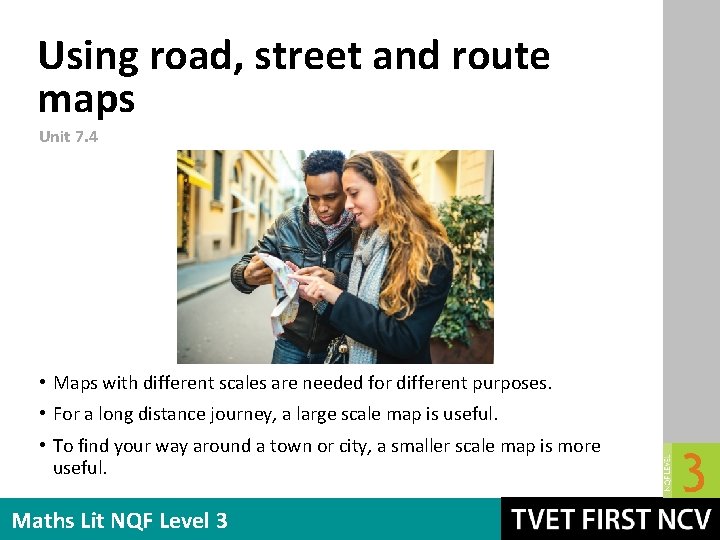
Using road, street and route maps Unit 7. 4 • Maps with different scales are needed for different purposes. • For a long distance journey, a large scale map is useful. • To find your way around a town or city, a smaller scale map is more useful. Maths Lit NQF Level 3
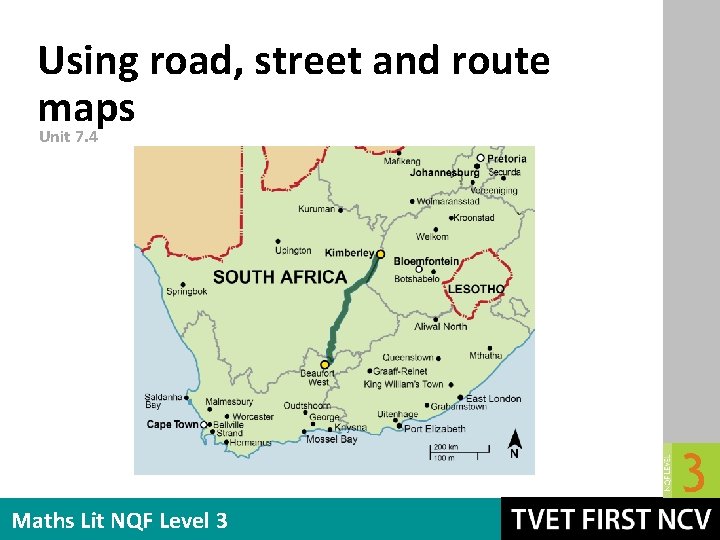
Using road, street and route maps Unit 7. 4 Planning a trip using a road map (map on next slide): • This example is a trip from Kimberley to Beaufort West. • On the national map, use the bar scale to estimate the distance. • On the scale, 3 cm represents 200 km. • Kimberley to Beaufort West is about 6 cm. It is about 400 km. • The journey is roughly in a south-west direction. Maths Lit NQF Level 3
Using road, street and route maps Unit 7. 4 Maths Lit NQF Level 3
Planning a trip using a road map Unit 7. 4 Maths Lit NQF Level 3
Exercise 7. 4 Unit 7. 4 Complete Exercise 7. 4 on page 131 of your Student’s Book Maths Lit NQF Level 3
Exercise 7. 5 Unit 7. 4 Complete Exercise 7. 5 on page 133 of your Student’s Book Maths Lit NQF Level 3
Plans to determine quantities of materials needed Unit 7. 5 • Builders use house plans to estimate the quantities of materials needed. • The dimensions shown on plans allow you to calculate lengths and areas. Maths Lit NQF Level 3
Exercise 7. 6 Unit 7. 5 Complete Exercise 7. 6 on page 136 of your Student’s Book Maths Lit NQF Level 3
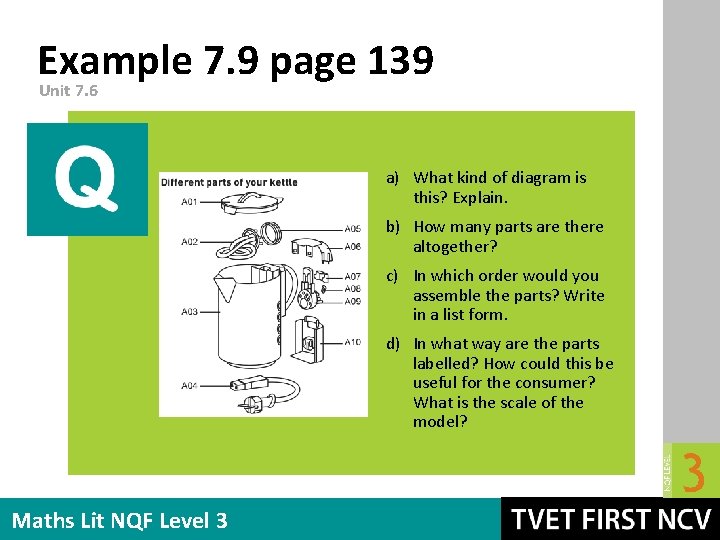
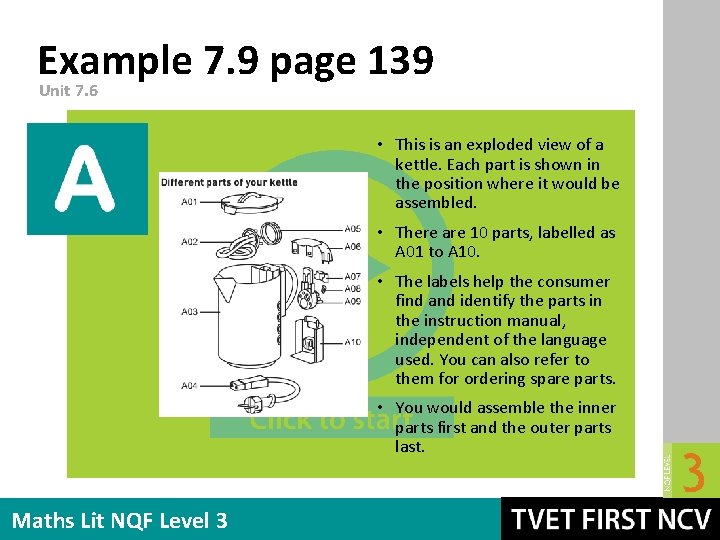
Interpreting instructions and assembly diagrams Unit 7. 6 • Assembly diagrams and instructions provide step-by-step directions for putting together an object or system from its parts. • An exploded view drawing shows how the parts fit together. • The parts in the centre are usually assembled first. Maths Lit NQF Level 3
Interpreting instructions and assembly diagrams Unit 7. 6 • If you are taking something apart using the diagram, you usually remove the outside parts first. • Exploded view diagrams are often used in instruction manuals and show part identification numbers and labels. Maths Lit NQF Level 3
Example 7. 9 page 139 Unit 7. 6 a) What kind of diagram is this? Explain. b) How many parts are there altogether? c) In which order would you assemble the parts? Write in a list form. d) In what way are the parts labelled? How could this be useful for the consumer? What is the scale of the model? Maths Lit NQF Level 3
Example 7. 9 page 139 Unit 7. 6 • This is an exploded view of a kettle. Each part is shown in the position where it would be assembled. • There are 10 parts, labelled as A 01 to A 10. • The labels help the consumer find and identify the parts in the instruction manual, independent of the language used. You can also refer to them for ordering spare parts. • You would assemble the inner parts first and the outer parts last. Maths Lit NQF Level 3
Exercise 7. 7 Unit 7. 6 Complete Exercise 7. 7 on page 140 of your Student’s Book Maths Lit NQF Level 3
Module assessment Module 7 Complete Module assessment on page 144 of your Student’s Book Maths Lit NQF Level 3
TERMS AND CONDITIONS This Power. Point Presentation has been developed by Macmillan Education South Africa (Pty) Ltd. All texts, images, videos, animations, audio and vector simulations contained in the slides are property of Macmillan South Africa. Reproducing, reselling and redistributing this material without the written permission of Macmillan South Africa is prohibited. Lecturers are granted permission to: (i) modify the slides by adding and removing content; (ii) print copies of the presentation; and (iii) download and save the slides to a computer or local server. Nothing in this copyright notice constitutes permission to assert or imply that your use of the materials is sponsored or endorsed by Macmillan South Africa. Maths Lit NQF Level 3