
Mathematical Literacy NQF 2 Maths Lit NQF Level
- Slides: 29
Mathematical Literacy NQF 2 Maths Lit NQF Level 2
Reading and interpreting bank information Module 11 Maths Lit NQF Level 2
Overview 11. 1 Bank accounts for personal use 11. 2 Read and interpret bank statements and fees brochures Maths Lit NQF Level 2
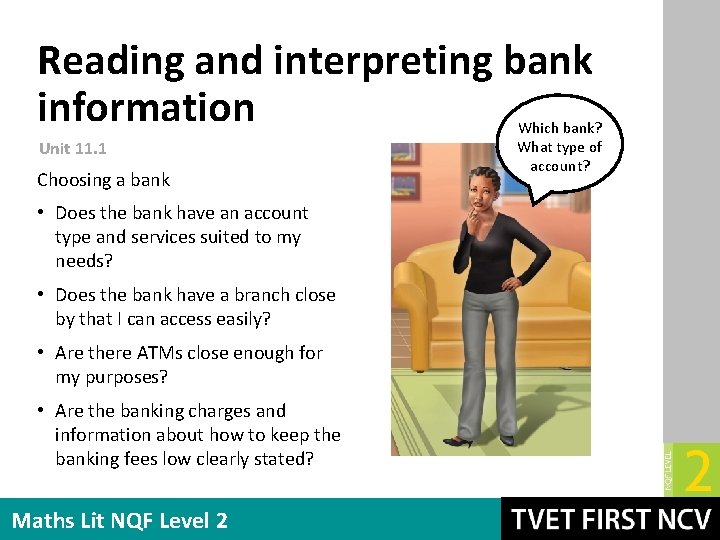
Reading and interpreting bank information Unit 11. 1 Choosing a bank • Does the bank have an account type and services suited to my needs? • Does the bank have a branch close by that I can access easily? • Are there ATMs close enough for my purposes? • Are the banking charges and information about how to keep the banking fees low clearly stated? Maths Lit NQF Level 2 Which bank? What type of account?
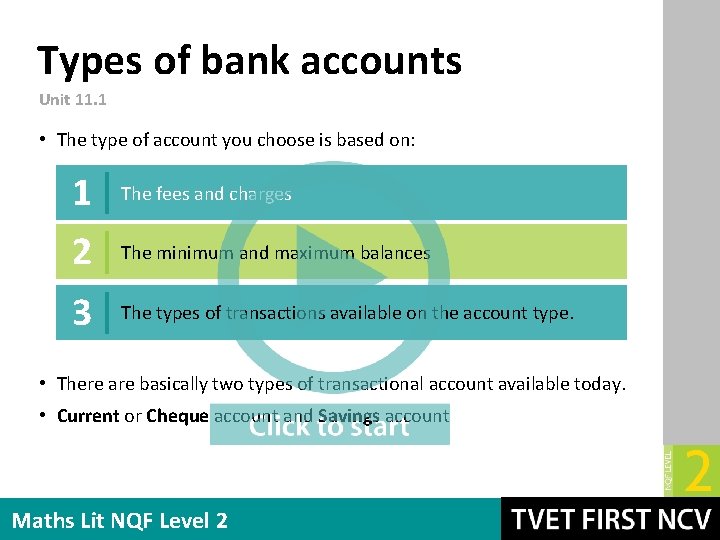
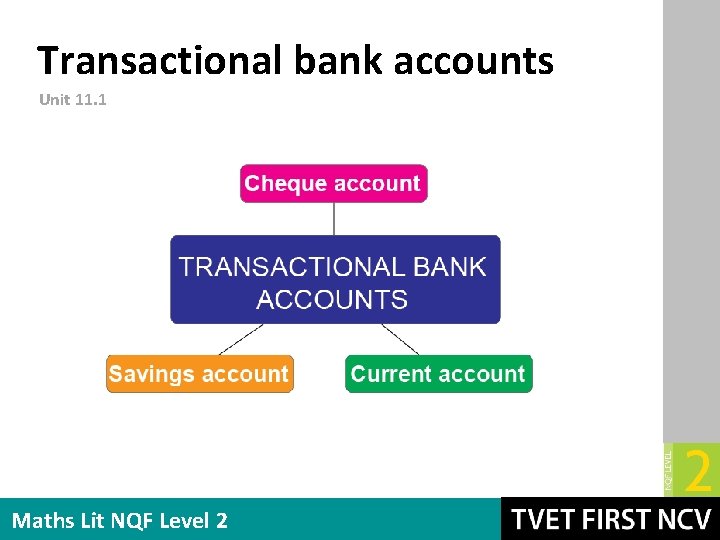
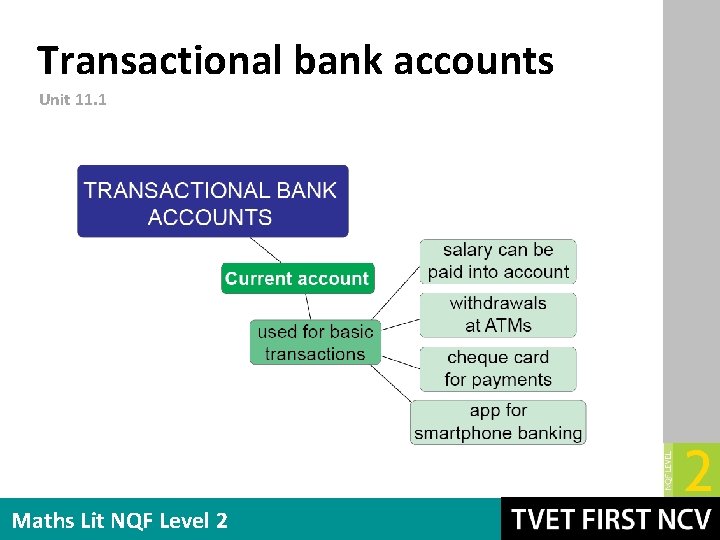
Types of bank accounts Unit 11. 1 • The type of account you choose is based on: 1 2 3 The fees and charges The minimum and maximum balances The types of transactions available on the account type. • There are basically two types of transactional account available today. • Current or Cheque account and Savings account Maths Lit NQF Level 2
Transactional bank accounts Unit 11. 1 Maths Lit NQF Level 2
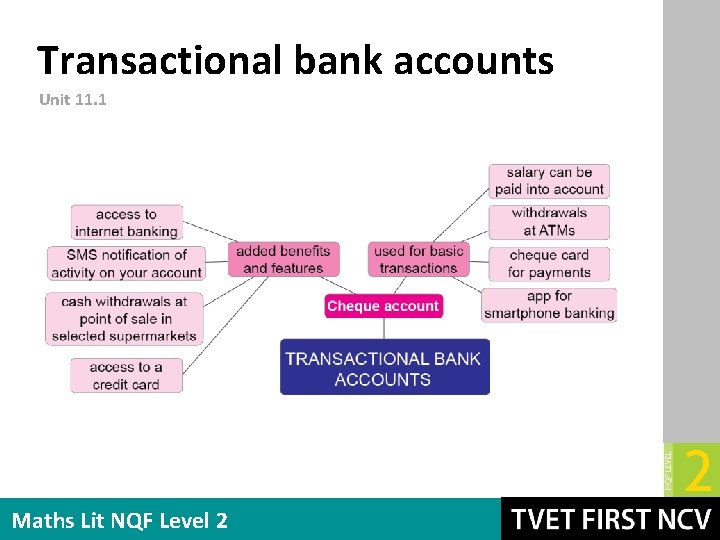
Transactional bank accounts Unit 11. 1 Maths Lit NQF Level 2
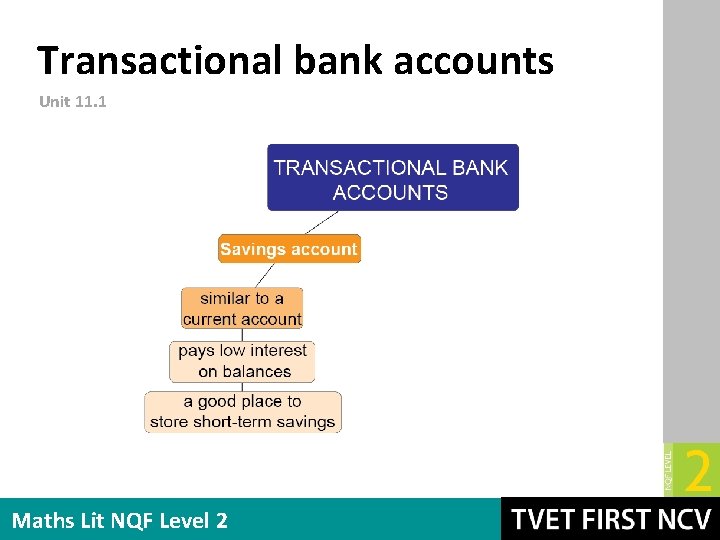
Transactional bank accounts Unit 11. 1 Maths Lit NQF Level 2
Transactional bank accounts Unit 11. 1 Maths Lit NQF Level 2
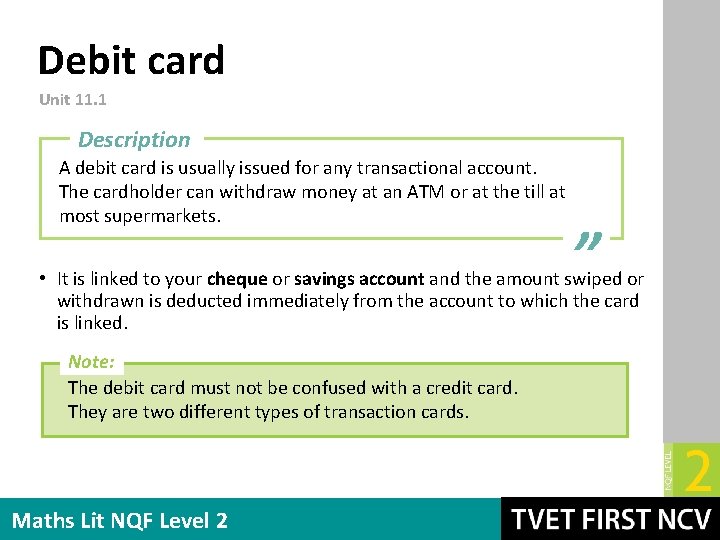
Debit card Unit 11. 1 Description A debit card is usually issued for any transactional account. The cardholder can withdraw money at an ATM or at the till at most supermarkets. ” • It is linked to your cheque or savings account and the amount swiped or withdrawn is deducted immediately from the account to which the card is linked. Note: The debit card must not be confused with a credit card. They are two different types of transaction cards. Maths Lit NQF Level 2
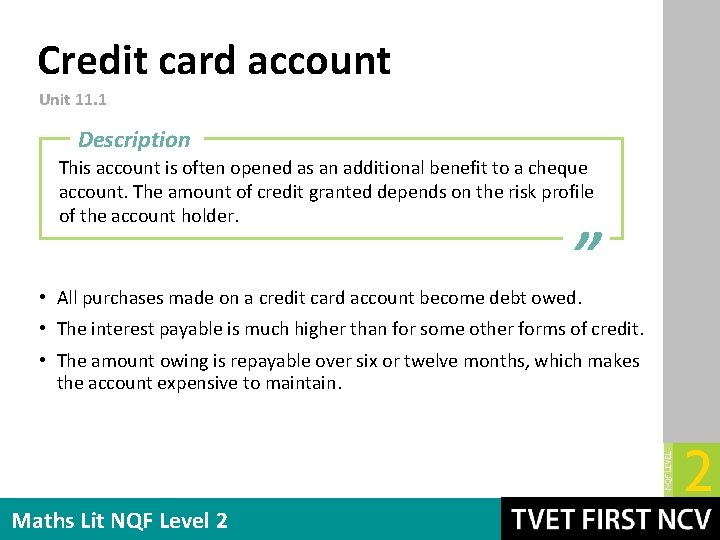
Credit card account Unit 11. 1 Description This account is often opened as an additional benefit to a cheque account. The amount of credit granted depends on the risk profile of the account holder. ” • All purchases made on a credit card account become debt owed. • The interest payable is much higher than for some other forms of credit. • The amount owing is repayable over six or twelve months, which makes the account expensive to maintain. Maths Lit NQF Level 2
Case study Unit 11. 1 Complete Case study on page 208 of your Student’s Book Maths Lit NQF Level 2
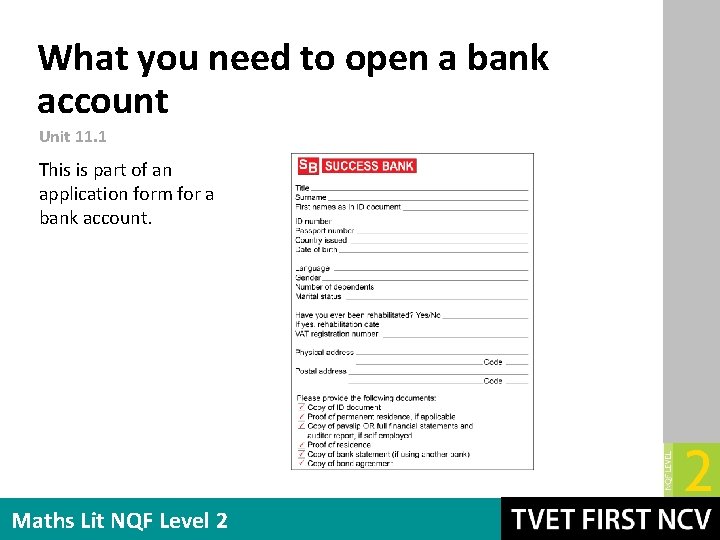
What you need to open a bank account Unit 11. 1 This is part of an application form for a bank account. Maths Lit NQF Level 2
What you need to open a bank account Unit 11. 1 • The Financial Intelligence Centre Act, 38 of 2001, abbreviated to “FICA” requires every person opening a bank account to provide the bank with: i. a bar-coded Identity document ii. proof of residence iii. a source of primary income, e. g. salary, rental income, etc. • FICA regulations are necessary to prevent money laundering (the abuse of financial systems to hide or disguise the proceeds of crime). Maths Lit NQF Level 2
Banking forms Unit 11. 1 • Most banking today takes place via the internet and ATMs. There is not much need for bank forms. • Cheques will soon become a thing of the past. Some companies do not accept cheques anymore. • A cheque is only valid for a limited time period and once expired is referred to as being stale and no longer valid. Maths Lit NQF Level 2
Cheques Unit 11. 1 Maths Lit NQF Level 2
The deposit slip Unit 11. 1 Maths Lit NQF Level 2
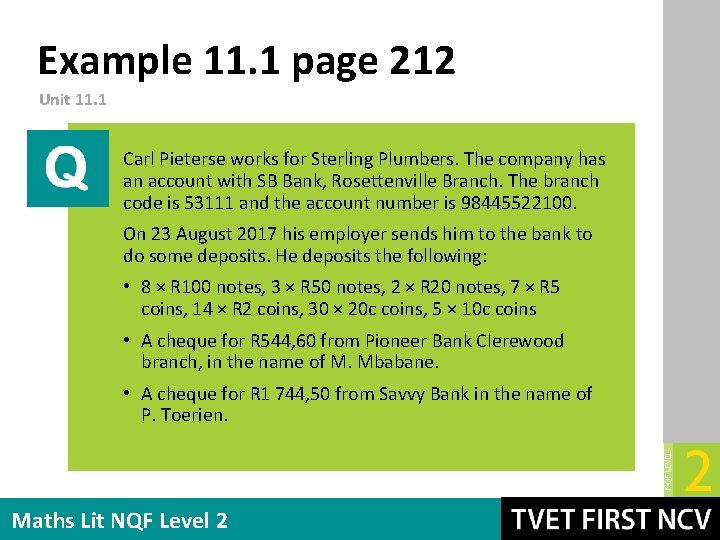
Example 11. 1 page 212 Unit 11. 1 Carl Pieterse works for Sterling Plumbers. The company has an account with SB Bank, Rosettenville Branch. The branch code is 53111 and the account number is 98445522100. On 23 August 2017 his employer sends him to the bank to do some deposits. He deposits the following: • 8 × R 100 notes, 3 × R 50 notes, 2 × R 20 notes, 7 × R 5 coins, 14 × R 2 coins, 30 × 20 c coins, 5 × 10 c coins • A cheque for R 544, 60 from Pioneer Bank Clerewood branch, in the name of M. Mbabane. • A cheque for R 1 744, 50 from Savvy Bank in the name of P. Toerien. Maths Lit NQF Level 2
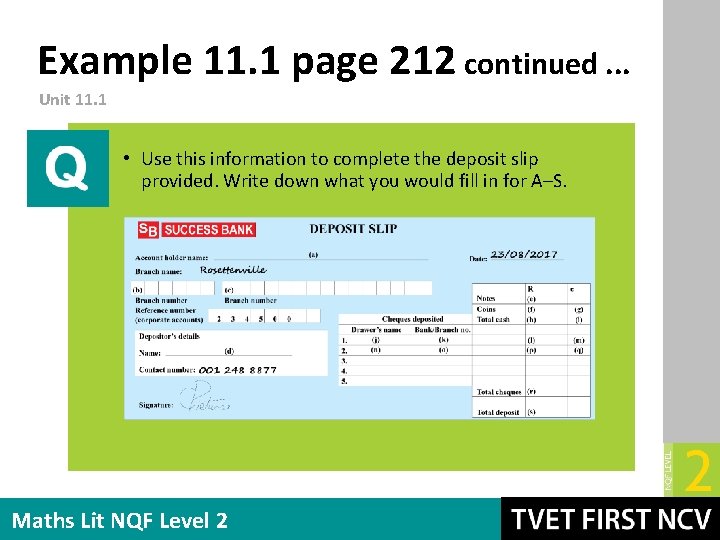
Example 11. 1 page 212 continued. . . Unit 11. 1 • Use this information to complete the deposit slip provided. Write down what you would fill in for A–S. Maths Lit NQF Level 2
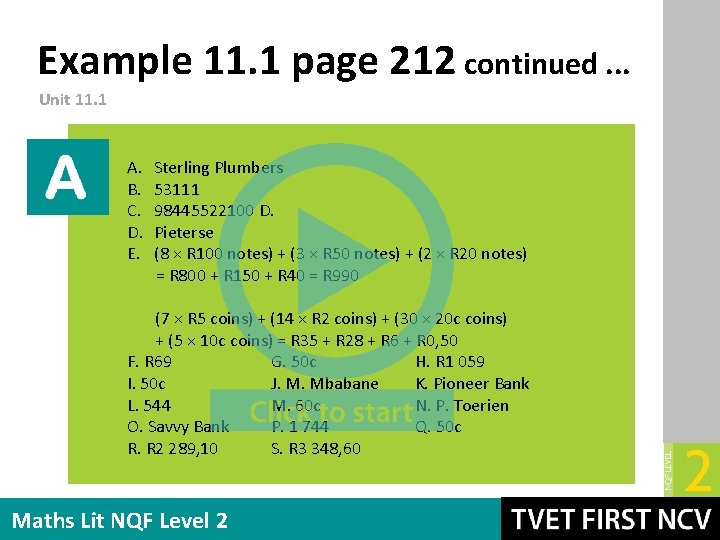
Example 11. 1 page 212 continued. . . Unit 11. 1 A. B. C. D. E. Sterling Plumbers 53111 98445522100 D. Pieterse (8 × R 100 notes) + (3 × R 50 notes) + (2 × R 20 notes) = R 800 + R 150 + R 40 = R 990 (7 × R 5 coins) + (14 × R 2 coins) + (30 × 20 c coins) + (5 × 10 c coins) = R 35 + R 28 + R 6 + R 0, 50 F. R 69 G. 50 c H. R 1 059 I. 50 c J. M. Mbabane K. Pioneer Bank L. 544 M. 60 c N. P. Toerien O. Savvy Bank P. 1 744 Q. 50 c R. R 2 289, 10 S. R 3 348, 60 Maths Lit NQF Level 2
Exercise 11. 1 Unit 11. 1 Complete Exercise 11. 1 on page 213 of your Student’s Book Maths Lit NQF Level 2
Read and interpret bank statements and fees brochures Unit 11. 2 A bank statement is a record of all transactions on a bank account. Internet banking and EFTs (electronic funds transfer) are recorded online, so banks only issue statements when you ask. Most bank statements have the same format: • Transaction date • Type of transaction • Description of transaction • Credit transaction • Debit transaction • Balance on the account after each transaction. Maths Lit NQF Level 2
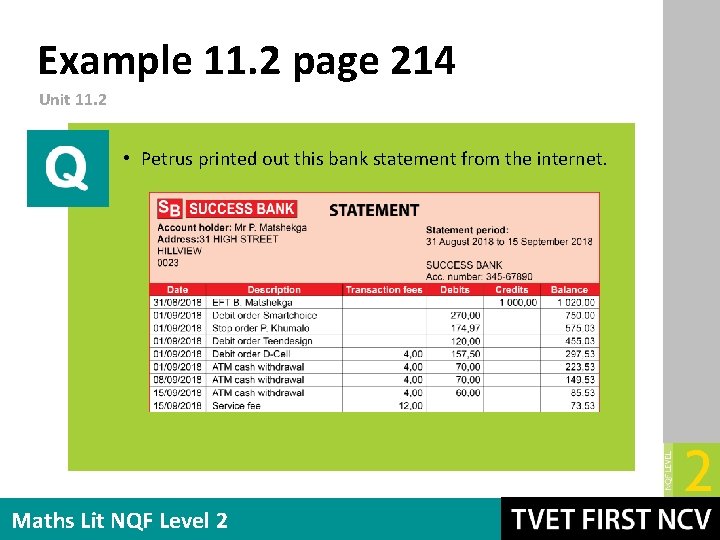
Example 11. 2 page 214 Unit 11. 2 • Petrus printed out this bank statement from the internet. Maths Lit NQF Level 2
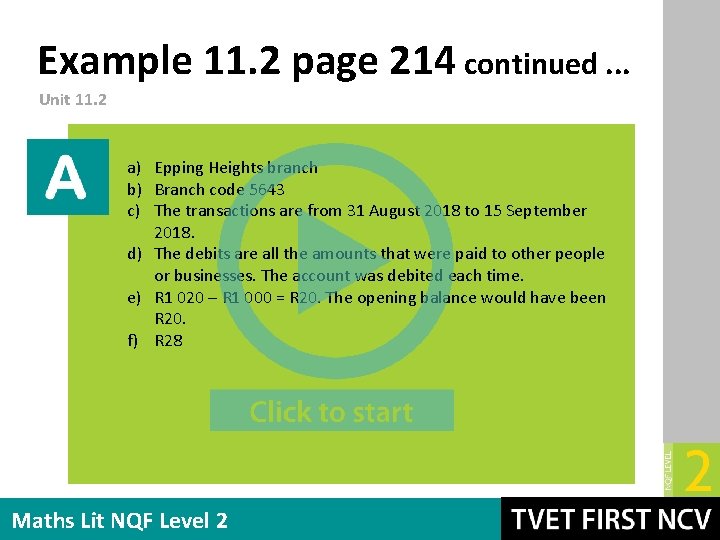
Example 11. 2 page 214 continued. . . Unit 11. 2 a) At which branch does Petrus bank? b) Write down the branch code he uses on transactions. c) For which dates did Petrus request a statement? Name the opening and closing dates of the statement. d) Explain what the debits are. e) The opening balance is not given on this statement. Calculate what it would have been. f) How much did Petrus pay in banking charges this month? Maths Lit NQF Level 2
Example 11. 2 page 214 continued. . . Unit 11. 2 a) Epping Heights branch b) Branch code 5643 c) The transactions are from 31 August 2018 to 15 September 2018. d) The debits are all the amounts that were paid to other people or businesses. The account was debited each time. e) R 1 020 – R 1 000 = R 20. The opening balance would have been R 20. f) R 28 Maths Lit NQF Level 2
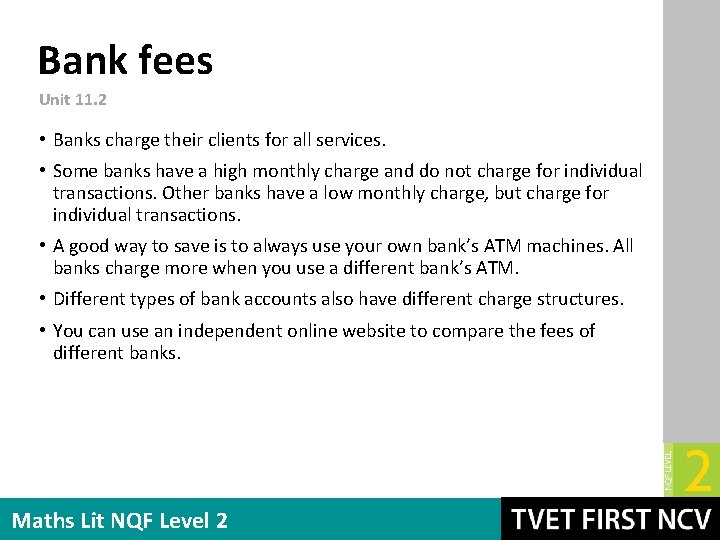
Bank fees Unit 11. 2 • Banks charge their clients for all services. • Some banks have a high monthly charge and do not charge for individual transactions. Other banks have a low monthly charge, but charge for individual transactions. • A good way to save is to always use your own bank’s ATM machines. All banks charge more when you use a different bank’s ATM. • Different types of bank accounts also have different charge structures. • You can use an independent online website to compare the fees of different banks. Maths Lit NQF Level 2
Exercise 11. 2 Unit 11. 2 Complete Exercise 11. 2 on page 215 of your Student’s Book Maths Lit NQF Level 2
Module assessment Module 11 Complete Module assessment on page 218 of your Student’s Book. Maths Lit NQF Level 2
TERMS AND CONDITIONS This Power. Point Presentation has been developed by Macmillan Education South Africa (Pty) Ltd. All texts, images, videos, animations, audio and vector simulations contained in the slides are property of Macmillan South Africa. Reproducing, reselling and redistributing this material without the written permission of Macmillan South Africa is prohibited. Lecturers are granted permission to: (i) modify the slides by adding and removing content; (ii) print copies of the presentation; and (iii) download and save the slides to a computer or local server. Nothing in this copyright notice constitutes permission to assert or imply that your use of the materials is sponsored or endorsed by Macmillan South Africa. Maths Lit NQF Level 2