
MATHEMATICAL LITERACY GRADE 11 CAPS TOPIC 3 FINANCE


- Slides: 24
MATHEMATICAL LITERACY GRADE 11 CAPS TOPIC 3: FINANCE Section 3. 4: Cost price and selling price
Topic 3: Finance The following sections will be covered: 3. 1. Financial documents 3. 2. Tariff system 3. 3. Income, Expenditure, Profit/ Loss, Incomeexpenditure statements and budgets 3. 4. Cost price and Selling price 3. 5. Break-even-analysis and-
Topic 3: Finance 3. 6. Interest 3. 7 Banking 3. 8 Inflation 3. 9. Taxation (VAT and UIF) 3. 10. Exchange
Cost price and selling price In Section 3. 4 learners will be able to: § Determine the cost of production. § Determine the cost price of an item or service § Understand the difference between cost production and cost price of an item. § Decide on an appropriate selling price for an item and/or service based on an expected percentage profit.
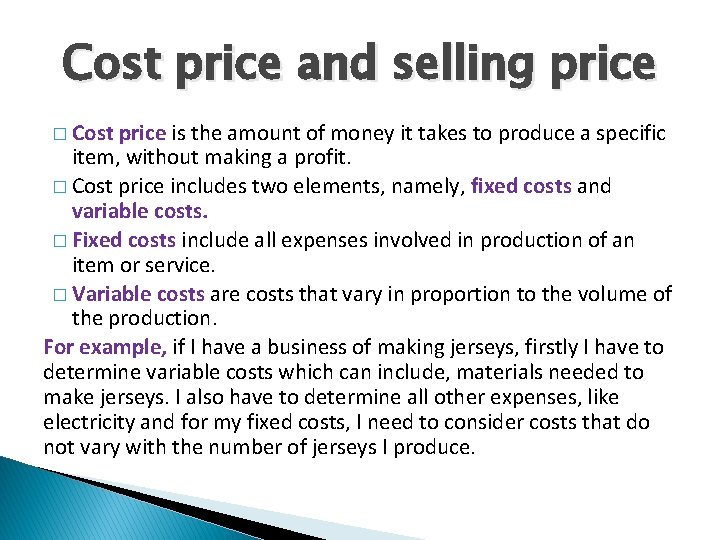
Cost price and selling price � Cost price is the amount of money it takes to produce a specific item, without making a profit. � Cost price includes two elements, namely, fixed costs and variable costs. � Fixed costs include all expenses involved in production of an item or service. � Variable costs are costs that vary in proportion to the volume of the production. For example, if I have a business of making jerseys, firstly I have to determine variable costs which can include, materials needed to make jerseys. I also have to determine all other expenses, like electricity and for my fixed costs, I need to consider costs that do not vary with the number of jerseys I produce.
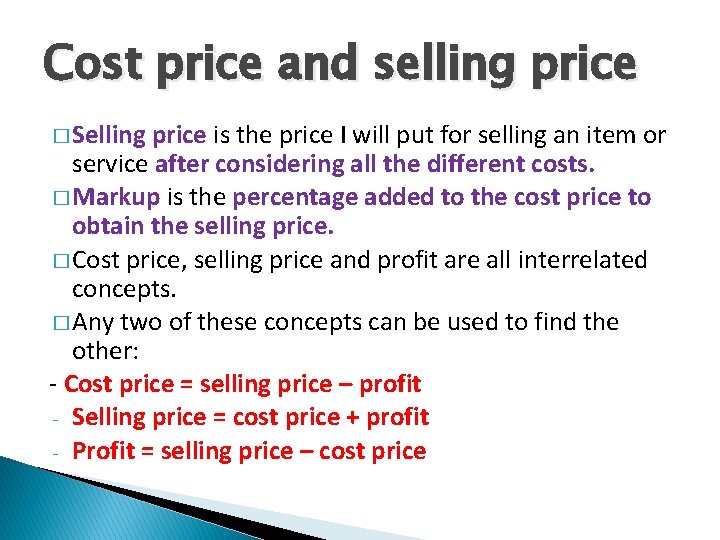
Cost price and selling price � Selling price is the price I will put for selling an item or service after considering all the different costs. � Markup is the percentage added to the cost price to obtain the selling price. � Cost price, selling price and profit are all interrelated concepts. � Any two of these concepts can be used to find the other: - Cost price = selling price – profit - Selling price = cost price + profit - Profit = selling price – cost price
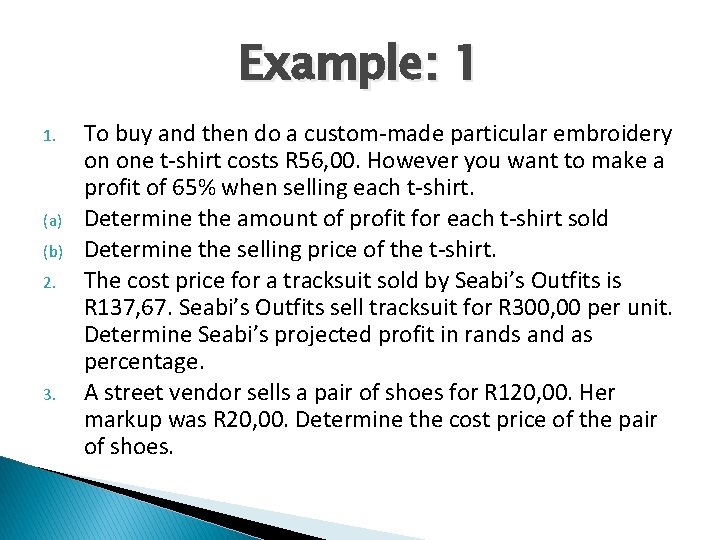
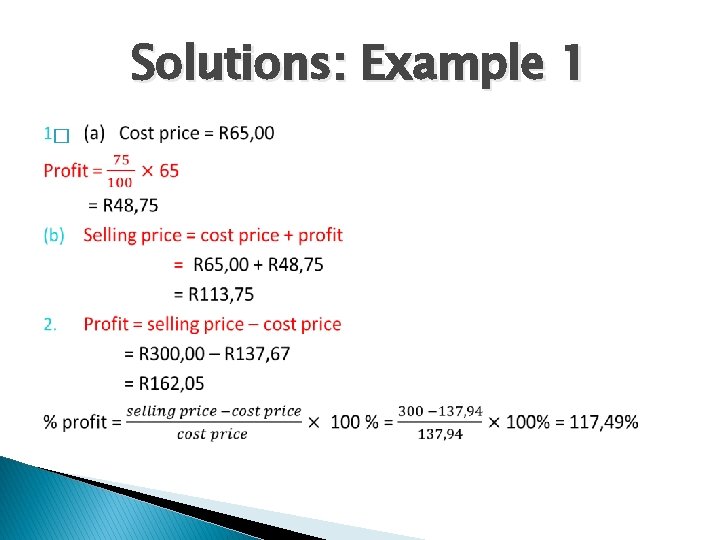
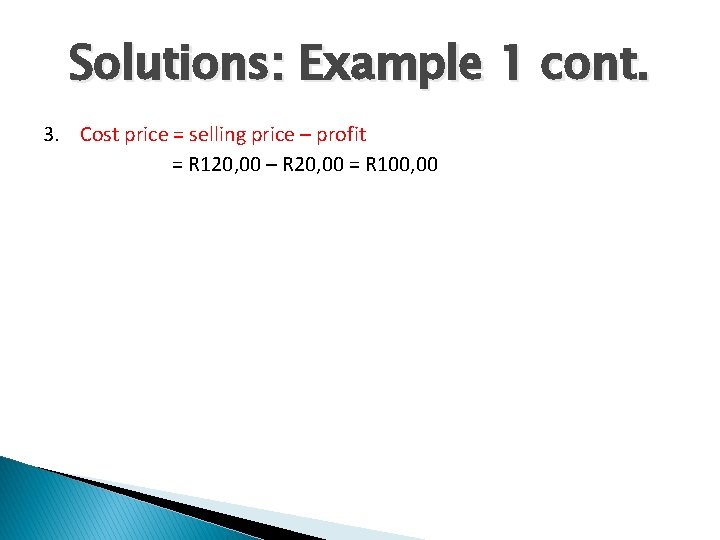
Example: 1 1. (a) (b) 2. 3. To buy and then do a custom-made particular embroidery on one t-shirt costs R 56, 00. However you want to make a profit of 65% when selling each t-shirt. Determine the amount of profit for each t-shirt sold Determine the selling price of the t-shirt. The cost price for a tracksuit sold by Seabi’s Outfits is R 137, 67. Seabi’s Outfits sell tracksuit for R 300, 00 per unit. Determine Seabi’s projected profit in rands and as percentage. A street vendor sells a pair of shoes for R 120, 00. Her markup was R 20, 00. Determine the cost price of the pair of shoes.
Solutions: Example 1 �
Solutions: Example 1 cont. 3. Cost price = selling price – profit = R 120, 00 – R 20, 00 = R 100, 00
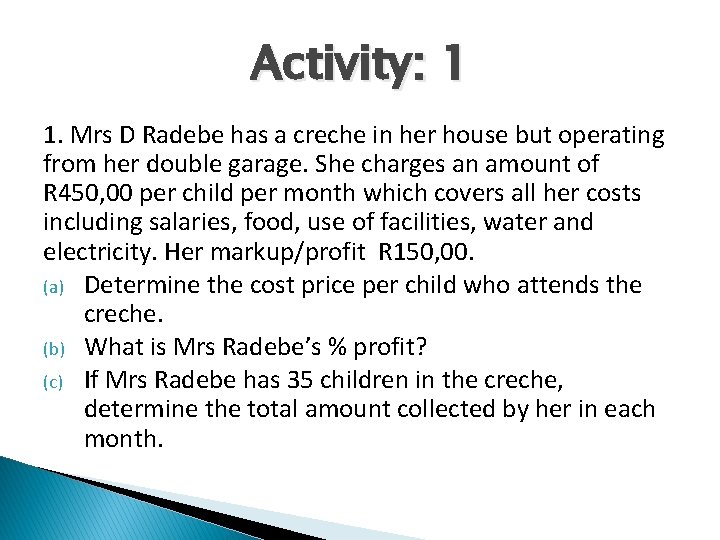
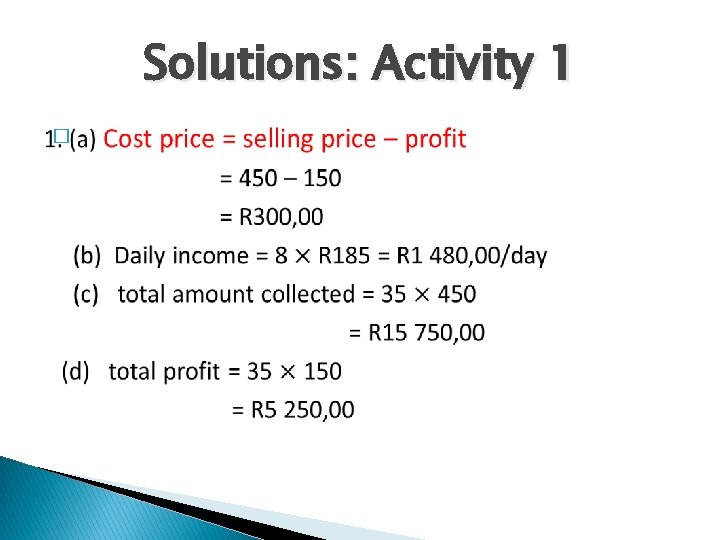
Activity: 1 1. Mrs D Radebe has a creche in her house but operating from her double garage. She charges an amount of R 450, 00 per child per month which covers all her costs including salaries, food, use of facilities, water and electricity. Her markup/profit R 150, 00. (a) Determine the cost price per child who attends the creche. (b) What is Mrs Radebe’s % profit? (c) If Mrs Radebe has 35 children in the creche, determine the total amount collected by her in each month.
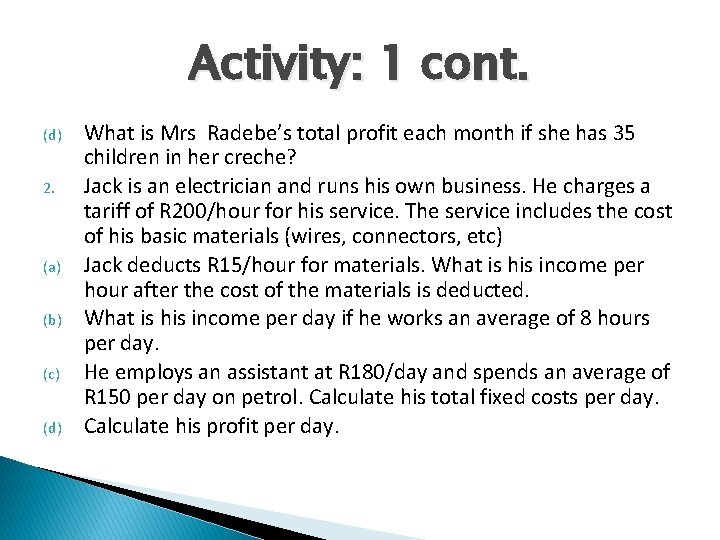
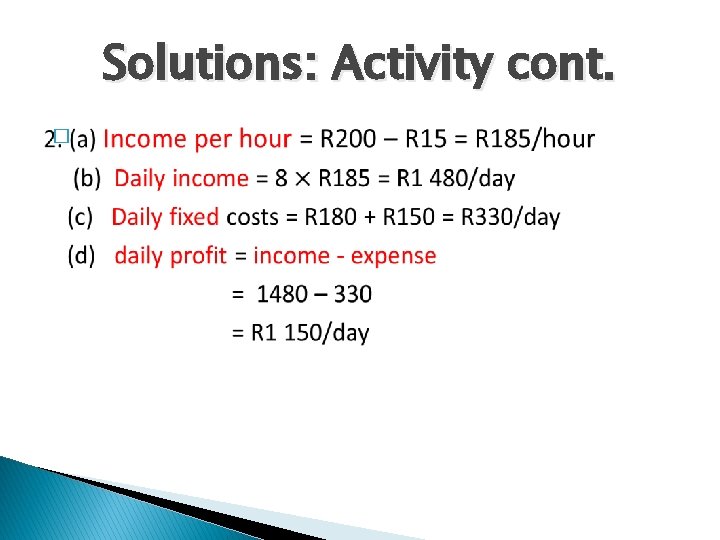
Activity: 1 cont. (d) 2. (a) (b) (c) (d) What is Mrs Radebe’s total profit each month if she has 35 children in her creche? Jack is an electrician and runs his own business. He charges a tariff of R 200/hour for his service. The service includes the cost of his basic materials (wires, connectors, etc) Jack deducts R 15/hour for materials. What is his income per hour after the cost of the materials is deducted. What is his income per day if he works an average of 8 hours per day. He employs an assistant at R 180/day and spends an average of R 150 per day on petrol. Calculate his total fixed costs per day. Calculate his profit per day.
Solutions: Activity 1 �
Solutions: Activity cont. �
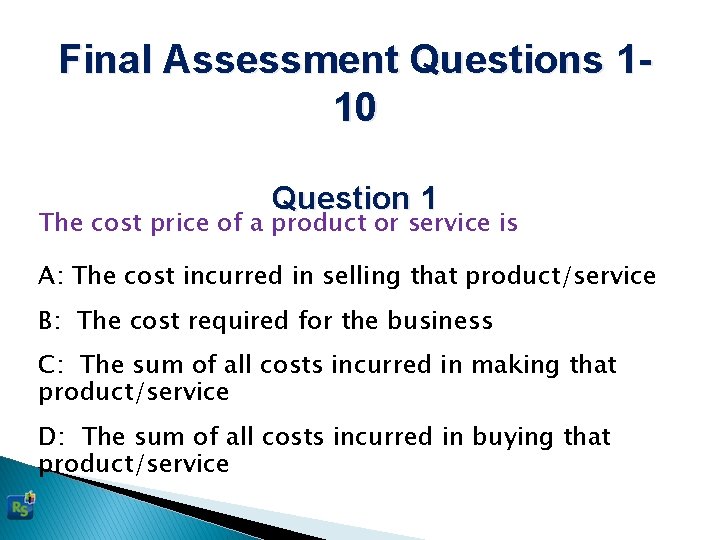
Final Assessment Questions 110 Question 1 The cost price of a product or service is A: The cost incurred in selling that product/service B: The cost required for the business C: The sum of all costs incurred in making that product/service D: The sum of all costs incurred in buying that product/service
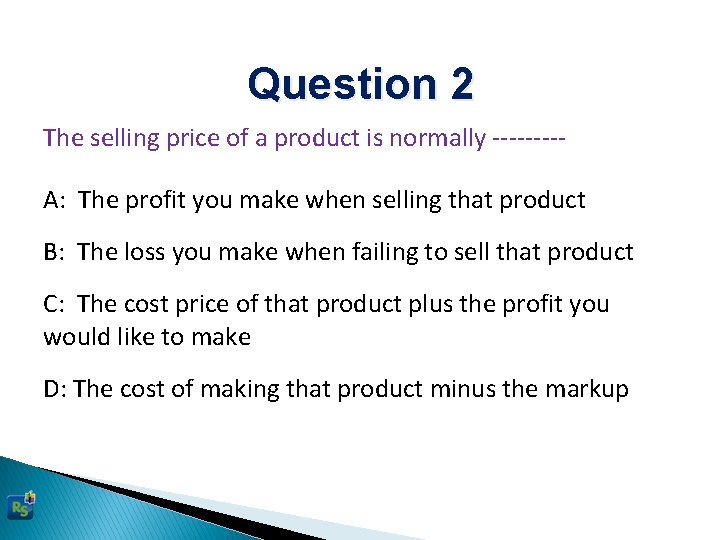
Question 2 The selling price of a product is normally ----A: The profit you make when selling that product B: The loss you make when failing to sell that product C: The cost price of that product plus the profit you would like to make D: The cost of making that product minus the markup
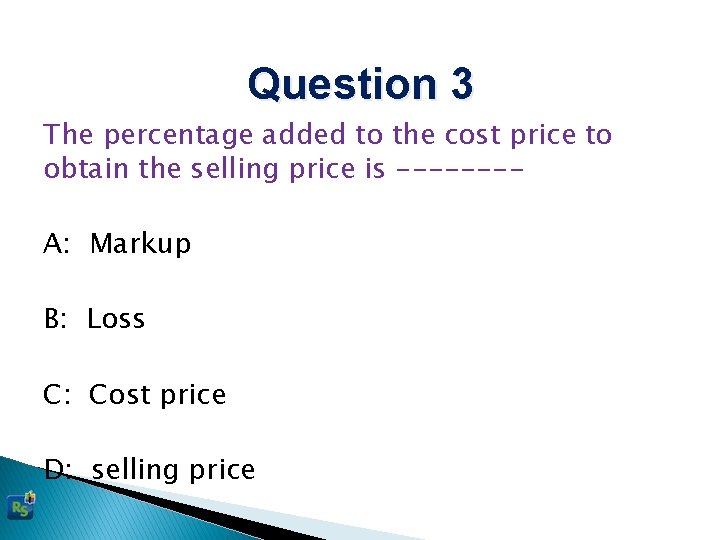
Question 3 The percentage added to the cost price to obtain the selling price is -------A: Markup B: Loss C: Cost price D: selling price
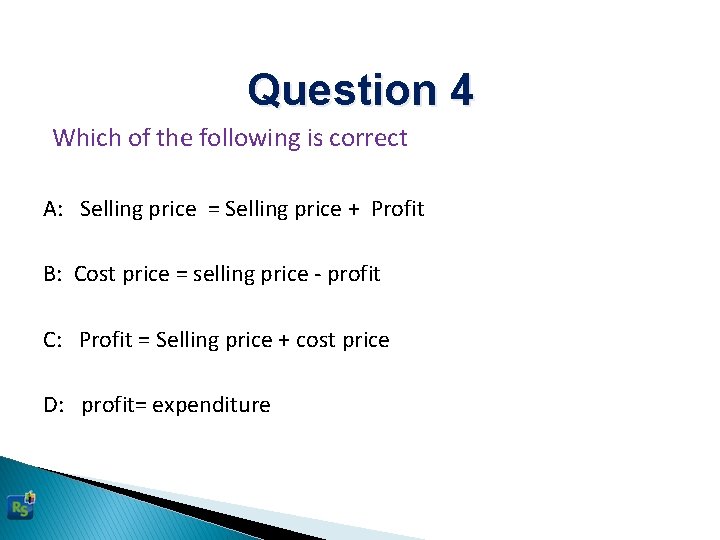
Question 4 Which of the following is correct A: Selling price = Selling price + Profit B: Cost price = selling price - profit C: Profit = Selling price + cost price D: profit= expenditure
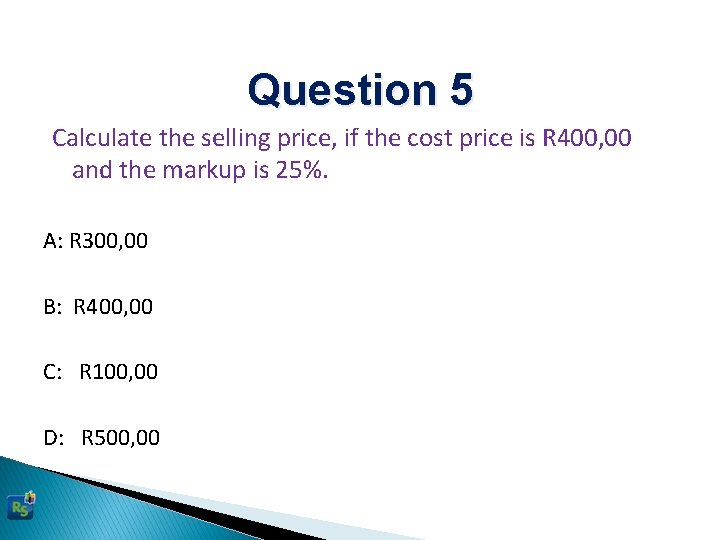
Question 5 Calculate the selling price, if the cost price is R 400, 00 and the markup is 25%. A: R 300, 00 B: R 400, 00 C: R 100, 00 D: R 500, 00
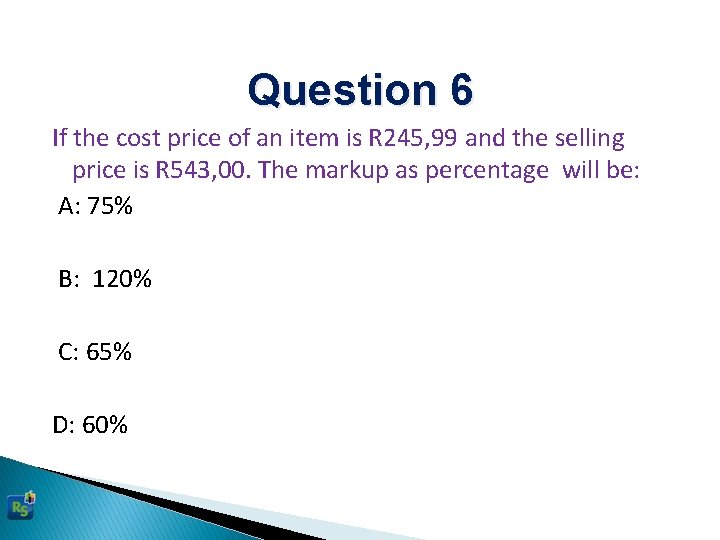
Question 6 If the cost price of an item is R 245, 99 and the selling price is R 543, 00. The markup as percentage will be: A: 75% B: 120% C: 65% D: 60%
Question 7 If t-shirts are marked up by 65% and sold for R 135, 00. Calculate the cost price. A: R 81, 82 B: R 87, 75 C: R 81. 00 D: R 87, 00
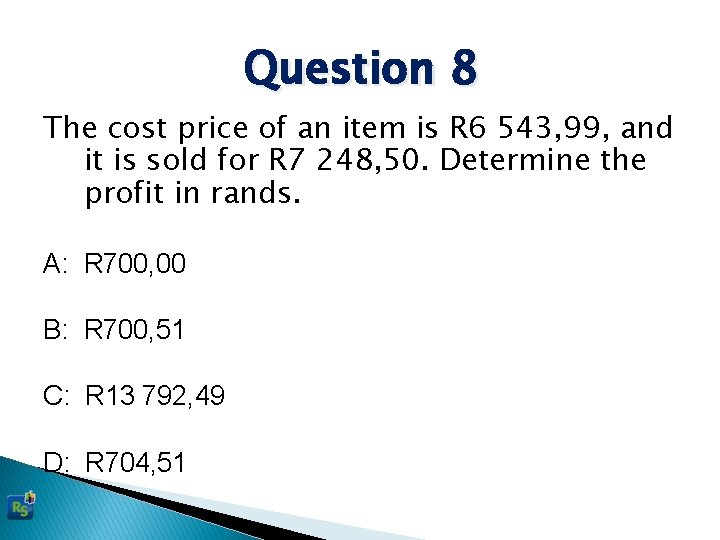
Question 8 The cost price of an item is R 6 543, 99, and it is sold for R 7 248, 50. Determine the profit in rands. A: R 700, 00 B: R 700, 51 C: R 13 792, 49 D: R 704, 51
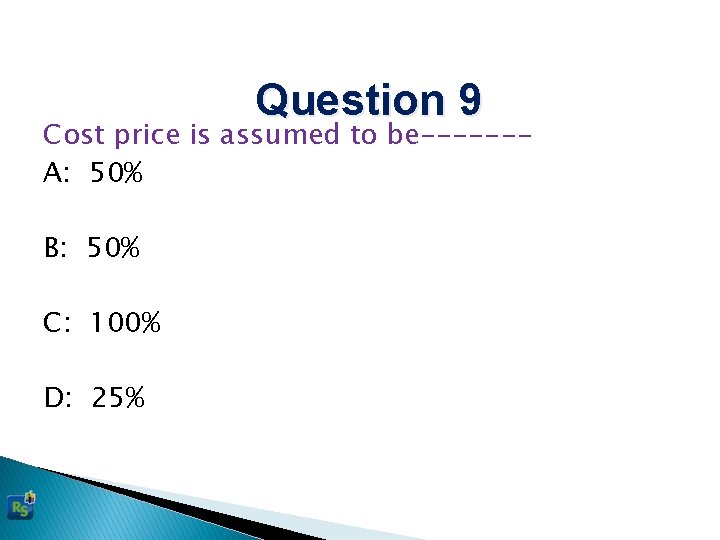
Question 9 Cost price is assumed to be------A: 50% B: 50% C: 100% D: 25%
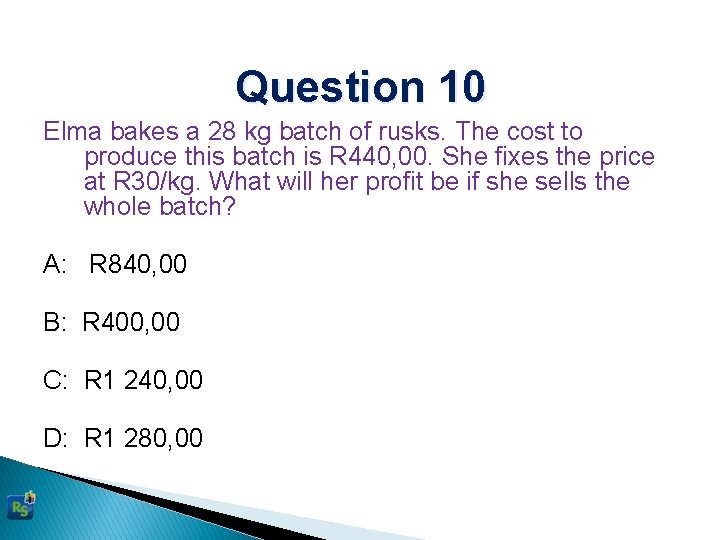
Question 10 Elma bakes a 28 kg batch of rusks. The cost to produce this batch is R 440, 00. She fixes the price at R 30/kg. What will her profit be if she sells the whole batch? A: R 840, 00 B: R 400, 00 C: R 1 240, 00 D: R 1 280, 00
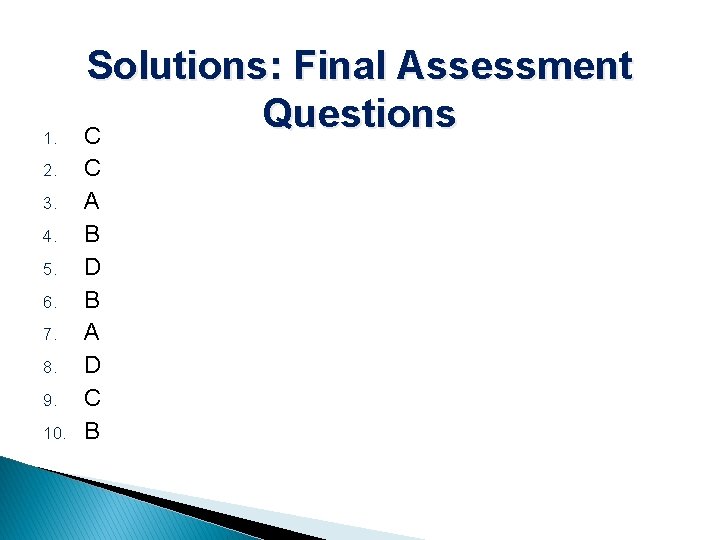
1. 2. 3. 4. 5. 6. 7. 8. 9. 10. Solutions: Final Assessment Questions C C A B D B A D C B