
MATHEMATICAL LITERACY GRADE 11 CAPS TOPIC 3 FINANCE
- Slides: 26
MATHEMATICAL LITERACY GRADE 11 CAPS TOPIC 3: FINANCE Section 3. 7: Banking
Topic 3: Finance The following sections will be covered: 3. 1. Financial documents 3. 2. Tariff system 3. 3. Income, Expenditure, Profit/ Loss, Income-and- expenditure statements and budgets 3. 4. Cost price and Selling price 3. 5. Break-even-analysis 3. 6. Interest 3. 7. Banking 3. 8. Inflation 3. 9. Taxation (VAT and UIF) 3. 10. Exchange
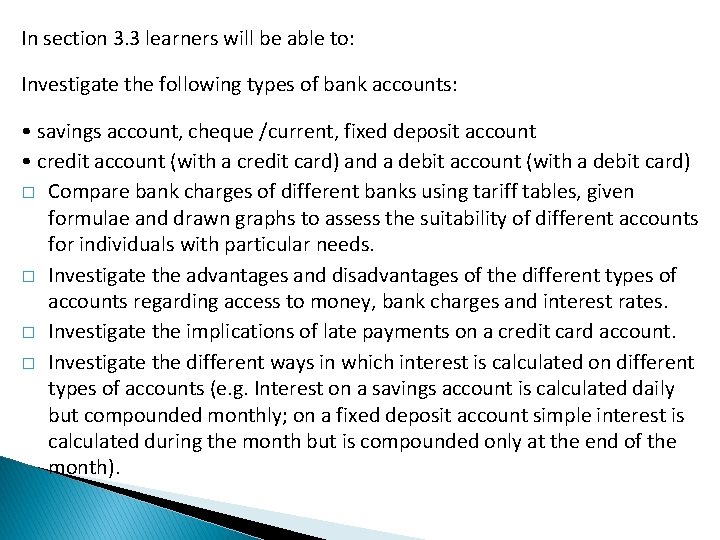
In section 3. 3 learners will be able to: Investigate the following types of bank accounts: • savings account, cheque /current, fixed deposit account • credit account (with a credit card) and a debit account (with a debit card) � Compare bank charges of different banks using tariff tables, given formulae and drawn graphs to assess the suitability of different accounts for individuals with particular needs. � Investigate the advantages and disadvantages of the different types of accounts regarding access to money, bank charges and interest rates. � Investigate the implications of late payments on a credit card account. � Investigate the different ways in which interest is calculated on different types of accounts (e. g. Interest on a savings account is calculated daily but compounded monthly; on a fixed deposit account simple interest is calculated during the month but is compounded only at the end of the month).
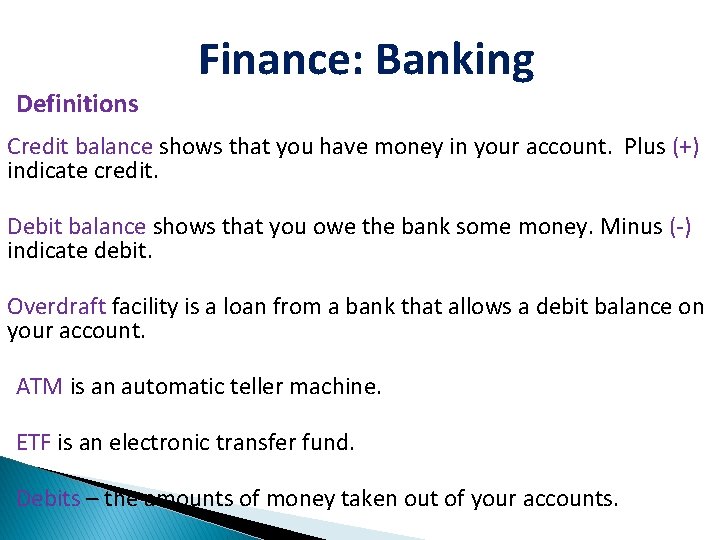
Finance: Banking Definitions Credit balance shows that you have money in your account. Plus (+) indicate credit. Debit balance shows that you owe the bank some money. Minus (-) indicate debit. Overdraft facility is a loan from a bank that allows a debit balance on your account. ATM is an automatic teller machine. ETF is an electronic transfer fund. Debits – the amounts of money taken out of your accounts.
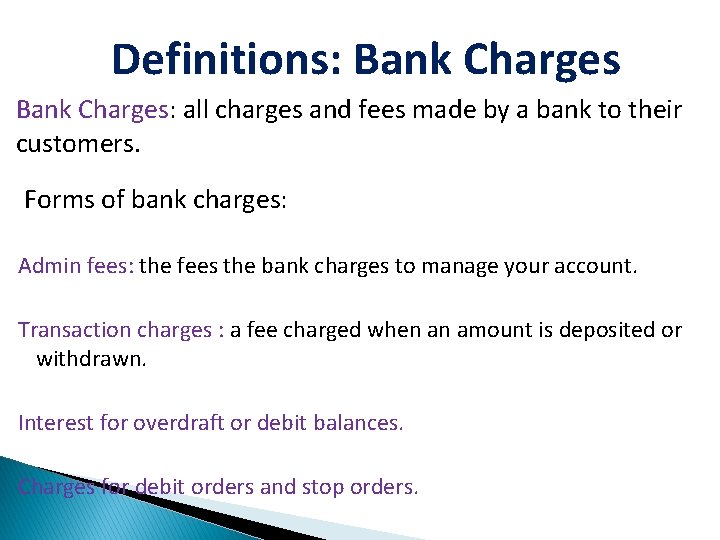
Definitions: Bank Charges: all charges and fees made by a bank to their customers. Forms of bank charges: Admin fees: the fees the bank charges to manage your account. Transaction charges : a fee charged when an amount is deposited or withdrawn. Interest for overdraft or debit balances. Charges for debit orders and stop orders.
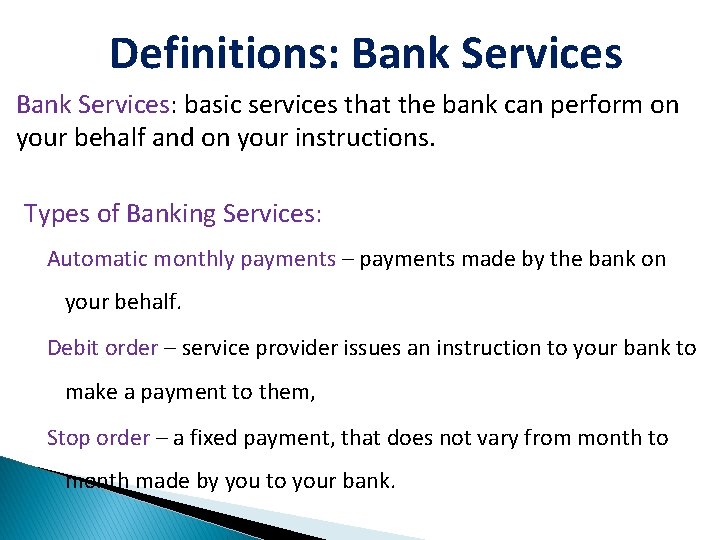
Definitions: Bank Services: basic services that the bank can perform on your behalf and on your instructions. Types of Banking Services: Automatic monthly payments – payments made by the bank on your behalf. Debit order – service provider issues an instruction to your bank to make a payment to them, Stop order – a fixed payment, that does not vary from month to month made by you to your bank.
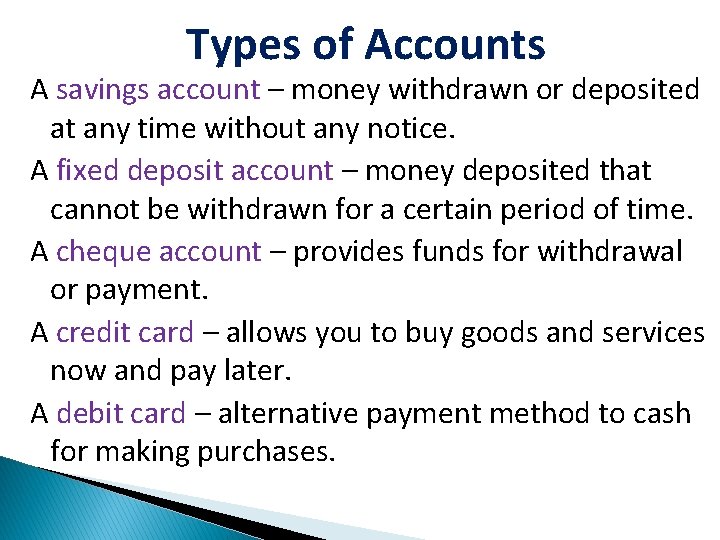
Types of Accounts A savings account – money withdrawn or deposited at any time without any notice. A fixed deposit account – money deposited that cannot be withdrawn for a certain period of time. A cheque account – provides funds for withdrawal or payment. A credit card – allows you to buy goods and services now and pay later. A debit card – alternative payment method to cash for making purchases.
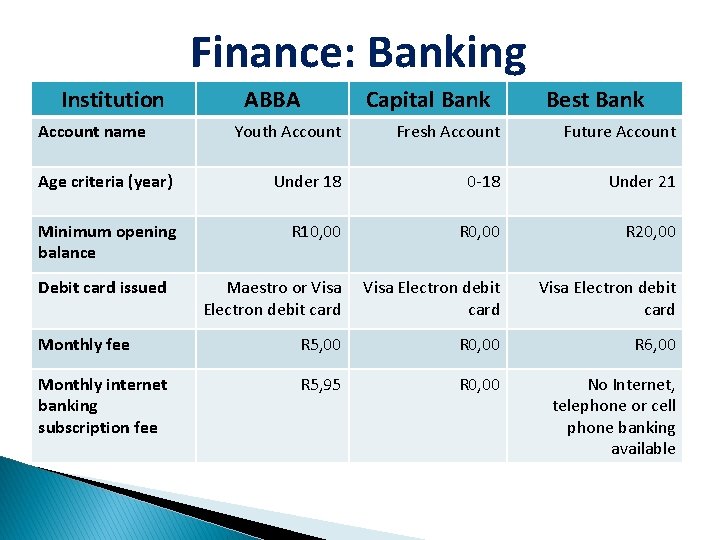
Finance: Banking Eunice, a grade 11 learner, has a weekend job. She wants to open a bank account to manage her dayto-day savings. She predicts that she will make about 12 transactions a month. Eunice has a cell phone that gives her unlimited internet access. Eunice considers the following:
Finance: Banking Institution Account name ABBA Capital Bank Best Bank Youth Account Fresh Account Future Account Age criteria (year) Under 18 0 -18 Under 21 Minimum opening balance R 10, 00 R 20, 00 Maestro or Visa Electron debit card Monthly fee R 5, 00 R 0, 00 R 6, 00 Monthly internet banking subscription fee R 5, 95 R 0, 00 No Internet, telephone or cell phone banking available Debit card issued
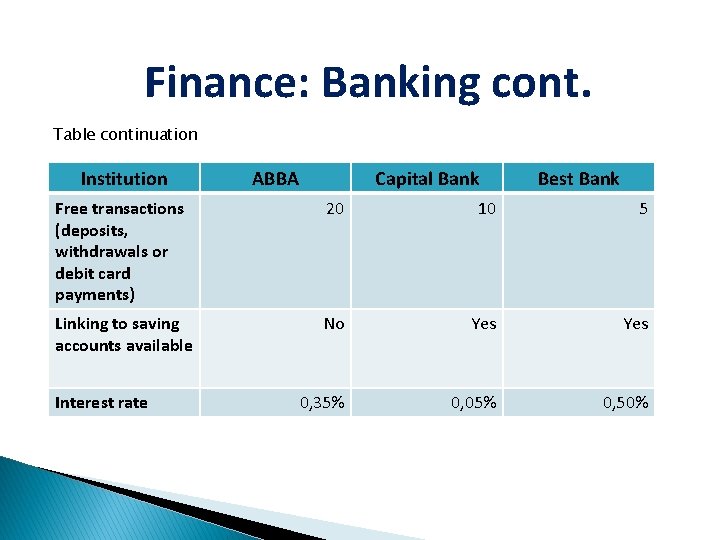
Finance: Banking cont. Table continuation Institution ABBA Capital Bank Best Bank Free transactions (deposits, withdrawals or debit card payments) 20 10 5 Linking to saving accounts available No Yes 0, 35% 0, 05% 0, 50% Interest rate
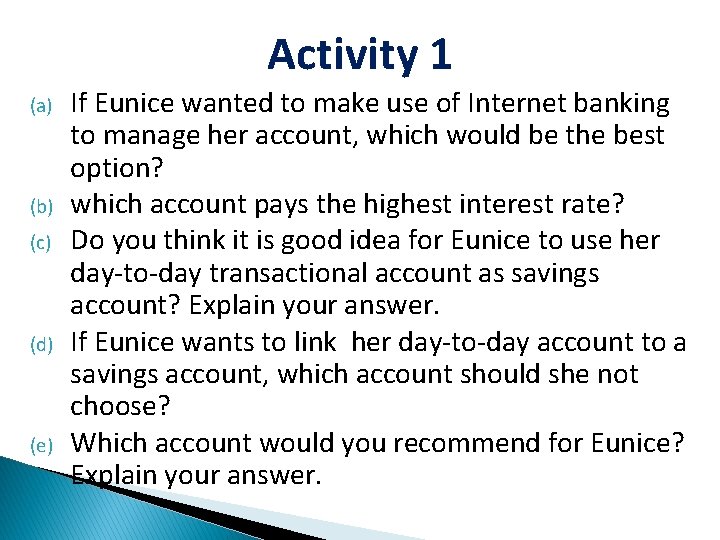
Activity 1 (a) (b) (c) (d) (e) If Eunice wanted to make use of Internet banking to manage her account, which would be the best option? which account pays the highest interest rate? Do you think it is good idea for Eunice to use her day-to-day transactional account as savings account? Explain your answer. If Eunice wants to link her day-to-day account to a savings account, which account should she not choose? Which account would you recommend for Eunice? Explain your answer.
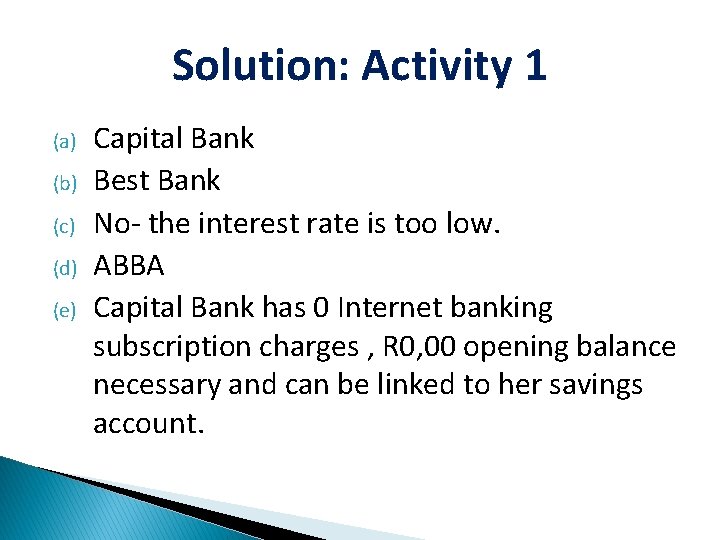
Solution: Activity 1 (a) (b) (c) (d) (e) Capital Bank Best Bank No- the interest rate is too low. ABBA Capital Bank has 0 Internet banking subscription charges , R 0, 00 opening balance necessary and can be linked to her savings account.
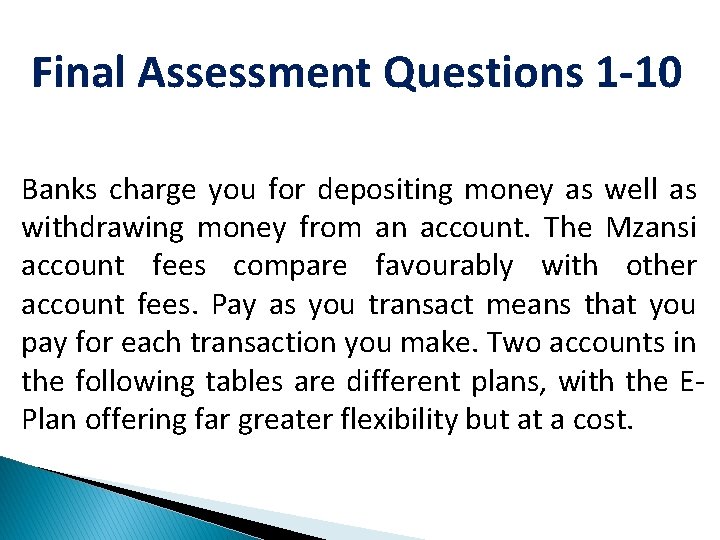
Final Assessment Questions 1 -10 Banks charge you for depositing money as well as withdrawing money from an account. The Mzansi account fees compare favourably with other account fees. Pay as you transact means that you pay for each transaction you make. Two accounts in the following tables are different plans, with the EPlan offering far greater flexibility but at a cost.
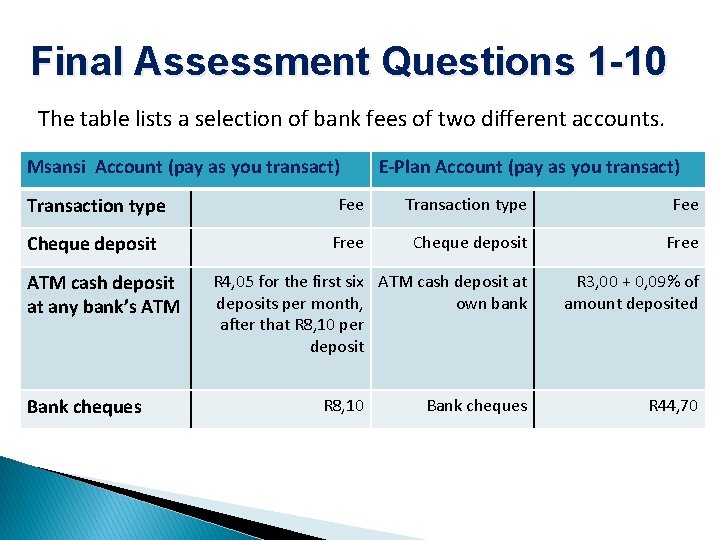
Final Assessment Questions 1 -10 The table lists a selection of bank fees of two different accounts. Msansi Account (pay as you transact) E-Plan Account (pay as you transact) Transaction type Fee Cheque deposit Free R 4, 05 for the first six ATM cash deposit at deposits per month, own bank after that R 8, 10 per deposit R 3, 00 + 0, 09% of amount deposited ATM cash deposit at any bank’s ATM Bank cheques R 8, 10 Bank cheques R 44, 70
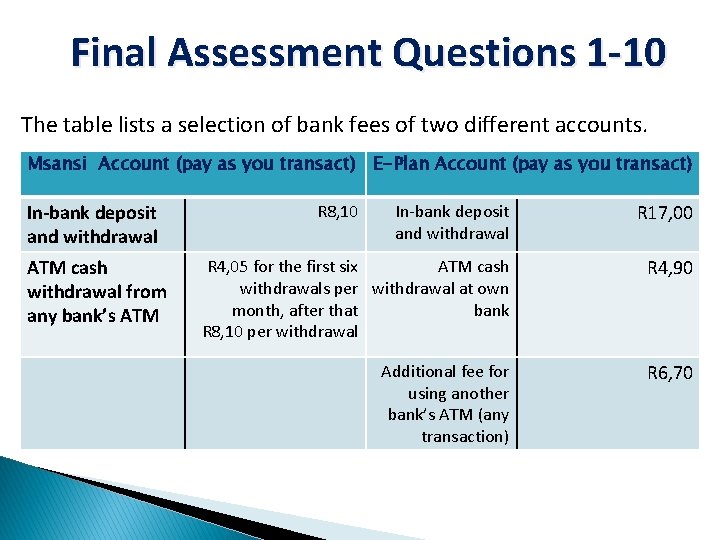
Final Assessment Questions 1 -10 The table lists a selection of bank fees of two different accounts. Msansi Account (pay as you transact) E-Plan Account (pay as you transact) In-bank deposit and withdrawal ATM cash withdrawal from any bank’s ATM In-bank deposit and withdrawal R 17, 00 R 4, 05 for the first six ATM cash withdrawals per withdrawal at own month, after that bank R 8, 10 per withdrawal R 4, 90 Additional fee for using another bank’s ATM (any transaction) R 6, 70 R 8, 10
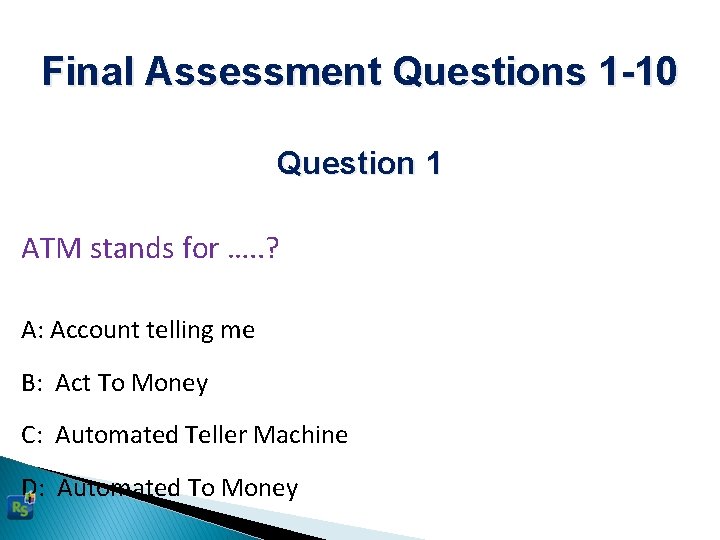
Final Assessment Questions 1 -10 Question 1 ATM stands for …. . ? A: Account telling me B: Act To Money C: Automated Teller Machine D: Automated To Money
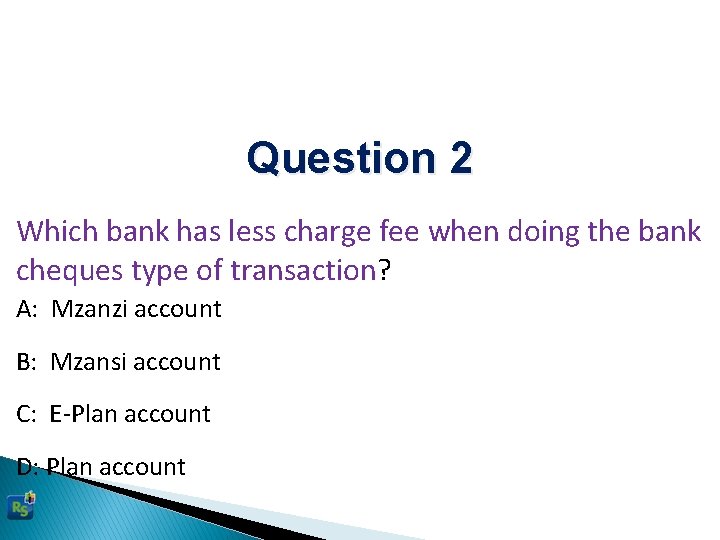
Question 2 Which bank has less charge fee when doing the bank cheques type of transaction? A: Mzanzi account B: Mzansi account C: E-Plan account D: Plan account
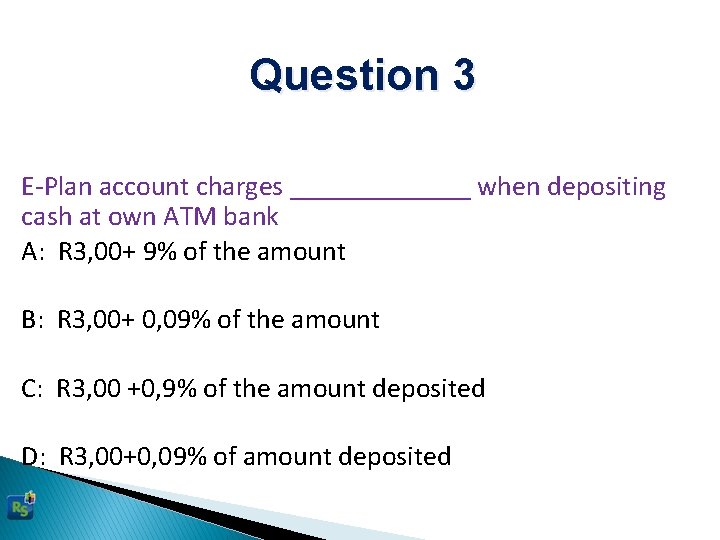
Question 3 E-Plan account charges _______ when depositing cash at own ATM bank A: R 3, 00+ 9% of the amount B: R 3, 00+ 0, 09% of the amount C: R 3, 00 +0, 9% of the amount deposited D: R 3, 00+0, 09% of amount deposited
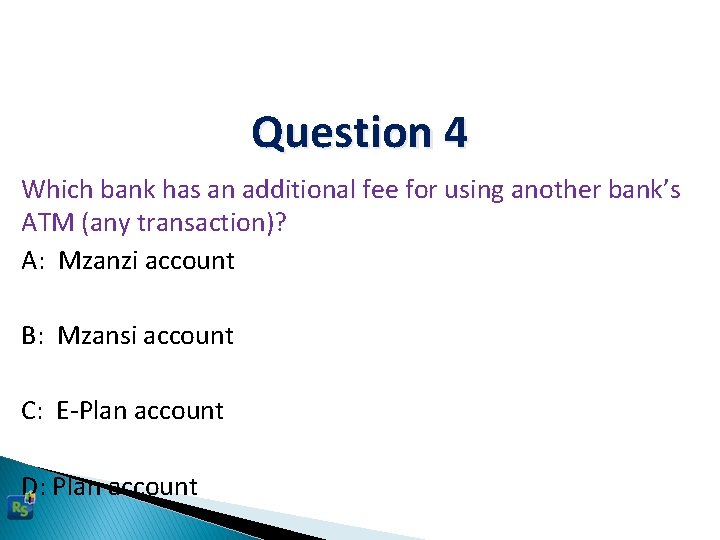
Question 4 Which bank has an additional fee for using another bank’s ATM (any transaction)? A: Mzanzi account B: Mzansi account C: E-Plan account D: Plan account
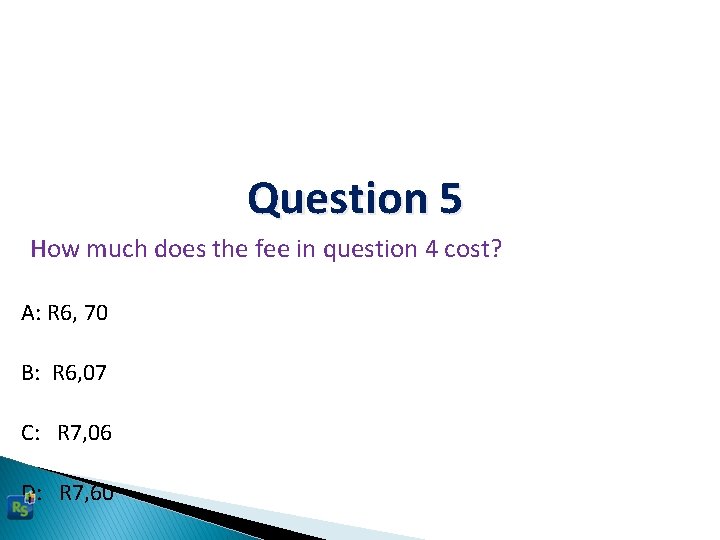
Question 5 How much does the fee in question 4 cost? A: R 6, 70 B: R 6, 07 C: R 7, 06 D: R 7, 60
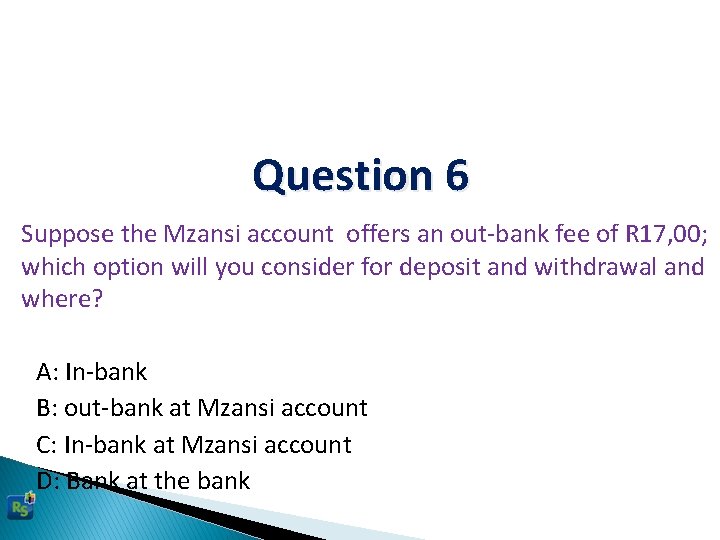
Question 6 Suppose the Mzansi account offers an out-bank fee of R 17, 00; which option will you consider for deposit and withdrawal and where? A: In-bank B: out-bank at Mzansi account C: In-bank at Mzansi account D: Bank at the bank
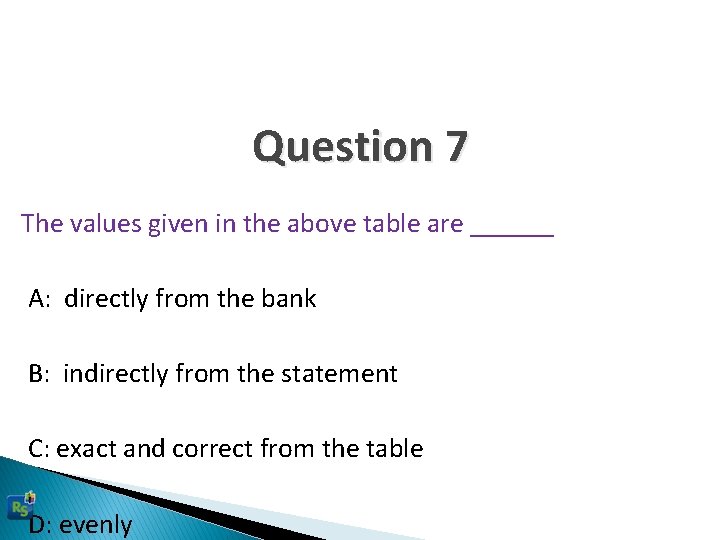
Question 7 The values given in the above table are ______ A: directly from the bank B: indirectly from the statement C: exact and correct from the table D: evenly
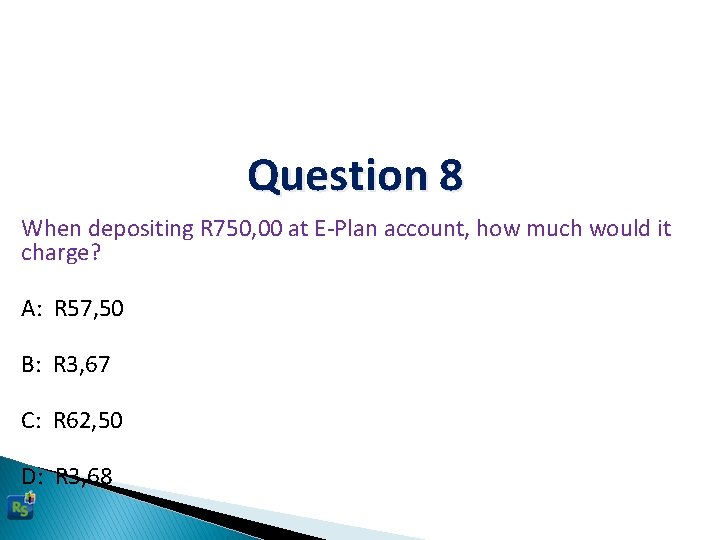
Question 8 When depositing R 750, 00 at E-Plan account, how much would it charge? A: R 57, 50 B: R 3, 67 C: R 62, 50 D: R 3, 68
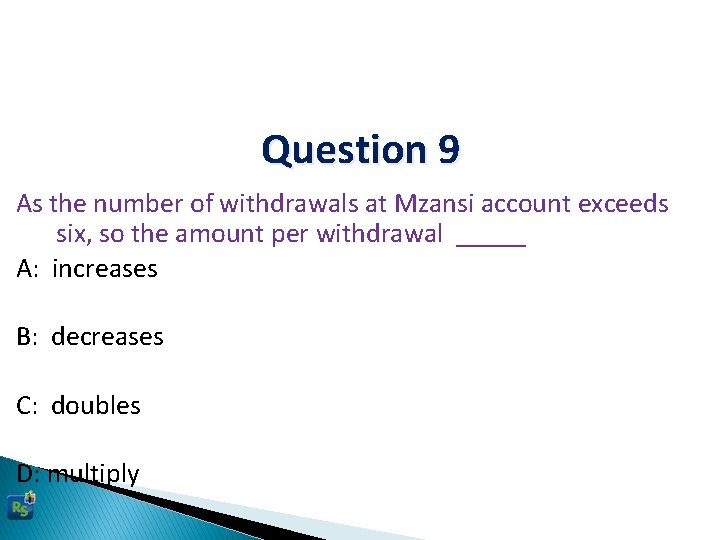
Question 9 As the number of withdrawals at Mzansi account exceeds six, so the amount per withdrawal _____ A: increases B: decreases C: doubles D: multiply
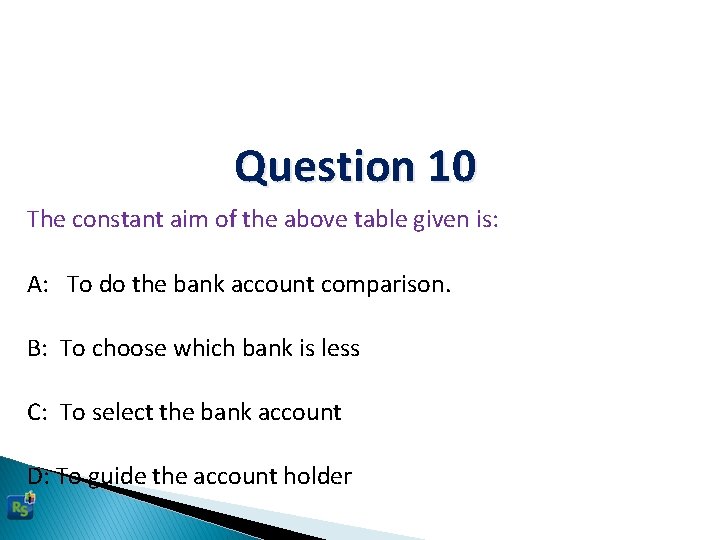
Question 10 The constant aim of the above table given is: A: To do the bank account comparison. B: To choose which bank is less C: To select the bank account D: To guide the account holder
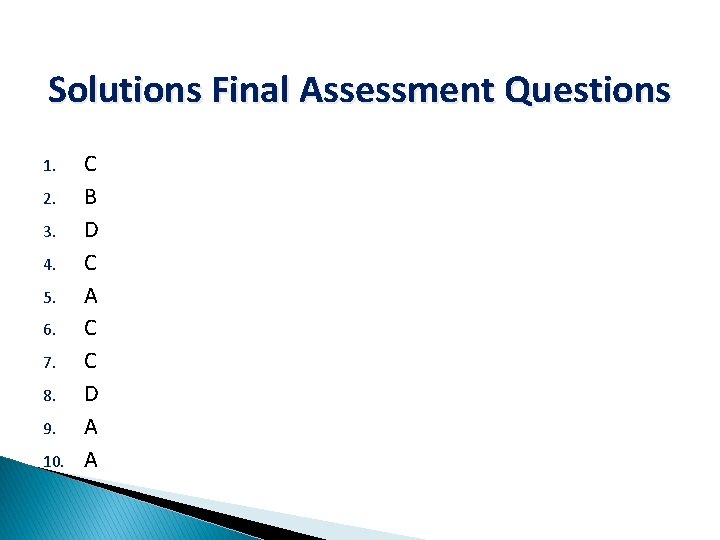
Solutions Final Assessment Questions 1. 2. 3. 4. 5. 6. 7. 8. 9. 10. C B D C A C C D A A