
Mathematical Literacy Break even analysis New words to
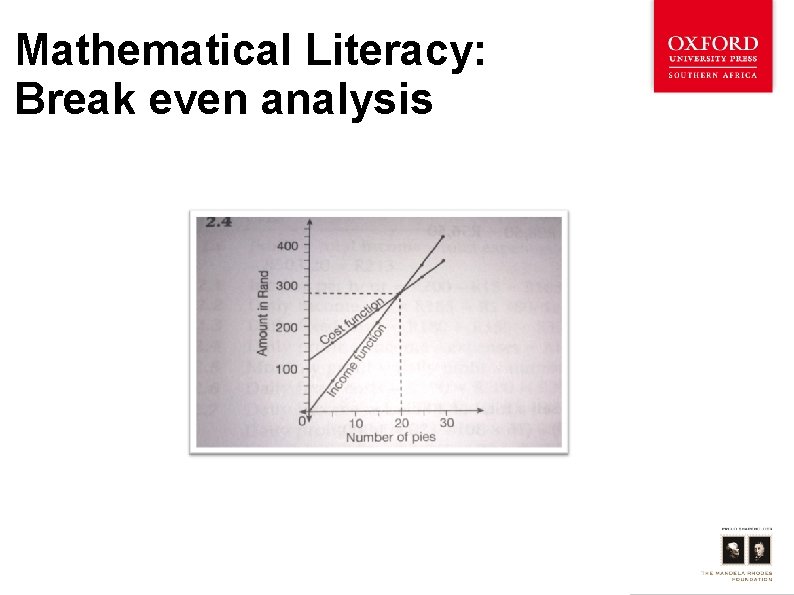
Mathematical Literacy: Break even analysis
New words to teach • Break-even point: The point where cost equals income. • Loss: If income is less than cost a business is running at a loss. • Break-even: If income is equal to the cost, a business breaks even. • Profit: If income is more than cost, a business makes a profit.
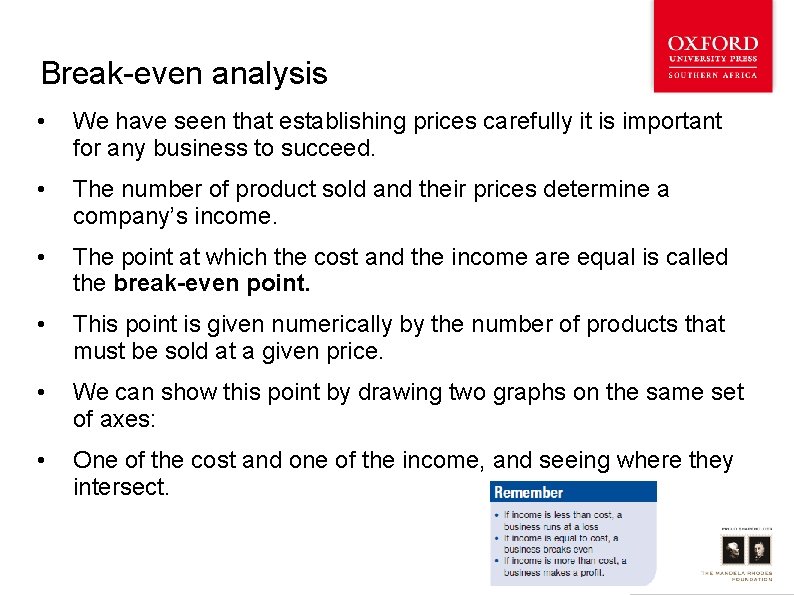
Break-even analysis • We have seen that establishing prices carefully it is important for any business to succeed. • The number of product sold and their prices determine a company’s income. • The point at which the cost and the income are equal is called the break-even point. • This point is given numerically by the number of products that must be sold at a given price. • We can show this point by drawing two graphs on the same set of axes: • One of the cost and one of the income, and seeing where they intersect.
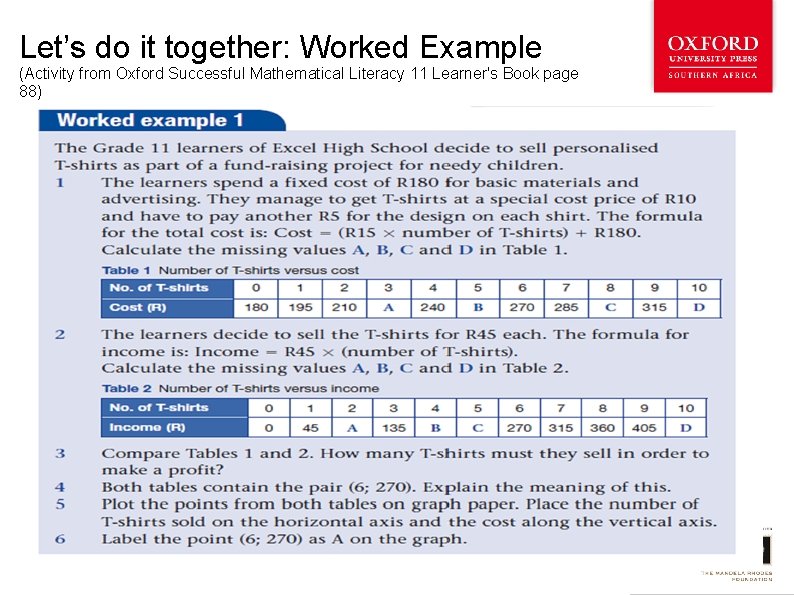
Let’s do it together: Worked Example (Activity from Oxford Successful Mathematical Literacy 11 Learner's Book page 88)
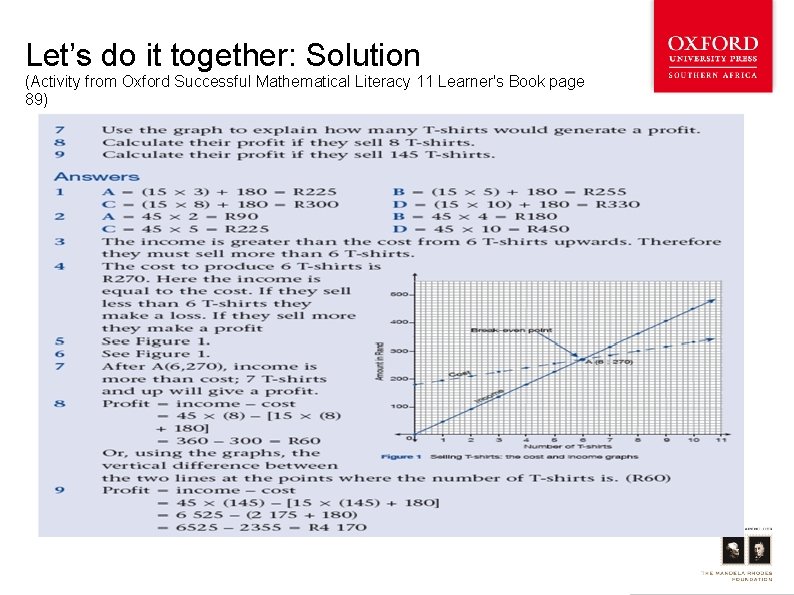
Let’s do it together: Solution (Activity from Oxford Successful Mathematical Literacy 11 Learner's Book page 89)
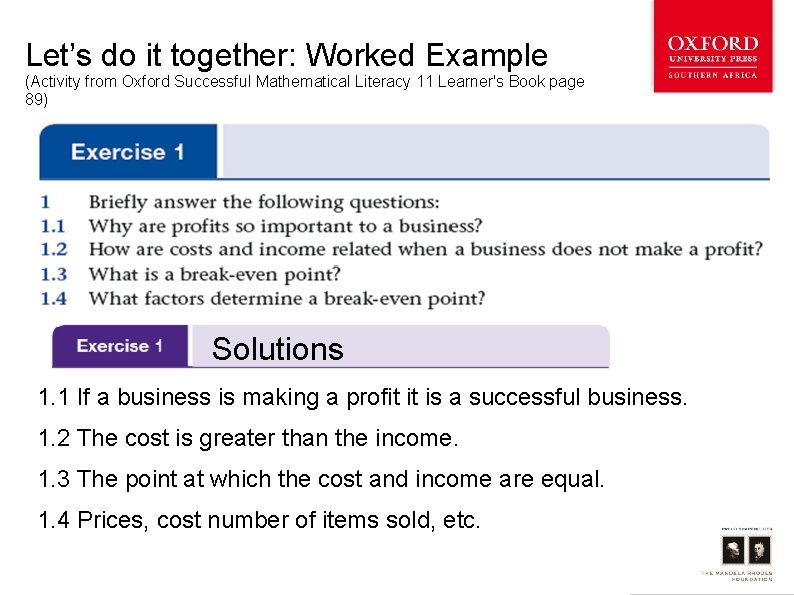
Let’s do it together: Worked Example (Activity from Oxford Successful Mathematical Literacy 11 Learner's Book page 89) Solutions 1. 1 If a business is making a profit it is a successful business. 1. 2 The cost is greater than the income. 1. 3 The point at which the cost and income are equal. 1. 4 Prices, cost number of items sold, etc.
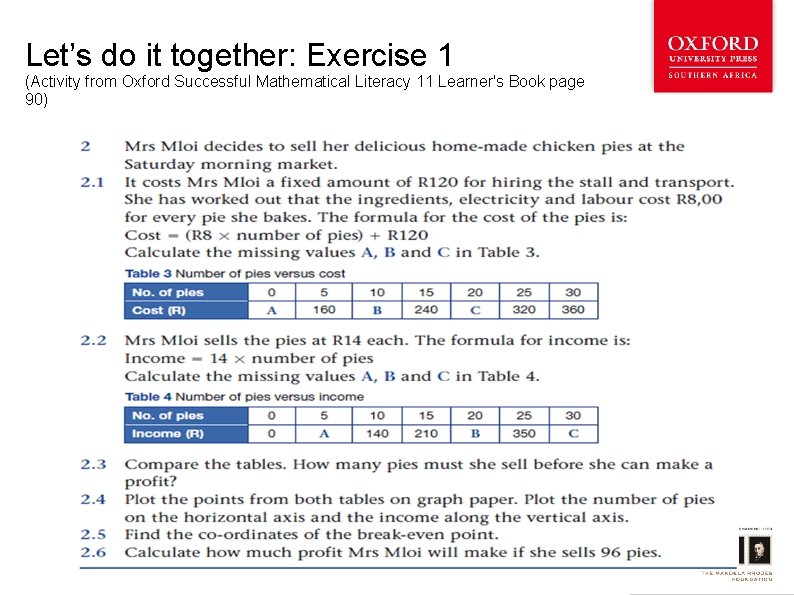
Let’s do it together: Exercise 1 (Activity from Oxford Successful Mathematical Literacy 11 Learner's Book page 90)
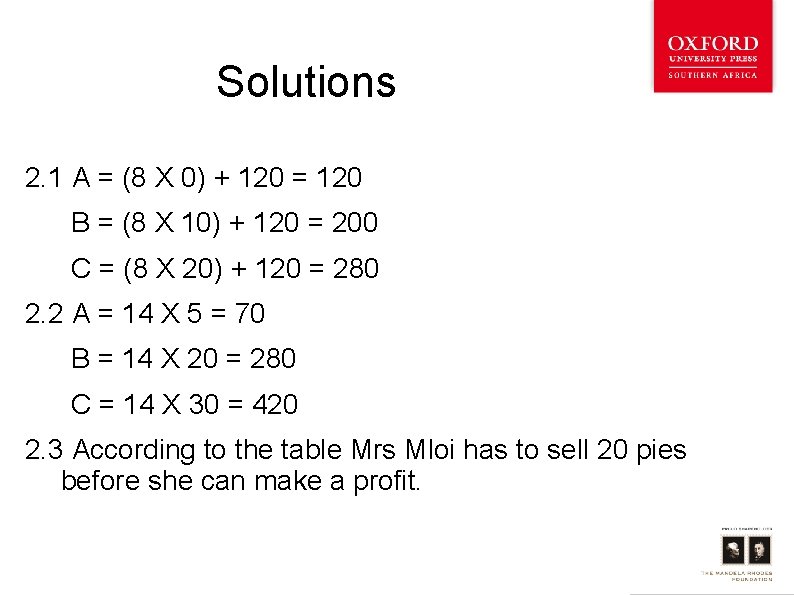
Solutions 2. 1 A = (8 X 0) + 120 = 120 B = (8 X 10) + 120 = 200 C = (8 X 20) + 120 = 280 2. 2 A = 14 X 5 = 70 B = 14 X 20 = 280 C = 14 X 30 = 420 2. 3 According to the table Mrs Mloi has to sell 20 pies before she can make a profit.
Solutions 2. 5 Break-even point at (20; 280) 2. 6 Profit = Income – Expenses = (14 X 96) – [(8 x 96) + 120] = R 456 • Remedial: By repeating these questions and allowing learners to also actually set up the table and by drawing the graph can help learners to understand this concept well. • Extension: Learners can set up their own scenario, draw up a table and plot a graph in order to find break-even point.
Let’s do it together: Worked Example 2 (Activity from Oxford Successful Mathematical Literacy 11 Learner's Book page 90)
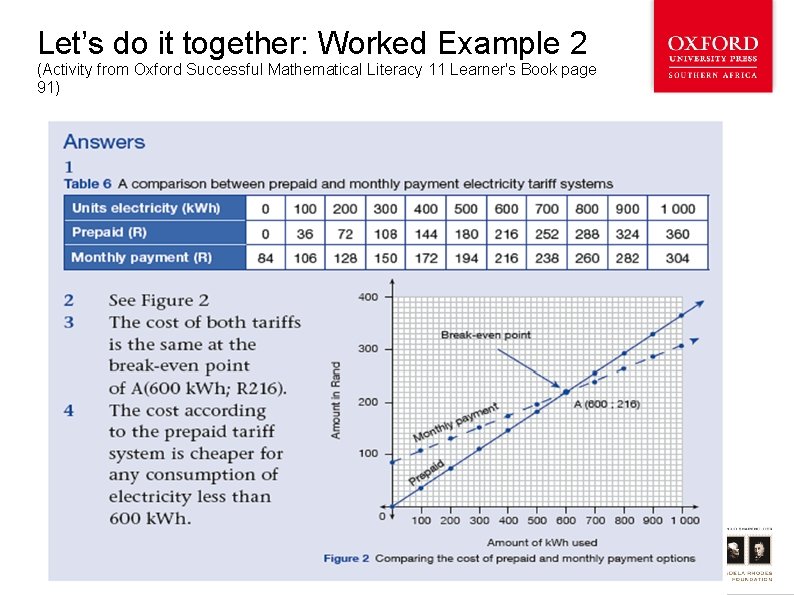
Let’s do it together: Worked Example 2 (Activity from Oxford Successful Mathematical Literacy 11 Learner's Book page 91)

Solutions
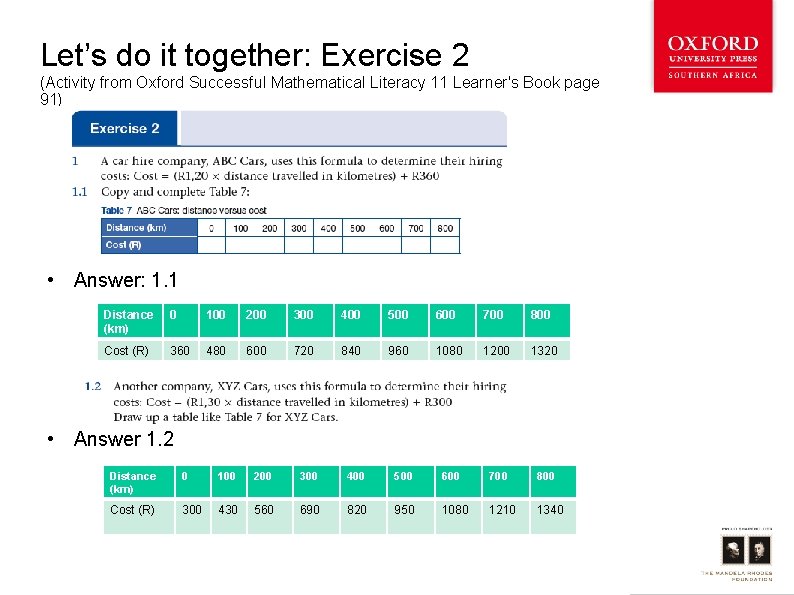
Let’s do it together: Exercise 2 (Activity from Oxford Successful Mathematical Literacy 11 Learner's Book page 91) • Answer: 1. 1 Distance (km) 0 100 200 300 400 500 600 700 800 Cost (R) 360 480 600 720 840 960 1080 1200 1320 • Answer 1. 2 Distance (km) 0 100 200 300 400 500 600 700 800 Cost (R) 300 430 560 690 820 950 1080 1210 1340
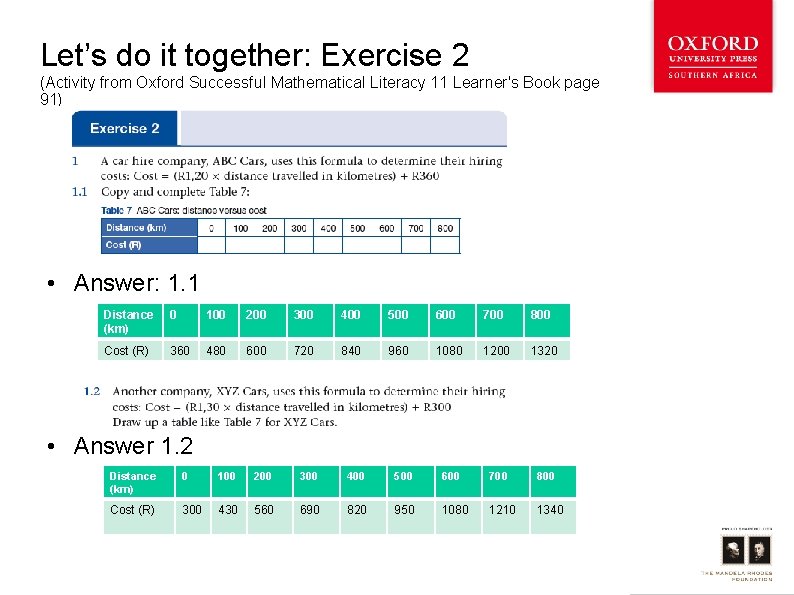
Let’s do it together: Exercise 2 (Activity from Oxford Successful Mathematical Literacy 11 Learner's Book page 91) • Answer: 1. 1 Distance (km) 0 100 200 300 400 500 600 700 800 Cost (R) 360 480 600 720 840 960 1080 1200 1320 • Answer 1. 2 Distance (km) 0 100 200 300 400 500 600 700 800 Cost (R) 300 430 560 690 820 950 1080 1210 1340
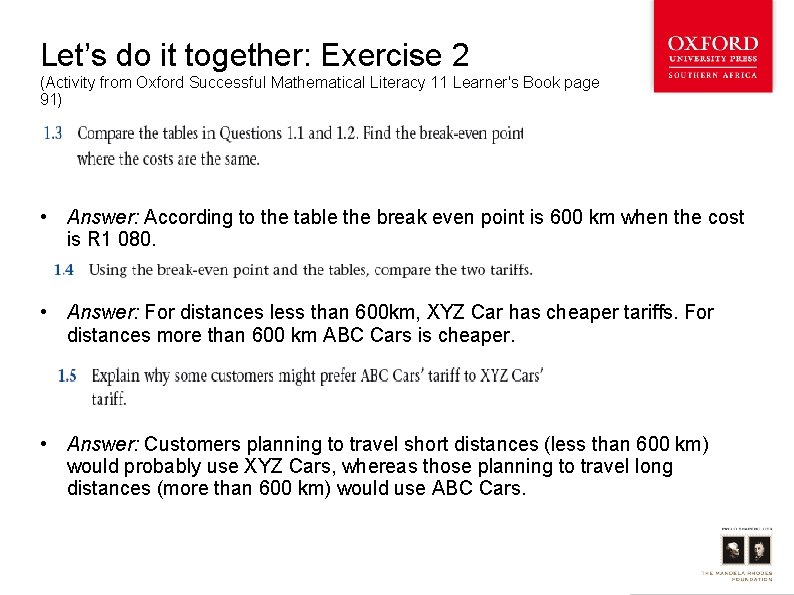
Let’s do it together: Exercise 2 (Activity from Oxford Successful Mathematical Literacy 11 Learner's Book page 91) • Answer: According to the table the break even point is 600 km when the cost is R 1 080. • Answer: For distances less than 600 km, XYZ Car has cheaper tariffs. For distances more than 600 km ABC Cars is cheaper. • Answer: Customers planning to travel short distances (less than 600 km) would probably use XYZ Cars, whereas those planning to travel long distances (more than 600 km) would use ABC Cars.
Let’s revise 1. What is income and expenditure? • Different ways to earn income are: salary/wage or commission, earning interest, getting tips, etc. • Income and Expenditure can be fixed or variable. 2. Why is it necessary to budget? • Budgets are a summary of all expenditure and income. • Budget helps you plan your expenses so that you can track your expenses, stay within your means and also save for big purchases 3. What is the cost and selling price 2 different prices? • It is necessary for any successful business to consider all types of expenses in order to decide on a suitable price. • Formula to mark-up a price by 20%: Marked up price = price + 20/100 x 100 4. Explain the break-even analysis: • At break-even point the total expenses equal to total income. • The break-even point can be determined by tables or graphs.
Questions
- Slides: 17