
Mathematical challenges for able pupils Year 5 A
Mathematical challenges for able pupils Year 5 A Counting, partitioning and calculating

Three digits Imagine you have 25 beads. You have to make a three-digit number on an abacus. You must use all 25 beads for each number you make. Hundreds Tens Units How many different three-digit numbers can you make? Write them in order. Learning Objective: • Solve mathematical problems or puzzles. • Know what each digit represents. • Order a set of whole numbers.

Solution to Three digits You can make six different numbers. In order, the numbers are: 799, 889, 898, 979, 988, 997.

Joins Join any four numbers. Find their total. Joins can go up, down or sideways, but not diagonally. The score shown is 8 + 15 + 6 + 18 = 47. Find the highest possible score. 8 15 6 9 14 13 18 20 18 17 3 2 5 15 19 6 Find the lowest possible score. Learning Objective: • Solve mathematical problems or puzzles. • Add and subtract two-digit numbers mentally.
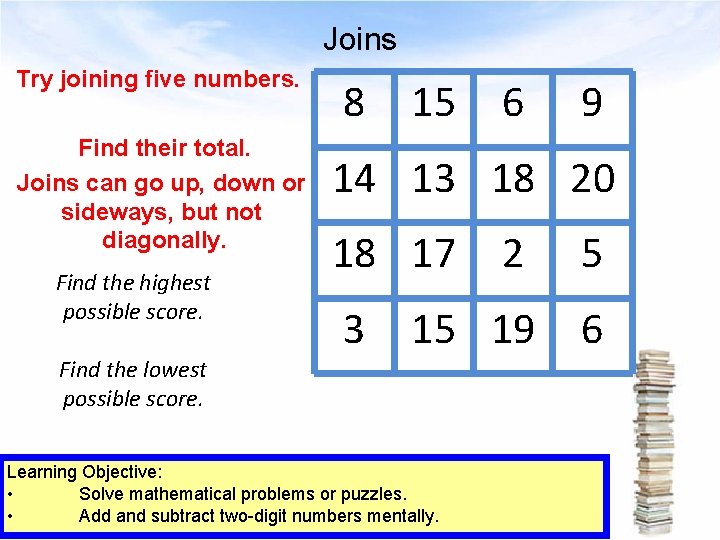
Joins Try joining five numbers. Find their total. Joins can go up, down or sideways, but not diagonally. Find the highest possible score. Find the lowest possible score. 8 15 6 9 14 13 18 20 18 17 3 2 5 15 19 6 Learning Objective: • Solve mathematical problems or puzzles. • Add and subtract two-digit numbers mentally.
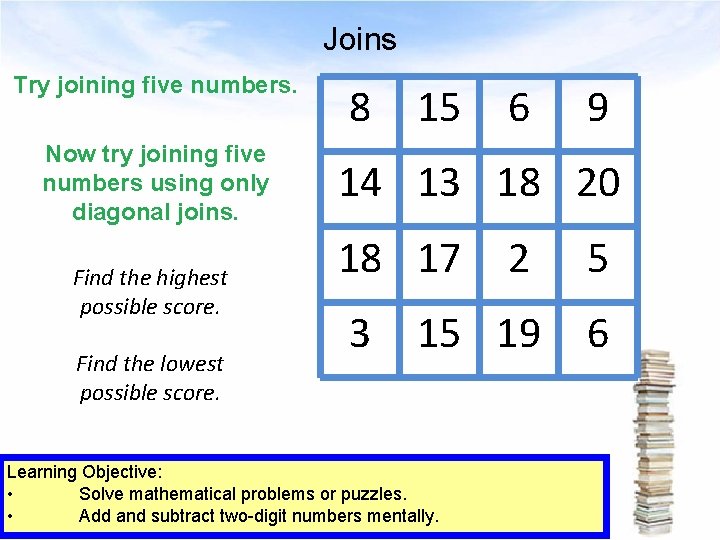
Joins Try joining five numbers. Now try joining five numbers using only diagonal joins. Find the highest possible score. Find the lowest possible score. 8 15 6 9 14 13 18 20 18 17 3 2 5 15 19 6 Learning Objective: • Solve mathematical problems or puzzles. • Add and subtract two-digit numbers mentally.
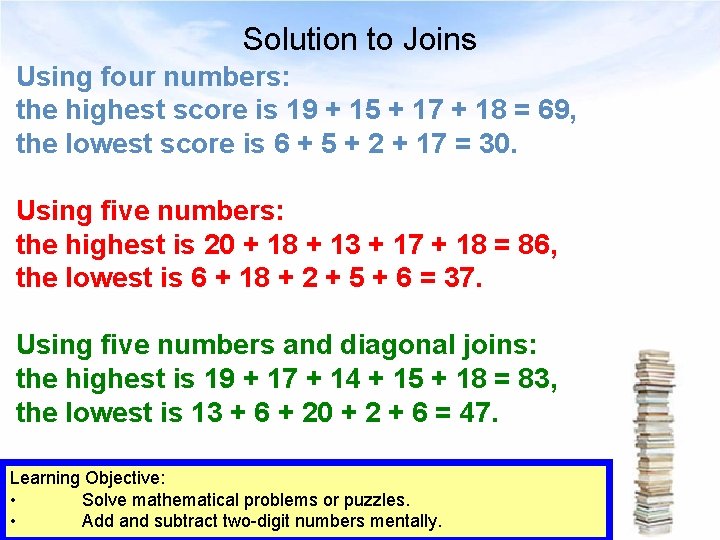
Solution to Joins Using four numbers: the highest score is 19 + 15 + 17 + 18 = 69, the lowest score is 6 + 5 + 2 + 17 = 30. Using five numbers: the highest is 20 + 18 + 13 + 17 + 18 = 86, the lowest is 6 + 18 + 2 + 5 + 6 = 37. Using five numbers and diagonal joins: the highest is 19 + 17 + 14 + 15 + 18 = 83, the lowest is 13 + 6 + 20 + 2 + 6 = 47. Learning Objective: • Solve mathematical problems or puzzles. • Add and subtract two-digit numbers mentally.
Age old problems 1. My age this year is a multiple of 8. Next year it will be a multiple of 7. How old am I? Learning Objective: • Solve mathematical problems or puzzles. • Know multiplication facts to 10 x 10. • Recognise square and cube numbers.

Age old problems 2. Last year my age was a square number. Next year it will be a cube number. How long oldmust am I? I wait until my age is both a square number and a cube? Learning Objective: • Solve mathematical problems or puzzles. • Know multiplication facts to 10 x 10. • Recognise square and cube numbers.
Age old problems 3. My Mum was 27 when I was born. 8 years ago she was twice as old as I shall be in 5 years’ time. How old am I now? Learning Objective: • Solve mathematical problems or puzzles. • Know multiplication facts to 10 x 10. • Recognise square and cube numbers.
Solution to age old problems 1. I am 48 years old (or possibly 104). 2. I am now 26 years old. In 38 years’ time, when I am 64, my age will be both a square number and a cube. 3. I am 9 years old now. Learning Objective: • Solve mathematical problems or puzzles. • Know multiplication facts to 10 x 10. • Recognise square and cube numbers.
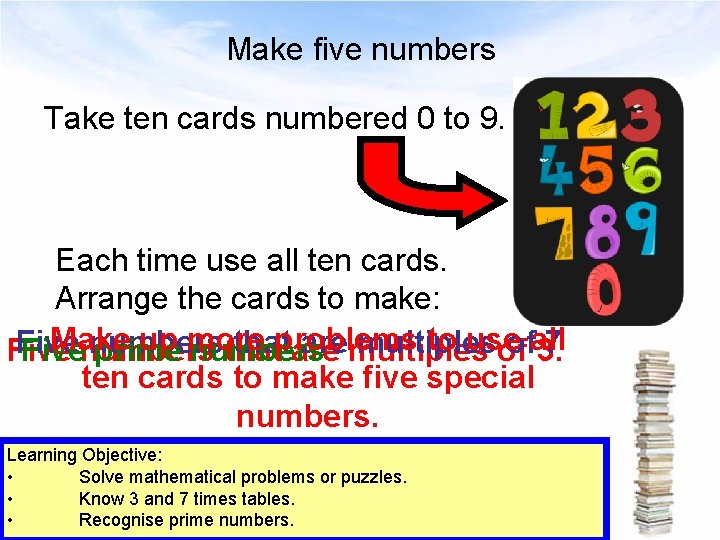
Make five numbers Take ten cards numbered 0 to 9. Each time use all ten cards. Arrange the cards to make: Make up more problems to use Five numbers that aremultiples ofall 7 Five numbers prime numbers that are of 3. ten cards to make five special numbers. Learning Objective: • Solve mathematical problems or puzzles. • Know 3 and 7 times tables. • Recognise prime numbers.
Solution to make five numbers For example: a. 12, 39, 45, 60, 78. b. 7, 42, 63, 98, 105. c. 5, 23, 67, 89, 401. There are other solutions. Learning Objective: • Solve mathematical problems or puzzles. • Know 3 and 7 times tables. • Recognise prime numbers.
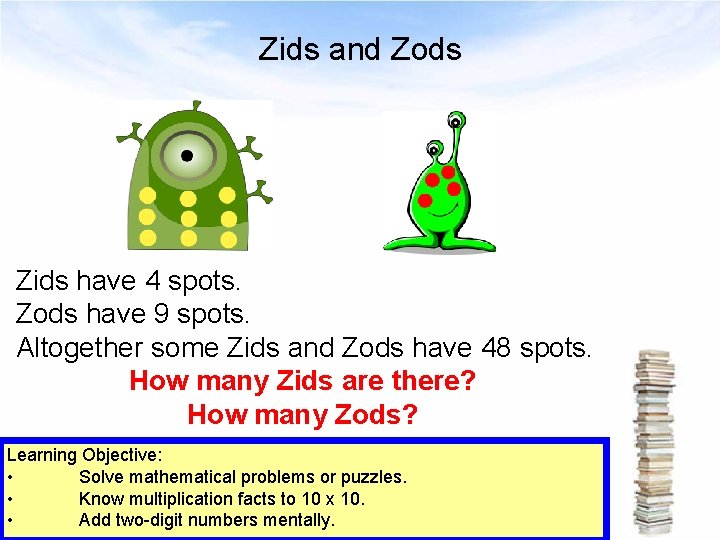
Zids and Zods Zids have 4 spots. Zods have 9 spots. Altogether some Zids and Zods have 48 spots. How many Zids are there? How many Zods? Learning Objective: • Solve mathematical problems or puzzles. • Know multiplication facts to 10 x 10. • Add two-digit numbers mentally.
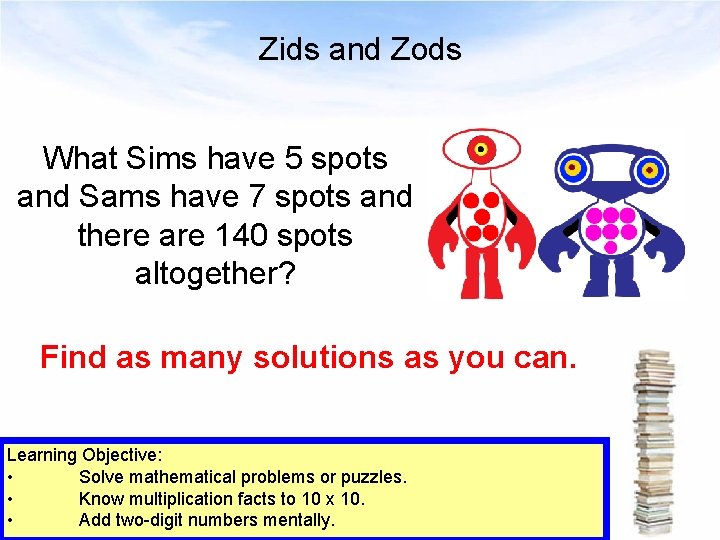
Zids and Zods What Sims have 5 spots and Sams have 7 spots and there are 140 spots altogether? Find as many solutions as you can. Learning Objective: • Solve mathematical problems or puzzles. • Know multiplication facts to 10 x 10. • Add two-digit numbers mentally.
Solution to Zids and Zods 1. There are 3 Zids with 4 spots and 4 Zods with 9 spots. 2. If Sims have 5 spots and Sams have 7 spots, the possible ways of making 140 are: 28 Sims; 21 Sims and 5 Sams; 14 Sims and 10 Sams; 7 Sims and 15 Sams; 20 Sams. Learning Objective: • Solve mathematical problems or puzzles. • Know multiplication facts to 10 x 10. • Add two-digit numbers mentally.

Maze Start with zero. Find a route from ‘Start’ to ‘End’ that totals 100 exactly. Which route has the highest total? Which has the lowest total? Now try some different starting numbers. Learning Objective: • Solve mathematical problems or puzzles. • Add and subtract two-digit numbers mentally. • Multiply and divide by single-digit numbers.
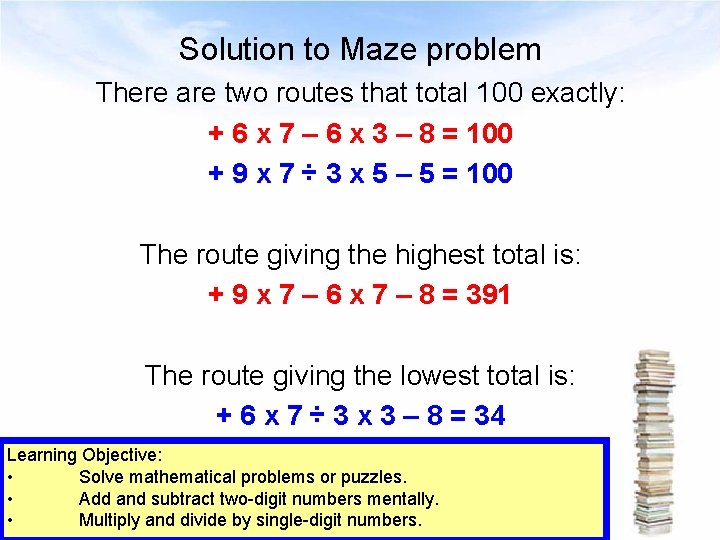
Solution to Maze problem There are two routes that total 100 exactly: + 6 x 7 – 6 x 3 – 8 = 100 + 9 x 7 ÷ 3 x 5 – 5 = 100 The route giving the highest total is: + 9 x 7 – 6 x 7 – 8 = 391 The route giving the lowest total is: + 6 x 7 ÷ 3 x 3 – 8 = 34 Learning Objective: • Solve mathematical problems or puzzles. • Add and subtract two-digit numbers mentally. • Multiply and divide by single-digit numbers.
The end, thank you!
References and additional resources. The questions from this Power. Point came from: Mathematical challenges for able pupils in Key Stages 1 and 2 Corporate writer was Department for Education and Employment and it is produced under a © Crown copyright 2000 Thank You Power. Point template published by www. ksosoft. com These Mental Maths challenges can be found as a PDF file at : http: //www. edu. dudley. gov. uk/numeracy/problem_solving/Mathematical%20 Challenges%20 Book. pdf Contains public sector information licensed under the Open Government Licence v 3. 0. (http: //www. nationalarchives. gov. uk/doc/open-government-licence/version/3/) All images used in this Power. Point was found at the free Public Domain Clip Art site. (https: //openclipart. org/) These units were organised using advice given at: http: //www. edu. dudley. gov. uk/numeracy/problem_solving/Challenges%20 and%20 Blocks. doc
- Slides: 20