
Mathematical challenges for able pupils Year 1 A
Mathematical challenges for able pupils Year 1 A Counting, partitioning and calculating
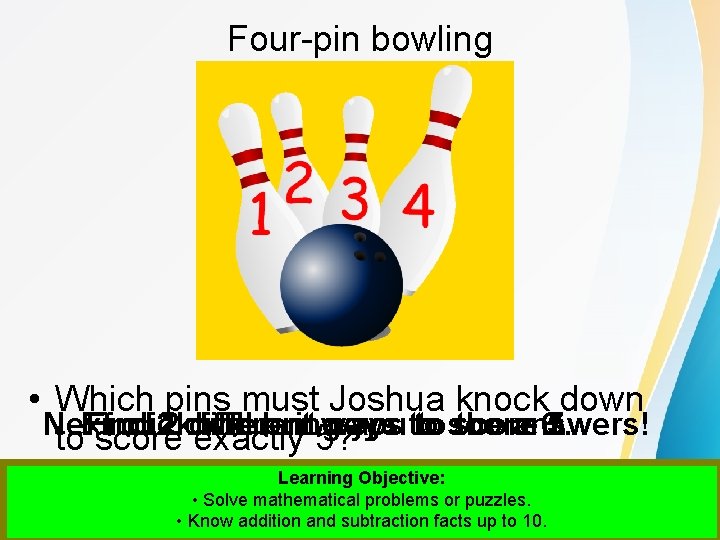
Four-pin bowling • Which pins must Joshua knock down Next Find click 2 2 different will bring ways you to to score the answers! 6. 5. 7. to score exactly 5? Learning Objective: • Solve mathematical problems or puzzles. • Know addition and subtraction facts up to 10.
Solution to the Four-pin bowling problem. • Score 5 by knocking down 1 and 4 or 2 and 3. • Score 6 by knocking down 2 and 4 or 1, 2 and 3. • Score 7 by knocking down 3 and 4, or 1, 2 and 4. Learning Objective: • Solve mathematical problems or puzzles. • Know addition and subtraction facts up to 10.
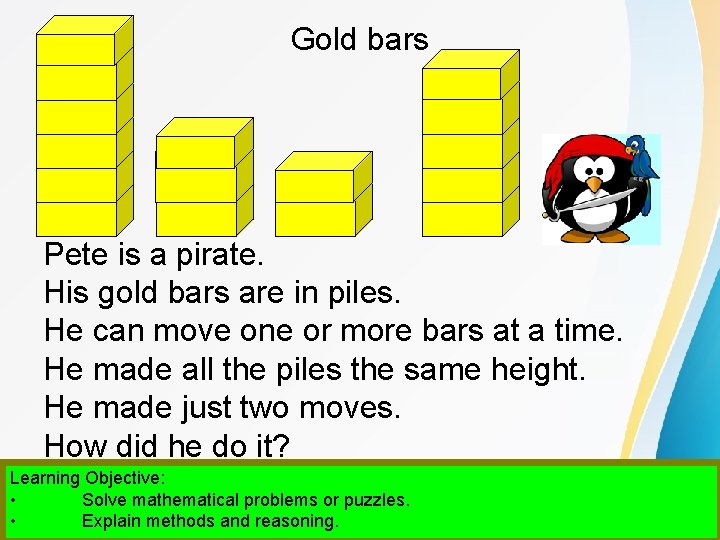
Gold bars Pete is a pirate. His gold bars are in piles. He can move one or more bars at a time. He made all the piles the same height. He made just two moves. How did he do it? Learning Objective: • Solve mathematical problems or puzzles. • Explain methods and reasoning.
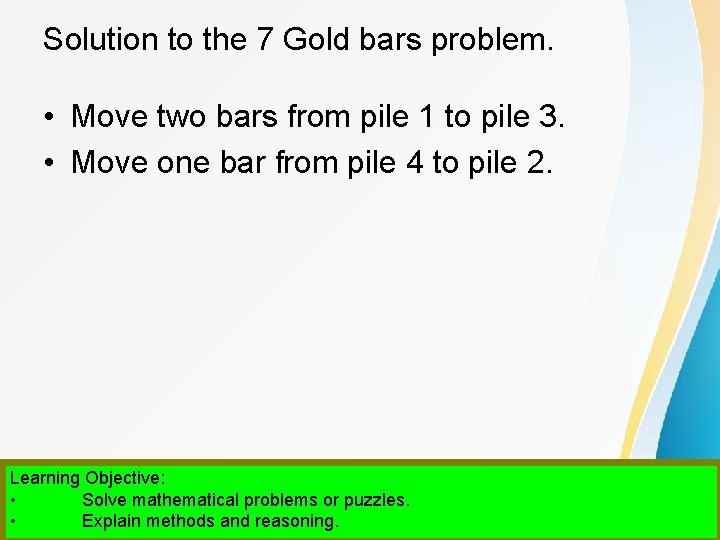
Solution to the 7 Gold bars problem. • Move two bars from pile 1 to pile 3. • Move one bar from pile 4 to pile 2. Learning Objective: • Solve mathematical problems or puzzles. • Explain methods and reasoning.
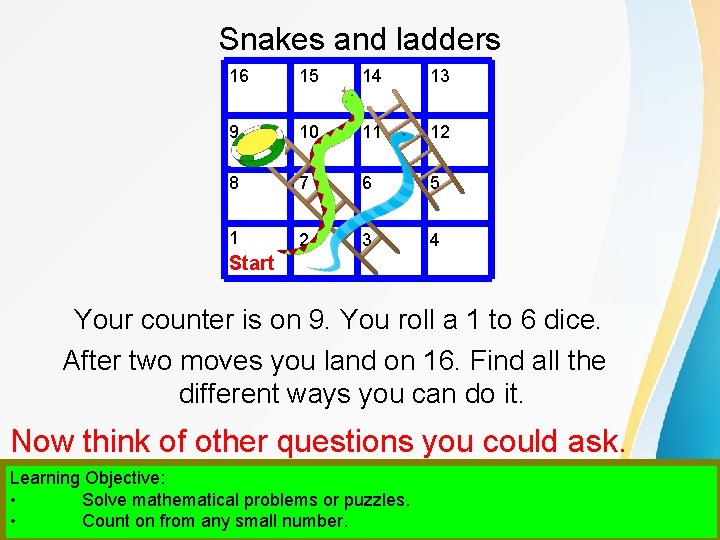
Snakes and ladders 16 15 14 13 9 10 11 12 8 7 6 5 1 2 3 4 Start Your counter is on 9. You roll a 1 to 6 dice. After two moves you land on 16. Find all the different ways you can do it. Now think of other questions you could ask. Learning Objective: • Solve mathematical problems or puzzles. • Count on from any small number.
Solution to the Snakes and ladders problem. Watching out for snakes, there are four different ways to get to 16 in two throws: 1 then 6 3 then 4 4 then 3 5 then 2 Learning Objective: • Solve mathematical problems or puzzles. • Count on from any small number.
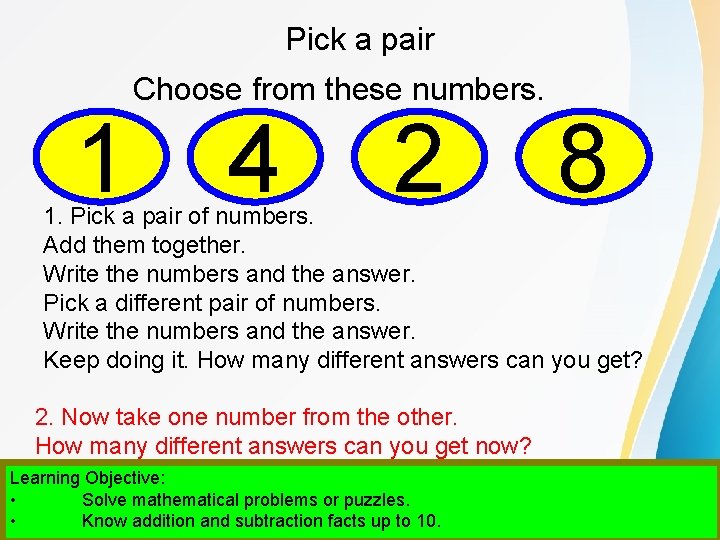
Pick a pair 1 Choose from these numbers. 4 2 8 1. Pick a pair of numbers. Add them together. Write the numbers and the answer. Pick a different pair of numbers. Write the numbers and the answer. Keep doing it. How many different answers can you get? 2. Now take one number from the other. How many different answers can you get now? Learning Objective: • Solve mathematical problems or puzzles. • Know addition and subtraction facts up to 10.
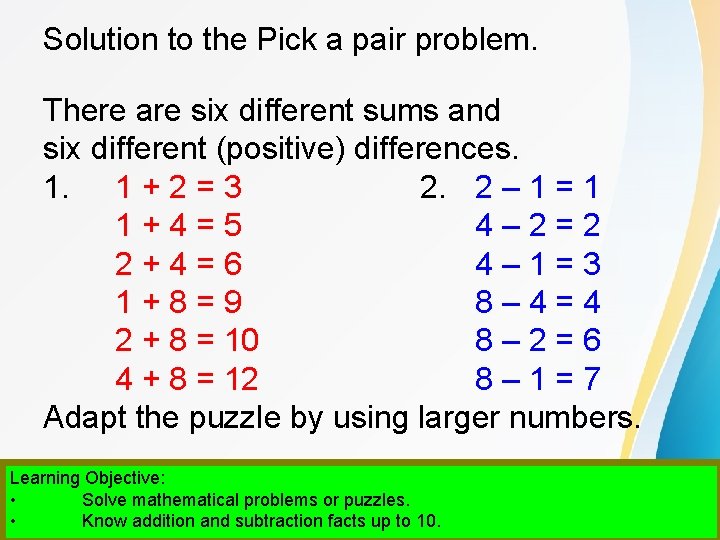
Solution to the Pick a pair problem. There are six different sums and six different (positive) differences. 1. 1 + 2 = 3 2. 2 – 1 = 1 1+4=5 4– 2=2 2+4=6 4– 1=3 1+8=9 8– 4=4 2 + 8 = 10 8– 2=6 4 + 8 = 12 8– 1=7 Adapt the puzzle by using larger numbers. Learning Objective: • Solve mathematical problems or puzzles. • Know addition and subtraction facts up to 10.

• • Bean-bag buckets Dan threw 3 bean-bags. Each bag went in a bucket. More than one bag can go in a bucket. The scores are written on the buckets. 3. 2. Find What three is scores the ways highest to score 9. 6. Dan can 4. 1. What other can Dan get? Next click brings you the solutions. . . Learning Objective: • Solve mathematical problems or puzzles. • Know addition facts up to 10.

Solution to the Bean-bag buckets problem. 1. The highest score is 12 4. Besides 6, 9 and 12, other possible (3 bags in 4). scores are: 3: 3 bags in 1 2. Score 6 in three ways: 4: 2 bags in 1, 1 bag in 2 1 bag in 4 and 2 bags in 1, or 1 bag in 1, 1 bag 5: 2 bags in 1, 1 bag in 3, or in 2 and 1 bag in 3, or 3 1 bag in 1, 2 bags in 2. 7: 1 bag in 1, 2 bags in 3, or 2 bags in 2, 1 bag in 3, or 3. Score 9 in three ways: 1 bag in 1, 1 bag in 2, 1 bag in 4 1 bag in 1 and 2 bags in 4, or 1 bag in 2, 1 bag 8: 2 bags in 2, 1 bag in 4, or 1 bag in 2, 2 bags in 3, or in 3, 1 bag in 4, or 3 bags in 3. 1 bag in 1, 1 bag in 3, 1 bag in 4 10: 1 bag in 2, 2 bags in 4 Learning Objective: • Solve mathematical problems or puzzles. • Know addition facts up to 10.
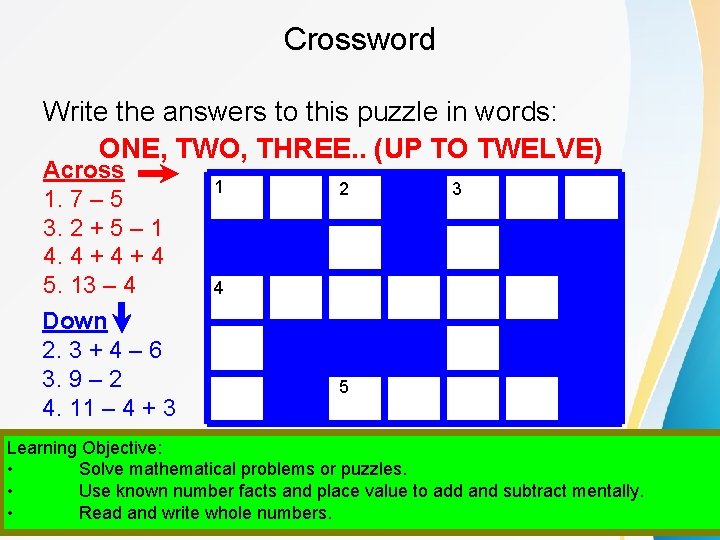
Crossword Write the answers to this puzzle in words: ONE, TWO, THREE. . (UP TO TWELVE) Across 1. 7 – 5 3. 2 + 5 – 1 4. 4 + 4 5. 13 – 4 Down 2. 3 + 4 – 6 3. 9 – 2 4. 11 – 4 + 3 1 2 3 4 5 Learning Objective: • Solve mathematical problems or puzzles. • Use known number facts and place value to add and subtract mentally. • Read and write whole numbers.
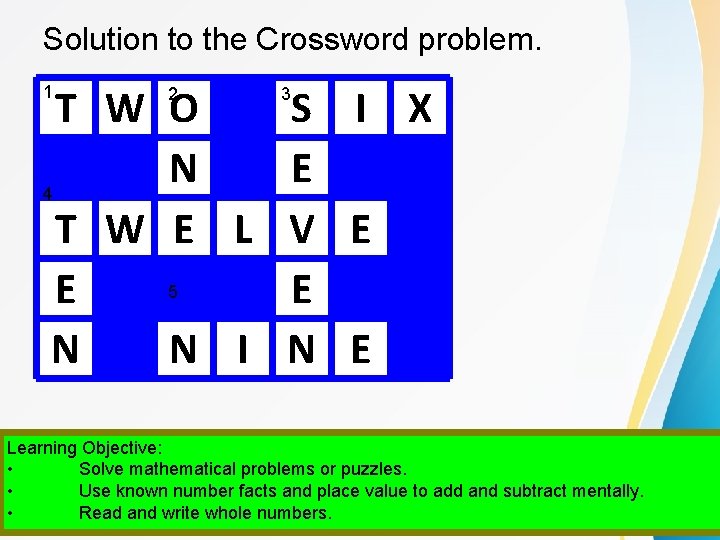
Solution to the Crossword problem. T W O S I X N E 4 T W E L V E 5 E E N N I N E 1 2 3 Learning Objective: • Solve mathematical problems or puzzles. • Use known number facts and place value to add and subtract mentally. • Read and write whole numbers.
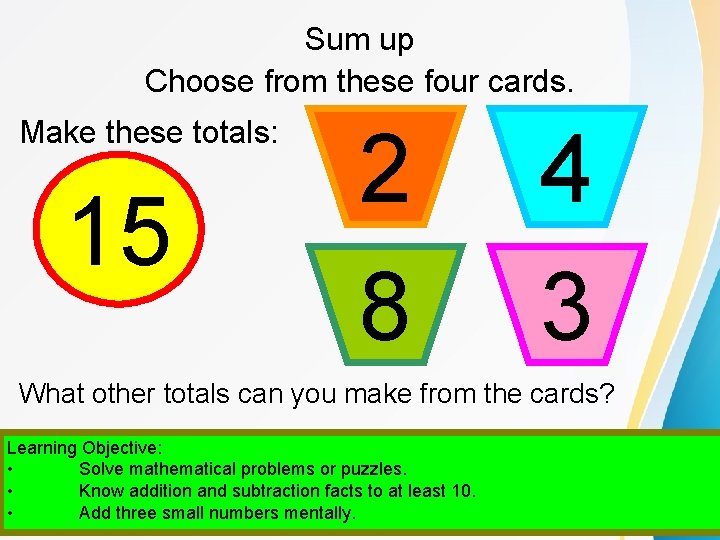
Sum up Choose from these four cards. Make these totals: 15 14 13 12 11 10 9 2 8 4 3 What other totals can you make from the cards? Learning Objective: • Solve mathematical problems or puzzles. • Know addition and subtraction facts to at least 10. • Add three small numbers mentally.
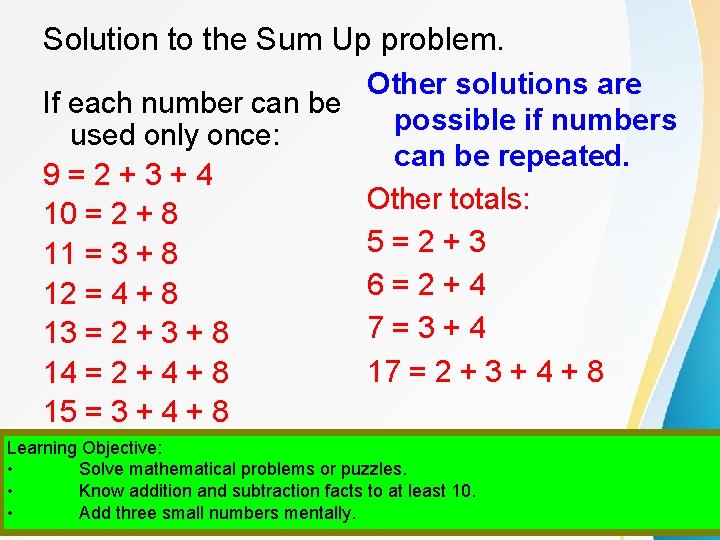
Solution to the Sum Up problem. Other solutions are If each number can be possible if numbers used only once: can be repeated. 9=2+3+4 Other totals: 10 = 2 + 8 5=2+3 11 = 3 + 8 6=2+4 12 = 4 + 8 7=3+4 13 = 2 + 3 + 8 17 = 2 + 3 + 4 + 8 14 = 2 + 4 + 8 15 = 3 + 4 + 8 Learning Objective: • Solve mathematical problems or puzzles. • Know addition and subtraction facts to at least 10. • Add three small numbers mentally.
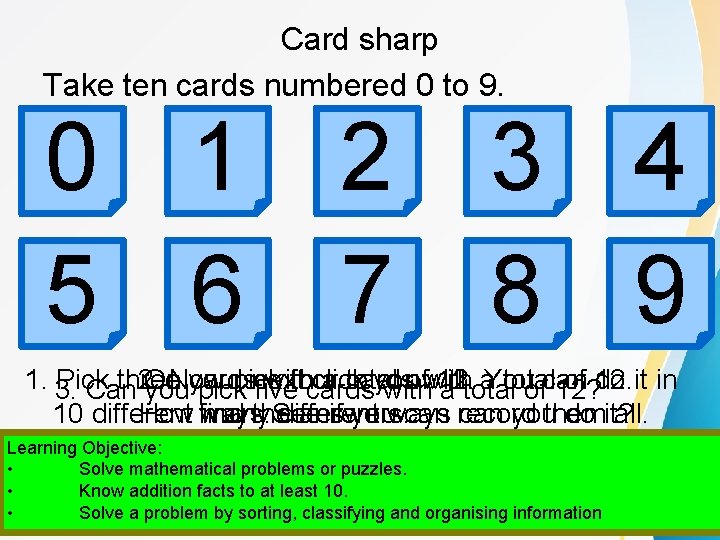
Card sharp Take ten cards numbered 0 to 9. 0 1 2 5 6 7 3 4 8 9 1. 3. Pick three 2. On Now cards your pick next with four click a total cards you ofwith will 12. a. You total of do 12. it in Can you pick five cards with a total ofcan 12? 10 different How find ways. See many thedifferent answers. if youways can record can youthem do it? all. Learning Objective: • Solve mathematical problems or puzzles. • Know addition facts to at least 10. • Solve a problem by sorting, classifying and organising information
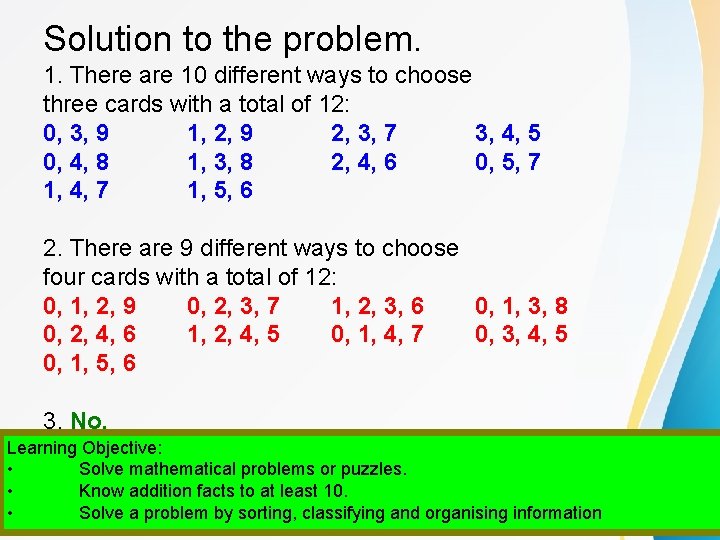
Solution to the problem. 1. There are 10 different ways to choose three cards with a total of 12: 0, 3, 9 1, 2, 9 2, 3, 7 3, 4, 5 0, 4, 8 1, 3, 8 2, 4, 6 0, 5, 7 1, 4, 7 1, 5, 6 2. There are 9 different ways to choose four cards with a total of 12: 0, 1, 2, 9 0, 2, 3, 7 1, 2, 3, 6 0, 1, 3, 8 0, 2, 4, 6 1, 2, 4, 5 0, 1, 4, 7 0, 3, 4, 5 0, 1, 5, 6 3. No. Learning Objective: • Solve mathematical problems or puzzles. • Know addition facts to at least 10. • Solve a problem by sorting, classifying and organising information

Thank You For Working!

References and additional resources. These units were organised using advice given at: http: //www. edu. dudley. gov. uk/numeracy/problem_solving/Challenges%20 and%20 Blocks. doc Power. Point template published by www. ksosoft. com These Mental Maths challenges can be found as a PDF file at : http: //www. edu. dudley. gov. uk/numeracy/problem_solving/Mathematical%20 Challenges%20 Book. pdf The questions from this Power. Point came from: Mathematical challenges for able pupils in Key Stages 1 and 2 Corporate writer was Department for Education and Employment and it is produced under a © Crown copyright 2000 Contains public sector information licensed under the Open Government Licence v 3. 0. (http: //www. nationalarchives. gov. uk/doc/open-government-licence/version/3/) All images used in this Power. Point was found at the free Public Domain Clip Art site. (https: //openclipart. org/)
- Slides: 19