
Mathematical Calculation Strategies 24 Mrta 2021 3 45

- Slides: 28
Mathematical Calculation Strategies 24 Márta 2021 3: 45 pm – 4: 30 pm le Robert Thompson agus Ashleigh Maw
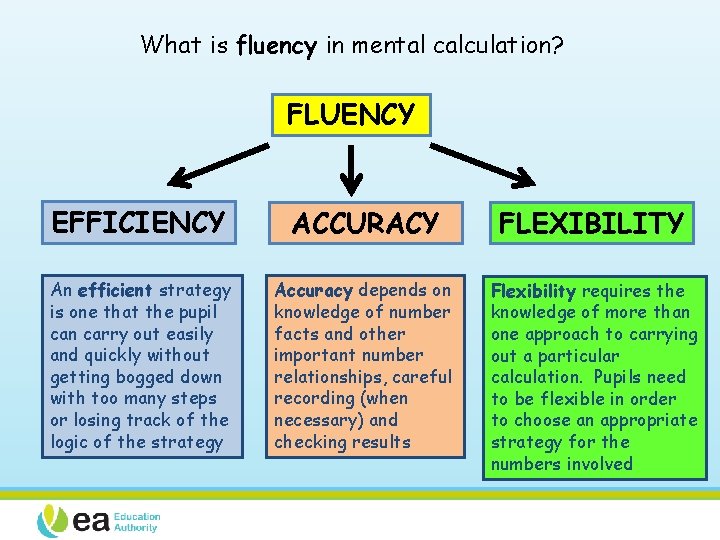
What is fluency in mental calculation? FLUENCY EFFICIENCY ACCURACY FLEXIBILITY An efficient strategy is one that the pupil can carry out easily and quickly without getting bogged down with too many steps or losing track of the logic of the strategy Accuracy depends on knowledge of number facts and other important number relationships, careful recording (when necessary) and checking results Flexibility requires the knowledge of more than one approach to carrying out a particular calculation. Pupils need to be flexible in order to choose an appropriate strategy for the numbers involved
Mental Maths Starter
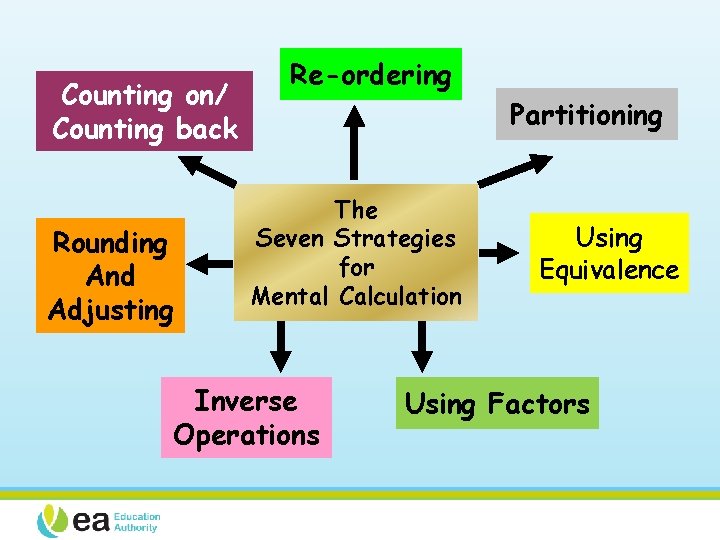
Mental Calculation There are seven strategies for mental calculation. Can the pupils in your school identify and employ these strategies by the time they reach Key Stage 2? Are all the teachers in your school aware of the seven strategies and are they actively teaching them? 70 times 4 is 280
Counting on/ Counting back Rounding And Adjusting Re-ordering Partitioning The Seven Strategies for Mental Calculation Inverse Operations Using Equivalence Using Factors
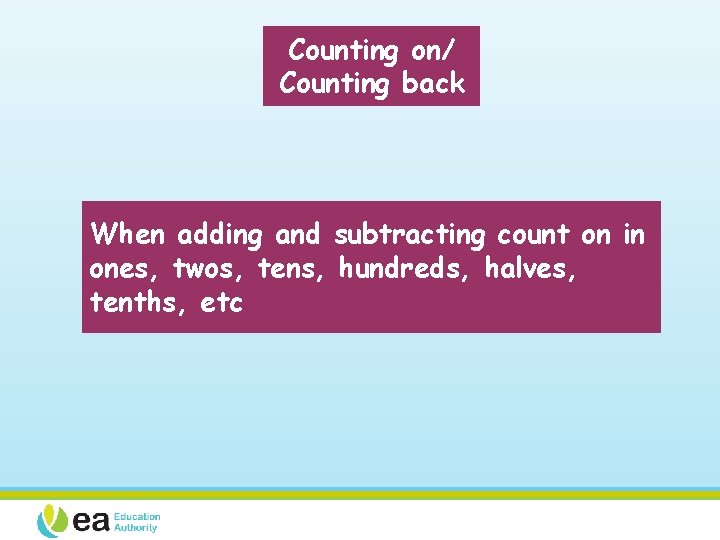
Counting on/ Counting back When adding and subtracting count on in ones, twos, tens, hundreds, halves, tenths, etc
Re-ordering Re-arrange numbers to make the calculation easier; look for components of 10, doubles, near doubles, etc. Calculate the following: 13 + 8 + 7 + 4 + 9 One method : 13 + 7 = 20 (components of 10 extended to 20) 8 + 9 = 17 (near doubles) 20 + 17 = 37 37 + 4 = 41
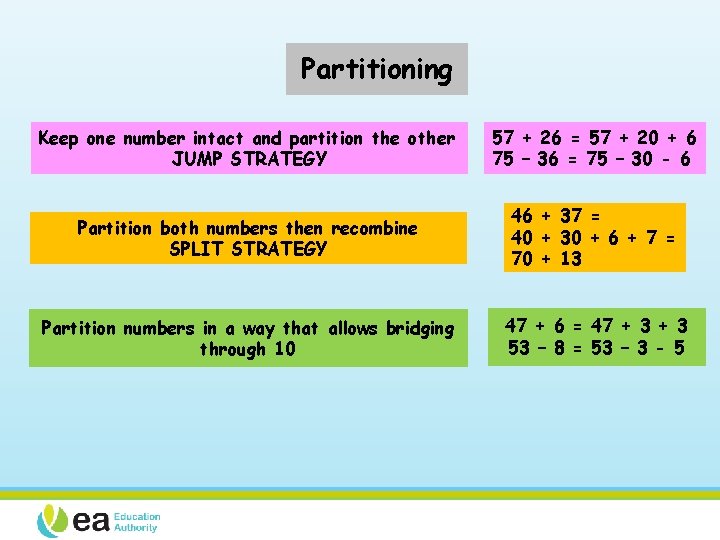
Partitioning Keep one number intact and partition the other JUMP STRATEGY 57 + 26 = 57 + 20 + 6 75 – 36 = 75 – 30 - 6 Partition both numbers then recombine SPLIT STRATEGY 46 + 37 = 40 + 30 + 6 + 7 = 70 + 13 Partition numbers in a way that allows bridging through 10 47 + 6 = 47 + 3 53 – 8 = 53 – 3 - 5
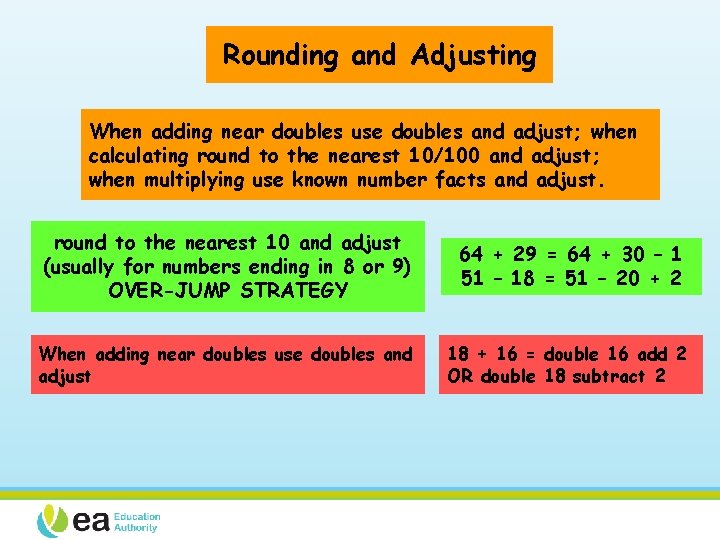
Rounding and Adjusting When adding near doubles use doubles and adjust; when calculating round to the nearest 10/100 and adjust; when multiplying use known number facts and adjust. round to the nearest 10 and adjust (usually for numbers ending in 8 or 9) OVER-JUMP STRATEGY 64 + 29 = 64 + 30 – 1 51 – 18 = 51 – 20 + 2 When adding near doubles use doubles and adjust 18 + 16 = double 16 add 2 OR double 18 subtract 2
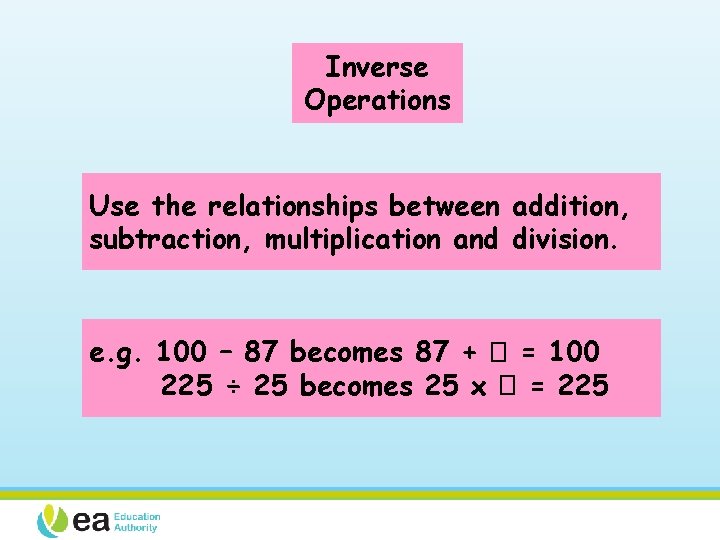
Inverse Operations Use the relationships between addition, subtraction, multiplication and division. e. g. 100 – 87 becomes 87 + � = 100 225 ÷ 25 becomes 25 x � = 225
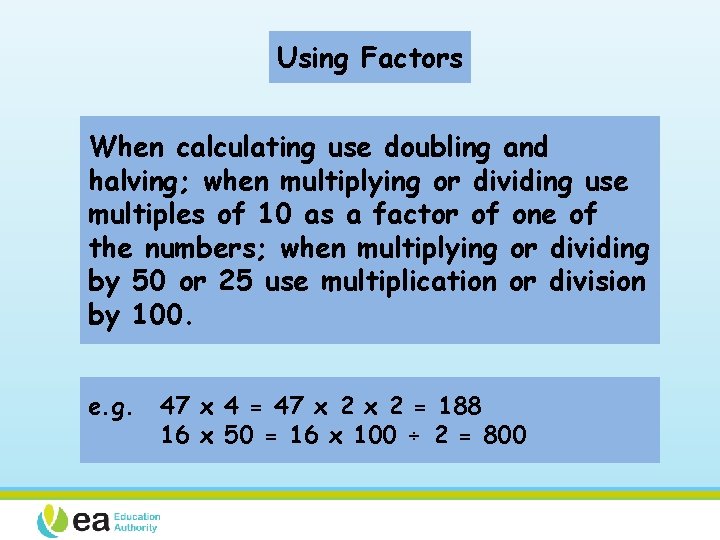
Using Factors When calculating use doubling and halving; when multiplying or dividing use multiples of 10 as a factor of one of the numbers; when multiplying or dividing by 50 or 25 use multiplication or division by 100. e. g. 47 x 4 = 47 x 2 = 188 16 x 50 = 16 x 100 ÷ 2 = 800
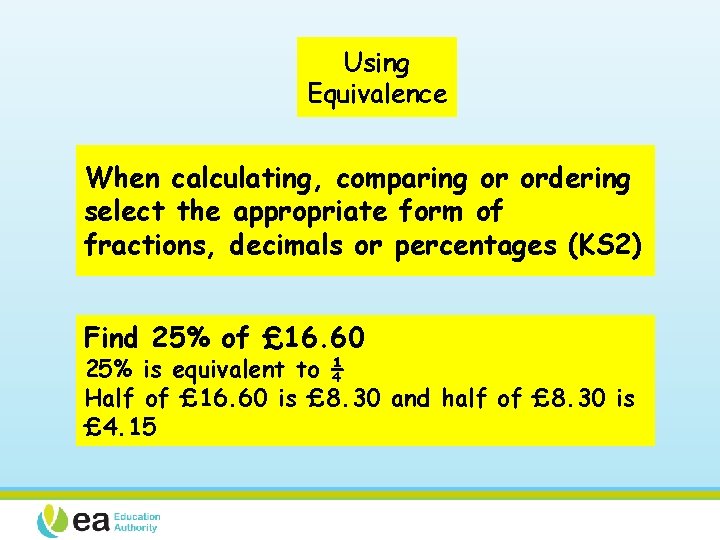
Using Equivalence When calculating, comparing or ordering select the appropriate form of fractions, decimals or percentages (KS 2) Find 25% of £ 16. 60 25% is equivalent to ¼ Half of £ 16. 60 is £ 8. 30 and half of £ 8. 30 is £ 4. 15
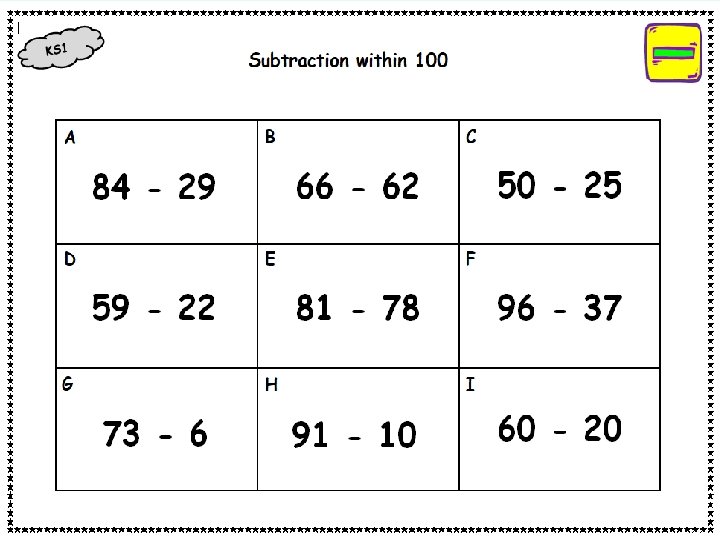
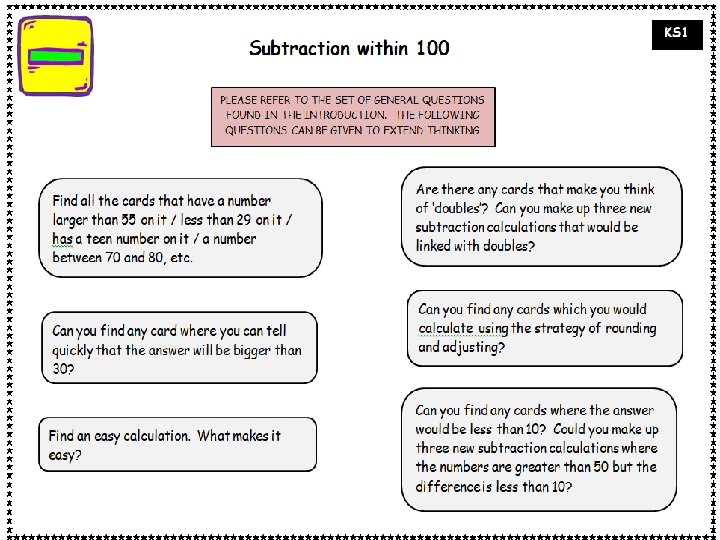
Calculation Conversation Comparing levels of difficulty in calculations
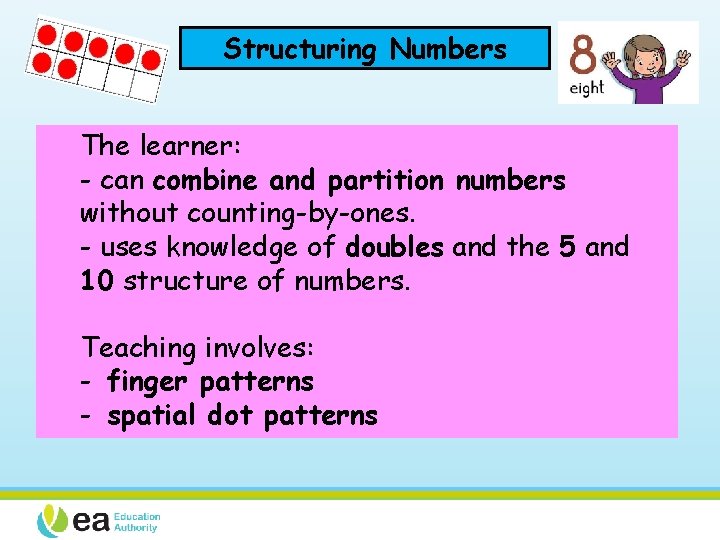
Structuring Numbers The learner: - can combine and partition numbers without counting-by-ones. - uses knowledge of doubles and the 5 and 10 structure of numbers. Teaching involves: - finger patterns - spatial dot patterns
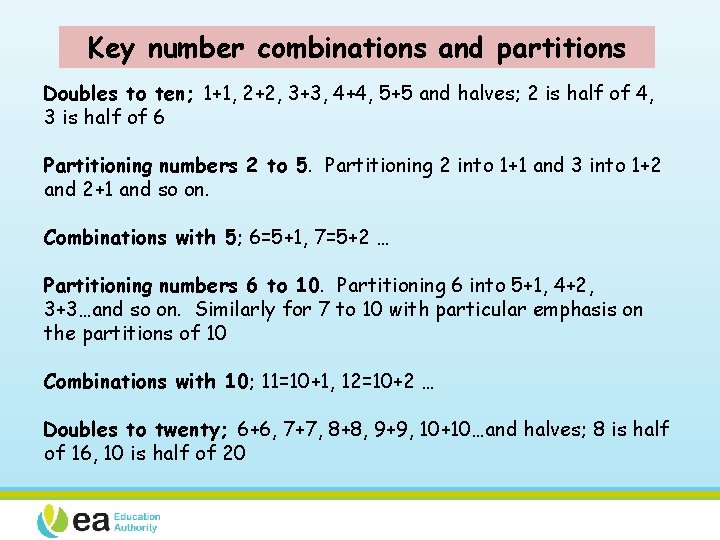
Key number combinations and partitions Doubles to ten; 1+1, 2+2, 3+3, 4+4, 5+5 and halves; 2 is half of 4, 3 is half of 6 Partitioning numbers 2 to 5. Partitioning 2 into 1+1 and 3 into 1+2 and 2+1 and so on. Combinations with 5; 6=5+1, 7=5+2 … Partitioning numbers 6 to 10. Partitioning 6 into 5+1, 4+2, 3+3…and so on. Similarly for 7 to 10 with particular emphasis on the partitions of 10 Combinations with 10; 11=10+1, 12=10+2 … Doubles to twenty; 6+6, 7+7, 8+8, 9+9, 10+10…and halves; 8 is half of 16, 10 is half of 20
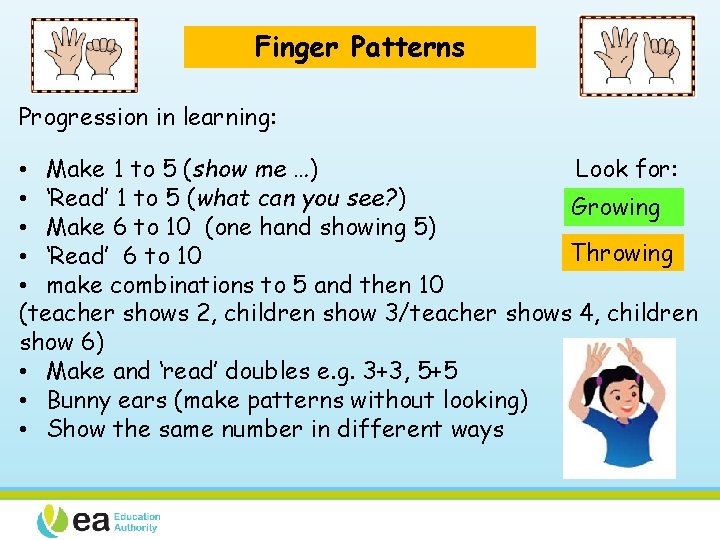
Finger Patterns Progression in learning: • Make 1 to 5 (show me …) Look for: • ‘Read’ 1 to 5 (what can you see? ) Growing • Make 6 to 10 (one hand showing 5) Throwing • ‘Read’ 6 to 10 • make combinations to 5 and then 10 (teacher shows 2, children show 3/teacher shows 4, children show 6) • Make and ‘read’ doubles e. g. 3+3, 5+5 • Bunny ears (make patterns without looking) • Show the same number in different ways
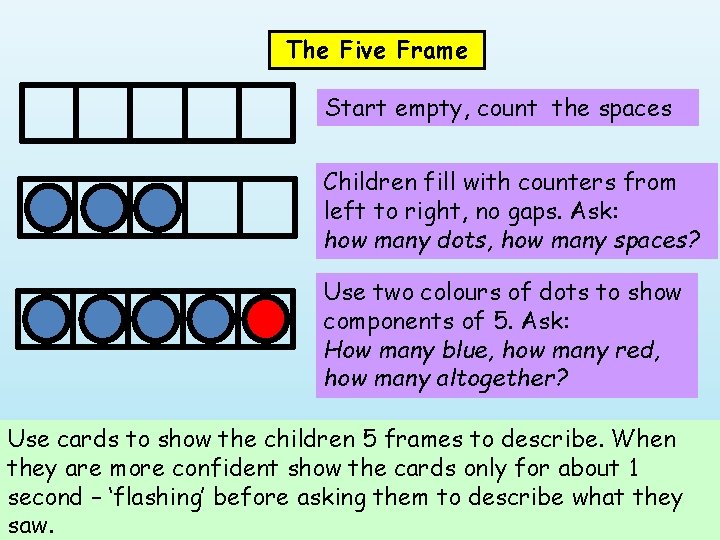
The Five Frame Start empty, count the spaces Children fill with counters from left to right, no gaps. Ask: how many dots, how many spaces? Use two colours of dots to show components of 5. Ask: How many blue, how many red, how many altogether? Use cards to show the children 5 frames to describe. When they are more confident show the cards only for about 1 second – ‘flashing’ before asking them to describe what they 19 saw.
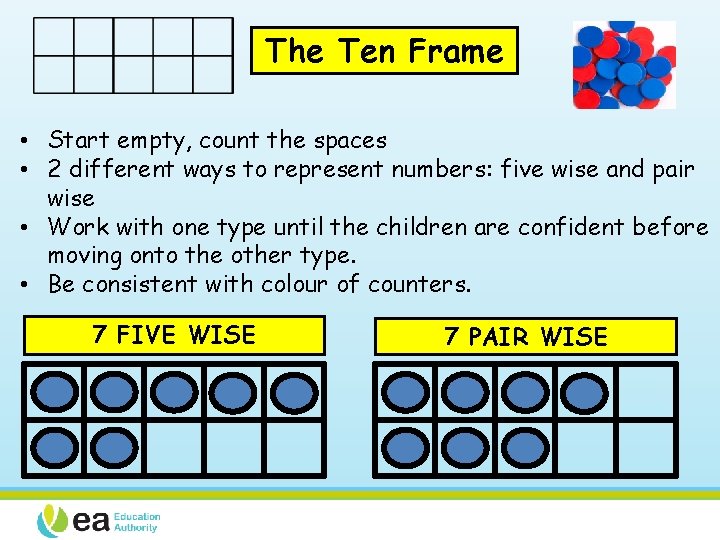
The Ten Frame • Start empty, count the spaces • 2 different ways to represent numbers: five wise and pair wise • Work with one type until the children are confident before moving onto the other type. • Be consistent with colour of counters. 7 FIVE WISE 7 PAIR WISE
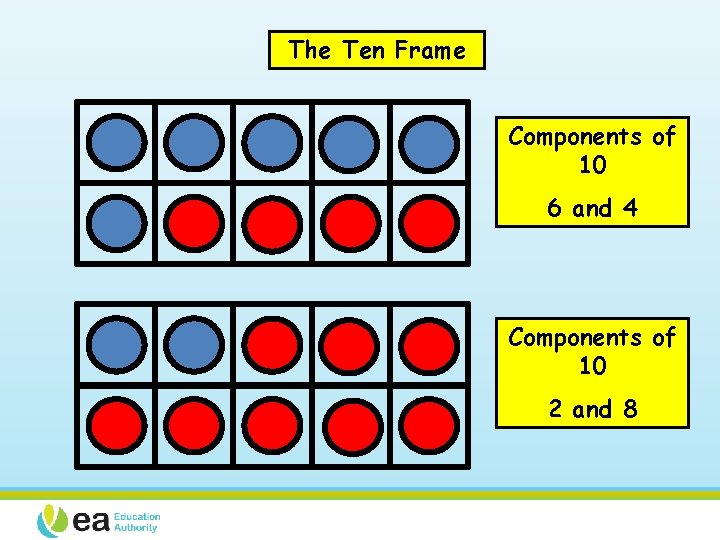
The Ten Frame Components of 10 6 and 4 Components of 10 2 and 8
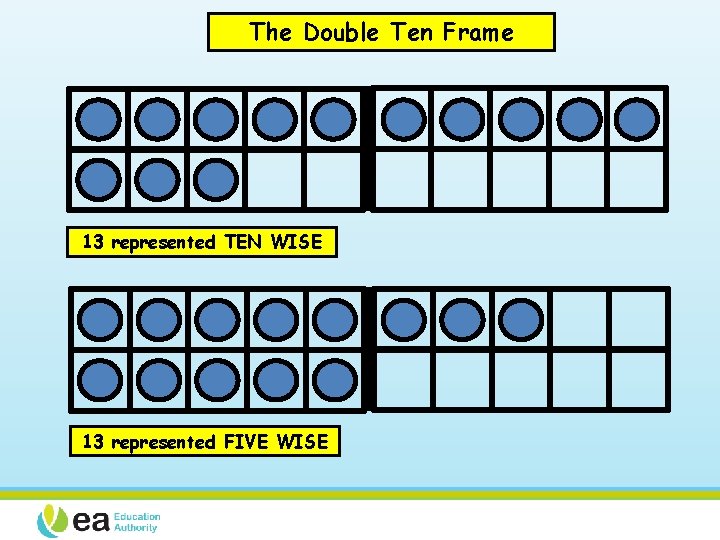
The Double Ten Frame 13 represented TEN WISE 13 represented FIVE WISE
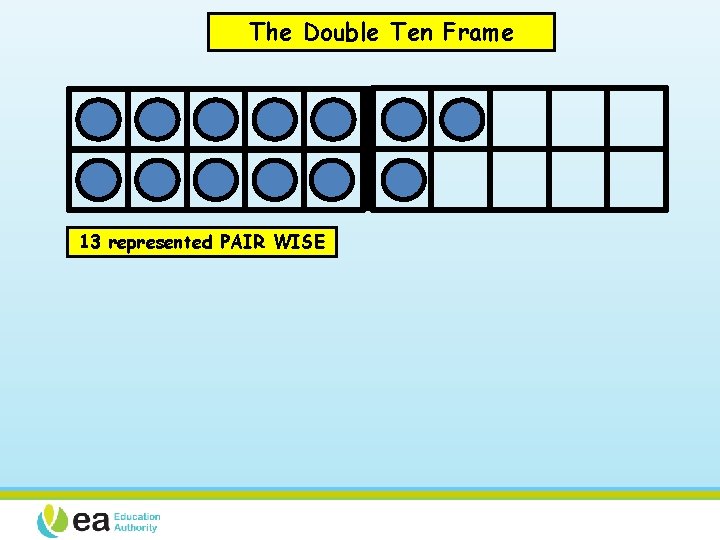
The Double Ten Frame 13 represented PAIR WISE
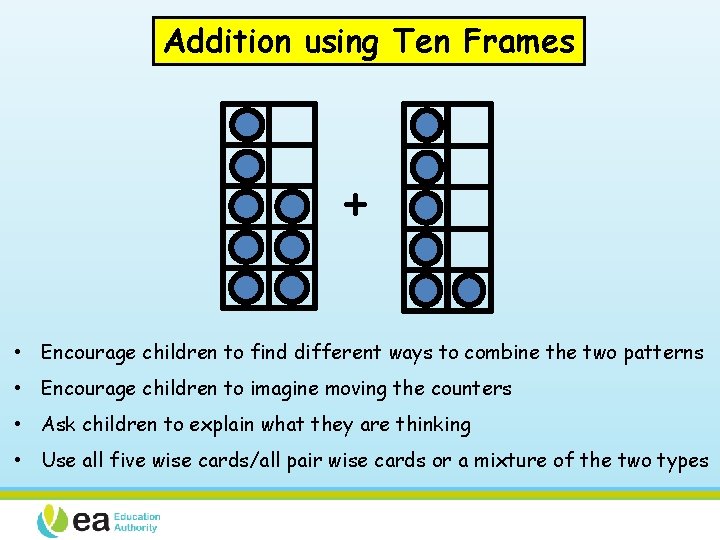
Addition using Ten Frames + • Encourage children to find different ways to combine the two patterns • Encourage children to imagine moving the counters • Ask children to explain what they are thinking • Use all five wise cards/all pair wise cards or a mixture of the two types
Comparing levels of challenge in calculations
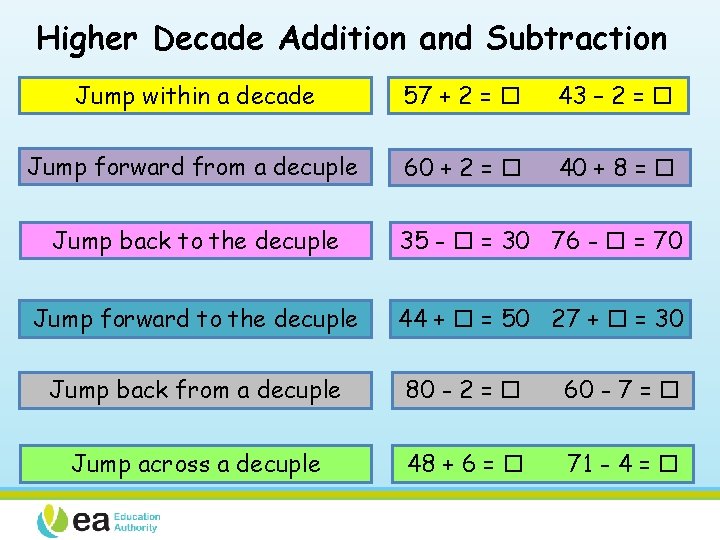
Higher Decade Addition and Subtraction Jump within a decade 57 + 2 = 43 – 2 = Jump forward from a decuple 60 + 2 = 40 + 8 = Jump back to the decuple 35 - = 30 76 - = 70 Jump forward to the decuple 44 + = 50 27 + = 30 Jump back from a decuple 80 - 2 = 60 - 7 = Jump across a decuple 48 + 6 = 71 - 4 =
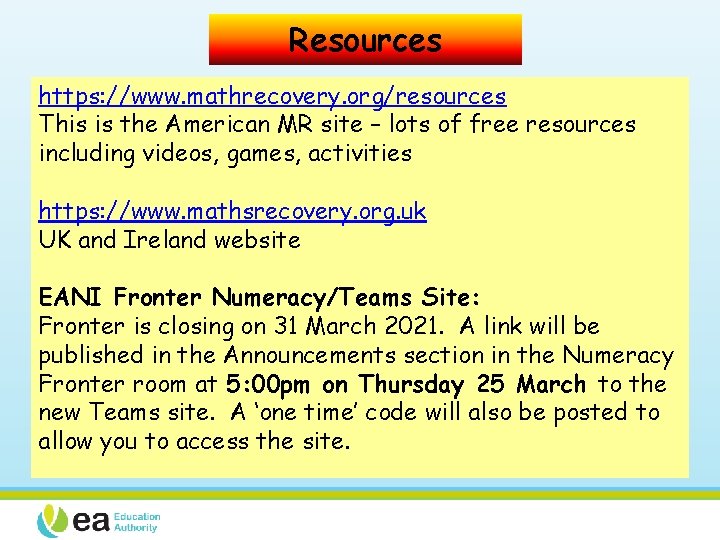
Resources https: //www. mathrecovery. org/resources This is the American MR site – lots of free resources including videos, games, activities https: //www. mathsrecovery. org. uk UK and Ireland website EANI Fronter Numeracy/Teams Site: Fronter is closing on 31 March 2021. A link will be published in the Announcements section in the Numeracy Fronter room at 5: 00 pm on Thursday 25 March to the new Teams site. A ‘one time’ code will also be posted to allow you to access the site.