
Mathematical Arguments and Triangle Geometry Chapter 2 Deductive


- Slides: 55
Mathematical Arguments and Triangle Geometry Chapter 2
Deductive Reasoning • A process § Demonstrates that if certain statements are true … § Then other statements shown to follow logically • Statements assumed true § The hypothesis • Conclusion § Arrived at by a chain of implications
Deductive Reasoning • Statements of an argument § Deductive sentence • Closed statement § can be either true or false • Open statement § contains a variable – truth value determined once variable specified
Deductive Reasoning • Statements … open? closed? true? false? § All cars are blue. § The car is red. § Yesterday was Sunday. § Rectangles have four interior angles. § Construct the perpendicular bisector.
Deductive Reasoning • Nonstatement – cannot take on a truth value § Construct an angle bisector. • May be interrogative sentence § Is ABC a right triangle? • May be oxymoron The statement in this box is false
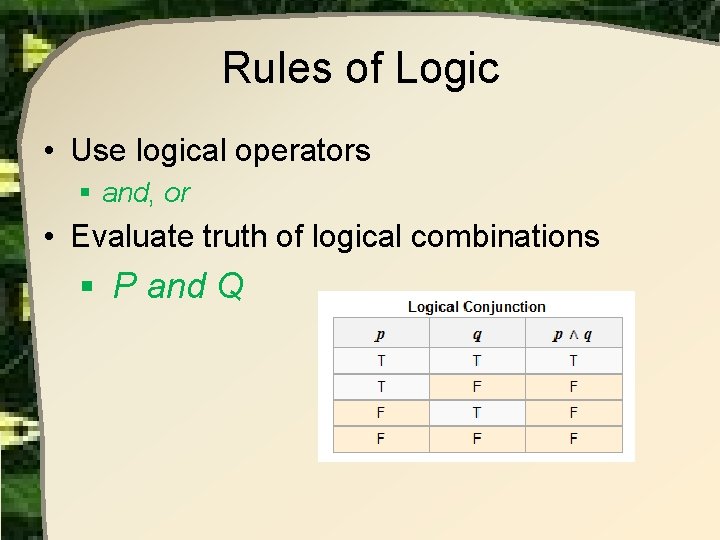
Rules of Logic • Use logical operators § and, or • Evaluate truth of logical combinations § P and Q
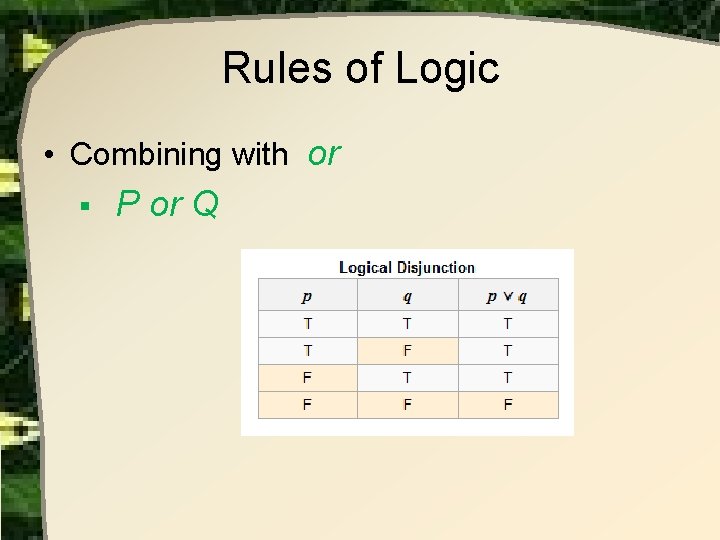
Rules of Logic • Combining with or § P or Q
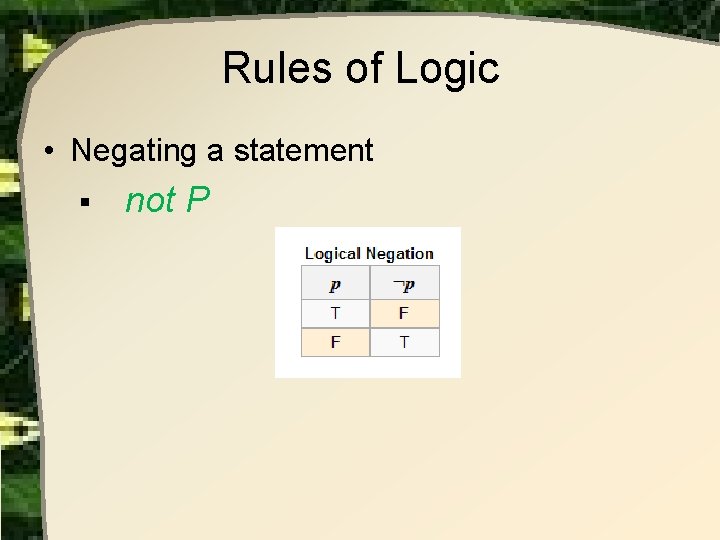
Rules of Logic • Negating a statement § not P
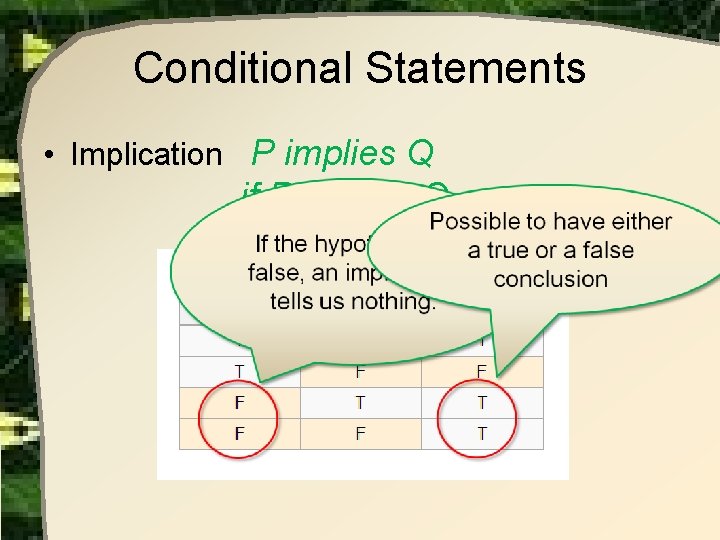
Conditional Statements • Implication P implies Q if P then Q
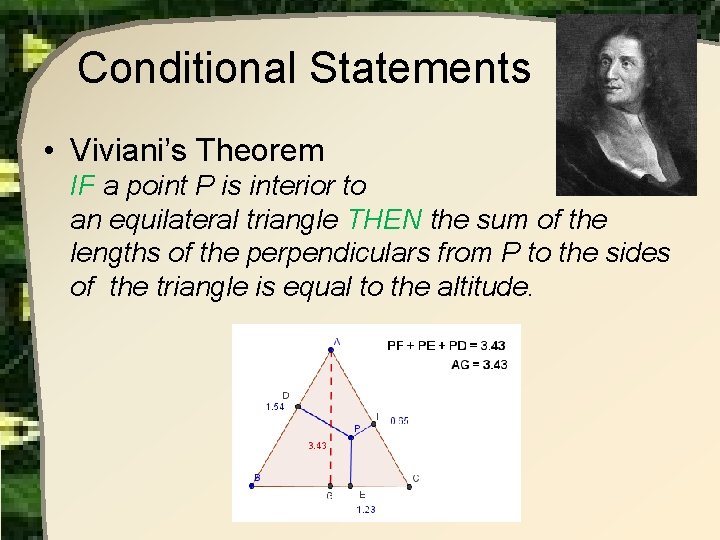
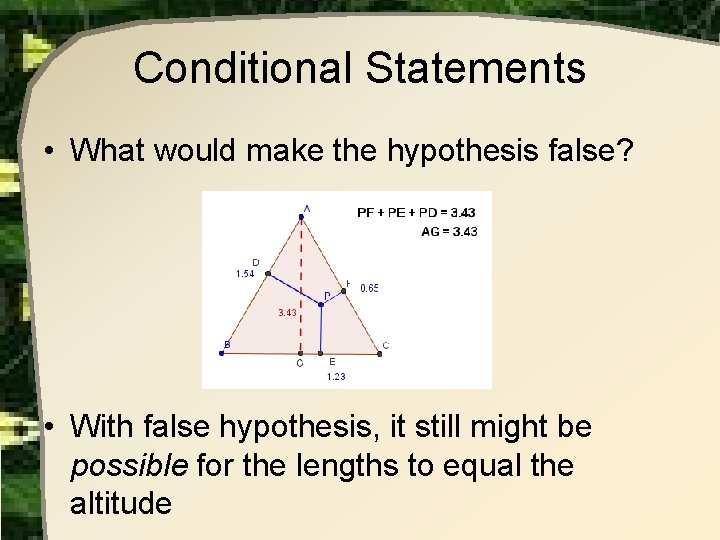
Conditional Statements • Viviani’s Theorem IF a point P is interior to an equilateral triangle THEN the sum of the lengths of the perpendiculars from P to the sides of the triangle is equal to the altitude.
Conditional Statements • What would make the hypothesis false? • With false hypothesis, it still might be possible for the lengths to equal the altitude
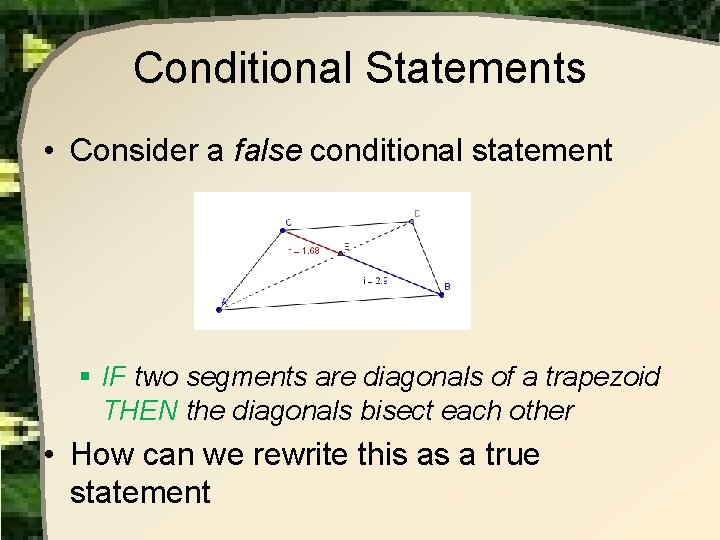
Conditional Statements • Consider a false conditional statement § IF two segments are diagonals of a trapezoid THEN the diagonals bisect each other • How can we rewrite this as a true statement
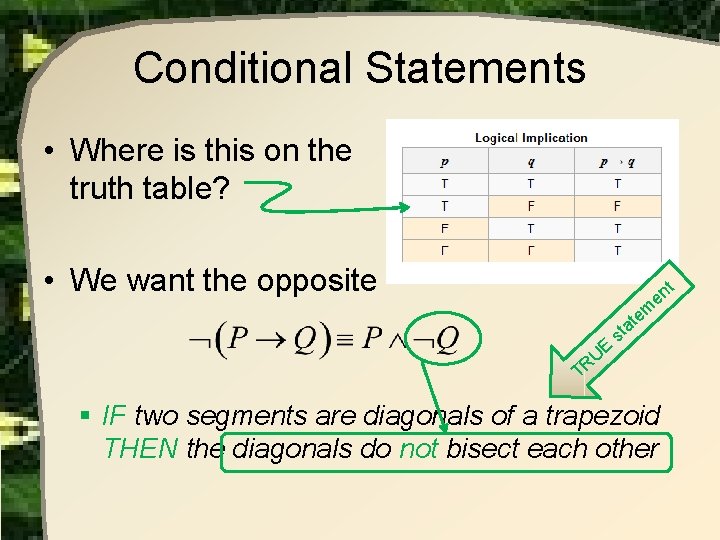
Conditional Statements • Where is this on the truth table? • We want the opposite t en m e at E U R st T § IF two segments are diagonals of a trapezoid THEN the diagonals do not bisect each other
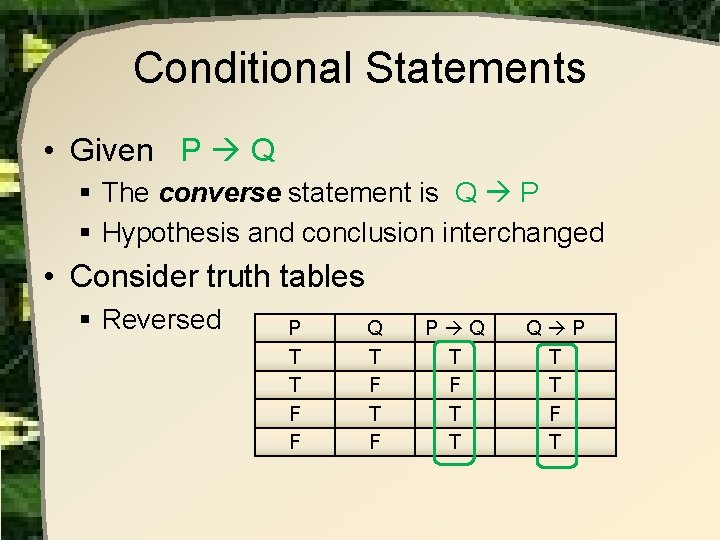
Conditional Statements • Given P Q § The converse statement is Q P § Hypothesis and conclusion interchanged • Consider truth tables § Reversed P T T F F Q T F P Q T F T T Q P T T F T
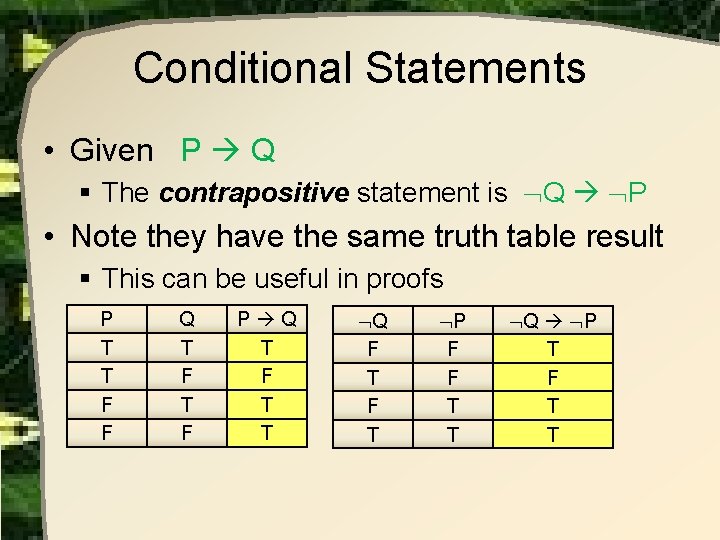
Conditional Statements • Given P Q § The contrapositive statement is Q P • Note they have the same truth table result § This can be useful in proofs P T T F F Q T F P Q T F T T Q F T P F F T T Q P T F T T
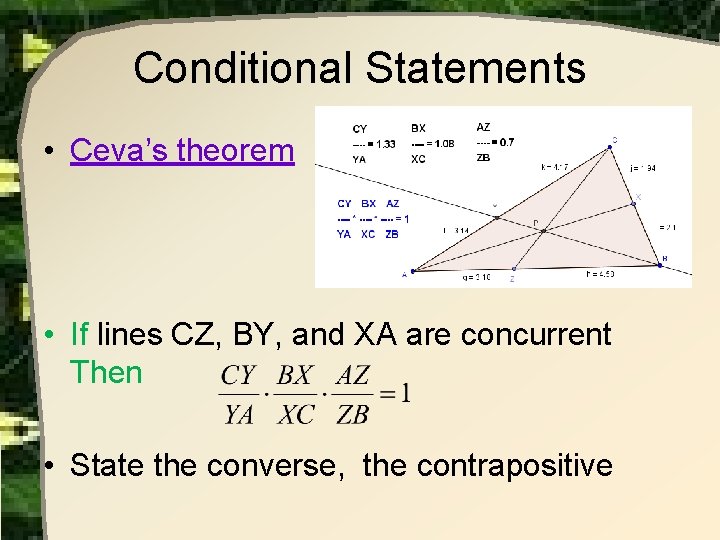
Conditional Statements • Ceva’s theorem • If lines CZ, BY, and XA are concurrent Then • State the converse, the contrapositive
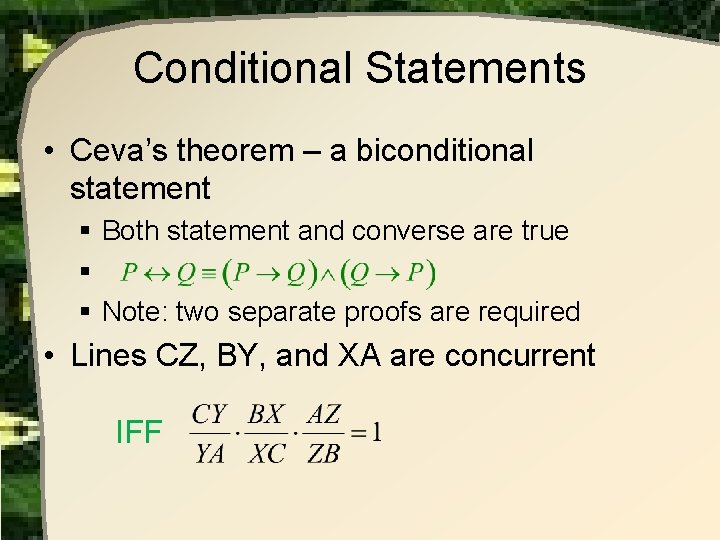
Conditional Statements • Ceva’s theorem – a biconditional statement § Both statement and converse are true § § Note: two separate proofs are required • Lines CZ, BY, and XA are concurrent IFF
Mathematical Arguments Developing a robust proof • Write a clear statement of your conjecture § It must be a conditional statement • Proof must demonstrate that your conclusions follow from specified conditions • Draw diagrams to demonstrate role of your hypotheses
Mathematical Arguments • Goal of a robust proof § develop a valid argument § use rules of logic correctly § each step must follow logically from previous • Once conjecture proven – then it is a theorem
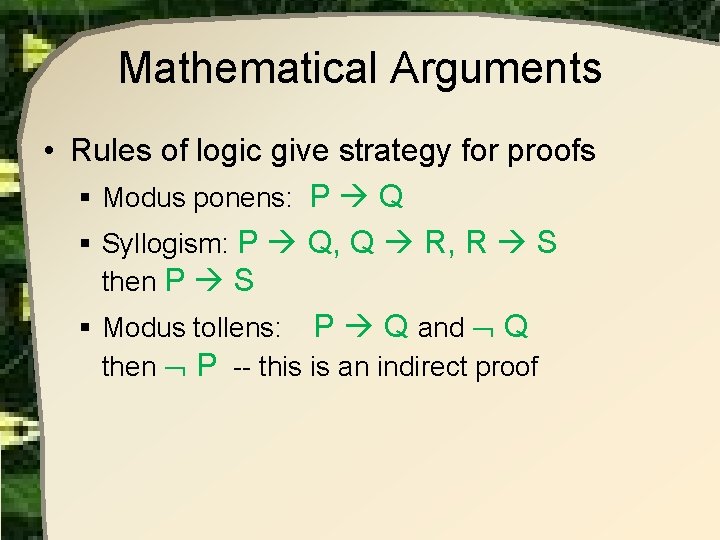
Mathematical Arguments • Rules of logic give strategy for proofs § Modus ponens: P Q § Syllogism: P Q, Q R, R S then P S § Modus tollens: P Q and Q then P -- this is an indirect proof
Universal & Existential Quantifiers • Open statement has a variable • Two ways to close the statement § substitution § quantification • Substitution § specify a value for the variable x+5=9 § value specified for x makes statement either true or false
Universal & Existential Quantifiers • Quantification § View the statement as a predicate or function § Parameter of function is a value for the variable § Function returns True or False
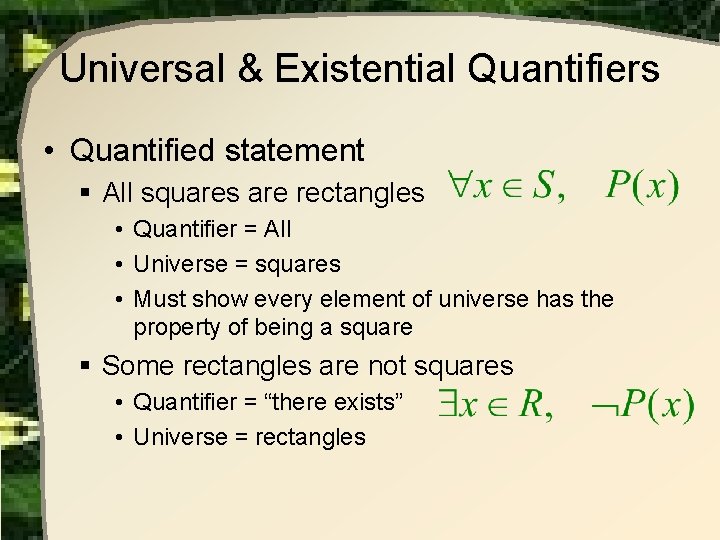
Universal & Existential Quantifiers • Quantified statement § All squares are rectangles • Quantifier = All • Universe = squares • Must show every element of universe has the property of being a square § Some rectangles are not squares • Quantifier = “there exists” • Universe = rectangles
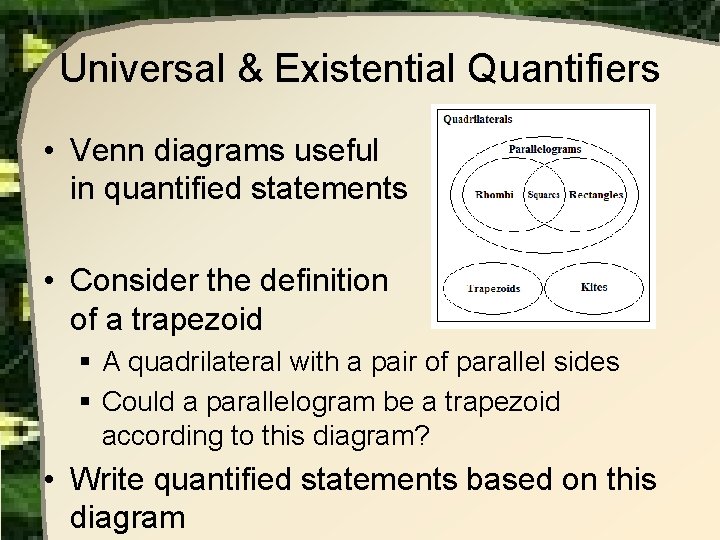
Universal & Existential Quantifiers • Venn diagrams useful in quantified statements • Consider the definition of a trapezoid § A quadrilateral with a pair of parallel sides § Could a parallelogram be a trapezoid according to this diagram? • Write quantified statements based on this diagram
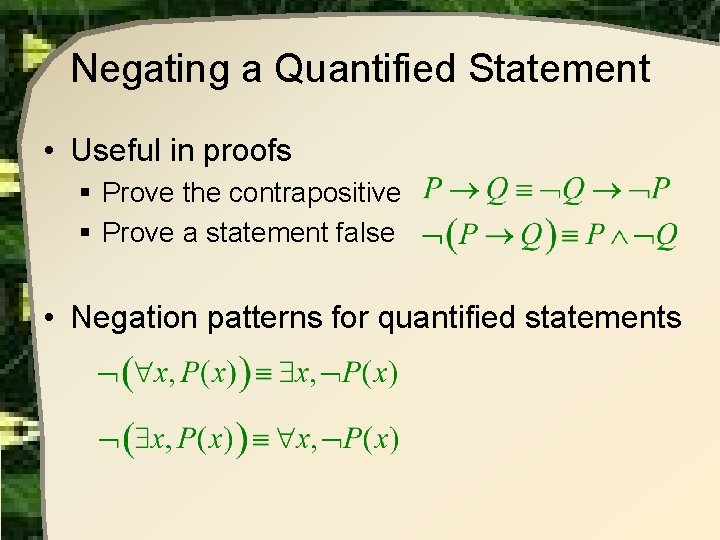
Negating a Quantified Statement • Useful in proofs § Prove the contrapositive § Prove a statement false • Negation patterns for quantified statements
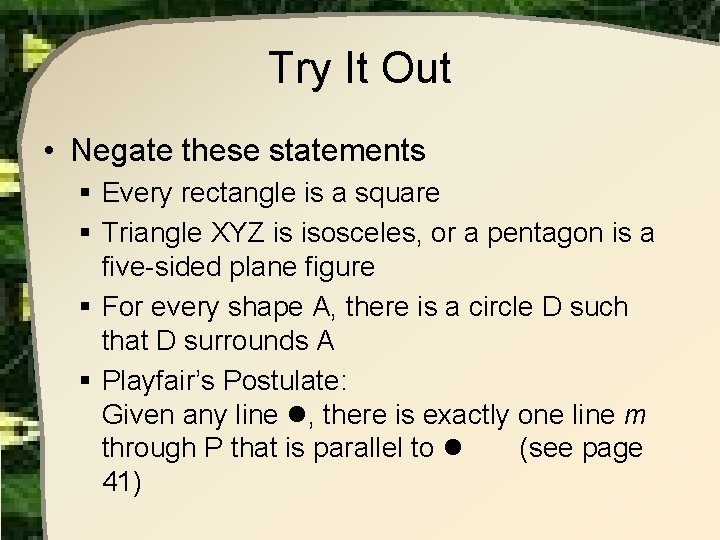
Try It Out • Negate these statements § Every rectangle is a square § Triangle XYZ is isosceles, or a pentagon is a five-sided plane figure § For every shape A, there is a circle D such that D surrounds A § Playfair’s Postulate: Given any line l, there is exactly one line m through P that is parallel to l (see page 41)
Congruence Criteria for Triangles • SAS: If two sides and the included angle of one triangle are congruent to two sides and the included angle of another triangle, then the two triangles are congruent. • We will accept this axiom without proof
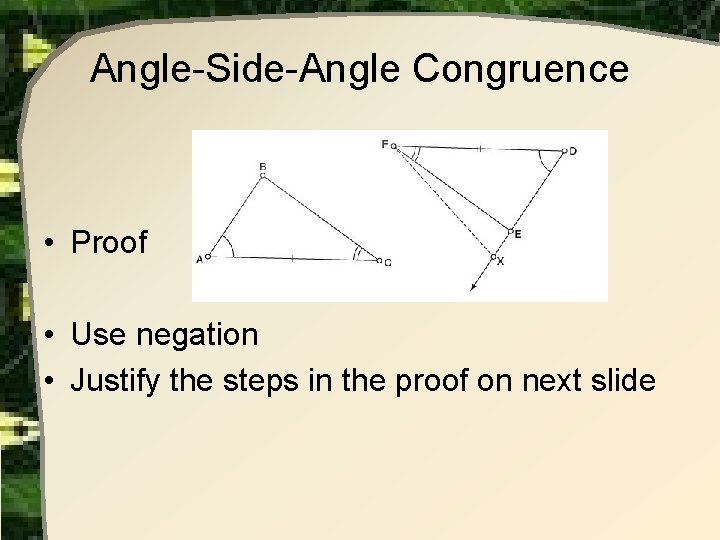
Angle-Side-Angle Congruence • State the Angle-Side-Angle criterion for triangle congruence (don’t look in the book) • ASA: If two angles and the included side of one triangle are congruent respectively to two angles and the included angle of another triangle, then the two triangles are congruent
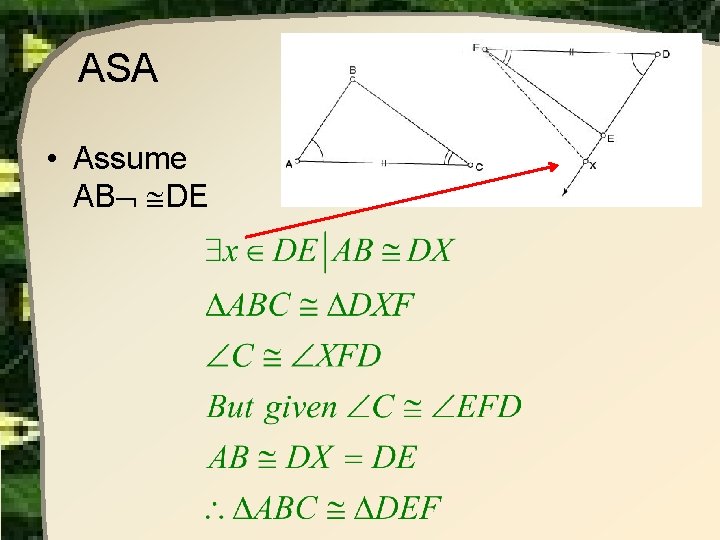
Angle-Side-Angle Congruence • Proof • Use negation • Justify the steps in the proof on next slide
ASA • Assume AB DE
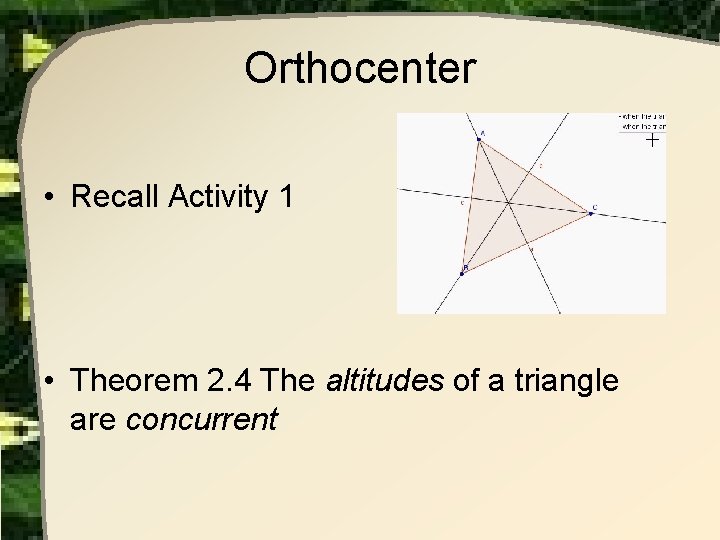
Orthocenter • Recall Activity 1 • Theorem 2. 4 The altitudes of a triangle are concurrent
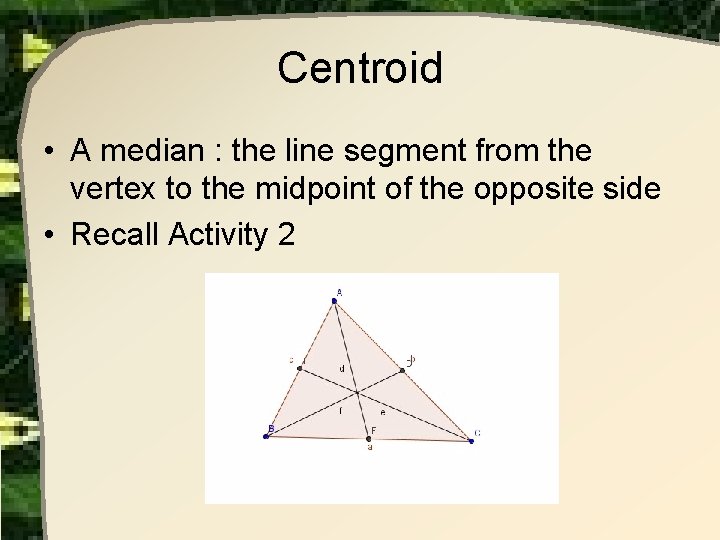
Centroid • A median : the line segment from the vertex to the midpoint of the opposite side • Recall Activity 2
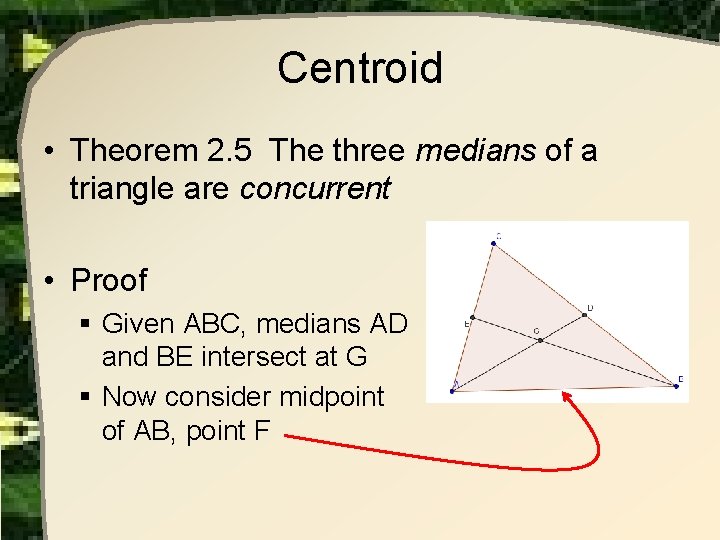
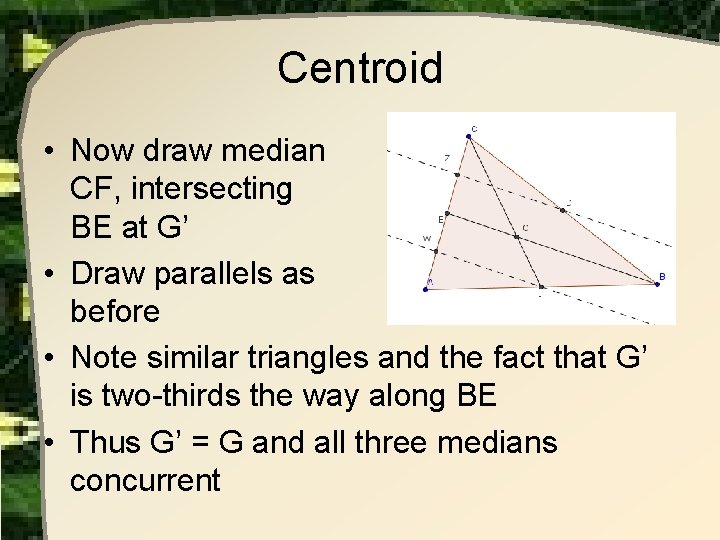
Centroid • Theorem 2. 5 The three medians of a triangle are concurrent • Proof § Given ABC, medians AD and BE intersect at G § Now consider midpoint of AB, point F
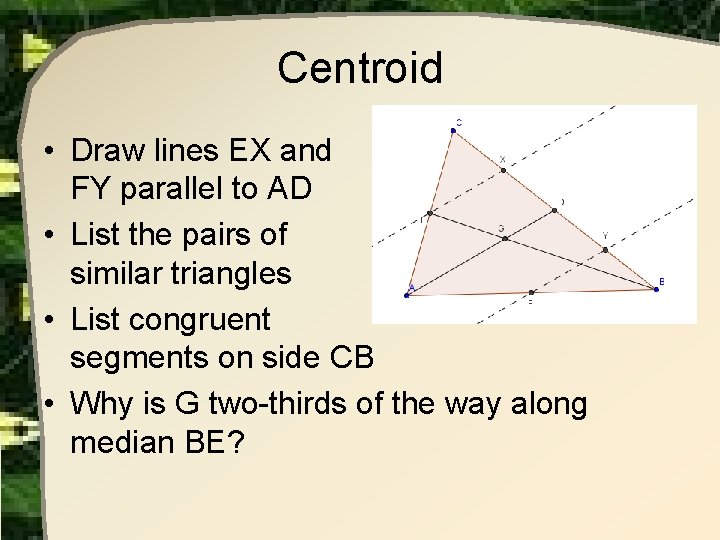
Centroid • Draw lines EX and FY parallel to AD • List the pairs of similar triangles • List congruent segments on side CB • Why is G two-thirds of the way along median BE?
Centroid • Now draw median CF, intersecting BE at G’ • Draw parallels as before • Note similar triangles and the fact that G’ is two-thirds the way along BE • Thus G’ = G and all three medians concurrent
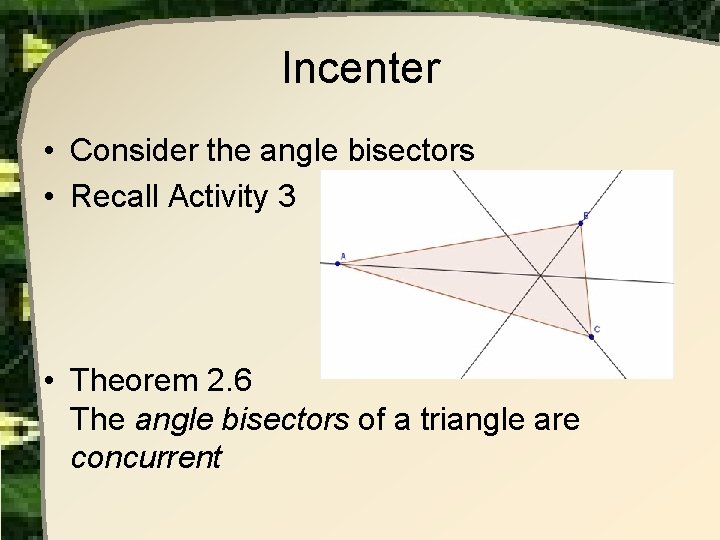
Incenter • Consider the angle bisectors • Recall Activity 3 • Theorem 2. 6 The angle bisectors of a triangle are concurrent
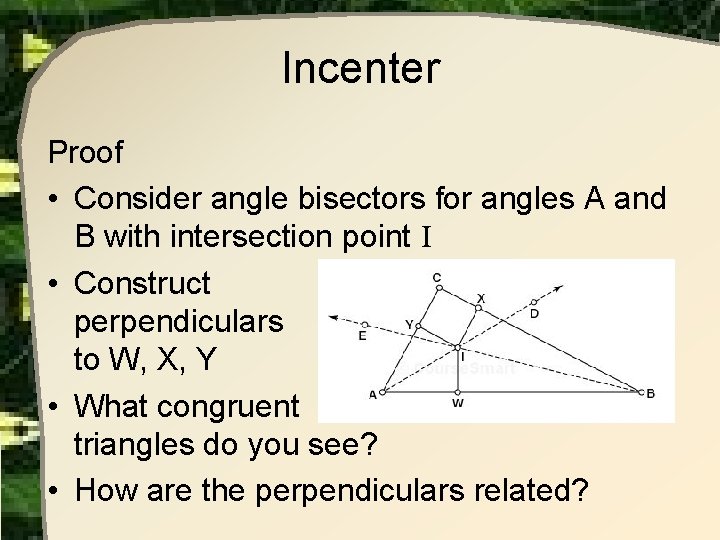
Incenter Proof • Consider angle bisectors for angles A and B with intersection point I • Construct perpendiculars to W, X, Y • What congruent triangles do you see? • How are the perpendiculars related?
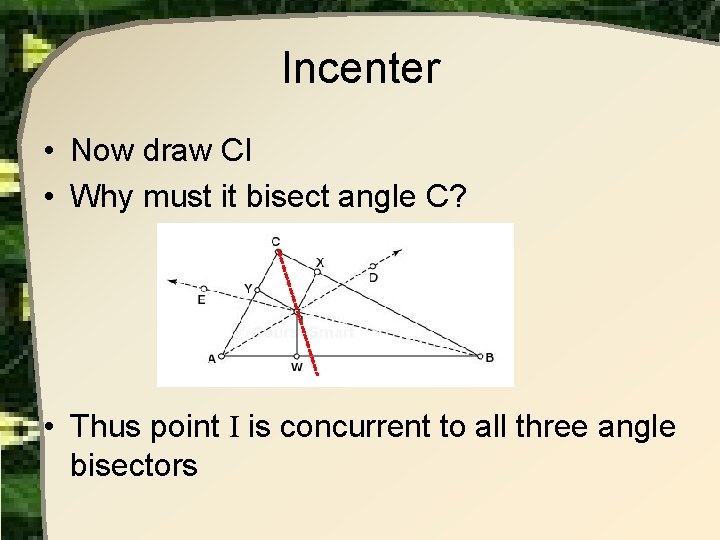
Incenter • Now draw CI • Why must it bisect angle C? • Thus point I is concurrent to all three angle bisectors
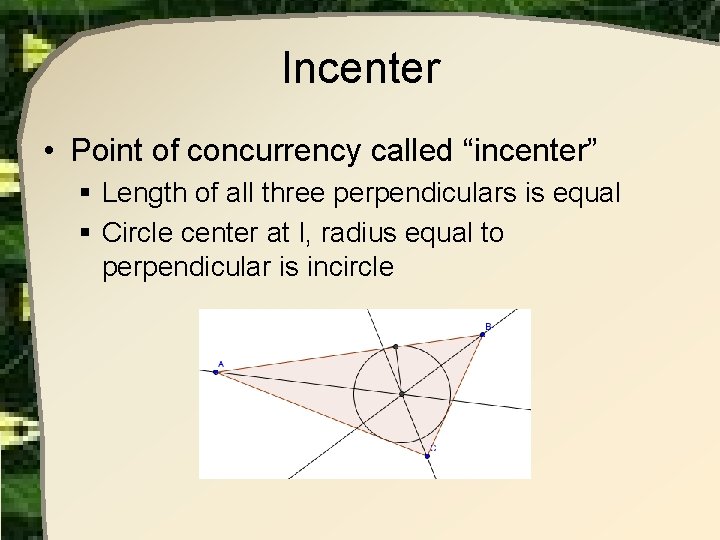
Incenter • Point of concurrency called “incenter” § Length of all three perpendiculars is equal § Circle center at I, radius equal to perpendicular is incircle
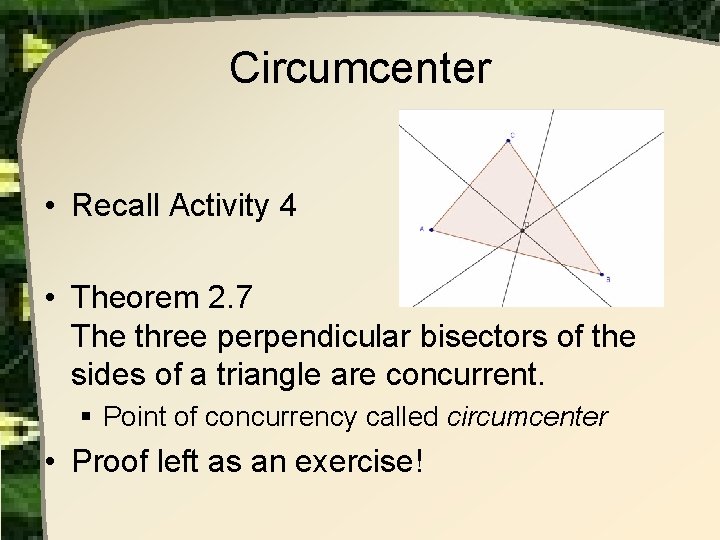
Circumcenter • Recall Activity 4 • Theorem 2. 7 The three perpendicular bisectors of the sides of a triangle are concurrent. § Point of concurrency called circumcenter • Proof left as an exercise!
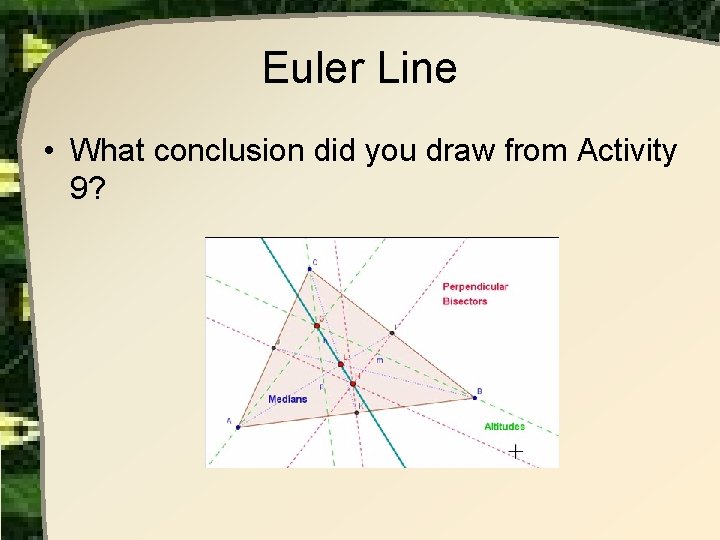
Euler Line • What conclusion did you draw from Activity 9?
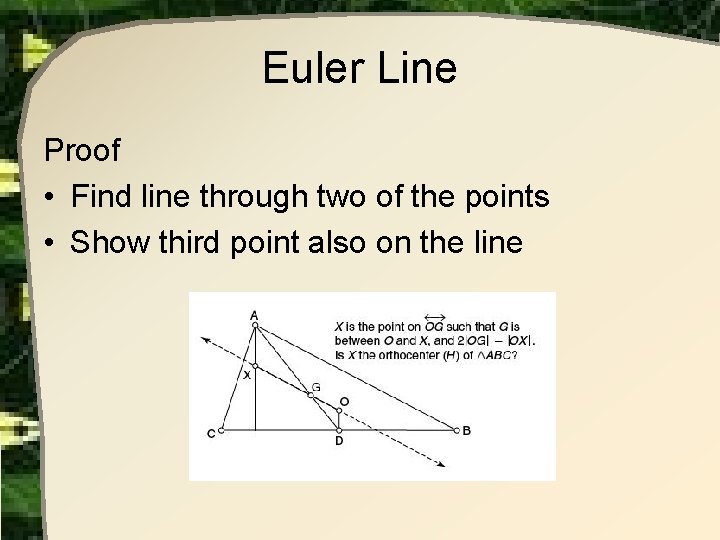
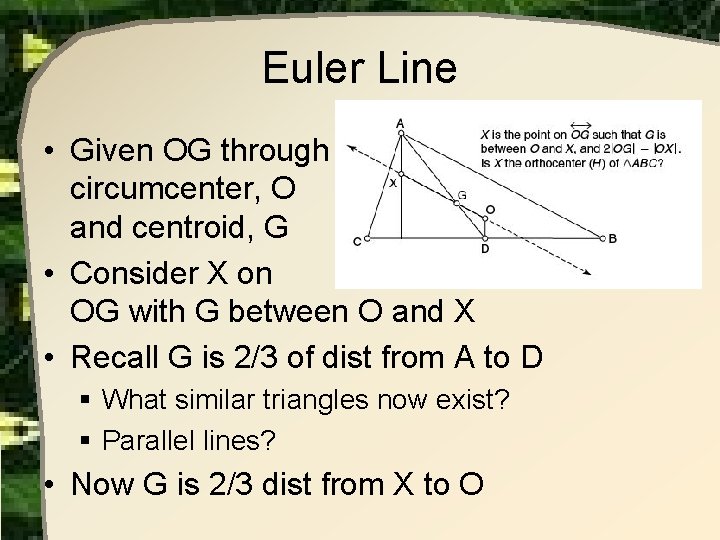
Euler Line Proof • Find line through two of the points • Show third point also on the line
Euler Line • Given OG through circumcenter, O and centroid, G • Consider X on OG with G between O and X • Recall G is 2/3 of dist from A to D § What similar triangles now exist? § Parallel lines? • Now G is 2/3 dist from X to O
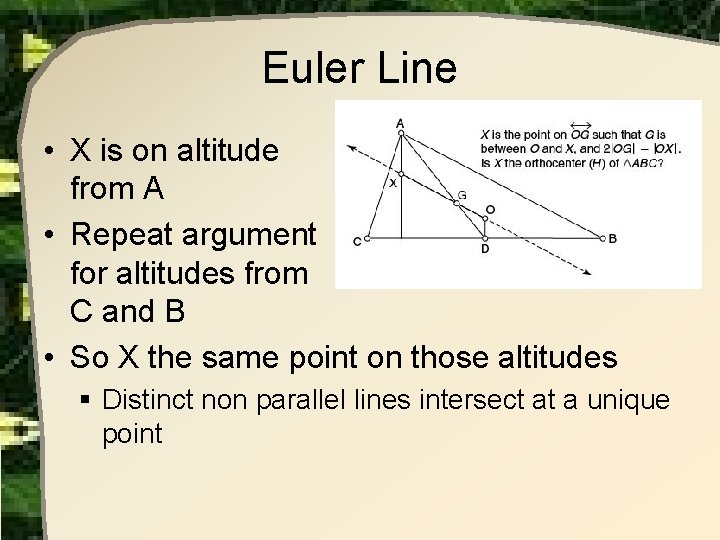
Euler Line • X is on altitude from A • Repeat argument for altitudes from C and B • So X the same point on those altitudes § Distinct non parallel lines intersect at a unique point
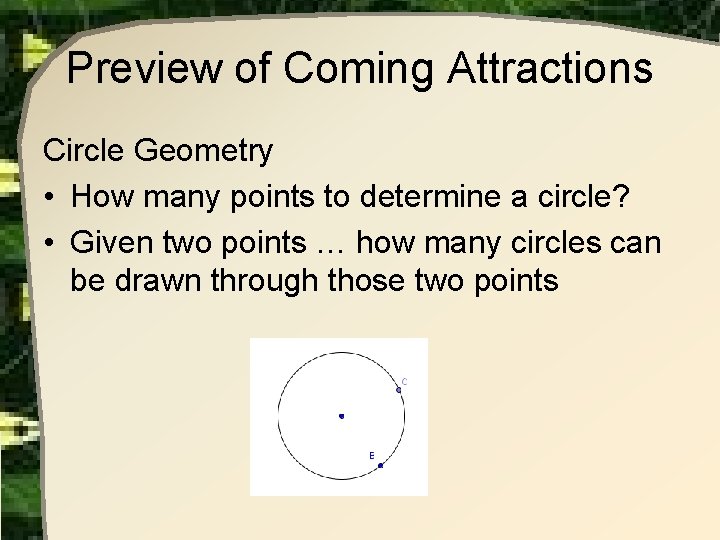
Preview of Coming Attractions Circle Geometry • How many points to determine a circle? • Given two points … how many circles can be drawn through those two points
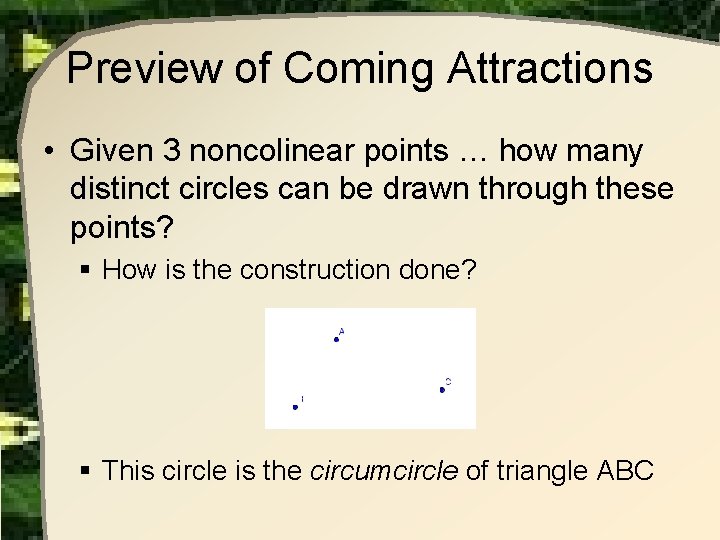
Preview of Coming Attractions • Given 3 noncolinear points … how many distinct circles can be drawn through these points? § How is the construction done? § This circle is the circumcircle of triangle ABC
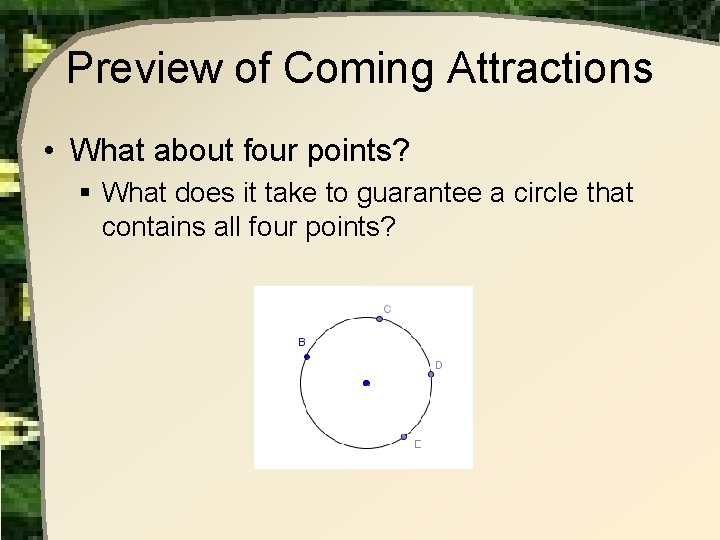
Preview of Coming Attractions • What about four points? § What does it take to guarantee a circle that contains all four points?
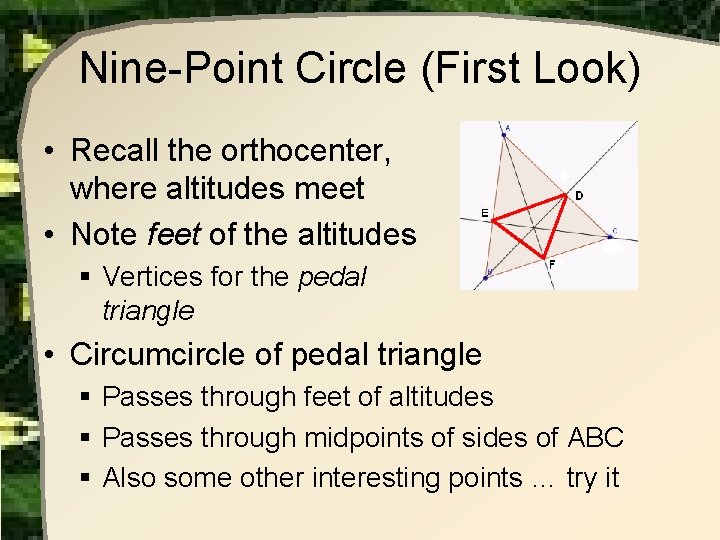
Nine-Point Circle (First Look) • Recall the orthocenter, where altitudes meet • Note feet of the altitudes § Vertices for the pedal triangle • Circumcircle of pedal triangle § Passes through feet of altitudes § Passes through midpoints of sides of ABC § Also some other interesting points … try it
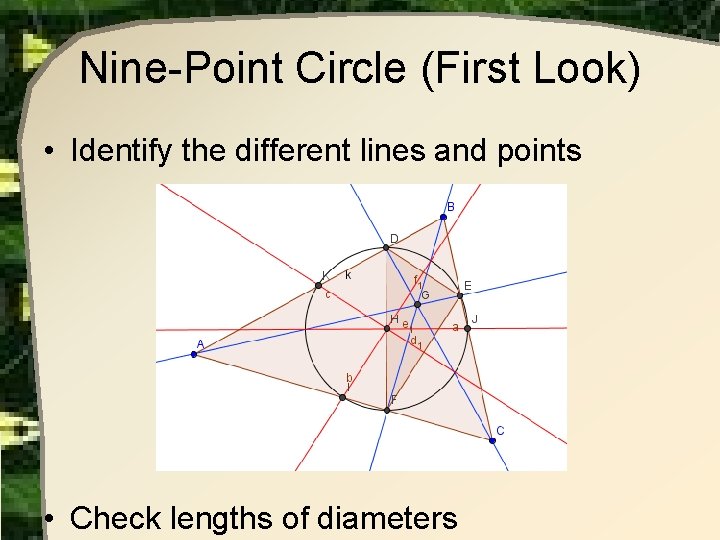
Nine-Point Circle (First Look) • Identify the different lines and points • Check lengths of diameters
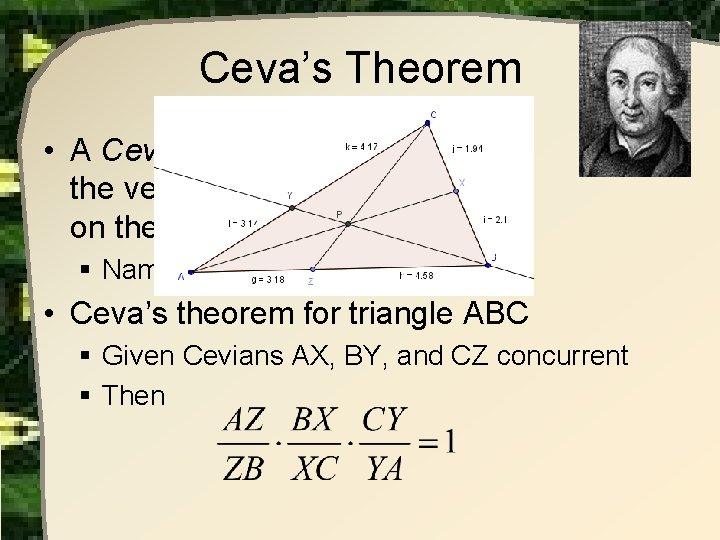
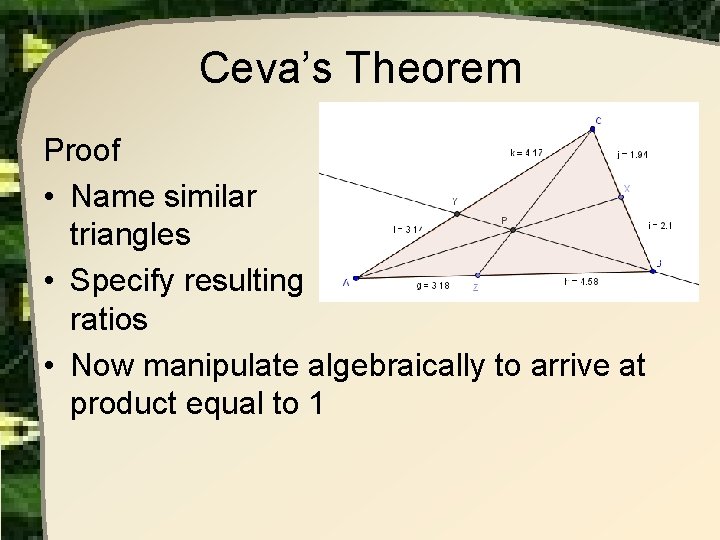
Ceva’s Theorem • A Cevian is a line segment from the vertex of a triangle to a point on the opposite side § Name examples of Cevians • Ceva’s theorem for triangle ABC § Given Cevians AX, BY, and CZ concurrent § Then
Ceva’s Theorem Proof • Name similar triangles • Specify resulting ratios • Now manipulate algebraically to arrive at product equal to 1
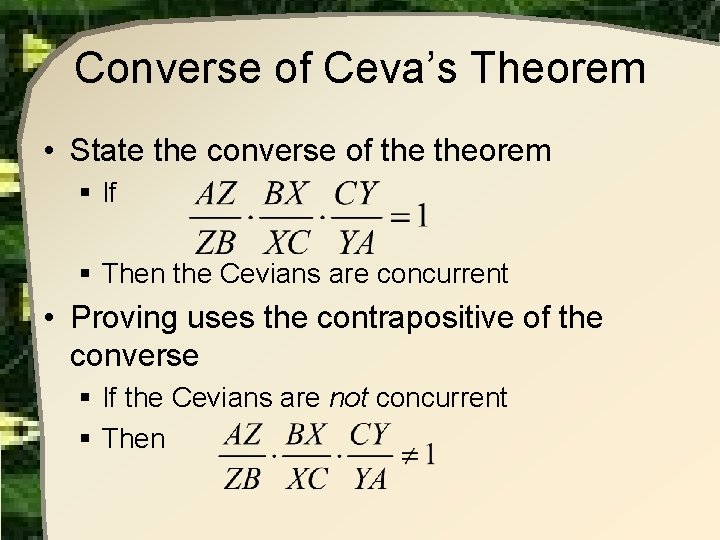
Converse of Ceva’s Theorem • State the converse of theorem § If § Then the Cevians are concurrent • Proving uses the contrapositive of the converse § If the Cevians are not concurrent § Then
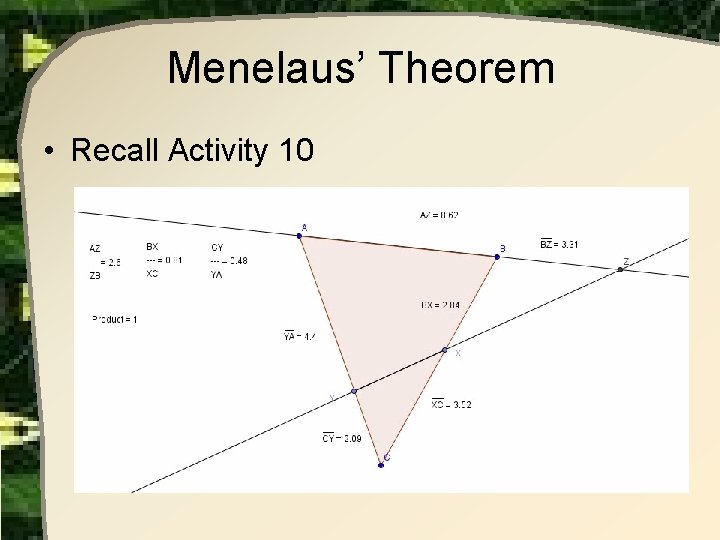
Menelaus’ Theorem • Recall Activity 10
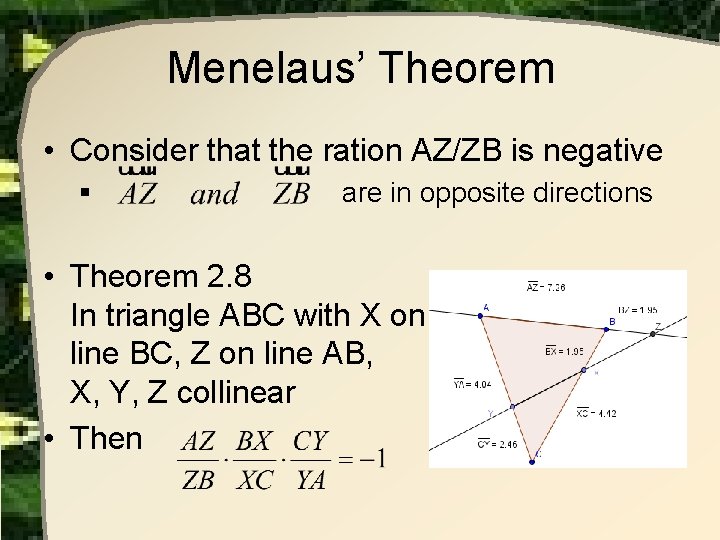
Menelaus’ Theorem • Consider that the ration AZ/ZB is negative § are in opposite directions • Theorem 2. 8 In triangle ABC with X on line BC, Z on line AB, X, Y, Z collinear • Then
Mathematical Arguments and Triangle Geometry Chapter 2