
MathEEB 589 Mathematics of Machine Learning Methods in
Math/EEB 589 - Mathematics of Machine Learning Methods in Ecology and Environmental Science Unsupervised learning methods: Multidimensional Scaling example and Clustering The objective of multidimensional scaling (MDS) is to represent measurements of similarity or dissimilarity between pairs of objects as distances between points in a lowdimensional space. So here you compute distances between points in a high dimensional space and attempt to find an arrangement of the objects in a lower dimensional space so that their distances approximate as close as possible the original distances. Here let X be an N x p data matrix (N observations on p variables) from which a dissimilarity matrix D is calculated. If interested in the observations, D is an N x N matrix and if interested in the variables it is a p x p matrix.
Unsupervised Learning Methods: Principal Coordinates Analysis PCA and FA are used for quantitative multivariate data and the objective is to preserve Euclidean distances between the observations. There are cases of data for which other distance metrics make more sense, for example in which the data are presence/absence matrices in which each row is a site or sample and the columns correspond to a species or taxon, and the matrix values are binary – 1 if present and 0 if not present. For these cases one approach for reducing the complexity of the data is Principal Coordinates Analysis (PCo. A). PCA is actually a special case of PCo. A when the data matrix corresponds to Euclidean distances. PCo. A is also called metric multidimensional scaling.
Unsupervised Learning Methods: Multidimensional scaling The matrix D={dij} has elements that are dissimilarities between observations i and j that satisfy: (i) a non-negativity property so that dij ≥ 0 for all i and j with dii = 0 and (ii) a symmetry property so that dij = dji for all i and j. If the dij satisfy the triangle inequality dij ≤ dik + dkj for any k then it is a proper distance metric and the method is called Metric Multidimensional Scaling (MMDS). If the triangle inequality is not satisfied, the method is called Non-Metric Multidimensional Scaling(NMMDS). PCo. A is MMDS. The objective is to approximate the dissimilarities calculated from the data in p dimensional space by Euclidean distances calculated in q << p dimensional space and q is typically chosen to be 2 or 3.
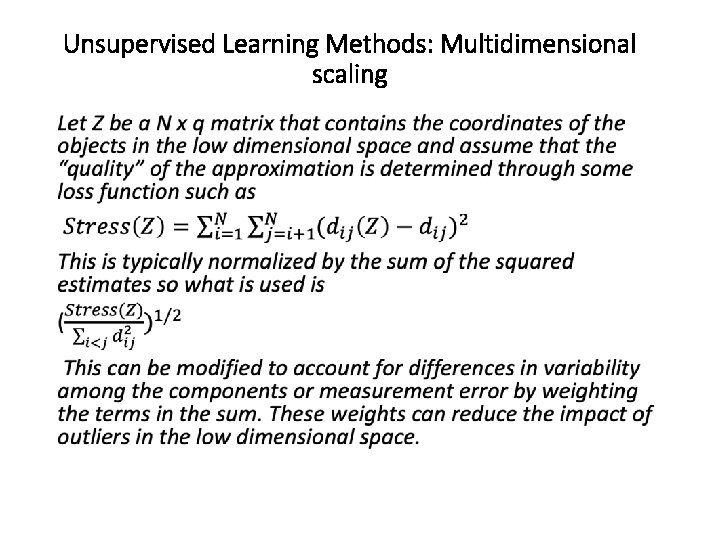
Unsupervised Learning Methods: Multidimensional scaling
Unsupervised Learning Methods: Multidimensional scaling The solution process involves some iterative method to reposition the objects in the lower dimensional space (e. g. perturb their locations a bit), recalculate the stress and continue to iterate until the stress does not become smaller. A typical method would include a linear regression step in this process to regress the lower dimensional dissimilarities against those in the data and use this to get a linear estimator in the lower dimensional space and the stress is then calculated using the observed and regressed estimates in the lower dimensional space. NMMDS goal is to place objects that are very different far apart in the low dimensional space while similar objects are placed close with only the rank ordering of the original dissimilarities preserved. The other ordination methods attempt to preserve the original distances.
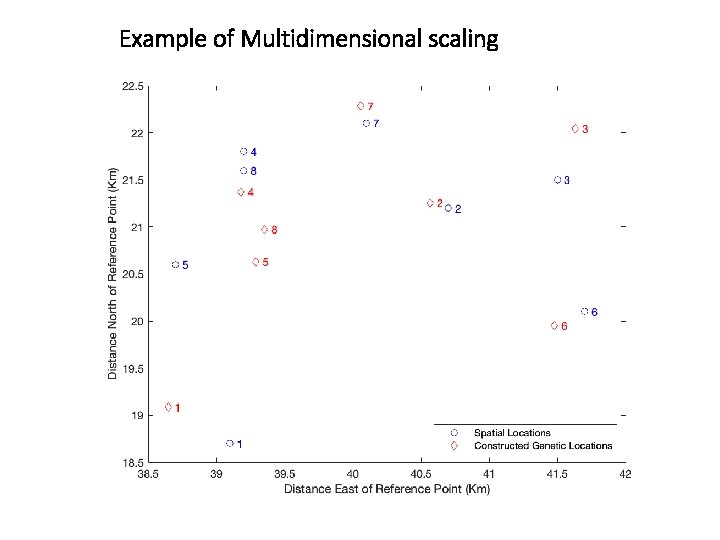
Example of Multidimensional scaling Principal Coordinates Analysis (PCo. A) is also called multidimensional scaling, takes a matrix of interpoint distances, and creates a configuration of points. Ideally, those points can be constructed in two or three dimensions (so this is a dimension reduction method), and the Euclidean distances between them approximately reproduce the original distance matrix. Thus, a scatter plot of those points provides a visual representation of the original distances. A Matlab example illustrates this for the case of genetic “distances” (or dissimilarity) between populations. A genetic distance between two populations is a measures of how different the allele distributions are in samples of individuals taken from the two populations (there are several different ways to calculate this). A standard question in evolutionary biology is whether the genetic distances between populations are related in some way to the physical spatial distances between populations. In this example there are 8 populations with known geographic locations. We want to know how closely their genetic and spatial distances correspond. If they are similar, it provides evidence that how much interbreeding there is between the populations is affected by their geographic locations.
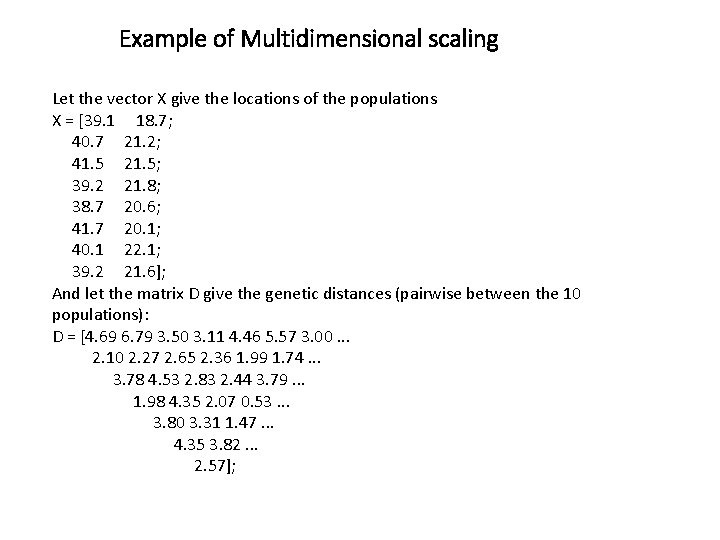
Example of Multidimensional scaling Let the vector X give the locations of the populations X = [39. 1 18. 7; 40. 7 21. 2; 41. 5 21. 5; 39. 2 21. 8; 38. 7 20. 6; 41. 7 20. 1; 40. 1 22. 1; 39. 2 21. 6]; And let the matrix D give the genetic distances (pairwise between the 10 populations): D = [4. 69 6. 79 3. 50 3. 11 4. 46 5. 57 3. 00. . . 2. 10 2. 27 2. 65 2. 36 1. 99 1. 74. . . 3. 78 4. 53 2. 83 2. 44 3. 79. . . 1. 98 4. 35 2. 07 0. 53. . . 3. 80 3. 31 1. 47. . . 4. 35 3. 82. . . 2. 57];
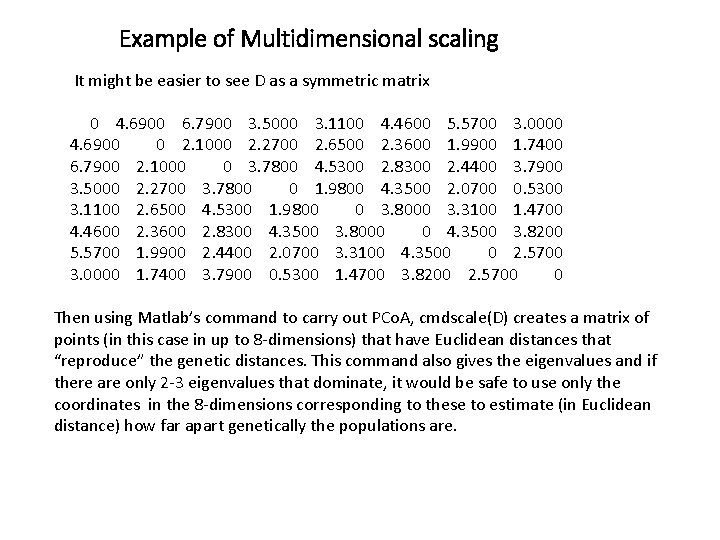
Example of Multidimensional scaling It might be easier to see D as a symmetric matrix 0 4. 6900 6. 7900 3. 5000 3. 1100 4. 4600 5. 5700 3. 0000 4. 6900 0 2. 1000 2. 2700 2. 6500 2. 3600 1. 9900 1. 7400 6. 7900 2. 1000 0 3. 7800 4. 5300 2. 8300 2. 4400 3. 7900 3. 5000 2. 2700 3. 7800 0 1. 9800 4. 3500 2. 0700 0. 5300 3. 1100 2. 6500 4. 5300 1. 9800 0 3. 8000 3. 3100 1. 4700 4. 4600 2. 3600 2. 8300 4. 3500 3. 8000 0 4. 3500 3. 8200 5. 5700 1. 9900 2. 4400 2. 0700 3. 3100 4. 3500 0 2. 5700 3. 0000 1. 7400 3. 7900 0. 5300 1. 4700 3. 8200 2. 5700 0 Then using Matlab’s command to carry out PCo. A, cmdscale(D) creates a matrix of points (in this case in up to 8 -dimensions) that have Euclidean distances that “reproduce” the genetic distances. This command also gives the eigenvalues and if there are only 2 -3 eigenvalues that dominate, it would be safe to use only the coordinates in the 8 -dimensions corresponding to these to estimate (in Euclidean distance) how far apart genetically the populations are.
![Example of Multidimensional scaling [Y, eigvals] = cmdscale(D); [eigvals/max(abs(eigvals))] (which shows the eigenvalues and](http://slidetodoc.com/presentation_image_h2/928b18872ceda8f0b57a8c8db811269b/image-9.jpg "Example of Multidimensional scaling [Y, eigvals] = cmdscale(D); [eigvals/max(abs(eigvals))] (which shows the eigenvalues and")
Example of Multidimensional scaling [Y, eigvals] = cmdscale(D); [eigvals/max(abs(eigvals))] (which shows the eigenvalues and relative magnitudes) 29. 0371 1. 0000 13. 5746 0. 4675 2. 0987 0. 0723 0. 7418 0. 0255 0. 3403 0. 0117 0. 0000 -0. 4542 -0. 0156 -3. 1755 -0. 1094 Here the 0 eigenvalue and the negative ones indicate that the genetics distances are not completely Euclidean but there are clearly two very dominant eigenvalues so it is reasonable to use only two dimensions and the coordinates corresponding to these dominant eigenvalues will be used to plot the points.
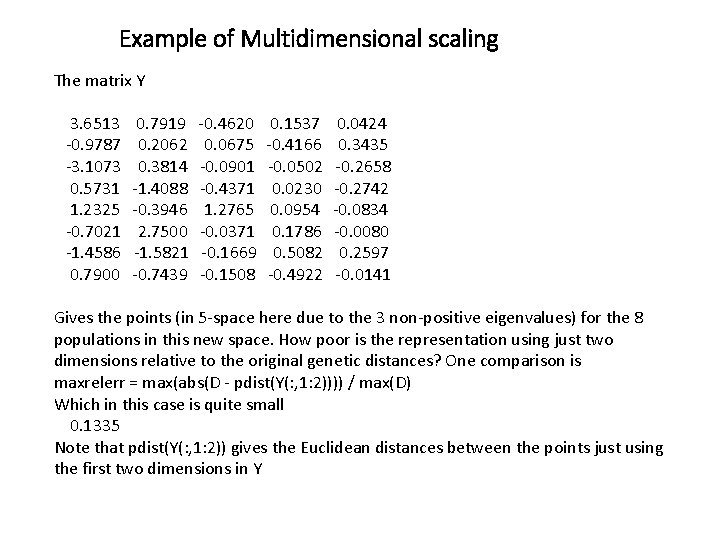
Example of Multidimensional scaling The matrix Y 3. 6513 -0. 9787 -3. 1073 0. 5731 1. 2325 -0. 7021 -1. 4586 0. 7900 0. 7919 0. 2062 0. 3814 -1. 4088 -0. 3946 2. 7500 -1. 5821 -0. 7439 -0. 4620 0. 0675 -0. 0901 -0. 4371 1. 2765 -0. 0371 -0. 1669 -0. 1508 0. 1537 -0. 4166 -0. 0502 0. 0230 0. 0954 0. 1786 0. 5082 -0. 4922 0. 0424 0. 3435 -0. 2658 -0. 2742 -0. 0834 -0. 0080 0. 2597 -0. 0141 Gives the points (in 5 -space here due to the 3 non-positive eigenvalues) for the 8 populations in this new space. How poor is the representation using just two dimensions relative to the original genetic distances? One comparison is maxrelerr = max(abs(D - pdist(Y(: , 1: 2)))) / max(D) Which in this case is quite small 0. 1335 Note that pdist(Y(: , 1: 2)) gives the Euclidean distances between the points just using the first two dimensions in Y
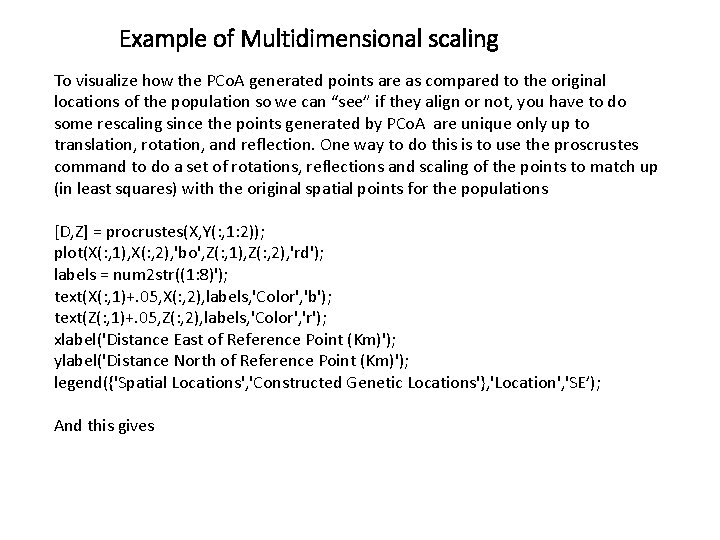
Example of Multidimensional scaling To visualize how the PCo. A generated points are as compared to the original locations of the population so we can “see” if they align or not, you have to do some rescaling since the points generated by PCo. A are unique only up to translation, rotation, and reflection. One way to do this is to use the proscrustes command to do a set of rotations, reflections and scaling of the points to match up (in least squares) with the original spatial points for the populations [D, Z] = procrustes(X, Y(: , 1: 2)); plot(X(: , 1), X(: , 2), 'bo', Z(: , 1), Z(: , 2), 'rd'); labels = num 2 str((1: 8)'); text(X(: , 1)+. 05, X(: , 2), labels, 'Color', 'b'); text(Z(: , 1)+. 05, Z(: , 2), labels, 'Color', 'r'); xlabel('Distance East of Reference Point (Km)'); ylabel('Distance North of Reference Point (Km)'); legend({'Spatial Locations', 'Constructed Genetic Locations'}, 'Location', 'SE’); And this gives
Example of Multidimensional scaling
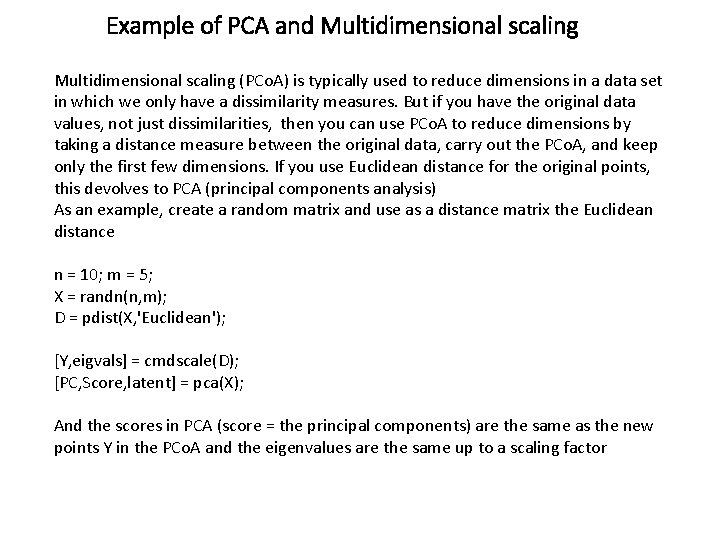
Example of PCA and Multidimensional scaling (PCo. A) is typically used to reduce dimensions in a data set in which we only have a dissimilarity measures. But if you have the original data values, not just dissimilarities, then you can use PCo. A to reduce dimensions by taking a distance measure between the original data, carry out the PCo. A, and keep only the first few dimensions. If you use Euclidean distance for the original points, this devolves to PCA (principal components analysis) As an example, create a random matrix and use as a distance matrix the Euclidean distance n = 10; m = 5; X = randn(n, m); D = pdist(X, 'Euclidean'); [Y, eigvals] = cmdscale(D); [PC, Score, latent] = pca(X); And the scores in PCA (score = the principal components) are the same as the new points Y in the PCo. A and the eigenvalues are the same up to a scaling factor
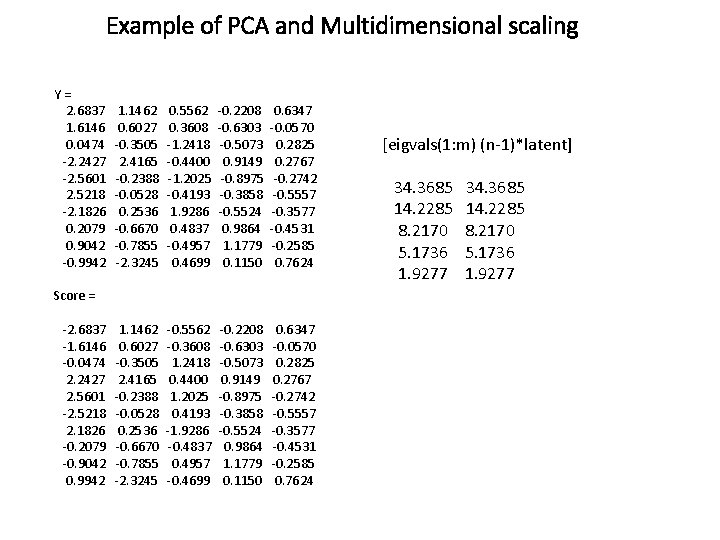
Example of PCA and Multidimensional scaling Y= 2. 6837 1. 6146 0. 0474 -2. 2427 -2. 5601 2. 5218 -2. 1826 0. 2079 0. 9042 -0. 9942 1. 1462 0. 6027 -0. 3505 2. 4165 -0. 2388 -0. 0528 0. 2536 -0. 6670 -0. 7855 -2. 3245 0. 5562 0. 3608 -1. 2418 -0. 4400 -1. 2025 -0. 4193 1. 9286 0. 4837 -0. 4957 0. 4699 -0. 2208 -0. 6303 -0. 5073 0. 9149 -0. 8975 -0. 3858 -0. 5524 0. 9864 1. 1779 0. 1150 0. 6347 -0. 0570 0. 2825 0. 2767 -0. 2742 -0. 5557 -0. 3577 -0. 4531 -0. 2585 0. 7624 1. 1462 0. 6027 -0. 3505 2. 4165 -0. 2388 -0. 0528 0. 2536 -0. 6670 -0. 7855 -2. 3245 -0. 5562 -0. 3608 1. 2418 0. 4400 1. 2025 0. 4193 -1. 9286 -0. 4837 0. 4957 -0. 4699 -0. 2208 -0. 6303 -0. 5073 0. 9149 -0. 8975 -0. 3858 -0. 5524 0. 9864 1. 1779 0. 1150 0. 6347 -0. 0570 0. 2825 0. 2767 -0. 2742 -0. 5557 -0. 3577 -0. 4531 -0. 2585 0. 7624 Score = -2. 6837 -1. 6146 -0. 0474 2. 2427 2. 5601 -2. 5218 2. 1826 -0. 2079 -0. 9042 0. 9942 [eigvals(1: m) (n-1)*latent] 34. 3685 14. 2285 8. 2170 5. 1736 1. 9277
Unsupervised learning: Clustering Cluster analysis takes a set of observations each with a vector variable, segregates these into groups so that members of the same group are as “similar” as possible while those in different groups are as “dissimilar” as possible. Some approaches used in ecology are: agglomerative clustering in which the observations are grouped into successively larger clusters until a single cluster is obtained divisive clustering starts with all the observations in one group and successively splitting them into smaller clusters until each observation is in its own cluster. In both cases, a rule is used to choose the appropriate number of clusters. These are examples of hierarchical clustering in which a hierarchy of clusters is created using a tree
Unsupervised learning: Clustering K-means clustering specifies a number of clusters and then assigns objects to clusters so that all objects within one cluster are closer to each other (so this requires a distance metric) than they are to objects within the other clusters – it minimizes the sums of squares from each object to the centroid of its cluster Gaussian mixture models uses a mixture of multivariate normal density components and views a collections of clusters as the total mixture of these Self-organizing maps use neural networks that learn the topology and distribution of the data
Unsupervised learning: Clustering Formally, there are N objects O = {o 1, o 2, …, o. N} and K subsets of O, C={C 1, …, CK} with input data either a profile data matrix XNxp of real-valued vectors with p measurements on each object or an Nx. N dissimilarity matrix that has the pairwise dissimilarities (often computed from the profile though). Clustering is based on distances between points so need to scale the variables appropriately. Clustering methods may not be robust to scaling changes. An issue is what of the variables in the profile to use for clustering – more variables may not be better. So it might be good to run a PCA first to assess which variables to include.
Unsupervised learning: Clustering There a couple of general forms of clustering algorithms: (i) Partition methods in which a partition of the objects is made so that each object is assigned to exactly one cluster and the clusters do not overlap. Then the partition is made so that distances between pairs of objects in the same cluster are smaller than pairs of objects from different clusters. (ii) Tree-type methods build a tree of clusters that includes all the objects and for which any two clusters are disjoint or one is a superset of the other.
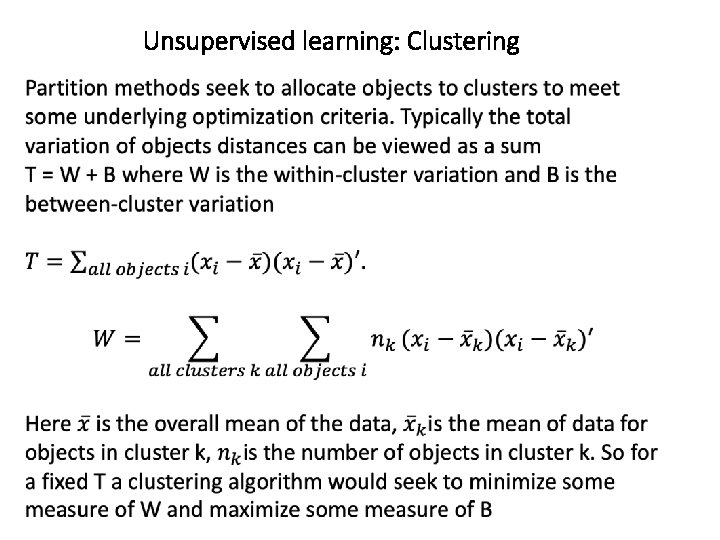
Unsupervised learning: Clustering
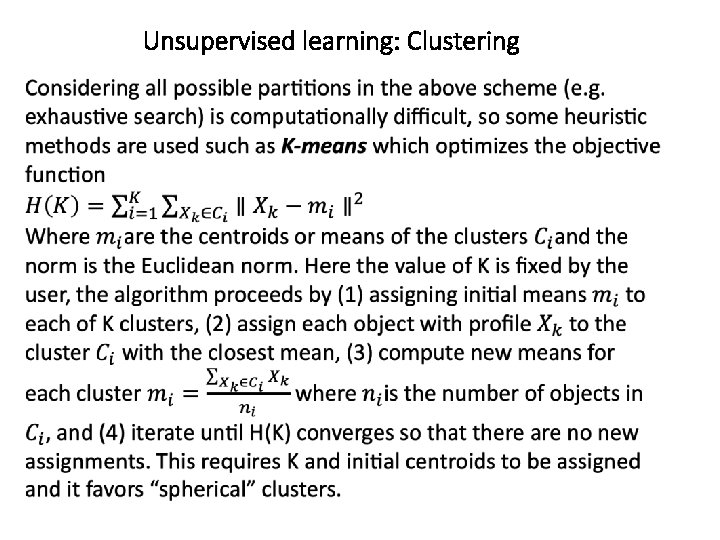
Unsupervised learning: Clustering
Unsupervised learning: Clustering Matlab has a nice example of K-means clustering and hierarchical clustering (e. g. creating a tree hierarchy of clusters, using the Fisher Iris data. Of course in the Iris case there is an independent set of information about what species each measured flower is in. In a sense then, doing clustering and then comparing to the clusters by which the flowers have been assigned as species provides a way to assess whether indeed the measurement data imply that the 3 species classifications are indeed distinct. The example compares the cases of K=2 and K=3 using sepal and petal lengths and widths.
- Slides: 21