
MathEEB 589 Mathematics of Machine Learning Methods in
Math/EEB 589 - Mathematics of Machine Learning Methods in Ecology and Environmental Science - Ecological Forecasting Main classic problems in ecological forecasting: Population sizes/demography: long history in fisheries, wildlife and disease with direct impact on policies for harvest, quotas, vaccination, etc. Standard models are matrix, ODE and statistical time series Environmental processes: biogeochemistry, temperature and precipitation projection on various time and spatial scales. Models link ecological states (e. g. landscape-type) to atmospheric and oceanographic physical models including mechanistic and statistical methods and ecosystem models Distribution and abundance: using environmental variables to project presence/absence and/or abundance. Species Distribution Models (SDM) also called niche models. Landscape/functional group/community: use environmental variables, history and community dynamics models to project what community type and level of biodiversity is present across space
Main classic problems in ecological forecasting: Population sizes/demography: Much of this classically is based on general models (logistic/ two-species ODE/Leslie matrix) to project population growth rate as affected by harvest, changing environment. Recent approaches include integral projection models, as well as integro-difference and integrodifferential models. Much focus has been on endangered species and accounting for uncertainty (e. g. in fecundity and survivorships) impacts on population growth rates and population viability. An additional modeling theme focuses on variability (seasonal/spatially) and impacts on long-term growth and viability. A completely different approach is purely statistical using a time series (ARMA, ARIMA) or Bayesan (including Hierarchical) and there are mixed methods that combine classic population models with statistical ones. Current data challenges are using learning methods to modify any of these models iteratively to improve model projections using future data as a test set.
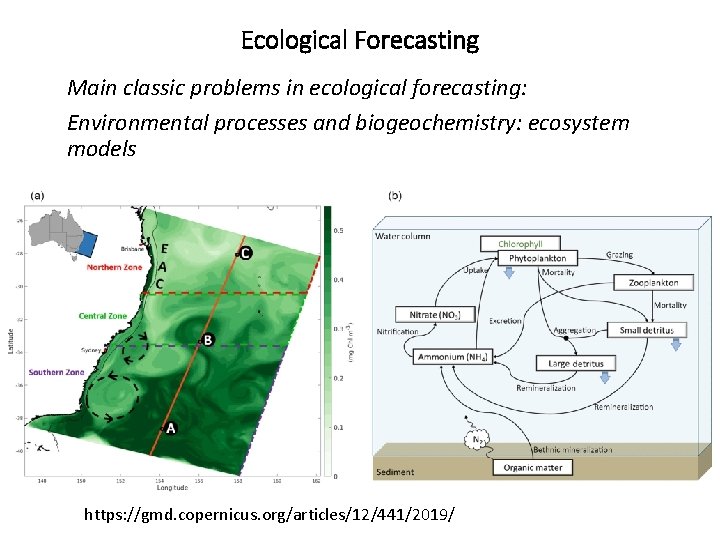
Ecological Forecasting Main classic problems in ecological forecasting: Environmental processes and biogeochemistry: ecosystem models https: //gmd. copernicus. org/articles/12/441/2019/
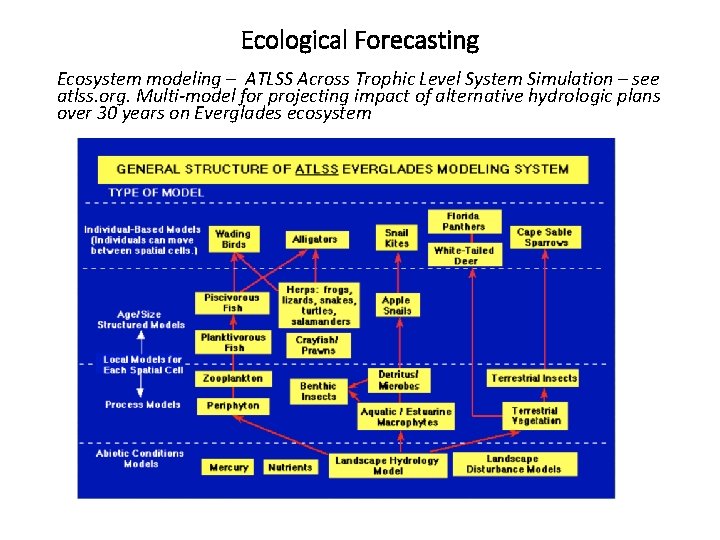
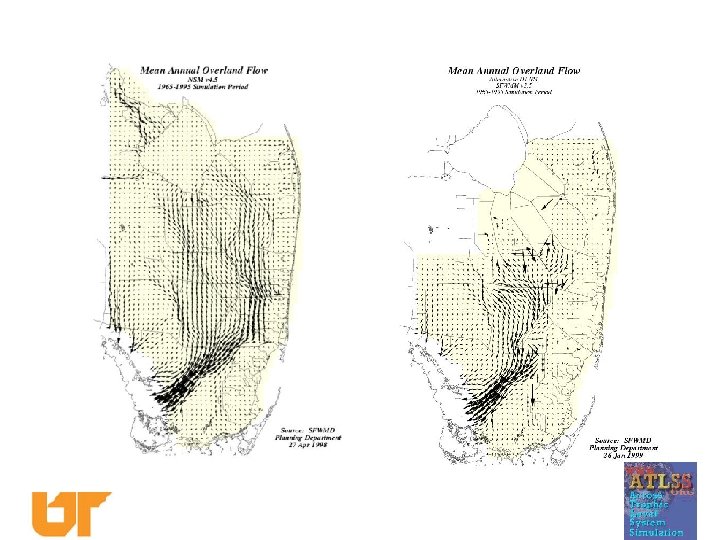
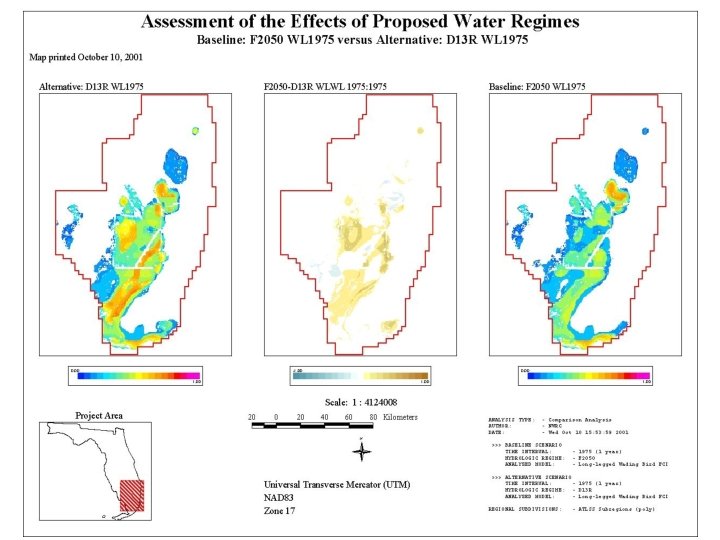
Ecological Forecasting Ecosystem modeling – ATLSS Across Trophic Level System Simulation – see atlss. org. Multi-model for projecting impact of alternative hydrologic plans over 30 years on Everglades ecosystem
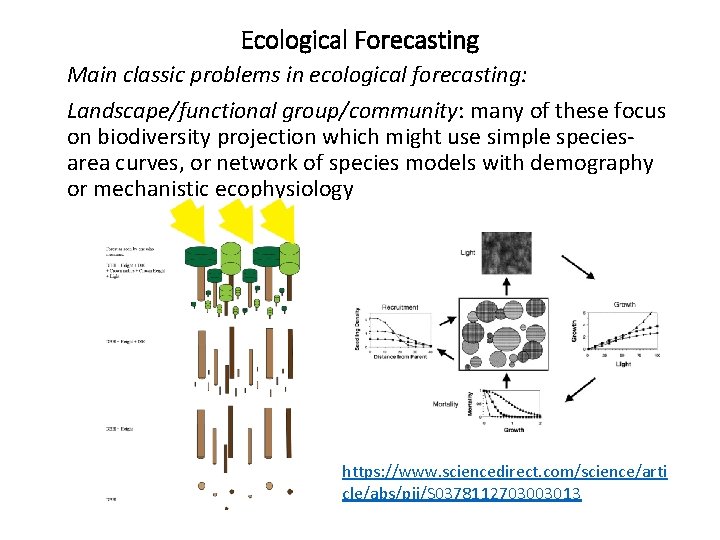
Ecological Forecasting Main classic problems in ecological forecasting: Landscape/functional group/community: many of these focus on biodiversity projection which might use simple speciesarea curves, or network of species models with demography or mechanistic ecophysiology https: //www. sciencedirect. com/science/arti cle/abs/pii/S 0378112703003013

Ecological Forecasting Main classic problems in ecological forecasting: Landscape/functional group/community: Dynamic Global Vegetation Models (DGVM) simulate shifts in potential vegetation and associated biogeochemical and hydrological cycles in response to shifts in climate. DGVMs use time series of climate data, and latitude, topography, and soil characteristics, to simulate monthly or daily dynamics of ecosystem processes. DGVMs are used to simulate the effects of future climate change on natural vegetation and its carbon and water cycles.
Ecological Forecasting Main classic problems in ecological forecasting: Distribution and abundance: using environmental variables to project presence/absence and/or abundance. Species Distribution Models (SDM), climate envelope or niche models. Correlative SDMs (climate envelope models) use statistical correlations between existing species distributions (range boundaries) and environmental variables to outline a range (envelope) of environmental conditions within which a species can exist. New range boundaries are forecast using future levels of environmental factors such as temperature, rainfall, and salinity from climate model projections. Mechanistic SDMs use a species' physiological tolerances and constraints, models of organismal body temperature and other biophysical properties, to define the range of environmental conditions within which a species can exist. These tolerances are mapped onto current and projected environmental conditions in the landscape to outline current and forecasted ranges for the species.
Ecological Forecasting SDM process in general using presence-only or abundance data: (1) compile the locations of the presence of the species; (2) from databases obtain values of environmental variables (precipitation, temperature, etc. ) for the compiled locations; (3) fit a model for these environmental variables to estimate the relationship between sites of occurrence or species richness; (4) apply the models to predict the variable of interest across the space or time of interest : For an example of one of the earliest applications of distributed computing using SDMs – see lifemapper. org which originally used a downloaded screensaver to compute GARP models for species distributions.
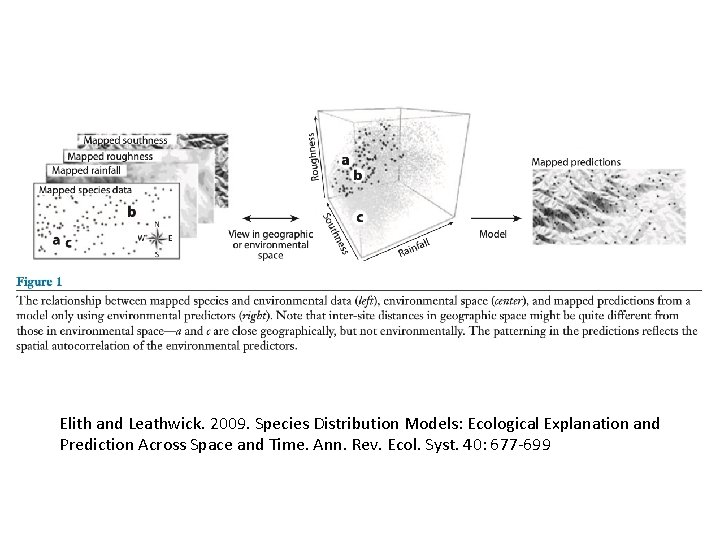
Elith and Leathwick. 2009. Species Distribution Models: Ecological Explanation and Prediction Across Space and Time. Ann. Rev. Ecol. Syst. 40: 677 -699
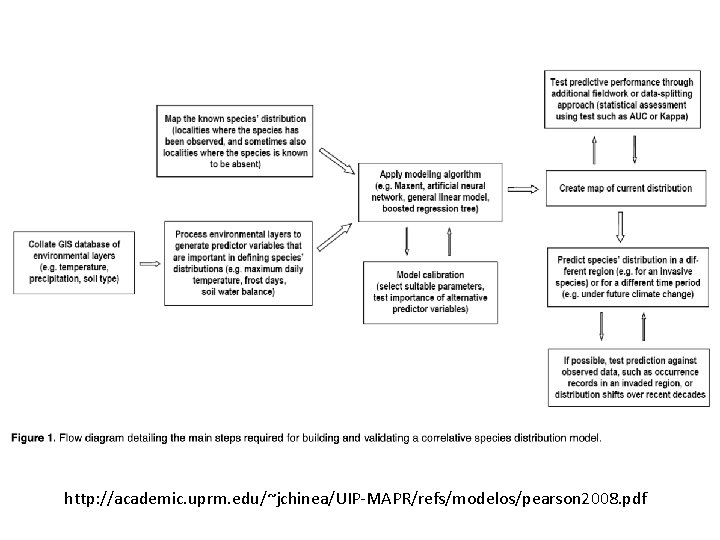
http: //academic. uprm. edu/~jchinea/UIP-MAPR/refs/modelos/pearson 2008. pdf
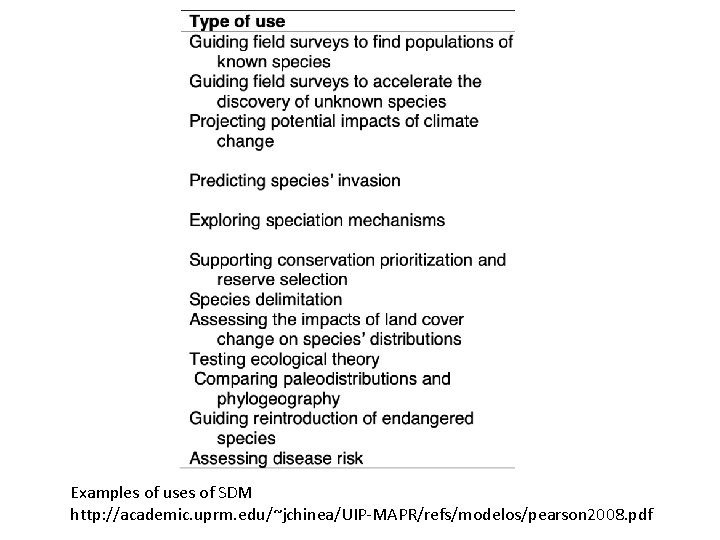
Examples of uses of SDM http: //academic. uprm. edu/~jchinea/UIP-MAPR/refs/modelos/pearson 2008. pdf
Ecological Forecasting Some methods for Correlative SDM: GARP, GAM, GLM and Max. Ent are some methods as well as taking a weighted mean of several different models. Several of these are used just with presence data. GARP: Genetic Algorithm Rule-Set Production - GARP includes multiple, non-deterministic iterative procedures that incorporate various model distribution methods such as logistic regression and range envelopes, producing with each run predicted binary maps of presences and absences. Multiple optimal models are produced for each data set, which can be converted into presence likelihoods. Max. Ent: Max. Ent finds the maximum entropy probability distribution that agrees with the provided presence data based on environmental data
Ecological Forecasting
Ecological Forecasting Some methods for Correlative SDM: CART: Classification and Regression Trees - generates binary trees iteratively, searching for the optimal cutoff values among all of the independent variables to obtain an optimal set of binary divisions, so as to minimize the variance within each node and maximize it between different nodes and the algorithm then prunes the tree to avoid overfitting of the data. Depending on the kind of dependent variable there can be two types of trees: regression (continuous dependent variable) and classification (discrete variable). MARS: Multivariate Adaptive Regression Splines - the models are weighted sums of a set of basic functions that are constants, “hinge” functions that are max(0, x- constant) or max(0, constant – x), or a product of hinge functions.
Ecological Forecasting Some methods for Correlative SDM: Max. Ent: develops a statistical model that maximizes the entropy (an information measure) of the model so the modeled expected value of each independent variable must match its empirical average from the data. Max. Ent obtains the maximum entropy probability of the distribution. Max. Ent is based on the following: (a) the presence of a species is represented by a likelihood function P on a set x of points in the study zone. P gives a positive value x everywhere so that the sum of P(x) is unity; (b) building a model of P with a group of constraints obtained from the empirical data of presence; (c) the restrictions are expressed as a simple function of known environmental variables, f(v); (d) the average forces of each function of each variable are close to the actual average of the variable zones of presence; (e) of the possible options available, a specific combination of features is selected to minimize the entropy function (measured by the Shannon index).
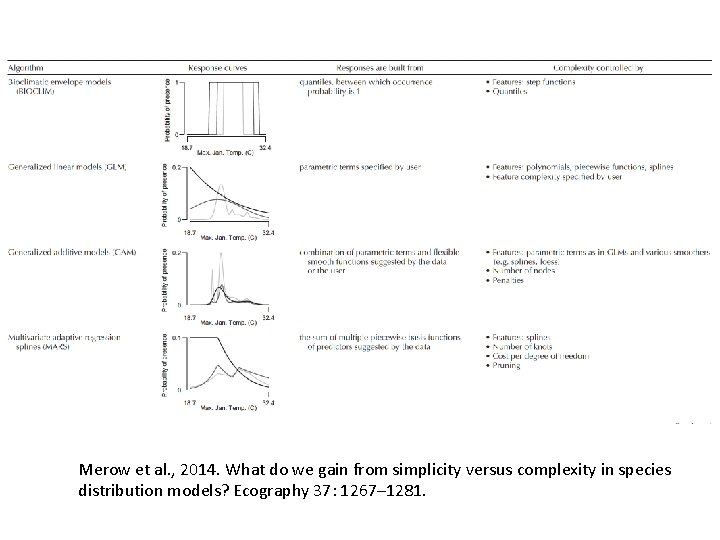
Merow et al. , 2014. What do we gain from simplicity versus complexity in species distribution models? Ecography 37: 1267– 1281.
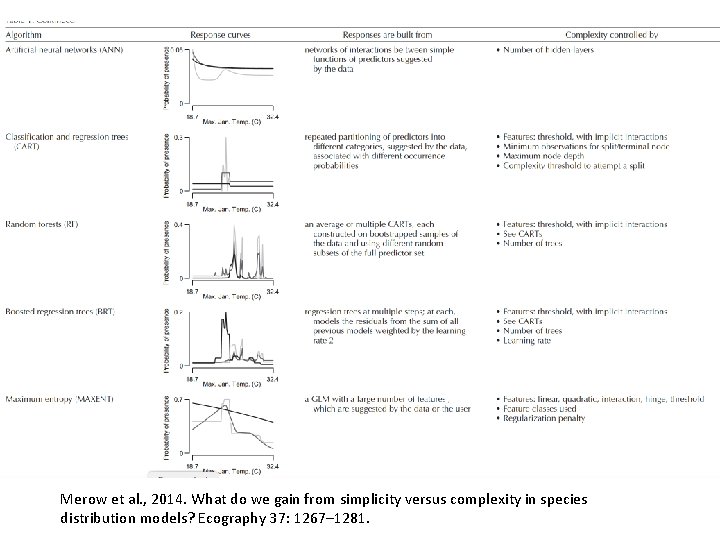
Merow et al. , 2014. What do we gain from simplicity versus complexity in species distribution models? Ecography 37: 1267– 1281.
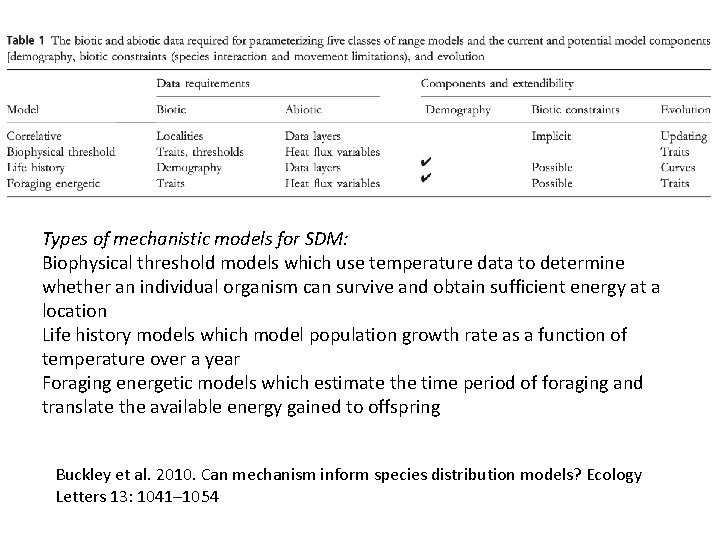
Types of mechanistic models for SDM: Biophysical threshold models which use temperature data to determine whether an individual organism can survive and obtain sufficient energy at a location Life history models which model population growth rate as a function of temperature over a year Foraging energetic models which estimate the time period of foraging and translate the available energy gained to offspring Buckley et al. 2010. Can mechanism inform species distribution models? Ecology Letters 13: 1041– 1054
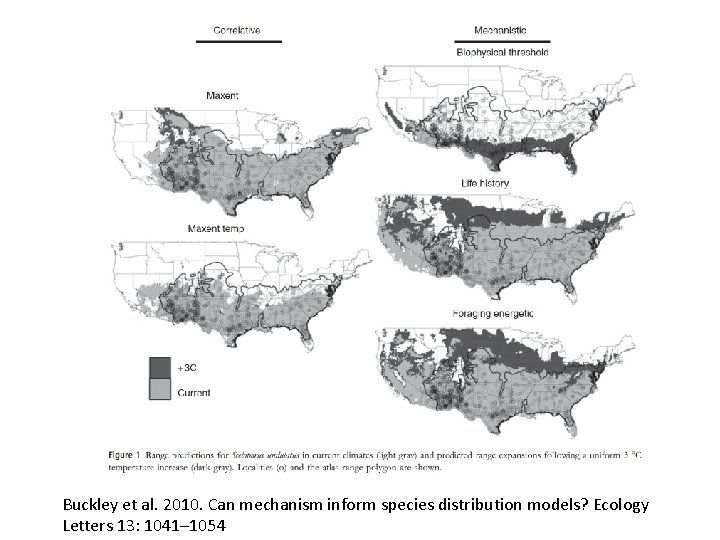
Buckley et al. 2010. Can mechanism inform species distribution models? Ecology Letters 13: 1041– 1054
- Slides: 21