
MATHCOUNTS Class Counting Probability Reagan Choi Part 1
MATHCOUNTS Class Counting & Probability Reagan Choi

Part 1: Basic Techniques
Basic Counting Jake has six red shirts and four pairs of jeans. How many ways can he choose an outfit to wear? Jake gets four blue shirts in addition to what he had before. Now, how many ways can Jake choose an outfit to wear?
Permutations and Combinations Ten people are in a club. In how many ways can they stand in a line? Ten people are in a club. In how many ways can we choose one president, one vice-president, and one secretary, if nobody is allowed to have more than one role? Ten people are in a club. In how many ways can we choose exactly three people to go on a committee?
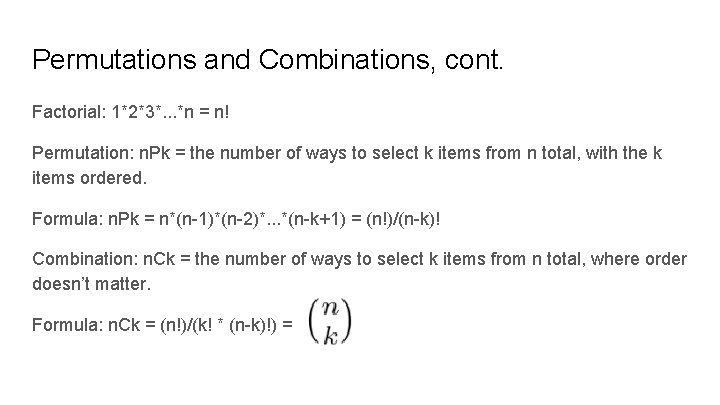
Permutations and Combinations, cont. Factorial: 1*2*3*. . . *n = n! Permutation: n. Pk = the number of ways to select k items from n total, with the k items ordered. Formula: n. Pk = n*(n-1)*(n-2)*. . . *(n-k+1) = (n!)/(n-k)! Combination: n. Ck = the number of ways to select k items from n total, where order doesn’t matter. Formula: n. Ck = (n!)/(k! * (n-k)!) =
Casework How many three-digit numbers satisfy the property that the middle digit is the average of the first and the last digits?
Complementary Counting How many positive 4 -digit numbers contain the digit 6 or the digit 7?
Exercises How many ways are there to select five distinct one-digit positive integers such that at least two of the integers have a difference of 1?
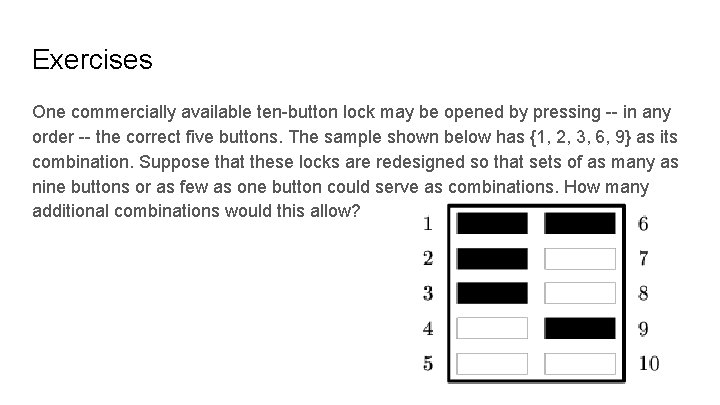
Exercises One commercially available ten-button lock may be opened by pressing -- in any order -- the correct five buttons. The sample shown below has {1, 2, 3, 6, 9} as its combination. Suppose that these locks are redesigned so that sets of as many as nine buttons or as few as one button could serve as combinations. How many additional combinations would this allow?

Part 2: Techniques
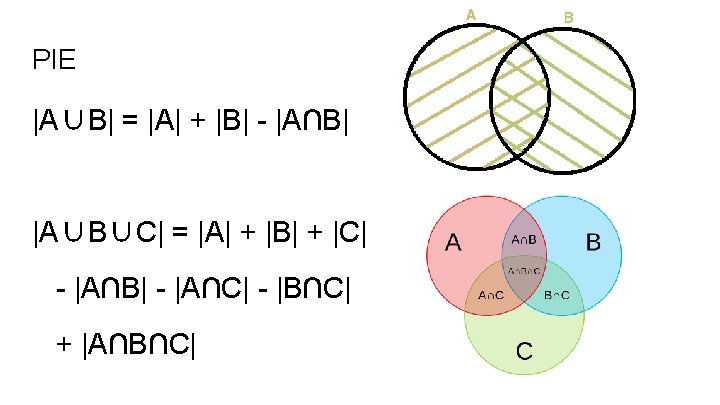
Example There are 300 people at my high school that attend some random high school, and everyone is in either Math Club, Drama Club, or Book Club. If there are 156 people in Math Club, 126 people in Drama Club, 106 people in Book Club, 44 people in both Math Club and Drama Club, 31 people in both Math Club and Book Club, and 33 people in both Drama Club and Book Club. How many people attend all three clubs?
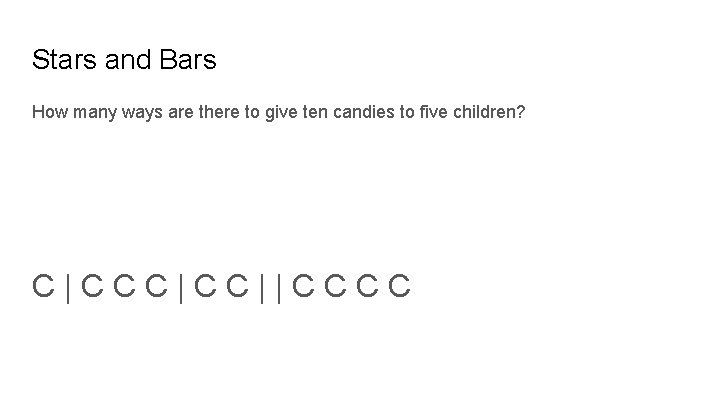
Stars and Bars How many ways are there to give ten candies to five children? C|CC||CCCC
Example How many ordered quintuples of positive integers, (a, b, c, d, e), satisfy a*b*c*d*e=4096?
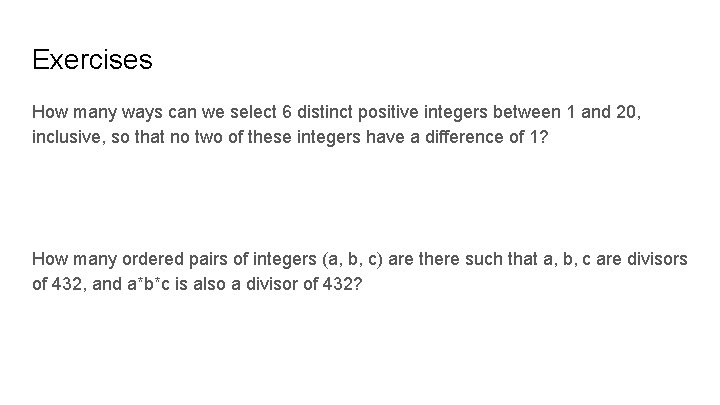
Exercises How many ways can we select 6 distinct positive integers between 1 and 20, inclusive, so that no two of these integers have a difference of 1? How many ordered pairs of integers (a, b, c) are there such that a, b, c are divisors of 432, and a*b*c is also a divisor of 432?
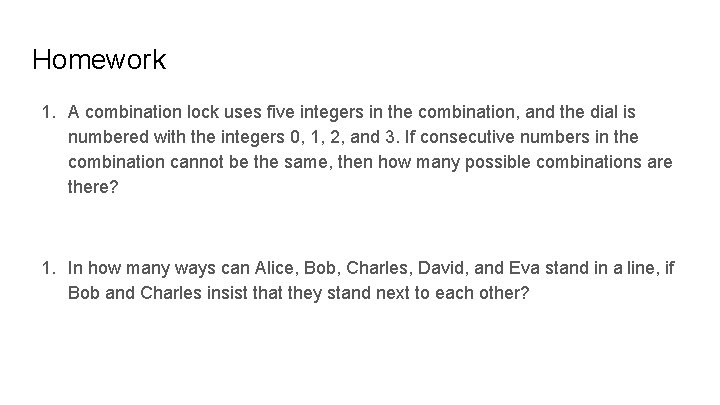
Homework 1. A combination lock uses five integers in the combination, and the dial is numbered with the integers 0, 1, 2, and 3. If consecutive numbers in the combination cannot be the same, then how many possible combinations are there? 1. In how many ways can Alice, Bob, Charles, David, and Eva stand in a line, if Bob and Charles insist that they stand next to each other?
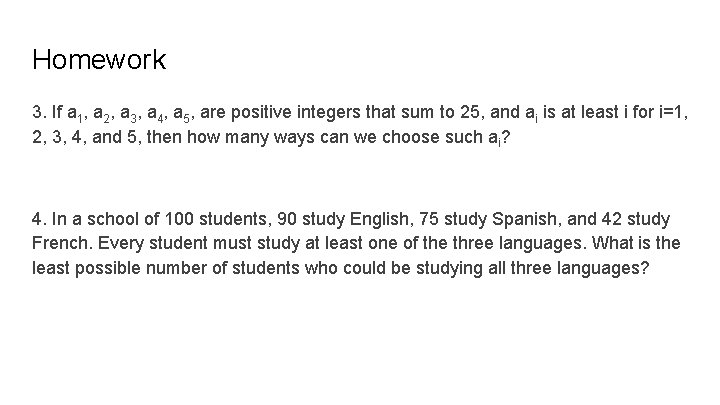
Homework 3. If a 1, a 2, a 3, a 4, a 5, are positive integers that sum to 25, and ai is at least i for i=1, 2, 3, 4, and 5, then how many ways can we choose such ai? 4. In a school of 100 students, 90 study English, 75 study Spanish, and 42 study French. Every student must study at least one of the three languages. What is the least possible number of students who could be studying all three languages?
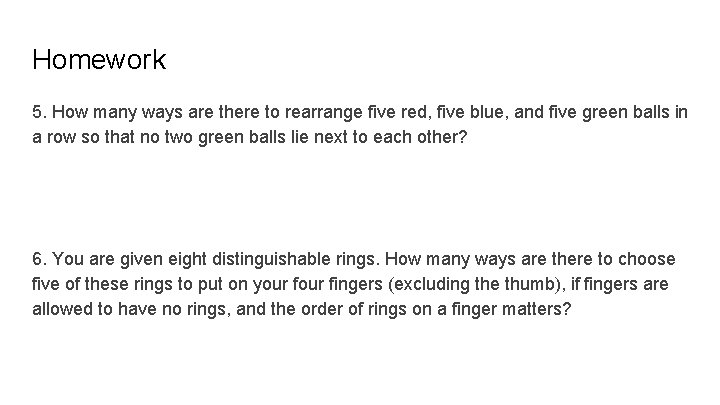
Homework 5. How many ways are there to rearrange five red, five blue, and five green balls in a row so that no two green balls lie next to each other? 6. You are given eight distinguishable rings. How many ways are there to choose five of these rings to put on your fingers (excluding the thumb), if fingers are allowed to have no rings, and the order of rings on a finger matters?
Homework 7. A positive integer abcd (a, b, c, d are digits) is called “snakelike” if the inequalities a<b, b>c, c<d are true. How many snakelike positive integers between 1000 and 9999 have four distinct digits?
Part 3: Probability
Probability Basics Probability = (# valid cases) / (# total cases). Probabilities of independent events can be multiplied, just like with counting. Example: Two fair dice are rolled. What is the probability that both of them land on 1?
Probability Basics cont. Many probability problems are simply counting problems. As a result, many of the basic counting principles apply. Examples: A random positive integer from 1 to 10000 is chosen. What is the probability that the number does not contain the digit 5? Five coins are flipped. What is the probability that exactly five of them land heads?
Conditional Probability P(B|A) = P(A∩B) / P(A). Conditional probability can be confusing and unintuitive sometimes! Make sure not to make assumptions, even if they seem “obvious”, and instead use the formula above. The following four well-known examples help show unintuitive conditional probability can be. (Most problems are not as unintuitive as these. ) In a game show, there are three doors; behind two of them are goats, and behind one is a car. The contestant chooses one door; then, the host opens one of the other two doors, revealing a goat. Then, the host offers the choice to switch or to stay. What are the probabilities of picking the car if you switch or stay?
Examples A family has two children. The oldest child is a girl. What is the probability that the other child is a boy? A family has two children. One of the children is a girl born on a Wednesday. What is the probability that the other child is a boy?
Geometric Probability Consider the formula: Probability = (# valid cases) / (# total cases). Sometimes, both of these are infinity, in which case we can’t define probability like this. In these cases, we can use geometric probability. Two people plan to meet at a park sometime between 10 and 11 am; however, they have not communicated which exact time. They both arrive at a uniformly random time between 10 and 11 am, and they will wait for 15 minutes for the other person before leaving. What is the probability that they meet?
Examples Three numbers are chosen uniformly at random on the interval [0, 1]. What is the probability that their sum is less than 0. 5? Two numbers are chosen uniformly at random on the interval [-1, 1]. What is the probability that the absolute value of the smaller number is greater than twice the absolute value of the larger number?
Probability Problems Seven sticks with lengths 2, 3, 5, 7, 11, 13, 17 are placed in a box. Three of these sticks are chosen randomly. What is the probability that the three sticks can form a non-degenerate triangle? Juan, Carlos, and Manu take turns flipping a coin in that order (cycling around if necessary). The first person to flip heads wins. What is the probability that Carlos wins?
Part 4: Binomial Coefficients
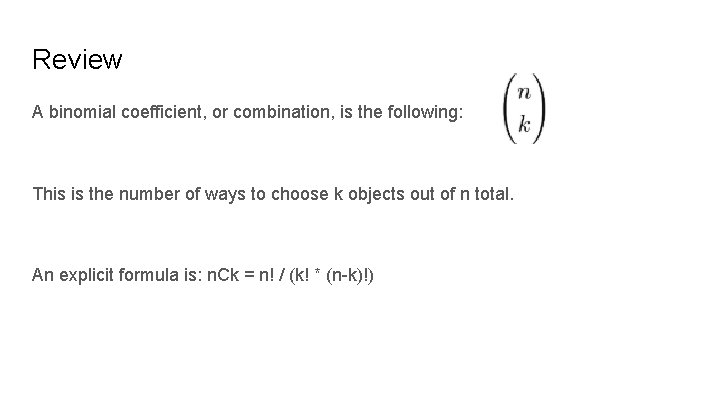
Review A binomial coefficient, or combination, is the following: This is the number of ways to choose k objects out of n total. An explicit formula is: n. Ck = n! / (k! * (n-k)!)
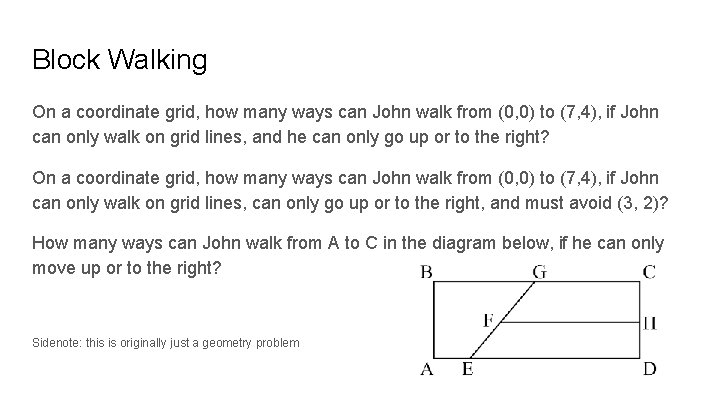
Block Walking On a coordinate grid, how many ways can John walk from (0, 0) to (7, 4), if John can only walk on grid lines, and he can only go up or to the right? On a coordinate grid, how many ways can John walk from (0, 0) to (7, 4), if John can only walk on grid lines, can only go up or to the right, and must avoid (3, 2)? How many ways can John walk from A to C in the diagram below, if he can only move up or to the right? Sidenote: this is originally just a geometry problem
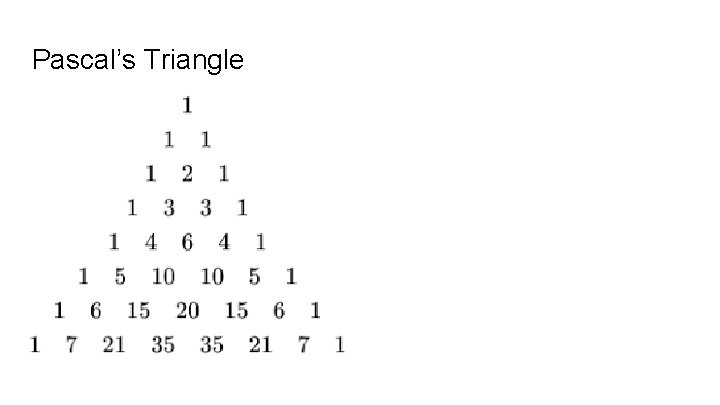
Pascal’s Triangle
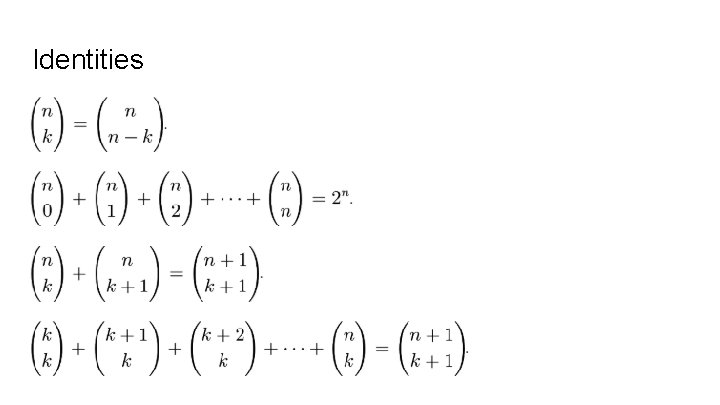
Identities
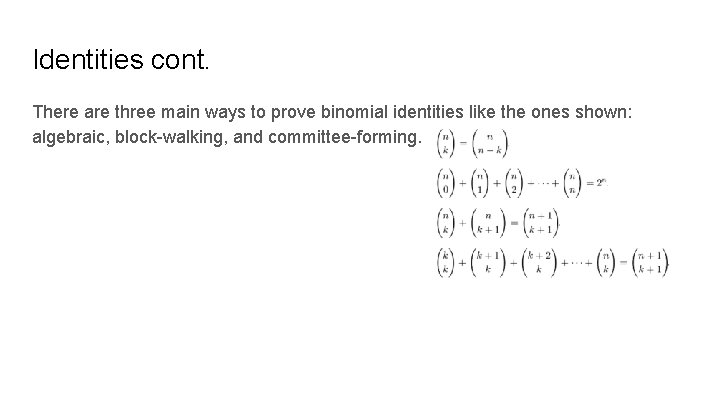
Identities cont. There are three main ways to prove binomial identities like the ones shown: algebraic, block-walking, and committee-forming.
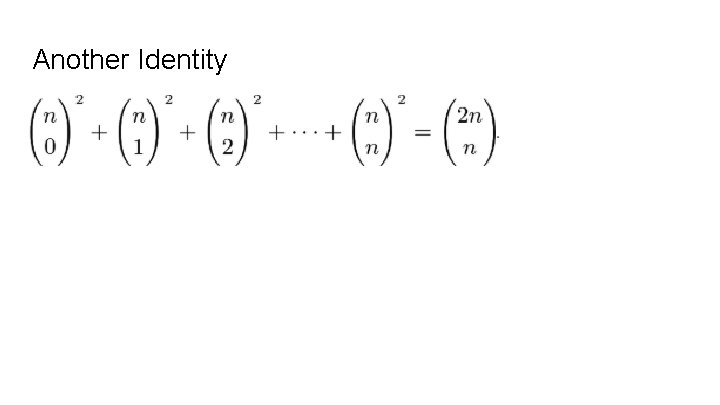
Another Identity
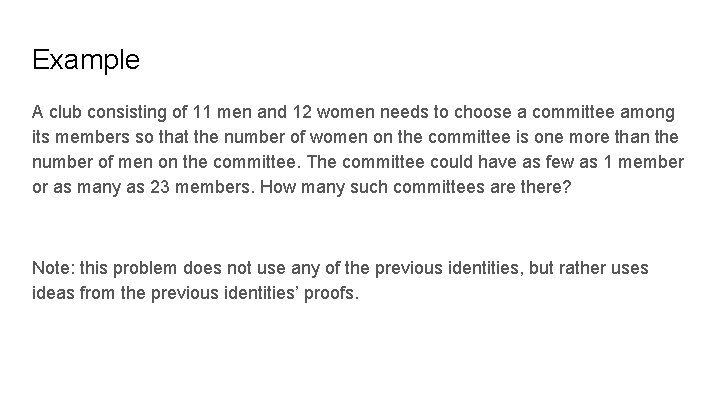
Example A club consisting of 11 men and 12 women needs to choose a committee among its members so that the number of women on the committee is one more than the number of men on the committee. The committee could have as few as 1 member or as many as 23 members. How many such committees are there? Note: this problem does not use any of the previous identities, but rather uses ideas from the previous identities’ proofs.
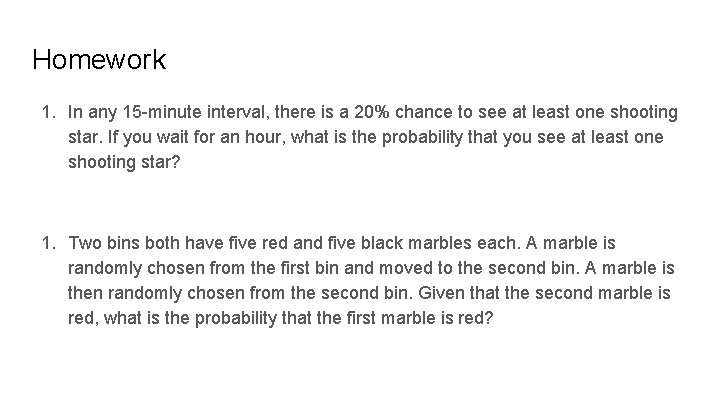
Homework 1. In any 15 -minute interval, there is a 20% chance to see at least one shooting star. If you wait for an hour, what is the probability that you see at least one shooting star? 1. Two bins both have five red and five black marbles each. A marble is randomly chosen from the first bin and moved to the second bin. A marble is then randomly chosen from the second bin. Given that the second marble is red, what is the probability that the first marble is red?
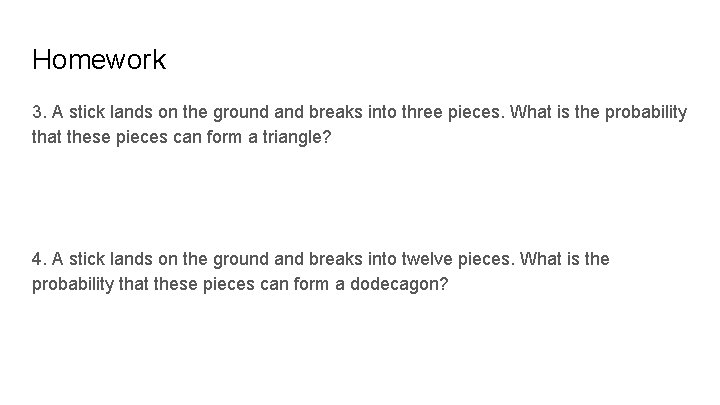
Homework 3. A stick lands on the ground and breaks into three pieces. What is the probability that these pieces can form a triangle? 4. A stick lands on the ground and breaks into twelve pieces. What is the probability that these pieces can form a dodecagon?
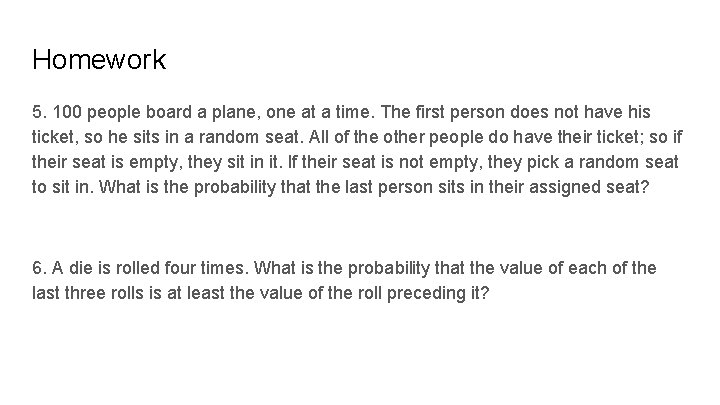
Homework 5. 100 people board a plane, one at a time. The first person does not have his ticket, so he sits in a random seat. All of the other people do have their ticket; so if their seat is empty, they sit in it. If their seat is not empty, they pick a random seat to sit in. What is the probability that the last person sits in their assigned seat? 6. A die is rolled four times. What is the probability that the value of each of the last three rolls is at least the value of the roll preceding it?
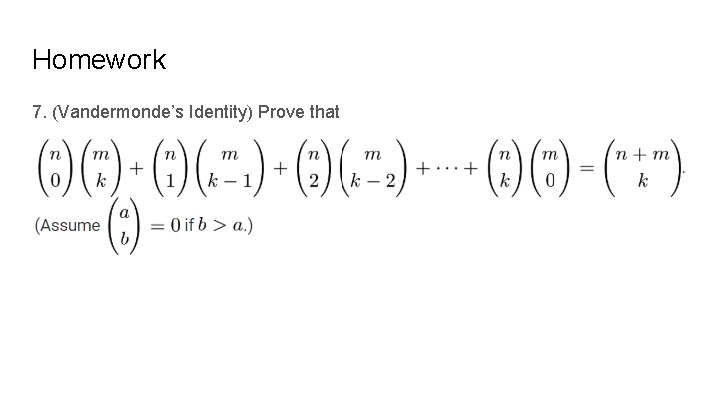
Homework 7. (Vandermonde’s Identity) Prove that
- Slides: 39