
MATHCHEMCOMP 2011 HYPERBOLIC ANALOG OF THE EASTWOODNORBURY FORMULA
MATH/CHEM/COMP 2011 HYPERBOLIC ANALOG OF THE EASTWOOD-NORBURY FORMULA FOR ATIYAH DETERMINANT Dragutin Svrtan
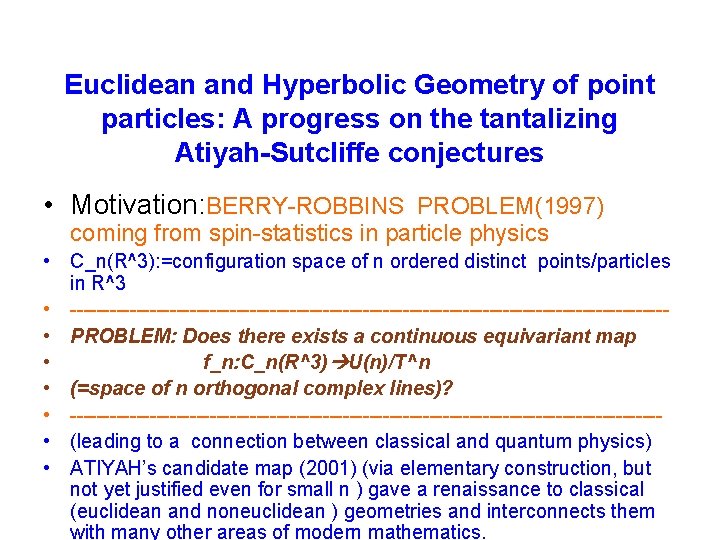
Euclidean and Hyperbolic Geometry of point particles: A progress on the tantalizing Atiyah-Sutcliffe conjectures • Motivation: BERRY-ROBBINS PROBLEM(1997) coming from spin-statistics in particle physics • C_n(R^3): =configuration space of n ordered distinct points/particles in R^3 • --------------------------------------------- • PROBLEM: Does there exists a continuous equivariant map • f_n: C_n(R^3) U(n)/T^n • (=space of n orthogonal complex lines)? • -------------------------------------------- • (leading to a connection between classical and quantum physics) • ATIYAH’s candidate map (2001) (via elementary construction, but not yet justified even for small n ) gave a renaissance to classical (euclidean and noneuclidean ) geometries and interconnects them with many other areas of modern mathematics.
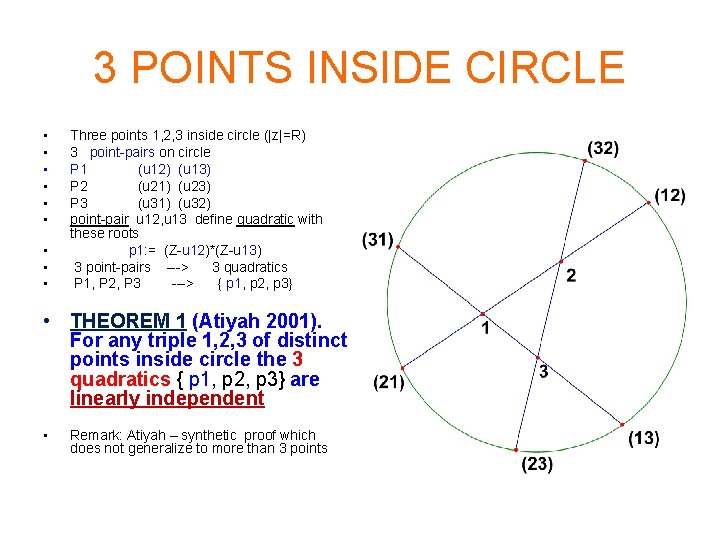
3 POINTS INSIDE CIRCLE • • • Three points 1, 2, 3 inside circle (|z|=R) 3 point-pairs on circle P 1 (u 12) (u 13) P 2 (u 21) (u 23) P 3 (u 31) (u 32) point-pair u 12, u 13 define quadratic with these roots p 1: = (Z-u 12)*(Z-u 13) 3 point-pairs ---> 3 quadratics P 1, P 2, P 3 ---> { p 1, p 2, p 3} • THEOREM 1 (Atiyah 2001). For any triple 1, 2, 3 of distinct points inside circle the 3 quadratics { p 1, p 2, p 3} are linearly independent • Remark: Atiyah – synthetic proof which does not generalize to more than 3 points
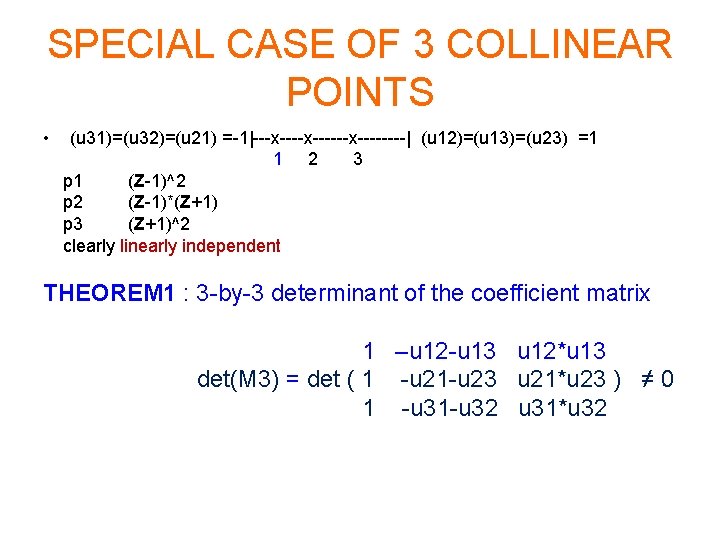
SPECIAL CASE OF 3 COLLINEAR POINTS • (u 31)=(u 32)=(u 21) =-1|---x------x----| (u 12)=(u 13)=(u 23) =1 1 2 3 p 1 (Z-1)^2 p 2 (Z-1)*(Z+1) p 3 (Z+1)^2 clearly linearly independent THEOREM 1 : 3 -by-3 determinant of the coefficient matrix 1 –u 12 -u 13 u 12*u 13 det(M 3) = det ( 1 -u 21 -u 23 u 21*u 23 ) ≠ 0 1 -u 31 -u 32 u 31*u 32
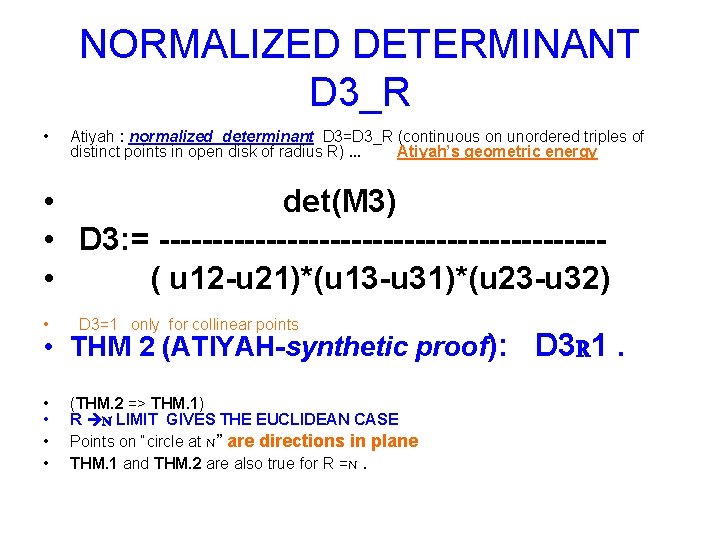
NORMALIZED DETERMINANT D 3_R • Atiyah : normalized determinant D 3=D 3_R (continuous on unordered triples of distinct points in open disk of radius R). . . Atiyah’s geometric energy • det(M 3) • D 3: = --------------------- • ( u 12 -u 21)*(u 13 -u 31)*(u 23 -u 32) • D 3=1 only for collinear points • THM 2 (ATIYAH-synthetic proof): D 3 R 1. • • (THM. 2 => THM. 1) R N LIMIT GIVES THE EUCLIDEAN CASE Points on “circle at N” are directions in plane THM. 1 and THM. 2 are also true for R =N.

EXPLICIT FORMULAS FOR D 3 • EXTRINSIC FORMULA: (u 21 – u 31) (u 13 – u 23) (u 12 -u 32) D 3= 1 + -----------------------(u 12 - u 21) (u 13 - u 31) (u 23 - u 32) • INTRINSIC FORMULA : For hyperbolic triangles (0< A+B+C< π): • D 3 = ½*(cos^2(A/2)+ cos^2(B/2)+ cos^2(C/2)) -1/2*Φ -------------------------------------------------- • ------- where: Φ^2: = cos(A+B+C)/2*cos(-A+B+C)/2*cos(A-B+C)/2*cos(A+B-C)/2 = ¼*(-1+cos^2(A)+cos^2(B)+cos^2(C)+2*cos(A)*cos(B)*cos(C))
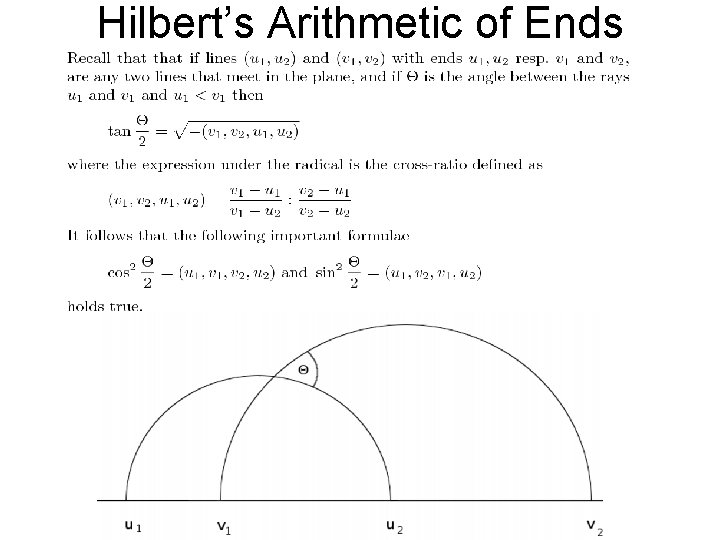
Hilbert’s Arithmetic of Ends
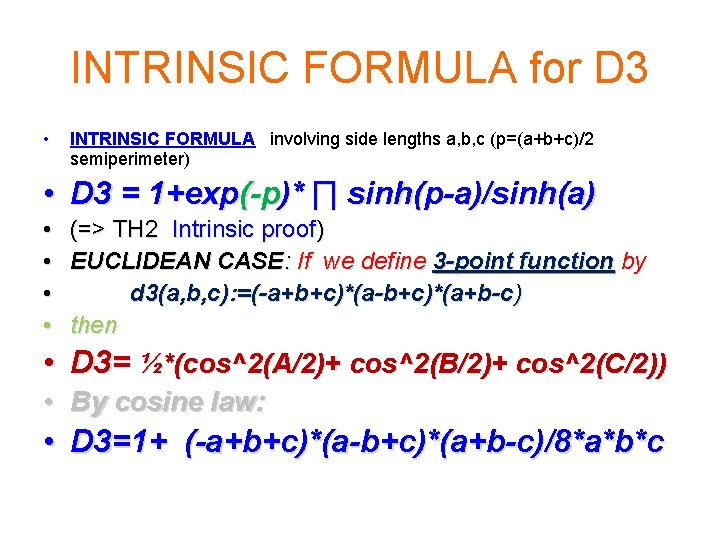
INTRINSIC FORMULA for D 3 • INTRINSIC FORMULA involving side lengths a, b, c (p=(a+b+c)/2 semiperimeter) • D 3 = 1+exp(-p)* ∏ sinh(p-a)/sinh(a) • (=> TH 2 Intrinsic proof) • EUCLIDEAN CASE: If we define 3 -point function by • d 3(a, b, c): =(-a+b+c)*(a-b+c)*(a+b-c) • then • D 3= ½*(cos^2(A/2)+ cos^2(B/2)+ cos^2(C/2)) • By cosine law: • D 3=1+ (-a+b+c)*(a-b+c)*(a+b-c)/8*a*b*c
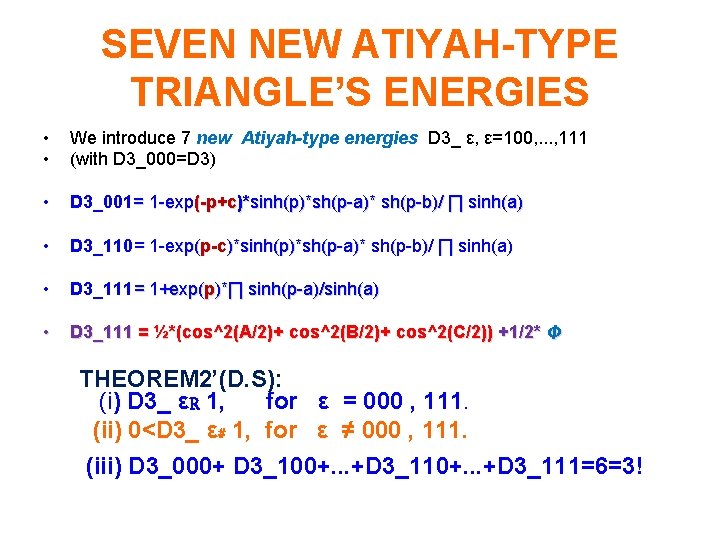
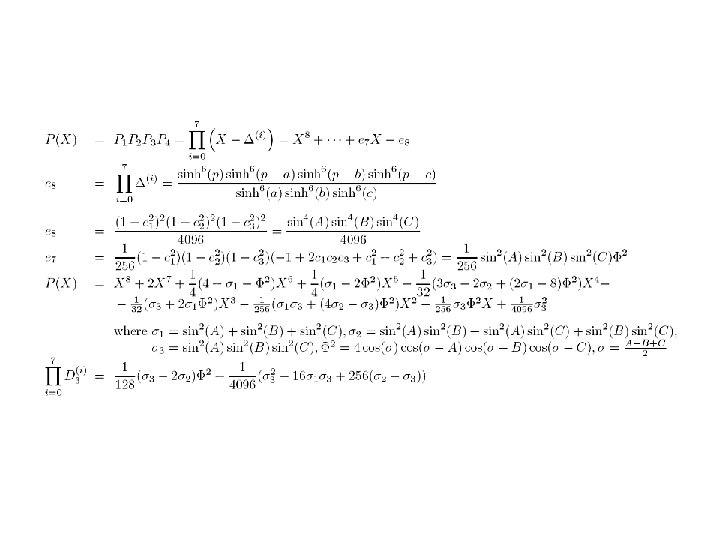
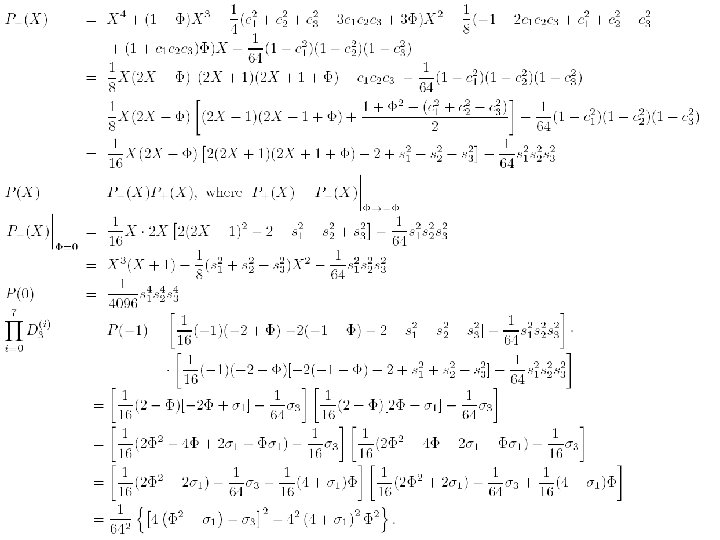
SEVEN NEW ATIYAH-TYPE TRIANGLE’S ENERGIES • • We introduce 7 new Atiyah-type energies D 3_ ε, ε=100, . . . , 111 (with D 3_000=D 3) • D 3_001= 1 -exp(-p+c)*sinh(p)*sh(p-a)* sh(p-b)/ ∏ sinh(a) • D 3_110= 1 -exp(p-c)*sinh(p)*sh(p-a)* sh(p-b)/ ∏ sinh(a) • D 3_111= 1+exp(p)*∏ sinh(p-a)/sinh(a) • D 3_111 = ½*(cos^2(A/2)+ cos^2(B/2)+ cos^2(C/2)) +1/2* Φ THEOREM 2’(D. S): (i) D 3_ εR 1, for ε = 000 , 111. (ii) 0<D 3_ ε# 1, for ε ≠ 000 , 111. (iii) D 3_000+ D 3_100+. . . +D 3_111=6=3!
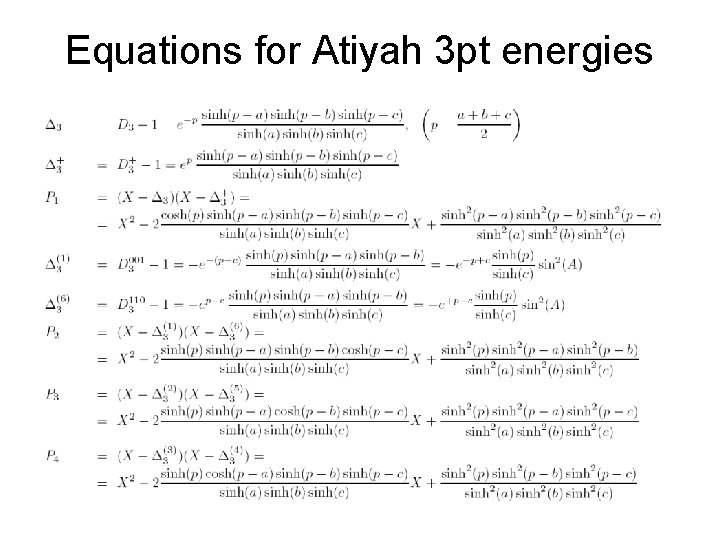
Equations for Atiyah 3 pt energies
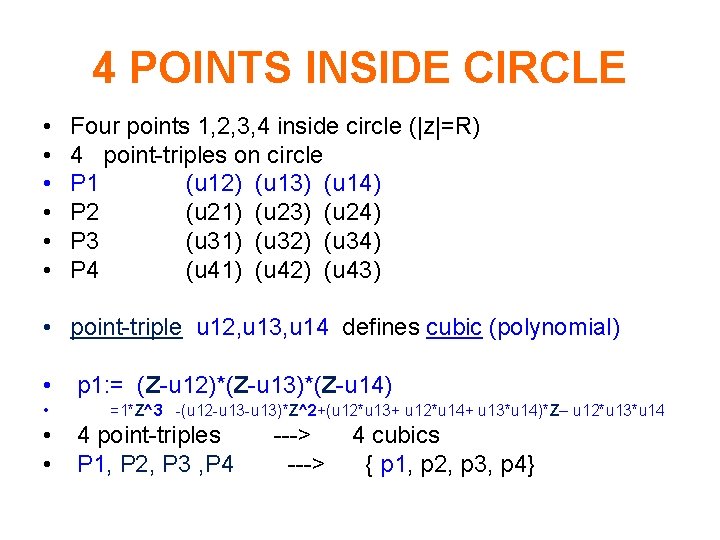
4 POINTS INSIDE CIRCLE • • • Four points 1, 2, 3, 4 inside circle (|z|=R) 4 point-triples on circle P 1 (u 12) (u 13) (u 14) P 2 (u 21) (u 23) (u 24) P 3 (u 31) (u 32) (u 34) P 4 (u 41) (u 42) (u 43) • point-triple u 12, u 13, u 14 defines cubic (polynomial) • • p 1: = (Z-u 12)*(Z-u 13)*(Z-u 14) =1*Z^3 -(u 12 -u 13)*Z^2+(u 12*u 13+ u 12*u 14+ u 13*u 14)*Z– u 12*u 13*u 14 4 point-triples P 1, P 2, P 3 , P 4 ---> 4 cubics { p 1, p 2, p 3, p 4}
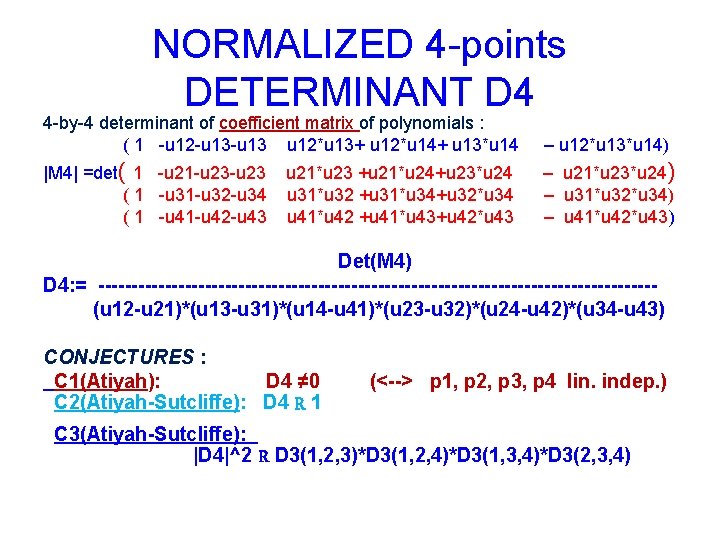
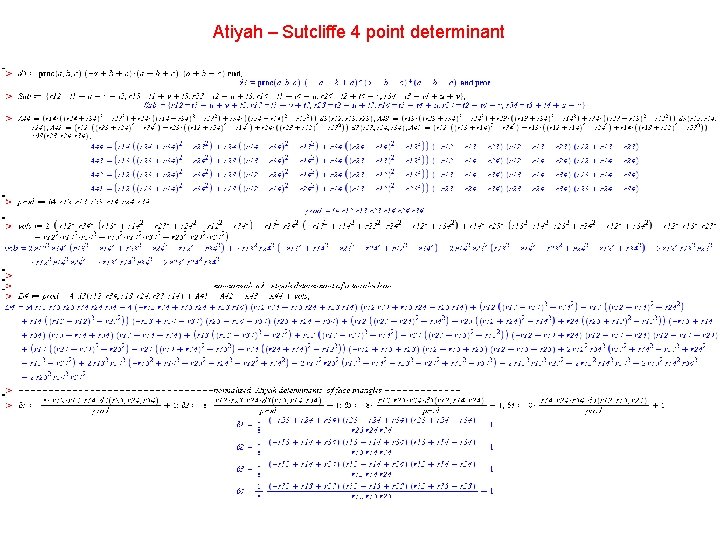
NORMALIZED 4 -points DETERMINANT D 4 4 -by-4 determinant of coefficient matrix of polynomials : ( 1 -u 12 -u 13 u 12*u 13+ u 12*u 14+ u 13*u 14 – u 12*u 13*u 14) |M 4| =det( 1 -u 21 -u 23 ( 1 -u 31 -u 32 -u 34 ( 1 -u 41 -u 42 -u 43 – u 21*u 23*u 24) – u 31*u 32*u 34) – u 41*u 42*u 43) u 21*u 23 +u 21*u 24+u 23*u 24 u 31*u 32 +u 31*u 34+u 32*u 34 u 41*u 42 +u 41*u 43+u 42*u 43 Det(M 4) D 4: = ------------------------------------------(u 12 -u 21)*(u 13 -u 31)*(u 14 -u 41)*(u 23 -u 32)*(u 24 -u 42)*(u 34 -u 43) CONJECTURES : C 1(Atiyah): D 4 ≠ 0 C 2(Atiyah-Sutcliffe): D 4 R 1 C 3(Atiyah-Sutcliffe): |D 4|^2 (<--> p 1, p 2, p 3, p 4 lin. indep. ) R D 3(1, 2, 3)*D 3(1, 2, 4)*D 3(1, 3, 4)*D 3(2, 3, 4)
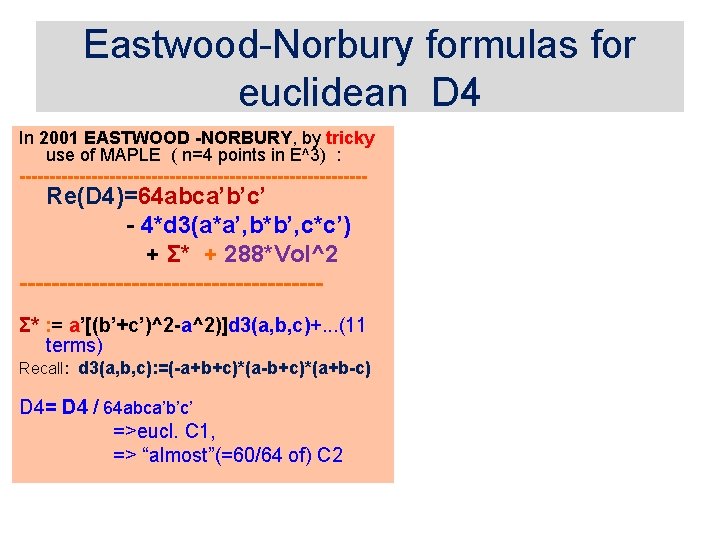
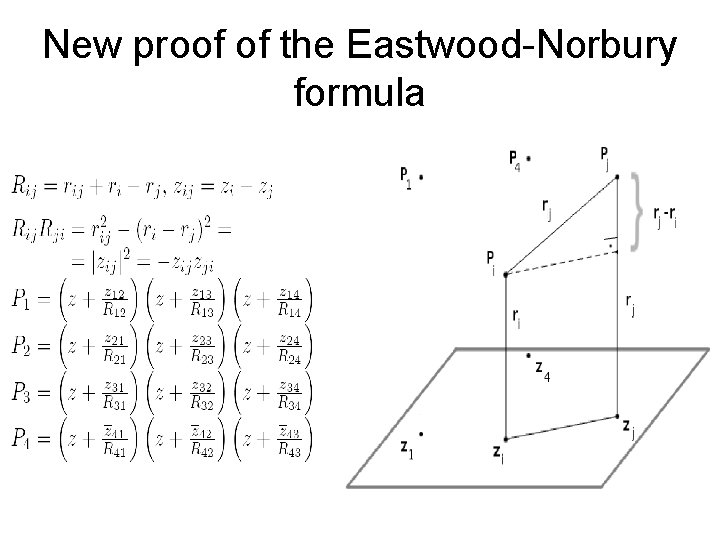
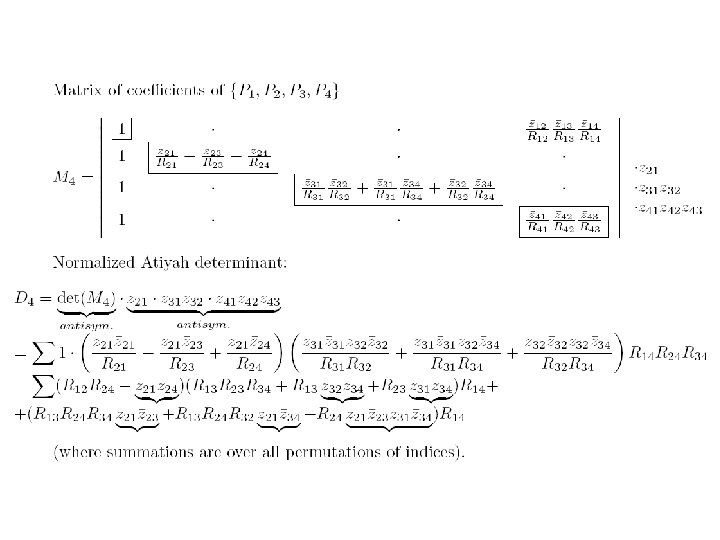
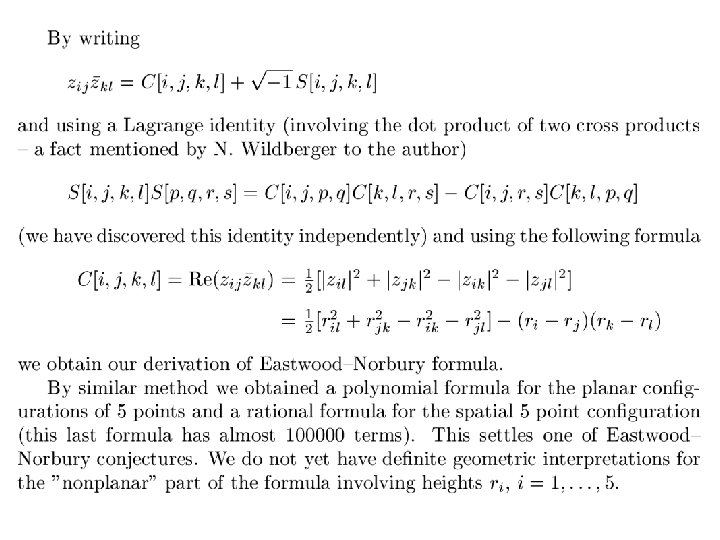
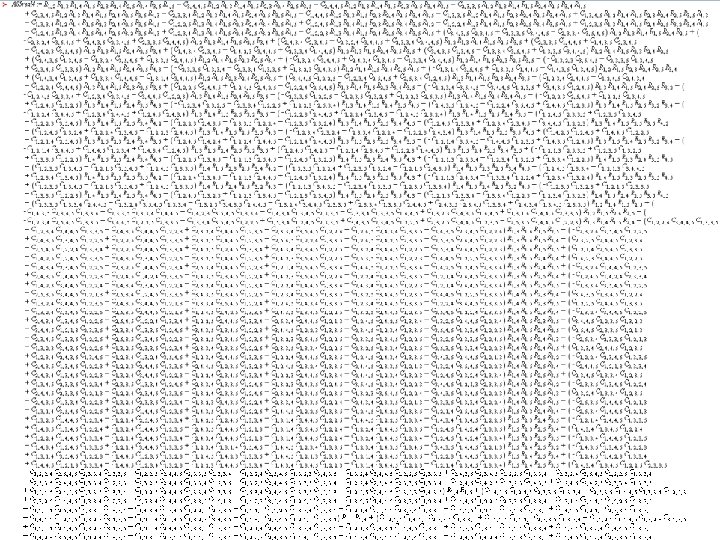
Eastwood-Norbury formulas for euclidean D 4 In 2001 EASTWOOD -NORBURY, by tricky use of MAPLE ( n=4 points in E^3) : ----------------------------- Re(D 4)=64 abca’b’c’ - 4*d 3(a*a’, b*b’, c*c’) + Σ* + 288*Vol^2 ------------------- Σ* : = a’[(b’+c’)^2 -a^2)]d 3(a, b, c)+. . . (11 terms) Recall: d 3(a, b, c): =(-a+b+c)*(a-b+c)*(a+b-c) D 4= D 4 / 64 abca’b’c’ =>eucl. C 1, => “almost”(=60/64 of) C 2
New proof of the Eastwood-Norbury formula
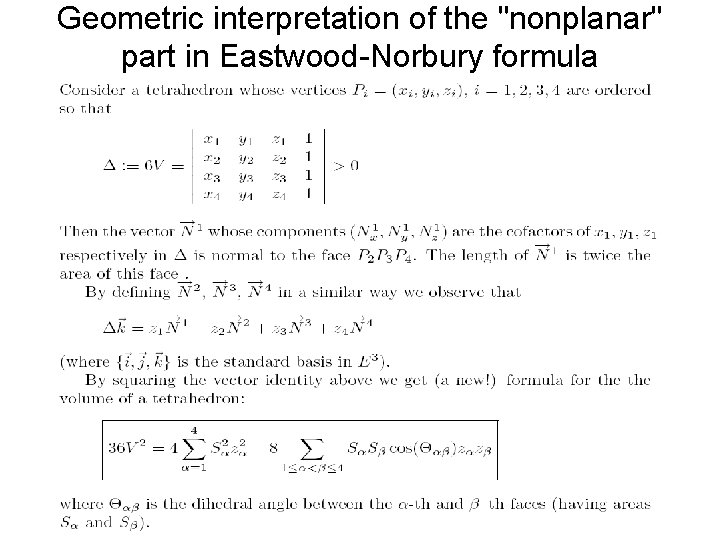
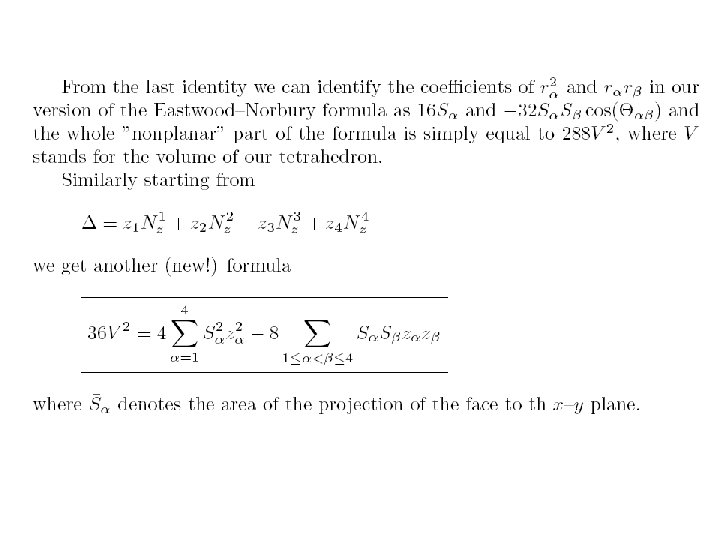
Geometric interpretation of the "nonplanar" part in Eastwood-Norbury formula
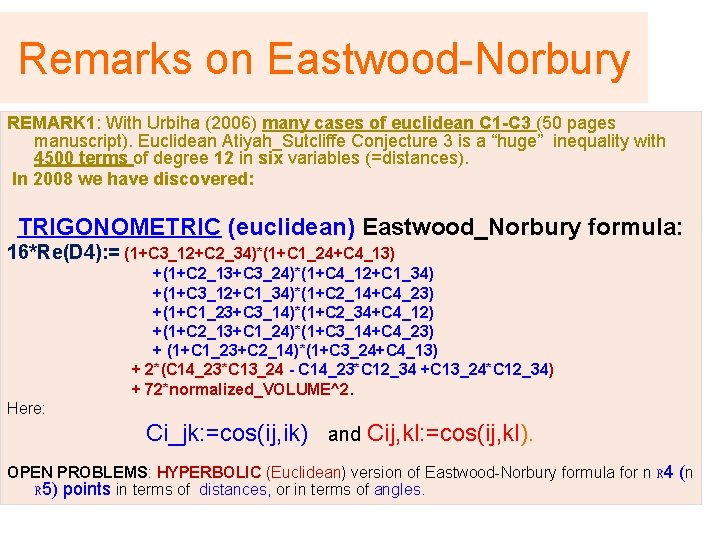
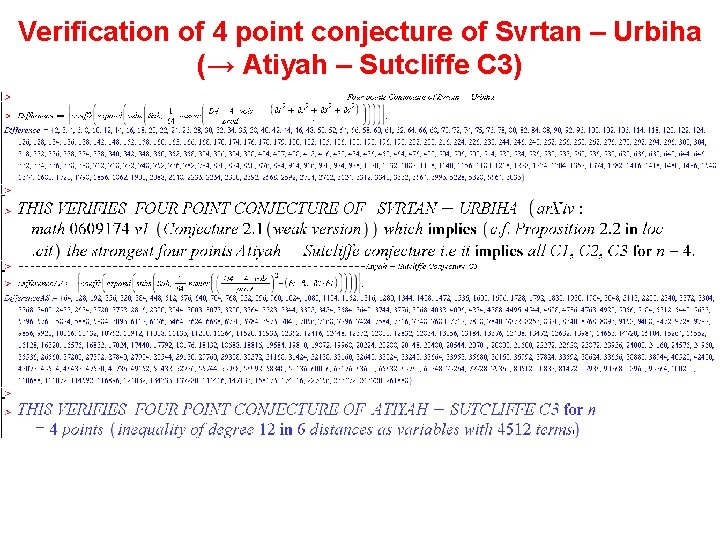
Remarks on Eastwood-Norbury REMARK 1: With Urbiha (2006) many cases of euclidean C 1 -C 3 (50 pages manuscript). Euclidean Atiyah_Sutcliffe Conjecture 3 is a “huge” inequality with 4500 terms of degree 12 in six variables (=distances). In 2008 we have discovered: TRIGONOMETRIC (euclidean) Eastwood_Norbury formula: 16*Re(D 4): = (1+C 3_12+C 2_34)*(1+C 1_24+C 4_13) +(1+C 2_13+C 3_24)*(1+C 4_12+C 1_34) +(1+C 3_12+C 1_34)*(1+C 2_14+C 4_23) +(1+C 1_23+C 3_14)*(1+C 2_34+C 4_12) +(1+C 2_13+C 1_24)*(1+C 3_14+C 4_23) + (1+C 1_23+C 2_14)*(1+C 3_24+C 4_13) + 2*(C 14_23*C 13_24 - C 14_23*C 12_34 +C 13_24*C 12_34) + 72*normalized_VOLUME^2. Here: Ci_jk: =cos(ij, ik) and Cij, kl: =cos(ij, kl). OPEN PROBLEMS: HYPERBOLIC (Euclidean) version of Eastwood-Norbury formula for n R 4 (n R 5) points in terms of distances, or in terms of angles.
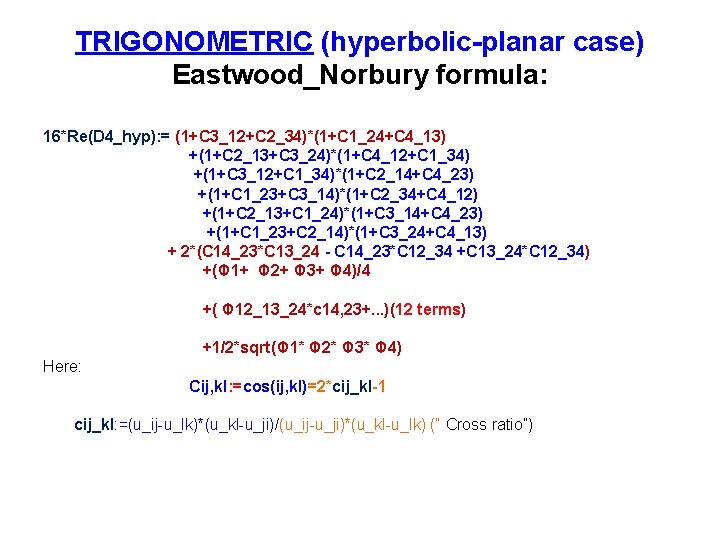
TRIGONOMETRIC (hyperbolic-planar case) Eastwood_Norbury formula: 16*Re(D 4_hyp): = (1+C 3_12+C 2_34)*(1+C 1_24+C 4_13) +(1+C 2_13+C 3_24)*(1+C 4_12+C 1_34) +(1+C 3_12+C 1_34)*(1+C 2_14+C 4_23) +(1+C 1_23+C 3_14)*(1+C 2_34+C 4_12) +(1+C 2_13+C 1_24)*(1+C 3_14+C 4_23) +(1+C 1_23+C 2_14)*(1+C 3_24+C 4_13) + 2*(C 14_23*C 13_24 - C 14_23*C 12_34 +C 13_24*C 12_34) +(Φ 1+ Φ 2+ Φ 3+ Φ 4)/4 +( Φ 12_13_24*c 14, 23+. . . )(12 terms) +1/2*sqrt(Φ 1* Φ 2* Φ 3* Φ 4) Here: Cij, kl: =cos(ij, kl)=2*cij_kl-1 cij_kl: =(u_ij-u_lk)*(u_kl-u_ji)/(u_ij-u_ji)*(u_kl-u_lk) (“ Cross ratio”)

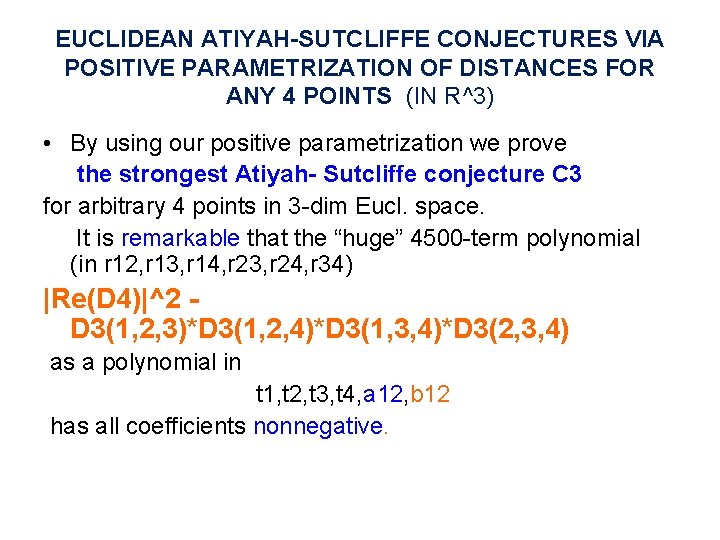
EUCLIDEAN ATIYAH-SUTCLIFFE CONJECTURES VIA POSITIVE PARAMETRIZATION OF DISTANCES FOR ANY 4 POINTS (IN R^3) • By using our positive parametrization we prove the strongest Atiyah- Sutcliffe conjecture C 3 for arbitrary 4 points in 3 -dim Eucl. space. It is remarkable that the “huge” 4500 -term polynomial (in r 12, r 13, r 14, r 23, r 24, r 34) |Re(D 4)|^2 D 3(1, 2, 3)*D 3(1, 2, 4)*D 3(1, 3, 4)*D 3(2, 3, 4) as a polynomial in t 1, t 2, t 3, t 4, a 12, b 12 has all coefficients nonnegative.
Atiyah – Sutcliffe 4 point determinant
Verification of 4 point conjecture of Svrtan – Urbiha (→ Atiyah – Sutcliffe C 3)
NEW DEVELOPMENTS • In 2011 M. Mazur and B. V. Petrenko restated the original Eastwood Norbury formula in trigonometric form which besides face angles of a tetrahedron uses also angles of the so called Crelle triangle (associated to the tetrahedron). Our formula in [5] does not involve Crelles angles, but uses “skew” angles. • C 2 for convex (planar) quadrilaterals and • C 3 for cyclic quadrilaterals (we have proved it already in [5]) and • stated 3 conjectures which are consequences of some of our conjectures in [5]. (Hence we have a proof of all 3)
POSITIVE PARAMETRIZATIONS FOR DISTANCES BETWEEN 6 POINTS
RELATIONS AND BASIC DISTANCES FOR 6 POINTS

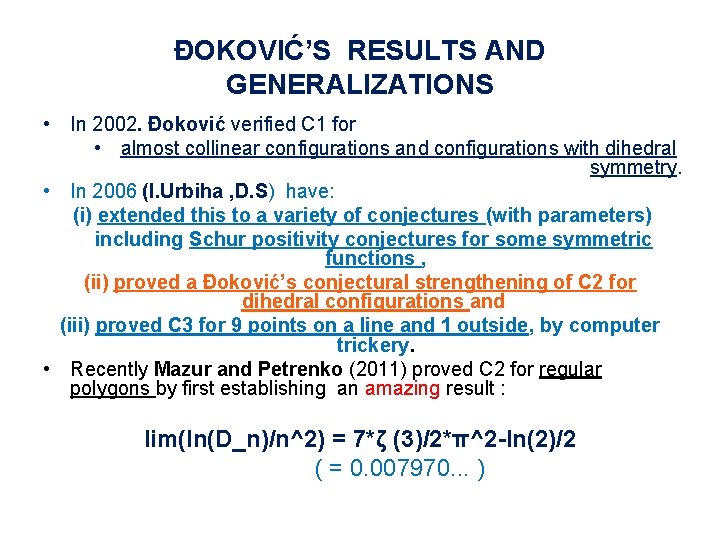
ĐOKOVIĆ’S RESULTS AND GENERALIZATIONS • In 2002. Đoković verified C 1 for • almost collinear configurations and configurations with dihedral symmetry. • In 2006 (I. Urbiha , D. S) have: (i) extended this to a variety of conjectures (with parameters) including Schur positivity conjectures for some symmetric functions , (ii) proved a Đoković’s conjectural strengthening of C 2 for dihedral configurations and (iii) proved C 3 for 9 points on a line and 1 outside, by computer trickery. • Recently Mazur and Petrenko (2011) proved C 2 for regular polygons by first establishing an amazing result : lim(ln(D_n)/n^2) = 7*ζ (3)/2*π^2 -ln(2)/2 ( = 0. 007970. . . )
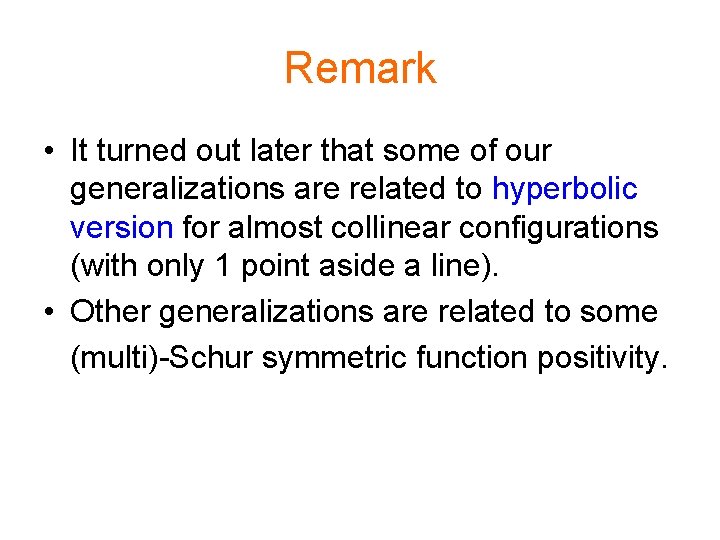
Remark • It turned out later that some of our generalizations are related to hyperbolic version for almost collinear configurations (with only 1 point aside a line). • Other generalizations are related to some (multi)-Schur symmetric function positivity.
![References • • • [1] Atiyah M, Sutcliffe P, The Geometry of Point Particles.](http://slidetodoc.com/presentation_image_h2/dacb45920be0817d3aab7e5e0f7ebafe/image-35.jpg "References • • • [1] Atiyah M, Sutcliffe P, The Geometry of Point Particles.")
References • • • [1] Atiyah M, Sutcliffe P, The Geometry of Point Particles. ar. Xiv: hepth/0105179 (32 pages). Proc. R. Soc. Lond. A (2002) 458, 1089 -115. [2] Atiyah M, Sutcliffe P, Polyhedra in Physics, Chemistry and Geometry, ar. Xiv: math-ph/03030701 (22 pages), “Milan J. Math. ” 71: 33 -58 (2003) [3] Eastwood M. , Norbury P. A proof of Atiyah’s conjecture on configurations of four points in Euclidean three space, Geometry and Topology 5(2001) 885 -893. [4]. Svrtan D, Urbiha I, Atiyah-Sutcliffe Conjectures for almost Collinear Configurations and Some New Conjectures for Symmetric Functions, ar. Xiv: math/0406386 (23 pages). [5]. Svrtan D, Urbiha I. , Verification and Strengthening of the Atiyah. Sutcliffe Conjectures for Several Types of Configurations, ar. Xiv: math/0609174 (49 pages). [6]. Atiyah M. An Unsolved Problem in Elementary Geometry , www. math. missouri. edu/archive/Miller-Lectures/atiyah. html. [7]. Atiyah M. An Unsolved Problem in Elementary Euclidean Geometry , http//c 2. glocos. org/index. php/pedronunes/atiyah-uminho [8] M. Mazur and B. V. Petrenko : On the conjectures of Atiyah and Sutcliffe ar. Xiv: 1102. 4662 v 1 [9] Atiyah M. Edinburgh Lectures on Geometry, Analysis and Physics, ar. Xiv: 1009. 4827 v 1.

Thank you very much for your attention.
- Slides: 36