
Math Standards James Tammy Parsons Metro Nashville Public
Math Standards James & Tammy Parsons Metro Nashville Public Schools
How to access today’s materials: http: //public. me. com/flyparsons James’ email: james. parsons@mnps. org Tammy’s email: tammy. parsons@mnps. org
What are Standards?
A Standards-Based Education System ¡ ¡ Standards help ensure students learn what is important, rather than allowing textbooks to dictate classroom practice. Student learning is the focus – aiming for a high and deep level of student understanding that goes beyond traditional textbook-based or lessonbased instruction.
A standards-based system: ¡ ¡ measures success based on student learning (the achievement of standards) rather than compliance with rules and regulations. aligns policies, initiatives, curriculum, instruction, and assessments with clearly defined academic standards. consistently communicates and uses standards to focus on ways to ensure success or all students. uses assessment to inform instruction.
Standards-based systems increase student achievement. Students generally learn better in a standards-based environment because everybody’s working towards the same goal.
In standards-based systems: ¡ ¡ Teachers know what the standards are and choose classroom activities and teaching strategies that enable students to achieve the standards. Students know the standards, too, and can see scoring guides that embody them. The students can use them to complete their work. Parents know them and can help students by seeing that their homework aligns with the standards. Administrators know what is necessary to attain the standards and provide professional development, resources and materials to ensure that students are able to reach the prescribed standards.
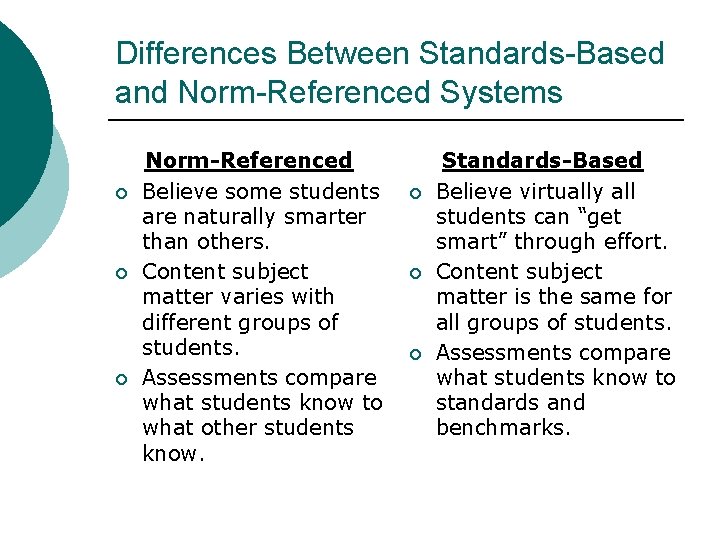
Differences Between Standards-Based and Norm-Referenced Systems ¡ ¡ ¡ Norm-Referenced Believe some students are naturally smarter than others. Content subject matter varies with different groups of students. Assessments compare what students know to what other students know. ¡ ¡ ¡ Standards-Based Believe virtually all students can “get smart” through effort. Content subject matter is the same for all groups of students. Assessments compare what students know to standards and benchmarks.
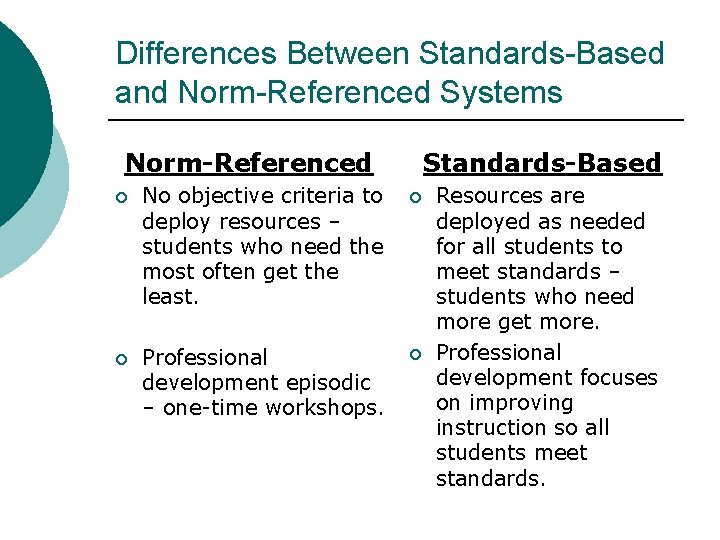
Differences Between Standards-Based and Norm-Referenced Systems Norm-Referenced Standards-Based ¡ No objective criteria to deploy resources – students who need the most often get the least. ¡ ¡ Professional development episodic – one-time workshops. ¡ Resources are deployed as needed for all students to meet standards – students who need more get more. Professional development focuses on improving instruction so all students meet standards.
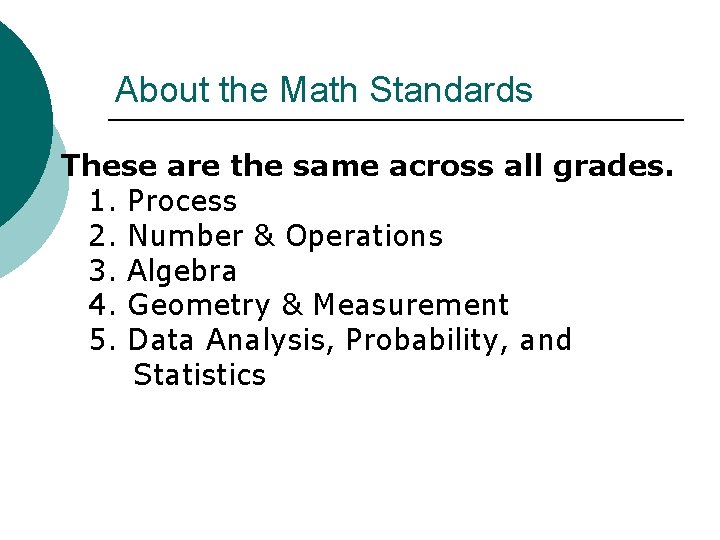
About the Math Standards These are the same across all grades. 1. Process 2. Number & Operations 3. Algebra 4. Geometry & Measurement 5. Data Analysis, Probability, and Statistics
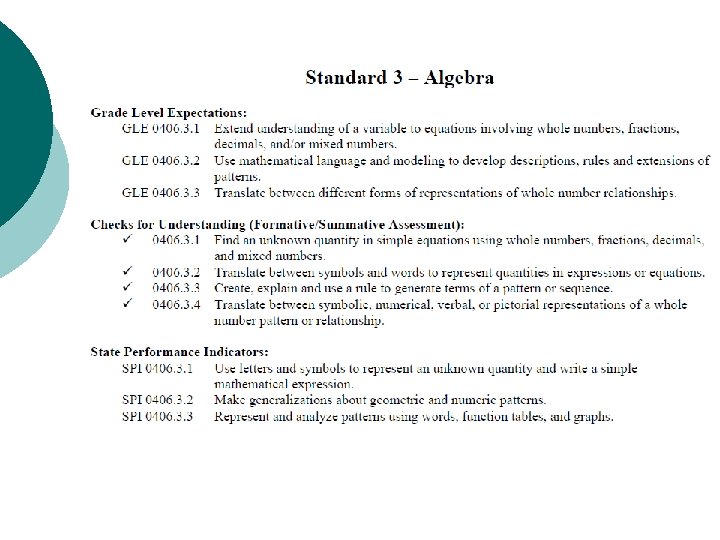
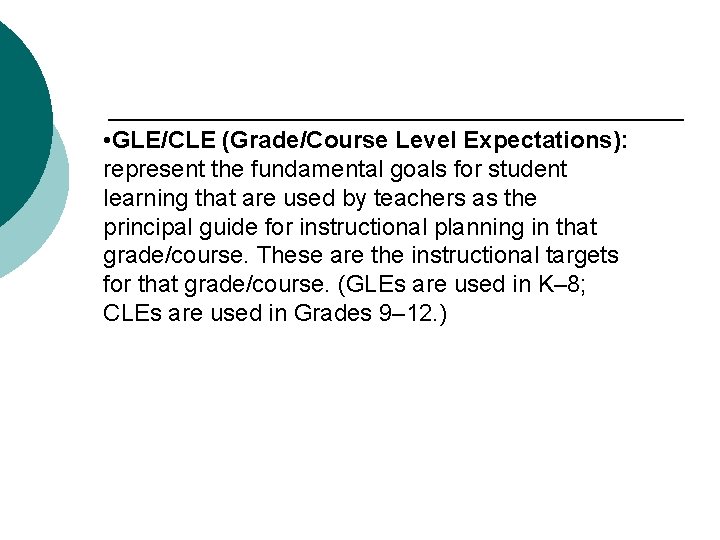
• GLE/CLE (Grade/Course Level Expectations): represent the fundamental goals for student learning that are used by teachers as the principal guide for instructional planning in that grade/course. These are the instructional targets for that grade/course. (GLEs are used in K– 8; CLEs are used in Grades 9– 12. )
Checks for Understanding: are suggestions for assessing student learning. These formative/summative checks provide information about whether a student has met a particular Grade or Course Level Expectation. Formative assessments are typically embedded within a lesson. (Checks for Understanding are denoted by the checkmark symbol (√). ) Checks for Understanding are resources to help the teacher determine if students are mastering what they are expected to learn.
¡ SPI (State Performance Indicators): are the basis for student accountability and are used by the state to prepare standardized test items aligned with corresponding Grade or Course Level Expectations. SPIs are not instructional targets. (There are no SPIs in Grades K– 2. )
¡ Process Standard – connected to NCTM process standards. Embeds communication, proof, reasoning, historical development of mathematics, and modeling into one standard. GLEs are same across K– 8 grade bands, but the checks for understanding and SPIs differ.
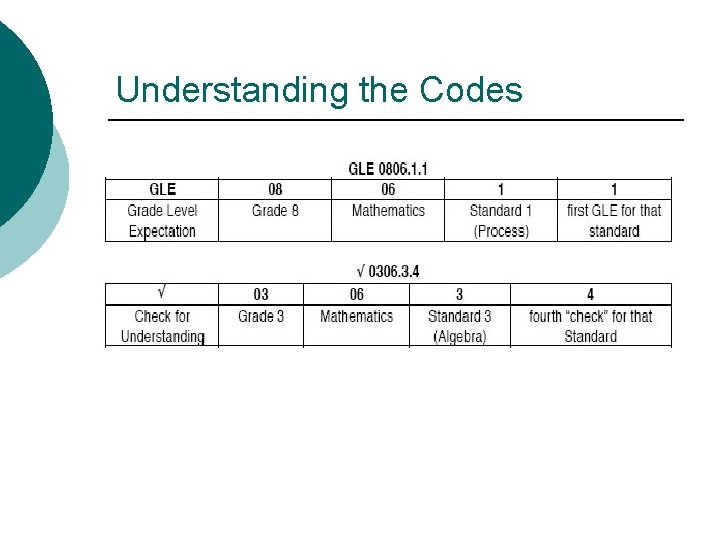
Understanding the Codes
Jefferson County Public Schools http: //jc-schools. net/dynamic/math. html Other website resources: http: //Illuminations. nctm. org www. portal. com www. internet 4 classrooms. com http: //www. thinkfinity. org/home. aspx
INTRODUCTION TO WEBB’S DEPTHOF-KNOWLEDGE LEVELS Model developed by Norman Webb, University of Wisconsin, Center for Education Research, to analyze alignment of standards with assessments.

Item Difficulty vs. Cognitive Complexity 19
DOK is a reference to the cognitive demand that must occur to answer a question, perform a task, or generate a product. ü Adding is a mental process. ü Knowing the rule for adding is the intended outcome that influences the DOK. ü Once someone learns the “rule” of how to add, 4 + 4 is DOK 1 and is also easy. ü Adding 4, 678, 895 + 9, 578, 885 is still a DOK 1 but may be more “difficult. ” 20
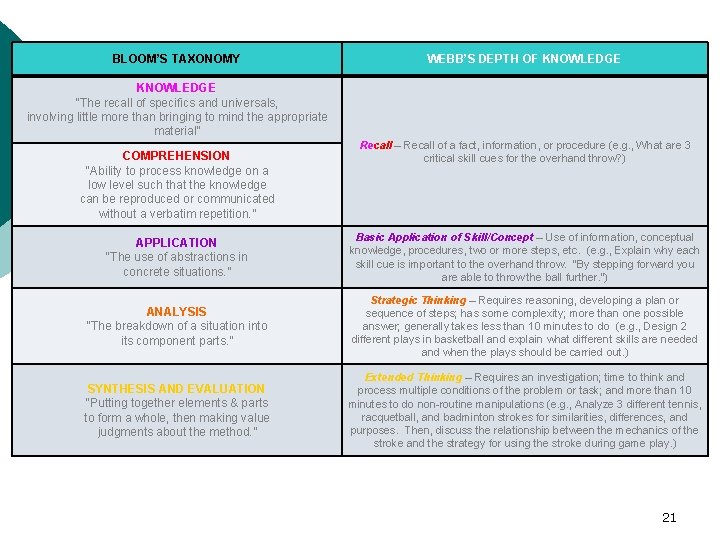
BLOOM’S TAXONOMY WEBB’S DEPTH OF KNOWLEDGE “The recall of specifics and universals, involving little more than bringing to mind the appropriate material” COMPREHENSION “Ability to process knowledge on a low level such that the knowledge can be reproduced or communicated without a verbatim repetition. ” Recall – Recall of a fact, information, or procedure (e. g. , What are 3 critical skill cues for the overhand throw? ) APPLICATION “The use of abstractions in concrete situations. ” Basic Application of Skill/Concept – Use of information, conceptual knowledge, procedures, two or more steps, etc. (e. g. , Explain why each skill cue is important to the overhand throw. “By stepping forward you are able to throw the ball further. ”) ANALYSIS “The breakdown of a situation into its component parts. ” Strategic Thinking – Requires reasoning, developing a plan or sequence of steps; has some complexity; more than one possible answer; generally takes less than 10 minutes to do (e. g. , Design 2 different plays in basketball and explain what different skills are needed and when the plays should be carried out. ) SYNTHESIS AND EVALUATION “Putting together elements & parts to form a whole, then making value judgments about the method. ” Extended Thinking – Requires an investigation; time to think and process multiple conditions of the problem or task; and more than 10 minutes to do non-routine manipulations (e. g. , Analyze 3 different tennis, racquetball, and badminton strokes for similarities, differences, and purposes. Then, discuss the relationship between the mechanics of the stroke and the strategy for using the stroke during game play. ) 21
Webb’s Depth of Knowledge levels Level 1 Recall and Reproduction Level 2 Skills & Concepts Level 3 Strategic Thinking Level 4 Extended Thinking 22
Level 1 Recall Requires simple recall of such information as a fact, definition, term, or performance of a simple process or procedure. A student answering a Level 1 item either knows the answer or does not. 23
Level 1 Examples ¡ ¡ ¡ List the numbers from 0 -5. Locate or recall facts about squares. Describe the attributes of a cube. Determine the perimeter or area of rectangles given a drawing or labels Identify basic rules for participating in simple games and activities 24
Level 2 Basic Application of Skills & Concepts Involves some mental skills, concepts, or processing beyond habitual response. Students must make some decisions about how to approach a problem or activity. Keywords distinguishing a Level 2 item include classify, organize, observe, estimate, collect data, and compare data. 25
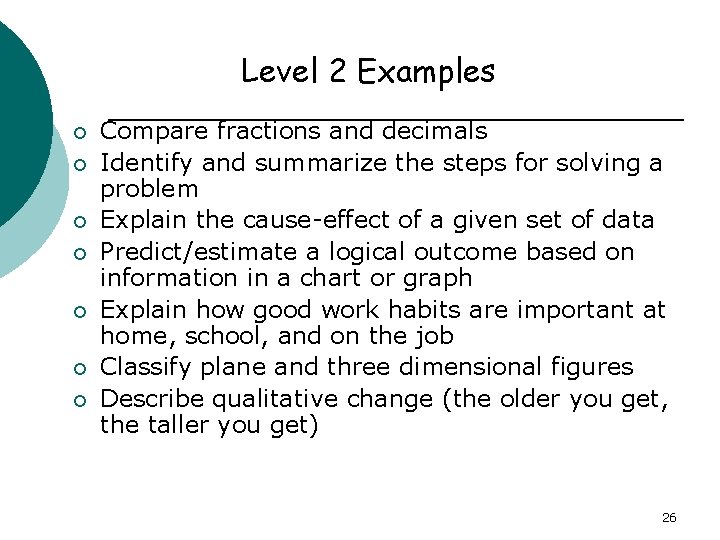
Level 2 Examples ¡ ¡ ¡ ¡ Compare fractions and decimals Identify and summarize the steps for solving a problem Explain the cause-effect of a given set of data Predict/estimate a logical outcome based on information in a chart or graph Explain how good work habits are important at home, school, and on the job Classify plane and three dimensional figures Describe qualitative change (the older you get, the taller you get) 26
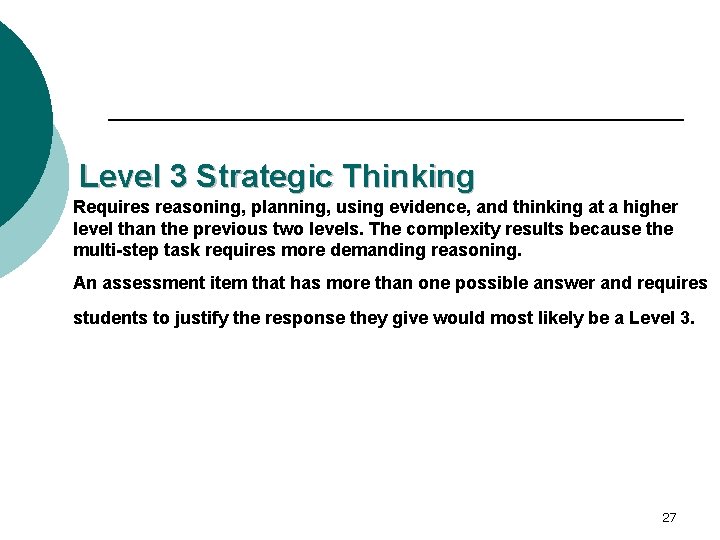
Level 3 Strategic Thinking Requires reasoning, planning, using evidence, and thinking at a higher level than the previous two levels. The complexity results because the multi-step task requires more demanding reasoning. An assessment item that has more than one possible answer and requires students to justify the response they give would most likely be a Level 3. 27
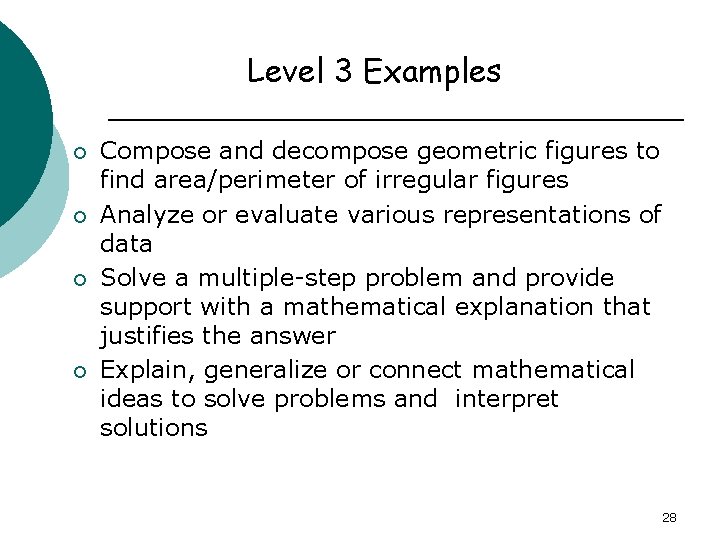
Level 3 Examples ¡ ¡ Compose and decompose geometric figures to find area/perimeter of irregular figures Analyze or evaluate various representations of data Solve a multiple-step problem and provide support with a mathematical explanation that justifies the answer Explain, generalize or connect mathematical ideas to solve problems and interpret solutions 28

Level 4 Extended Thinking Requires complex reasoning, planning, developing, and thinking, most likely over an extended time. Cognitive demands are high, and students are required to make connections both within and among subject domains. 29
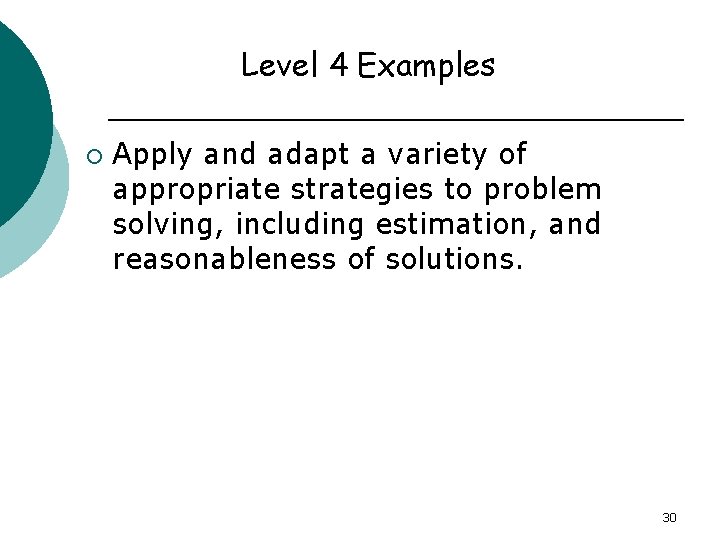
Level 4 Examples ¡ Apply and adapt a variety of appropriate strategies to problem solving, including estimation, and reasonableness of solutions. 30
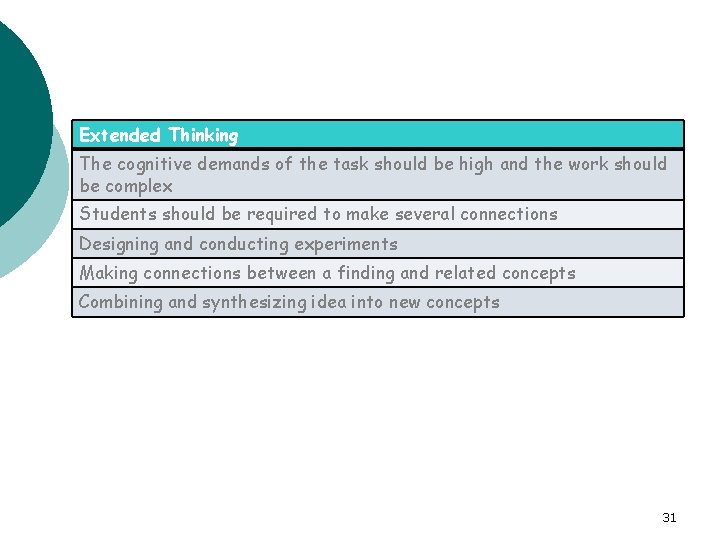
Extended Thinking The cognitive demands of the task should be high and the work should be complex Students should be required to make several connections Designing and conducting experiments Making connections between a finding and related concepts Combining and synthesizing idea into new concepts 31
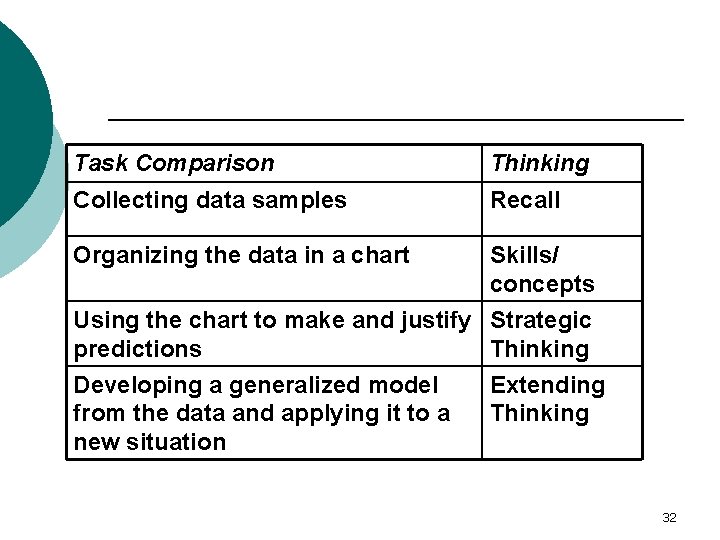
Task Comparison Thinking Collecting data samples Recall Organizing the data in a chart Skills/ concepts Using the chart to make and justify predictions Developing a generalized model from the data and applying it to a new situation Strategic Thinking Extending Thinking 32
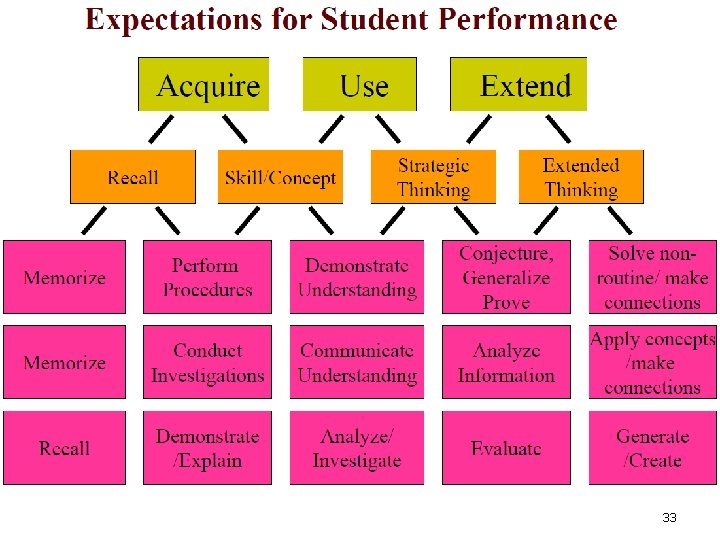
33
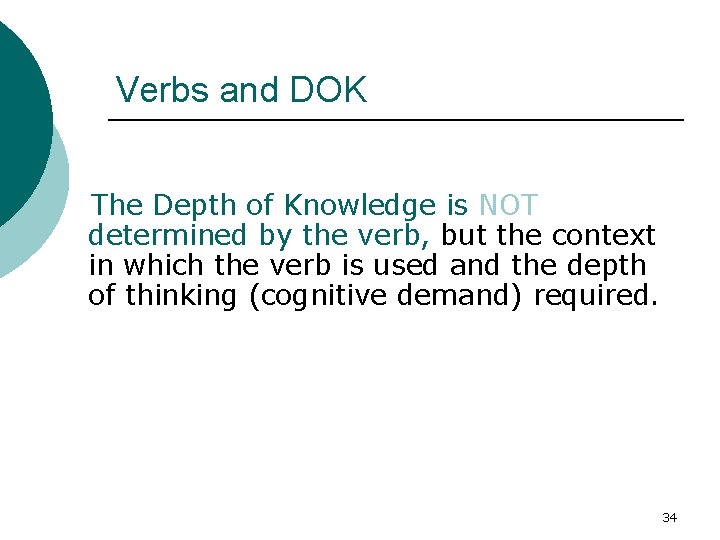
Verbs and DOK The Depth of Knowledge is NOT determined by the verb, but the context in which the verb is used and the depth of thinking (cognitive demand) required. 34
Same verb—three DOK levels Level 3 - Describe a model that you might use to represent the relationships of the areas of squares and triangles. (requires deep understanding of area and a determination of how best to represent it) Level 2 - Describe the difference between squares and triangles. (requires cognitive processing to determine the differences in the two types of figures) Level 1 - Describe two attributes of a square. (simple recall) 35
Reflect… • Depth of Knowledge is a scale of cognitive demand. • DOK requires looking at the assessment item/standard-not student work-in order to determine the level. DOK is about the item/standard-not the student. • The context of the assessment item/standard must be considered to determine the DOK-not just a look at what verb was chosen. 36
Click here: ¡ Screen Shot
Teacher frustrated over Standards Click on Teacher
Activities 2 nd Grade Multiplication Face Cards ¡ Number Roads ¡ Make a Dollar Game ¡ Gorilla Lunch Menu ¡ Circle Handout ¡ Pattern Block – Equivalent Fractions ¡
Activities How Does It Grow ¡ Balancing Act ¡ Math Machines ¡ How Far ¡ Create a House Number ¡ Mary Had a Little Lamb ¡
Activities More than One Story ¡ Which is Which ¡ Birthday Graph ¡ Unlikely/Likely Events ¡ How big is your foot? ¡
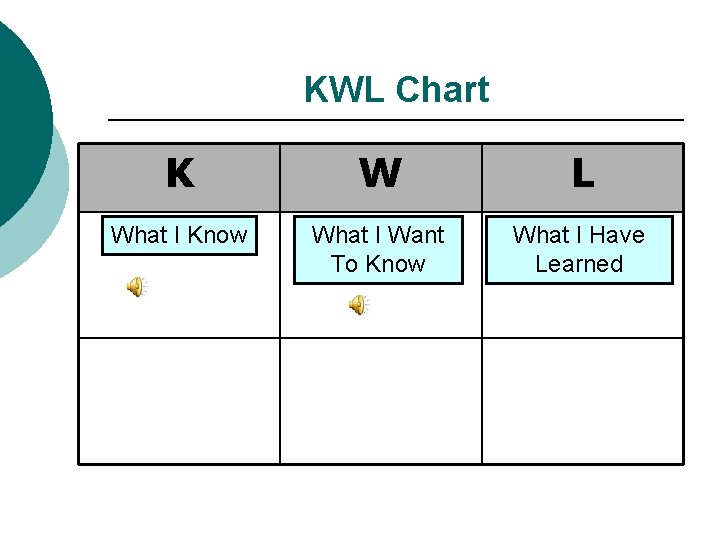
KWL Chart K W L What I Know What I Want To Know What I Have Learned
Activities (5 -8) Hallways and Bedrooms ¡ Quadrilateral Sort ¡ Triangles ¡ What’s Your Angle? ¡ Tangram Values ¡ Polygon Pizzas GLE Search ¡
Activities (5 -8) A PIN for Mr. Mitchell ¡ Remove One GLE Search ¡ ¡ ¡ Walk the Graphic Stories Building with Toothpicks Exploring Houses Table for 63, please
A Standards-Based Education System Standards-based education is a process for planning, delivering, monitoring and improving academic programs in which clearly defined academic content standards provide the basis for content in instruction and assessment.
Segment 7 Transforming Instruction Through Standards
Implications for Instructional Change Directions ¡ Individually read and highlight l l ¡ ¡ Traditional instructional aspects in BLUE Transformative aspects in YELLOW. Compare highlights with elbow partner. As a group, use your papers to complete the laminated chart. l l Match each transformative aspect with its traditional counterpart. Debrief with subsequent slides.
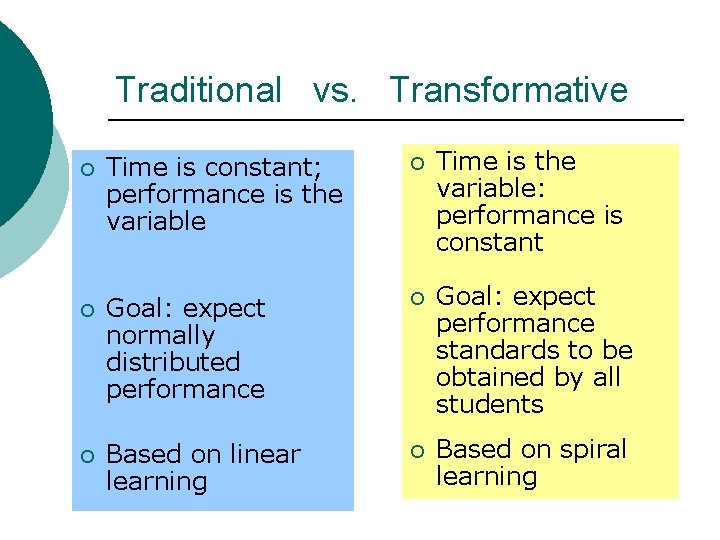
Traditional vs. Transformative ¡ Time is constant; performance is the variable ¡ Time is the variable: performance is constant ¡ Goal: expect normally distributed performance ¡ Goal: expect performance standards to be obtained by all students ¡ Based on linear learning ¡ Based on spiral learning
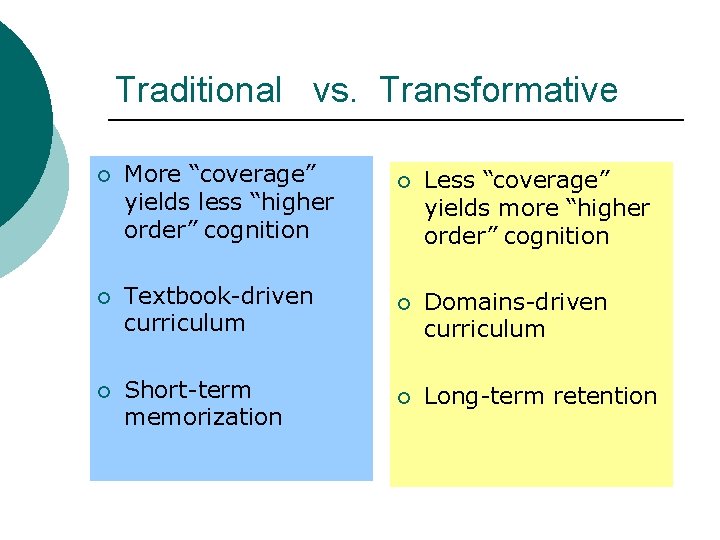
Traditional vs. Transformative ¡ More “coverage” yields less “higher order” cognition ¡ ¡ ¡ Less “coverage” yields more “higher order” cognition Textbook-driven curriculum ¡ Domains-driven curriculum Short-term memorization ¡ Long-term retention
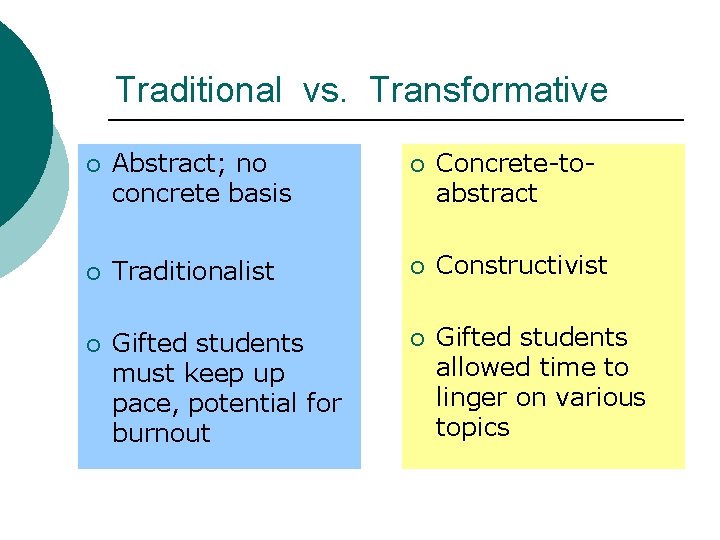
Traditional vs. Transformative ¡ Abstract; no concrete basis ¡ Concrete-toabstract ¡ Traditionalist ¡ Constructivist ¡ Gifted students must keep up pace, potential for burnout ¡ Gifted students allowed time to linger on various topics
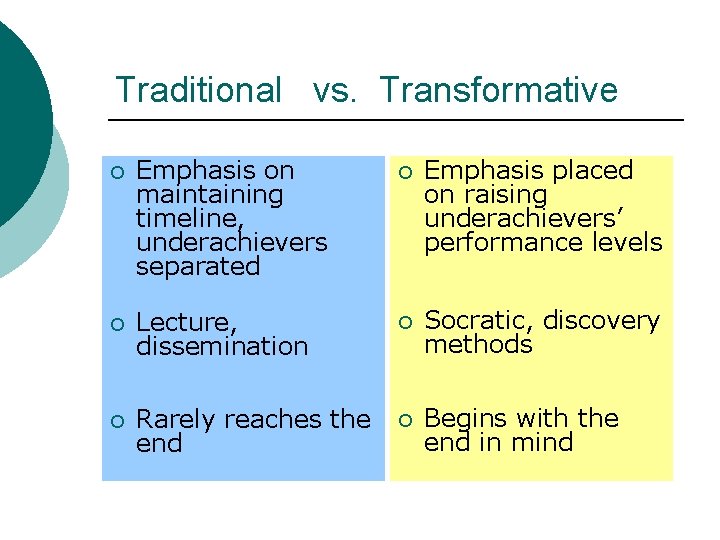
Traditional vs. Transformative ¡ Emphasis on maintaining timeline, underachievers separated ¡ Emphasis placed on raising underachievers’ performance levels ¡ Lecture, dissemination ¡ Socratic, discovery methods ¡ Rarely reaches the end ¡ Begins with the end in mind
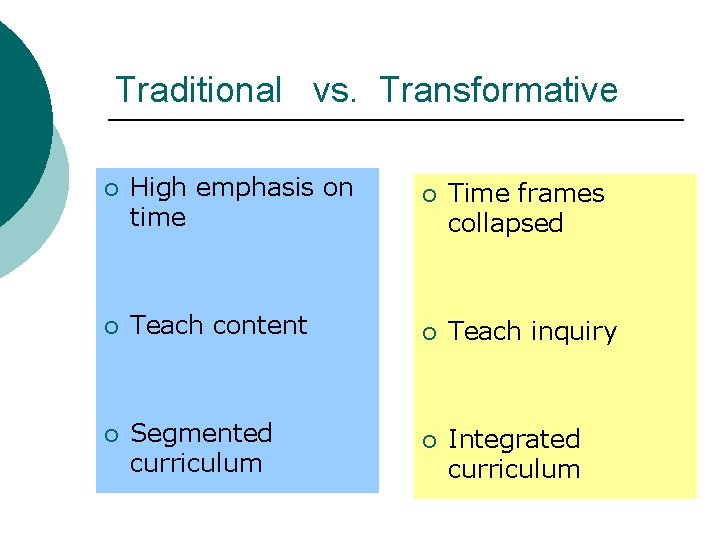
Traditional vs. Transformative ¡ High emphasis on time ¡ Teach content ¡ Segmented curriculum ¡ Time frames collapsed ¡ Teach inquiry ¡ Integrated curriculum
Segment 9 Making Standards User Friendly
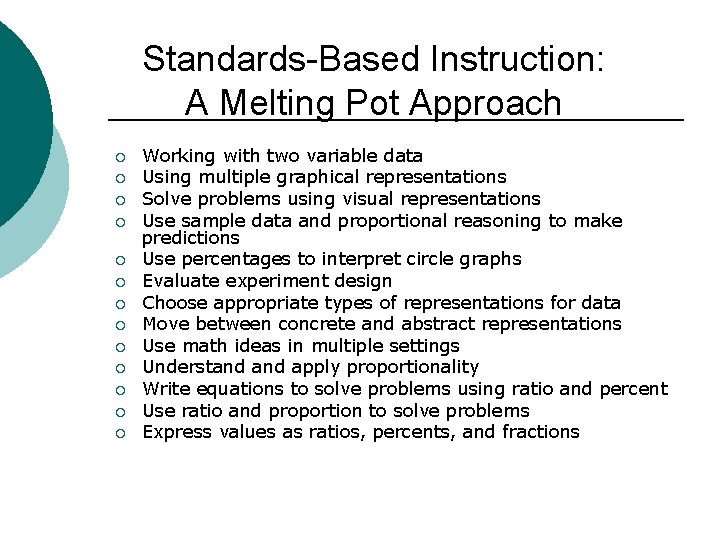
Standards-Based Instruction: A Melting Pot Approach ¡ ¡ ¡ ¡ Working with two variable data Using multiple graphical representations Solve problems using visual representations Use sample data and proportional reasoning to make predictions Use percentages to interpret circle graphs Evaluate experiment design Choose appropriate types of representations for data Move between concrete and abstract representations Use math ideas in multiple settings Understand apply proportionality Write equations to solve problems using ratio and percent Use ratio and proportion to solve problems Express values as ratios, percents, and fractions
Standards-Based Instruction: A Melting Pot Approach What is it about this activity that relates to the idea of a melting pot?
The Language of the Standards ¡ ¡ ¡ GLE: is a statement that defines what all students should know and be able to do at the end of a given grade level. GLEs add further definition to the content standards and benchmarks. Checks for Understanding: SPI:
- Slides: 56