
MATH STANDARD SHIFTS FROM GRADES 4 5 Presenters
- Slides: 14
MATH STANDARD SHIFTS FROM GRADES 4 -5 Presenters: Ms. Raniolo (Grades 4 and 5) and Ms. Cohen (Grade 5) May 22, 2019
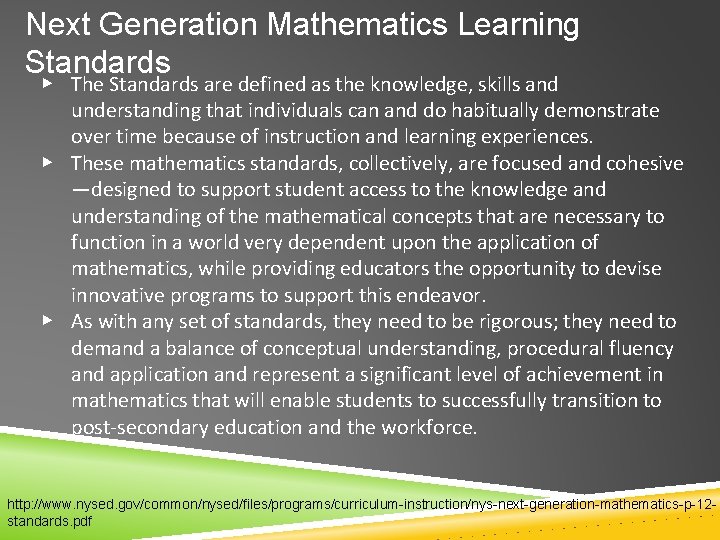
Next Generation Mathematics Learning Standards ▶ The Standards are defined as the knowledge, skills and understanding that individuals can and do habitually demonstrate over time because of instruction and learning experiences. ▶ These mathematics standards, collectively, are focused and cohesive —designed to support student access to the knowledge and understanding of the mathematical concepts that are necessary to function in a world very dependent upon the application of mathematics, while providing educators the opportunity to devise innovative programs to support this endeavor. ▶ As with any set of standards, they need to be rigorous; they need to demand a balance of conceptual understanding, procedural fluency and application and represent a significant level of achievement in mathematics that will enable students to successfully transition to post-secondary education and the workforce. http: //www. nysed. gov/common/nysed/files/programs/curriculum-instruction/nys-next-generation-mathematics-p-12 standards. pdf
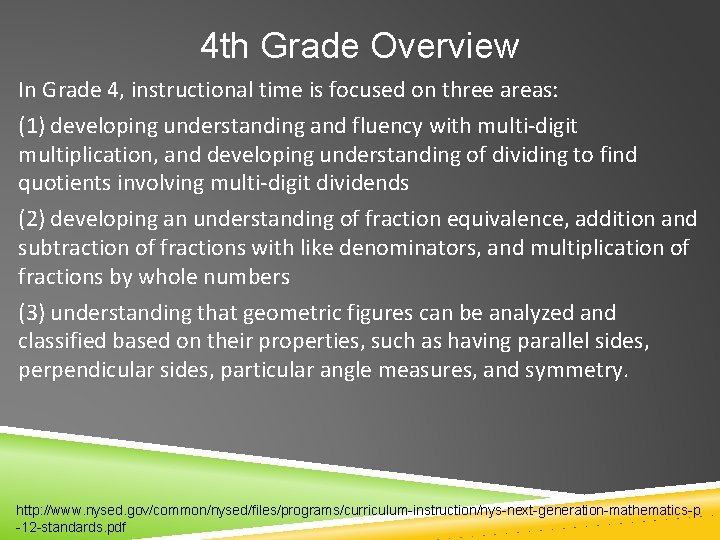
4 th Grade Overview In Grade 4, instructional time is focused on three areas: (1) developing understanding and fluency with multi-digit multiplication, and developing understanding of dividing to find quotients involving multi-digit dividends (2) developing an understanding of fraction equivalence, addition and subtraction of fractions with like denominators, and multiplication of fractions by whole numbers (3) understanding that geometric figures can be analyzed and classified based on their properties, such as having parallel sides, perpendicular sides, particular angle measures, and symmetry. http: //www. nysed. gov/common/nysed/files/programs/curriculum-instruction/nys-next-generation-mathematics-p -12 -standards. pdf
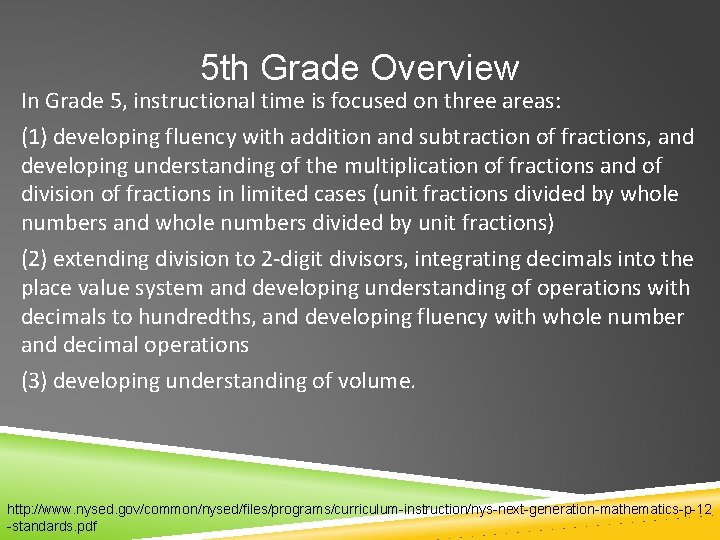
5 th Grade Overview In Grade 5, instructional time is focused on three areas: (1) developing fluency with addition and subtraction of fractions, and developing understanding of the multiplication of fractions and of division of fractions in limited cases (unit fractions divided by whole numbers and whole numbers divided by unit fractions) (2) extending division to 2 -digit divisors, integrating decimals into the place value system and developing understanding of operations with decimals to hundredths, and developing fluency with whole number and decimal operations (3) developing understanding of volume. http: //www. nysed. gov/common/nysed/files/programs/curriculum-instruction/nys-next-generation-mathematics-p-12 -standards. pdf
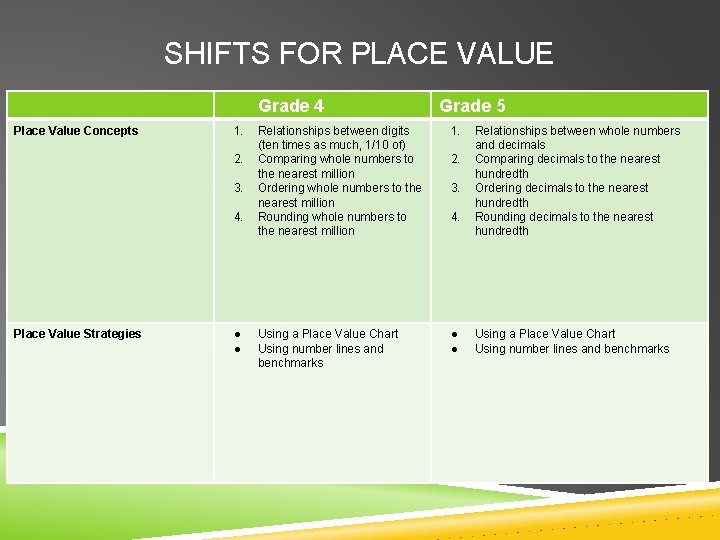
SHIFTS FOR PLACE VALUE Grade 4 Place Value Concepts 1. 2. 3. 4. Place Value Strategies ● ● Grade 5 Relationships between digits (ten times as much, 1/10 of) Comparing whole numbers to the nearest million Ordering whole numbers to the nearest million Rounding whole numbers to the nearest million 1. Using a Place Value Chart Using number lines and benchmarks ● ● 2. 3. 4. Relationships between whole numbers and decimals Comparing decimals to the nearest hundredth Ordering decimals to the nearest hundredth Rounding decimals to the nearest hundredth Using a Place Value Chart Using number lines and benchmarks
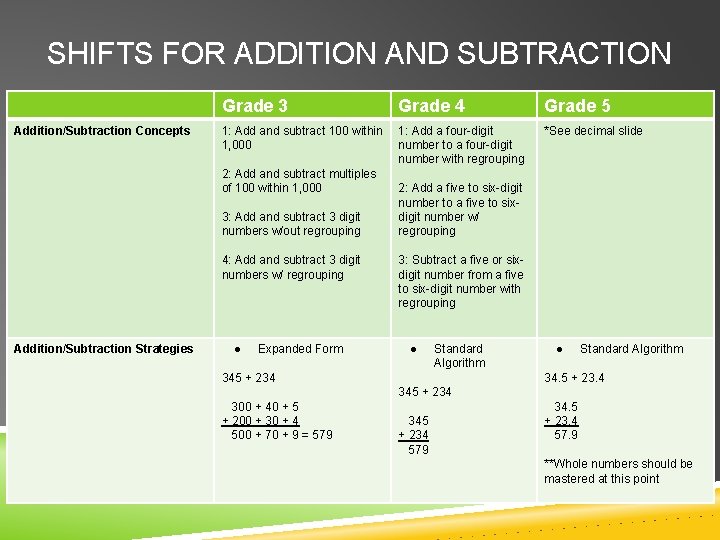
SHIFTS FOR ADDITION AND SUBTRACTION Addition/Subtraction Concepts Grade 3 Grade 4 Grade 5 1: Add and subtract 100 within 1, 000 1: Add a four-digit number to a four-digit number with regrouping *See decimal slide 2: Add and subtract multiples of 100 within 1, 000 3: Add and subtract 3 digit numbers w/out regrouping 4: Add and subtract 3 digit numbers w/ regrouping Addition/Subtraction Strategies ● Expanded Form 2: Add a five to six-digit number to a five to sixdigit number w/ regrouping 3: Subtract a five or sixdigit number from a five to six-digit number with regrouping ● Standard Algorithm 345 + 234 ● Standard Algorithm 34. 5 + 23. 4 345 + 234 300 + 40 + 5 + 200 + 30 + 4 500 + 70 + 9 = 579 345 + 234 579 34. 5 + 23. 4 57. 9 **Whole numbers should be mastered at this point
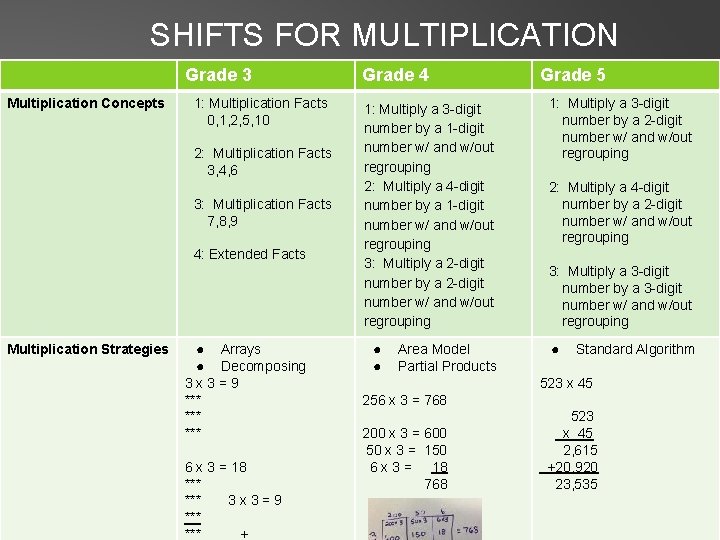
SHIFTS FOR MULTIPLICATION Grade 3 Multiplication Concepts 1: Multiplication Facts 0, 1, 2, 5, 10 2: Multiplication Facts 3, 4, 6 3: Multiplication Facts 7, 8, 9 4: Extended Facts Multiplication Strategies ● Arrays ● Decomposing 3 x 3=9 *** *** 6 x 3 = 18 *** 3 x 3=9 *** + Grade 4 1: Multiply a 3 -digit number by a 1 -digit number w/ and w/out regrouping 2: Multiply a 4 -digit number by a 1 -digit number w/ and w/out regrouping 3: Multiply a 2 -digit number by a 2 -digit number w/ and w/out regrouping ● ● Area Model Partial Products Grade 5 1: Multiply a 3 -digit number by a 2 -digit number w/ and w/out regrouping 2: Multiply a 4 -digit number by a 2 -digit number w/ and w/out regrouping 3: Multiply a 3 -digit number by a 3 -digit number w/ and w/out regrouping ● Standard Algorithm 523 x 45 256 x 3 = 768 200 x 3 = 600 50 x 3 = 150 6 x 3 = 18 768 523 x 45 2, 615 +20, 920 23, 535
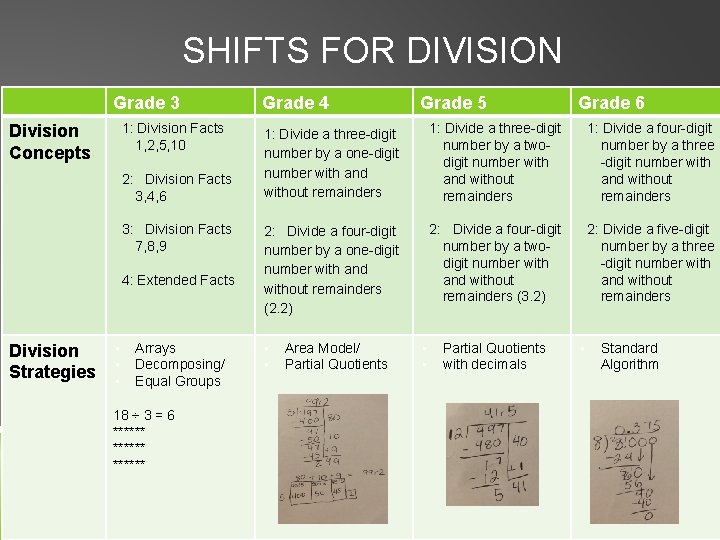
SHIFTS FOR DIVISION Grade 3 1: Division Facts 1, 2, 5, 10 Division Concepts 2: Division Facts 3, 4, 6 3: Division Facts 7, 8, 9 4: Extended Facts Division Strategies • • • Arrays Decomposing/ Equal Groups 18 ÷ 3 = 6 ****** Grade 4 Grade 5 Grade 6 1: Divide a three-digit number by a one-digit number with and without remainders 1: Divide a three-digit number by a twodigit number with and without remainders 1: Divide a four-digit number by a three -digit number with and without remainders 2: Divide a four-digit number by a one-digit number with and without remainders (2. 2) 2: Divide a four-digit number by a twodigit number with and without remainders (3. 2) 2: Divide a five-digit number by a three -digit number with and without remainders • • Area Model/ Partial Quotients • • Partial Quotients with decimals • Standard Algorithm
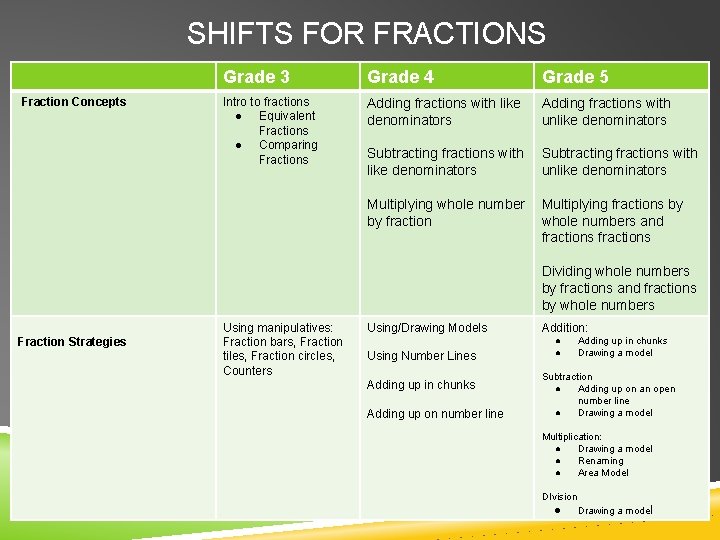
SHIFTS FOR FRACTIONS Fraction Concepts Grade 3 Grade 4 Grade 5 Intro to fractions ● Equivalent Fractions ● Comparing Fractions Adding fractions with like denominators Adding fractions with unlike denominators Subtracting fractions with unlike denominators Multiplying whole number by fraction Multiplying fractions by whole numbers and fractions Dividing whole numbers by fractions and fractions by whole numbers Fraction Strategies Using manipulatives: Fraction bars, Fraction tiles, Fraction circles, Counters Using/Drawing Models Using Number Lines Adding up in chunks Adding up on number line Addition: ● ● Adding up in chunks Drawing a model Subtraction ● Adding up on an open number line ● Drawing a model Multiplication: ● Drawing a model ● Renaming ● Area Model DIvision ● Drawing a model
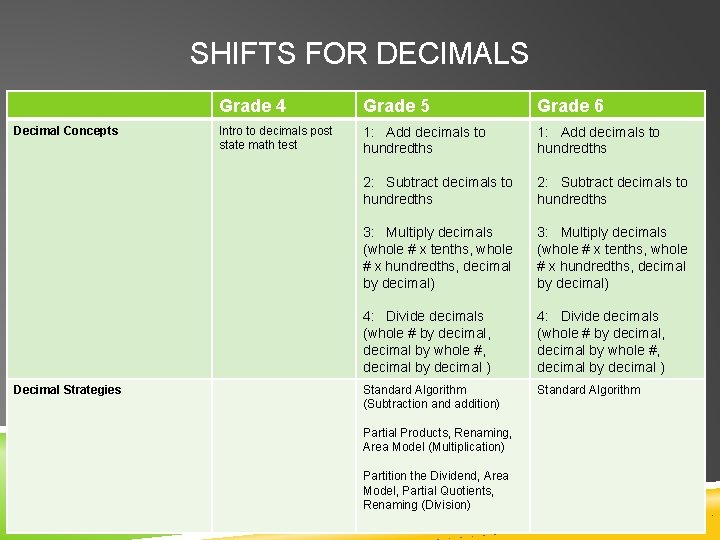
SHIFTS FOR DECIMALS Decimal Concepts Decimal Strategies Grade 4 Grade 5 Grade 6 Intro to decimals post state math test 1: Add decimals to hundredths 2: Subtract decimals to hundredths 3: Multiply decimals (whole # x tenths, whole # x hundredths, decimal by decimal) 4: Divide decimals (whole # by decimal, decimal by whole #, decimal by decimal ) Standard Algorithm (Subtraction and addition) Standard Algorithm Partial Products, Renaming, Area Model (Multiplication) Partition the Dividend, Area Model, Partial Quotients, Renaming (Division)
WAYS TO SUPPORT YOUR CHILD AT HOME ▶ Engageny. org ▶ Zearn. org ▶ Computer games that focus on fluency ▶ For multiplication facts – use flash cards, playing cards, dominoes, dice ▶ Board games ▶ Making word problems up at grocery store or at dinner ▶ Using real world experiences to support math concepts ▶ Using appropriately mathematical terms ▶ Review notes given in class daily
Questions? ? ? Thank you for coming!